Category

Research Articles

Category

and A study of the appointed Feasts of YHWH by Norman B. Willis

YHWH we are the temple

2015 Oct 15th is the The Eighth Day of YHWH 

When YHWH gave us HIS Calendar, He did not choose the days at random.  Rather, He incorporated specific days into His calendar in order to give us prophetic shadow pictures of the things He has purposed to come to pass.
In the last chapter on Sukkot we spoke briefly about the Last Great Day of the feast.  This Last Great Day is also called ‘Shemini Atzeret,’ which means, essentially, ‘The Assembly of the Eighth (Day).”
While the Assembly of the Eighth is often thought of simply as the final day of the Feast of Sukkot, it is actually a separate festival.  This is in much the same way as the Passover is followed by the seven Days of Unleavened Bread.  However, in this case, the seven days of Sukkot are followed by the one day Assembly of the Eighth (Shemini Atzeret).
In Hebrew, the word ‘Atzeret’ (עֲצֶרֶת) means not just ‘an assembly,’ but a very special kind of assembly.  It indicates that one’s host is not letting one go home.  Rather, one’s host is ‘holding one over’ for an extended period of time.  Strong’s Concordance defines the word atzeret (עצרת) in this way:

OT:6116 `atsarah (ats-aw-raw’); or `atsereth (ats-eh’-reth); from OT:6113; an assembly, especially on a festival or holiday:

When we look up the root at Strong’s OT:6113, we get:

OT:6113 `atsar (aw-tsar’); a primitive root; to enclose; by analogy, to hold back; also to maintain, rule, assemble:

KJV –  be able, close up, detain, fast, keep (self close, still), prevail, recover, refrain, reign, restrain, retain, shut (up), slack, stay, stop, withhold (self).

Shemini Atzeret, then, shows us that YHWH intends to hold us back, to detain us, or to ‘close us up’ in some fashion for the eighth day.  But in what way does YHWH intend to ‘detain us’, or to ‘hold us over’?
The Apostle Kepha (Peter) tells us that one prophetic day can symbolize a thousand earth years.

Kepha Bet (2nd Peter) 3:8
8 But, beloved, do not forget this one thing: that with YHWH, one day is as a thousand years, and a thousand years is as one day.

Notice, then, that Scripture tells us that the Creation Week was seven days long.

B’reisheet (Genesis) 2:2
2 And on the seventh day Elohim ended His work which He had done, and He rested on the seventh day from all His work which He had done.

If the Creation Week lasted seven days, and if one prophetic day can represent a thousand earth years, then the Creation Week is symbolic of a seven thousand year plan for the earth and its inhabitants.
But if the earth is to last for seven thousand years, then why would the Feast of Sukkot last for eight days? And what is the symbolism of the eighth day?
In truth, the Feast of Sukkot lasts only seven days.  We know this because it is only for seven days that the children of Israel are to dwell in booths.

Vayiqra (Leviticus) 23:41-43
41 You shall keep it as a feast to YHWH for seven days in the year. It shall be a statute forever in your generations. You shall celebrate it in the seventh month.
42 You shall dwell in booths for seven days. All who are native Israelites shall dwell in booths,
43 that your generations may know that I made the children of Israel dwell in booths when I brought them out of the land of Egypt: I am YHWH your Elohim.’”

The eighth day of Sukkot, then, is really a separate festival.  Leviticus 23:36 tells us that we are to hold an assembly (עֲצֶרֶת) on this eighth day in order to bring an offering made by fire.  We are also to do no ordinary or laborious work.

Vayiqra (Leviticus) 23:36
36 For seven days you shall offer an offering made by fire to YHWH. On the eighth day you shall have a set-apart assembly, and you shall offer an offering made by fire to YHWH. It is a set-apart assembly, and you shall do no customary work on it.

Verse 39 then tells us to keep the first and the eighth days of the festival as set-apart sabbaths of rest.

Vayiqra (Leviticus) 23:39
39 ‘Also on the fifteenth day of the seventh month, when you have gathered in the fruit of the land, you shall keep the feast of YHWH for seven days; on the first day there shall be a sabbath-rest, and on the eighth day a sabbath-rest.

It may be that the first day of the feast symbolizes the first day of the Creation Week, when YHWH Elohim created the heavens and the earth.

B’reisheet (Genesis) 1:1-2
1 In the beginning Elohim created the heavens and the earth.
2 The earth was made formless and void; and darkness was on the face of the deep.

If the first day of the Feast of Tabernacles symbolizes the first day of Creation, could it be that Shemini Atzeret symbolizes how we will go to the New Earth, which Isaiah speaks of?

Yeshayahu (Isaiah) 65:17-20
17 “For behold, I create new heavens and a new earth; and the former shall not be remembered or come to mind.
18 But be glad and rejoice forever in what I create; for behold, I create Jerusalem as a rejoicing, and her people a joy.
19 I will rejoice in Jerusalem, and joy in My people; the voice of weeping shall no longer be heard in her, nor the voice of crying.
20 “No more shall an infant from there live but a few days, nor an old man who has not fulfilled his days; for the child shall die one hundred years old,
But the sinner being one hundred years old shall be accursed.”

While the Feast of Tabernacles is symbolic of many things, it is also symbolic of the New Earth, for the Book of the Revelation tells us that in the New Earth, the Tabernacle of Elohim will be with men.

Gilyana (Revelation) 21:1-4
1 Now I saw a new heaven and a new earth, for the first heaven and the first earth had passed away. Also there was no more sea.
2 Then I, Yochanan, saw the set-apart city, New Jerusalem, coming down out of heaven from Elohim, prepared as a bride adorned for her husband.
3 And I heard a loud voice from heaven saying, “Behold, the Tabernacle of Elohim is with men, and He will dwell with them, and they shall be His people. Elohim Himself will be with them, and be their Elohim.
4 “And Elohim will wipe away every tear from their eyes; there shall be no more death, nor sorrow, nor crying. There shall be no more pain, for the former things have passed away.”

If YHWH wills, we will explore this topic in much more detail in the Joseph’s Return study, as well as explore why Yahuhua returns to take us to the New Earth at the end of the earth’s seven thousand years.
Once we understand the prophetic symbolism of the number eight, we can begin to see this symbolism turn up throughout the Torah.

Vayiqra (Leviticus) 22:26-27
26 And YHWH spoke to Moshe, saying:
27 “When a bull or a sheep or a goat is born, it shall be seven days with its mother; and from the eighth day and thereafter it shall be accepted as an offering made by fire to YHWH.”

YAHushua tells us that those who believe on Him are like unto sheep, or to goats.

Mattai (Matthew) 25:31-33
31 “When the Son of Man comes in His glory, and all the set-apart messengers with Him, then He will sit on the throne of His glory.
32 All the nations will be gathered before Him, and He will separate them one from another, as a shepherd divides his sheep from the goats.
33 And He will set the sheep on His right hand, but the goats on the left.”

For seven days, our sheep and our bulls and our goats are not acceptable as sacrifice offerings unto YHWH.  In much the same way, for seven thousand years, the ‘sheep’ and the ‘goats’ and the ‘bulls’ who believe on Yeshua are not acceptable into YHWH’s kingdom.  Rather, we must wait until the start of the ‘Assembly of the Eighth’, after the Judgment, when YHWH will ‘hold us over’ in the New Earth.  Then we will Tabernacle with Him.
Going Deeper:
As one might expect, the Most High Perfect Elohim has created multiple layers of symbolism and meaning not only in His Torah, but also in His Festivals.  While a complete discussion of the significance of the festivals is outside the scope of this work, let us take a look at the interrelationships between the spring and the fall festivals.
In Yoel (Joel) 2:23, YHWH tells us that the latter rains come in the first month.

Joel 2:23
23 Be glad then, you children of Zion, and rejoice in YHWH your Elohim, for He has given you the former rain faithfully, and He will cause the rain to come down for you — The former rain, and the latter rain in the first (month).

(23) וּבְנֵי צִיּוֹן גִּילוּ וְשִׂמְחוּ בַּיהוָה אֱלֹהֵיכֶם כִּי נָתַן לָכֶם אֶת הַמּוֹרֶה לִצְדָקָה | וַיּוֹרֶד לָכֶם גֶּשֶׁם מוֹרֶה וּמַלְקוֹשׁ בָּרִאשׁוֹן:

The Land of Israel is semi-tropical, and has essentially two seasons: a hot dry summer, and a wet winter.  In between these seasons are short temperate periods of transition, when the Spring and Fall Feasts take place.  Most of the rain in the Land of Israel falls in the winter, after the Fall Festivals, but before the Passover.  Later we will see symbolic aspects of this as well.
Scripture speaks of the early rains, and the latter rains.  From a Western-Roman standpoint, one might think the earlier rains fall in the spring, and the latter rains fall in autumn.  However, when we realize that the Hebrew year does not start until the spring, and that the Land of Israel is then normally sunny for at least six months, we see that the ‘earlier’ rains actually fall after the Fall Festival season, and the ‘latter’ rains fall just before the Passover, in the first month.
But when is rain more than just rain?  In Joel 2:23, the word for the early ‘rain’ is מוֹרֶה (moreh), which is also the word for a teacher, or a teaching (i.e., instruction).

OT:4175 mowreh (mo-reh’); from OT:3384; an archer; also teacher or teaching; also the early rain [see OT:3138]:

The word for the latter rains is malqosh (מַלְקוֹשׁ), which translates figuratively as ‘eloquence.’

OT:4456 malqowsh (mal-koshe’); from OT:3953; the spring rain (compare OT:3954); figuratively, eloquence:

YHWH says, then, that He will give His teachings and His eloquence at the times of the early and the latter rains, which come just before the Spring festivals, and after the Fall ones.
But if YHWH gives instruction and eloquence at His festival times, are there other relationships between His feasts?  Other relationships turn up if we match up these festivals and their associated traditions side-by-side, reading from left to right.
Spring Festivals > > > > > > Fall Festivals
[Rabbinical Tu B’Shevat]
[Traditional Jewish New Year for Trees]
Yom Teruah (Trumpets)
The Bridegroom comes for His bride
Purim (before Pesach)
The bride-to-be is tested, and turns back to Him.
Traditionally celebrated by eating and drinking, and then starting to cleanse one’s house of leaven
Yom HaKippurim (can also be translated, “a Day like the Purim”)
The bride-to-be is taken in marriage.
No eating, drinking, or any other pleasures of the flesh.
Pesach and Unleavened
Bread.  A one day feast followed by a seven day feast.  All native Israelites must eat unleavened bread
Sukkot and Shemini Atzeret.  A seven day feast followed by a one day feast.  All native Israelites must dwell in sukkot.
Pentecost (Shavuot)
Traditionally, the bride was given the Torah on this day as a marital covenant (ketubah).
[Shemini Atzeret]
[Traditionally, the bride rejoices, from whence the tradition of ‘Simchat Torah’ comes]
Second Passover
A second opportunity to celebrate Passover, for those who were unclean at the first Passover
Chanukah
Originally established as a ‘second sukkot’, since the Maccabees were fighting the Greeks during Sukkot.
Physical renewal
Spiritual renewal
Additionally, there are parallels between the first and the seventh months.
First Month (Aviv) > > > > > > Seventh Month
Day 1
The Tabernacle was put into service on the first day of the first month (reference Exodus 40:2)
Day 1
Traditionally, Yahushua our Temple, will return on the first day of the first month (Yom Teruah)
Day 10
The Passover Lamb is chosen
Day 10
Two goats are chosen, one for YHWH, and one for Azazel (Satan).
Day 10
The Feast of the Passover and Unleavened Bread basically begins here, and five days later, Israel will be freed from bondage
Day 10
Jubilee (‘Release’) is declared, when Israelite slaves are released from bondage, and property returns to its owner
Day 10
Israel enters the Promised Land (Joshua 4:9)
Day 10
High Sabbath of rest
Day 14/15
YHWH’s people enter inside their houses for protection
Day 15
YHWH’s people enter into their sukkot for protection
Day 15
Israel begins dwelling in Sukkot while traveling in the Wilderness of Sinai
Day 15
Israel dwells in Sukkot for protection while living in the Promised Land
Day 14/15
Yahushua dies
Day 15
Yahushua is born
Day 14-22
Israel eats unleavened bread
Day 14-22
Israel lives in sukkot
Day 15
Pilgrimage festival
Day 15
Pilgrimage festival
Day 15
Opening harvest.  Barley is waved before YHWH
Day 15
Final harvest.  The Four Species are waved before YHWH
Ripening of grains
Ripening of grapes and olives
But why does YHWH not give all of the commandments regarding the festivals in one place, so we can understand what He wants more easily?  The answer is that there are hidden messages in how the commands are laid out within the Torah.
Pilgrimage Feasts
Days of Judgment
(Traditional)
Exodus 23:14-19
Exodus 34:18-26
Deuteronomy 16:1-17
Passover/Unleavened
Yom Teruah (Trumpets)
Pentecost/Weeks
Yom Kippur (Atonements)
Sukkot/Tabernacles
Shemini Atzeret
In Exodus and Deuteronomy, the date of the festival is not given with regards to its numerical or ordinal date, but with regards to the agricultural season and the harvests.  This is also why the tithe is mentioned in these passages, is that the tithe was also historically based on the harvests of the land, whether animal or vegetable.

Shemote (Exodus) 23:14-19
14 “Three times you shall keep a feast to Me in the year:
15 You shall keep the Feast of Unleavened Bread (you shall eat unleavened bread seven days, as I commanded you, at the time appointed in the month of the Aviv, for in it you came out of Egypt; none shall appear before Me empty);
16 and the Feast of Harvest, the firstfruits of your labors which you have sown in the field; and the Feast of Ingathering at the end of the year, when you have gathered in the fruit of your labors from the field.
17 “Three times in the year all your males shall appear before YHWH Elohim.
18 “You shall not offer the blood of My sacrifice with leavened bread; nor shall the fat of My sacrifice remain until morning.
19 The first of the firstfruits of your land you shall bring into the house of YHWH your Elohim. You shall not boil a young goat in its mother’s milk.

Exodus 34:18-24 gives us a similar set of commands, with the dates also being set with regards to the firstfruits of the land, both animal and vegetable.

Shemote (Exodus) 34:18-26
18 “The Feast of Unleavened Bread you shall keep. Seven days you shall eat unleavened bread, as I commanded you, in the appointed time of the month of the Aviv; for in the month of the Aviv you came out from Egypt.
19 “All that open the womb are Mine, and every male firstborn among your livestock, whether ox or sheep.
20 But the firstborn of a donkey you shall redeem with a lamb. And if you will not redeem him, then you shall break his neck. All the firstborn of your sons you shall redeem.  And none shall appear before Me empty-handed.
21 “Six days you shall work, but on the seventh day you shall rest; in plowing time and in harvest you shall rest.
22 “And you shall observe the Feast of Weeks, of the firstfruits of wheat harvest, and theFeast of Ingathering at the year’s end.
23 “Three times in the year all your men shall appear before the Adon, YHWH Elohim of Israel.
24 For I will cast out the nations before you and enlarge your borders; neither will any man covet your land when you go up to appear before YHWH your Elohim three times in the year.
25 “You shall not offer the blood of My sacrifice with leaven, nor shall the sacrifice of the Feast of the Passover be left until morning.
26 “The first of the firstfruits of your land you shall bring to the house of YHWH your Elohim. You shall not boil a young goat in its mother’s milk.”

Deuteronomy 16:1-15 follows this same pattern, by making reference to the animal and vegetable fruits of the land, and the harvest seasons.

Devarim (Deuteronomy) 16:1-15
1 “Observe the month of the Aviv, and keep the Passover to YHWH your Elohim, for in themonth of the Aviv YHWH your Elohim brought you out of Egypt by night.
2 Therefore you shall sacrifice the Passover to YHWH your Elohim, from the flock and the herd, in the place where YHWH chooses to put His name.
3 You shall eat no leavened bread with it; seven days you shall eat unleavened bread with it, that is, the bread of affliction (for you came out of the land of Egypt in haste), that you may remember the day in which you came out of the land of Egypt all the days of your life.
4 And no leaven shall be seen among you in all your territory for seven days, nor shall any of the meat which you sacrifice the first day at twilight remain overnight until morning.
5 “You may not sacrifice the Passover within any of your gates which YHWH your Elohim gives you;
6 but at the place where YHWH your Elohim chooses to make His name abide, there you shall sacrifice the Passover at twilight, at the going down of the sun, at the time you came out of Egypt.
7 And you shall roast and eat it in the place which YHWH your Elohim chooses, and in the morning you shall turn and go to your tents.
8 Six days you shall eat unleavened bread, and on the seventh day there shall be a sacred assembly to YHWH your Elohim. You shall do no work on it.
9 “You shall count seven weeks for yourself; begin to count the seven weeks from the time you begin to put the sickle to the grain.
10 Then you shall keep the Feast of Weeks to YHWH your Elohim with the tribute of a freewill offering from your hand, which you shall give as YHWH your Elohim blesses you.
11 You shall rejoice before YHWH your Elohim, you and your son and your daughter, your male servant and your female servant, the Levite who is within your gates, the stranger and the fatherless and the widow who are among you, at the place where YHWH your Elohim chooses to make His name abide.
12 And you shall remember that you were a slave in Egypt, and you shall be careful to observe these statutes.
13 “You shall observe the Feast of Tabernacles seven days, when you have gathered from your threshing floor and from your winepress.
14 And you shall rejoice in your feast, you and your son and your daughter, your male servant and your female servant and the Levite, the stranger and the fatherless and the widow, who are within your gates.
15 Seven days you shall keep a sacred feast to YHWH your Elohim in the place which YHWH chooses, because YHWH your Elohim will bless you in all your produce and in all the work of your hands, so that you surely rejoice.

Notice also how the festivals line up with what most Americans would traditionally call spring, summer, and fall.  However, since there are really only two seasons in the Land of Israel, these dates actually line up with the transition time at the start of summer, mid summer, and the transition at the end of summer.  These are the times when the crops come ready in the Land.
Pilgrimage Festival
Season
Passover/Unleavened
Start-of-summer transition
Shavuot/Pentecost
Mid-summer
Sukkot/Tabernacles
End-of-summer transition
However, while Exodus and Deuteronomy describe the feasts in relation to the agricultural harvests, Leviticus and Numbers simply tell us what month and day they should be held in.  However, Leviticus and Numbers do give us the offerings the priests are to make in the Temple.  If we study these offerings side by side, in a chart, we can begin to see some interesting parallels.  First we will look at Numbers 25:10 thru 30:1.
Feast
Numbers 25:10 – 30:1
(Parasha Pinchas)
Passover/Unleavened
15th day of the 1st month
2 bulls, 1 ram
7 male lambs,
1 male goat
Shavuot/Pentecost
50 days after the First Day of the Week after Pesach
2 bulls, 1 ram
7 male lambs,
1 male goat
Yom Teruah (Trumpets)
1st day of the 7th month
1 bull, 1 ram
7 male lambs,
1 male goat
Yom Kippur (Atonements)
10th day of the 7th month
1 bull, 1 ram
7 male lambs,
1 male goat
(plus one for Azazel)
Sukkot (Tabernacles)
15th day of the 7th month
Day 1
13 bulls, 2 rams,
14 male lambs,
1 male goat
Day 2
12 bulls, 2 rams,
14 male lambs,
1 male goat
Day 3
11 bulls, 2 rams,
14 male lambs,
1 male goat
Day 4
10 bulls, 2 rams,
14 male lambs,
1 male goat
Day 5
9 bulls, 2 rams,
14 male lambs,
1 male goat
Day 6
8 bulls, 2 rams,
14 male lambs,
1 male goat
Day 7
7 bulls, 2 rams,
14 male lambs,
1 male goat
Shemini Atzeret (Assembly of the Eighth)
Day 8
Leviticus 23 (in Parasha Emor) is unique.  It not only tells us what unique commandments are associated with each festival, but it also tells us which agricultural season each one of these special commandments falls into.
Feast
Special Command
Season
Unleavened Bread
Wave Sheaf (Omer)
Leviticus 23:10 “When you enter the Land… and harvest the grain
Shavuot (Pentecost)
(Weeks)
Specially leavened loaves of wheat bread.
Leviticus 23:16 “… count seven weeks, then… you shall bring a new grain offering….”
Yom Teruah (Trumpets)
Blowing the shofar
Yom Kippurim (Atonements)
Afflicting one’s soul
Sukkot (Tabernacles)
Waving the four species: Lulav, etrog, etc.
Leviticus 23:39-40 “… when you gather the produce of the land… and you shall take on the first day a goodly fruit….”
We do not know for sure why YHWH does not give us all of the commandments for the festivals all in one place.  However, we do know that there are many layers of spiritual implication to His timing.
Israel’s physical redemption from slavery in Egypt came in the spring.  The springtime is also when Israel crossed the Jordan River, to enter the Land of Israel.
Spring is an interesting time.  While some crops (such as barley) do grow and mature in winter, most crops lay dormant in the winter, and only begin to experience renewed growth in the spring.  In much the same way, while YHWH does have some servants who may flourish and grow in the ‘winter’ (or in the ‘Wilderness’) the majority of Israelites need the warmth of spring before they can begin to grow and flourish.
However, just as spring only marks the onset of plant growth, we must also realize that our acceptance of Yeshua only marks the onset of our spiritual growth.  Just as plant and animal life is also tenuous, salvation also is far from being certain.  Each one of us needs to continue to work out his salvation in fear, and in trembling before the Father.

Kepha Aleph (1st Peter) 1:17-19
17 And if you call on the Father, who without partiality judges according to each one’s work, conduct yourselves throughout the time of your stay here in fear;
18 knowing that you were not redeemed with corruptible things, like silver or gold, from your aimless conduct received by tradition from your fathers,
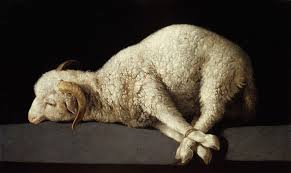
19 but with the precious blood of Messiah, as of a lamb without blemish and without spot.

Tradition holds the Messiah will return on Yom Teruah, which is referred to as ‘the day and the hour which no man knows,’ at the end of the growing season.

Mattai (Matthew) 24:36
36 “But of that day and hour no one knows, not even the angels of heaven, but My Father only.

Revelation also seems to imply that Messiah will return at the time of the Fall Harvests, which is when the grapes and the olives come ripe.  Some among Israel will have reached a similar state of maturity then.

Gilyana (Revelation) 14:17-19
17 Then another angel came out of the temple which is in heaven, he also having a sharp sickle.
18 And another angel came out from the altar, who had power over fire, and he cried with a loud cry to him who had the sharp sickle, saying, “Thrust in your sharp sickle and gather the clusters of the vine of the earth, for her grapes are fully ripe.”
19 So the angel thrust his sickle into the earth and gathered the vine of the earth, and threw it into the great winepress of the wrath of Elohim.

Just as grapes and olives have but one short season in which to mature and come ready for the harvest, we also have just one short lifetime in order to become fit and worthy companions for the King above all kings.  Let us seize the opportunity, knowing that we must work while it is still day, for soon the night will come, when no man can work.
Let us prepare ourselves for Him, and be ready before Him when He comes.

YHWH Stirs up the thirst for more of HIM within us..

(Audio Discussion Series) What The Ancient Zadoks  Prophesy  Concerning The  Greater Exodus Redemption Of YHVH’s Remnant in The Latter Days

This is a three part audio discussion on significant prophetic statements by the ancient exiled Zadok priesthood that we discovered in our studies this past year in the Dead Sea Scrolls and how they amplify and clarify (but do not change) the written prophetic narrative of the process of significant events  that will unfold affecting the redemption of YHVH’s remnant in the last days..

When carefully examined in the light of the biblical writ, the Zadok testimony confirms the written testimony of the biblical prophets and Yahushua Melchizedek and is also grounded in the shadow types revealed in the Law of Moses, …  but they detail an eschatological process which is not recognized across the the streams of the western “religious polemic” of Rabbinical Judaism through Christendom, and is at variance with popular prophetic perspectives and proclamations promoted in certain streams of the contemporary Hebrew roots / messianic Jewish movements.

Rob from http://www.inthatday.net/

Stream the audios by clicking on the links below, or go to the webpage (Click here)  todownload the audio files

Part 1: Investigating the prophetic credentials of the ancient Zadok testimony.

Part 2: Exploring some significant Zadok Prophetic teachings in the light of the Written Word.

Part 3: Understanding the Zadok perception of the Prophetic Narrative of The Greater Exodus And Its Association With The Victory Of The “Sons of Light”.

Ascribe Greatness to our Elohim

By B. Earl Allen

I will publish the name of YAHUWAH: ascribe you greatness unto our Elohim.
Deuteronomy 32:3


YAHUWAH gave the word: great was the company of those that published it. 
Psalm 68:11


INTRODUCTION

Since all doctrine or religious beliefs ought to be sustained by Sola Scriptura (by scripture alone), the unique focus of this publication is to weigh the evidence and prove each point of the set-apart name from the Scriptures alone. The topic of the set-apart name has not been exempt from those being overly zealous about tradition for proof of the exact pronunciation.
This publication takes into consideration all of Scripture upon the subject, the original and exact pronunciation is attainable (Deut. 29:29), as the Lawgiver Himself declared from Mt. Sinai. Not taking what is on the surface of several Bibles, but sinking the shaft deep into the mine of truth, comparing Scriptural names, translations, also considering historical evidences, putting them in their proper setting, allowing Scripture to reign paramount.
This book also touches on the importance of the set-apart name, and also the example set forth by our Saviour, how He reverenced His Father’s name. He certainly was not ashamed of it, as many seem to be. Nor did He over use it, but by His life and example sought to bring honour to it.
The object of this publication is to show the part that the set-apart name plays in the great controversy between truth and error; exposing the counterfeit which is promoted by principalities, powers, and academics in high places. It is also to help guide the pilgrim on his journey to the Promise Land and to the honour of Him who loved us, and gave Himself for us.
B. Earl Allen
Chapter One/ Index

Chapter 1

The Set-Apart Name in the Three Angels Message

The first angel’s message is, “Fear Elohim, and give honour to Him; for the hour of His judgment is come: and worship Him that made heaven and earth, and the sea, and the fountains of waters.” Revelation 14:7

Some think that preaching the importance of keeping the seventh day Sabbath is the Three Angels Message. Yes, it definitely includes the Sabbath, but there is more involved. There are principles laid out in this message. “Fear Elohim” implies that many are not fearing enough to obey Him; this further implies all points of Scripture that the Creator has given us to obey.

Let’s use the seventh day Sabbath as an illustration. If man decides to sprinkle holy water on a day other than the seventh day Sabbath, and tries to say that it’s holy, which he has not the power to do, but might think he does; then if men honour this man made holy day, are they fearing Elohim? Of course not! This would be the fear of man, thus obeying because man might require it of you, even to the point of making it a law of the land. All of the afore-said about a man made holy day applies to Sunday keeping. Does it give honour to Elohim to observe a man made sabbath? No! Obedience is the highest form of worship! So if we obey a man made law, is this worship toward the Creator? Again a resounding “No!” Yet, this is what almost the whole Christian community is doing! Sunday is a day that man has set aside for worship, yet there is no Scriptural decree to make it a weekly sabbath. “Fear Elohim” means to tremble at His Word (see Isaiah 66:2).

In His Word there is a commandment that our Creator has given, “Remember the Sabbath day to keep it set-apart. Six days shall thou labour, and do all thy work: but the seventh day is the Sabbath of YAHUWAH thy Elohim.” Exodus 20:8-10

The principle of the Three Angels Message is this: Fearing Elohim means to get back to and obey the original, as given by the Creator Himself; and put away the man made commandments and doctrines.

The Sabbath is part of the Three Angels Message, and a major part; but the Three Angels Message includes the whole law.

The same principles apply to the observance of Christmas. No where in Scripture is there a statute requiring us to set aside December 25, as a day to honour the birth of our Saviour! To the contrary, Paul said, “ye do show the Sovereign’s death till He come.” I Cor. 11 26; not His birth till He come. It is in the hearts of millions to honour this papal holiday, while the holidays of our Creator are despised. But if we truly fear Elohim, we should obey His statutes, one which states: “Three times thou shalt keep a feast unto Me in the year.” Exodus 23:14. But do we really tremble at His Word? Or, do we fear man, and what he might think of us if we actually started obeying the Creator.

The principle is obeying the original commands given from our Creator, and putting away the man made statutes, that go contrary to His Word.

This principle also applies to the set-apart name. Our Creator has given the original set-apart name for us to reverence. He spoke it with His own mouth from Mount Sinai when He spoke the ten commandments. The whole assembly heard it. That name is the original! But through language and culture and time man has thought to change the original pronunciation. Therefore we need to discover the original, so we can get back to it, and put away the man made names for the Creator.

Really, if man makes up the name for the Creator, it is not much different from what the heathen used to do! The heathen would make up their god, and give it a name, and start worshipping it. In reality, making up a name for the Creator is not much different, it’s an attempt to create the Creator.

Is it the fear of Elohim to give Him a name? Yea, it is the fear of Elohim to honour the name that He has given. Let’s let Elohim be Elohim.

Part of fearing Elohim is to fear His name, as the Scripture says, “unite my heart to fear Thy name.” Psalm 86:11

“Then they that feared YAHUWAH spake often one to another: and YAHUWAH hearkened, and heard it, and a book of remembrance was written before Him for them that feared YAHUWAH, and that thought upon His name.” Malachi 3:16

Let’s give honour to Him also! “Not unto us, O YAHUWAH, not unto us, but unto Thy name give honour, for Thy mercy, and for Thy truth’s sake.” Psalm 115:1

“I will praise thee, O Sovereign my Elohim, with all my heart: and I will honour Thy name for evermore.” Psalm 86:12

“Who shall not fear thee, O YAHUWAH, and honour thy name? for Thou alone art set-apart: for all nations shall come and worship before Thee; for Thy judgments are made manifest.” Revelation 15:4

The question is, will we fear Him now, while there is probation time? Or, will we fear Him only when it’s too late?

Because the first angel’s message is not received, which is a message of truth, it is then that the second angel must sound, warning, “Babylon is fallen, is fallen, that great city, because she made all nations drink of the wine of the wrath of her fornication.” Revelation 14:8. This gives additional force to the first message, because it is an expose’ of man-made errors.

The third angel presses the same truth even further, declaring, “If any man worship (obey) the beast and his image, and receive his mark in his forehead, or in his hand, the same shall drink of the wine of the wrath of Elohim, which is poured out without mixture into the cup of His indignation; and he shall be tormented with fire and brimstone in the presence of the set-apart angels, and in the presence of the Lamb: and the smoke of their torment ascendeth up for ever and ever: and they have no rest day nor night, who worship the beast and his image, and whosoever receiveth the print of his name.” Revelation 14:11 Tyndale Bible

Ultimately, it is the rejection of truth that souls end up lost. If souls heeded the first message “Fear Elohim”, and worship (obey) Him, no one would have to be warned about worshipping the beast and his image. Paul stated; “all deceivableness of unrighteousness in them that perish; because they receive not the love of the truth, that they might be saved.” Paul continues, “and for this cause Elohim shall send them strong delusion, that they should believe a lie (something that is not the original): that they might be damned who believe not the truth, but had pleasure in unrighteousness.” II Thessalonians 2:10-12

“Give unto YAHUWAH the honour due unto His name; worship YAHUWAH in the beauty of being set-apart.” Ps. 29:2

“I am YAHUWAH: that is My name: My splendour will I not give to another, neither My praise to graven images.” (inventions of man) Isaiah 42:8

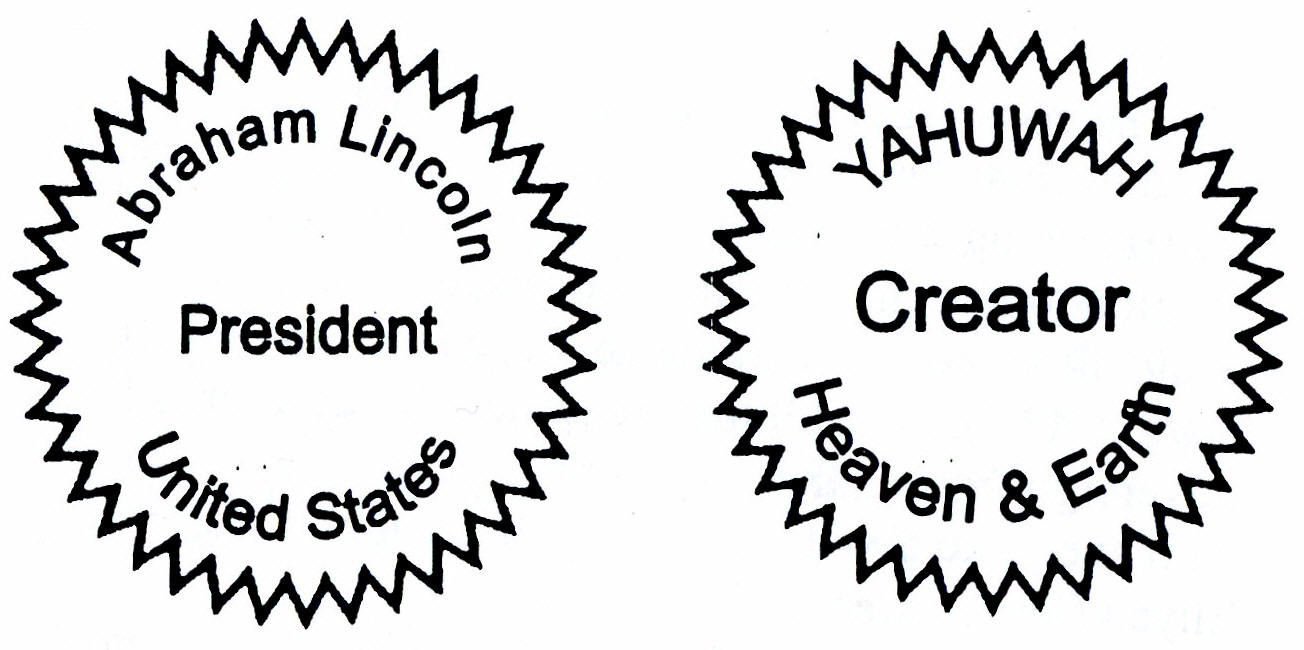
The fourth commandment contains the great seal. Compare the presidential seal below:

The Seal

A seal always contains the Name, Title and Jurisdiction.

Anciently, on the 10th day of the seventh month, the Hebrews faithfully observed the great Day of Atonement, which is a type of the great work of Judgment in the heavenly set-apart place, before tabernacling with YAHUSHUA forever. Anciently, on this day, after the ceremonies were completed, the high priest would proclaim the set-apart name, and pronounce a blessing upon the congregation; a type of what YAHUSHUA our heavenly high priest is doing. “I have declared unto them thy name, And will declare it: that the love wherewith thou hast loved Me may be in them, and I in them.” John 17:26.

When a bride is in the sealing of a marriage covenant, she takes on her husband’s name.

“They shall put My name upon the children of Israel and I will bless them.” Numbers 6:27

Chapter 2 / Index

Chapter 2

The Jewish Cover Up:
“Don’t Mention the Set-Apart Name!”

The conspiracy to cover up the set-apart name goes way back, even as far back as the days of Eliyah. The religious leaders thought that they would get along better with religiondom around them if they used a common title they could all agree on; Baal means Lord (see Hosea 2:16 margin KJV). After all, they reasoned the Creator is Lord or Sovereign; by this they could be in ecumenical harmony with everyone about them. Eliyah thought differently. To Eliyah truth mattered.

Even as far back as 787 B.C.E, Amos tried to show the children of Israel the folly of their reasoning about not mentioning the set-apart name. . . “Hold thy tongue: for we may not make mention of the name of YAHUWAH.” Amos 6:10.

When the Jews were carried into Babylon 606 B.C.E, many of the personal names had the element “yahu”, thus came the slanderous term “yahoo” for folk who seemed uncivilized like those barbaric beard-wearing Ju’s or Jews (Interesting to note, in the 1611 KJV is a word spelled “Iurie“, the modern KJV has “Jewry”, and Matthew is really Matithyahu).

Perhaps they meant well in covering up the name, because they were afraid the Babylonians might desecrate the set-apart name by using it in a profane way. This might seem like good logic at first, but the Jews went into captivity because they were not concerned with the name to begin with. The prophet Jeremiah rebuked the Jews about the time of the Babylonian captivity, for trying to cause the people to forget His name.

“How long shall this be in the heart of the prophets that prophecy lies? Yea, they are prophets (or preachers) of the deceit of their own heart; which think to cause My people to forget My name by their dreams which they tell every man to his neighbor, as their fathers have forgotten My name for Baal.” Jeremiah 23:26, 27

Satan and his evil angels hate hearing the set-apart name being praised and exalted. It has been his constant effort to remove the name, through culture and time, and slip in titles, that he might direct the worship to himself. “In Egypt, for example, the concept of the ‘concealed Name’ was extremely common.” The Encyclopedia of Occultism & Parapsychology

“In Gnostic thought, the concrete is resolved into the abstract. Personal names are replaced by terms of philosophy; mythological figures are changed into qualities and attributes and events into cosmic processes. [Hence, the personal name (YAHUWAH) becomes the attribute ‘Lord’.] In many religions the god represents a thing such as Aeolus, as personification of the wind. [Hence the personal name Lucifer becomes a thing ‘morning star’.]” (quoted in New Age Bible Versions)1

“In this New Age ‘name game’, new versions have substituted ‘titles’ which transport the reader to a list of Satan’s latest poison pen names.” New Age Bible Versions p. 14

The prophets of old wrote more about the last days than their own time. For they saw the big picture, that the things they were experiencing were only a foreshadow of the end times, or types for the last days (I Cor 10:11); thus Jeremiah was mostly talking about the end time preachers who cause the people to forget His name for Lord.

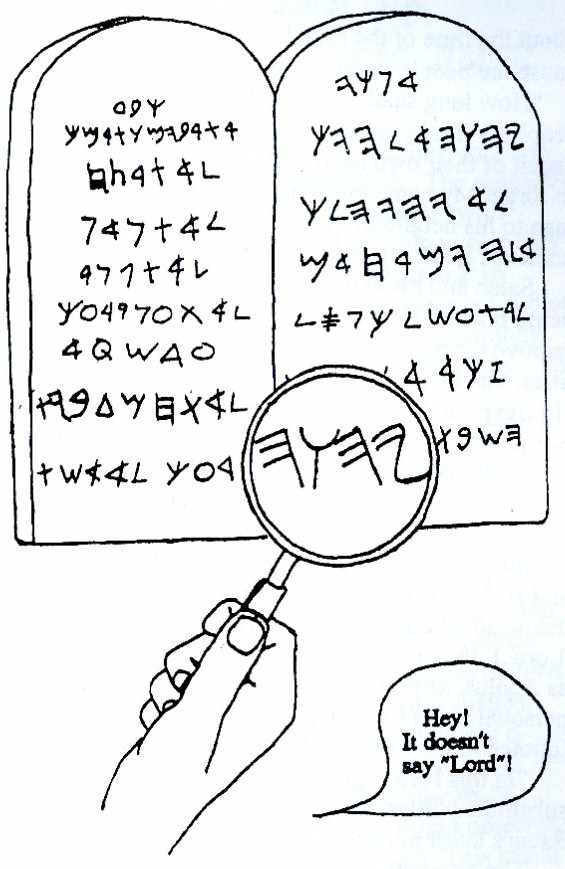
The Tablets

Baruch, the scribe of Jeremiah, wrote (mostly for the last days): “I will scatter them. For I knew that they would not hear Me: because it is a stiff-necked people: but in the land of their captivity they shall remember themselves, and shall know that I am YAHUWAH their Elohim: For I give them an heart, and ears to hear. And they shall praise Me in the land of their captivities, and think upon My name. “And for this cause Thou hast put Thy fear in our hearts, to the intent that we should call upon Thy name, and praise Thee in our captivity.” Baruch 2:29-32; 3:7 (KJV Apocrypha)

In the Messiah’s time, the Jews were still in this mode of not mentioning the Creator’s name. YAHUSHUA had constant controversy with the religious leaders and tried to show them that their traditions caused them to break the commandments.

One example of our Saviour uttering His Father’s name, was when He got up to read the scroll in the synagogue on Sabbath. He read from the prophet Isaiah. When He read the portion He bypassed all Jewish tradition and simply read the Scriptures just as they read. When He came to the tetragrammaton, He did not say “Adonai” or “Lord”, but simply spoke His Father’s name.

“The Spirit of YAHUWAH is upon Me, because He hath anointed Me to preach the good news to the poor; He hath sent Me to heal the brokenhearted, to preach deliverance to the captives, and recovering of sight to the blind, to set at liberty them that are bruised. To preach the acceptable year of YAHUWAH.” Luke 4:18, 19 (quoting from Isaiah 61:1, 2)

“And He closed the book, and He gave it again to the minister, and sat down. And the eyes of all them that were in the synagogue were fastened on Him.” Luke 4:20

Did He realize what He had just done? He transgressed the tradition of the elders. The Jews considered it blaspheme to speak the set-apart name, and thus the punishment of Lev. 24:16. The common people didn’t mind too much at first, they did think it was a bit brave of Him. But the synagogue leaders instigated things and ended up attempting to throw this radical Jew off the edge of the cliff for blaspheming and uttering the set-apart name, lest a plague should break out and everyone start mentioning the name.

Another place YAHUSHUA mentioned the name is in Matthew 22:44, quoting from Psalm 110:1; this is indicated in the English text by putting all capital letters “LORD”. This leads us to ask, “How many other times did He mention His Father’s name when quoting from the Old Testament?” Obviously every time! He was a “user of the true name” in His day. I’m sure He didn’t over use it, to the point of being obnoxious.

It is Scriptural to mention and praise the name of YAHUWAH, “by Thee only will we make mention of Thy name.” Isaiah 26:13

Another example of the Jews avoiding the name is in Mark 14, where YAHUSHUA is brought in before the high priest at His trial. The high priest asked, “Art thou the Messiah, the Son of the Blessed?” When he said “Blessed” it was to avoid the name. What was YAHUSHUA’s reply? The English says “I am”, but the Greek is the same as the Septuagint for Ex. 3:14, THE BEING. But YAHUSHUA was speaking Hebrew to the high priest and possibly said the set-apart name, at least the translation. It was as if YAHUSHUA corrected the high priest and said, “you mean YAHUWAH”.

But the response of the high priest gives it away also.

“Then the high priest rent his clothes, and said. What need we any further witnesses? Ye have heard the blasphemy: what think ye? And they all condemned Him to be guilty of death.” Mark 14:63-64

What was the counsel of Moses? “Because I will publish the name of YAHUWAH: ascribe ye greatness to our Elohim.” Deuteronomy 32:3

Martin Luther made a profound comment concerning this issue. “They [the Jews] now allege the name Yehovah to be unpronounceable; they do not know what they are talking about… If it can be written with pen and ink, why should it not be spoken, which is much better than being written with pen and ink.”

The name Yehovah came about as a result of an attempt, by the Jews, to cover up the set-apart name. Example: When a reader, in the King James Version, comes to “LORD God”, the Hebrew words and vowel points are “Yehowah Elohim”. But, instead of a Jewish person speaking the set-apart name, the scribes put vowel marks on the tetragrammaton to indicate for the reader, to say “Adonai Elohim”. But when a reader in the KJV comes across “Lord GOD” (as in Ezek. 33:27), in Hebrew is “Adonai Yehowih”, because in this instance the tetragrammaton has the vowel points of Elohim. Otherwise the Jewish reader would say “Adonai Adonai” [twice], so to avoid this, they vowel pointed it to indicate to the reader to say, “Adonai Elohim”. You will notice that the vowel marks on the Tetragrammaton in Ezek. 33:27 differ from the vowel marks used in Exodus 9:1.

Peter Galatin simply read the Hebrew as it was, without the special instruction to say Adonai. Thus, he must have thought he came upon a new revelation of how to pronounce the set-apart name. The message of Eliyah was to restore the set-apart name to its proper use.


Reference

1) The Encyclopedia of Religion & Ethics ed. James Hastings p. 223

Chapter 3/ Index

Chapter 3

The Elijah Message

What is the Elijah message? The Messiah said that “Eliyah truly shall first come and restore all things.” Mt. 17:11. Restore what things? Those things that have been forgotten! The prophet Malachi gives us some insights: “Behold, I will send you Eliyah the prophet before the coming of the great and dreadful day of YAHUWAH.” Malachi 4:5. As YAHUWAH’s mouth piece, what shall he come saying? “Remember ye the law of Mosheh My servant, which I commanded him in Horeb for all Israel, with the statutes and the judgments.” Malachi 4:4

“Repent ye therefore, and be converted, that your sins may be blotted out, when the times of refreshing shall come from the presence of YAHUWAH; and he shall send YAHUSHUA the Messiah, which before was preached unto you: whom the heavens must receive until the times of restitution of all things, which Elohim hath spoken by the mouth of all His set-apart prophets since the world began.” Acts 3:19-21

Not only does this include the seventh day Sabbath, but also the appointed festivals. Marriage is a heavenly institution; the land sabbaths, yea, all the statutes. Animal offerings are not listed in the statutes given from Mt. Sinai. The statutes are listed in Exodus 21-23 and repeated in Deuteronomy chapters 12 through 26.

Another thing that Eliyah is said to accomplish, is that he would “turn the heart of the fathers to the children, and the heart of the children to their fathers, lest I come and smite the earth with a curse.” Malachi 4:6

Not only does this apply to family relationships, but it also applies to our spiritual forefathers, like the reformers, who were bringing us step by step out of Babylon. How many hearts despise early American reformers who were real pioneers in the Scriptures (this is not the work of Eliyah). On the other hand, many have been turned off because those who pretend to uphold the reformers and pioneers, refuse to walk in advancing truth, using the reformers and pioneers as an excuse for not walking in further light. Evidently they have become comfortable with playing the game of church, nor can they appreciate the work the reformers and pioneers accomplished. If it were not for them, we would not be enjoying the blessings of the Sabbath truth and other truths, along with great reference works like Strong’s Concordance. We would have found ourselves as those in the Dark Ages without truth. Since that state of affairs, truth has been progressive.

“They that shall be of thee shall build the old waste places: thou shall raise up the foundations of many generations; and thou shalt be called, The repairer of the breach, The restorer of paths to dwell in.” Isaiah 58:12. We should understand more than the reformers and pioneers, because we should be building on the truths that we received from them as a blessed inheritance, instead of trying to abolish their works and trying to start over.

Not only does this apply to them, but to the Reformers who brought us out of the Dark Ages. They were witnesses to Catholicism’s abusive nature and terrible abominations. YAHUWAH did not reveal all His truths to them, but gave them enough truth to call them out from her.

The hearts of the forefathers were toward us! “YAHUWAH having provided some better thing for us, that they without us should not be made perfect.” Hebrews 11:40. They did their best to preserve the truths they did have, so that we would not be deceived by that false system of Satan.

This principle goes back even further to Columba, Patrick, Paul, Peter, John, the other apostles as well; even back to “father Abraham”, Shem, Noah, and yes Adam. Abraham observed the appointed times, even the Feast of Unleavened Bread, as Scripture bares out that YAHUWAH came and communed with Abraham (Gen. 12:1-3) at this appointed time, and “four hundred and thirty years (later), even to the selfsame day, it came to pass, that all the hosts of YAHUWAH went out of the land of Egypt.” Exodus 12:41 (see also Galatians 3:17).

This is no surprise, of course, for Scripture states; “Abraham obeyed My voice, and kept My charge, My commandments, My statutes, and My laws.” Gen. 26:5

What other message might Eliyah bring?

Remember how the children of Israel were tricked by their religious leaders into thinking Baal could send rain? Baal means “Lord” (see Hosea 2:16 margin). The religious leaders reasoned that they could have more influence with other nations around them if they mingled among them and used a common title they could all agree on. In this way, everyone could be in ecumenical harmony. The result, of course, was that the heathen converted them to their ways. But Eliyah believed that the Israelites needed to get back to calling the Creator by His name, the name that He had addressed Himself on Mt. Sinai, when He spoke the Ten Commandments. Thus, the idea came to him that there should be a confrontation on Mt. Carmel. The story is called “The Set-Apart Name Showdown.” Where Elijahu (I Kings 17:1 margin KJV) confronted the Israelites with a question, “How long halt ye between two opinions? if YAHUWAH be Elohim, follow Him: but if the Baal, then follow him.” And the people answered him not a word. I Kings 18:21. You know the story, when fire came down and consumed the wet sacrifice they acknowledged, “YAHUWAH, He is the Elohim; YAHUWAH, He is haElohim.”

This story applies, with great force, to our time as well, when Sabbath keepers want to use man made terminology for the Creator, so that they can blend well with other Christians who observe Sunday (a man made holy day). How long will ye halt between two thoughts: if YAHUWAH be Elohim serve Him, but if the Lord, serve him. “Fear YAHUWAH, and give honour to Him; for the hour of His judgment is come: and worship Him that made heaven, and earth, and the sea, and the fountains of water.” Revelation 14:7

The set-apart name is given for the purpose of distinguishing the Creator from other deities. The issue is TRUTH versus man made religion.

“Then they that feared YAHUWAH spake often one to another: and YAHUWAH hearkened, and heard it, and a book of remembrance was written before Him for them that feared YAHUWAH, and that thought upon His name. And they shall be Mine saith YAHUWAH of hosts, in that day when I make up My jewels; and I will spare them, as a man spareth his own son that serveth him. Then shall ye return, and discern between the righteous and the wicked, between him that serveth Elohim and him that serveth Him not.” Malachi 3:16-18

Chapter 4 / Index

Chapter 4

The 144,000
The Wise Virgins with Oil

We are told in the parable of the Ten Virgins, that “the foolish virgins took their lamps and took no oil with them: but the wise virgins took oil in their vessels with their lamps” Matthew 25:3, 4. What is the lamp? “Thy Word is a lamp unto my feet and a light unto my path.” Psalm 119:105. What is the oil? “My Spirit, saith YAHUWAH of hosts.” Zech. 4:6. “Oil for the light.” Ex. 25:6; 27:20 etc.

When we store up the Word in our vessels, the Set-Apart Spirit can bring all these things to our remembrance (John 14:26) and help us rightly divide the Word of Truth, and give us favour in the right path. Then when it comes to investigating a new topic, we should already be acquainted with certain passages that help us grasp the subject, having a goodly background.

“Thy name is as oil poured forth, therefore do the virgins love you.” Song of Solomon 1:3 [Shemen is translated “oil” about 164 times and “ointments about 13 times, compare also Isaiah 1:6 margin]

The 144,000 are called “virgins” because they have the unadulterated doctrine, the pure faith. We can glean a few of their characteristics from Revelation 14 and thus seek to be in that number. They definitely love the set-apart name, and understand it’s importance, for it is “in their foreheads.” John saw them on Mt. Zion, not the Mt. Zion on this earth, but the real Mt. Zion in heaven, because Scripture states they “were redeemed from the earth.” Revelation 14:3. This Mt. Zion in heaven is the same which Lucifer said, “I will exalt my throne above the stars of EL: I will sit also upon the mount of the congregation, in the sides of the north.” Isaiah 14:13

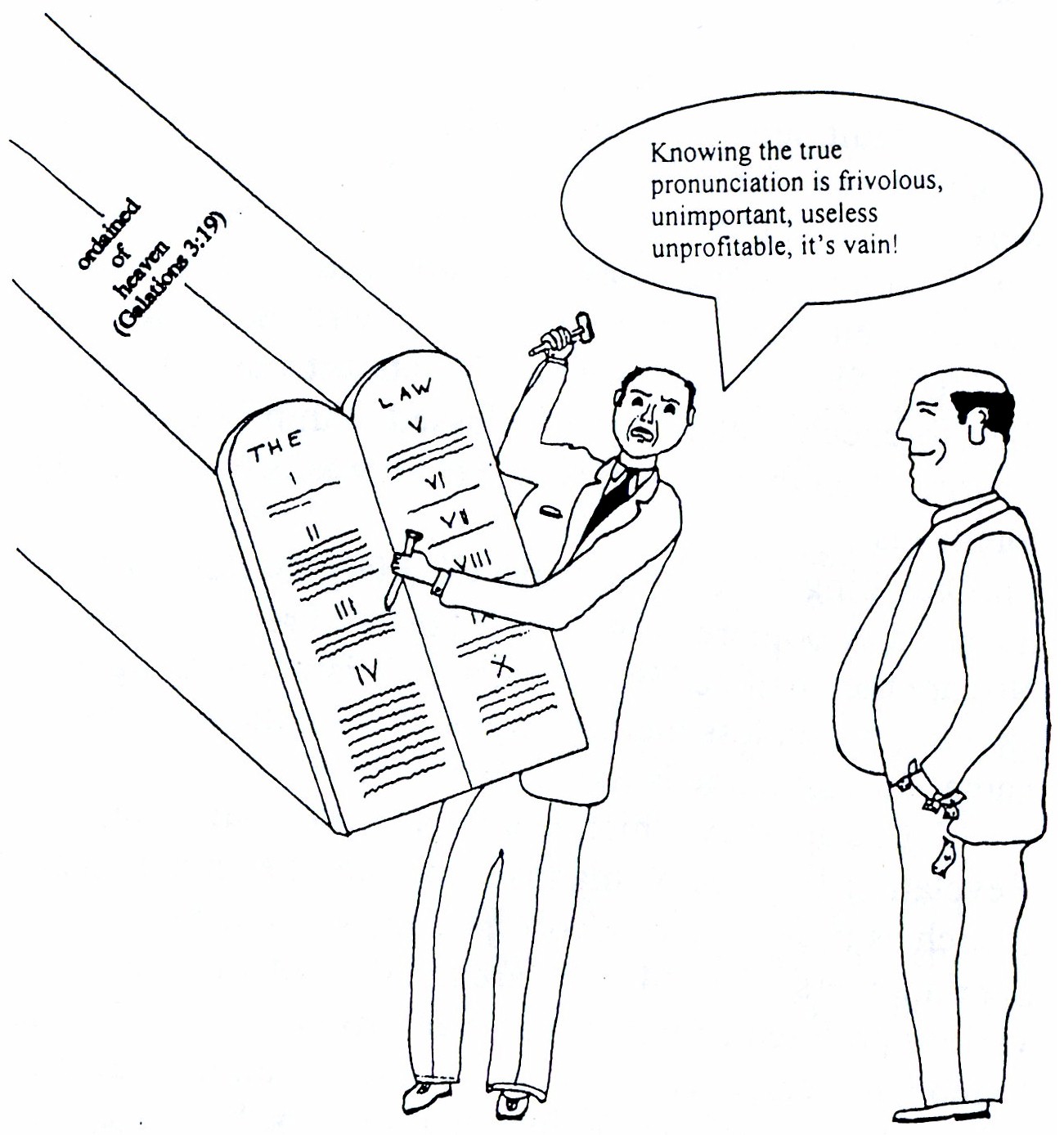
The Law (the third commandment being nailed)

“…set-apart and reverend is His Name.” Psalm 111:9

“The works of His hands are verity and judgment; all His commandments are sure. They stand fast forever and ever, and are done in truth and uprightness.” Psalm 111:7-8

“And in their mouth was found no guile: for they are without fault before the throne of Elohim.” Rev. 14:5 In other words, TRUTH was in their mouth. Their lives were the life of truth, because the Father’s character (His law) is in their minds, they received a seal to that effect, thus on their crowns, as John saw, was written, (Set-Apart to YHWH). In other words, because it was first “in” their foreheads, later they are blessed with privilege of wearing it on their crown where the name is then “on” their foreheads.

One thing for certain, these wise virgins were not incensed or bothered nor irritated by a name study. Nor are they irritated by brothers and sisters praising, and exalting, much less mentioning or singing the Father’s name, for that name is like music to their ears.

These are they which were not defiled with women.” Revelation 14:4. A woman is symbolic of a church, a pure church as in Jer. 6:2 or a corrupt church (Rev. 17:5) and her daughters. The 144,000 are not defiled with the various polluted churches and their errors; these follow the Lamb whithersoever He goeth. These do not look at the Bible through their denominational glasses, but instead, go by Sola Scriptura, letting Scripture be its own interpreter.

Ezra saw this same group of people that John saw. “I Esdras (Greek for Ezra) saw upon mount Zion a great people, whom I could not number, and they all praised YAHUWAH with songs. And in the midst of them there was a young man of a high stature, taller than all the rest, and upon every one of their heads He set crowns, and was more exalted, which I marveled at greatly. So I asked the angel, and said, “Sir, what are these?” He answered, and said unto me, “These be they that have put off the mortal clothing, and put on the immortal, and have confessed the Name of YAHUWAH: now are they crowned, and receive palms.” (II Esdras 2:42-45)

continuing in verse 46:

Then said I unto the angel, “What young person is it that crowneth them, and giveth them palms in their hands?” So he answered, and said unto me, “It is the Son of El, whom they have confessed in the world.” Then began I greatly to commend them, that stood so stiffly for the name of YAHUWAH.” (II Esdras 2:46-47). This book, II Esdras, is missing from the Catholic Bible; their II Esdras is actually the book of Nehemiah.

From both accounts of John and Ezra, we see how the set-apart name was important to this blessed group of people. To them, knowing the set-apart name was not frivolous, unimportant, useless or vain. Nor did it side track them from Sabbath observance; as a matter of fact, it helped them to actually keep the day set-apart, since the Sabbath is to be kept in honour of His set-apart name. We are told in Exodus 23 how to keep the Sabbath set-apart: “And in all things that I have said unto you be circumspect: and make no mention of the name of other elohim, neither let it be heard out of thy mouth.” Ex. 23:13

“A good name is better than precious oil.” Eccl. 7:1

“There is treasure to be desired and oil in the dwelling of the wise.” Proverbs 21:20

Chapter 5 / Index

Chapter 5

FOUR VOWELS?

Josephus the Jewish historian wrote that the set-apart name consisted of “four vowels” (Jewish Wars, 5. 5. 7.). Why did Josephus write this? Please consider the following thoughts.

Remember, Josephus was writing to a Greek audience! He first wrote his history [at least his notes] in Hebrew Aramaic (Antiquities 12.5. 1-4 footnotes; Against Apion 1. 9). After the Jewish/Roman war, he had time, and with long perseverance, he mastered the Greek language, and compiled his history in Koine Greek, which was the international language of the world at that time. Though it was the international language, do not think it was the every day language in Israel, for it was not!

Josephus frequently altered Hebrew names, spelling them after the fashion of the Greeks, “to please [his Greek] readers” (Antiquities 1. 5. 1.). Josephus describes the head-gear worn by the Levitical priest:

“Of this was a crown made, as far from the hinder part of the head to each of the temples; but this … did not cover the forehead, but it was covered by a golden plate, which had inscribed upon it the Name of (Elohim) in SET-APART CHARACTERS.” (Antiquities 3. 7. 6. set-apart title and emphasis added).

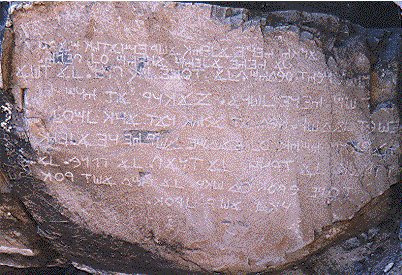
The term HOLY CHARACTERS, means not just Hebrew letters, but the ancient Hebrew, known as Paleo-Hebrew, used in the time of Moses, and David.

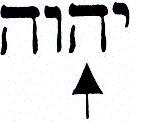
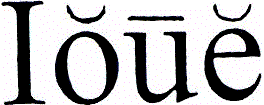
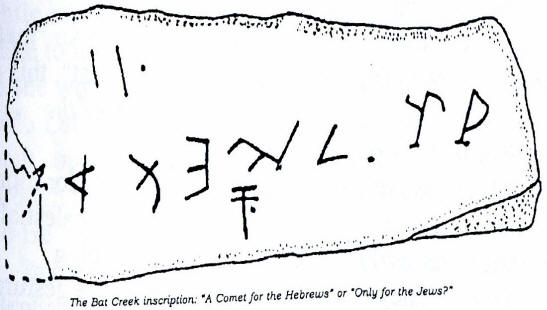
Anciently, even the Greek language, like the Hebrew, was written from right to left. Also, the ancient Greek letters were similar to Paleo Hebrew. Therefore, the ancient Greek would have written the set-apart name very similar to the ancient Hebrew, which appeared like this: YHWH. The Modern Greek equivalent would be written IHYH, and understood as IEUE. But do not think that this, in any wise, proves the pronunciation of the set-apart name. Josephus was writing to the Greeks, the equivalent of YHWH. It was from this [Greek form] that the heathen formed their Jeue, Jove, and Jeve (see Adam Clarke’s Commentary on Exodus 3:14)

It is true that the letters waw, hei, yod can function as vowel letters. Let us consider a few examples: the yod acts as a vowel in the words “Eli” (Mt 27:46) also #430 Elohim, #4899 Mashiach, ish (Gen 2:23 margin KJV) etc. Yet it also functions as a consonant in other words like #3050 Yah, #2968 ya ab etc. Sometimes it acts as a vowel and a consonant all in the same letter, as in Eliyah, where it is a double yod.

“The hei is stronger and firmer than aleph, and never loses it’s consonantal sound in a middle of a word . . . . On the other hand, at the end of a word it is always a mere vowel letter, unless expressly marked by Mappiq as a strong consonant.” (As in YAHH Yahh, and Eloah Eloahh) Gesenius’ Hebrew Grammarp. 81

The waw waw also can act as a vowel in words like #452 Eliyahu, #3194 Yutah etc.. It also carries the “o” sound, as in #3117 yom. On the other hand, it acts like a consonant in words like #2331 chavah, actually the consonant is not a V, but as in Arabic, or as the English sound of “w”.

Sometimes the waw acts like a vowel and a consonant all in the same letter; they can also be consonants, depending on the usage.

Concerning the Set-Apart Name, the structure of the letters tell us that the yod is a consonant, as in the word YAH (Ps. 68:4 & Isa. 12:2; 26:4; 38:11 NKJV). Also the hei is a consonant, since “it never loses it’s consonantal sound in the middle of a word.” Gesenius’ Hebrew Grammar p. 81

Also, the waw waw always acts as a consonant when ending words waw hei (except in Eloah Eloahh). When Hebrew-words end with “uah” sound, it is expressed in Hebrew as waw-eyin-hei or waw-alef-hei; therefore, if the Hebrew word ends waw-hei, it will always act as a consonant, ending like “wah” or “weh” etc.

The final hei in YHWH is the vowel letter in the set-apart name, “at the end of a word it is always a mere vowel letter.” Gesenius’ Hebrew Grammar p. 81

Conclusion: When Josephus said “four vowels”, he was talking to his Greek audience trying to express the Tetragrammaton in a way that they would comprehend, trans-letter-ating from Paleo-HebrewPaleo Hebrew, which in Paleo Greek wasPaleo Greek, then into modern Greek, thus arriving with IHYH (literally IEUE.) But this does not in any way prove the pronunciation of the set-apart name.

Chapter 6 / Index

Chapter 6

Proving the Set-Apart Name from Scripture Alone!


The first letter in the set-apart name (YHWH) is a YOD; it can be seen in most Bibles just above Psalm 119:73.

The Saviour said, “Till heaven and earth pass, one YOD or one tittle shall in no wise pass from the torah, till all be fulfilled.” Matthew 5:18

When Bible translators put LORD in the place of the set-apart name (YHWH), they unknowingly attempted to make many YOD’s pass from the law. More specifically, when the Hebrew letter “Y” is turned into a “J”.

From my research, the “J” began to have a “g” sound in the English language about 1637, just after the King James Version came out. It was probably an attempt to out date this sharp sword. The King James Version later adjusted to keep up with the times. The “J” having a “g” sound, came about from the influence of the French, the long time enemy of Britain.

Noah Webster comments about the letter J: “This letter has been added to the English alphabet in modern days; the letter i being written formerly in words where j is now used. It seems to have had the sound of “y” in many words as it still has in the German.” 1828 American Dictionary

“JAH” the first part of the set-apart name is seen in the King James Version in Psalm 68:4, as in the word Hallelujah, meaning, “Praise ye YAH” as seen in the New King James Version in Psalm 68:4 & Isa. 12:2; 26:4; 38:11. Again, Noah Webster comments about this word HALLELUIAH: “This word is improperly written with j, in conformity with the Germans and other continental languages, in which j has the sound of y. But to pronounce the word with the English sound of j destroys it’s beauty. The like mistake of the sound of j in Jehovah, Jordan, Joseph, has perverted the true pronunciation, which was Yehovah, Yordan, Yoseph. This perversion must now be submitted to, but in Halleluiah it ought not to be tolerated.” 1828 American Dictionary

Any forester will tell you that J-rooted trees that have been forced or jammed into the ground by a careless tree planter will not grow well. When a dry spell comes along, often it is the J-rooted trees that die. Or, if the tree does live, the growth is really set back.

It is not the will of our Creator to be J-rooted; it is not His will that our spiritual growth should be set back or retarded by this J error. His will for us is to dig deep in Scripture and be rooted and grounded in the love of the truth. The old paths. (See Jeremiah 6:16)

“Those that be planted in the house of YAHUWAH shall flourish in the courts of our Elohim.” Psalm 92:13

When the spirit of Eliyah comes, the Set-Apart Spirit will cause us, “To appoint unto them that mourn in Zion, to give them beauty for ashes, the oil of joy for mourning, the garment of praise for the spirit of heaviness; that they might be called trees of righteousness, the planting of YAHUWAH, that He might be magnified.” Isaiah 61:3

The Paleo YOD (), which looks like a Flying J, had a Y sound!

The Messiah foretold that before His second coming, the spirit of Eliyah would first come, “and restore all things.” Matthew 17:11 & Malachi 4:5. Certainly the Y sound would be restored in the set-apart name.

A complete list of names from Strong’s Exhaustive Concordance that include the short form YAH in Israelite names:

137 Names with YAH

Strong’s #

Name

Common Name

#29

Abiyah

Abijah

#138

Adoniyah

Adonijah

#223

Uriyah

Uriah

#245

Azanyah

Azaniah

#274

Achazyah

Ahaziah

#281

Achiyah

Ahijah

#452

Eliyah

Elijah

#558

Amatsyah

Amaziah

#568

Amaryah

Amariah

#728

Amiyah

Araunah

#912

Bedeyah

Bedeiah

#964

Bizyothyah

Bizjothjah

#1141

Benayah

Benaiah

#1152

Besoclcyah

Besodciah

#1183

Bealyah

Bealiah

#1202

Baaseyah

Baaseiah

#1229

Baqbukyah

Bakbukjah

#1232

Buqqiyah

Bukkiah

#1256

Berayah

Beraiah

#1296

Berekyah

Bercchiah

#1332

Bithyah

Bithiah

#1436

Gedalyah

Gedaliah

#1587

Gemaryah

Gemariah

#1806

Delayah

Delaiah

#1937

Hode wah

Hodevah

#1938

Hodawyah

Hcdaviah

#1940

Hodiyah

Hodiah

#1941

Hodiyah

Hodiah

#1955

Hoshayah

Hoshaiah

#2069

Zebadynh

Zebadinh

#2148

Zckaryah

Zcchariah

#2252

Chabayah

Habaiah

#2396

Chizqiyah

Hezekiah

#2446

Chakalyah

Hachaliah

#25I8

Chilquiyah

Hilkiah

#2608

Chananyah

Hananiah

#2619

Chasadyah

Hasadiah

#2736

Charhayah

Harhaiah

#2811

Chashabyah

Hashabiah

#2813

Chahabneyah

Hashabniah

#2900

Tobiyah

Tobiah

#2970

Yaazanyah

Jaazaniah

#2977

Yoshiyah

Josiah

#2997

Yibneyah

Ibnciah

#2998

Yibniyah

Ibnijah

#3041

Yedideyah

Jedidiah

#3042

Yedayah

Jedaiah

#3048

Yedayah

Jedaiah

#3050

Yahh

JAH Psalm 68:4

#3056

Yahdai

Jehdai

#3057

Yahudiyah

Jehudijah

#3094

Yahalelel

Jehalelel

#3131

Yosiphyah

Josiphiah

#3143

Yoshibiyah

Josibiah

#3145

Yoshawyah

Joshaviah

#3150

Yizziyah

Jeziah

#3153

Yezanyah

Jezeniah

#3156

Yizrachyah

Izrahiah

#3167

Yachzeyah

Jahaziah

#3169

Yechizqiyah

Hezekiah

#3174

Yechiyah

Jehiah

#3203

Yckolyah

Jecoliah

#3204

Yekonyah

Jcconiah

#3298

Yaareshyah

Jaresiah

#2262

Chabatstsanyah

Habazaniah

#3301

Yiphdeyah

Iphedeiah

#2293

Chaggiyah

Haggiah

#3359

Yeqamyah

Jekamiah

#2382

Chazayah

Hazaiah

#3376

Yiriyah

Irijah

#3404

Yeriyah

Jerijah

#6411

Pelayah

Pelaiah

#3439

Yeshochayah

Jeshoaiah

#3449

Yishshiyah

Ishiah

#3460

Yishmayah

Ishmaiah

#3470

Yeshayah

Isaiah

#3663

Kenanyah

Chenaniah

#4153

Moadyah

Moadiah

#4179

Moriyah

Moriah

#4271

Machseyah

Maaseiah

#4320

Mikayah

Micah

#4424

Melaryah

Melatiah

#4441

Malkiyah

Malchiah

 #4573

Maadyah

Maadiah

#4590

Maazyah

Maaziah

#4641

Maaseyah

Maaseiah

#4677

Metsobayah

Mosobaite

#4811

Merayah

Meraiah

#4920

Meshelemyah

Meshelcmiah

#4983

Matlanyah

Mananiah

#4993

Mattithyah

Mattithiah

#5072

Nedabyah

Nedabiah

#5I29

Noadyah

Noadiah

#5166

Nechemyah

Nehemiah

#5294

Nearyah

Neariah

#5374

Neriyah

Neriah

#5418

Ncthanyah

Nethaniah

#5662

Obadyah

Obadiah

#5718

Adayah

Adaiah

#5818

Uzziyah

Uzziah

#5838

Azaryah

Azariah

#5839

Azaryah

Azariah

#6007

Amasyah

Amasiah

#6043

Anayah

Anaiah

#6055

Ananyah

Ananiah

#6070

Anthothiyah

Antothijnh

#6222

Asayah

Asaiah

#6265

Athayah

Alhaiah

#6271

Alhalyah

Athaliah

#6305

Pedayah

Pedaiah

#6410

Pelatyah

Pelatiah

#6494

Pcqachyah

Pekahiah

#6611

Pelhachyah

Pethakiah

#6645

Tsibyah

Zibiah

#6667

Tsidqiyah

Zedekiah

#6846

Tsephanyah

Zephaniah

#6870

Tseruyah

Zeruiah

#6964

Qolayah

Kolaiah

#7041

Qelayah

Kelaiah

#7211

Reayah

Reaiah

#7345

Rechabyah

Rehabiah

#7422

Ramyah

Ramiah

#7480

Reelayah

Reeliah

#7485

Raamyah

Raamiah

#7509

Rephayah

Rephaiah

#7634

Shobyah

Shachia

#7645

Shebanyah

Shebaniah

#7841

Shacharyah

Shechariah

#7935

Shekanyah

Shechaniah

#8018

Shelemyah

Shelemiah

#8098

Shemayah

Shcmaiah

#8114

Shemaryah

Shemariah

#8187

Shearyah

Shcariah

#8203

Shephaiyah

Shephaiiah

#8274

Sherebyah

Sherebiah

#8304

Scrayah

Seraiah

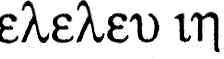
So far, we have established from Scripture that the first part of the set-apart name is YAH (from Ps. 68:4); there are 137 Israelite names with “yah”, and there is also the word Halleluyah. Therefore, the first part cannot be “Yeh”! It is interesting to note that the heathen or Greeks in their hymns, in honor of Apollo, began and ended with hallelu greek, eleleu Ie, a mere corruption of the Hebrew word Halleluyah (see Clarke’s Commentaryunder Revelation 19:1).

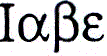
Also consider the “IE” in the first two letters of IHS which is actually IES in Greek!

Ies was also a surname for Bacchus.2

Another consideration is YEHWE ZOGBANU – In Dahomean mythology, a forest giant, which had thirty horns and was a threat to hunters.3

The “Yeh” and/or “Yeho” came in with the Jewish cover up of our Heavenly Father’s Name.

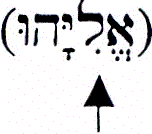
To be safe, let’s hold fast to the Scriptural YAH! YAH is the short form of the great set-apart name; an extended form is seen in the King James Version where the translators hid a clue for the true pronunciation in the very story of the set-apart name show down on Mt. Carmel. In the margin of I Kings 17:1, we see the name Elijahu. Translators tell us that the first part of this name “Eli”  means “my God” See Matthew 27:46. Thus, the last part jahu or yahu is in reference to the set-apart name. Elijah’s name means “my El or Elohim is YAHUWAH”.

The Saviour said, “It is also written in your law, that the testimony of two men is true” (John 8:17). Thus, the King James translators hid for us two witnesses that give us a clue to the true pronunciation of the set-apart name, not just one. Look in I Kings 18:3 margin, where we see the nameObadiahu, which name means “servant of YAHUWAH.” But there is more!

72 Names End in ‘YAHU’

Strong’s #

    Name

Meaning

Common Name

#29

 Abiyahu

(my Father is YAHUWAH)

Abijah

#138

 Adoniyahu

(my Master is YAHUWAH)

Adonijah

#223

 Uriyahu

(my flame is YAHUWAH)

Urijah

#274

Achazyahu

(possession of YAHUWAH)

Ahaziah

#281

Achiyahu

(my brother is YAHUWAH)

Ahijah

#452

Eliyahu

(my Elohim is YAHUWAH)

Elijah

#558

Amatsyahu

(strength of YAHUWAH)

Amaziah

#568

Amaryahu

(promised of YAHUWAH)

Amariah

#683

Atsalyahu

(reserved to YAHUWAH)

Azaliah

#1141

Benayahu

(built up of YAHUWAH)

Benaiah

#1296

Berekyahu

(kneel to YAHUWAH)

Berechiah

#1436

Gedalyahu

(YAHUWAH is great)

Gedaliah

#1587

Gemaryahu

(perfected by YAHUWAH)

Gemariah

#1735

Dodawahu

(Love of YAHUWAH)

Dodavah

#1806

Delayahu

(delivered by YAHUWAH)

Delaiah

#1936

Hodaywahu

(majesty of YAHUWAH)

Hodevah

#2069

Zebadyahu

(endurance of YAHUWAH)

Zebadiah

#2148

Zacharyahu

(remembered by YAHUWAH)

Zechariah

#2396

Chizeqiyahu

(my strength is YAHUWAH)

Hezekiah

#2518

Chiliqiyahu

(my portion is YAHUWAH)

Hilkiah

#2608

Chananyahu

(favored by YAHUWAH)

Hananiah

#2811

Chashabyahu

(regarded by YAHUWAH)

Hashabiah

#2882

Tebalyahu

(immersed by YAHUWAH)

Tebaliah

#2899

Tob Adoniyahu

(pleasing to my Master YAHU)

Tob-adonijah

#2900

Tobiyahu

(my goodness is YAHUWAH)

Tobiah

#2970

Yaazanyahu

(will be heard by YAHUWAH)

Jaazaniah

#2977

Yoshiyahu

(my foundation is YAHUWAH)

Josiah

#3000

Yeberekyahu

(kneeling to YAHUWAH)

Jebcrechiah

#3012

Yigdalyahu

(magnified by YAHUWAH)

Igdaliah

#3153

Yezenyahu

(adorned of YAHUWAH)

Jezaniah

#3165

Yechdiyahu

(my unity is YAHUWAH)

Jehdeiah

#3169

Yechizqiyahu

(my strength is YAHUWAH)

Hezekiah

#3203

Yekolyahu

(YAHUWAH will enable)

Jecoliah

#3204

Yekonyahu

(YAHUWAH will establish)

Jeconiah

#3269

Yaaziyahu

(my boldness is YAHUWAH)

Jaaziah

#3404

Yeriyahu

(taught by YAHUWAH)

Jeriah

#3414

Yirmeyahu

(exalted of YAHUWAH)

Jeremiah

#3449

Yishiyahu

(YAHUWAH will lend)

Ishiah, Isijahu

#3460

Yishmayahu

(heard by YAHUWAH)

Ishmaiah

#3470

Yeshayahu

(salvation of YAHUWAH)

Isaiah

#3562

Conanyahu

(sustained by YAHUWAH)

Conaniah

#3659

Conyahu

(stability by YAHUWAH)

Coniah

#3663

Kenanyahu

(planted by YAHUWAH)

Chenaniah

#4321

Mikayahu

(like YAHUWAH)

Michaiah

#4441

Malkiyahu

(my king is YAHUWAH)

Malchiah

#4590

Maazyahu

(rescue of YAHUWAH)

Maaziah

#4641

Maaseyahu

(work of YAHUWAH)

Maaseiah

#4737

Miqncyahu

(purchase of YAHUWAH)

Mikneiah

#4920

Meshelemyahu

(repaid by YAHUWAH)

Meshelcmiah

#4983

Mattanyahu

(present of YAHUWAH)

Mattaniah

#4993

Mattithyahu

(gift of YAHUWAH)

Matthew

#5374

Neriyahu

(my light is YAHUWAH)

Neriah

#5418

Nethanyahu

(given by YAHUWAH)

Nethaniah

#5565

Semakyahu

(supported by YAHUWAH)

Semachiah

#5662

Obadyahu

(Servant of YAHUWAH)

Obadiah

#5718

Adayahu

(continuing in YAHUWAH)

Adaiah

#5812

Azazyahu

(strength of YAHUWAH)

Azaziah

#5818

Uzziyahu

(my power is YAHUWAH)

Uzziah

#5838

Azaryahu

(helped of YAHUWAH)

Azariah

#6271

Athalyahu

(constrained by YAHUWAH)

Athaliah

#6305

Pedayahu

(ransomed of YAHUWAH)

Pedaiah

#6410

Pelatyahu

(delivered by YAHUWAH)

Pelatiah

#6667

Tsidekiyahu

(YAHUWAH is righteous)

Zedekiah

#6846

Tsephanyahu

(hidden by YAHUWAH)

Zephaniah

#6984

Qushayahu

(entrapped of YAHUWAH)

Kushaiah

#7345

Rechabyahu

(enlarged of YAHUWAH)

Rehabiah

#7425

Remalyahu

(protected by YAHUWAH)

Remaliah

#7645

Shebanyahu

(prospered by YAHUWAH)

Shebaniah

#7935

Shekanyahu

(lodging of YAHUWAH)

Shecaniah

#8018

Shelemyahu

(thank offering of YAHUWAH)

Shelemiah

#8098

Shemayahu

(heard of YAHUWAH)

Shemaiah

#8114

Shemaryahu

(hedged by YAHUWAH)

Shemariah

#8203

Shephatyahu

(judged by YAHUWAH)

Shephatiah

#8304

Serayahu

(prevailed by YAHUWAH)

Seriah

Anciently, names not only ended with “yahu”, but also began with “Yahu”; this was determined by comparing other languages like Arabic and Cuneiform.

Jehoahaz — “An inscription of Tiglathpileser III records tribute being received from Iauhazi (mat) Ia-u-da-a

‘Jehoahaz of Judah’. The Illustrated Bible Dictionary

Jehoiachio–“In Babylon, Jehoiachin was treated as a royal hostage. He is named (Yau-kin) in Bab. tablets, dated 595 and 570 BC, as receiving rations at the court in company with his five sons.” The Illustrated Bible Dictionary

Jehonuthan— “The name occurs in Cuneiform records as Yahu-natunnu.” Seventh-day Adventist BIBLE DICTIONARY

Jehu-– “Cuneiform Ia-u-a.” The New Brown-Driver-Briggs-Gesenius Hebrew English Lexicon. In Arabic, Jehu was pronounced “Yahu”. See Hastings Dictionary of the Bible. All this evidence and more, suggest that “Yahu” was used at the beginning of names, instead of the more modem Jewish “Yeho” cover up of the set-apart name. Therefore, the 27 following names are restored to their original pronunciation.

27 Names Begin with “YAHU”

Strong’s #

Name

Meaning

Common Name

#3057

 Yahudiyah

 (a Jewess)

Jehudijah

#3058

 Yahu

 (He exists)

Jehu

#3059

 Yahuachaz

 (YAHUWAH seized)

Jehoahaz

#3060

Yuhuash

 (YAHUWAH fired)

Jehoash

#3061

Yahud

 (a name for Judea)

Jehud

#3063

Yahudah

 (praise YAHUWAH Gen. 29:35 marg)

Judah

#3064

Yahudi

 (a Jew, a descendant of Yehudah)

Jew

#3067

 Yahudith

 (Jewess-Jehudith, a Canaanitess)

Judith

#3068

 YAHUWAH

 (I AM THAT I AM Ex 3:14)

Jehovah

#3075

 Yahuzabad

 (YAHUWAH-endowed)

Jehozabad

#3076

 Yahuchanan

 (YAHUWAH-favored)

Jehohanan

#3077

 Yahuyada

 (YAHUWAH-known)

Jehoiada

#3078

 Yahuyakin

 (YAHUWAH-will establish)

Jehoiada

#3079

 Yahuyaqim

 (YAHUWAH-will raise)

Jehoiakim

#3080

Yahuyarib

 (YAHUWAH-will contend)

Jehoiarib

#3081

Yahukal

 (YAHUWAH-is able)

Jehucal

#3082

Yohunadab

 (YAHUWAH-enlagessed)

Jehonadab

#3083

Yahunathan

 (YAHUWAH-given)

Jehonathan

#3084

Yahuseph

 (YAHUWAH-is adding)

Jehoscph

#3085

 Yahuaddah

 (YAHUWAH-adomed)

Jehoadah

#3086

 Yahuaddan

 (YAHUWAH-pleaaed)

Jehoaddan

#3087

 Yahutsadaq

 (YAHUWAH-righteouness)

Jehozadak

#3088

 Yahuram

 (YAHUWAH-raised)

Jehoram

#3089

 Yahusheba

 (YAHUWAH-sworn)

Jehosheba

#3090

Yahushabath

 (YAHUWAH hath sworn)

Jehoshabeath

#3091

YAHUSHUA

 (YAHUWAH-Saviour)

Jehoshua

#3092

Yahushaphat

 (YAHUWAH-judged)

Jehoshaphat

1 With “YAHU” in the Middle

#454 Elyahuenai (toward YAHUWAH are my eyes) – Elihoenai

    72 Times at the End
      27 Times at the Beginning
        1 Time in the Middle
    100 Times; names with YAHU

So far we have established YaHu from Scripture!

References

2) Come Out of Her My People by Chris Koster

3) Mythology Folklore & Symbols

Chapter 7 / Index 

Chapter 7

Next Letter

U, V or W?


Was the sixth Hebrew letter waw developed from two uu’s put together? Of course not! However, it is true that our English W developed from two uu’s or vv’s put together; this is why it is called double u. But we English speaking people have to use this letter W to convey the ancient sound ofwaw in Hebrew and w_arabic in Arabic etc.

The Oxford English Dictionary lists two columns worth of information about the English W, explaining how it developed from two uu’s put together, then a statement toward the end: “1869 ELLIS E.E. Pron, I. iii. 187 In Europe (w) is thought to be peculiar to England… In Arabic however (w) is quite at home.”


“. . . the sound of waw, a long time ago, wasn’t ‘vav’ at all; but ‘w’, and ‘w’ is weak. . . The Yemenite Jews of Arabia, who retain an ancient, correct and pure pronunciation of Hebrew, still pronounce the waw as ‘w’ -as does Arabic, the close sister language of Hebrew.” How the Hebrew LanguageGrew p. 29, 30

Why do many Jews today contend that the sixth letter of the Hebrew alphabet is a V? According to the Theological Wordbook of the Old Testament, and other reference materials, it is because of German influence. “The German (Ashkenazic) influence arose within the last 1800 years, after the Jews were dispersed in 135 CE. As Jewish communities gradually developed in Eastern, Central and Western Europe, German influence eventually made its mark on the Hebrew language.” The Sixth Letter is Waw (study by Voy Wilks 3/3/96)

There are, generally speaking, two main pronunciations: the Ashkenazi, or German, originated by Central and Eastern European Jews, carried to all countries to which those Jews have emigrated (Western Europe, America, etc.): and the Sephardi, or Spanish, used by the Jews of Spanish or Portuguese stock in Europe and America and also by Jews from Oriental countries. In all the universities and throughout Israel, the Sephardic pronunciation has been adopted, since it is generally believed that this is the pronunciation nearest to the original….” Biblical Hebrew p. 33 by Menahem Mansoor

The shape of the letter V came from the design on the back of the cobra.


But when did the sound “V” come into use? Consider the following argument! The original set-apart name was pronounced Yahuwah (which we will seek to prove in the continuation of this book). Clement of Alexandria (c.150-c.215) transliterated from the original set-apart name of the Hebrew language into Greek as Iaoue (Iaoue), the Greeks had a tendency to put an “e” on the end of names, as seen in the New Testament, which only the KJV points out. Names like Noe (Matt. 24:37), Osee (Rom 9:25), Jude (NT Book), Core (Jude 11) etc; which, according to the Old Testament, were Noah, Hosea, Judah, and Korah. But obviously Clement was transliterating from the Hebrew at a time when the waw had a W sound. Later on, Theodoret (c.390-455) and Epiphanius (c.315-404) transliterated the set-apart name as Iabe (Iabe); a couple of hundred years had passed since Clement, and they must have been transliterating at the time that the Hebrew had adopted the V.

Original Hebrew Name: YAHUWAH

Clement transliterates into Greek: iaoe

Later Theodoret & Epiphanius:       iabe

Probably transliterating from Hebrew with “v”: YAH VAH

“From Latin v, which was at first bilabial (voiced like ‘b’ using the lips), but became labiodental (using the bottom lip to the teeth) in the 2d century A.D.”4

So, from the quote above, we learn that even in Latin the V did not come into use until the second century, and also comparing Clement with Theodoret and Epiphanius, using Iaoue and labe, we can see when this change of V came in. But the question we must ask is: “What pronunciation did waw have when the Creator spoke the ten commandments from Mt. Sinai? What about the Hebrew that Abraham spoke? Or Noah? Or Adam, which he had learned from YHWH Himself?” Obviously, it was the more ancient pronunciation that our English W conveys, which even the American Indians retained in their language from the original; for at one time, “the whole earth was of one language, and of one speech.” (Gen 11:1). Place names in America bare this out, such as Waxahachie Tex, Nowata Ok, Hiawassee Ga, Wewoka Ok, Iowa etc.

“…The Hebrew letter waw waw can function as a consonant or a vowel. When the waw is a consonant, it sounds like w, as in water, and usually has a vowel sign under it. . . When the waw functions as a vowel, it has the sound of o as in row or oo as in pool. With a dot above it, the waw sounds likeo as in row: waw_oh. With a dot in its center, the waw sounds like oo as in pool waw_oo. Note: This dot in the center of the waw is not a daghesh (a dot in the center that indicates that the letter is doubled, in such a case a vowel mark is also beneath that letter)… When a waw functions as a vowel, sounded o or oo, it does not have the sound of w as in water. The yod, like the waw, can be both vowel and consonant.” A Simple Approach To Old Testament Hebrew, p. 9

“The Semitic waw and yod are certainly, by usage, consonants; although by nature they are vowels, viz. u and i and consequently are consonantal vowels.” Gesenius’ Hebrew Grammar p. 26

There is a structural system in Hebrew, depending on the arrangement, whether it was a vowel or a consonant; which existed before vowel points were used, also during the time when the paleo-waw waw_paleo was used.

The point to be made is this: “Was our Creator influenced by the German (Ashkenazi) speech, when He delivered His name on Mt. Sinai?” Of course not! Man is notorious for altering that which has gone out of the Creator’s lips (Review Ps. 89:34). He made it plain, “I change not.” Malachi 3:6, thus we understand that the Creator was not the one who changed the waw_paleo to a vav. In the Father of lights, there “is no variableness, neither shadow of turning.” James 1:17; likewise with His only begotten Son “YAHUSHUA the Messiah the same yesterday, and today, and forever.” Hebrew 13:8.

Not only did the Jews change the waw (W) to vav (V), but in recent times have also changed the Hebrew B to V as well. Therefore, Abraham becomes Avraham, and Yacob becomes Yacov, Tel Abib becomes Tel Aviv, and everyone gets confused. Did we really need two v’s in Modern Hebrew?

So far, using Scripture and history, we have established YaHuW. But, the question might be asked, “Can the waw sustain the ‘u’ and the ‘w’ all in the same letter?” Consider the following illustration with the words Phuvah, (more accurate Phuwah) or should it be Puah? The same Hebrew word is transliterated both ways; even the Bible scholars were baffled as to the true way to transliterate from Hebrew on this point. This point needs to be understood, to understand the set-apart name.

Phuwah or Puah?

The waw, with a dot in the center and with a vowel sign under it waw.ah, is a “strengthened consonant” (the older term of doubling). “The waw_oo u is, however, easily to be recognized, since it cannot take a vowel before or under it.” Gesenius Hebrew Grammar p. 55

Genesis 46:13

Numbers 26:23

Version

Puah_Greek

Puah_Greek

LXX

Phua

Phua

Latin Vulgate

Phuva

Phuva

William Tyndale

Phuuah

Pua

Geneva Bible

Phuuah

Pua

1611 King James

Phuvah

Pua (Phuvah)

margin KJV

Puvah

Puah

New King James

Phuvah

Pua

Peshitta/Lamsa

Puvah

Puvah

RSV

Puvah

Puvah

ASV

Puah

Puah

NIV

Pua

Pua

NEB

Puah

Puah

TEB

Puvah

Puvah

Living Bible

Fuvah

Fuvah

Spanish/Velera

Puah

Puvah

NAB (Cath.)

Puvah

Puvah

New Jerusalem

Puwah

Puah

Book of Yahweh

Puw ‘ah (?)

Puwwah (OK)

The Scriptures 5


The Point Made With Phuwah: Tested, Tried and True

The translation, I AM THAT I AM, has three parts; therefore, the name has three parts (or syllables) and is vowel pointed YAHUWAH

Now, to give an explanation:

The letter *waw* does not carry the “oo” sound, because the markings are beneath the letter *he*:hoo. The waw.ah is doubled, indicated by the dot in the center and vowel mark beneath (Example, see Strong’s Heb. #2332). Now, this is how the “huw” and the “wah” are combined all in the same letter.

This may seem hard to comprehend, but it is absolutely proper Hebrew grammar. This same situation appears in many other names like Eliyahu. The “i” and the “y” are both indicated by a double "I" "Y" (yod):

 Eliyahu

The dot in the center of the double yod, with the vowel mark Qamets beneath it, indicates that this is a double yod. The dot beneath the lamed_dot (see arrow above) indicates that the first yod is a vowel, and the second yod is a consonant (Eliyahu).

Elihu (#453) has the same Hebrew letters as Eliyahu (#452), the only difference is a double yod. The vowel marking indicates that the yod has a vowel sound, else it would read Elyahu instead of Elihu. The same principle applies to the Tetragrammaton, as it does to Eliyahu; instead of the yod, the waw is doubled, but is written only once. The first waw is a vowel sound of (U), indicated by the hoo with three dots under it. The second waw is a consonant sound of “w”.

Thus, the name is perfectly transliterated Yah?wwah, written in English as Yahuwah. Compare Strong’s #6312

Proving the Set-Apart Name From
HEBREW GRAMMAR RULES

Josephus, the Jewish historian, seems to refer to the tetragrammaton as consisting of four vowels (Wars of the Jews, 5. 5. 7)

We already covered this in a previous chapter, but briefly, Josephus himself admitted to frequently altering Hebrew names, spelling them after the Greek fashion “to please [his Greek] readers.” (Antiquities 1.6. 1.)

“Why Josephus speaks of ‘four vowels’ is uncertain. The first and third letters are probably ‘by nature vowels’ (= i and u), though by usage, consonants (Gesenius, Heb. Grammar, ed. Cowley, pp. 26,45). He is perhaps thinking of a Greek form (iaue).” Wars of the Jews 5. 5. 7. footnote; edition Loeb Classical Library

The first letter in the set-apart name is a consonant, the “Y” in YAH, and in the word Halleluyah.

RULE #1 “hei can never be a vowel letter in the middle of a word.” Gesenius Hebrew Grammar p. 56.

YHWH_arrow

This means that this letter must be a consonant, and have a vowel following it, such as ‘ho’, ‘hu’ ‘he’, ‘ha’ etc.

RULE #2 Since the hei in the middle of a word is always a consonant, this means that in the set-apart name, there must be three syllables.

“The vowel letters hei,yod, waw, and Alef, as such, naturally do not close a syllable … On the other hand, syllables are closed by the consonantal waw and yodGesenius Hebrew Grammar p. 75

“Assimilation” usually takes place when one consonant, which closes a syllable, passes over into another, beginning the next syllable, and forms with it a strengthened letter.” Gesenius Hebrew Grammar p. 68

“Stade, Lehrb. der hebr. Gr., Lpz 1879, pp. 44, 103, rightly insists on the expression strengthened pronunciation instead of the older termdoubling, since the consonant in question is only written once. The common expression arises from the fact that in transcription a strengthened consonant can only be indicated by writing it as doubled.” Ibid p. 55 footnote

This means that in the set-apart name Yahuwah, the waw must be a consonant, because it closes a syllable and opens a new one; and therefore it becomes a strengthened consonant written double waw, or doubled.

“Waw with Deges (waw_oo) cannot, in our printed texts, be distinguished from waw pointed as Sureg (waw_oo); in the latter case the point should stand higher up. The waw_oo u is, however, easily to be recognized since it cannot take a vowel before or under it. Ibid p. 55 footnote

When a Hebrew word ends “waw_hei“, the waw is almost always a consonant after such an arrangement. Example: Strong’s Hebrew Dictionary lists no words that end with “uah” spelled in Hebrew waw_hei. The sound always ends waw_eyin, waw_eyin_hei, waw_alef_hei. However, there is an exception to the waw being a consonant after such an arrangement, that is Eloahh #433, and is spelled eloah, but please notice the hei_dot is dotted in the center, meaning that it is a consonant.

“A point in the bosom of hei_dot is called Mappiyq (mappeek). It occurs only in the final vowelless letter of a few words, and we have it represented by hh” Strong’s Concordance, Introduction to the Hebrew Dictionary.

RULE #3 Unless the hei is dotted with the Mappiyq, “at the end of a word, it is always a mere vowel letter.” Gesenius Hebrew Grammar p. 81

Yahuwah YAHUWAH fits all the Hebrew Grammar Rules!

References

4) Funk & Wagnal’s Encyclopedia (1934) under V

5) The Scriptures, by the Institute For Scripture Research

Chapter 8/ Index

Chapter 8

The Translation

I AM   WHO   I AM
AHAYAH   ASHER    AHAYAH

SAME MEANING

HAYAH  HUW    HAWAH
YAH   HUW    WAH

YAHUWAH

I AM THAT I AM Ex. 3:14. “This passage is intended to indicate the etymology of Jehovah [YAHUWAH], as understood by the Hebrews, no one has ventured to doubt.” Smith’s Bible Dictionary

“Etymologically . . . of the verb hawah (or hajah), signifying to be.” Funk & Wagnalls New Standard Encyclopedia (1934) under Jehovah Exists or Self Existing in the sense of: “yesterday, and today, and forever.” Hebrews 13:8

Various Bible Translations render Exodus 3:14 differently

I AM WHO I AM

New American Standard

I am what I am

The Living Bible

AHIAH ASHER HIGH

Peshitta / Lamsa

 am who I am

NIV

I am who am

Catholic Douay Version

I am who I am

Today’s English Version

I  AM; that is who I am

New English Bible

I am he who is

New Jerusalem Bible

I AM WHO I AM

Revised Standard Bible

A YAH- ASHER- A YAH

Holy Name Bible

I will be what I will to be

footnote (Holy Name Bible)

I am the Being

Septuagint

I will become whatsoever I please

Rotherham

I will be what I will be

William Tyndale

I AM THAT I AM

1599 Geneva Bible

I AM WHO I AM

New King James Version

I AM THAT I AM

King James Version

The note in the margin of the 1599 Geneva Bible sums it up well. “The [El] which ever have been, am and shall be: the [El] Almighty, by whom all things have their being, and the [El] of mercy, mindful of My promise.” Ex 3:14

Which is the most accurate is not what I wish to dwell on; the point is that from the Hebrew words AHAYAH ASHER AHAYAH, we can derive the true pronunciation of the set-apart name. It is the interpretation, definition, explanation, translation, or meaning of the set-apart name.

Though the Scofield Bible footnote on Gen. 2:4 uses Yahwe (?), it also states that the name is from “havah”, or more accurate “hawah”.

According to Gesenius Hebrew English Lexicon, pp.219-22, the Hebrew characters and vowel points used, one can see the NAME is derived from (hawah), and from (hayah), meaning to EXIST, SELF EXISTING.

“Many critics contend for Hebrew: Yahveh, some for Yahvah, and some for Yahaveh. It is generally derived from havah, an old form of haiah,meaning ‘He is’. The import of the name is explained in the book of Exodus: ‘And (Elohim) said unto Moses, I AM THAT I AM …’ (Ex. 3:14, thereby predicating self-existance in a sense in which it can be applied to no created being.” The American Peoples Encyclopedia Vol. II, page 599 (1952)

Many more references could be given as pointed out by Young’s and Strong’s Concordances, Funk & Wagnalls Encyclopedia, and Gesenius’ Hebrew English Lexicon, page 337, 338. The name is derived from hawah (ha WAH). Combining Yah with Wah, we have the first and last part of YAHUWAH.

A statement by Alexander MacWhorter of Yale University in his book, Memorial Name, published in 1857, harmonizes with this, as he said the NAME is derived from the Hebrew verb “havah”, the OLD FORM of “hayah”, meaning to EXIST or SELF EXISTING ONE. This passage from Exodus 3:14 has not two parts, but three. Many have not noticed the middle section of the translation I AM THAT I AM. In Hebrew Asher means: who, which, what, that, are, etc. Another Hebrew word that often means the same thing is #1931 huw. Huw also means: this or that, which (is), who and he etc.

Huw and asher often mean the same thing, or can interchange. Example: compare the following passages and usage’s of asher and huw.

“And Elohim saw every thing that (asher) He made, and, behold, it was very good.” Gen 1:31.

“And the gold of that (huw) land is good.” Gen. 2:12.

“Behold, Rebekah came out, who (asher) was born to Bethuel.” Gen. 24:15

“Now these are the generations of Esau, who (huw) is Edom.” Gen 36:1

See by these examples both asher and huw can interchange with each other!

THE TESTIMONY OF TWO MEN IS TRUE. (Jn. 8:17)

Not only does Moses give us a translation of the set-apart name, but so does the prophet John in the book of Revelation, which gives us a revelation of the set-apart name. Notice the marginal reference in Revelation 1:4 to Exodus 3:14, where the translators were hinting and telling us that this is another translation of the set-apart name. Although the true chronological arrangement of time, past, present and future, is found in Revelation 4:8, “which was, and is, and is to come.” See also the other passages of the same, in Revelation chapters 1:8; 11:17; 16:5. Some of the new versions omit “and art to come” in Rev. 11:17 & 16:5. John warned them not to take out any portion lest Elohim take away their part out of the book of life. See Revelation 22:19

Thus it becomes ultra important to have all three parts of the translation included as our proof for determining the true original set-apart name.

Which was,which is, and which isto come

# 1961 hayah; was, to exist, to be, come to pass
#1931 huw; he, which (is), who, that
#1933, 34 hawah; to be, to exist, come to pass

HAYAH   HUW   HAWAH

YAH   HUW   WAH

YAHUWAH

Now that we have carefully considered both translations, we can also begin the process of elimination. If the set-apart name were Yahowah, which might be a corruption of the set-apart name, but cannot be the original, for then the translation must read “I AM oh I AM” or “I Am alas I Am,” since the Hebrew word “how” #1930 (pronounced ho) and means Oh and/or alas.

Notice in the translation of Exodus 3:14, “I AM” is repeated, thus in the set-apart name YAH is repeated with WAH, both YAH and WAH mean basically the same thing. In Hebrew the Y and W can interchange and yet the same meaning is preserved. A couple of examples from Scripture are in order.

Take the name Dodavah, II Chronicles 20:37 (more proper Dodawah), which means love of Yah. Which part of this name means Yah? The wah of course! Let’s do another. Hodevah (more accurate Hodewah) means majesty of Yah. Again the testimony of two men is true.

Are there Hebrew words where the (yod) and the (waw) are interchangeable and the meaning remains the same or similar?

The translation of the Father’s Name is “I AM that I AM.” Notice that “I AM” is repeated. Since Strong’s H#1961 (hayah) and #1933-1934 (hawah) both mean “to exist,” His Name covers the aspect of His past, present and future existence. So, in the Father’s Name, Yah is repeated with Wah. Are the yod (y) and the waw (w) interchangeable? Let’s find out… Remember, Hebrew is read from right to left.

Sometimes scholars get it right though they come at it from a different angle.

“Among etymologies proposed, S. Mowinckel and J. Montgomery contend that the name is a compound, yahu or yahuwah, ‘O He!’. “6 (An Arabic angle). James Montgomery shows sort of a secondary translation in his study THE HEBREW DIVINE NAME AND THE PERSONAL PRONOUN HU, where he touches on the basic theme “I am YHWH” and it’s parallel, “I am He”.7 Tracing the Biblical references in Deuteronomy 32:39 for “I am He” to Isa. 41:4; 43:10, 13; 46:4; 48:12.

It is also interesting to note that when Judas and the band of officers came looking for YAHUSHUA in the garden of Gethsemane: “YAHUSHUA therefore knowing all things that should come upon Him, went forth, and said unto them, ‘Whom seek ye?’ They answered Him and said, ‘YAHUSHUA of Nazareth.’ YAHUSHUA saith unto them, ‘I am He….’ As soon then as He said unto them ‘I am He’, they went backward, and fell to the ground.” (John 18:5,6). The possibility does exist here that He spoke the set-apart name. The Greek words are the same as used in John 8:58, “Before Abraham was, I am,” which is the same Greek usage the Septuagint uses in Exodus 3:14, “THE BEING”. There is more from the book of John:

“If ye believe not that I am He, ye shall die in your sins.” John 8:24.

“When ye have lifted up the Son of man, then ye shall know that I am He.” Jn 8:28. See also Jn 4:26; 9:9; 13:19

The King James translators knew this, and thus italicized “He” to indicate this connection with Ex. 3:14.

The main thing this bares out is that “He” in Hebrew is “Hu”, thus verifying the element Hu instead of “Ho” in the set-apart name.

References

6) The New 20th-century Encyclopedia (2nd Ed.) of Religious Knowledge p. 886

7) Journal of Biblical Literature Vol. 1xiii, 1944, p. 161

Chapter 9 / Index

Chapter 9

Evidence for Yahweh

Several Early Greek Writers?

What’s wrong with the following statement? “Several early Greek writers of the Christian Church testify that the name was pronounced Yahweh.” The Modern Judaica Encyclopedia, Vol. 7 p. 679
YHWH YHWH is a Hebrew name!

On the surface the above quote sounds pious doesn’t it? Very few scholars detected anything. Who were these Greek writers?

“The pronunciation, Yahweh, is indicated by the transliteration of the name into Greek in early Christian literature. . .’by Clement of Alexandria, and by Theodoret. . . . Strictly speaking, Yahweh is the only name of god.” The New Bible Dictionary p. 478 by J.D. Douglas. Not mentioned in the quote, but also used for evidence for Yahweh, is Epiphanius (who wrote Iabe) and Origen who wrote (Iae).

The Catholic Church quoted fairly:”… Judging from Greek transcriptions, the Set-Apart Name .. . YHWH ought to be pronounced Yahweh.” 8

Gesenius stated in his Hebrew-Chaldee Lexicon “this same form appears on the gems of the Egyptian Gnostics as the name of God . . .[but these gems are not of the most remote antiquity; they are the work of heretics of the second and third centuries].” (brackets not supplied) under #3068 Jehovah

Clement of Alexandria was a teacher of the Gnostic’s; Origen was one of his students. The Masons and Catholics alike claim Clement, Origen, Theodoret and Epiphanius as the forefathers of their faith.

Simon Magus (Acts 8:9-24) was the father of Gnostic heresies, also pseudo-messiah, he was a teacher who went to Rome and taught angelology and astrology.

The school in Alexandria was mixing paganism in the true apostolic faith and promoting “sun worship.” It was the school of Gnosticism that prepared the way for the Papacy to be established. Constantine was also a Gnostic Christian. Some of their heretical beliefs:

Predestination from astrology! The body could never be saved! That prophets were not dependable for inspiration! They believed in magic!Believed in speaking in tongues like today’s charismatics, which does not edify believers in truth! Sprinkling instead of baptism by immersion! Sunday worship! Hatred for the Torah!

The Jesuits restored Gnosticism in the Council of Trent:

“The Society of Jesus proposed to subordinate the Holy Scriptures and in their place substitute the interpretations of the Bible by the ecclesiastical writers of the first centuries whom they call the ‘fathers’. All the errors and vagaries of the allegorizers who confused and darkened the first three centuries were selected. The first great papal council which assembled after the Reformation, the Council of Trent (A.D. 1545-1563), was dominated by the Jesuits. This assembly laid down the law, and no papal authority has dared since to dispute it.” Truth Triumphant p. 317

Why use Greek writers for evidence anyway? Greeks were notorious for altering Hebrew names.

Compare Hebrew and Greek Names

Notice the “a” ending in Hebrew vs. “e” in Greek!

HEBREW Base

KJV Text

GREEK Base

Abishua

I Chr. 8:2

Abisue

Douay

Adna

Ezra 10:30

Edne

Septuagint

Ahlra

Num. 1:15

Achirc

Septuagint

Ahoah

I Chr. 8:4

Ahoe

Douay

Ajah

Gen. 36:24

Aie

Septuagint

Arab

I Chr. 7:39

Aree

Douay

Arbah

Gen 35:27

Arbee

Douay

Bathsheba

II Sam. 11:3

Bethsabee

Douay

Betah

11 Sam. 8:8

Bete

Douay

Careah

II Kings 25:23

Caree

Douay

Chavah

Gen 3:20 marg

Eve

Elisha

I Kings 19:16

Elisaie

Septuagint

Elishua

II Sam 5:16

Elisuc

Septuagint

Gaba

Josh. 18:24

Gabee

Douay

Gilboa

I Sam 28:4

Gelboe

Douay

Gomorrah

Gen. 19:24

Gomorrhe

II Esd 2:8

Halah

II Kings 17:6

Alae

Septuagint

Hammedatha

Esther 3:1

Amadathes

Septuagint

Hashubah

I Chr. 3:20

Asube

Septuagint

*Ishua

Gen. 46:17

*Ieooova:

Possible LXX

Janohah

Josh. 16:6

Janoc

Douay

Jeremiah

II Chr. 36:21

Ieremie

II Mace 2:5

Jerah

I Chr. 1:20

Jare

Douay

Jehodiada

II Sam. 8:18

Jodae

Septuagint

Jehosheba

II Kings 11:2

Joscbcc

Septuagint

Jehoshua

I Chr. 7:27

Inoo\)£

Septuagint

Jeshua

Ezra 2:6

Inoove

Septuagint

Jephthah

Judg. 11:1

Jephte

Douay

Jimnah

Gen. 46:17

Jamne

Douay

Joppa

Ezra 3:7

Joppe

Douay

Joshah

I Chr. 4:34

Jose

Luke 3:29

Joshua

Exodus 17:9

Josue

Douay

Judah

Gen. 29:35

Jude

NT- Book

Kareah

Jer. 40:8

Caree

Douay

Korah

Num. 16:1

Core

Jude 11

Malchishua

I Chr. 8:33

Melchisue

Douay

Massa

Gen. 25:14

Masse

Septuagint

Mizzah

Gen. 36:13

Moze

Septuagint

Neziah

Ezra 2:54

Nasthie

Septuagint

Nobiah

Num. 32:42

Nobe

Douay

Noah

Gen. 6:29

Noe

Man. 24:37

Nogah

I Chr. 3:7

Nagge

Luke 3:25

Nophah

Num. 21:30

Nophe

Douay

Ho sea

Num 13:16

Osee

Rom. 9:25

Paruah

I Kings 4:17

Pharue

Douay

Paseah

I Chr. 4:12

Phesse

Douay

Pekah

II Kings 15:25

Phakee

Septuagint

Potipherah

Gen. 41:45

Patiphare

Douay

Reba

Num. 31:8

Rebe

Douay

Rephah

I Chr. 7:25

Raphe

Septuagint

Roma

(Greek #4516)

Rome

Acts 18:2

Salah

Gen. 10:24

Sale

Douay

Shammah

Gen. 36:13

Some

Septuagint

Sheba

II Sam. 20:1

Sabee

Septuagint

Shiloah

Isa. 8:6

Siloe

Douay

Shimeah

II Sam. 21:21

Samae

Douay

Shua

I Chr. 2:3

Sue

Douay

Tarah

Num. 33:27

Thare

Douay

Tebah

Gen. 22:24

Tabee

Douay

Tekoa

I Chr. 2:24

Thecoe

Septuagint

Telah

I Chr. 7:25

Thale

Douay

Terah

Gen. 11:24

Thare

Douay

Tobiah

Ezra 2:60

Tobie

I Mace. 5:13

Zanoah

Josh. 15:34

Zanoe

Douay

Zebah

Judg. 8:5

Zebee

Douay

Zechariah

OT Book

Zacharie

II Esd. 1:40

Zerah

II Chr. 14:9

Tare

Septuagint

The Roman Catholic Douay version was largely based on the Greek Septuagint and thus many names ended with an “e”.

Though the Greeks loved to walk around in white pretentious robes, our Creator labeled them as a kingdom with spots “like a leopard.” Dan. 7:6. Can the leopard change his spots? (Jer. 13:23). How then can they do good that are accustomed to do evil, including changing names? Our Creator knew that the Grecians would seek to remove the children of Israel far from their border! YAHUSHUA is coming back for a glorious congregation “not having spot, or wrinkle, or any such thing; but that it should be holy and without blemish.” Eph 5:27

In the last days our Creator said: “I will turn to the people a pure language.” For what purpose? “That they may call upon the name of YAHUWAH, to serve Him with one consent.” Zephaniah 3:9. What language should we consult to derive the true pronunciation of the set-apart name? Certainly not the Greek! However Scripture tells us which language it is.

Thus saith YAHUWAH of hosts, “In those days it shall come to pass, that ten men shall take hold out of all the languages of the nations, even shall take hold of the skirt of him that is a Yahudi, saying, ‘We will go with you: for we have heard that Elohim is with you.'” Zechariah 8:23. It seems strange that scholars only mention the evidence of the early Greek writers. Why do they not give all the other evidences?

The evidence from Origen is “Iae”, but this was also the name of a pagan god. In the Dictionary of World Mythology by Cotterell under Kuat, who is “The sun god in Kamaiuran mythology.” We find that “Iae” was the moon god, and brother to Kuat. Strange that Origen came up with this, when Clement his teacher used Iaoue.

“Clement, most famous of the Alexandrian college faculty and teacher of Origen, boasted that he would not teach Christianity unless it were mixed with pagan philosophy.” Truth Triumphant p. 47

The Greek language does not even have a “Y” sound, or an H sound in the middle of a word, nor a W, nor an “sh” sound. Neither did the Latin have a W sound, nor an “sh” sound. Therefore many early believers contended that the Messiah’s name could only be pronounced from the Hebrew correctly.

Celsus, a pagan editorialist who lived about 185 C. E., finds fault with Christians, and so reports that many of their beliefs are from Jews, paganism and folly. Upon reading through his book, however, it is obvious that what Celsus calls “Christian” is not always what we would call a believer today. Celsus lumps everybody together. Celsus is obviously categorizing together both those who claim to be Christians and those in the Faith once transmitted to the Apostles. Regardless of the distinction, he comments, “… they assume that by pronouncing the name of their teacher they are armored against the powers of the earth and air and that their God will send armies to protect them….And they are quite insistent on the efficacy of the name as a means of protection: pronounce it improperly, they say, and it is ineffective. Greek and Latin will not do; it must be said in a barbaric tongue to work.” Celsus, On the True Doctrine, [Joseph Hoffman, Translator, Oxford University Press, 1987] page 118.

Since Celsus ridicules the Jewish faith and the Jewish race, it seems he considered them to be the lowest forms of human life on earth. Thus, the language referred to as “barbaric” can be none other than Hebrew.

The fact is that the early Gnostic Greek writers did not speak according to the law and the testimony. How could they? They hated it. Thus they had no light in them. If you ask the Greek writers what the set-apart name is, you will get several different answers. Some would say, Iaoue, or Iape, or Iao, or Iae, or, Iaoth, or as Philo, the one who amalgamated Judaism and mythology producing Gnosticism said, the name was “leuo”. Does it seem like they really knew what the set-apart name was!?!

“Alexandria and Antioch were always antagonists, Alexandria presenting a mystical transcendentalism and promoting the allegorical interpretation of the Scriptures; Antioch insisting on the grammatico-historical interpretation of the Scriptures, and having no sympathy with mystical modes of thought.” A Manuel of Church History, Vol. 1, p. 297

This quotation shows a bit of the background of what we are dealing with concerning the name Yahweh. Clement of Alexandria said: “The name of God too, among the Greeks, contains four letters.” Stromata, Book V Chap. VI. The English text shows “Jave”.

Often, it can be seen in various literature like the Catholic Encyclopedia and The Jehovah Witness Bible- the elegant edition where they show the form “Jahve”. We have already seen how the “J” began having a “g” sound about the middle of the 17th century; before that it was a fancy i, often having a y sound. Earlier words with “J” were spelled with “I”, thus Jove would be spelled Iove and pronounced Yahve, the priests have introduced it to the Spanish community as Yave.

According to Noah Webster’s 1828 American Dictionary, under the word ALLELUIAH, we learn that “Io” is a corruption of Jah or Yah.

How Long Halt Ye Between Two Opinions?

“There are two opinions as to what was the actual pronunciation of the set-apart name while Hebrew was still a spoken language. On the one hand, we may gather from the contemporary Assyrian monuments that it was pronounced “Yahu.” Wherever an Israelitish name is met with in the cuneiform inscriptions which, like Jehu or Hezekiah is compounded with the heavenly title, the latter appears as Yahu; Jehu being Yahua, and Hezekiah Khazaki-yahu. Even according to the Masoretes it must be read Yeho (that is, Yahu) when it forms part of a proper name. The early Greek characters, wrote Iao (that is, Yaho). On the other hand, the four consonants, YHVH, can hardly have been pronounced otherwise, than as Yahveh; and this pronunciation is supported by the two Greek writers Theodoret and Epiphanios, who say that the word was sounded Yave. The form Yahveh, however, is incompatible with the form Yahu (Yeho), which appears in proper names.” The Century Cyclopedia (1900)

However, Professor Eerdman’s article showed that it is not safe to follow the Samaritan pronunciation advocated by Theodoret and Epiphanius, because the Samaritans were opposed to the Jewish way. “They built their own temple on Gerizim and had their own priesthood. They thwarted the Jews whenever they could. On the count of their attitude, we may safely assume that the Samaritans had their own [different] pronunciation of the holy name. For this reason the Samaritan pronunciation should not have been regarded [by modem scholars] as evidence for the Jewish pronunciation.” Quoted in The Good News Nov-Dec 1972 (Magazine of The World Wide Church of God).

References

8) The New Catholic Encyclopedia, Vol. 14 p. 1065

Chapter 10 / Index

                                      Chapter 1

                                              Modern Idolatry

                                  BAAL means LORD

                                             Hosea 2:16 margin KJV

“How long halt ye between two opinions? if YAHUWAH be Elohim, follow Him: but if haBaal (the Lord), then follow him.” 1 Kings 18:21

“Baal-gad” Joshua 11:17 means “Lord-god”

Gad = G-d

Pronounced Gawd, or God, and written Gad! See Isaiah 65:11 margin

#1408 “a Babylonian deity” of Fortune.

Strong’s Exhaustive Concordance

No wonder our money has the phrase

“IN GOD WE TRUST”

(that is the deity of fortune)

“I am YAHUWAH: that is My name: and My glory will I not give to another, neither My praise to graven images.” Isaiah 42:8

(Note: In Joshua 11:17, g-d is marked with Qamets)

Dios = Dios

Observe the Greek text of:

Acts 14:13

Which is translated “Jupiter”??

See also the Greek text of II Maccabees 6:2 The Hebrews died faithfully for not worshipping Dios. See the Maccabee story.

In the Greek text of Acts 28:11 is sons of zeus (Dioscuri), meaning “sons of Zeus”. The KJV translated it “Castor and Pollux”.

“For all the gods of the nations are idols: but YAHUWAH made the heavens.” Psalm 96:5

ZEUS = DEUS

= DEOS

= DIOS

= Theos (Theos)

“Thou shalt not make unto thee any graven image, or likeness of anything that is in heaven above…” Exodus 20:4

“Professing themselves to be wise, they became fools, and changed the glory of Elohim into an image.” Romans 1:23

“Only in a few localities, notably in Crete, does any form of the name Zeus survive, but the god still lives under the title Theos

[Theos], a title so conveniently equivocal, that the Christian can use it without heresy and square perfectly with the ancient pagan belief.” Greek and Roman Mythology, Appendix I, Survivals of Ancient Greek Divinities and Myths in Modern Greece, p. 312

“The early Christians (Messiahans) were called atheists because they denied the gods of the Greeks and Romans.” Funk & Wagnalls New Standard Enc.(Atheist)

Christ = Krishna

“Krsna, whose name is pronounced as Krsta in many parts of India at the present day.” Mythology of All Races, Vol. 6, p. 178

Mythology, Folklore and Symbols also show Krsta as a variant spelling of Krsna.

Russians spell Christ Christa (Pronounced Christa)

Khri also means white, or opening; Khris, the orb of the Sun. Krishna was the Hindu Sun god.” Morals and Dogma p. 78

Kriss Kringle means Christ child, (see the dictionaries) also used for Santa Clause years ago.

Christ is spelled Kristos; (Xristos) in Greek! “X stands for Christ, as in Xian. Christian; Xmas. Christmas.“ Noah Webster’s (1828) American Dictionary

“And they have no rest day nor night, who worship the beast and his image, and whosoever receiveth the mark of his name.” Revelation 14:11

X can also stand for Xpovos (Chronos) or Saturn.

Esus = Ecyc Mongolian for Jesus

=Isus Crotian & Romanian for Jesus

Eesoos   Eesoos, Russian for Jesus

=Esu (A god of trickery in Africa)

=Esu Isis in the Cuneiform language

=Esu (A principle title of Tammuz)

“Esu, one of the principle titles of Tammuz.” Mythology of All Races Vol. 5 p. 131

“Hesus. Also called Esus. In Celtic religion, he was the supreme god.” Dictionary of Pagan Religions

“The first Druids were the true children of the Magi, and their initiation came from Egypt and Chaldea; that is to say, from the pure sources of the primitive Kabalah. They adored the Trinity under the names Isis or Hesus, the Supreme Harmony; of Belen or Bel, which in Assyrian means Lord.” Morals & Dogma p. 103

“The three letters S S S (in Greek SSS) were the symbol of Isis, which is thus connected with 666.” Number in Scripture p. 49 by E.W. Bullinger

“And she shall bring forth a son, and thou shall call His name YAHUSHUA: for He shall save His people from their sins. Matthew 1:21

Ioue = Yahueh used by some


Jove = Jave Ante-Nicene Fathers

= Yave used by the Spanish

= Yahveh

= Yahweh by Christians

“I am YAHUWAH: that is My name: and My glory will I not give to another (name), neither My praise to graven images.” Isaiah 42:8

If you were going to counterfeit a one hundred dollar bill, wouldn’t you make it appear as close as you could to the real thing. Thus, any name that deviates at all from the original is a counterfeit! Which only appears to be genuine, but isn’t. It might take careful study!

“Between truth and error there is an irrepressible conflict. To uphold and defend the one is to attack and overthrow the other.” The Great Controversy, p. 126

The Scripture teaches that the deadly wound would be healed (Revelation 13:7), and upon its heads the “names” of blasphemy (Rev. 13:1 margin & 17:3).

In the end time scenario, the Scripture says of the beast, that “he opened his mouth in blasphemy against Elohim, to blaspheme His name, and His tabernacle, and them that dwell in heaven [including Moses and Eliyahu], “And it was given unto him to make war with the saints, and to overcome them; and power was given him over all kindreds, and tongues (languages), and nations.” Revelation 13:6, 7. But in the book of Daniel it brings out that while YAHUSHUA is in the Most Set-Apart place in the heavenly sanctuary before the Ancient of Days, “there was given Him dominion, and glory, and a kingdom, that all people, nations, and languages, should serve Him.” Dan. 7:14. Languages can serve YAHUSHUA by following the rules of transliteration, letter for letter, sound for sound, from the Hebrew as near as possible, regarding the set-apart name issue.

“I will turn to the people a pure language, that they may call upon the name of YAHUWAH, to serve Him with one consent.” Zeph. 3:9

It does seem strange that the name Dios can be perfectly preserved, letter for letter, sound for sound, from ancient Greece to modern day Mexicans. Why was not this same special care given to the name of the Creator of heaven and earth?!?

Today the Spanish call “Dios” the Creator, but in old time this was the name of Zeus or Jupiter. The Greek word behind “Jupiter” in Acts 14:13 is Dios, also the same of II Maccabees 6:2. Anciently the Hebrews would rather die than worship “Dios”, which they did; you can read about it in the Maccabee story. Also the Spanish call the Saviour Jesus, pronounced “Heh soos”; that’s odd, the supreme god of the Druids was called Hesus.

Why is this? “Jesuit missionaries played a crucial role in taking Catholicism to Asia, Africa, and Latin America. Jesuit scholars made contributions to philosophy, language studies, and especially theology.” Encyclopedia Americana

This explains why the precious Spanish folk call on these various gods.

Today the Spanish scholars and priests are teaching the set-apart name is Yave which is pronounced the same as Iove or Jove.

In 1672, Wilkins National Religion p. 51, “Believing but one supreme Deity, the Father of all subordinate powers:.. whom they call Jupiter or Jove, with plain reference to the Hebrew name Jehovah.” Oxford English Dictionary, under “Jove'”.

In the book Two Babylons by Alexander Hislop, it shows that “Jove” was used as the set-apart name, see pages 26 & 73.

The Catholic scholars and monks have no problem with the form Yahweh! As a matter of fact, they are evangelizing it! It is contained in their New Jerusalem Bible and in their New American Bible in Genesis 22:14 and Exodus 17:15 etc.

 In the Greek Dictionary of Strong’s Concordance #2203, we find that “Jove” is a name for Jupiter or Zeus!? Yet in Numbers 21:14 of Orginenis Hexapla, in the place of the tetragrammaton is found the word “Jovae”.

When the “a” comes before the “e” such as the above, it is a hint to the old style of their combining the letters such as, ae, as in “Judaea”; others spell it “Judea”, while the old good quality King James Versions combine them as “Judaea”.

The oldest form of Jove is spelled “Ioue”. If these four vowels are said fast enough, as today’s modem promoters teach, you will say “Yahweh!”

How can commandment keepers, living in the closing scenes of earth’s history, who profess to love the appearing of the Sovereign YAHUSHUA in the great clouds of glory, be sympathetic to a name that was invented or made up by men’s hands? Especially the Greeks and Gnostics, at that! How can we be sympathetic to the gods of the Romish church?

In Summary

So far we have considered if the last part of the name should have an “a” at the end or an “e”. Using Scripture alone, the translation suggests an “a” because “I AM” is repeated; therefore YAH would be repeated with WAH. The Greek evidence suggests a “WEH” ending.

But what about all the evidences and forms of the set-apart name from around the world other than the Greek? What about Latin scholars? What about Sabbath keepers in Western Europe? What about the Arabs? What about the American Indians and more? How is it that scholarship overlooks these evidences, and looks only to the Greek? The next several chapters will examine some of these other evidences.

Chapter 11 / Index

 Chapter 11

Testimonies to the Historic “a” Sound

At the End of the Set-Apart Name

At about 1516 Peter Galitin felt that he made a great discovery, that the set-apart name was more accurately pronounced IEHOVAH; from this point forward reformers felt they were on to a new revelation of the set-apart name. William Tyndale slipped it in his Bible of 1530 in a few places. Other Bibles like Coverdale, 1599 Geneva Bible, and the 1611 King James Version followed in succession. This was due to the learning of Hebrew by Peter Galitin, and reading the vowel points of the Masoretic Hebrew text.

The name Yehovah had the vowel points of another word, because Jewish scribes in the Dark Ages placed vowel points above and below the four letters to remind the reader to say Adonai (Lord) instead of the set-apart name. Peter Galitin did not know this, he just simply read it the way it was written.

But, before 1516 Roman scholars and theologians in the 1400’s and 1500’s used the form Jova, before that it was Iova, and before that it was Ioua,(Which form is seen in the Oxford English Dictionary under Jehovah). The sentence is in Latin, and reads:

“Non enim he quatuor liter YHWH si ut punctate sunti, legantur, Ioua reddunt: sed (ut ipsi optime nosti) Iehoua efficiunt].”

The sentence basically translates: “Not certain here of four letter YHWH (or) if in what manner to punctuate with marks the magnificent leger, Iouaredundant: apart from what manner He is able to do. Until then Iehova will suffice.”

Also a book called Origen’s Hexapla (not the original), but put together by Roman theologians in the 16th century, the text shows Jova Deus.

Also in 1278, Raymundus Martini came out with a book called Pugiofidei (Daggar of Faith), wherein he spelled the name Yohoua. Some time after, in 1303, Porchetus de Salvaticus completed a work called Victoria Porcheti adversus impios Hebraeos (Porchetus’ Victory Against the Ungodly Hebrews). In this book he also referred to the name spelling it variously Iohouah, lohoua and Ihouah.

It shall now be admitted that these forms are not necessarily from the best of sources, nor are they very old, but are from Catholic writers during the Dark Ages. Nevertheless, they are forms that existed, and should be brought to light for what ever purpose they might serve. The Reformation did not begin until about 1353, with John Wycliffe.

                                                    Chapter 12 / Index


Chapter 12

Ioua
Iona

Place names were very significant to the English Europeans; they were like landmarks for a memorial, that the generation to come might ask, “What does this name mean, and what significance does it have?” In this way, an important message could be passed on from one generation to the next.

In the law we are told, “Thou shalt not remove thy neighbor’s landmark, which they of old time have set.” Deuteronomy 19:14

The wicked move the ancient landmarks, as brought out in the book of Job: “Some remove the landmarks; they violently take away flocks and feed thereof” (Job 24:2). In this chapter you will probably be able to determine who the wicked crew was that altered the place name of Ioua to Iona, and why it was done.

“Place names and dedications of churches across Europe and its islands, demonstrate the extent to which these evangelists traveled.” The Celtic Church in Britain, p. 9

“IONA, the ordinary name of the island which was the great Christian (Messiahan) seminary of North Britain, is due to false derivation. The oldest form of the mime in the MSS. is Ioua, used as an adjective agreeing with insula. . . . Ioua was altered into Iona.” Folk Etymology, A Dictionary of Verbal Corruption’s or Words Perverted in Form or Meaning, by False Derivation p. 537 by A. Smythe Palmer

Did you know that there was something special about Iona? Oh yes, there was! For out of this place many ancient truths were preserved and proclaimed. Truths which have been forgotten, hidden away, burned up, axed etc. The great enemy and champion of error fought hard against this place because of its propagation of the Truth. “It is not an injustice to history to say that Scotland twice saved the world for the Reformation.”Truth Triumphant p. 116

A question we might ask ourselves: Which ancient truths were preserved at Iona? There were many, but, as this chapter will show, the two most prominent were the seventh-day Sabbath, and the great set-apart name of our Creator.

The headquarters of Iona was established by Columba the successor of Patrick. These two prominent figures have now been “sainted” by the Catholic church, but the truth is, that they were not Catholic; as a matter of fact, they contended against Catholicism. The Catholic church had to “saint” them in order for the church to find acceptance in the minds of the people, who dearly loved Patrick and Columba.

One testimony concerning Patrick was that he “spread everywhere the name of God without fear, confidently,” Celtic Church in Britain p. 53 by Leslie Hardinge.

Columba observed the commandment of our Creator, His seventh day Sabbath. The last hours of Columba are recorded as follows:

“Having continued his labors in Scotland thirty four years, he clearly and openly foretold his death and on Saturday, the ninth of June, said to his disciple Diermit: This day is called the Sabbath, that is, the day of rest, and such will it truly be to me; for it will put an end to my labors’.” Truth Triumphant p. 108

“Columba taught his followers never to receive as religious truth any doctrine not sustained by proofs drawn from the Sacred Writings.” Ibid p. 106

The followers of Columba did this very thing. One letter which has survived, and is generally attributed to Columbanus “dealt with the Hebrew festivals as well with the Sabbath, and shows an affinity with early Celtic practice in quoting solely from the Scriptures.” The Celtic Church in Britainp. 83

“Columba with his own hand copied three hundred New Testaments, as well as portions of the Old Testament. What must have been the output of Iona when all the workers assigned to making manuscripts produced their contributions?” Truth Triumphant p. 107

“The object of the writing was, of course, to multiply copies of the Scriptures. . . .There must have been at Iona a separate room or hut where the writing materials were kept; a library where those engaged in transcribing the Scriptures might work, where the polaires containing the finished copies hung on the walls and where the valuable manuscripts were kept.” Menzies, St. Columba of Iona p. 68, 70

“Iona was not a monastery, but a great mission institute. It can be likened to the schools of the prophets of the Old Testament. Truth Triumphant p. 105

“The name (Iona) is believed to be a misreading of Iova, Ioua, a name that occurs in old MSS.” Winstons Cumulative Loose Leaf Encyclopedia & Dictionary 1936

“The earliest form of the word has excellent authority, for it occurs many times in the life of Columba written by one of his successors as abbot within a century of his death. But it is always given as an adjective, Ioua Insula the island of Io.” Place Names of the English-Speaking World p. 158, by CM. Matthews

Noah Webster in his first American Dictionary (1828) under the word ALLELUIAH shows that “Io” is a corruption of Jah (see Psalm 68:4 KJV) as in the word Hallelujah, meaning, Praise ye YAH!

This short form of “Io” as the set-apart name can also be seen in the original 1611 King James Version where it is attached to such Biblical names as Ioshua, Iohn, Ioci, Ioab, Ionathan, Iosedech, Iochcbcd, Ioram, Ioseph, etc.

Strong’s Exhaustive Concordance shows the fuller form of some of these names as Yehoshua, Yehochanan, Yehonathan, Yehosedech, Yehoseph, Yehoram.

Ioua was a form of the set-apart name of our Creator. When the set-apart name YAHUWAH was carried or pronounced into the Greek, it became Ioua. Example, take for instance the name Jehu (originally Yahu) in the Septuagint it becomes “Iou”. Let’s do another, take “Yahudah” (Judah) in the Greek it is “Iouda”. Yahu, which is the first part of the set-apart name of our Creator, was reduced to “Iou” when transferring to Greek, then on to Latin and other European languages.

Before it was pronounced Iova, the o and u were sounded together, the “o” being silent. CM. Matthews in his book Place Names of the English-Speaking World continues on to call it “Iova”, which resembles “Iowa”. By the way, the Lewis & Clark map of 1814 refers to the Iowa river, spelling it “Ioua”, which is exactly as the island of Iona anciently.

Iona, the great Sabbitarian center, was the hightower, or defense from Catholicism, where the righteous could run to and be safe from persecution. It was called “the government of Ia.” J. O’Donovan, The Annals of Ireland, Three Fragments, Fragment II, year 704. Quoted in The Celtic Church in Britain p. 26, 95 by Leslie Hardinge

This supports the idea that the island of “Ioua”, being named after the Creator, Who worked through this place in making His truth known, showing that Iona originally Ioua is another historical testimony to the original “a” sound at the end of the set-apart name.

What Ever Became of Iona?

Iona was the “Lighthouse of Truth” in Europe through the centuries of the Dark Ages. It was the last great hold out against Catholicism, until the Reformation.

What became of this great Sabbitarian center?

Queen Margaret, with a zeal for the Roman church, set out to Romanize the ancient Celtic Church in Scotland.

“Margaret never hesitated to unite church and state. Like Constantine, she joined together that which (the Messiah) had put asunder. Beginning with a Sunday law, she proceeded to the demolition of the Celtic Church. How little does the public suspect that religious legislation to enforce Easter and Sunday has often been the method of choking out the life of a liberty loving church.” Truth Triumphant p. 112 (proper title restored)

Chapter 13 / Index

Chapter 13

Testimony from the American Indians

James Adair is the earliest source information concerning the American Indians. He observed several Israelite characteristics in the southern American Indians.

James Adair was a backwoods preacher that lived and traded with the Southern Indians some forty years; he was called, by various writers, an Englishman, a Scotchman, and an Irishman. He was of a noble birth, whose family was of Earldom. His book was first published in London in 1775, and the main reason he wrote this book was to give evidence to show that the Indians were the lost tribes of Israel.

In recent times many stones have been turned up in America with ancient writings on them. These writings were compared to writings in the old world, and have been identified. These writings were found to be Arabic, Basque, Celtic, Cuneiform, Egyptian, Gaelic, Greek, Iberian, Libyan, Norse Runic, Numidian, Phoenician, and yes, there is ancient Hebrew inscriptions as well. One of these inscriptions is the “Bat Creek Stone” discovered in Loudon County Tennessee….

 Bat Creek Stone

Usually interpreted “Only for the Yehudim” (Jews)

With inscriptions like this popping up, its easy to see how someone could come to such conclusions of the American Indians being the lost tribes of Israel, but James Adair had no rocks to go by.

Moses warned the Israelites that if they departed from the covenant faith that “YAHUWAH shall scatter thee among all people, from the one end of earth even unto the other.” Deuteronomy 28:64. Most scholars interpret this to mean everywhere but America.

It is not the burden of this book to belabor the point too long, but it is in order to at least mention some points, because they are so interesting.

The American Indians did practice certain aspects of the Hebrew religion. “Cotton Mather in Boston, in the course of a long series of extraordinary letters to the Royal Society in London, drew attention to the existence, in Connecticut, of a tribe of Indians which practiced circumcision.” America B.C. p. 17

Even today the Cherokee nation honors the 7th day of the week. The numbers 4 and 7 are sacred to them, largely because it is the fourth commandment that sanctifies the seventh day.

A few evidences that James Adair listed:

1) They constructed their place of worship so “that their backs are to the east, and faces to the west”, this is after “the Jerusalem copy”! Adair’s History of the American Indians p. 118

2) “They do not pay the least perceivable adoration to any images, or to dead persons; neither to the celestial luminaries, nor evil spirits, nor any created being whatsoever. They are utter strangers to all the gestures practiced by the pagans in their religious rites.” Ibid p.20

3) “The Germans among them, frequently say “Yah-yah”, as an affirmative, they call them Yah-yah Algeh, Those of the blasphemous speech’; which strongly hints to us, that they still retained a glimpse of the third moral command delivered at Sinai.” Ibid p.70

4) They “observed a weekly sabbath”. Ibid p. 79 [This Sabbath is the seventh-day, as the Cherokee observe and many Seminole, the same day which Jews observed]

5) When they go to war they always carried their “sacred ark” with them! Ibid p. 162

6) They rejoiced “at the appearance of the new moon.” Ibid p. 20

7) They “observed a year of jubilee”! Ibib p. 226

8) They used the word “HalleluYah” in their religious gatherings etc.

James Adair, throughout his book, notes the set-apart name used by these American Indians as Yo He Wah. Josiah Priest, in his book American Antiquities p. 76 bears out that this was from the Choctaw and Florida Indians.

I remember attending a Feast of Tabernacles down in Kerrville, Texas where we had a formal reading of the book of Deuteronomy, where persons would take turns reading from the Scriptures. When the readers came to capital LORD (which indicates in the King James Version where the tetragrammaton originally appeared in the Hebrew Scriptures), some readers would say Yahweh, while others would say YAHUWAH, but when one sister came to it, she was uncertain of the correct pronunciation, so she would simply say the four letters “Yod He Vav He”. Later on she began using “Yod He Waw He”. To me, it sounded much like what Adair heard, possibly through time the three letters “Yod He Waw” turned into Yo He Wah.

In the old world, the form YHW was used by Jews in Elephantine Egypt.9

Also worth noting is that James Adair mentioned the Hebrew word huw which Strong’s shows to be “huw“, which Adair transliterated as Hewa,meaning he or she. Adair did this because of the way it is vowel pointed.

Another statement by Adair is worth noting:

“It is plain that where the Indians have not been corrupted by foreigners, their customs and religious worship are nearly alike; and also that every different tribe, or nation of Indians, uses such-like divine proper name, and awful sounds, as Yah-WahHetovah,&c. being transpositions of the divine essential name, as our northern Indians often repeat in their religious dances. As the sound of Yah-wah jarred in Laudon’s ear, he called it Java, in resemblance to the Syriac and Greek method of expressing the tetragrammaton, from which Galatinus imposed it upon us, calling it Jehowah, instead of Yohewah.“History of the American Indians p. 218

Notice in the above statement the word “Java”, a Syriac and Greek way of expressing the tetragrammaton. The Syriac nor Greek have the letter “J” in their alpha-beta, nor do they have a “V”! It must have been a modem way of expressing it, just as the translators of the Ante-Nicene Fathers put “Jave” in the text of an early Greek writer. The reason for bringing this out, is that YAHUWAH would be transliterated correctly into Greek as Ioua instead of Iaue, as Josephus related to the Greeks, which he did say consisted of “four vowels”, which leaves out the “J” and the “V”!

To this day the Cherokee call the Creator “Yowa”, which does resemble “Iowa”, which would be a short form. J.C. Beltrami called the Iowa river the YAHOWA10 river, interesting to say the least.

Some have argued the Hebrew connection of the Hopi, that their ways were similar to the Baal worship of the Hebrews, the Kabalah connection. The Hopi have a word which describes from whence life first began, this word is “yayva”.

In the Book of the Hopi by Frank Waters, the Sun God is referred to as the Creator by the name “Taiowa”, a combination of Tau and iowa. The Paleo-Hebrew Tau Paleo Tau, is a symbol of the sun, also called the “MARK” or cross. The Hebrew Aleph and Tau are the first and last letters in the Hebrew alephbet. “Thus saith YAHUWAH the King of Israel, and His redeemer YAHUWAH of hosts; I am the first, and I am the last; and beside Me there is no Elohim.” Isaiah 44:6. The Greeks related it as Alpha and Omega as in Revelation 1:8. Other books refer to the Sun Spirit as Tawa. The Pueblo also call the creator godTawa.

“Yahoya” is the deity of Bear Clan at Shongopovi.11

The Chickasaw Indians call the Creator “Chihoowah”. In Arizona there is a county and tribe of Indians called “Yavapai”, meaning sun people, pai, meaning people, and Yava meaning sun. There are many examples throughout history of the sun being confused with the deity. These Indians literally make prayers to the sun. We know from Scripture, in Ezekicl 8 for example, that this is not only an error but an abomination. However, YAHUSHUA said that the sun was a symbol that pointed to Himself when He said, “I am the light of the world.” John 8:12. The sun is the light of this world, which enables us to see about us and not wander around in darkness. What the Catholic church has done is take something that is a symbol of YAHUSHUA, and worship the symbol instead of what the symbol represents, which is the Messiah Himself.

Another example is that the Saviour said, “If any man will come after Me let him deny himself, and take up his cross and follow Me.” Matthew 16:24. The Catholic takes this literally and wears a cross around their neck.

Obviously they are in darkness and have not seen the “Sun of righteousness.”

In Texas, the Catholic priests established the Alamo as a mission for the very purpose of “Christianizing” the Indians. These areas, near the border of Mexico, were heavily Catholicized! Thus, my point with the Yavapai Indians of Arizona. Yahushua’s missionaries are needed out west, to help correct these errors.

Another one that is a bit speculative, but worth considering, is another tribe in Arizona called Havasupai. While passing down the interstate in Arizona, and seeing the word “Havasu” on a sign, caused me to ponder a bit. I already knew that “pai” means “people”. So what is left is Havasu; then I thought, what if this “H” is an English translation from the Spanish “J”, that would make it appear more like Javasu. Then this Spanish “J” would lead us back to an old “I” or “Y” in the Old World.

Well sure enough, in doing some research into this, several writers expressed it like I thought they might.

Havasua Pai – Ewing in Great Divide, 203, Dec. 1892

Jabesua – Garces (1776). Diary, 340, 1900

Java Supais – Baxter in Harpers Mag., June 1882

Javeusa – Escudero, Noticius de Chihuahua, 228, 1834 (misquoting Garces)

Yabipals – Garces (1776), Diary, 340, 1900

Yavai Suppai – Arthur (1882) in Indian Aff. Rep., 297, 1886

Yavipai Jabesua – Bandelier in Arch, Inst. Papers III, 112, 1890

Yavipai Javesua – Orozco y Berra, Geog., 1864 (after Garces)

Yuva Supai – Corbusier in Am. Antiq., 276 Sept. 1886

Notice the “Jabesua”, the “Jabe” resembles the way Theodoret and Epiphanius expressed the tetragrammaton which was Iabe. Also notice “Yuva”, it is understood that “Yu” is a corruption of Yahu, the first part of the set-apart name. Example: the Arabs call Joseph “Yusef, though Strong’s has Yehoseph; originally it was Yahuseph.

“Havasupai”, we are told, means “the blue green people”, breaking it down:

Hava = Blue, Su = Green, Pai = people.

On the surface, this seems illogical. Why would anyone call themselves the Blue-green people? But there is a deeper two-fold meaning…

Blue represents “heaven”, as it is blue when you look up at a clear sky in the day time. Green represents the “earth”. Heaven came to earth, or YAHUWAH came to earth in YAHUSHUA (some sacred namers like to say Yahuahshua; I’ve even heard Yahweshua).

The ancients used to associate a virtuous idea with the set-apart name, and from this stemmed many words, like jus = law, judge, justice, jury, jurisprudence etc. Take for instance the name “Jupiter”; the “Ju” is a corruption of “Yahu”. A quick example: Judah, in Hebrew is Yahudah. The prophet/king Jehu (originally Yahu) in the Septuagint is “Iou”, the English text beside it has “Ju”. Jupiter was associated with “the heavens”, as many reference works bare out; yea, even the Bible in Acts 19:35, “the image which fell down from Jupiter”. Newer versions put “the image which fell down from heaven.”

Piter is the same as pater, pader, padre, fader, meaning father, in this way Jupiter would mean heavenly father. What the Romans did was make an image of what they thought god looked like, which is forbidden in the Ten Commandments. At first, it was intended to only represent what El was like; then a couple of hundred years ago, by and by, they start worshipping it. Idolatry usually doesn’t start over night, but I still say men are more in the “image of Elohim” than some statue. Give glory to Elohim, wear a beard!

Back to the subject:

David wrote, “the heavens shall declare His righteousness.” Ps. 50:6. The heavens are blue, but blue also represents “the law”. Lets finish the text, “for Elohim is judge Himself.” There are hints in Scripture that the Ten Commandments were written on sapphire stone from YAHUWAH’s very throne (see Ex. 24:10 & Ezek. 1:26). Dan means “judge”, and the stone in the breast plate, worn by the high priest of Israel for the tribe of Dan, was sapphire (Sapphire is the fifth stone listed Ex. 28:18 and Dan is the fifth son listed in Gen 29 & 30).

YAHUWAH also told Mosheh, “Bid the children of Israel to make fringes, and be sure that when you make it, put a “ribband of blue“, why? “that you may look upon it, and remember all the commandments of YAHUWAH, and do them; and that you seek not after your own heart and your own eyes, after which you use to go a whoring: that ye may remember, and do all My commandments.” Numbers 15:38,39.

Green also represents “living”, to be “alive” in YAHUSHUA. In the book of Revelation, chapter 9:4, the angel is commanded not to hurt “any green thing” or those written in the Book of Life, who have “life” in them. But the text continues, “but only those men which have not the seal of Elohim in their foreheads.” Rev 9:4.

They receive not the set-apart name which is part of the great seal, Name – YAHUWAH, Title – Creator, and Jurisdiction – Heaven & Earth, as brought out from the fourth commandment. Those who are not a green thing, receive not the love of the truth that they might be saved.

This is the hidden message of the Blue-green folks. This same concept is throughout Scripture. YAHUSHUA the Messiah told the rich young ruler and tells us today, “If thou wilt enter into LIFE, keep the commandments.” Matthew 19:17, with a reference to Leviticus 18:5

John also wrote, “Blessed are they that do His commandments, that they may have right to the tree of LIFE.” Revelation 22:14 KJV

There is also a large rock on Mystery Mountain near Los Lunas, New Mexico, which is inscribed with the ten commandments. Some scholars believe it to be some form of Paleo-Hebrew, others Phoenician Cyrus Gordon thought it to be Samaritan. The inscription is certainly authentic, as it was inscribed in a nearby stone, the documentation of a lunar eclipse; possibly how Los Lunas got it’s name. Researchers discovered that there was a lunar eclipse there in 107 B.C.E.

The set-apart name is inscribed therein as YHWH.

decalogue

The Testimony from the American Indians have one common thread that runs through them all, and that is the “a” sound at the ending of the set-apart name.

References

9) The New 20th Century Encyclopedia (2nd Ed.) of Religious Knowledge p. 886

10) A Pilgrim in Europe and America Vol. II p. 151 byJ.C. Beltrami (1828)

11) Book of the Hopi by Frank Waters

Chapter 14 / Index

Chapter 14

 The Karen of Burma

In 1795 an English diplomat visited Burma near Rangoon. The first encounter with a European’s white face electrified the people in that village. Like moths drawn to a lamp they swarmed around the diplomat, who recoiled slightly as wiry brown hands reached out to touch his arms and cheeks.

The Burmese guide spoke disparagingly of the Karen, they’re just wild hill people given to stealing and fighting, which was not entirely true. The Karen were in fact the most progressive of Burma’s many tribal peoples. Burmese, however, had abused and exploited the Karen for centuries.

The Burmese Buddhists could not forgive the Karen minority for stubbornly adhering to their own folk religion in the face of unremitting attempts by the Burmese to make Buddhists of them!

The Englishman, in any case, was no longer listening to his guide. Cheerful Karen voices now charmed his ears. Every man, woman, and child around him glowed with radiant welcome. How refreshingly different, he thought, from the usual Burmese crowd’s aloofness toward foreigners.

A Karen man who could speak Burmese explained something to the guide.

“This is most interesting,” the guide said, “these tribesmen think you may be a certain ‘white brother’ whom they as a people have been expecting from time immemorial!”

“How curious,” replied the diplomat. “Ask them what this ‘white brother’ is supposed to do when he arrives.”

“He’s supposed to bring them a book,” the guide said. “A book just like one their forefathers lost long ago. They are asking-with bated breath-‘hasn’t he brought it’?” “Ho! Ho!” the Englishman guffawed. “And who, pray tell, is the author whose book has power to charm illiterate folk like these?”

“They say the author is Y’wa–the Supreme God.” To make a long story short, these Karen were greatly disappointed that he had not brought the book that, through many years of traditional teaching, had been passed down. Returning to the newly-established British embassy in Rangoon, the diplomat reported his strange experience in the Karen village to his superior, Lieutenant Colonel Michael Symes. Symes in turn, mentioned it in a manuscript entitled An Account of an Embassy to the Kingdom of Ava in the Year 1795, published 32 years later in Edinburgh, Scotland.

Thus the Karen nation was poised like an 800,000 member welcoming party, ready for the first unsuspecting missionary who approached them with a Bible and a message from YAHUWAH. Whoever it proved to be, he was destined to enjoy one of history’s greatest privileges! This story is taken from the book Eternity In Their Hearts by Don Richardson p. 73, 74

The Karen of Burma have been a special interest to missionaries, because of what they call the Creator. William Spicer, a Seventh-day Adventist missionary, documents this name the Karen called the Creator as “Yuan” in Miracles of Modern Missions p. 178. The Encyclopedia Britannica and Don Richardson in his book documents what it sounded like to them as “Y’wa”. But really what the Karen sounded out is actually a blend of both “Yuwah”. Sound them out, they all sound nearly the same.

Now a real bona fide corruption of the set-apart name easily comes into focus. The original set-apart name that our Father and Creator spoke from Mt. Sinai was YAHUWAH, which is easily proven from Scripture alone. Throughout the ancient world, over and over, we see how “Yahu” got corrupted to “Yu”, and even “Yo” (the Cherokee version as Yowa). Example, Yahuseph in Arabic is Yusef (and Hebrew Yoseph), Yahuchanan (original Hebrew of Iohn or John) became Juan in Spanish. Thus, we can see how Yuwah was corrupted from Yahuwah.

Yuwa is another historical testimony to the “wah” sound at the end of the set-apart name, instead of the “weh” sound. This one is from a really good source.

Chapter 15 / IndeX


                                                      Chapter 15

                                                               FROM THE ARABS

A friend from New Mexico sent me a little booklet from the Islamic Propagation Center in Saudi Arabia entitled What is His Name? by Ahmed Deedat. He promotes the Islamic faith of worshipping Allah; some believe this is a variation of Ellah, Eloah. In the book he quotes Ellen G. White the prophetess of the early Seventh-day Adventist church;

“Learned men had in some instances changed the words, [of Scripture] thinking that they were making it plain, when in reality they were mystifying that which was plain.” Early Writings p. 220, 221

This is mainly referring to the change of the name, to Lord etc.

His book attacks Christianity (which Rome is the heart of), because of its paganism borrowed from Mithraism, Druidism, Essenism and Gnostiism. I don’t agree with everything in this little booklet, but the point I wanted to make is that he (an Arab) showed the name to be “Ya Huwa”.

Back when I lived in Texas, a friend of mine, Bill Matheson and I, made a visit to the Dallas Theological Seminary Library, where I introduced him to a lady that worked there, that spoke Arabic. I asked her what something read in Arabic, and she told me. During the conversation, brother Bill asked her how she read the set-apart name from her Arabic Bible in Exodus 6:3. Without hesitation she said, “Ya Huwa”. Bill replied, “Yahuwah”? She said, “No, it’s Ya Huwa”. She pointed out how the accent was a little bit different.

We were somewhat amazed, and thought it quite interesting, that they didn’t try covering it up, like the Jews.

Summary of the Historic Testimonies of a “wah” Sound
at the End of the Name

Yava – Arizona Indians

Iaua / Yaua – Syriac, Greek and Assyrian

Ioua / Iova – Sabbitarians on Iona 7th century

Jova – Roman scholars

Yova – Turks

Yowa – Cherokee Indians

Yuah /Y’wa /Yuwa -Karen of Burma

Yuva – Corbusier refers to the Havasupai

Yuva – The word young in Sanskrit,(tying in

Jeva – Hottinge. with juvenile & Jove)

Tawa / Taiowa – Pueblo, Hopi

Yo He Wah – Adair’s History of American Indians p.218

Yohoua – Raymundus Martini 1278 C.E. Iohouah – Porchetus de Salvations 1303 C.E

lehovah – Peter Galitinus 1516 C.E.

Yahoyah – deity of Bear Clan at Shongopovi

Chihoowah – Chickasaw Indians

Ya Huwa – Arabs

Yehuwa – Indonesian

Greek Writers

Iccode – Clement of Alexandria

Iape – Theodoret & Epiphanius

Iae – Origen

Iao -Iranaeus

Ieuo – Philo

Jove – Homer

Jave – Ante-Nicene Fathers

Chapter 16 / Index

                                  Chapter 16

                                             The Charge of Being Feminine

Some of the advocates of the name Yahweh have charged the name of YAHUWAH to be feminine, because that in many Hebrew words the “ah” ending denotes femininity; an example is Proverbs 8. Translators noticed the feminine ending throughout many of the words, and thus the personification of Wisdom was made feminine. But this does not always apply! For there are 137 names that end with “yah”, but the Advocates of Yahweh dismiss this because it is the short form of the set-apart name.

The name Jonah was used as an example, because it means dove, and the word dove is assigned feminine gender.

What about all the other male names that end in “ah”? Did they forget to notice these?

#5734

Adnah

II Chr. 17:14

#5933

Alvah

Gen. 36:40 Interchangeable with Alyah

# 841

Asarclah

I Chr. 25:2

#1196

Baanah

II Sam. 4:2

# 880

Beerah

I Chr. 5:6

#1294

Berachah

I Chr. 12:3

#1083

Bilgah

I Chr. 24:14

# 946

Bunah

I Chr. 2:25

#1853

Diklah

Gen. 10:27

#1735

Dodavah

II Chr. 20:37 -meaning “love of Yah”

#1746

Dumah

Gen. 25:14

# 497

Eladah

I Chr. 7:20

# 501

Elasah

Ezra 10:22

# 448

Eliathah

I Chr. 25:4

# 473

Elishah

Gen 10:6

# 511

Elkanah

Ex. 6:24

# 433

Eloah, Elah

Dan. 2:37 title of YHWH, The Deity

#2726

Harbonah

Esther 7:9

#5574

Hasenuah

I Chr. 9:7

#2807

Hushabah

I Chr. 3:20

#2641

Hasrah

II Chr. 34:22

#5574

Hassenaah

Neh. 3:3

#2341

Havilah

Gen. 10:7

#1937

Hodevah

Neh. 7:43 – means “majesty of Yah”

#2647

Huppah

I Chr. 24:13

#2364

Hushah

I Chr. 4:4

#3229

Imlah

I Kings 22:8

#3232

Imnah

I Chr. 7:30

#3236

Imrah

I Chr. 9:4

#3438

Ishwah

Gen. 46:17

#3472

Ispah

I Chr. 8:16

#3495

Ithmah

I Chr. 11:46

#3291

Jaakobah

I Chr. 4:36

#3170

Jahzerah

I Chr. 9:12

#3085

Jehoadah

I Chr. 8:36

#3160

Jehubbah

I Chr. 7:34

#3480

Jesharelah

I Chr. 25:14

#3232

Imnah

Gen. 46:17

#3139

Jorah

Ezra 2:18

#3144

Joshah

I Chr. 4:34

#3063

Judah

Gen. 29:35

#6929

Kedemah

Gen. 25:15

#3935

Laadah

I Chr. 4:21

#3838

Lebanah

Ezra 2:45

#3922

Lecah

I Chr. 4:21

#4244

Mahalah

I Chr. 7:18

#4992

Mattathah

Ezra 10:33 – means “gift of Yah”

#4925

Mishmannah

I Chr. 12:10

#4199

Mizzah

Gen. 36:13

#5052

Nogah

I Chr. 3:7

#6513

Phurah

Judg. 7:10

#6312

Phuvah

Gen. 46:13

#6462

Pispah

I Chr. 7:38

#7441

Rinnah

I Chr. 4:20

#5454

Sabtah

Gen. 10:7

#8072

Samlah

Gen. 36:36

#5574

Senuah

Neh. 11:9

#8048

Shammah

II Sam. 5:14

#7956

Shelah

Gen. 38:5

#8616

Tikvah

II Kings 22:14

#8425

Togarmah

Gen. 10:3

#2155

Zimmah

I Chr. 6:20

#2125

Zizah

I Chr. 23:11

Also words like:

#7497

giant

“raphah”

#6213

warrior

“asah” I Kings 12:21

#6822

watchman

“tsaphah”

#6635

soldier

“tsebaah

#4139

circumcision

“muwlah”

#3712

branch

“kippah”

So, does the “ah” ending make these giants, warriors, watchmen soldiers and circumcisions, female? No!

The set-apart name, you could say ends with “Yah”, but in the form “wah”. Since I AM THAT I AM is the translation, it stands to reason the set-apart name has three parts, since I AM is repeated. Therefore, “wah” the last portion stands for “yah”. The set-apart name is the tetragrammaton (four letters) YHWH, not YHYH, nor a pentegrammaton (five letters) YHUYH. Therefore the set-apart name cannot be Yahuyah, for the waw blends with the middle part “huw”, whereas the yod does not, which we already learned in Hebrew grammar rules. Yah huw wah. Yahuwah!

Yahuwah therefore is not feminine. If the set-apart name were Yahuah, then the gainsayers might have a point. Yahuah however could be a perfect Latin transliteration, since the Latin has no “w” to express the Hebrew.

But even if the ending of Yahuwah were feminine, does that somehow make the name of Yahweh correct? The “HU” part of YAHUWAH is masculine as Hu means He,which is lacking in Yahweh.

In the Old Testament, more than one person acted in the set-apart name. The Son of Elohim was also called by the name of YAHUWAH in His pre-existence. A quick example is in Exodus 3:2, “The angel of YAHUWAH appeared unto him.” Further down in verse four it says, “And when YAHUWAH saw that, he turned aside to see, Elohim called unto him out of the midst of the bush.”

Consider also Matt. 28:20, “Baptizing them in the name (singular) of the Father, and of the Son , and of the Holy Spirit.”

So I suspect the Set-Apart Spirit is also named with the set-apart name, and/or acts in the name of YAHUSHUA (Jn. 14:18 &16:13), the Family name (Eph. 3:14,15).

“Hear, 0 Israel: YAHUWAH our Elohim (plural) is united YAHUWAH.” Deut. 6:4

Chapter 17 / Index


                                   Chapter 17

                                      The Messiah’s Original Name!

If you were a treasure seeker, how would you go about trying to find those treasures? Would you expect to find them lying on the surface? Not usually! Treasures usually have to be dug for.

If you knew there was oil under the ground, would it not be worth drilling for? Of course it would be!

So often the religious world just surface read the Scriptures, and too often the cheap rocks on the surface mean more to them than the gold nugget.

The name “Jesus” is a name that is on the surface of the Bible. But, when you dig a little deeper into this subject, something very precious and profound comes out.

The Saviour Himself spoke to Saul on the road to Damascus, and Saul said, “Who art thou Master?”. The Messiah did not say, “I am Jesus whom thou persecutest.” Acts 26:15; though this is on the surface. By digging a little deeper, we understand that He did not say “Jesus”, for it is recorded that the Saviour spoke “in the Hebrew tongue” (Acts 26:14). Neither did Messiah stop in the middle of His sentence, speak a Greek-Latin name, and then resume in Hebrew.

So the question arises, “What was the Saviour’s name in the Hebrew tongue?” Scripture asks the same question! “What is His name, and what is His son’s name if thou canst tell?” (Prov. 30:4). The next verse gives the clue, taking all of Scripture into account upon the subject, the honest in heart will find it.

The name Jesus is translated from Greek manuscripts from “Iesous”, the same word that describes “Joshua” in Acts 7:45 and Hebrews 4:8; butJoshua is usually found in the margin of the KJV. The New Age bible version restores “Joshua” to these texts, but did not restore the Saviour’s name, because they did not want to confuse everyone with the facts! [Does that make sense to you?]

What does this mean? It means that Joshua and the Messiah had the same name! Which was? Well we have a list. In the Septuagint the name of Joshua is transliterated in a variety of forms, the same with the Saviour in the New Testament, such as, Iesoi, Iesou, Iesouv, Iesous, and Iesoue(Ezra 2:6). Why do we arbitrarily choose “Iesous” as the one to transliterate from? Even the Greek New Testament shows Iesoun (Iesoun) in Matthew 1:21, yet, you never hear the Saviour called Jesun.

The question still remains. Which name is the only one under heaven given to men whereby we must be saved? The Greeks gave us quite a list!

In the KJV, Joshua is spelled Jeshua (Nehemiah 8:17), Joshua (Exodus 17:9), and Jehoshua (Numbers 13:16). Was it Jeshua? Well, let’s dig a little deeper! Though the “J” is on the surface, we know that it should have a “Y” sound, as in the Hebrew. Example, Hallelujah, where the “J” has a “Y” sound. OK Yeshua. Was Yeshua the original which Gabriel delivered to Yoseph and Miriam? Let’s dig a little deeper and find out! The Messiah said, “I am come in My Father’s name” (John 5:43). The Torah also prophesied that “My name is in Him.” Ex. 23:21. In other words, part of the set-apart name must be a part of the Messiah’s name. David also said, concerning the Messiah, of which Solomon was a type, “He shall be as a son to continue His Father’s name forever.” Psalm 72:17 margin

In the name Jehoshua, we at least see the concept of the Father’s name being involved, which most know as Jehovah. But we have already learned that the original set-apart name was, and is YAHUWAH; therefore the Saviour’s name, which was delivered by Gabriel, was YAHUSHUA.

Originally, Joshua’s name was spelled Yahushua (Deut. 3:21 & Judges 2:7); but after the children of Israel came out of Babylonian captivity (536 BCE) Joshua’s name was shortened (at least in the manuscripts of Ezra) to Yeshua. The Israelites might have changed, but our Creator said, “I change not.” Malachi 3:6

The angel Gabriel was not subject to Babylonian corruption through culture and time. No, Gabriel’s job was to deliver a message from the Father Himself. Woe unto Gabriel if he should alter it! Gabriel was a faithful messenger and delivered the original “Yahu” in Messiah’s name. The Messiah seemed as one who would restore Israel back to its former splendour when many used the element “yahu” in their names, before the Babylonian captivity. It is true that Yeshua was a common name in Israel in the time of Messiah, but YAHUSHUA was not.

If you were to have a son, and you being the parent, name your son Brent, and your neighbor comes along and says his name is Bert, you first try to be nice and cordial and reply to your neighbor, “we named him Brent”. But the neighbor says, “well, I named him Bert!” Then, you draw a breath and think for a moment. Then you try to explain kindly as possible to your neighbor, helping him to understand. “I am the parent, this is my son! I have named him Brent.” But the neighbor is quite insistent that his name is Bert. How would you begin to feel toward your neighbor? You know that he or she is out of line; this is your son and you named him. What to do?

This is the same situation our heavenly Father finds Himself in! He sent His angel Gabriel to Yoseph and Miriam; no human gave the name, not even Yoseph or Miriam, and woe to Gabriel if He should alter it!

The Saviour’s original name has been under serious attack, for Satan hates it.

Aquila was “celebrated for a very literal and accurate translation of the Old Testament into Greek.” Encyclopedia Britannica

He recorded the name Joshua in Greek as Iesoua (Iesoua), a perfect transliteration of the Hebrew Yeshua. This can be seen in Origen’s Hexapla in Deut. 1:38. This shows that it was at least possible for Greeks to transliterate correctly, it’s just that they wouldn’t. This form from Aquila is never noticed or mentioned by modern scholarship. Why?

If the Greeks were true to transliteration to begin with, we would never have had so much controversy concerning the Saviour’s name. But that’s just the way it is in this life, that truth must be controversial; for Satan, working through humans, has made error popular, and very credible and sometimes prestigious. Nevertheless, the long continuation of time cannot make error into truth.

Paul “spake boldly in the name of the Sovereign YAHUSHUA, and disputed against the Grecians: but they went about to slay him.” Acts 9:29

YAHUSHUA told Paul; “rise, stand upon thy feet: for I have appeared unto thee for this purpose, to make thee a minister and a witness both of these things which thou hast seen, and of those things in the which I will appear unto thee; delivering thee from the people, from the Gentiles, unto whom now I send thee, to open their eyes, and turn them from darkness to light, and from the power of Satan unto Elohim, that they may receive forgiveness of sins, and inheritance among them which are set-apart by faith that is in Me.” Acts 26:16-18

Paul further stated, “I was not disobedient unto the heavenly vision.” Acts 26:19

Scripture shows a bit of the controversy between truth and the Grecian name game, which existed in Paul’s day (see Acts 18:15).

Greek may have been the international language of the world, but it was not the national language used in Israel. Josephus, the Jewish historian, shows how learning the Greek language was discouraged in Israel. (Antiquities of the Jews Book XX chapter 11 par. 2)

Even the Bible shows how Greeks were despised by the Jews (Acts 21:28).

While our Saviour was upon this earth, He was called by the Hebrew name YAHUSHUA. Can you imagine the kind of look that would have come across the face of the priest in the temple if Mirium had told the priest His name is “Jesus”? It surely would have startled him, and would have thought that they were rebellious Jews trying to bring in the Greek culture. But when the priest heard YAHUSHUA, he must have pondered the greatness of the child to be named after the heavenly Father (meaning YAHUWAH’s Salvation).

“Neither is there salvation in any other: For there is none other name under heaven given among men whereby we must be saved.” Acts 4:12

The Germans, the Greeks, the Romans, the Spanish, the Britons, the Africans etc, are all under heaven.

If folks only knew how Satan hates the Saviour’s name and deliberately destroyed all the early manuscripts. The manuscripts had to either conform to Satan’s Grecian name game, or be destroyed. But the Truth can be discovered by taking the Bible as a whole; not surface reading, but digging as for hidden treasure. As veins of precious ore are hidden under the surface of the earth, so also are spiritual riches concealed in passages of Scripture, and it requires mental effort and prayerful attention to discover the hidden meaning of the Word of Elohim. Let every student who values the heavenly treasures, put to the stretch his mental and spiritual powers, and sink the shaft deep into the mine of truth, that he or she may obtain the celestial gold . . . that wisdom which will make us wise unto salvation.

Paul stated the reason people find themselves in a strong delusion, is “because they receive not the love of the truth, that they might be saved.” II Thes 2:10

Chawah (Eve) was not condemned for believing the lie of the serpent, rather she was condemned for not believing the truth. That is, not believing what Elohim had said.

Our hearts should naturally love the Saviour’s original name, simply because it is His name. How can we say we love Him, and have a bad attitude toward His original name! We ought to love Him for what He has done for us, and for who He is: YAHUWAH’s Salvation.

Paul spoke expressly that in the latter times men would be “ever learning, and never able to come to the knowledge of the truth.” II Tim. 3:7

The truth is the original; and what is not the original is a counterfeit.

“Acknowledging the truth which is after righteousness.” Titus 1:1

Paul told Timothy: “In meekness instructing those that oppose themselves; if Elohim possibly will give them repentance to the acknowledging of the truth.” II Tim. 2:25.

In other words, if we wish to show ourselves repentant toward our Creator, this can only be done by our acknowledging of the truth.

Chapter 18 / Index

                                         Chapter 18

                                                    The Two Witnesses

The historic application of the two witnesses were the Old and New Testament. Since the 1260 days (years) applied to the Dark Ages, then this view is not incorrect. But as the 1260 literal days pre-eminently apply to the last days just prior to the appearing of the Son of Man, then the Two Witnesses must also have another pre-eminent application for the latter days.

The Two Witnesses are also called “the two olive trees” and the “two candlesticks”, “that stand by the Sovereign of the whole earth.” Zech. 4:14. This title Lord or Adonai usually applies to the Son of YAHUWAH throughout the Old Testament. Since YAHUSHUA is in the heavenly sanctuary, it stands to reason that these two witnesses are also represented in the earthly sanctuary, which served unto the example of heavenly things (Hebrews 8:5), thereby locating them in the heavenly sanctuary, standing by YAHUSHUA. Zechariah stated: “These are the two sons of oil.” Zech. 4:14 margin KJV.

In YAHUWAH’s temple, made by Solomon, the Scripture states that “within the oracle he made two cherubim of olive tree (ring a bell?) each ten cubits high.” (I Kings 6:23) The margin states the Hebrew more accurately “trees of oil”.

Moses is in heaven, and Eliyahu is in heaven, and evidently they have a work that they do there. From reading Zechariah 4:12, they possibly produce oil which keeps the seven branched candlestick burning. “Oil for the light.” Ex. 25:6. The seven branched candlestick represents something in heaven. It says within Hebrews 8:5…

…as Moses was admonished of Elohim when he was about to make the tabernacle: “for, see” saith He, “that thou make all things according to the pattern shewed thee in the mount.”

The candlestick represents “the seven spirits which are before His throne.” Rev 1:4. “The seven spirits of Elohim (are) sent forth into all the earth.” Rev. 5:6. “Who maketh His angels spirits; His ministers a flaming fire.” Psalm 104:4.

Now, the Three Angels Message are not three literal angels, but three proclamations, messages and/or movements; but it is the people who give them. This is possibly also the case with the two witnesses. It is a message or proclamation and/or movements; people with a certain message. What was the message of Moses? The prophet Malachi gives us some insight, “Remember ye the law of Moses My servant, which I commanded him in Horeb for all Israel, with statutes and judgments. Behold, I will send Eliyahu the prophet before the coming of the great and dreadful day of YAHUWAH.” Malachi 4:4, 5. Strange how he mentions both of them together like this. Eliyahu is known for the set-apart name showdown upon Mt. Carmel, where the people of Elohim were tricked by their religious leaders to call upon a common title (Baal means Lord – Hosea 2:16 margin), thus they could be in ecumenical harmony with the churches around them. But Eliyahu burdened with a message of restoration of the true worship, thus acknowledging, praising and honoring the Creator’s majestic name.

And Eliyahu came unto all the people, and said, “How long halt ye between to opinions? if YAHUWAH be Elohim, follow Him: but if haBaal (the Lord), then follow him. And the people answered him not a word.” I Kings 18:27

If this true worship is followed, it shall turn the heart of the fathers to the children, and the heart of the children to the fathers. If the message is not received, I YAHUWAH will smite the earth with a curse. (Malachi 4:6)

“These have power to shut heaven, that it rain not in the days of their prophecy: and have power over waters to turn them to blood, and smite the earth with all plagues, as often as they will.” Revelation 11:6. This passage is a wide open hint to who the Two Witnesses are! Read it again! Does it ring a bell? Remember that it didn’t rain in the days of Eliyah? Remember the plagues of Egypt with Mosheh?

The Two Witnesses are the Two Sons of Oil. So how does the oil tie in with the message? Consider the following passages carefully!

Your name is as oil poured forth, therefore do the (wise) virgins love you.” Song of Solomon 1:3 ASV. Thus the names of the Father and His Son are likened unto oil. “A good name is better than precious oil.” The Parson 7:1 ASV

“Oil to make his face to shine.” Psalm 104:15 “Wisdom maketh his face to shine.” The Preacher 8:1 Thus oil is also likened unto “wisdom”. What does Scripture associate with wisdom? Moses said concerning the statutes and judgments: “this is your wisdom and your understanding in the sight of the nations.” Deut. 4:6. Also “the man of wisdom shall see Thy name.” Micah 6:9.

There isn’t that much problem with folks acknowledging the statutes, except when it comes to the Feast Days, and because folks wish not to embrace the Feast days as part of the covenant given at Mt. Sinai (see Exodus 23:14-17), they feel that they must try to rationalize away not only the Feast days, but all the statutes, since they rise and fall together [Note, the animal sacrifices were not given on Mt. Sinai, but from the cloudy pillar above the tabernacle later on, see Lev. 1:1 and onward]. Therefore you could sum up the Two Witnesses, Moses and Eliyahu, in the two messages, “the Set-Apart name and the Feast days.”

Moses admonished the children of Israel to observe the statutes and judgments “that ye should do so in the land whither ye go to possess it.” Deuteronomy 4:5. A type of entering heaven! Today this same message is designed to prepare modern Israel to enter the Promise Land (the New Earth). “And they that love thy name shall dwell therein,” Ps. 69:36. As men, women, and children proclaim the good news, YAHUWAH will open the eyes of the blind to see His statutes. The animating Spirit of Elohim, working through human agencies, leads the believers to be of one mind, one soul, unitedly loving Elohim and keeping His commandments—preparing here below for translation. This is what the angel of Revelation 18 will accomplish.

Moses told, in the plainest of speech, “My doctrine shall drop as the (latter) rain, my speech shall distill as the dew . .. Because I will publish the name of YAHUWAH: ascribe ye greatness to our Elohim.” Deut. 32:2, 3

It remains to be seen if these Two Witnesses actually come from heaven and walk among men. That possibility does exist; they did appear upon the mount of transfiguration with YAHUSHUA (Matthew 17:2). It probably would not be necessary, since we have the writings of Moses and the prophets. If we do not believe them, neither would we be persuaded though one rise from the dead.

The Scripture has already foretold that the majority will reject their messages, yet because they are messages of truth, they will triumph and rise again. Let Scripture be true and every man a liar, “that the testimony of two men is true.” John 8:17

Chapter 19 / Index

Chapter 19

Power of the Set-Apart Name

“He came unto His own, and His own received Him not. But as many as received Him, to them gave He power to become the sons of Elohim, even to them that believe on His name.” John 1:11, 12

Even the seventy disciples of YAHUSHUA testified, saying, “Master, even the devils are subject unto us through Thy name.” Luke 10:17

The Set-Apart Name messages will be one of the most powerful messages here in these last days. How do I know? The Scriptures are full of types and their anti-types. Paul said, “All these things happened unto them for ensamples [or types, margin]: and they are written for our admonition, upon whom the ends of the world are come.” I Corinthians 10:11

Remember David, the shepherd boy, he came to bring some food to his brothers who were fighting against the Philistines. But lo, they had stopped fighting against the Philistines because of a big giant, called Goliath. David said, “Who is this uncircumcised Philistine, that he should defy the armies of the living Elohim?” I Samuel 17:26

So, to make a long story short, David took his sling and picked up five smooth stones, (of course he only needed one).

Goliath makes a death decree upon David and cursed David by his Elohim. (I Samuel 17:43,44). David overlooked these threats by faith and says, “Thou comest to me with a sword, and with a spear, and a shield: but I come to thee in the Name of YAHUWAH of hosts, the Elohim of the armies of Israel, whom thou hast defied ” I Samuel 17:45.

What happened? David put one little stone in his sling, and the sling went round and round and round and round, and one little stone went up in the air and the giant came a tumbling down!

This “stone” represents what? The Set-Apart Name! This was the stone that was set at naught by the soldiers.

“Because I will publish the name of YAHUWAH: ascribe ye greatness unto our Elohim. He is the Rock.” Deuteronomy 32: 3,4

“Their rock is not our Rock.” Deut. 32:31. For they literally worship rocks, which is an abomination (Rev. 9:20). David took what represented the set-apart name and hurled it right into the forehead of the giant. What happened? He died! The giant represents who? That’s right, the Devil!

Martin Luther wrote in his song, “A Mighty Fortress” (compare Proverbs 18:10): “And though this world, with devils filled, should threaten to un-do us, we will not fear, for (YAH) hath willed His truth to triumph through us. The prince of darkness grim, we tremble not for him; his rage we can endure for lo his doom is sure, one little word shall fell him.”

That one little word which will overthrow the Devil is the SET-APART NAME. (“In My name shall they cast out devils.” Mark 16:17)

Nimrod the mighty hunter, who also represents the Devil, was a threat to the inhabitants of the then known world. His system of religion was in defiance of heaven, but it was “Shem” (Whose name in Hebrew means name) that slew Nimrod, that giant of a man! (see The The Two Babylons p. 63-66). Again we sec how the name overthrew the giant.

When Kepha and John were asked, “By what power, or by what name have ye done this?” Kepha replied, “By the name of YAHUSHUA the Messiah of Nazareth … This is the stone which was set at naught of you builders (reformers), which is become the head of the corner.

“Neither is there salvation in any other: for there is none other NAME under heaven given among men, whereby we must be saved.” Acts 4:7, 10-12

All of these Old Testament stories point to a greater event about to happen! There is this great big giant image, which was in the making all the way back from Babylon, Media-Persia, Greece, Rome, and the ten divisions of Rome.

Daniel said to king Nebuchadnezzar, “Thou art this head of gold. And after thee shall arise another kingdom inferior to thee (which was Media-Persia see Dan. 5:31) and another third kingdom of brass, which shall bear rule over all the earth.” Daniel 2:39. Which kingdom conquered Media-Persia? That’s right, Greece! Daniel 8:20,21.

The fourth kingdom, we all know, was the Roman empire; and the ten toes, part of iron and part of clay, are the ten divisions of Rome.

Hitler nor Napoleon could ever conquer all of Europe because of these very words of Scripture: “they shall mingle themselves with the seed of man: but they shall not cleave one to another, even as iron is not mixed with clay.” Daniel 2:43. That is powerful! That is why Europe is not united even now! The New World Order will never be completely set up because of these words.

As the New World Order pushes to be completely set up, and becomes partly strong, YAHUWAH will pour out plagues, and it will be partly broken (Dan. 2:42)

Watch out for that stone! It’s coming! Boom! Smash!

“A stone was cut out with out hands, which smote the image upon his feet that were of iron and clay and brake them in pieces.” Dan. 2:34

The authority of the Kingdom of YAHUWAH “shall never be destroyed: and the Kingdom thereof shall not be left to another people, but it shall break in pieces and consume all these kingdoms, and it shall stand forever.” Daniel 2:44 margin

“For as much as thou sawest that the stone was cut out of the mountain without hands, and it brake in pieces the iron, the brass, the clay, the silver, and the gold; the great Eloah hath made known to the king what shall come to pass hereafter: and the dream is certain, and the interpretation thereof is sure.” Daniel 2:45

So let us identify ourselves with this Rock, the Set-Apart Name, the Name “of whom the whole family in heaven and earth is named.” Ephesians 3:15. The Kingdom of YAHUWAH!

“Whosoever shall fall upon that stone shall be broken; but on whomsoever it shall fall, it will grind him to powder.” Luke 20:18

The Scripture hath said, “The wicked are not so (like a tree planted by the rivers of waters, who meditate in the law day and night), but are like the chaff which the wind driveth away. Therefore the wicked shall not stand in the judgment, nor sinners in the congregation of the righteous. For YAHUWAH knoweth the way of the righteous: but the way of the wicked shall perish.” Psalm 1:4, 6

Let us not occupy the seat of the scornful concerning the set-apart name. Whoever thought the Name was vain?

Christendom (Babylon) is mad upon their idols, but the set-apart name will overthrow Babylon.

Chapter 20 / Index

 Chapter 20            Publish the Name of Yahuwah

When YAHUWAH roars out of New Jerusalem (Jo-el 3:16), and shakes the heavens and the earth (Hag. 2:6) and delivers the everlasting covenant to His people on Judgment day (literally speaks the Ten Commandments), which name will He use to identify Himself? Jehovah? Which no one heard of before 1500 of the current era. Yahweh? The Greek version! Or, Yahvah? Or, will everyone hear the pronunciation they like best. Are we so slow to understand that truth is eternal?

“Every new truth has made its way against hatred and opposition; those who were blessed with its light were tempted and tried. (YAHUWAH) gives a special truth for the people in an emergency. Who dare refuse to publish it? He commands His servants to present the last invitation of mercy to the world. They cannot remain silent, except at the peril of their souls.” Great Controversy p. 609

From the conclusion of this book, the Father will utter the only name sustained by taking all of Scripture into account on the subject, the proof drawn from Scripture alone! Which is YAHUWAH, that all will hear on Judgment day, like it was on Mt. Sinai.

Moses said, “Because I will publish the name of YAHUWAH: ascribe ye greatness unto our Elohim.” Deuteronomy 32:3.

How can we “give glory unto Him” if we refuse to ascribe greatness unto our Elohim by refusing to publish the name of YAHUWAH?

“For You have made great Your Word, Your Name, above all.” Psalm 138:2 (ISR). Every point has been made by using Scripture alone.

“The Sovereign gave the word”, may the next portion of the verse be fulfilled in your life, “great was the company of those that published it.” Ps. 68:11

Therefore publish the name of YAHUWAH in the books, the Bibles, the hymnals, tracts. “Say among the heathen that YAHUWAH reigneth.” Psalm 96:10

“YAHUWAH reigneth; let the earth rejoice; let the great isles be glad thereof.

“Confounded be all they that serve graven images, that boast themselves of idols: worship him, all ye elohim.” Psalm 97:1

“Fear YAHUWAH, give honour unto Him for the hour of His judgment is come.” Rev 14:7.

“Give unto YAHUWAH the honour due unto His name.” Ps. 29:2

“O magnify YAHUWAH with me, and let us exalt His name together.” Psalm 34:3

“Let them praise thy great and terrible name; for it is set-apart.” Psalm 99:3

May the praise to YAHUWAH swell from nation to nation, from island to island, from hill to hill, till the whole world resounds with praise and glory due to His holy name.

HalleluYAH!

By B. Earl Allen

References

1) The Encyclopedia of Religion & Ethics ed. James Hastings p. 223

2) Come Out of Her My People by Chris Koster

3) Mythology Folklore & Symbols

4) Funk & Wagnal’s Encyclopedia (1934) under V

5) The Scriptures, by the Institute For Scripture Research

6) The New 20th-century Encyclopedia (2nd Ed.) of Religious Knowledge p. 886

7) Journal of Biblical Literature Vol. 1xiii, 1944, p. 161

8) The New Catholic Encyclopedia, Vol. 14 p. 1065

9) The New 20th Century Encyclopedia (2nd Ed.) of Religious Knowledge p. 886

10) A Pilgrim in Europe and America Vol. II p. 151 byJ.C. Beltrami (1828)

11) Book of the Hopi by Frank Waters

Index


Rev 1:8  “I am the ‘Aleph’ and the ‘Tau’, Beginning and the Covenant without End,” says יהושע Messiah, “who is and who was and who is to come, the Almighty.”

“The Man Child”…upon completion, this book shall be available at NO charge.

Part 1: Please click the link below for Part 1 of 4 for the Book of Man Child Vol.1

8-1-13 PDF Part 1 – The Man Child of the Book of Revelation

Part 2: Please click the link below for Part 2 of 4 for the Book of Man Child Vol.1

3-1-2014 PDF Part 2 – Vol 1 Only – First Draft

Part 3: Please click the link below for Part 3 of 4 for the Book of Man Child Vol.1

5-25-2015 PDF Section 1 of 3, Part 3 – Vol 1 – First Draft

5-27-2015 PDF Section 2 of 3, Part 3 – Vol 1 – First Draft


YHWH Overcomer in book of Revelation by Eliyahu Channel

Etymologist Eliyahu exposes the words commonly used by most religious groups today-and how words of the Principalities have slipped into the English language in Greek-Latin-Germanic-forms over clean Greek words and some not so clean to get the believers to speak their language of the rulers of this age controlling the education systems around the world. we’re exposing the strong holds on our tongue and words that show the fruit of these rulers of darkness active in the places’s of religious groups of worship on all sides of the fence and as Followers of Yah we need to be the called out ones to have a clean lip and tongue as a example for others and to fight these Principalities with the clean Hebrew words to have more authority in our prayers.

We declare that the Replacement Theology now made Void “Canceled”, and the lost sheep are continuing to be Restored and Grafted into YHWH /YHUH, HOUSE of  Yisrael.                  

Romans 11:15-27;     Eph.2:11-14,19;    3:3-7;

  1. ALPHA & OMEGA Greek for Beginning & Ending. Replaced Hebrew-ALEPH & TAV meaning Beginning & Never  Ending  Covenant, He is our Covenant and has NO Ending.

  2. ANGEL,  ANGELS=Latin Origin / Replaced English-Set Apart Messenger–    Hebrew-MALACH– Plural- Messengers= MELACHIM.

  3. Apostle -Latin for grk#652.Apostolos-Replaced English=AMBASSADOR Envoy; Heb. SHELIACH;              Ambassador 2 Corinth.5:20, &   Eph.6:20,

  4. BLESS, BLESSED, BLESSING=Origin 100% Latin Catholic-“Bloedsian” a Pagan blood Ritual for luck. REPLACED, in Heb.#1288 Barak, Baruch- blessedis a bad curse word against us believers. bless-BRACHA or blessings  BRACHOT, blessing-=BRACHAT, Clean words=Prosperity, Prosperous favored, Prospering.

  5. Bible-BYBLOS  a City named after a Pagan deity; that made paper. Replaced-Hebrew  Sefer-Scrolls, Scriptures, Parchments, Manuscripts.  2 Tim. 4:13. Also Biblion=Bella Rules.

  6. Christ, CHRISTOS, CRISTOS, KRISTO, KRISTI-Latin/Greek. Grk#5547 Orthodox Catholics REPLACED-Original Anointed in 100 ADGrk#3323,Greek true word stayed in scriptures Messi’as –John 1:41, 4:25, compare to Heb.#4899 & #4886 MASHIYACH or MASHIACH=English-Messiah, All the same.

  7. Christ Jesus; Latin, REPLACED English-Messiah or Anointed  Joshua  or in Hebrew  Mashiyach   Yahushua.

  8. Christian CRISTIANOS-Latin /Greek KHRISTIANOS, Created in the Greek  Orthodox Catechetical School of Alexandrian 190AD.Then Roman Emperor Constantine adopted it in 310-326 AD.REPLACED-“Anointed” But before 310 AD believers were Called- in Greek. Nazoraeans  in Heb.#5139 NAZIYR.

  9. Church  Roman Catholic Greek for KIRKE,CIRCE, Sirse a Pagan LUST  Temple  REPLACED a clean Greek#1577 word  EKKLESIA ; old Greek  Ekklesiyah which means  CONGREGATION- Called Out Ones!

  10. Charity-Latin Chariti’es; Grk.5463 Charis; Pagan g-ddess, REPLACED Hb.#4976 Mat’tath” a Reward, Free Gift, Gratuity, Bestowment.  Charity does Not mean LOVE everyone knows love in Greek is Gk#26 Agape and Gk#25 Agapao.

  11. Charisma / Charismatic /Charm/ Greek Pagan g-ddess has the ability to Charm, Captivate, spellbound one into believing anything, male or female  Counterfeit spirit  REPLACED The Anointed gift of Yahh on believer’s.   NOTE; The wordsCharisma & Charismatic are not in the Scriptures at all.

  12. COMANNDMENTS/ Replaced-‘Right Rule, Prescribed Instruction

  13. FATE is the g-ddess of destiny,daughter of Zeus one of three sisters called Moirai                                                                                                                                                                              Page 1 of 5                               

  14. 14. FAITH / Faithfull-Greek Pagan g-ddess PisteuoPistis-a female g-ddess with a Holli wood magic wand for persuasive false Religious trust on someone or  something  of the Greek deities FATA;  without    REPLACEING   2 Tim.2:15   Belief, Trust, Established Reliance, firmness-Heb.#530 EMUNAH.

  15. FEAR-Grk.#5391-PHOBEO/PHOBOS-deimon deity, OK to use in the term like; Perfect love cast off FEAR=Deimon” also; He has not given us a spirit of Fear”.  But never towards   Aloahiym as to Fear Him We Revere   YHWH not fear Him. They want us to “FEAR G-d” the Germen deity on their dollar bill.

  16. GRACE /GRACIOUS  Grk#5485 for The Olympics “The 3 Graces” a Pagan  Trinity g-ddess  still worshiped wide today, a  female deity that married HaZeus   Zeus; She REPLACED=FAVOR  unmerited benefit  Favor, a state of favorable disposition.   Hebrew#2580 CHEN=FAVOR.

  17. GENTILE /GENTILIS-a Latin word 1350-1400AD Originally Grk#1484 Ethnos “ETHNIC” a tribe, foreign one, RACE, Nation. Inhabitant of Hellas of Greek speaking, REPLACED-Heb.#1471 Qoy=Nation Stranger-Qoyim- Sojourner same word used always for Abraham Gen.18:18 a great Nation/ Great Qoy or Qoyim.

  18. 18. GOSPEL=GOTTSPELL German Teutonic word also Anglo Saxon Goddspell= their a male Pagan deity  Fortune,money.NOT Greek nor Latin REPLACED covered over  clean word in Greek#2097 EUANGELION a proclaimer of good news /good tidings, to declare.  GOODNEWS In Hebrew #1319 Basar=bring take proclaim good news also Hebrew #1309 BESORAH “Towb” Hebrew for good, News, Good news tidings.

  19. 19. GLORY-Grk. GLORIA-Latin, “THEORIA” Greek PAGAN deity g-ddess   REPLACED covered over Grk.#1391/1392 word Dox’ah-apparent dignity, honor  praise esteem magnify exult, full of honor In Hebrew There’s  13  different words 225X used REPLACED over Hb#3519 KABOD-KABAD=                  Properly Weighed, Splendor, Honor  to Magnify Magnificence-Beauty  excellency, triumph loud, there is so many clean words in Greek and Hebrew  that could be Translated into English, There is NO reason to cover over them with a PAGAN g-ddess word replacement??

  20. GOD-in O.T.1st. Covenant all Capitalized letters is “GAD a Deity of The Phoenician Canaanite origin. REPLACED Hb.#430-Elohiym; of Hb.#430 Eloahh; also Hb.#410 EL,el-Mighty deity or Mighty One in Paleo Hebrew the E sound is more of The A sound before the Babylon captivity; so it                            REPLACED ”ALOAHH” The Lil’ letters god is  “el” a pagan deity.

  21. 21. God or god in the N.T. New Covenant; Is a PAGAN word for a German Celtic Teutonic Deity Called “GOTT” or Anglo Saxon “GODD” They are NOT Hebrew, Latin or Greek words. Latin would be ”DEIOS”, Greek=THEIOS; Hebrew EL / el” Mighty One. Means also Judge, Ruler, Authority, officer, EL in Spanish is still today, Great One, mighty one.

  22. 22. GHOST=SPIRIT=Grk#4154 & Gk#4151 Pneuma- exhaled air of a dead human, daemon, fallen angel, NOTE; not the breath of our YHWH which is His Ruach Only His Breath of Him is only “Ruach”. Not Spiritus Latin.

  23. HalleluYAH, AlleluYah = YAHH be Praised / Praise be to Yahh= Hb#3050 is YAHH.

PAGE 2 of 5

  1. HEAVEN=middle English 900AD Norse Valhalla Walhalla the Place where the dead warrior’s go with Odin. Grk.#3772 Ouramos the elevation sky extension abode of Greek G-ds angel’s happiness.” Elysian Fields” a Greek place after death to be with their G-ds-Thor, Zus, Grace, Glory, Sophia, Victoria, Apalo, etc. in the clouds above us. REPLACED; Shamayim Hb.#8064 Hebrew understanding of where the dead resurrect. OR  the abode of our Father YHWH and His Son Yahushua siting at His right hand of Authority.  Shamayimpart from Mayim “waters” past clouds to where Celestial bodies revolve.

  2. HEBREW is IYVREE / Hebrews-Iy’vreem / the Hebrew language-Iyvreem

  3. Holy Spirit– REPLACED- Ruach HaKodesh orRuach HaQodesh or Kodesh Ruach.

  4. HOLY holy Holi Hail Hal In the year 1100 first appeared in Catholic Latin Vulgate Bibles as Hal; Anglo Saxson as Hail also the German & Dutch bibles. Then appeared in the Wycliffe bible in 1382 AD, Grk# 40 h’agios Gk#39 h’agion Gk.#37 h’agiazo and Helios or gk#2413 Hieros-All related to a Greek  PAGAN        g-ddess still worshiped today a female Epithet “agios agioi  agioi  REPLACED; 7 Hebrew clean words, Mainly Heb#6944 Kodesh,  Hb.#6918 Kadosh-Hb.#6942 Kadash, There ok with a Q or K  beginning letters, Person,place or thing= Clean, Pure, dedicated, Set Apart, Morally  blameless, dedication.              28. Holy of Holies– REPLACED-Kadosh HaKedoshim, The Most Pure Dedicated Place.

  5. HOPE= 61x used over 2 Greek words only found from Luke to 1 John ; Grk # 1679 “el’pid’zo root #1680 el-pis a female name after a female Greek PAGAN g-ddess First seen in the Orthodox Catholic; Queen of Heaven Trinity  is FAITH, HOPE, CHARITY, REPLACED- 9 clean Hebrew words; Hb.#8615 Tiq’vah  Hb.#4723 Miq’veh Miq’vay, Miqve- A cord of expectancy, expectation,confidence, a place of refuge, a security trust assurance.

  6. 30. I AM THAT I AM in HEBREW=AhaYah Asher AhaYah also with E sound- EhYah Asher EhYah=All “Existent Eternal One”. I AM Capitalized in The New Covenant- N.T. when Messiah said it, is EhYah or AhaYah.

  7. J”j letters was not created until late 1478 AD Germanic sound unofficially. By 1524AD used in Italian language unofficially as well and was not added to the English Dictionaries till 1634 or so. King Iames Bibles didn’t use the letter “J” till mid 1750’sAD The1604 & 1611AD official bibles used “Iesus, Iesvs, Iesoos, Esus and King James was really “King Iames” Son of Queen Bloody Mary of Scotland the Catholic Queen; and the letter”J” was not starting to change till 1634 or so.  They even changed the Messiah’s brother name from Ya’aqob to James  also??  WHAT? Does this say, Hazon-Rev.22:18-19;

  8. JESUS Gk.#2424 Iesus,Iesvs,Esus, young name REPLACED Hb# 3091 Joshua In Hebrew Yahh-short of-YHWH-Hb#3068 with Hb.#1954 Hoshua=#3091  Yahushua  – YHWH is our Deliverer Savior Hb#3091              Yeh-Ho-shoo-ah.  Bemid’bar  Numbers 13:8,16;

  9. Jesus Christ– REPLACED-Yahushua Ha Mashiyach/ English=Yahushua The Messiah or Anointed.                                                                                      34. Judah– REPLACED- Yehudah  A tribe of the house of Yisrael.                                                                       35.  JEW – Replaced- Yehudi or Yehudite ; Also  Jewish   Replaced   Yehudim.                      PAGE   3 of 5

  10. JUSTICE-Roman Latin; Justitia – Greek Pagan G-ddess DIKE a figure of a masculine female g-ddessNOT in N.T. at all. They added this Greek Pagan word in O.T.REPLACING-Heb#6663 & #6664T’sedeq– Virtue, Morally, Rightness.

  11. KING -Replaced-Hb. Melech-English Sovereign;     KINGS-Melechim-Sovereigns

  12. 38. KING of KINGS   REPLACED-Melech Ha Melechim   English=Sovereign of Sovereigns.

  13. Kingdom of G-d; REPLACED Malchut Ha Alohiym-English= Reign of Alohiym.                                    Modern Aramaic Hebrew uses Elohim or Elohiym.

  14. Kingdom of Haven; REPLACED Malchut Ha Shamayim more  of a English way, Reign of Shamayim.

  15. LAW A Latin word not Hebrew nor  Greek, older word was LEW REPLACED=TORAH=Instructions.

  16. 42. Liberty  is Latin; Liberates  is Greek; both a G-ddess REPLACED 7 wide range  of Greek words ? Freedom, permit, pardon, deliverance, Tax free, a wide room, relief, rest. In HB.#7342 Rachab or Hb#1865-A wide Room, Pure, Clear. The statue of liberty has her own Law book on her arm Not TORAH.

  17. LORD a title  Ba’al=according to-Webster 1828 Dictionary; Smiths Bible Dictionary; International Standard Bible Encyclopedia; Fausset’s  Bible Dictionary and Easton’s Bible Dictionary; REPLACING=

YAHH, YHWH, YHUH, YHVH, YAHUAH, YAHWEH, YAHUWAH;   for  LORD  What?

  1. lord small caps is ba’al still, but as=Master, king, ruler of Authority

Landlord, He is not our Landlord but our Creator with a NAME.

  1. Lord our G-d ; BA’AL GAD Meaning =Lord of Fortune-REPLACED

Yahuah or Yahuwah our Aloahiym;

  1.  MERCY The Greek G-ddess of Clementia; Roman Latin-g-ddess   Romantica-Romance; REPLACED                                                      Gk#1653-Eleeo & Gk#1656 Eleos; In Latin for Compassioionate;  English meaning=Compassionate, Pity;           In Heb#2616 & Hb#2617=Kheh-sed-Pity, Kindly, Compassion. Greek and Hebrew meanings clean words, why?  Use a Pagan deity Mercy?

  2. NAME  A Capitalized N with the word Name expressed for the Father or the Messiah REPLACED “HaShem in Hebrew or The Name in English; Shem is the Attributes and Characteristics of Their Names, But we don’t call Him Name Name=Shem Shem, we call them by their Name’s, Yahuwah / Yahushua.

  3. “PEACE “Not Hebrew or Greek; Latin-PAX; French-PAC; Peace Pac means-To  bring settling disagreements or takeover of one Nation, Country, By War force, Forceful Agreements, take over  your land, will, Laws; Then TAX you and let  you live on your own land or Country for a Temporary time on their terms. REPLACED  Shalom  Shalom  He is not the Prince of Peace,  But the Prince of Shalom.

Page 4 of 5


  1. Rabbi, Rhabbi, Rhabboni these words never in the O.T. First Covenant, it first appeared in N.T. New Covenant. The only O.T. word was “RAB” as Hb#7227 meaning; Many, Great Captain, Mighty, Greatly, all different meanings for English. The N.T. New Covenant Meaning in Gk#4461 G4462 for Rabbi, Rhabbi Rhabboni are GREAT, GREAT ONE, GREAT Master? NOT TEACHER, Teacher in Hebrew#995 is Biyn-Bene or Teacher, Instructor. In Greek#1320 it is KALOS Instructor, Teacher. Yahushua said to call no one Rabbi =GREAT MASTER, Great One.

  2. SAINT & SAINTS is a 100% Catholic Pagan word the original Greek it’s the same Gk#40 root word of Gk#53 which is the same words for holy Hali HaloAGIOS Agion Replacing in English SET Apart Person Hb #6944 Kodesh or chasiyd =”elohim man” today people say  Man of G-d –NO but  Man of Aloahiym.

  3. Testament Old & New?? Catholic REPLACED words Testament Latin Testamentum Middle English 1250 to 1300AD is the Last Will & Testament of a Dead Person. Our Messiah is not Dead He is Resurrected & Alive! Correction! FIRST Marriage Covenant is TORAH, NEBL’IM, Kethuim, are “TaNaK” N.T. is the New  Covenant or The Messianic Scriptures, Kethubim Bet. Etc.

  4. VICTORY – #3529-Greek G-ddess-NIKE; Victoria-Latin Roman Gk#3534 G-ddesss NIKOS; G-ddess of CONQUEST, Success, Subdue, Triumph,REPLACED-Hb.#8668-T’shu-ah= National Spiritual Safety, Deliverance with  Perpetual Strength,  Rescue  Salvation trustfulness.

  5. WISDOM GK#4678/#4679/#4680 SOPHIA a Pagan G-ddess ,Latin Roman  ATHENA; Catholic’s have Saint Athena, A ’Theo’noa  Today she is on the Calif..Seal as g-ddess of war Minerva-Roman, They say She fell out of Zeus head?  There are better Greek words of choice that they covered over with just one pagan word- Wisdom. REPLACEDHb#2451 Cha’kam or #2451 Chok’mah=English clean words Prudence with Morals; Skillful Intelligence;   Success discretion; Knowledge sense.   Understanding;    Intelligent.

We Must Obey The  Word without Compromise; READ

Shemoth EX.23:13     Yehoshua Joshua 23:6-11;    YirmeYahu Jeremiah 12:15-17; 

PAGE  5 of 5.

Baal   “Lord”                WEBSTER  1828   DICTIONARY

BA’AL, n. An idol among the ancient Chaldeans and Syrians, representing the sun. The word signifies also lord, or commander; and the character of the idol was varied by different nations, at different times. Thus Baal Berith is supposed to signify the Lord of the Covenant; Baal Peor, or rather Baal Phegor, the Lord of the dead. Ps. cvi, Baal Zebub, the god of flies, &c.

Baal                                               SMITH’S   BIBLE   DICTIONARY

Ba’al. (lord).                           

  1. A Reubenite 1Ch_5:5.

  2. The son of Jehiel, and grandfather of Saul.1Ch_8:30; 1Ch_9:36.

The supreme male divinity of the Phoenician and Canaanitish nations, as Ashtoreth was their supreme female divinity. Some suppose Baal to correspond to the sun and Ashtoreth to the moon; others that Baal was Jupiter and Ashtoreth Venus. There can be no doubt of the very high antiquity of the worship of Baal. It prevailed in the time of Moses among the Moabites and Midianites, Num_22:41, and through them spread to the Israelites. Num_25:3-18; Num_4:3.

In the times of the kings, it became the religion of the court and people of the ten tribes, 1Ki_16:31-33;1Ki_18:19; 1Ki_18:22, and appears never to have been permanently abolished among them. 2Ki_17:16Temples were erected to Baal in Judah, 1Ki_16:32and he was worshipped with much ceremony.1Ki_18:19; 1Ki_26-28; 2Ki_10:22. The attractiveness of this worship to the Jews undoubtedly grew out of its licentious character. We find this worship also in Phoenician colonies.

The religion of the ancient British islands much resembled this ancient worship of Baal, and may have been derived from it. Nor need we hesitate to regard the Babylonian Bel, Isa_46:1, or Beaus, as essentially identical with Baal, though perhaps under some modified form. The plural, Baalim, is found frequently, showing that he was probably worshipped under different compounds, among which appear —

  1. Baal-Berith. (the covenant Baal), Jdg_8:33;Jdg_9:4, the god who comes into covenant with the worshippers.

  2. Baal-Zebub. (lord of the fly), and worshipped at Ekron. 2Ki_1:2-3; 2Ki_1:16.

  3. Baal-Hanan. a. The name of one of the early kings of Edom. Gen_36:38-39; 1Ch_1:49-50.

  4. The name of one of David’s officers, who had the superintendence of his olive and sycamore plantations. 1Ch_27:28.

  5. Baal-Peor. (lord of the opening, that is, for others to join in the worship). We have already referred to the worship of this god. The narrative Numbers 25 seems clearly to show that this form of Baal-worship was connected with licentious rites.

Geographical. This word occurs as the prefix or suffix to the names of several places in Palestine, some of which are as follows:

  1. Baal a town of Simeon, named only in 1Ch_4:33which from the parallel list in Jos_19:8 seems to have been identical with Baalath-Beer.

  2. Baalah. (mistress).

  3. Another name for Kirjath-Jearim, or Kirjath-Baal, the well-known town now Kuriet el Enab. Jos_15:9-10; 1Ch_13:6.

  4. A town in the south of Judah, Jos_15:29 which inJos_19:3, is called Balah, and in the parallel list,1Ch_4:29, Bilhah.

  5. Baalath. (mistress), a town of Dan named with Gibbethon, Gath-rim-mon and other Philistine places. Jos_19:44.

  6. Baalath-Beer. (lord of the well). Baal, 7, a town among those in the south part of Judah, given to Simeon, which also bore the name of Ramath-Negeb, or “the height of the south.” Jos_19:8.

  7. Baal-Gad. (lord of fortune), used to denote the most northern, Jos_11:17; Jos_12:7, or perhaps northwestern, Jos_13:5, point to which Joshua’s victories extended. It was in all probability a Phoenician or Canaanite sanctuary of Baal under the aspect of Gad or Fortune.

  8. Baal-Hamon. (lord of a multitude), a place at which Solomon had a vineyard, evidently of great extent.Son_8:11.

  9. Baal-Hazor. (village of Baal), a place where Absalom appears to have had a sheep-farm, and where Amnon was murdered. 2Sa_13:23.

  10. Mountain Baal-Hermon. (Lord of Hermon), Jdg_3:3, and simply Baal-hermon. 1Ch_5:23 This is usually considered as a distinct place from Mount Hermon; but we know that this mountain had at least three names Deu_3:9 and Baal-hermon may have been a fourth in use among the Phoenician worshippers.

  11. Baal-Meon. (lord of the house), one of the towns which were built by the Reubenites. Num_32:38. It also occurs in 1Ch_5:8 and on each occasion with Nebo. In the time of Ezekiel, it was Moabite, one of the cities which were the “glory of the country.”Eze_25:9.

  12. Baal-Perazim. (lord of divisions), the scene of a victory of David over the Philistines, and of a great destruction of their images. 2Sa_5:20; 1Ch_14:11. See Isa_28:21 where it is called Mountain Perazim.

  13. Baal-Shalisha. (lord of Shalisha), a place named only in 2Ki_4:42 apparently not far from Gilgal; Compare 2Ki_4:38.

  14. Baal-Tamar. (lord of the palm tree), a place named only in Jdg_20:33 as near Gibeah of Benjamin. The palm tree (Hebrew, tamar) of Deborah, Jdg_4:5, was situated somewhere in the locality, and is possibly alluded to.

  15. Baal-Zephon. (lord of the north), a place in Egypt near where the Israelites crossed the Red Sea.Num_33:7; Eze_14:2; Eze_9. We place Baal-zephon on the western shore of the Gulf of Suez, a little below its head, which at that time was about 30 or 40 miles northward of the Present head.

        INTERNATIONAL STANDARD BIBLE ENCYCLOPEDIA

Baal (1)

bā´al̀ (בּעל, ba‛al; Βάαλ, Báal, or Βαάλ, Baál): The Babylonian Belu or Bel, “Lord,” was the title of the supreme god among the Canaanites.

  1. Name and Character of Baal

  2. Attributes of Baal

III. Baal-Worship

  1. Temples, etc.

  2. Use of the Name

  3. Forms of Baal

  4. Baal-berith

  5. Baal-gad

  6. Baal-hamon

  7. Baal-hermon

  8. Baal-peor

  9. Baal-zebub

  1. Name and Character of Baal

In Babylonia it was the title specially applied to Merodach of Babylon, which in time came to be used in place of his actual name. As the word in Hebrew also means “possessor,” it has been supposed to have originally signified, when used in a religious sense, the god of a particular piece of land or soil. Of this, however, there is no proof, and the sense of “possessor” is derived from that of “lord.” The Babylonian Bel-Merodach was a Sun-god, and so too was the Can Baal whose full title was Baal-Shemaim, “lord of heaven.” The Phoenician writer Sanchuniathon (Philo Byblius, Fragmenta II) accordingly says that the children of the first generation of mankind “in time of drought stretched forth their hands to heaven toward the sun; for they regarded him as the sole Lord of heaven, and called him Beel–samēn, which means ‘Lord of Heaven’ in the Phoenician language and is equivalent to Zeus in Greek” Baal-Shemaim had a temple at Umm el-Awamid between Acre and Tyre, and his name is found in inscriptions from the Phoenician colonies of Sardinia and Carthage.

  1. Attributes of Baal

As the Sun-god, Baal was worshipped under two aspects, beneficent and destructive. On the one hand he gave light and warmth to his worshippers; on the other hand the fierce heats of summer destroyed the vegetation he had himself brought into being. Hence, human victims were sacrificed to him in order to appease his anger in time of plague or other trouble, the victim being usually the first-born of the sacrificer and being burnt alive. In the Old Testament this is euphemistically termed “passing” the victim “through the fire” (2Ki_16:3; 2Ki_21:6). The forms under which Baal was worshipped were necessarily as numerous as the communities which worshipped him. Each locality had its own Baal or divine “Lord” who frequently took his name from the city or place to which he belonged. Hence, there was a Baal-Zur, “Baal of Tyre”; Baal-hermon, “Baal of Hermon” (Jdg_3:3); Baal-Lebanon, “Baal of Lebanon”; Baal-Tarz, “Baal of Tarsus.” At other times the title was attached to the name of an individual god; Thus we have Bel-Merodach, “the Lord Merodach” (or “Bel is Merodach”) at Babylon, Baal-Melkarth at Tyre, Baal-gad (Jos_11:17) in the north of Palestine. Occasionally the second element was noun as in Baal-Shemaim, “lord of heaven,” Baalzebub (2Ki_1:2), “Lord of flies,” Baal–Hammān, usually interpreted “Lord of heat,” but more probably “Lord of the sunpillar,” the tutelary deity of Carthage. All these various forms of the Sun-god were collectively known as the Baalim or “Baals” who took their place by the side of the female Ashtaroth and Ashtrim. At Carthage the female consort of Baal was termedPenē–Baal, “the face” or “reflection of Baal.”

III. Baal-Worship

In the earlier days of Hebrew history the title Baal, or “Lord,” was applied to the national God of Israel, a usage which was revived in later times, and is familiar to us in the King James Version. Hence both Jonathan and David had sons called Merib-baal (1Ch_8:31; 1Ch_9:40) and Beeliada (1Ch_14:7). After the time of Ahab, however, the name became associated with the worship and rites of the Phoenician deity introduced into Samaria by Jezebel, and its idolatrous associations accordingly caused it to fall into disrepute. Hosea (Hos_2:16) declares that henceforth the God of Israel should no longer be called Baali, “my Baal,” and personal names like Esh-baal (1Ch_8:33; 1Ch_9:39), and Beelinda into which it entered were changed in form, Baal being turned into bōsheth which in Heb at any rate conveyed the sense of “shame.”

  1. Temples, Etc

Temples of Baal at Samaria and Jerusalem are mentioned in 1Ki_1:18; where they had been erected at the time when the Ahab dynasty endeavored to fuse Israelites and Jews and Phoenicians into a single people under the same national Phoenician god. Altars on which incense was burned to Baal were set up in all the streets of Jerusalem according to Jeremiah (Jer_11:13), apparently on the flat roofs of the houses (Jer_32:29); and the temple of Baal contained an image of the god in the shape of a pillar or Bethel (2Ki_10:26, 2Ki_10:27). In the reign of Ahab, Baal was served in Israel by 450 priests (1Ki_18:19), as well as by prophets (2Ki_10:19), and his worshippers wore special vestments when his ritual was performed (2Ki_10:22). The ordinary offering made to the god consisted of incense (Jer_7:9) and burnt sacrifices; on extraordinary occasions the victim was human (Jer_19:5). At times the priests worked themselves into a state of ecstasy, and dancing round the altar slashed themselves with knives (1Ki_18:26, 1Ki_18:28), like certain dervish orders in modern Islam.

  1. Use of the Name

In accordance with its signification the name of Baal is generally used with the definite art.; in the Septuagint this often takes the feminine form, ἀισχύνη, aischúnē “shame” being intended to be read. We find the same usage in Rom_11:4. The feminine counterpart of Baal was Baalah or Baalath which is found in a good many of the local names (see Baethgen, Beitrage zur semitischen Religionsgeschichte, 1888).

  1. Forms of Baal

  2. Baal-Berith

Baal-berith בּעל בּרית, ba‛al berı̄th; Βααλβερίθ,Baalberı́th, “Covenant Baal,” was worshipped at Shechem after the death of Gideon (Jdg_8:33;Jdg_9:4). In Jdg_9:46 the name is replaced by El-berith, “Covenant-god.” The covenant was that made by the god with his worshippers, less probably between the Israelites and the native Canaanites.

  1. Baal-Gad

Baal-gad בּעל גּד, ba‛al gādh; Βαλαγάδα, Balagáda, “Baal [lord of good luck” (or “Baal is Gad”) was the god of a town called after his name in the north of Palestine, which has often been identified with Baalbek. The god is termed simply Gad in Isa_65:11the Revised Version, margin; where he is associated with Meni, the Assyrian Manu (King James Version “troop” and “number”).

  1. Baal-Hamon

Baal-hamon בּעל המון, ba‛al hāmōn; Βεελαμών,Beelamō̇n is known only from the fact that Solomon had a garden at a place of that name (Son_8:11). The name is usually explained to mean “Baal of the multitude,” but the cuneiform tablets of the Tell el-Amarna age found in Palestine show that the Egyptian god Amon was worshipped in Canaan and identified there with the native Baal. We are therefore justified in reading the name Baal-Amon, a parallel to the Babylonian Bel-Merodach. The name has no connection with that of the Carthaginian deity Baal-hamman.

  1. Baal-Hermon

Baal-hermon בּעל חרמון, ba‛al ḥermōn; Βαλαερμών,Balaermō̇n is found in the name of “the mountain of Baal-hermon” (Jdg_3:3; compare 1Ch_5:23), which also bore the names of Hermort, Sirion and Shenir (Saniru in the Assyrian inscriptions), the second name being applied to it by the Phoenicians and the third by the Amorites (Deu_3:9). Baal-hermon will consequently be a formation similar to Baal-Lebanon in an inscription from Cyprus; according to the Phoenician writer Sanchuniathon (Philo Byblius, Fragmenta II) the third generation of men “begat sons of surprising size and stature, whose names were given to the mountains of which they had obtained possession.”

  1. Baal-Peor

Baal-peor בּעל פעור, ba‛al pe‛ōr; Βεελφεγώρ,Beelphegō̇r was god of the Moabite mountains, who took his name from Mount Peor (Num_23:28), the modern Fa‛ūr, and was probably a form of Chemosh (Jerome, Comm., Isa_15:1-9). The sensual rites with which he was worshipped (Num_25:1-3) indicate his connection with the Phoenician Baal.

  1. Baal-Zebub

Baal-zebub בּעל זבוּב, ba‛al zebhūbh; Βααλμυία Θεός,Baalmuı́a Theós (“Baal the fly god”) was worshipped at Ekron where he had famous oracle (2Ki_1:2,2Ki_1:3, 2Ki_1:16). The name is generally translated “the Lord of flies,” the Sun-god being associated with the flies which swarm in Palestine during the earlier summer months. It is met with in Assyrian inscriptions. In the New Testament the name assumes the form of Beelzebul (Βεελζεβούλ), in King James Version: BEELZEBUB (which see).


                          FAUSSET’S  BIBLE  DICTIONARY

Baal (1)

The chief male deity, as Ashtoreth is the chief goddess, of the Canaanites and Phoenicians. Baalim, the plural form, expresses the various aspects of Baal, as different localities viewed him. Baal is also associated with Aaherah, inaccurately translated “THE GROVE” or “groves” (Jdg_3:7; 2Ch_33:3;2Ch_34:4; 2Ki_23:5-6). (See ASHERAH.) Baal means lord, in the sense of owner, possessor; but Adownmeans lord, master. The Hebrew article distinguishes the proper name Baal from the common noun; Bel, the Babylonian idol (Isa_46:1), is related. Midian and Moab, as early as Moses’ time, tempted Israel, by Balaam’s devilish counsel (Rev_2:14; Jos_13:22;Num_25:18), to worship the phase of the deity called Baal-peor (Numbers 25), from peor, “aperire hymenem virgineum” corresponding to the Latin,Priapus.

Terrible licentiousness not only was sanctioned, but formed part of the worship. A plague from Jehovah destroyed 24,000 Israelites in consequence, and was only stopped by the zeal of Phinehas. Moses subsequently, when warning the people from this example, notices no circumstance of it but one, which, though in the original narrative not stated, was infinitely the most important to advert to, but which none but spectators of the fact, perfectly acquainted with every individual concerned in it, could possibly feel the truth of. “Your eyes have seen what Jehovah did because of Baal-peor, for all the men that followed Baal-peor the Lord thy God hath destroyed them from among you. But ye that did cleave unto the Lord your God are alive every one of you this day” (Deu_4:3). For Moses to have used this argument was extremely natural but if a forger had asserted this at hazard, and put it in Moses’ mouth it seems very strange that it is the only circumstance he should forget to notice in the direct narrative, and the only one he should notice in his reference to it (Graves, Pentateuch, 1:4).

Baal worship prevailed much in Israel, except during Gideon’s judgeship (hence called Jerubbaal, “let Baal plead”), up to Samuel’s time (Jdg_2:10-13;Jdg_6:26-32; Jdg_8:33; Jdg_10:6-10). At Samuel’s reproof they put away this worship (1Sa_7:4). Solomon brought back Ashtoreth worship to please his foreign wives. Ahab, king of Israel, under Jezebel’s influence (daughter of Ethbaal, priest of Baal and king of Zidon), established the worship of Baal and Asherah (“the groves”): 1Ki_16:31-33;1Ki_18:19-22. Elijah successfully for a time resisted it. His influence and that of king Jehoshaphat produced its effect in the following reign and that of Jehu. It was laid aside for Jeroboam’s calves, under Jehoram, Ahab’s son (2Ki_3:2), and under Jehu (2Ki_10:28); but for the most part prevailed until the Lord in vengeance removed the ten tribes from their land (2Ki_17:16).

Baal worship also in Judah found entrance under Ahaz (2Ch_28:2-3), but was suppressed by Hezekiah (2Ki_18:4). Manasseh sought to bring Judah to the same state of Baal worship as Israel had been under Ahab (2Ki_21:3; compare Mic_6:16). Josiah made a thorough eradication of it (2Ki_23:4-14). A remnant of it and an effort to combine idolatry with Jehovah worship still in part survived until the final purgation of all tendency to idols was effected by the severe discipline of the Babylonian captivity (Zep_1:4-6). The Hebrew for “Sodomites” (1Ki_14:24; 1Ki_15:12;1Ki_22:46; 2Ki_23:7) is qideshim, “those consecrated” to the vilest filthiness, which constituted part of the sacred worship! Flat roofs at Jerusalem were often used as altars (Jer_32:29).

“Standing images,” or possibly pillars or obelisks (matsebah) were his symbols (1Ki_14:23; 2Ki_18:4;2Ki_23:14; Mic_5:13). “Sun images” (hammanim;Isa_17:8; Isa_27:9; 2Ch_34:4) “were on high above the altars” of Baal (Jer_43:13); “the images of Bethshemesh,” literally “the pillars (obelisks) of the house of the sun.” At Tyre one title was Malqereth “King of the city.” In a Maltese inscription, Melkart, lord of Tyre, is identified with “Hercules, the prince leader” of the Greeks; from melek “king,” and qereth“of the city.” Tyre’s colonies (Carthage, etc.) honored Melkart, the god of the mother city; the name appears in Hamilcar. An inscription at Palmyra names him Baal Shemesh, owner of the sun. Philo says his title among the Phoenicians was Beelsamen (shamain), “owner of the heavens.”

Plautus also in his Poenulus calls him Bal-samen. Contrast Melchizedek’s title for Jehovah, “PossessorQoneh; not Baal of heaven and earth” (Gen_14:19). High places were chosen for Baal worship, and human victims were sometimes offered as burnt offerings (Jer_19:5). The worshippers wore peculiar vestments (2Ki_10:22). They gashed themselves with knives at times to move his pity (1Ki_18:26-28). The name appears in Asdrubal (“help of Baal”), Hannibal (“grace of Baal”), Adherbaal, Ethbaal. His generating, vivifying power is symbolized by the sun (2Ki_23:5), as Ashtoreth is by the moon, Venus, and the heavenly hosts.

                                  EASTON’S BIBLE DICTIONARY

Baal

Lord.

(1.) The name appropriated to the principal male god of the Phoenicians. It is found in several places in the plural BAALIM (Jdg_2:11; Jdg_10:10; 1Ki_18:18;Jer_2:23; Hos_2:17). Baal is identified with Molech (Jer_19:5). It was known to the Israelites as Baal-peor (Num_25:3; Deu_4:3), was worshipped till the time of Samuel (1Sa_7:4), and was afterwards the religion of the ten tribes in the time of Ahab (1Ki_16:31-33;1Ki_18:19, 1Ki_18:22). It prevailed also for a time in the kingdom of Judah (2Ki_8:27; compare 2Ki_11:18;2Ki_16:3; 2Ch_28:2). till finally put an end to by the severe discipline of the Captivity (Zep_1:4-6). The priests of Baal were in great numbers (1Ki_18:19), and of various classes (2Ki_10:19). Their mode of offering sacrifices is described in 1Ki_18:25-29. The sun-god, under the general title of Baal, or “lord,” was the chief object of worship of the Canaanites. Each locality had its special Baal, and the various local Baals were summed up under the name of Baalim, or “lords.” Each Baal had a wife, who was a colourless reflection of himself.

(2.) A Benjamite, son of Jehiel, the progenitor of the Gibeonites (1Ch_8:30; 1Ch_9:36).

(3.) The name of a place inhabited by the Simeonites, the same probably as Baal-ath-beer (1Ch_4:33;Jos_19:8).


1.                     Yah’ushua  vs  Yahu’shua =shua as Vain.

Yes  SHUA  H7723 & 7722 “Shav”Shawu”Shau” in Ex.20:7, Vain”means a bad word, but has several different meanings not just here Like Lev.26:16 Vain=H7385 REEK. Deut.32:47=Vain H7386 Rake rake, 

1 Sam.12:21 Vain=8414 Tohu,  1 Sam.25:21

Vain=H8267=Sheqer… and there is much much more. But look at the first one H7723 & 7722=Shawu does that look like shua,

It Has the almost the same Phonetic sound but these are Latin letters creating Hebrew Phonetic sounds there not the same.

Also she leaves out the fact that the Name of our Messiah is Ye^h’ushua found in Num.13:16=Mosheh changed Hoshea Oshea

H1954 & 3442=Salvation by Kinsmen redeemer) to Ye^hushua Yahushua adding the H3068 root of 3467 Yahuwah Yahuah

to the short sound H3050 YaHH like Hallelu’ YaH in front of Hoshea’s name which turns the Hebrew name now to # H3091=

Yah’ushua the Phonetic break down is Ye^h’ ushua” Not Yahu-shua; they never show this one letter moved the wrong way, this

changes the meaning and sound of each part of a word in Hebrew Yibri’e like so many new believers say Tor’ah but it is To’ raH

The Phonetic sound changes some never shows this. In Strongs Hebrew Greek concordance the H3091 is (yeh-ho-shoo-ah ) the e is A sound

some never shows this either, same name as mentioned in my teaching of this on Youtube =His name is Yahushua=

Zechariah 3:1, 3, 6, 8, 9, Haggai 1:1, 14, all these verses are in my video.  We have spotted some afro-american  groups going around arguing with others to prove their point of view and condemning others if they don’t believe their way only, which is wrong even if someone did use “Yahusha” as their savior we don’t condemn them because there is places where it’s spelled 

this way and  Yah’usha which means Yahuwah’s Salvation.  But in Luke 1:31, 2:21= His name Iesus #2424 is linked to Hebrew #h3091 the same as Num.13:16, where Mosheh changed lengthened Hoshea name to Yahushua, so We must walk in His Shem=

Name which is His Character of his love, And this spirit on these people judging others are not walking in His love. I believe this will help.


2   Power Points:

A.  Doc37 gift & Fruit of the Ruach Ha Qodesh

B. Origins of God,gott, goud,

C. Name True Ha Shem,Power Point – Copy

D.Replacement Theology Corrections

E. Yah’ushua vs Yahu’shua


Anoint, Anointed & Anointing Pt.1 & 2


Published on Feb 5, 2015

This is a shorter version for MP3 audio recording of Pt.1 & 2.of the message Messiah,Messia’s, Mashiyach, or Christ-Christo-Khristos, revealing the Hebrew understanding of each word and the Greek root words found in part 3, this is a video of a compressed copy short version. But to get a more fuller understanding watch Part 1.& 2. by Eliyahu

Messiah,Messia’s,Mashiyach,vs Christ,Khristos Pt.1 & 2

Published on Feb 8, 2015

This is the full edited Version of Part 1 and 2 of the Teaching on the topic word study with detail depth Hebrew words Viewed on screen of Anoint, Anointing & Anointing for the Mashach,Mashiyach,Moshiyach different types of Anointings in our Hebrew scriptures Naturally Automatically understood by Hebrew readers of what each word means, and what does the word in Latin Christ Christo and Kristos in Greek really mean ??
come and join us to find out how many are divided because of a lack of Knowledge.by Etymologist Eliyahu.

Messiah,Messia’s,Mashiyach vs Christ Khristos Pt.3

Published on Feb 9, 2015

Part 3 full edited version for MP4 & MP3 copies, of the completion of the message; Messiah,Messia’s,Mashiyach or Christ-Kristos, and whats the difference of the words-Messiah- Mashach- Moshiyach-Anointings, in the Greek, and what does Yahushua-Yahusha-Have to Fulfill and finish for all the House’s of Yisrael and Yehudim to accept Him as their Messiah. and why they don’t at this moment except any scriptural insight of Yahushua as their messiah, and what scriptural standing they stand on to not except Yahushua as the Messiah of Yisrael come and watch this detail verse by verse teaching exposing what has mislead many from the off shoots of Catholicism and in all forms of Christianity that don’t recheck what they have learned from whom they call the forefathers of their belief.


Principalities & Powers Exposed Pt.1

Principalities & Powers Exposed Pt.1

Published on Feb 13, 2015

This video by Etymologists Eliyahu is a edited remix of a old video with old words He does not use any more but is still Tov to share with others that are coming out. Eliyahu exposes the words commenly used by most religious groups today-and how words of the Principalities have slipped into the English language in Greek-Latin-Germanic-forms over clean Greek words and some not so clean to get the believers to speak their language of the rulers of this age controlling the education systems around the world. we’re exposing the strong holds on our tongue and words that show the fruit of these rulers of darkness active in the places’s of religious groups of worship on all sides of the fence and as Followers of Yah we need to be the called out ones to have a clean lip and tongue as a example for others and to fight these Principalities with the clean Hebrew words to have more authority in our prayers.

          Principalities & Powers Exposed Pt.2

                             https://www.youtube.com/watch?v=gi1Sk0kc2vE


Published on Feb 16, 2015

Part 2 of a teaching done years ago is so up to date of what’s happening right now in the spirituality of society so we remixed it with Greek and Hebrew words for a powerful message to the Fallowers of Yah to walk in this end time Anointing and Power of the Ruach of Yahuah against the evil principalities operating in the religious systems of today, Come and join in to hear this message with a live audience in the Upper room at Eagles Haven Congregation with Elder and Etymologist Eliyahu.

EIGHT REASONS

A study explaining why Messiah could not have been slain as the Passover Lamb 
by  Author Unknown
EIGHT REASONS – A study explaining why Messiah could not have been slain as the PassoverLamb  PDF click here
Additional study:  https://perfectgiftorg.com/?p=1330
What Calendar Did Yahushua Keep – Whose Report Will We Believe?

 Lamb images

Rev 3:8

(8) “I know your works…that you…have not denied My Name.

Mat 10:33

(33) “But whoever shall deny Me before men, him I shall also deny before My Father who is in the heavens.

Jer 23:27

(27) who try to make My people forget My Name… 

Unless otherwise noted, Scripture verses contained in this document come from The Scriptures, second edition published by the Institute for Scripture Research Copyright 2006. All emphasis added is mine.

This composition may be duplicated in its entirety to be distributed in whole at no cost to the recipient. Any attempt to plagiarize, forge authorship or dissect to misconstrue in part or parcel will be met with the curses and plagues of a thief. B’shem YAHSHUA.

The following True Names are used throughout this document.

הוהי YHWH/Yahweh            The Father

עשוהי Yahshua                        The Son

Beyth Anyah  Bethany          Mosheh       Moses

Dawid   David                             Sha’ul         Paul

El’ azar  Lazarus            Shelomoh        Solomon

Ephrayim  Ephraim            Ya’aqob          James

Kepha  Peter                            Yehudah        Judah

MattithYahu Matthew      YeshaYahu     Isaiah

Miryam Miriam or Mary             Yisra’el  Israel

Mitsrayim Eygpt                           Yohanan  John

3

TABLE OF CONTENTS

Introduction………………………………………page 4

  1. Messiah was slain for sin………………page 6

  2. Messiah is not a goat………………………page 11

  3. The Passover was slaughtered to protect the firstborn male of both man and beast…page 13

  4. Messiah kept the Passover the day before He died………………page 15

  5. Messiah broke unleavened artos at the Passover………….……page 22

  6. Messiah was killed on the 4th Day of the week / W-dnesday…………………………………page 26

  7. It is against the Law to ride a donkey on the Sabbath…………page 31

  8. One witness does not a truth establish………………………………page 35

4

INTRODUCTION

For years I wrestled with the Gospel accounts of Passover Week and with Sha’ul’s testimony that Messiah was our Passover. My mind was plagued with questions. There are twelve witnesses in the Gospels that all testify that He desired, commanded, slaughtered, prepared, and ate the Passover seder on Passover yet Sha’ul states that He died as the Passover. Why does Sha’ul contradict Messiah’s own testimony and that of the twelve disciples? Did He eat the Passover or was He the Passover? What day was the Passover? What day was the Crucifixion? And why do the Synoptic Gospels state that Messiah ate the Passover seder on Passover yet the Gospel of Yohanan states He ate the Passover seder before the Passover?

My motive for searching for the Truth was driven by my desire to obey. I knew that if I was to follow Him then I needed not only know the answer to these questions I needed to understand them.

The problem with seeking knowledge is that we humans tend to reject something newly revealed if it contradicts what we already know or have been taught. The rejection of knowledge is embedded in our lack of understanding. If we don’t understand the Word then we are handicapped and no amount of knowledge that is presented to us will enable us to move forward.

Recall the days when we believed Sunday was the Sabbath, when we thought Christmas was Messiah’s birthday, when we thought Easter was His resurrection, when we thought His Name was Jesus and when we thought that Grace meant we no longer had to obey the Word of YHWH. When we were faced with the knowledge of the Truth on these points we had a choice. We could either reject the knowledge in favor of what we already thought we knew or we could abandon our own understanding and step out of the boat.

Psa 119:104-105

(104) From Your orders I get understanding; Therefore I have hated every false way.

(105) Your word is a lamp to my feet And a light to my path.

We have left so much behind. The trouble is that in some cases we have traded the pot for the frying pan. In our abandonment of gentile and pagan practices we have looked to Yehudah for much knowledge. But not all that is taught in Yehudah is kosher with the Word of YHWH which Messiah makes clear in the Gospels.

Just as Dawid says in the Psalm above, it is from the orders and commands of YHWH that we gain understanding and are able to discern every false way. His Word is the lamp on the Path. The traditions of men will only lead us right back into rebellion. So…

Just as we stepped out in faith and courageously embraced the Word of YHWH in opposition to what we thought we knew of Biblical teaching and tradition, we must take another step that will lead us away from the confusion of Babylon.

5

It is time to understand the difference between the required sacrifice for sin that could only be a male lamb versus the slaughter of the Passover. We cannot reject His Law in favor of man-made teachings and traditions. If we do, we might as well hang up the stockings with care in hopes that Saint Nick will soon be there.

He has made us kings. (Rev 1:6) And the duty of a king is to seek the Truth.

Pro 25:2

(2) It is the esteem of Elohim to hide a matter and the esteem of sovereigns to search out a matter.

Mat 7:7 (also Luk 11:9)

(7) … seek and you shall find…

6

  1. MESSIAH WAS SLAIN FOR SIN

YHWH told the prophet YeshaYahu that when the Messiah came He would offer Himself up as a specific and particular offering for sin which happens to be the only sacrifice for sin that requires a male lamb. As a result our sickness would be laid upon Him and His stripes would heal us.

Messiah was the Lamb of Elohim who was sacrificed as an atoning offering for sin. YAHSHUA Messiah died for sin. This cannot be stressed enough. (Isa 53:7, 10; Mat 1:21; Joh 1:29, 36; 1 Pe 1:19; 3:18; 1 Jn 2:2; 3:5-8; 4:10; Rev 1:56; 5:6, 9,12; 7:14; 12:11; 13:8)

Yohanan the Immerser and Kepha testify that Messiah was a lamb who would die for sin. Notice Yohanan the Immeser does not say the “Passover Lamb” but the “Lamb of Elohim”…

John 1:29, 36

(29) On the next day Yohanan saw יהושע coming toward him, and said,

“See, the Lamb of Elohim who takes away the sin of the world!

(36) and looking at יהושע walking, he said,

“See the Lamb of Elohim!” 

1Pe 1:13-21

(19) but with the precious blood of Messiah, as of a lamb unblemished and spotless

1Pe 3:18

(18)

Because even Messiah once suffered for sins, the righteous for the unrighteous, to bring you to Elohim, having been put to death indeed in flesh but made alive in the Spirit,

Yohanan the Beloved Disciple testifies even more specifically that Messiah died as an atoning offering (sacrifice) for sin. Yohanan is pointing back to the fulfillment of a prophesy in YeshaYahu as we shall soon see.

1Jn 2:2

(2) And He Himself is an atoning offering for our sins,  and not for ours only but also for all the world.

1Jn 4:10

(10)  In this is love, not that we loved Elohim, but that He loved us and sent His Son to be an

atoning offering for our sins.

7

There is absolutely no question that Messiah fulfills the typology of a slain lamb. But slain for what? For sin.

Yohanan the Immerser, Kepha and Yohanan the Beloved are adamant that Messiah was a male lamb that was an atoning sacrifice for sin.

The real question is what type of sacrifice atones for sin and requires a male lamb to be slain.

The first thing we need to understand is that according to Scripture there are three types of sin: defiant, accidental and ignorant.

This truth lies in the face of the popular doctrine that teaches that all sin is the same.

See the chart below.

TYPES OF SIN STRONG’S # HEBREW ENGLISH SYNONYM EXPLANATION SACRIFICE

H3027 H7311

Yad Rum

High –Handed

Defiant

Know the law and break it anyway

None

H7684

Shegagah

By Mistake

Accidental

Know the law but by accident cause injury or transgress

Chatta’ah

H3045 H3808

Yada Lo

Know Not

Ignorant

Ignorant of the law though still guilty of breaking it

Asham

For defiant sin there is no sacrifice.

For accidental sin the Chatta’ah is offered. The Chatta’ah is often translated as the “sin offering” in most English Bibles. The offerings required as a Chatta’ah are determined by who sinned accidently.

For ignorant sin the Asham is offered. The Asham is often translated as the “guilt or trespass offering” in most English Bibles. The offerings required as an Asham are determined by the type of accidental sin and is then further distinguished by what the sinner can afford.

The sacrificial laws as laid out in Leviticus, Numbers and Deuteronomy are unyielding. There are only two sacrifices for sin: the Chatta’ah and the Asham.

The Passover was never, ever, sacrificed for sin. Not in Mitsrayim, nor anytime thereafter. Ever.

To hold on to this man-made teaching is to cling to the coat tails of Santa Claus. It’s a fable.

8

The irony today is that Yehudah knows this, but believers don’t. The Jews today know that the Passover was not a sacrifice for sin and as long as believers continue to insist that it is, Yehudah will deny Messiah.

The chart below describes in detail the Torah for sin sacrifices.

TYPES OF SACRIFICES FOR SIN SCRIPTURE TYPE OF SIN TYPE OF OFFERING

Num 15:30-31

Deu 4:23-31;30:1-20

Yod Rum

High-handed (Defiant)

No offering –

  1. Death penalty

  2. Karath / cut-off (no afterlife, family line terminated)

  3. Exile

  4. Plagues, leprosy, etc.

Lev 4

Shegagah

By mistake (Accidental)

Chatta’ah (Sin Offering) – depends on who sins

  1. High Priest or Elder: Bull (not eaten)

  2. Nation: Bull

  3. Ruler: Buck Goat

  4. Any Being: Female Goat or Female Lamb

Lev 5-7, 14

For Leprosy:

Lev 14:1, 12-13, 21, 24-25

For Nazarite:

Num 6:12

Yada Lo

Know not (Ignorant)

Asham (Guilt/Trespass Offering) – depends on type of sin

  1. Any being who hears, sees or has known swearing, touches any unclean matter, or speaks rashly:

Female Goat or

Female Lamb or

two turtledoves or

two pigeons or

1/10 ephah of fine flour

  1. Any being who sins against the set-apart matters of YHWH (i.e. regulations of Temple service):

Ram from flock (sheep) and valuation in silver plus 1/5

  1. A Leper after he has been healed:

One male lamb

  1. A Nazarite Vow:

One male lamb

There are only two occasions when a male lamb is sacrificed as the Asham offering for sin. One is when a leper has been healed the other is when a Nazarite Vow is taken.

9

This becomes all the more poignant when we discover that YHWH told the prophet YeshaYahu that Messiah would offer Himself up as the Asham offering…

Isa 53:10

(10) But יהוה He made was pleased to crush Him, He laid sickness on Him, that when Himself an Asham H817 offering, He would see a seed, He would prolong His days and the pleasure of יהוה prosper in His hand.

The Asham offering is the only sacrifice for sin that requires a male lamb. The only one.

We need to heed the Word of YHWH and understand why Messiah was slain as the atoning Asham offering of a male lamb for sin. When we can set aside the teachings and traditions of men that have nullified the Word of YHWH we will find the Truth and it will set us free from captivity.

It is crucial to understand that this sacrifice was required in order to bring an exiled leper back into the camp. Why would Messiah offer Himself up as a male lamb to be slain for sin as an Asham offering in the case of leprosy? The answer lies in our understanding of why someone was struck with leprosy in the first place and their ensuing exile as a result of that punishment.

Leprosy and exile was a punishment for defiant sin. Just ask Miryam, the sister of Mosheh. For defiant sin there is no offering of atonement! The only hope a leper has is to be healed and have a male lamb offered as an Asham offering for their sin. This allows the healed leper to be released from exile/captivity and rejoin the nation. Sound familiar?

Now apply this understanding to the lost sheep of the House of Yisra’el. These lost sheep are of course the Northern Kingdom of Yisra’el (also known as the Northern Ten Tribes or Ephrayim) that was sent into exile in approximately 722 BCE by the King of Assyira. The House of Yisra’el is not to be confused with the Southern Kingdom of Yehudah also known in Scripture as the House of Yehudah which was allowed to return to the Land after their Babylonian captivity.

Mat 10:6

(6)but rather go to the lost sheep of the house of Yisra’ĕl. 

Mat 15:24

(24) And He answering, said, “I was not sent except to the lost sheep of the house of  Yisra’ĕl.”

Here is a nation guilty of defiant sin and is struck with “spiritual” leprosy and sent “outside” the camp into the world in exile. Their only hope? Healing and the blood of a slain male lamb as an Asham atoning offering for their sin.

10

Now read the Word of YHWH as given to the prophet YeshaYahu…

Isa 53:4-10

(4) Truly, He has borne our sicknesses and carried our pains. Yet we reckoned Him stricken, smitten by Elohim, and afflicted.

(5) But He was pierced for our transgressions, He was crushed for our crookednesses. The 

chastisement for our peace was upon Him, and by His stripes we are healed.

(6) We all, like sheep, went astray, each one of us has turned to his own way. And יהוה has laid on Him the crookedness of us all.

(7) He was oppressed and He was afflicted, but He did not open His mouth. He was as a

led lamb to the slaughter, and as a sheep before its shearers is silent, but He did not open His mouth.

(8) He was taken from prison and from judgment. And as for His generation, who considered that He shall be cut off from the land of the living? For the transgression of My people, 

He was stricken.

(9) And He was appointed a grave with the wrong, and with the rich at His death, because He had done no violence, nor was deceit in His mouth.

(10) But יהוה  was pleased to crush Him, He laid sickness on Him, that when He made Himself an Asham offeringH817, He would see a seed, He would prolong His days and the pleasure of יהוה prosper in His hand.

The words of the prophet are clear…

Messiah was going to offer Himself up as an Asham offering for sin, specifically a male lamb because we all (the lost sheep of the House of Yisra’el/Ephrayim) have gone astray by defiant sin and are sent into exile away from His Presence.

Messiah would be struck with our spiritual leprosy and cut off (in the middle of the week according to Daniel 9:27) but it was by His stripes we would be healed and by His blood we are forgiven and allowed to re-enter the Covenant and be restored to the nation.

Mind-blowing and beautiful.

We’ll save the study of Messiah taking a Nazarite Vow at the Passover Supper for another day.

11

  1. MESSIAH IS NOT A GOAT

Messiah may be a lamb but He is definitely not a goat! Messiah applies many forms of typology (descriptions) to Himself to expand our understanding of Who He is and why He came. When we seek to find the fulfillment of typology in the Word of YHWH, we must be vigilant to ensure that not one jot or tittle falls to the ground. (Luke 16:17)

In other words, if Messiah was to fulfill the typology of the Passover then He must fulfill the Word of YHWH perfectly in its entirety without adding to or taking away from the Word of YHWH. (Deut 4:2, 12:32; Prov 30:6; Rev 22:18-19)

The first thing we need to understand is that the Passover is an anniversary meal and not a sacrifice for sin. The animal is slaughtered for Passover, not sacrificed.

At the time of the Exodus and even in the days of Messiah, the animal was slaughtered to be eaten – all of it, sans its blood. According to the command of YHWH “its head with its legs and its inward parts” were all to be eaten. (Exo 12:9) No part of the slaughtered animal was ever placed on the altar of YHWH to be burned as a sacrifice. None of it. Why? Because the animal was not a sacrifice and most certainly not a sacrifice for sin. It was slaughtered, to be eaten as a meal.

Also keep in mind that the day of Passover is a regular work day. Not the weekly Sabbath or even one of the six yearly prophetic Shabbathons (High Shabbat Days).

Most importantly, Messiah is never described as a goat. (Isa 53:7; Joh 1:29,36; 1 Pet 1:1; Rev 1:56; 5:6, 9,12; 7:14; 12:11; 13:8) The Passover slaughter is a male goat or male lamb both now and at the time of the Exodus. For Messiah to perfectly fulfill the typology of the Passover He would also have to symbolize a male goat. Messiah is never prophesied to be a goat. Ever.

It is a mistranslation of the Hebrew word שׂי and suspiciously close to appearing like a hidden agenda to only render Strong’s H7716 as lamb when it actually means goat and/or lamb.

H7716

שׂי שׂה

śeh śêy

seh, say

Probably from H7582 through the idea of pushing out to graze; a member of a flock, that is, a sheep or goat.

12

YHWH makes it clear to Mosheh in verse five below, that the type of animal that is to be slaughtered and eaten is to be taken from the sheep or from the goats. Messiah is not a goat.

Exo 12:1-6

(1) And יהוה spoke to Mosheh and to Aharon in the land of Mitsrayim, saying,

(2) “This month is the beginning of months for you, it is the first month of the year for you.

(3) “Speak to all the congregation of Yisra’ĕl, saying, ‘On the tenth day of this month each goat or lambH7716, one of them is to take for himself according to the house of his goat or lambH7716 father, a for a household.

(4) goat or lambH7716‘And if the household is too small for the , let him and his neighbour next to his house take it according to the number of the beings, according to each man’s goat or lambH7716. need you make your count for the

(5) goat or lambH7716 Take it from the sheep or ‘Let the be a perfect one, a year old male.from the goats.

(6) ‘And you shall keep it until the fourteenth day of the same month. Then all the assembly of the congregation of Yisra’ĕl shall kill it between the evenings.

The Typology of Messiah:

The Lamb Slain for Sin (Isa 53:7,10; Joh 1:29,36; 1Pe 1:13-21, 3:18)

The Unleavened Bread (Joh 6:35,41,48,51)

The Light (Joh 8:12, 9:5)

The Door (Joh 10:7,9)

The Good Shepherd (Joh 10:11,14)

The Resurrection & Life (Joh 11:25)

The Way, the Truth & the Life (Joh 14:6)

The Vine (Joh 15:1,5)

Notice that when His disciples, Yohanan the Immerser and the prophet YeshaYahu are typing Messiah they describe him as a lamb slain for sin. Messiah describes Himself as unleavened bread, light, a door, a good shepherd and a vine. No goats.

In fact, Messiah says He is the Unleavened Bread of Life four times. Could He be hinting that His crucifixion would be fulfilled on the Shabbathon (High Holy Day) of Unleavened Bread? It would seem so. Hindsight confirms it.

We should be focusing on the typology of Unleavened Bread in order to understand the Kadosh Day that He fulfilled at His crucifixion.

13

  1. THE PASSOVER WAS SLAUGHTERED TO PROTECT THE FIRSTBORN MALE OF BOTH MAN AND BEAST

The first Passover goats and lambs were slaughtered (not sacrificed) to protect the firstborn males of man and animal from certain death of the Destroyer. Messiah did not die to protect the firstborn males of man and animal from the Destroyer. He came to save His people from their sins. This is in fact the precise Hebrew meaning of His Name as the Messenger Gabriel explains…

Mat 1:21

(21) “And she shall give birth to a Son, and you shall call His Name יהושע for He shall save His people from their sins

There can be no question that Messiah came to suffer for sin. (Isa 53:7, 10; Mat 1:21; Joh 1:29, 36; 1 Pe 1:19; 3:18; 1 Jn 2:2; 3:5-8; 4:10; Rev 1:56; 5:6, 9,12; 7:14; 12:11; 13:8)

Nor can it be argued that Messiah came to take away the sin of only the firstborn males of both man and beast…

Joh 1:29

(29) On the next day Yohanan saw יהושע coming toward him, and said, “See, the Lamb of Elohim who

takes away the sin of the world! 

Messiah came to take away the sins of the world. His death would accomplish His mission and would fulfill the words of the Torah and the Prophets. (Mat 5:17) The Passover is a misapplication to the Crucifixion.

The prophetic theme of the first Passover is all about saving a small remnant from the Destroyer, Abbadon. And so it will be again for its prophetic fulfillment in the last days as Yohanan the Beloved describes in detail in the Book of Revelation. The Destoyer, Abbadon, is once again released to harm the earth and those upon it except for those who are marked on the lintel of their doorway – their forehead, the frontal lobe of their brain where new knowledge is perceived – for protection. (Rev 7:1-4, 9:1-11) This will be the fulfillment of the Passover. It could be called the Second Passover.

H3091

יהושׁע יהושׁוּע

Yahushua

From H3068 and H3467; Yahweh-saved(s).

English transliteration: Joshua.

14

Study the Torah below.

Exo 12:12-13, 21-23

(12) the first-‘And I shall pass through the land of Mitsrayim on that night, and shall smiteall born both man and beast. in the land of Mitsrayim, And on all the mighty ones of Mitsrayim I shall execute judgment. I am יהוה .

(13) ‘And the blood shall be a sign for you on the houses where you are. And when I see the blood, I shall pass over you, and let the plague not come on you to destroy you when I smite the land of Mitsrayim.

…

(21) from And Mosheh called for all the elders of Yisra’ĕl and said to them, “Go out and take the flocks of goats or sheepH6622 for yourselves according to your clans, and slaughter the Passover.

(22) “And you shall take a bunch of hyssop, and dip it in the blood that is in the basin, and the lintel strike and the two doorposts with the blood that is in the basin, and you, none of you shall go out of the door of his house until morning.

(23) “And יהוה the lintel shall pass on to smite the Mitsrites, and shall see the blood on and on the two doorposts, and יהוה the destroyer shall pass over the door and not allowto come into your houses to smite you.

Every Passover meal since the first one in Mitsrayim has been merely a solemn anniversary dinner in remembrance of the moment that YHWH passed over to Himself every firstborn male opening the womb of both man and animal. Notice how we are commanded to answer our children when they ask us what the Passover means…

Exo 13:14-15

(14) ‘What is this?’ “And it shall be, when your son asks you in time to come, saying, then you shall say to him, ‘By strength of hand יהוה brought us out of Mitsrayim, out of the house of bondage.

(15) ‘And it came to be, when Pharaoh was too hardened to let us go, that יהוה killed every first-born in the land of Mitsrayim, both the first-born of man and the first-born of beast. Therefore I am slaughtering to יהוה every male that open the womb, but every first-born of my sons I ransom.’

Messiah ate and observed this anniversary meal on Passover, the day prior to His crucifixion. As the Firstborn Son of YHWH, Messiah YAHSHUA must have been greatly encouraged and comforted by the reminder that His Father will redeem His Firstborn Son and will not let Him be destroyed.

15

  1. MESSIAH KEPT THE PASSOVER THE DAY BEFORE HE DIED

There is much debate as to whether or not the Passover was the day before Messiah died or the actual day of the crucifixion. In the Gospels there are no less than twelve witnesses (Scripture verses) that all testify in agreement. Twelve. However, because popular tradition is based on one verse which is the testimony of a person who was not even present at the seder, confusion has led to division.

It is shocking how frequently supposed followers of Messiah will cast aside His Own Words in favor of a man who was neither a disciple of His nor taught by Him. Even though Messiah says something twelve times yet Sha’ul says something only once in contradiction, the masses continue to follow the created instead of the Creator. How are we any different from the Pharisees and Sadducees? Woe to us.

We are forbidden to add or take away from the Word.

Deu 4:2

(2)“Do not add to the Word which I command you, and do not take away from it1, so as to guard the commands of יהוה your Elohim which I am commanding you. Footnote: 1See also 12:32, Prov. 30:6, Rev. 22:18-19.

Deu 12:32

(32) do not add nor take away“All the words I am commanding you, guard to do it – to it from it.

Pro 30:6

(6) Do not add to His Words, Lest He reprove you, and you be found a liar.

Rev 22:18-19

(18) For I witness to everyone hearing the words of the prophecy of this book: If anyone adds to them, Elohim shall add to him the plagues that are written in this book,

(19) and if anyone takes away from the words of the book of this prophecy, Elohim shall take away his part from the Book of Life, and out of the set-apart city, which are written in this Book.

Anyone who adds or takes away from the Words and testimony of YAHSHUA is anti-Messiah. Because we have been brain-washed in popular doctrine, teaching and tradition it is almost impossible to discern where the commands of men usurp the Word. Almost.

Father warned us a very long time ago about the commands of men that are taught. Notice in 2 Kings that it is the man-made teachings of the Northern Kingdom of Yisra’el (Ephrayim) that leads the Southern Kingdom of Yehudah astray. There is nothing new under the sun. (Ecc 1:9)

16

Sadly even now it is the man-made teachings of followers of Messiah that prevents Jews from seeing the Truth of YAHSHUA. So sad…

Isa 29:13

(13) And יהוה says, “Because this people has drawn near with its mouth, and with its lips they have esteemed Me, and it has kept its heart far from Me, and their fear of Me has become a command of men that is taught1!

2Ki 17:19

(19)  Yehuḏah, also, did not guard the commands of יהוה their Elohim, but walked in the laws1 of Yisra’ĕl which they made. Footnote: Man-made laws.

Messiah rebukes and condemns the traditions of men that usurp the commands of Elohim.

Mat 15:3-9

(3) But He answering, said to them, “Why do you also transgress the command of Elohim1 because of your tradition?

(6) …So you have nullified the command of Elohim by your tradition.

(7) “Hypocrites! Yeshayahu rightly prophesied about you, saying,

(8) ‘This people draw near to Me with their mouth, and respect Me with their lips, but their heart is far from Me.

(9) teaching as teachings the commands of men.’ ” ‘But in vain do they worship Me,

Mar 7:6-13

(6) And He answering, said to them, “Well did Yeshayahu prophesy concerning you hypocrites, as it has been written, ‘This people respect Me with their lips, but their heart is far from Me.

(7) teaching as teachings the commands of men.’ And in vain do they worship Me,

(8) “Forsaking the command of Elohim, you hold fast the tradition of men.”

(9)  And He said to them, “Well do you set aside the command of Elohim, in order to guard your tradition.

(13) nullifying the Word of Elohim through your tradition which you have handed down. And many such traditions you do.”

17

Two thousand years ago it was the teachings and commands of the Pharisees and Sadducees that were nullifying the Word of Elohim. Today that honor belongs to the Church.

The Gospel of Yohanan provides us with ample evidence that the religious authorities had succeeded in changing the appointed times. For even Messiah’s own brothers did not follow His lead as they were observing the man-made teachings of the day. This is apparent in John 7:2-9 where Messiah refused to observe Sukkot at the same time as his brothers…

John 7:2-9

(2) And the festival of the Yehuḏim was near, the Festival of Booths.

(3) So His brothers said to Him, ‘Get away from here and go into Yehudah, so that Your taught ones also see the works that You are doing.

(4) “For no one acts in secret while he himself seeks to be known openly. If You do these works, show Yourself to the world.”

(5) For even His brothers did not believe in Him.

(6)  יהושע therefore said to them, “My time has not yet come, but your time is always ready.

(7) “It is impossible for the world to hate you, but it hates Me because I bear witness of it, that its works are wicked.

(8) “You go up to this festival. I am not yet going up to this festival, for My time has not yet been verified G4137.”

(9) And having said this to them, He stayed in Galil.

Sukkot, the Fall Festival of Tabernacles, is six months prior to the Spring Festival of Unleavened Bread. The context does not support the popular teaching that Messiah is prophesying about His death.

According to the testimony of Messiah we have two choices from which to conclude: either Messiah was a disobedient rebel who refused to obey the command of YHWH by going to Yerushalayim at the commanded time of Sukkot or Messiah was following a different calendar.

There is still yet another account of Messiah observing the commanded qodesh feast days at a different time. Now let’s listen to the 12 witnesses who all testify that Messiah observed and obeyed the Torah of the Passover the day before He died which was not according to the ruling calendar of the religious authorities at the time.

As we move forward we need to keep in mind three things: first, we are forbidden to add or take away from the Word; second, at that time of Messiah the teachings of men had nullified the Torah of YHWH and the people where worshipping Elohim in vain; and third, Messiah had already revealed that His time of observing the festivals was different than the traditions of the day.

Now let’s listen to Messiah’s own testimony in the Gospel of MattithYahu…

18

Mat 26:17-19

(17) And on the first day of Unleavened Bread the taught ones came to יהושע, saying to Him, “Where do You wish us to prepare for You to eat the Passover?”

(18) And He said, “Go into the city to a certain man, and say to him, ‘The Teacher says, “My time is near. I am to observe the Passover at your house with My taught ones.” ’ ”

(19)And the taught ones did as יהושע had ordered them, and prepared the Passover.

Note that MattithYahu reveals the colloquialism of that time to refer to Passover as the first of the days of when they were celebrating the Festival of Unleavened Bread. This is similar to our present day colloquialism of referring to the Last Great Day as the eighth day of Sukkot when in fact it is a separate day from the weekly festival.

This day is the day of Passover which is clarified in the conclusion of the same sentence when the disciples acknowledge that Messiah wishes to eat the Passover. Further, we cannot ignore the very Word of Messiah when He states that He is to observe the Passover. He would not dare to transgress the command of His Father by adding to the Torah or taking away from it by observing the command on a different day. If there remains any doubt on His unwavering obedience to the command, verse 19 testifies that Messiah ordered the disciples to prepare the Passover.

Now let’s listen to the Gospel of Mark…

Mar 14:12-16

(12) on the first day of Unleavened Bread, when they were slaughtering the And Passover lamb, His taught ones said to Him, “Where do You wish us to go and prepare, for You to eat the Passover?”

(13) And He sent out two of His taught ones and said to them, “Go into the city, and there a man bearing a jar of water shall meet you, follow him.

(14) “And wherever he enters, say to the master of the house, ‘The Teacher says, “Where is the guest room in which I am to eat the Passover with My taught ones?” ’

(15) “And he shall show you a large upper room, furnished, ready. Prepare for us there.”

(16)And His taught ones went out and came into the city, and found it as He said to them, and they prepared the Passover.

Again we see in Mark the colloquialism appear when Passover is considered the first day of the weekly celebration of Unleavened Bread. This is not to be confused with the actual first day of Unleavened Bread which is a Shabbathon (a non-working holy day) on the 15th day of the first month. We know this is a colloquialism because of the clause that defines the phrase preceding it. Mark clarifies the matter by stating that on this day the disciples were slaughtering the Passover lamb. If Messiah was obeying the command of Elohim, then the day the Passover lamb was to be slaughtered was the 14th day of the first month. Messiah states again that He is to eat the Passover with His disciples.

19

Now let’s listen to the Gospel of Luke…

Luk 22:7-15

(7) And the Day of Unleavened Bread came when the Passover had to be slaughtered.

(8) and He sent Kĕpha and Yoḥanan, saying, “Go and prepare the Passover for us to eat.”

(9) And they said to Him, “Where do You wish us to prepare?”

(10) And He said to them, “See, as you enter into the city, a man shall meet you carrying a jar of water. Follow him into the house he enters.

(11) “And you shall say to the master of the house, ‘The Teacher says to you, “Where is the guest room where I might eat the Passover with My taught ones?” ’

(12) “And he shall show you a large, furnished upper room. Prepare it there.”

(13) And going they found it as He had said to them, and they prepared the Passover.

(14) And when the hour had come, He sat down, and the twelve emissaries with Him.

(15)  And He said to them, “With desire I have desired to eat this Passover with you before My suffering”

Luke takes the colloquialism a step further by telling us that this was the day that the Passover had to be slaughtered. Had to be! The King James renders the verse: “when the passover must be killed.” Additionally, Messiah states that He will eat this Passover before His crucifixion. Messiah Himself tells us that the day of Passover is the day before He is put on the stake. Therefore, the next day, the day of His Crucifixion is the 15th day of the 1st month, the High Holy Day (Shabbathon) of Unleavened Bread.“With desire I have desired to eat this Passover with you And He said to them, before My suffering,

Luke takes the colloquialism a step further by telling us that this was the day that the Passover had to be slaughtered. Had to be! The King James renders the verse: “whenG1722 G3739 theG3588 passoverG3957 mustG1163 be killed.G2380” Additionally, Messiah states that He will eat this Passover before His crucifixion. Messiah Himself tells us that the day of Passover is the day before He is put on the stake. Therefore, the next day, the day of His Crucifixion is the 15th day of the 1st month, the High Kadosh Day (Shabbathon) of Unleavened Bread.

Notice that Scripture states twelve (12!) times that this meal was the Passover. How many more times do we need to be told before we will believe?

had to be :This was the day the Passover slaughtered.

ordered: Messiah the disciples to prepare it.

obeyed: The disciples the command of Messiah.

ate: beforeMessiah and His disciples the Passover the day His crucifixion.

Some people go so far as to believe that this meal was a practice for the actual Passover. Nowhere does Scripture even hint that Messiah “practiced” the Passover. In fact there is no Torah for such a tradition! Messiah did not look kindly upon the traditions of men. Do not pay attention to fables.

Tit 1:14

(14) not paying attention to Yehudite fables, and commands of men who turn from the truth.

Messiah was killed the day after He ordered the Passover to be slaughtered and ate the meal with His disciples.

20

The Jewish authorities at the time were following a different calendar which was off by one day from Messiah’s calendar. From the perspective of the Jewish authorities (including the Pharisee Sha’ul) Messiah was killed the following day, the day of their Passover.

This is proven true by the beloved disciple, Yohanan…

John 13:1-2

(1) before the Festival of the [Jew’s] Passover, And יהושע knowing that His hour had come that He should move out of this world unto the Father, having loved His own who were in the world, He loved them to the end.

(2) And supper taking place, the devil having already put it into the heart of Yehudah from Qerioth, son of Shimʽon, to deliver Him up,

Yohanan testifies that the supper took place before the Passover. We know this is not a false testimony because Yohanan is referring to the Passover of the Jew’s as he clearly confirms later in the following verse:

Joh 19:42

(42) There, then, because of the Preparation Day of the Yehuḏim, they laid יהושע, because the tomb was near.

Yohanan tells us that the day Messiah was laid in the tomb was the Preparation (a.k.a. the Passover) of the Jew’s. Yohanan is the only Gospel writer to make the distinction of the “Jew’s” Passover. Why would he feel the need to make such a distinction if there was only one calendar?

The day of Passover is called the Preparation because it is a work day (not a holy day) in which goats and lambs are being slaughtered and houses are rid of leaven in preparation for the remembrance meal to follow that evening. Messiah died on the day of the Jew’s Passover… Not His.

This is so very important to understand. In Gospel of Luke Messiah tells us that the day of Passover, when He eats the Passover meal, is the day before the day of His Crucifixion.

In the Gospel of Yohanan we are told that the day of Passover and the day of the Crucifixion are one and the same. Yet Yohanan also tells us He ate the Passover meal the day before.

21

How can both be accurate? This makes no sense if one cannot see that Messiah was following a different calendar.

GOSPEL DAY ONE DAY TWO

Luke 22:15

Day of Passover & Passover Meal

Crucifixion

Yohanan 13:1-2

Passover Meal

Day of Passover & Crucifixion

Let’s look at it another way…

MESSIAH’S CALENDAR SUNDAY MONDAY TUESDAY WEDNESDAY THURSDAY FRIDAY SHABBAT

12

13

14 (Day 3 of the week)

Messiah orders the Passover to be observed

15 (Day 4 of the week)

Messiah crucified

1ST Day of Unleavened Bread

16

17

18 Weekly Shabbat- He resurrected before sunset/ first day of the week start at the eve after Shabbat)

THE JEWS’ CALENDAR SUNDAY MONDAY TUESDAY WEDNESDAY THURSDAY FRIDAY SHABBAT

11

12

13

14 (day 4 of the week)

The Jews’ Passover

Messiah crucified

15 (day 5 of the week)

The Jews’

1st Day of Unleavened Bread

16

17

This is the only reckoning that explains all four Gospel accounts.

22

  1. MESSIAH BROKE UNLEAVENED ARTOS AT PASSOVER

There is a popular teaching circulating among believers of Messiah that attempts to prove that the meal YAHSHUA ate on the evening prior to the crucifixion could not have been the Passover because the Greek word for bread that is used is Strong’s G740 which is “artos”. Listen to the witnesses below…

Mat 26:26

(26) And as they were eating, יהושע took bread/artosG740 , and having blessed, broke and gave it to the taught ones and said, “Take, eat, this is My body.”

Mar 14:22

(22) And as they were eating, יהושע took bread/artos, G470  having blessed, broke it, gave it to them and said, “Take, eat, this is My body.”

Luk 22:19

(19)And taking bread/artos G470 , giving thanks, He broke it and gave it to them, saying, “This is My body which is given for you, do this in remembrance of Me.”

Unfortunately, the usage of the Greek word G740 “artos” has led to the misunderstanding of when the Passover of Messiah actually took place. The confusion lies behind the meaning of the word “artos” which can mean raised bread or loaf. But not always.

The real problem here is that the Greek language has an inadequate vocabulary for a one-to-one translation of Hebrew words. Such is the case with the Greek word “artos” which is used all throughout the Gospels to describe various types of bread-like products both leavened and unleavened. Artos is even used to describe a type of food that is not even made with flour and is even used to describe something that is not even a food product at all as we shall soon see.

One of the best proofs that “artos” can in fact mean unleavened bread is found in the Gospel of Luke. Messiah breaks “artos” with the two that He met on the road to Amma’us this event occurs on the same day that Miryam brought the spices to an empty tomb which was first day of the week/S-nday during the week of Unleavened Bread. This is proof positive that “artos” can refer to matzah.

G740

ἄρτος

artos

ar’-tos

From G142; bread (as raised) or a loaf: – (shew-) bread, loaf.

23

Luk 24:30-35

(30) And it came to be, when He sat at the table with them, having taken the bread/artos G470 , He blessed, and having broken, He was giving it to them.

(31) And their eyes were opened and they recognized Him. And He disappeared from their sight.

(32) And they said to each other, “Was not our heart burning within us as He was speaking to us on the way, and as He was opening the Scriptures to us?”

(33) And rising up that same hour they returned to Yerushalayim, and found the eleven and those who were with them gathered together,

(34) saying, “The Master was truly raised, and has appeared to Shimʽon!”

(35) And they related what took place on the way, and how He was recognized by them in the breaking of the bread/artosG470. 

Not only can “artos” refer to unleavened matzah, but it is also applied to the meaning of the word manna. When Messiah is discussing manna in the Gospel of Yohanan, “artos” is used to describe manna as bread/artos out of heaven. Not only was manna not a bread product or even made with flour it was not a substance that can even be found here on earth.

But even more startling is the fact that “artos” is used to describe Messiah Himself as the “Artos” of Life. If leaven is a symbol of sin and corruption then undoubtedly “artos” must be referring to Messiah as the Unleavened Bread of Life for He knew no sin/leaven. (1 Joh 3:55; 1 Pet 2:2; 2 Cor 5:21)

John 6:31-58

(31) “Our fathers ate the manna in the wilderness, as it has been written, ‘He gave them bread/artos G470 out of the heaven to eat.’ ”

(32) Therefore יהושע said to them, “Truly, truly, I say to you, Mosheh did not give you the bread/artos G470 out of the heaven, but My Father gives you the true bread out of the heaven.

(33) “For the bread/artos G470 of Elohim is He who comes down out of the heaven and gives life to the world.”

(34)So they said to Him, “Master, give us this bread/artos G470 always.”

(35)And יהושע “I am the bread/artos G470 of life said to them, . He who comes to Me shall not get hungry at all, and he who believes in Me shall not get thirsty at all…

(41)Therefore the Yehuḏim were grumbling against Him, because He said, “I am the bread/artos G470 which came down out of the heaven.”

(48) “I am the bread/artos G470 of life.“

(49) “Your fathers ate the manna in the wilderness and they died.

(50) “This is the bread/artos G470 which comes down out of the heaven, so that anyone might eat of it, and not die.”

(51) “I am the living bread/artos G470 which came down out of the heaven. If anyone eats this bread/artos G470, he shall live forever. And indeed, the that I shall give is My flesh, which I shall give for the life of the world.”…

(58) “This is the bread/artos G470 which came down out of the heaven, not as your fathers ate the manna and died. He who eats this bread shall live forever.”

24

Another example of “artos” being used to reference unleavened bread is found in both the Gospels of MattithYahu and Luke. In these accounts Messiah is referring to 1 Shemu’el 21:1-6 when David eats the challah/shewbread on the Sabbath. Unlike what we know of challah to be today, that is a sweet leavened eggy bread, the Biblical recipe for challah/shewbread is fine flour and water, the dough of which is punctured.

Mat 12:1-8 (also Luke 6:1-5)

(1) At that time יהושע went through the grain fields on the Sabbath. And His taught ones were hungry, and began to pluck heads of grain, to eat.

(2) And when the Pharisees saw it, they said to Him, “Look, Your taught ones are doing what is not right to do on the Sabbath!” 

(3) But He said to them, “Have you not read what Dawid did when he was hungry, he and those who were with him:

(4)how he went into the House of Elohim and ate the showbread/tartosG740 which was not right for him to eat, nor for those who were with him, but only for the priests?

Lev 24:5-9

(5) “And you shall take fine flour challahH2471 and bake twelve cakes with it, two-tenths of an ĕphah in each cake.

(6) “And you shall set them in two rows, six in a row, on the clean table before יהוה .

(7) the bread H3899“And you shall put clear frankincense on each row, and it shall be on as a remembrance portion, an offering made by fire to יהוה .

(8)every Sabbath “On he is to arrange it before יהוה continually, from the children of an everlasting covenant.Yisra’ĕl –

(9) “And it shall be for Aharon and his sons, and they shall eat it in the set-apart place, because it is most set-apart to him from the offerings of יהוה an made by fire – everlasting law.”

H2471

חלּה

challâh

khal-law’

From H2490; a cake (as usually punctured): – cake.

25

The unleavened challah/shewbread was only brought into the House on the Sabbath, never during the week. This would ensure that no leaven was ever brought into the Temple which certainly simplifies the Passover preparations. No need to clean the Father’s House of leaven!

Having leavened challah/shewbread poses a number of problems, the least of which is that there is no Torah for removing the leavened challah/shewbread during the week and replacing it with unleavened matzah. Likewise there is no Torah for removing the matzah and replacing it with the supposed leavened challah/shewbread at the end of the festival which also ceases in the middle of the week. The Torah states that the challah/shewbread is to only be brought in on the Sabbath. A Law forever. (Lev 24:5-9)

When Messiah reminds us that Dawid ate the unleavened challah/shewbread we find the Greek word used in the Gospels is “artos”. We know from 1 Shemu’el 21:1-6 that Dawid was eating the unleavened challah/shewbread that had just been taken out of the presence of YHHW on the Sabbath according to the command in Leviticus 24:5-9. We therefore find that “artos” is once again used to reference unleavened bread.

We have heard twelve witnesses (Matt 26:17,18,19; Mar 14:12a,12b,14,16; Luk 22:7,8,11,13,15) state that the Passover was the day before the crucifixion and now we have heard ample evidence that proves that artos can and often does mean unleavened bread. We know therefore that Messiah broke unleavened artos at His Passover seder just as He did with the two on the road to Amma’us.

But do we understand that Messiah YAHSHUA is the Unleavened Artos of Life which came down like manna, the artos out of heaven? (Joh 6:31-32, 41, 50,-58) Do we understand that the artos that He gave was His Flesh for the life of the world and he who eats this artos shall live forever? (Joh 6:33, 35, 50-51, 58)

Do we likewise understand that Messiah offered Himself as the Asham offering, the only sacrifice for sin that requires a male lamb? (Lev 14:1, 12-13, 21, 24-25) Do we understand that He was the Lamb (not the goat) of Elohim who was slain for sin for the world not for a remnant of man and animal? (Isa 53:10; Joh 1:29; 1 Pet 1:19, 3:18; 1 Joh 2:2, 4:10)

If we are unable to understand the words of Messiah then we will be unable to see how He perfectly fulfilled the prophetic high Kadosh day of Unleavened Bread which was the Day4 of the week/Wedne-day, the middle of the week…the fifteenth day of the month.

26

  1. MESSIAH WAS KILLED ON THE 4th DAY OF THE WEEK 

Daniel prophesied that Messiah would to be killed in the middle of the week…on the fourth day of the week – a.k.a. Wedne-day.

Dan 9:25-27

(25) “Know, then, and understand: from the going forth of the command to restore and build Yerushalayim until Messiah the Prince is seven weeks and sixty-two weeks. It shall be built again, with streets and a trench, but in times of affliction.

(26)Messiah shall be cut off “And after the sixty-two weeks and have naught. And the people of a coming prince shall destroy the city and the set-apart place. And the end of it is with a flood. And wastes are decreed, and fighting until the end.

(27) And in the middle of the “And he shall confirm a covenant with many for one week. week sacrifice and offering shall rest H7673. (Strong’s H7673 שׁבת shâbath) And on the wing of abominations he shall lay waste, even until the complete end and that which is decreed is poured out on the one who lays waste.”

There is so much hidden meaning here. The first most obvious is that Messiah will die on a Wedne-day. The next is that His death will be a completion/fulfillment of sacrifice because after which all sacrifice and offering shall rest. This confirms YeshaYahu’s prophesy that Messiah would offer Himself as the Asham sin sacrifice. (Isa 53:10) Yohanan the Beloved also testifies that Messiah was a lamb slain as an atoning sacrifice for sin. (I Joh 2:2, 4:10)

Now notice the Aramaic word for rest. It employs the Hebrew letters shin, beit, tav which would be pronounced, “sh-bh-t.” We know that in the original manuscripts of the Hebrew Bible there were no vowel markers as Strong’s likes to now indicate. We also know that the Hebrew word spelled shin, beit, tav and means rest is Shabbat or Sabbath. But we also know that Dani’el cannot be pointing us to the weekly Shabbat as that is on the last day of the week, not in the middle. So what gives?

Is it possible that Dani’el is telling us that not only will Messiah’s death be a fulfillment of sin sacrifice but it will also occur in the middle of the week on a day of rest. But this day of rest is not the weekly Shabbat…No, it is a high Kodesh day known in Hebrew as a Shabbathon. (Strong’s H7677) The Shabbathon are the six high Kodesh days of the year in which no work is to be done. The six Shabbathon are: the first and last day of Unleavened Bread, Shavuot, the Feast of Trumpets, the first day of Sukkot and the Last Great Day.

Recall that Messiah observed the Passover on the day prior to His death when the animal had to be slaughtered…

27

Luk 22:7,15

(7)And the Day of Unleavened Bread came when the Passover had to be  the slaughtered…

(15) And He said to them, “With desire I have desired to eat this Passover with you before My suffering,

The Torah of YHWH states that the Passover is slaughtered on the 14th day of the first month.

Exo 12:1-6

(1) And יהוה spoke to Mosheh and to Aharon in the land of Mitsrayim, saying,

(2) “This month is the beginning of months for you, it is the first month of the year for you…

(6)‘And you shall keep it until the fourteenth day of the same month. Then all the assembly of the congregation of Yisra’ĕl shall kill it between the evenings.

We know that Messiah was killed the day after He ate the Passover. That makes the day on which Messiah died the 15th day of the 1st month…the first day of Unleavened Bread, a Shabbathon. For Him it was a day of rest, a high Kodesh day. Dani’el’s prophecy came true.

Ever wonder why the most powerful being ever created couldn’t carry the stake? He was badly beaten this is true, but do we honestly think that man could prevail over the Son of YHWH? Could He not walk on water, disappear at will, survive forty days without food, heal the sick, raise the dead and call legions of Messengers to Himself? Is it possible that the reason He couldn’t carry the stake had less to do with His physical strength and more to do with keeping His Father’s Command which is why a gentile was tasked with the burden? (Matt 27:32; Mark 15:21; Luk 23:26)

Jer 17:21-22

(21) ‘Thus said יהוה

, “Guard yourselves, and bear no burden on the Sabbath day, nor bring it in by the gates of Yerushalayim,

(22) nor take a burden out of your houses on the Sabbath day, nor do any work. And you shall set apart the Sabbath day, as I commanded your fathers.

Messiah’s middle of the week crucifixion can be proven by following the actions of the women immediately upon His death. Look for the trail of spices…

28

  1. The women followed the Body of Messiah as He was being laid in the tomb the day after His Passover but on the day of the Jews’ Passover. (Mat 27:61; Mar 15:47; Luk 23:55; Joh 19:40-42) This was a Wedne-day. (Day One & Night One)

  2. The next day was a High Sabbath (“Shabbathon” – the first day of Unleavened Bread) for the Jews. This was a non-working Kodesh day in Yerushalayim in which buying or selling was forbidden. The women were thus prohibited from buying spices on this day.

It is important to understand that the Greek language does not have a word-for-word vocabulary equivalent to Hebrew. Such is the case with the Strong’s Greek word G4521 “Sabbaton” which when translated into English becomes only the word, “Sabbath” when in fact the Greek “Sabbaton” is also employed to translate the Hebrew word, “Shabbathon”. The unfortunate result of having English Bibles translated from the Greek which is translated from the Hebrew is that we inevitably loose the Truth. The English translation is not infallible and the Strong’s Concordance is not Scripture nor is it a dictionary.

Every English Bible translates the Greek word Sabbaton as Sabbath only. This has led to much confusion and even more division. The simple truth is that Hebrew word Shabbathon has become lost to us and its profound and prophetic meaning along with it.

Study the Scriptures below which have been corrected for this error and Yahh willing, the picture of the women and what they were doing and when they were doing it will come crystal clear. Keep in mind that the term, “The Preparation” was a colloquialism for Passover not Friday!

John 19:31-33

(31) Therefore, since it was the Preparation Day, that the bodies should not remain on the stake on the ShabbathonG4521 for that ShabbathonG4521  was a high one – the Yehudim asked Pilate to have their legs broken, and that they be taken away.

(32) Therefore the soldiers came and broke the legs of the first, and of the other who was impaled with Him,

(33) but when they came to יהושע and saw that He was already dead , they did not break His legs.

Mar 16:1

(1)And when the ShabbathonG4521was past, Miryam from Magdala, and Miryam the mother of Ya aqob, and Shelomah boughtspices, to go and anoint Him.

Luk 23:56

(56)And having returned, they prepared spices and perfumes. And they rested on the SabbathG4521 according to the command.

29

Luk 24:1-2

(1) And on the first day of the week, at early dawn, they came to the tomb, bringing the spices which they had prepared,

(2) and they found the stone rolled away from the tomb.

The day after Messiah was laid in the tomb was a High Shabbathon for the Jews. According to the Jews’ calendar that Day 5/Thur-day was the 15th day of the 1st month…the First Day of Unleavened Bread, a non-working holy day in Jerusalem. This was a Thur-day. (Day One & Night Two)

  1. The next day when the High Shabbathon for the Jews was past, the women went out and bought and prepared spices. This was Day 6 / Fr-day. (Day Two & Night Three)

Mar 16:1

(1) when the ShabbathonG4521 was past And , Miryam from Magdala, and Miryam the mother of Yaʽaqob, and Shelomah, bought spices to go and anoint Him.

  1. The women rested on the weekly Sabbath according to the command. This was a Satu-day. (The resurrection of the Master of the Sabbath before sunset!)

Luk 23:56

(56)  And having returned, they prepared spices and perfumes.And they rested on the SabbathG4521 according to the command.

Deu 5:12-14

(12) ‘Guard the Sabbath day, to set it apart, as יהוה your Elohim commanded you.

(13) ‘Six days you labour, and shall do all your work,

(14) but the seventh day is a Sabbath of יהוה your Elohim. You do not do any work – you, nor your son, nor your daughter, nor your male servant, nor your female servant, nor your ox, nor your donkey, nor any of your cattle, nor your stranger who is within your gates, so that your male servant and your female servant rest as you do.

Mal 4:2

(2) “But to you who fear My Name, the Sun of Righteousness shall arise with healing in His wings. And you shall go out and leap for joy like calves from the stall.

Luk 6:5 (also Mat 12:8 & Mar 2:28)

(5) And He said to them, “The Son of Aḏam is Master of the Sabbath.”

30

  1. The following day, the first day of the week, the women came to the tomb bringing the spices which they had purchased and prepared on the previous Day 6 /Fr-day. (Mat 28:1; Mar 16:2; Luk 24:1; Joh 20:1) This was Day 1 /a S-nday.

Luk 24:1

(1) And on the first day of the week, at early dawn, they came to the tomb,  bringing the spices which they had prepared,

MESSIAH’S CALENDAR Day1/S-NDAY M-NDAY T-ESDAY W-DNESDAY TH-RSDAY F-IDAY SHABBAT

10 ( Day 6 of the Week)

Messiah rides donkey

11 Shabbat Day

12

13

14 ( Day 3 of the week)

Messiah orders the Passover to be observed

15

Messiah crucified

1ST Day of Unleavened Bread

16

Shops closed in Yerushalayim due to Jews’ Shabbathon

(Jews’ 1st Day of Unleavened Bread)

17 ( Day 6 of the week)

After the Kadosh Shabbaton was past, the women women bought and prepared spices

18 Weekly Shabbat

Women rest according to the command

19

Women carried spices to tomb in the earliest time of the first day of the week

The actions of the women confirm a middle of the week crucifixion as prophesied by Dani’el and lock in these daily events in perfect chronology. According to Messiah’s calendar, He was killed on Day4 which was the 15th day of the 1st month, the first day of Unleavened Bread, not Passover. He fulfilled the prophetic High Kodash Shabbat Day as the Unleavened Bread of Life.

John 6:51-58

(51) “I am the living bread which came down out of the Shamayim/heaven. If anyone eats of this , the bread that I shall give is My flesh, which bread, he shall live forever. And indeed I shall give for the life of the world.”

John 1:29

(29) On the next day Yohanan saw יהושע coming toward him, and said, “See, the Lamb of  Elohim who takes away the sin of the world!

31

  1. IT IS AGAINST THE LAW TO RIDE A DONKEY ON THE SABBATH

According to the Pharisees’ calendar as described in the Gospels, the Jews’ Passover was on a We-nesday. Consistent with this Pharisaic calendar is the Christian doctrine that claims Messiah was slain as the Passover lamb (or goat). To support this tradition, Christian teaching also claims that Messiah fulfilled the command in Exodus 12:3 when He rode the donkey into Yerushalayim up to the Temple.

Exo 12:3-6

(3)  “Speak to all the congregation of Yisra’ĕl, saying, ‘On the tenth day of this month each one of them is to take for himself a lamb, according to the house of his father, a lamb for a household.

(4)  ‘And if the household is too small for the lamb, let him and his neighbour next to his house take it according to the number of the beings, according to each man’s need you make your count for the lamb.

(5) ‘Let the goat or lamb be a perfect one, a year old male. Take it from the sheep or from the goats.

(6) ‘And you shall keep it until the fourteenth day of the same month. Then all the assembly of the congregation of Yisra’ĕl shall kill it between the evenings.

As you can plainly see, this teaching is problematic to say the least. In fact, it is anti-Messiah.

JEWISH & CHRISTIAN CALENDAR SU-DAY MO-DAY TU-SDAY WE-NESDAY THU-SDAY FRI-AY SHABBAT

10  is Shabbat Day

Messiah rides donkey

“Lamb inspected in Temple”

11

12

13

14

The Jews’ Passover

Messiah crucified

15

1st Day of Unleavened Bread

16

17

32

Christian teaching claims that this donkey ride was a fulfillment of the lamb being brought into the House for inspection. According to the Pharisaic calendar the 10th day of the month would fall on a S-turday, the Sabbath. This is problematic because it has Messiah in direct violation of the commandment which states that one is not allowed to ride a donkey on the Sabbath…

Exo 23:12

(12) the seventh day “Six days you are to do your work, and on you rest, in order that your ox your donkey might rest and , and the son of your female servant and the sojourner be refreshed.

Deu 5:12-15

(12) ‘Guard the Sabbath day, to set it apart, as יהוה your Elohim commanded you.

(13) ‘Six days you labour, and shall do all your work,

(14)but the seventh day is a Sabbath1 of יהוה your Elohim. You do not do any work – you, nor your son, nor your daughter, nor your male servant, nor your female servant, nor your ox, nor your donkey, nor any of your cattle, nor your stranger who is within your gates, so that your male servant and your female servant rest as you do. Footnote: 1See footnote at Ex. 20:10.

(15) ‘And you shall remember that you were a slave in the land of Mitsrayim, and that יהוה your Elohim brought you out from there by a strong hand and by an outstretched arm. Therefore יהוה your Elohim commanded you to observe the Sabbath day. 

Had YAHSHUA ridden a donkey on the Sabbath, the Jewish authorities could have put Messiah to death immediately with no need for Roman jurisprudence.

Another problem with trying to force Messiah into fulfilling the inspection of the Passover is that the Torah commands that the goat or lamb stay in the house until the fourteenth of the month once it is brought in. Messiah did not stay in the Temple (His Father’s House) from the tenth until the fourteenth neither did He stay in Jerusalem. On both the night of the donkey ride and the night after that, Messiah left Jerusalem and stayed with His friends Miryam, Martha and El’azar in Beyth Anyah. (Matt 21:17; Mar 11:11,19)

The prophet Zechariah never stated that Messiah’s donkey ride would be a fulfillment of the Passover lamb inspection. He prophesied that our “King” would come to us “righteous and endowed with deliverance, humble and riding on a donkey, a colt, the foal of a donkey.” (Zec 9:9) Zechariah prophesied that the daughter of Tsiyon would greatly rejoice and shout! And that is exactly what she did! (Mat 21:9; Mar 11:9-10; Luk 19:38; Joh 12:13)

33

Luk 19:38

(38) the Sovereign saying, “ ‘Baruch is who is coming in the Name of יהוה !’ Shalom in Shamayim and esteem in the highest!”

John 12:13

(13) took the branches of palm trees and went out to meet Him, and were crying out, “Hoshia-na! Baruch is He who is coming in the Name of יהוה the Sovereign of Yisra’ĕl!” ,

In order to understand the Truth of Messiah we must diligently study the context of His actions and the reaction of those around Him. Where did the King go and what did the King do when He got there?

Psa 24:7-9

(7) Lift up your heads, O you gates! And be lifted up, you everlasting doors! And let the Sovereign of esteem come in.

(8) Who is this Sovereign of esteem? יהוה strong and mighty, יהוה mighty in battle.

(9) Lift up your heads, O you gates! Even lift up, you everlasting doors! And let the Sovereign of esteem come in.

Twice King Shelomoh prophesies about the misuse of scales, weights and measures and warns that if they are differing the King’s wrath will be like the roaring of a lion and a messenger of death and the wrong will be overturned. Sound familiar?

Pro 16:11-14

(11)A right scale and balances are of יהוה ; all the weights in the bag are His work…

(14) The sovereign’s wrath is a messenger of death, but a wise man appeases it.

Pro 20:2-26

(2) The dread of a sovereign is like the roaring of a lion; whoever provokes him sins against his own life…

(10) Differing weights and differing measures, both of them are an abomination to יהוה …

(26) A wise sovereign winnows out the wrong, and turns the wheel over them.

Christian doctrine claims that Messiah rode into town and went up to the Temple to be inspected as the Passover lamb. In fact Scripture states quite the opposite! It was not the lamb who was being inspected but rather the Lion who was doing the inspecting and He was not happy with what He saw…

34

Mat 21:12

(12)  And יהושע went into the Set-apart Place of Elohim and drove out all those buying and selling in the Set-apart Place, and overturned the tables of the money changers and the seats of those who sold doves.

Mar 11:11

(11) And יהושע went into Yerushalayim and into the Set-apart Place. And having looked around on all, He went out to Bĕyth Anyah with the twelve, as the hour was already late.

Luk 19:45

(45)And having entered into the Set-apart Place, He began to drive out those selling and buying in it,

How often are these verses used to justify one’s anger? Righteous anger it is called. Rubbish.

If one reads the Gospels carefully it is evident that Messiah over turns the tables of the money changers two days in a row. Once on the day He rode the donkey as well as the day after that. No wonder He was enraged.

This was no meek lamb being inspected for slaughter. This was the King, whose wrath was like the roaring of a lion because not only were the money changers turning His Father’s house into a corrupt and satanic banking system but they were also doing it on the Sabbath!

As King Shelomoh prophesied…The Dreadful Lion turned the wheel over them.

One cannot make a claim that Messiah fulfilled the Passover requirements but broke the Torah by either riding a donkey on the Sabbath or broke the Torah by riding it on the wrong day to fulfill said inspection requirements or broke Torah by not staying in the House from the tenth to the fourteenth. In this instance Messiah was not the meek Lamb but the raging Lion. He fulfilled the Torah that day, just not the Torah of the Passover.

It was not He that was inspected but He that was doing the inspecting!

35

  1. ONE WITNESS DOES NOT A TRUTH ESTABLISH

We are absolutely positively forbidden to establish a truth based on the testimony of one witness.

Deu 17:6

(6) “At the mouth of two or three witnesses shall he that is to die be put to death. He is not put to death by the mouth of one witness.

Deu 19:15

(15)“One witness does not rise up against a man concerning any crookedness or any sin that he commits. At the mouth of two witnesses or at the mouth of three witnesses a matter is established.

Mat 18:16

(16) “But if he does not hear, take with you one or two more, that ‘by the mouth of two or three witnesses every word might be established.’

This means that we cannot and must not create a doctrine, teaching or tradition founded on the basis of one verse of Scripture. Regrettably this is exactly what has happened in regards to the teaching that Messiah was killed as our Passover. This doctrine is based on the single testimony of Sha’ul in the one verse below…

1Co 5:6-8

(6) Your boasting is not good. Do you not know that a little leaven leavens the entire lump?

(7) Therefore cleanse out the old leaven, so that you are a new lump, as you are unleavened. For also Messiah our Passover was offered for us.

(8) So then let us observe the festival, not with old leaven, nor with the leaven of evil and wickedness, but with the unleavened bread of sincerity and truth.

The Pharisee Sha’ul is the only witness to testify that Messiah died as the Passover. Even so, an honest assessment of the context of this verse reveals that even Sha’ul is referring to unleavened artos. But I fear that knowledge will fall on deaf ears as it is customary to uphold the teachings of Sha’ul in favor of those of Messiah which he too often contradicted.

36

As a practicing and ardent Pharisee at the time of the crucifixion Sha’ul was most certainly observing the Jewish national calendar of the day. (It should also be noted that Sha’ul still considered himself to be a Pharisee even after his “conversion”.)

Act 23:6

(6) Now Sha’ul, perceiving that one part were Sadducees and the other Pharisees, cried out in the council, “Men, brothers, I am a Pharisee, the son of a Pharisee, I am being judged concerning the expectation and resurrection of the dead!”

Act 26:1-5

(1)And Agrippa said to Sha’ul, “You are allowed to speak for yourself.” Then Sha’ul stretched out his hand and made his defence:

(4) “Truly, then, all the Yehudim know my way of life from youth, which I led from the beginning among my own nation at Yerushalayim,

(5) since they have known me from the first, if they wish to witness, that I lived as a Pharisee according to the strictest sect of our observance.

Php 3:4-5

(4) though I too might have trust in the flesh. If anyone else thinks to trust in the flesh, I more –

(5) circumcised the eighth day, of the race of Yisra’ĕl, of the tribe of Binyamin, a Hebrew of Hebrews, according to Torah a Pharisee.

In his letter to the Philippians, the Pharisee Sha’ul states that a Hebrew of Hebrews is one who observes the Torah as a Pharisee.

So when we read Sha’ul’s statement in his first letter to the Corinthians, we must keep his Pharisaic perspective in context…

1Co 5:7

(7) Therefore cleanse out the old leaven, so that you are a new lump, as you are unleavened. For also Messiah our Passover was offered for us.

From Sha’ul’s perspective Messiah was killed on the day of his Passover. And he is correct!

37

But to use this testimony as proof that Messiah died as the Passover is but one witness and is to deny twelve witnesses in the Gospels that state the contrary. Sha’ul was neither a disciple of Messiah nor a follower of His during the time of His ministry. A matter is only ever confirmed by the testimony of at least two or three witnesses.

1Co 5:7

(7) Therefore cleanse out the old leaven, so that you are a new lump, as you are unleavened. Messiah our Passover For also was offered for us.

Vs.

1John 2:2

(2)And He Himself is an atoning offering for our sins, and not for ours only but also for all the world.

1Jn 4:10

(10) In this is love, not that we loved Elohim, but that He loved us and sent His Son to be an atoning offering for our sins.

Yohanan is quoting Isaiah 53:10 in the verses above. The Beloved Disciple is clarifying emphatically that Messiah was an “atoning” offering for sin. Yohanan opposes Sha’ul’s teaching that Messiah was offered as the Passover since the Passover was not even a sacrifice for sin. At the time of the Exodus, the Passover was slaughtered for protection of all firstborn males of both man and beast from the Destroyer. Every year since then the Passover has been merely a remembrance (anniversary) meal.

Indeed, Sha’ul’s teachings can be confusing and in some cases they are just not Scriptural. In the example below Sha’ul makes a startling claim. Can it be corroborated in Scripture that women are saved through childbearing? What need have these women of Messiah then? Are the barren then unsaved?

1Ti 2:11-15

(11) Let a woman learn in silence, in all subjection.

(12) But I do not permit a woman to teach or to have authority over a man, rather, to be in silence.

(13) Because Adam was formed first, then Ḥawwah.

(14) And Adam was not deceived, but the woman, having been deceived, fell into transgression

(15) But she shall be saved in childbearing if they continue in belief, and love, and set-apartness, with sensibleness.

38

Sha’ul has other teachings that are just as troubling such as the establishment of a hierarchy within the Body of believers. However, Messiah is very clear on this issue. We are not to be called leader, teacher, elder, father, etc. Most especially we are not to expect, demand, teach or give double esteem or honor to another brother. In fact those who are the greatest are to become the servants or else he who exalts himself will be humbled. (Mat 23:8-12) Yet Sha’ul not only teaches but commands that a hierarchy be established amongst the brethren and that we bestow double respect to those who are placed above us…

1Ti 5:17

(17) Let the elders who rule well be counted worthy of double respect, especially those who labour in the word and teaching.

Tit 1:5

(5) The reason I left you in Crete was that you should straighten out what was left undone, and appoint elders in every city as I commanded you:

Vs.

Mat 23:8-12

(8) “But you, do not be called ‘Rabbi,’ for One is your Teacher, the Messiah, and you are all brothers.

(9) “And do not call anyone on earth your father, for One is your Father, He who is in the heavens.

 (10) “Neither be called leaders, for One is your Leader, the Messiah.

(11) “But the greatest among you shall be your servant.

(12) “And whoever exalts himself shall be humbled, and whoever humbles himself shall be exalted.

Luk 22:25-27

(25) And He said to them, “The sovereigns of the gentiles rule over them, and those who control them are called ‘workers of good.’

(26) “But not so with you, but let him who is greatest among you be as the youngest, and the leader as one who serves.

(27)  “For who is greater, the one who sits at the table, or the one who serves? Is it not the one who sits at the table? But I am in your midst as the One who serves.

Rev 2:6

(6)“Yet this you have, that you hate the works of the Nikolaites G3531, which I also hate.

Rev 2:15

(15) “So you also have those who adhere to the teaching of the NikolaitesG3531, which teaching I hate.

39

The Greek etymology of the word Nicolaitans or Nikolaites:

Hate is a very strong word and Messiah uses it twice. Two witnesses. He hates the teaching that establishes a hierarchy within the Body of believers. Hates. Hates.

Religious organizations that justify their doctrine of leadership and eldership based on the teachings of Sha’ul are in for a huge shock when they face the wrath of the Lion.

Sha’ul is not shy about establishing his own teachings which he even confesses are not always of Messiah. Not only that, but he requires his followers to imitate him! Are we not commanded by YAHSHUA Messiah to follow His Way and not the way of man? (Joh 14:6; Mat 4:19, 8:22, 9:9, 16:24, 19:21; Mar 1:17, 2:14, 8:34, 10:2; Luk 5:27, 9:23, 9:59, 18:22; John 1:43, 10:27, 12:26, 13:36, 21:19-22)

Listen to what Sha’ul says…

2Ti 3:10

(10) But you did closely follow my teaching, the way of life, the purpose, the belief, the patience, the love, the endurance,

1Co 4:16-17

(16) Therefore I appeal to you, to become imitators of me.

(17)For this reason I have sent Timothy to you, who is my beloved and trustworthy son in the Master, who shall remind you of my ways in Messiah, as I teach everywhere in every assembly.

G3531 & G3532

Νικόλαος

Nikolaos

nik-ol’-ah-os

From G3534 and G2004; victorious over the people

Nico-, combinatory form of nīko, “victory” in Greek, and laos means people, or more specifically, the laity; hence, the word may be taken to mean “lay conquerors” or “conquerors of the lay people”. Consequently, “Nicolaitan” (Greek: Νικολαϊτῶν; Νικολαΐτης) means “victorious over people”.

40

Php 3:17

(17) Become joint imitators of me, brothers…

1Co 7:12

(12) And to the rest I say, not the Master: 

1Co 11:1

(1) Become imitators of me…

Do not think to defend Sha’ul by claiming that he said to follow him as he followed Messiah. Now where does Messiah allow us to follow a man as he follows Messiah. No, Messiah says…

“Follow Me.” Twenty-two times. (Mat 4:19, 8:22, 9:9, 10:38, 16:24, 19:21; Mar 1:17, 2:14, 8:34, 10:21; Luk 5:27, 9:23, 9:59, 18:22; Joh 1:43, 10:27, 12:26, 13:36)

If I were to now command you here in this document to imitate and follow me as I follow Messiah you would immediately be offended and pronounce me a heretic and rightfully so.

In fact, Yohanan the Beloved tells us that fellowship occurs when we believe what the disciples have seen and heard and we are compelled to repentance. When we begin to walk in the Light as we learn the words of Messiah as announced by them, then we experience fellowship. Fellowship with Messiah is not the result of following or imitating a man no matter how much knowledge he appears to have. That is the very definition of a cult. Fellowship is the fruit of loving and obeying the Word. The understanding of which is a result of being taught by the Spirit. (Joh 14:15-24) Never confuse fellowship with socializing. And never follow or imitate a man in your desire to know Messiah, not even Sha’ul.

1Jn 1:1-7

(1) What was from the beginning, what we have heard, what we have seen with our eyes, what we have looked upon, and our hands have handled, concerning the Word of life:

(2)And the life was manifested, and we have seen, and bear witness, and announce to you that everlasting life which was with the Father and was manifested to us.

(3)  We announce to you what we have seen and heard, so that you too might have fellowship with us. And truly our fellowship is with the Father and with His Son יהושע Messiah.

Messiah.

(4) And we write this to you in order that your joy might be complete.

(5) And this is the message which we have heard from Him and announce to you, that Elohim is light and in Him is no darkness at all.

(6)If we say that we have fellowship with Him, and walk in darkness, we lie and are not doing the truth.

(7) But if we walk in the light as He is in the light, we have fellowship with one another, and the blood of יהושע Messiah His Son cleanses us from all sin.

41

If the testimony that appears in Kepha’s letter is authentic (2Pet 3:15-16), then we have no choice but to accept that Sha’ul is a believer in Messiah but that in no way means that his writings are inspired Scripture any more than mine or yours or the countless other Christian and Messianic authors in the local bookstore.

Sha’ul was not a disciple nor was he privy to the private and secret teachings of Messiah. Clearly the disciples did not think it pertinent to inform him of the calendar that Messiah kept. That omission speaks volumes.

We cannot establish a truth based on the testimony of one witness especially when that witness has been proven to teach counter to the Torah, the words of Messiah and His disciples.

Messiah’s words are as true today as they were two thousand years ago.

Mat 15:9

(9) ‘But in vain do they worship Me, teaching as teachings the commands of men.’ ”1 Footnote: 1Isa. 29:13, Mk. 7:7, 2 Ki. 17:19. 

If we have to discount twelve witnesses who all state that Messiah ordered and ate the Passover on the day before His crucifixion in favor of one witness who was not even present at the Passover Meal of Messiah, then our worship of Elohim is in vain for we favor the teachings of men thereby nullifying the Word of YHWH. Selah.

It is the esteem of Elohim to hide a matter,

And the esteem of sovereigns to search out a matter.

Proverbs 25:2

 Website Editor’s Note:

In order to have a clearer perspective  of this message regarding to calendar of YAHUSHUA’s time, please visit the page: https://perfectgiftorg.com/?p=1757

2. . According to my astronomical simulation software (Starry Night Pro) The equinox occurred in 30CE at 12.48 am (Jerusalem time) on 23rd March (Julian calendar not Gregorian) marking Day 1 Month 1. Note from the astronomic simulation that the moon was 0.12 days old and that would mean the Rabbis would have marked their Day 1 month 1 beginning on the evening of the 24th – this gives one day difference between the 14 day  count to Passover from the equinox calendar as opposed to the 14 day count to Passover from the conjunctive moon calendar (Rabbinic).


Jersualem 30 CE VE and moon

3. What is confusing you I think is you are thinking the Gregorian calendar is stable and how the days work out, when the Roman calendar was at that time a Julian formula  and not the Gregorian formula that we have today – so there is a change in  the Roman days that would have been on the Roman calendar in those days. However if you discard the Roman calendar which is an added confusion and do a simple count of days to day 14 you will find that Yahushua’s crucifixion fell on the 4th day of the week given a 14 day count from the conjunctive moon day declaration as the counting of days on the equinox calendar works out the same to Passover/unleavened bread every year if one is working from the equinox, as per my diagram in the last article.

30 CE Equinox vs Conjunctive       Moon (Starry Night Pro Astronomical Software)

Yahushua       Melchizedeck Calendar

Rabbinic Lunar       Calendar

Equinox mean sun       calculation 22nd March, 11.39 pm –True       Sundial Observation on 23rd March

Day

Day

1

4

2

5

1

Conjunction New Moon Day 1 –       evening of 23rd March

3

6

2

4

7

Sabbath

3

7

Sabbath

5

1

4

1

6

2

5

2

7

3

6

3

8

4

7

4

9

5

8

5

10

6

9

6

11

7

10

7

Sabbath

12

1

11

1

13

2

12

2

14 Yahushua’s

Passover

3

13

3

Crucifixion

15

Unleavened Bread

14

Rabbinic Passover

Crucifixion

16

5

15

Unleavened Bread

17

6

16

6

18

7

Sabbath

17

7

Sabbath

19

1

Resurrection

18

1

Resurrection

20

2

19

2

21

3

20

3

22

4

21

4

23

5

22

5

24

6

23

6

25

7

Sabbath

24

7

Sabbath

26

25

27

26

28

27

29

28

30

29

31

30

Month 1

Nisan 1

 Additional staudy:  https://perfectgiftorg.com/?p=1330
What Calendar Did Yahushua Keep – Whose Report Will We Believe?

Abstract:

This paper demonstrates how astronomical, historical and biblical evidence directly points to Yahushua’s Passover meal as described in Mark 14:12-26 as being:

1) a most significant lawful Passover and not a “last supper”,

2) that Yahushua’s very timing of His Passover meal speaks loudly concerning the biblical calendar He is observing,

3) that 30 CE is the only year where the astronomical events are closely associated to permit precisely 1 day difference between Yahushua’s Passover and the Temple’s calendar for the Passover,

4) that 30 CE is the only year where the timing of the proper astronomical events of the year permit the fulfillment of Yahushua’s sign of three days and three nights, and

5) the timing of the astronomical events occurring in that year, together with the biblical account of Yahushua’s behaviour reveal that the first sliver new moon was not observed by the Temple calendar in the year of His suffering.

The issue of the biblical calendar is not simply a central issue of passion to messianics but, at its highest level it is at the heart of all institutionalized religions of the so-called “Abrahamic faiths”, and as such the most significant theological issue second only to the deity of Yahushua Messiah.


Isaac Yahshua sacrificed 1st day Unleaven Bread

submitted by Ray Taul

Most everyone recognizes the parallels between Isaac and Yahshua. It would only be fitting that they both would be offered up as a sacrifice on the same day …. a annual holy day at that.

This timeline I’m presenting starts in Jubilees 17:15 which is the 12th day of the first month. Then Jubilees 18:3 says he arose in the morning (13th) saddled his ass and came to the place of the altar on the third day (15th) to offer up Isaac. This was the 1st day of unleavened bread, the same day Yahshua was offered up for the sins of the world.

Click here for Details: Isaac-Yahushua-sacrificed-1st-day-UB

xxxxxxxxxxxxxxxxxxxxxxxxxxxxxxxxxxxxxxxxxxxxxxxxxxxxxxxxxxxxxxxxxxxxxxxxxxxxxxxxxxxxxxxxxxx


An Interesting study by  DoublePortionInheritance

YahuShua At 30 C.E :

The Witness of “Three” in Daniel’s 70th Week Prophecy


 In 2nd Keefa (Peter) 3:8 we are told that “one day is like a thousand years to YaHuWaH, and a thousand years is like one day.” In Daniel 9:27, the Hebrew word used for “week” is “shabuwah” which means “sevened.” This means that any time-period that is divisible by the number seven is a “shabuwah.”

Thus we can apply the word “week” in Daniel 9:27 to more than just a literal seven-day calendar week. Since Elohiym created the earth in six days, and he rested on the seventh day, we know that there will be 6,000 biblical years from creation before Messiah returns to set up his kingdom as the “Sabbath Millennium.” When we look at the 7,000-year “week” our Messiah, Yahuwshuwa came to earth in human form during the “4th Millennium” (the middle of the week). This is one layer of understanding of this prophecy. We can also see that Messiah died “in the middle of the week” (Passover week on the 4th day of the week, Wednesday). He also died in the middle of “Daniel’s 70th Week” (in the middle of his 7-year ministry working for Rachel.) 

Hence, Messiah died “in the midst of the week, within the week, within the week.”

7,000 years = Messiah died in the 4th Millennium from creation (in the midst of the week of 7 Millennia).

7 years = Messiah died in the middle of a 7-year ministry of working for Rachel (like Jacob). His ministry was 3.5 years, and his “Two Witnesses” in Revelation 11 will pick up where he left off with a 3.5 year ministry (1,260 days). They will finish out the 7-year ministry of working for Rachel, but like Jacob, Messiah will first be married to the bride who typifies Leah. But at the end of the 7-days in between Yom Teruw’ah (Feast of Trumpets) and Yom Kippur (Day of Atonement), Yahuwshuwa will also be married to the bride who typifies Rachel!


7 days
 = Messiah died in the middle of Passover Week on the 4th day of the week.

Hence, the 7th Day Sabbath points to our Messiah Yahuwshuwa!


Yahuwshuwa made the sacrifice and oblation “acceptable” to YaHuWaH. But since the House of Yahuwdah (Judah) rejected his atonement, he could not proclaim “The Acceptable Year of YaHuWaH” on Yom Kippur from the year of his crucifixion in 30 C.E., and moving forward up until 70 C.E.  They continued to perform the evening and morning sacrifices right up until 70 C.E. as well as the Yom Kippur sacrifices, but YaHuWaH did not recognize their vain oblations

What does the term “vain oblations” mean? It means “empty” or meaningless. Because the House of Judah rejected their Messiah, their evening and morning oblations were in vain:

Yeshayahuw (Isaiah) 1:13 Bring no more vain oblations; incense is an abomination unto me; the new moons and sabbaths, the calling of assemblies, I cannot away with; it is iniquity, even the solemn meeting.

Yah was already showing them that he would not accept their sacrifices of worship because they rejected his blood atonement. Isaiah prophesied about the day when Jerusalem would see her final destruction in the Roman Siege:

Yeshayahuw (Isaiah) 1:


7 Your country is desolate, your cities are burned with fire: your land, strangers devour it in your presence, and it is desolate, as overthrown by strangers.

8 And the daughter of Tziyown (Zion) is left as a cottage in a vineyard, as a lodge in a garden of cucumbers, as a besieged city.

11 To what purpose is the multitude of your sacrifices unto me? says YHWH: I am full of the burnt offerings of rams, and the fat of fed beasts; and I delight not in the blood of bullocks, or of lambs, or of he goats.

For forty consecutive years between 30 C.E., and 70 C.E., the Jewish Talmud says that the stone “failed” or “ceased” to turn from black to white and the ribbon “failed” or “ceased” to turn from red to white on Yom Kippur. And so the sacrifices on Yom Kippur failed or “ceased” to be recognized as an acceptable sin offering, because they had to accept Messiah’s Red Heifer sacrifice (which sanctifies the altar) in order for it to be acceptable.  How do we know this?

What exactly does the phrase from Isaiah 61:2 mean when it says that the anointed one (the Messiah) will proclaim   “The Acceptable Year of YaHuWaH?”

It is once per year on Yom Kippur (Day of Atonement) when the scapegoat is sent into the wilderness, that the children of Yisra’el find out if their names are written in The Lamb’s Book of Life. If the sins of the nation were forgiven, Yah declared to them “The Acceptable Year of YaHuWaH.” But if their sins as a nation were not forgiven, then they were “not acceptable” to YaHuWaH, and they had another year to get it right.

Yeshayahuw (Isaiah) 
61:2 To proclaim the acceptable year of YHWH and the day of vengeance of our Elohiym; to comfort all that mourn;

Luqas (Luke) 4:

18 The Spirit of YHWH is upon me, because he has anointed me to preach the gospel to the poor; he has sent me to heal the brokenhearted, to preach deliverance to the captives, and recovering of sight to the blind, to set at liberty them that are bruised,

19 To preach the acceptable year of YHWH. 

20 And he closed the book, and he gave it again to the minister, and sat down. And the eyes of all them that were in the synagogue were fastened on him.

21 And he began to say unto them, This day is this scripture fulfilled in your ears.

Yahuwshuwa declared this in the synagogue on Yom Kippur in at the beginning of his ministry (after his 40-day fast in the wilderness). It was at this time that he fulfilled the pattern of the scapegoat. As the sacrificial goat, his legal moment of death was his baptism (Romans 6:4). That is why Yahuwchanon (John) the Immerser (Baptizer) declared that he was the “Lamb of Elohiym who takes away the sin of the world.” Now, if he took their sins away for that year, then why did he still judge them as a nation forty years later in the Roman Siege?

Well first of all, we must realize that the atonement is only applied to those who repent and “accept” his blood atonement for their sins. On the whole as a nation, the Jewish Sanhedrin had a forty-year probationary period to accept him as the sacrificial lamb, but the religious leaders refused to receive him as the Messiah. There were many Jewish believers (the remnant of the House of Judah) who did indeed believe on him as the Messiah, and they did receive atonement for their sins. But on the whole, the Jewish religious and political leadership did not.

We can show through scripture that Yahuwshuwa fulfilled an intermediary fulfillment of the Day of Atonement aka Yom Kippur by being baptized forty days before and then he was led by the Holy Spirit to be tested on our behalf as the scapegoat. In other words, during the forty days of repentance leading up to Yom Kippur (Day of Atonement), Yahuwshuwa was being tempted for our sake so that he could act as our intercessor to help us overcome sin. Not that he needed to overcome sin, but he stood in the gap for us! He was not a sinner, but he was a representation of “sinful man” when he was tempted in all things as we are yet without sin (Hebrews 4:15).


Even in the Jewish Talmud, (Oral Traditions of the Rabbis) we can see historical documentation which positively proves that Yahuwshuwa did indeed die on the tree in 30 C.E. There are two verses out of the Talmud that can be used to show the Jewish people that Yahuwshuwa was the authentic Jewish Messiah.

And since most uphold the Talmud to be as great as the Towrah (since they teach it is the Oral Towrah) this testimony should be that much more effective. In Yisra’el, before the time of Messiah, the priests were required to draw lots on Yom Kippur (Day of Atonement) to see whether or not YaHuWaH Elohiym would forgive them of their sins as a nation or not. The priests would draw either a white stone (for YHWH) or a black stone (for the scapegoat) to determine what the goat would be used for. For the 200 years before 30 C.E., the white and black stones came up about even with each other (50/50 chance). But for the 40 years after 30 C.E., the black stone came up EVERY time! The chance of that happening is about 5.5 billion to 1.


On Yom Kippur, the High Priest reaches into the lottery box and chooses lots. Thus is determined which goat will be used as an offering to YaHuWaH, and which will be sent off to Azazel, as an atonement for the sins of the people. During the First Temple, the lots were fashioned of wood. In the time of the Second Temple, they were of gold. The lots pictured to the right are fashioned of both wood and gold.  – The Temple Institute.

The priests would also take a red ribbon (symbolizing sin) and tie half around the horn of the scapegoat and tie half to the temple door. The scapegoat bore the sins of the nation of Yisra’el. If YaHuWaH forgave them of their sins, the red ribbon on the temple door would miraculously turn white. This was done in front of a large crowd to show them they had Elohiym’s favor:

Yeshayahuw (Isaiah) 1:18 Come now, let us reason together, 
says YaHuWaH. Though your sins are like scarlet, they shall be as white as snow; though they are red as crimson, they shall be like wool.

Since 30 C.E., the ribbon stopped turning white as snow; this is also recorded in the Talmud:

Yoma 39b “Our rabbis taught: During the last forty years before the destruction of the Temple the lot [For YHWH] did not come up in the right hand; nor did the crimson-colored strap become white; nor did the western most light shine; and the doors of the Hekel [Temple] would open by themselves.”

There is only one possible explanation for this: Because Yahuwshuwa ha’Mashiyach was the perfect sin sacrifice and died in 30 C.E.!

Ibriym (Hebrews) 9:12 Neither by the blood of goats and calves, but by his own blood he entered in once into the holy place, having obtained eternal redemption for us.

Only His blood can truly atone for our sins and once He paid that price, animal sacrifice was worthless. Not that animal blood ever did take sins away, because it never did! But he was always that lamb slain from the foundations of the world even in eternity (Revelation 13:8)! Therefore his sacrifice in eternity past was being illustrated for us all of those years in the earthly temple!

Ibriym (Hebrews) 10:4-6 For it is not possible that the blood of bulls and of goats should take away sins. Wherefore when he comes into the world, he says, Sacrifice and offering you would not, but a body have you prepared me: In burnt offerings and sacrifices for sin you have had no pleasure.

This was all done as a rehearsal for things to come, so Yisra’el would recognize the true Messiah when He came.

Yeshayahuw (Isaiah) 1:11 To what purpose is the multitude of your sacrifices unto me? says YHWH: I am full of the burnt offerings of rams, and the fat of fed beasts; and I delight not in the blood of bullocks, or of lambs, or of he goats.

Another thing that is recorded in the Talmud is this historical mystery of the temple doors. The doors to the temple would swing open by themselves starting in 30 C.E. recorded in the Talmud:

Sota 6:3 Said Rabban Yohanan Ben Zakkai to the Temple, ‘O Temple, why do you frighten us? We know that you will end up destroyed. For it has been said, ‘Open your doors, O Lebanon, that the fire may devour your cedar.

Lastly, the most important was the menorah lamp that was to remain lit at all times, but it kept going out on its own accord. The priests went to all measures to insure it would stay lit but much to their futile efforts, the menorah kept going out.

Yahuwshuwa died for our sins and just like the book of Hebrews tells us, the priesthood changed. Messiah is now our High Priest and has given us access to the Father. In Genesis 14:18, the first priesthood was Melchizedek who met with Abraham who was always the priesthood in eternity, and he never disappeared. The Lewiytes (Levites) were simply an earthly representation of the priesthood that always existed in eternity.

And so it is significant that the temple was destroyed in 70 C.E, which was exactly forty years after Yahuwshuwa’s death. YaHuWaH gave Yisra’el forty years to repent of their sins and to accept Yahuwshuwa as their Messiah. And when they did not, (in spite of all the signs he gave them), their probationary period ended in 70 C.E. and their temple and city was destroyed just as Yahuwshuwa prophesied. But why was there forty years between Messiah’s sacrifice and the destruction of Jerusalem?

The number “forty” in scripture is a symbol of “testing” and also of “judgment.” We see many places in scripture where the number forty was used to test mankind. We see that it rained “forty days and forty nights” in the flood of Noah’s time (Genesis 7:12). The children of Yisra’el ate manna for “forty years” in the wilderness (Exodus 16:35). Moses was in the mountain and did not eat for “forty days and forty nights” while he communed with YaHuWaH and received the commandments (Exodus 34:28). In Joshua 5:6 we read that the Yisra’elites walked in the wilderness for “forty years.” Jonah prophesied that Ninevah would be destroyed within “forty days” if they did not repent (Jonah 3:4). In Matthew 4:2 we read that our Messiah was tempted and tested for “forty days and forty nights” as he fasted and prayed for Yisra’el.

Yahuwshuwa fasted and prayed “a day for each year” for Yisra’el’s rebellion, just like Ezekiel!

Yahuwshuwa fasted for 40 days to fulfill the 40 years that Yahuwdah (Judah) rejected him from 30 C.E. until 70 C.E. when he allowed the destruction of the temple. Just like Ezekiel, he bore the iniquity for the House of Judah a day for each year:

Yechezqel (Ezekiel) 4:

6 And when you have accomplished them, lie again on your right side, and you shall bear the iniquity of the house of Yahuwdah (Judah) forty days: I have appointed you each day for a year.


7 Therefore you shall set your face toward the siege of Yerushalayim (Jerusalem), and thine arm shall be uncovered, and you shall prophesy against it.

8 And, behold, I will lay bands upon you, and you shall not turn you from one side to another, till you have ended the days of your siege. 

Yahuwshuwa fasted one day for each year just like Ezekiel, and then he prophesied against Jerusalem that their generation would be destroyed 40 years later in the Roman Siege!

Mattithyahuw (Matthew) 23:36-38 “O Yershalyim…behold your house is left to you desolate.”

What did Yahuwshuwa accomplish by going into the wilderness? Well, he first displayed the role of the scapegoat going to the wilderness, never to return. In other words, the sins of Yisra’el he bore himself“never to be remembered!”

But he also displayed the role of the sacrificial lamb at his baptism because Yahuwchanon (John) called him “The Lamb of Elohiym that takes away the sin of the world…”

And so Yahuwshuwa fulfilled both the sacrificial lamb and the scapegoat during the forty days of repentance leading up to Yom Kippur!

But when he emerged out of the wilderness, he acted as the “High Priest” who would declare “The Acceptable Year of YaHuWaH” on behalf of the nation!

when he began his ministry, he emerged from the wilderness and he had turned “thirty years old” during this time according to the Towrah. He not only fulfilled the role of the sacrificial goat and the scapegoat, but he also became the “High Priest” that year who was the perfect and sinless priest whose intercession was perfect.

Yahuwshuwa is the one who would make their sacrifices of worship either “acceptable” or “not acceptable.”

If their sins were forgiven as a nation, and their sins washed by the blood of the Lamb, then Yah would have accepted their evening and morning oblations of worship. But because their sins remained for rejecting his sacrifice, hence their oblations and sacrifices were unacceptable to him.

Therefore, it is not the Anti-Messiah (Antichrist) who “confirms the covenant,” because the word for “covenant” in Daniel 9:27 is as follows:


#1285 briyth 
ber-eeth’ from #1262: in the sense of cutting.

It was Yahuwshuwa who “confirmed the covenant with many.” How many covenants are there? In reality there is only one covenant that YaHuWaH made with Abraham and this is “the covenant” that binds together all of the other “covenants” to form one continuous and everlasting covenant. 

There are seven colors in a rainbow: Red, Orange, Yellow, Green, Blue, Indigo, Violet. Each of these seven colors represent one of the seven covenants below. The rainbow will be completed when our Messiah returns and fulfills the Sabbath Millennium for 1,000 years. That is when the “Everlasting Covenant” will commence in the 8th Millennium. This “everlasting covenant” is a term used to describe all of these other seven covenants. Let’s see what they are:

1.) The Adamic Covenant: Genesis 3:15

2.) The Noahide Covenant: Genesis 6:18- 9:9-17

3.) The Abrahamic Covenant: Genesis 15:18-17:21

4.) The Mosaic Covenant: Exodus 2:24- Joshua 23:16

5.) The Davidic Covenant: 1st Chronicles 17:1-Jeremiah 33:21

6.) Messiah’s Renewed Covenant: Jeremiah 31:31, Hebrews 8:8 & 12:24

7.) The Everlasting Covenant: Genesis 9:16, Genesis 17:7,13,19;  Leviticus 24:8, Numbers 25:13, 2nd Samuel 23:5, 1st Chronicles 16:17, Psalms 105:10, Isaiah 24:5, 55:3, 61:8, Jeremiah 32:40, Ezekiel 16:60, 37:26, Hebrews 13:20.

You will notice that there are “seven covenants” in the list above. The 7th one called “the everlasting covenant” however is used to describe all of them! We see that YaHuWaH called his covenant with Noah, Abraham, Moses & Yisra’el an “everlasting covenant.” He also referred to the covenant he made with David as “everlasting” and then he sent the Messiah to “renew” this “everlasting covenant” that he had made with all of these people!

Now we understand why our Messiah’s blood covenant was so important! In order for YaHuWaH to show us that his covenants are truly “everlasting” with all of mankind, something had to be sacrificed! And what did he sacrifice? Himself!

The night before his crucifixion he said “This is the blood of my covenant shed for MANY!”


The Hebrew word for “covenant” in Daniel 9:27 is “briyth” and it is a word that means “to cut, to circumcise.” Satan has never been one to offer up himself for he is the most selfish creature of all. He would never allow himself to be sacrificed, cut or circumcised for anyone. He uses the blood of “others” to seal his false satanic covenants. The very same covenants that YaHuWaH made with Adam, Noah, Abraham, Yisra’el, Moses, and David etc. are only “one covenant” in reality called “The Everlasting Covenant” and this is what our Messiah came to “confirm!”

You see, animal blood could never actually “confirm” any of YaHuWaH’s covenants. Those animal sacrifices done from the beginning only meant to serve as “shadows” of the once-and-for-all true blood sacrifice of our Messiah from the foundation of the world (Revelation 13:8).

In order to “confirm a covenant” there had to be one in place already. Furthermore, the King James Version uses the phrase: “the covenant” indicating that there is only one covenant. All other modern translations say “a covenant” implying that it was just “any old covenant.” 

No other place in scripture do we find that the Anti-Messiah “confirms” a covenant for one week. We must have “two or three witnesses” elsewhere in scripture to make a doctrine out of the “seven-year tribulation” theory. But theologians build a doctrine around this idea that the Antichrist forms a seven-year peace treaty based solely on Daniel 9:27 without any corroboration from the other scriptures.

It is this “Everlasting Covenant” that is used to describe all of the other covenants that YaHuWaH made with mankind. Our Messiah came to confirm them all with the shedding of his own blood “for one week,” which was Passover Week!

Jacob had worked for Rachel for “seven years” or a “shebuwah” and this is what is meant by the term “Jacob’s Time of Trouble” (Jeremiah 30:7) but as the prophecy indicates, “he shall be saved out of it!”

What does this mean? In Yirmeyahuw (Jeremiah) 30:7, we read:

Alas! for that day is great, so that none is like it: it is even the time of Ya’aqob’s (Jacob’s) trouble, but he shall be saved out of it.

The Hebrew word for “saved” is:


#3467. yasha` yaw-shah’ a primitive root; properly, to be open, wide or free, i.e. (by implication) to be safe; causatively, to free or succor; at all, avenging, defend, deliver(-er), help, preserve, rescue, be safe, bring (having) salvation, save(-iour), get victory; to save, be saved (in battle), be delivered;  to be liberated, be victorious; to save from moral troubles.

The Hebrew word for “trouble” is:


#6869 tsarah tsaw-raw’ feminine of 6862; tightness (i.e. figuratively, trouble); transitively, a female rival:adversary, adversity, affliction, anguish, distress, tribulation, trouble; rival wife; vexer.


As you can see, the prophecy states that Jacob’s family will be “saved” out of this time of trouble! We can see that the word “trouble” is referring to the “rivalry” between Leah and Rachel or in other words “The Two Houses of Yisra’el” also called “Jews & Gentiles.”


This troublesome time applies to both brides: Leah & Rachel, or Judah & Ephrayim, or Jews & Gentiles!

This understanding has been lost due to an erroneous doctrine that has been taught in the Church that goes something like this:

“The Church goes in the Rapture first and she is in heaven for seven years while the Jews down here are suffering tribulation.”

But beloved, this is completely false!


Leah represents the Gentile nations, and Rachel represents the House of Yahuwdah (Judah). Both sisters are in “rivalry” during this period called “tribulation,” and both are “saved” out of it (Jeremiah 30:7).

This is precisely why our Messiah was “cut off in the midst of the week” or in the middle of Jacob’s seven years of trouble. In the same way that our Messiah was “cut off” during the midst of these seven years, so shall the bride could be saved during the middle of these seven years:

Mattithyahuw (Matthew) 24:22 And except those days should be shortened, there should no flesh be saved: but for the elect’s sake those days shall be shortened.


Marqos (Mark) 13:20 And except that YHWH had shortened those days, no flesh should be saved: but for the elect’s sake, whom he has chosen, he has shortened the days.


Enmity & Rivalry Causes a Breach in the House
 

Jacob worked for Rachel for seven years, just as Yahuwshuwa will work for his beloved bride for a total of “seven years.” I have often wondered why Ya’aqob (Jacob) worked for two periods of seven years for his two brides (Rachel & Leah) for a total of 14 years, yet our Messiah only works for half of that period.

I also wondered why Yahuwceph (Joseph) worked for Pharaoh for two periods of seven years as well (seven years of plenty followed by seven years famine). Why did our Messiah have a ministry that lasted for 3.5 years followed by another 3.5 years in the future by his Two Witnesses? And why is there a 2,000-year gap between these two periods of 3.5 years?

The Gap Theory

Some people have argued against the idea of there being a “gap” during the last seven years of “Daniel’s 70th Week,” but in my case, I believe that there is a 2,000-year gap between two periods of 3.5 years “in the midst of Daniel’s 70th Week.” Now let us consider the 2,000-year gap between the first fulfillment of Yom Kippur at our Messiah’s first coming in Luke 4 and his second coming on Yom Kippur in Revelation 19.

In Luke 4:19, Yahuwshuwa read only “half” of Isaiah 61:2 when he declared that he had come “to preach the acceptable year of YaHuWaH.” He then closed the scroll and gave it to the minister and said to the people present in the synagogue: “This day is this scripture fulfilled in your ears.”But Isaiah 61:2 has a second part to it that he did not read. What was it? “…and the day of vengeance of our Elohiym; to comfort all that mourn.” So why did he not read the last part of this verse? Why did he stop dead in the middle of the verse? It is for the very same reason that he was “cut off in the midst of the week, causing the sacrifice and oblation to fail to be accepted!”

You see, there is a 2,000-year gap between the first Yom Kippur that he fulfilled at the beginning of his ministry (when he had completed his 40-day fast in the wilderness), and the second Yom Kippur that he will fulfill at his second coming!

In Revelation 19:2 we see how he is going to fulfill the “Day of Vengeance” for his beloved bride: “…For true and righteous are his judgments: for he has judged the great whore, which did corrupt the earth with her fornication, and has avenged the blood of his servants at her hand…”

Here is another example of a “gap” in prophecy. In Acts 2:17-21, the Apostle Keefa (Peter) announced the beginning of the end-time fulfillment of the prophecy in Joel 2:28-32, even though much of it has yet to be fulfilled just before the second coming of Messiah!

A House Divided Against Itself Cannot Stand

The answer to this question has eluded me for almost 30 years, but now in recent times, I have begun to understand why our Messiah only fulfilled “half” of “Daniel’s 70th Week” with two 3.5-year periods of ministry and why it was only “half” the amount of time that Jacob & Joseph both served (14 years each). The reason why is because both Houses of Yisra’el have been “divided in half!”

Solomon Divides the Inheritance, the Living Son

Have you ever been baffled over the fact that King Solomon was ready to slice a baby in half with a sword? When I first read this, it seemed barbaric to me, that he would even think of such a thing. However, there is a much deeper meaning to this story than meets the eye.


1st Melakiym (Kings) 3:16 Then came there two women, that were harlots, unto the king, and stood before him.

*Note: In Jeremiah 3:8 we can see the identity of these two harlots as Judah & Samaria. Thus these two women in the following story are symbolic of the Two Houses of Yisra’el & Judah.

1st Melakiym (Kings) 3:

17 And the one woman said, O my lord, I and this woman dwell in one house; and I was delivered of a child with her in the house.

18 And it came to pass the third day after that I was delivered, that this woman was delivered also: and we were together; there was no stranger with us in the house, save we two in the house.

19 And this woman’s child died in the night; because she overlaid it.

20 And she arose at midnight, and took my son from beside me, while your handmaid slept, and laid it in her bosom, and laid her dead child in my bosom.

*Note: 
This story has familiar language to the Parable of the Ten Virgins in Matthew 25:5-9. Do you recognize it yet? In both of these stories the women arose at midnight. The foolish woman who stole the baby from the wise woman is the same as the foolish virgins who had no oil in their lamps and they wanted to borrow the oil from the wise virgins. Listen to the similar language:


Mattithyahuw (Matthew) 25:5-6 “While the bridegroom tarried, they all slumbered and slept….And at midnight there was a cry made, Behold, the bridegroom comes; go you out to meet him.”


The dead son represents the crucified Messiah, but the living son represents the resurrected Messiah who is able to redeem these two harlots. But if the living son was killed, neither of them could be redeemed. This is why Messiah had a ministry of seven years that was divided in half! By dividing his ministry in half, and having a gap of 2,000 years for the Gentiles, it gave the Two Houses of Yisra’el a chance to see how foolishly they were behaving by rivaling with one another. Only those who humble themselves will receive the living son—the resurrected Messiah, and thereby have their inheritance and their land redeemed!


Now let’s continue with Solomon’s trial of these two harlots:

1st Melakiym (Kings) 3:

21 And when I rose in the morning to give my child suck, behold, it was dead: but when I had considered it in the morning, behold, it was not my son, which I did bear.

22 And the other woman said, No, but the living is my son, and the dead is your. And this said, No; but the dead is your son, and the living is my son. Thus they spoke before the king.

23 Then said the king, The one says, This is my son that lives, and your son is the dead: and the other says, No, but your son is the dead, and my son is the living.

24 And the king said, Bring me a sword. And they brought a sword before the king.

25 And the king said, Divide the living child in two, and give half to the one, and half to the other.

26 Then spoke the woman whose the living child was unto the king, for her bowels yearned upon her son, and she said, O my lord, give her the living child, and in no wise slay it. But the other said, Let it be neither mine nor yours, but divide it.

27 Then the king answered and said, Give her the living child, and in no wise slay it: she is the mother thereof.

In this story, both harlots represent the Two Houses of Yisra’el: Judah & Samaria (Ephrayim). The living son is the Messiah who would later on be born to the nation as their kinsman redeemer to redeem their inheritance. The woman who loved the child was like the “wise virgin” who would then inherit the “double portion” or in other words “the entire living child” and not a dead child divided into two parts. Now we can see why our Messiah had to “divide” the two periods of “seven years” that Jacob worked for Leah & Rachel, and why he was “cutting in half” those two periods of “seven years!” In other words, he was “cutting the covenant” in two pieces, just like YaHuWaH did with Abraham!

In this story, the child represents the inheritance, and as long as both women are in rivalry, the kingdom will continue to be divided and it cannot stand! So in order to test these women to see who deserves to inherit the “one new man-child,” or in other words “the double portion” (a living son), they must go through “tribulation!” In other words, they must go through a period of testing to see whose heart is true to the covenant and this means a “time, times, and a dividing of times” (Daniel 7:25; 12:7; Revelation 12:14).

After King Solomon died, his kingdom was divided into two nations under the reign of his son Rehoboam. But it was all because of King Solomon and his many wives who led him into idolatry, and this would be the main cause for why the kingdom would be divided. Solomon had been warned in advance by YaHuWaH:

1st Melakiym (Kings) 11:

9 And YHWH was angry with Shelomo (Solomon), because his heart was turned from YHWH Elohiym of Yisra’el, which had appeared unto him twice,


10 And had commanded him concerning this thing, that he should not go after other gods: but he kept not that which YHWH commanded.


11 Wherefore YHWH said unto Shelomo (Solomon), Forasmuch as this is done of you, and you have not kept my covenant and my statutes, which I have commanded you, I will surely rend the kingdom from you, and will give it to your servant.


12 Notwithstanding in your days I will not do it for Dawiyd (David) your father’s sake: but I will rend it out of the hand of your son.


13 Howbeit I will not rend away all the kingdom; but will give one tribe to your son for Dawiyd (David) my servant’s sake, and for Yerushalayim (Jerusalem)’s sake which I have chosen.

Now we can understand why the entire Kingdom of Yisra’el & Judah was about to be dealt a crushing blow in 70 C.E. under General Titus. The Kingdom of Judah continued in the same idolatry as Solomon and our Messiah prophesied that their kingdom would be finally be destroyed as he gave them ample time to repent, but they did not:

Mattithyahuw (Matthew) 12:25 And Yahuwshuwa knew their thoughts, and said unto them, Every kingdom divided against itself is brought to desolation; and every city or house divided against itself shall not stand:


So how did the Kingdom of Yisra’el become so divided? It all began with the rivalry between Rachel & Leah and the jealousy never stopped from there. And to this very day, there continues to be rivalry and “enmity” (hatred) between both Houses of Yisra’el (Ephesians 2:15-16). You see, even though our Messiah came to abolish in his flesh this “enmity”at his first coming, the “gap” or the “breach” has been getting more narrow as we get closer to the second coming, until the gap or the breach will be repaired. Now we can understand the reason for there being three animal sacrifices with the Abrahamic Covenant, and why the animal pieces had to be “divided in half!”

In Genesis 38, we read about Tamar, the daughter-in-law of Judah, and her husband Er died leaving her childless. Judah gave her his other son Onan, but Onan refused to do the duty of a kinsman redeemer by raising up seed for his dead brother, therefore YaHuWaH slew him. Then Judah promised to send his son Shelah when he was grown up, but Judah himself ended up becoming the kinsman redeemer when Tamar dressed like a harlot and tricked him. Judah then impregnated Tamar and she bore twins by him:

Bereshiyth (Genesis) 38:

29 And it came to pass, as he drew back his hand, that, behold, his brother came out: and she said, How have you broken forth? this breach be upon you: therefore his name was called Perets (Pharez).

30 And afterward came out his brother, that had the scarlet thread upon his hand: and his name was called Zerach (Zarah).

In this story, the name of the twin “Perets” means “breach” and the name of the other twin “Zerach”means “rising of light,” and he is the one who bore the scarlet thread to symbolize the Yom Kippur sacrificial goat! In other words, Zerach symbolizes Messiah who would later on “repair the breach” caused by the other twin who symbolizes the scapegoat who was sent away because of idolatry!

In other words both houses at one point had been sent away to the nations because of idolatry and both Houses of Yisra’el (Judah & Ephrayim) have been guilty of causing a breach or a gap in the covenant! YaHuWaH foreknew that this would happen, so he established the Abrahamic Covenant in advance for three groups of people as I mentioned at the beginning of this article.

In these last days, when the born-again Gentiles forsake the Mother Harlot Church system, and they begin to obey the Towrah, that is when they will “sojourn” back to Jerusalem with these Two Houses of Yisra’el (Judah & Ephrayim) and they shall be the ones who cause the breach to be repaired!

Yeshayahuw (Isaiah) 58:12 And they that shall be of you shall build the old waste places: you shall raise up the foundations of many generations; and you shall be called, The repairer of the breach, The restorer of paths to dwell in.


Repairers of the Breach


In order to repair the breach in the covenant with both houses, YaHuWaH commanded Abraham to divide the animal pieces because he knew that in fu
ture the Two Houses of Yisra’el would also become divided. What did these animal pieces represent in Genesis 15? The “ram” always symbolizes “the firstborn son” because in Genesis 22:13, when Abraham was about to offer up his son Yitzchaq (Isaac) on the altar, YaHuWaH sent a substitute offering which was a ram. This is why the ram symbolizes all those who are “born-again of incorruptible seed” through the blood of Messiah.

The “bullock” represents the House of Ephrayim, because Ephrayim is likened unto a bullock in prophecy (Jeremiah 31:18; Deuteronomy 33:17). The “goat” represents the House of Judah, (Zechariah 10:3). And finally, the turtledove and the pigeon represent the “birds of prey” that will eat the flesh of all those who rejected Messiah in the last days (Revelation 19:21). When the fowls came down on the divided pieces, Abraham had to drive them away, because they symbolized the adversary, the devil who has always wanted to devour the inheritance.

This is why YaHuWaH “walked between the pieces,” (to close the gap in the divided house). And this is why Messiah divided the seven years for Rachel into two periods of 3.5 years. And this is why there has been a 2,000-year gap between both covenants and the restoration of both houses. You see this 2,000-year gap is called “the fullness of the Gentiles” (Romans 11:25) and the purpose of this gap was to accomplish the very same thing that King Solomon accomplished when he tested these two harlots to see who was the genuine mother.

In Revelation 12:1-5, there is a woman who gives birth to a “man-child.” Who is this woman? Well, you see, this prophecy has a “dual fulfillment.” At the first coming of Messiah, the woman in Revelation 12 was Miryam, his mother and he is the literal man-child. However before his second coming, the woman in Revelation 12 is Jerusalem “the mother of us all”(Galatians 4:26), and the man-child is the “one new man” described by Paul in Ephesians 2:15. This one new man consists of born-again Yahuwdiy (Jews) as well as born-again Gentile converts. Like the two harlots that were tested by King Solomon, the true mother of this child was willing to forfeit her inheritance so that the son might live. The other woman was not the genuine mother because she only cared for her own interests. Thus, the true bride of Messiah only cares for the sheep as she lays down her life for them just as our Messiah did (John 10:15).

When these two harlots realized that their rivalry would result in neither one of them having an inheritance, the real mother revealed herself. Similarly, YaHuWaH has caused this 2,000-year gap to exist to test both Houses of Yisra’el in order to show them how foolish they have been to allow division and sibling rivalry in the house. As a result, neither house has the inheritance, but the Gentiles now have what they were meant to have all along which is “the living son!”

When Jacob gave the blessing that belonged to Reuben and Simeon (his two oldest sons) to Joseph’s sons Ephrayim & Manesseh, they were greatly humbled by this and they suddenly realized that their jealousy and rivalry would cost them their inheritance to the heathen nations. Joseph’s sons were regarded as Gentiles because they were born in Egypt and so the original sons of Jacob did not inherit the blessing because of their sibling rivalry. In these last 2,000 years we have seen a “gap or a breach” between both Houses of Yisra’el, but now in these last days, that breach is about to be repaired. What does the word “breach” mean in prophecy?

Strong’s Concordance #H6556. perets breach, gap, bursting forth
; bursting forth, outburst; breach;broken wall; outburst (fig. of God’s wrath); a break (literally or figuratively):–breach, breaking forth (in), forth, gap.


As you can see by the definition above, the Hebrew word for “breach”

is describing what the Apostle Sha’uwl (Paul) wrote about in Ephesians 2 where he says that Messiah has broken down that “middle wall of partition” between both Houses of Yisra’el (Jew & Gentile). What was this middle wall of partition? It was a wall that the Rabbis built around the outer court of the temple in order to keep the other lost tribes from returning back to the covenant. Messiah came to break down that wall or the breach!

Paul referred to the House of Ephrayim (the returning tribes) as “former Gentiles” and he said that they were no longer considered strangers, for they were now part of the Commonwealth of Yisra’el through Messiah’s blood atonement. So why has there still been a gap or a breach for the past 2,000 years? In the parable of the woman with three measures of meal in Matthew 13:33, the three measures of meal symbolize the same three groups of people for which the three animal pieces in Abraham’s covenant were divided. Who are they?

Once, again, they are the House of Ephrayim (Yisra’el), the House of Yahuwdah (Judah) & the Gentile converts. In this parable, there has to be a full “leavening process” of the good news of Messiah, before the “fullness of the Gentiles” is accomplished. And once this happens, the breach or the gap will be completely repaired between both Houses of Yisra’el. When both houses realize how “full” the Gentiles have become as a result of their jealousy and sibling rivalry, they will stop fighting and they will become one again:


Yeshahyahuw (Isaiah) 30:26 Moreover the light of the moon shall be as the light of the sun, and the light of the sun shall be sevenfold, as the light of seven days, in the day that YHWH binds up the breach of his people, and heals the stroke of their wound.


Yeshayahuw (Isaiah) 58:12 And they that shall be of you shall build the old waste places: you shall raise up the foundations of many generations; and you shall be called, The repairer of the breach, The restorer of paths to dwell in.


Yirmeyahuw (Jeremiah) 14:17 Therefore you shall say this word unto them; Let my eyes run down with tears night and day, and let them not cease: for the virgin daughter of my people is broken with a great breach, with a very grievous blow.


Eykah (Lamentations) 2:13 What thing shall I take to witness for you? what thing shall I liken to you, O daughter of Yerushalayim (Jerusalem)? what shall I equal to you, that I may comfort you, O virgin daughter of Tziyown (Zion)?for your breach is great like the sea: who can heal you?


Amowc (Amos) 9:11 In that day will I raise up the tabernacle of David that is fallen, and close up the breaches thereof; and I will raise up his ruins, and I will build it as in the days of old:

Yahuwshuwa already fulfilled the first half of the last seven years of Daniels 70th Week at his first coming, but his Two Witnesses will fulfill the latter half of his ministry for 1,260 days (Revelation 11:4) leading up to his second coming. When these Two Witnesses are killed at the end of the tribulation, and then resurrected, they will also be “born” to the woman (Jerusalem) who is “the mother of us all” (Galatians 4:26). See my other article entitled: “Tribulation versus Wrath.”


In the prophecy of Revelation 12, there are two layers of fulfillment. It was first fulfilled when our Messiah Yahuwshuwa was born to this literal woman (Miryam) and he was that “man-child” in Revelation 12:5 who was “caught up” unto Elohiym after he resurrected. But in the last days, the prophecy of Revelation 12 applies to his body of believers who will follow the same pattern as he did.

Our Messiah will rule all nations with a rod of iron, but his corporate “man-child” will also be “born” to the woman (Jerusalem) and then be “caught up unto Elohiym” at the seventh trumpet (Revelation 11:15).

This corporate man-child will be gone from the earth during what it called “The Ten Days of Awe,” and during this time, the “woman” in Revelation 12 will be taken into the wilderness under YaHuWaH’s protection. This woman is none other than the bride who is typified in Rachel who has not accepted Yahuwshuwa as the Messiah as of yet. But she will have to “suffer tribulation for ten days” (Revelation 2:10), and during this time, she will be “saved” (1st Timothy 2:15) when she gives birth to the corporate man-child which is “born-again” Ephrayim.


A rod of wood or a (stick) can be burned and it is corruptible, but a rod of iron is incorruptible and indestructible. This means that the rod made of wood (the branches) were of human or corruptible seed, but when the bride puts on incorruption (the iron) she changes from a rod of wood to a rod of iron.

This “corporate man-child” is none other than what the Apostle Sha’uwl (Paul) talked about when he said that both Jewish & Gentile believers would come together as “one new man” (Ephesians 2:15). The “Two Witnesses” in the last days will come together bearing the anointing of Mosheh & Eliyahuw (Moses & Elijah). This is what is known as the “double portion anointing.” The Two Witnesses are not merely two individual men, but they are two groups of people identified as “two olive trees” (Ephrayim & Judah) and “two candlesticks” (Smyrna & Philadelphia) or the two overcoming congregations (Revelation 1:20).

In Romans 11:25, the Apostle Sha’uwl spoke about “the fullness of the Gentiles” and he said that Yisrael’s “blindness” would be healed after the Gentiles come into the “fullness” of their identity as Yisra’elites. You see, both Houses of Yisra’el are “blinded in part.” The House of Ephrayim are still blinded to their true identity as Yisra’elites. Like the first Ephrayim born in Egypt to a Gentile woman in a pagan land, he did not realize that he was an Yisra’elite until his grandfather said to he and his brother Manasseh “let my name be named upon them.” 

When Ephrayim stops behaving as a Gentile and he stops celebrating pagan holidays and customs, he will then come into his “fullness” and his blindness will be healed! Beloved this is the same blindness that exists in the Christian Churches!

And when Ephrayim’s blindness is healed, then his older brother Yahuwdah (Judah) will then be “provoked to jealousy” and that is when the “sister rivalry” will begin between Rachel & Leah. In order for both houses of Yisra’el to be saved, there has to be a “time of rivalry” or a time of tribulation, as seen by the Hebrew definition for “trouble” which is “tsarah” (sister rivalry).

You see, both houses of Yisra’el cannot be saved unless they go through the tribulation period of sister rivalry! In other words those in the Christian Churches (The Lost Sheep of the House of Yisra’el) must first come out of Mystery Babylon the Great the Mother of Harlots to embrace their true identity as Yisra’el before they can begin to provoke their other sister Rachel (the Jews) to jealousy!

And when this happens, it will result in “riches to the rest of the world!” (Romans 11:12).

These “two olive branches” (wild and natural) will finally see that they are truly of Abraham’s seed through Messiah regardless of culture, religion or DNA. In Malachi 4:4 we are shown that the Spirit of Eliyahuw (Elijah) was sent to accomplish this. We are told that he will “restore the hearts of the fathers to the children.” This means that the children of Yisra’el have been “lost” to the true heart of the Heavenly Father as well as the fathers of our faith, Abraham, Isaac & Jacob.

These “children” are Ephrayim who thought they were “Gentiles” or foreigners but through the blood of Messiah, they are “brought near” (Ephesians 2:15) and when these children in all the nations discover that their identity is with Yisra’el, then the other House of Judah (symbolic of Rachel, the barren woman) will also be saved!

But before the Spirit of Eliyahuw (Elijah) can restore the children of Yisra’el back to the heart of the Father, we are told that they must first:

“Remember the Law of Mosheh…” Malachi 4:4.

In the final analysis, we can see that the true Messiah is the one who confirmed the Abrahamic Covenant for “one week” or a “shebuwah” (a period of seven).

But will the false Messiah try to mimic the genuine Messiah by forming a “seven-year peace treaty?” Yes! I do believe that he will attempt to imitate what our Messiah has already done.

The Vatican will establish a fake a seven-year peace treaty in order to create a diversion to throw people off, thereby causing the Jewish people to believe that he is the one who is fulfilling Daniel 9:27. And when this happens, they will believe that their awaited Messiah has finally come, rather than Yahuwshuwa ha’Mashiyach who has already begun to confirm the covenant for a seven-year period that was cut in half. The true Messiah will finish these seven years through his Two Witnesses in the last days. But at the same time, concurrently, the false Messiah will invent a seven-year peace treaty:

Daniel 8:25 And through his policy also he shall cause craft to prosper in his hand; and he shall magnify himself in his heart, and by peace shall destroy many: he shall also stand up against the Prince of princes; but he shall be broken without hand.

In the above passage, the word for “peace” is not the usual word that is used in Hebrew which is “shalowm.” In this passage, a different word is used for “peace” which is “shalvah” (#H7962) which means the following:

#7962.
 shalvah shal-vaw’ from 7951; security (genuine or false):–abundance, peace (-ably), prosperity, quietness.


#7951.
 shalah shaw-law’ or shalav (Job 3:26) {shaw-lav’}; a primitive root; to be tranquil, i.e. secure or successful:–be happy, prosper, be in safety.

As you can see, this word can mean either a genuine or a false peace:

1st Thessalonians 5:3 For when they shall say, Peace and safety; then sudden destruction comes upon them, as travail upon a woman with child; and they shall not escape.

As of October 19th 2013, Pope Francis has made an astonishing announcement:


BREAKING NEWS: Pope Meets with Abbas declares “I hope to sign a peace treaty with Israel with this pen.” Read the full story at this link: “Pope Francis Wants to Sign Peace Treaty With Israel.”
 

Satan, the great counterfeiter can only mimic the true Messiah, Yahuwshuwa who has already confirmed the one and only covenant with all of Yisra’el until “in the midst of the week he was cut off.”

But the Anti-Messiah will pretend to confirm this covenant with Yisra’el when the third Jewish Temple is seen once again in Jerusalem and the “abomination of desolation” is set up. When this happens, the prophetic time clock of Daniel’s Seventieth Week will once again begin to tick. And from this point and moving onward, the “Two Witnesses” will have a corporate ministry that will duplicate the Messiah’s ministry for 3.5 years (Revelation 11:4).

Concurrently, the Anti-Messiah will have a false ministry of blasphemy for 42 months (Revelation 13:5). Our Messiah told us precisely when the “great tribulation” will commence:


Mattithyahuw (Matthew) 24:15-21: “…When you therefore shall see the abomination of desolation, spoken of by Daniel the prophet, stand in the holy place, (whoso reads, let him understand)….For then shall be great tribulation, such as was not since the beginning of the world to this time, no, nor ever shall be.”

And so the final time-period which is called “the time of trouble” or the “great tribulation” is only going to be for “a time, times and a half times” as recorded by Daniel & the Apostle John (Daniel 12:7, Revelation 12:14). The Hebrew word for “time” is#4050 mow`ed, which means “conventionally a year.” And so we can ascertain that this peculiar phrase means a period of 3.5 years:

Time = one year, Times = 2 years, and a half times = 6 months = 3.5 years.

This agrees with the other scriptures that tell us that the “time of trouble” is either 1,260 days, or 42 months. This time of trouble will last right up until the “consummation” of the wedding between Messiah and his bride. Thus we can see that Daniel 9:27 is not talking about the Anti-Messiah confirming some kind of seven-year peace treaty. It is talking about Yahuwshuwa who confirms the covenant with many for one week.

But why do so many theologians believe that the “he” in Daniel 9:27 is talking about the Antichrist? They take this verse and they somehow extract the “Prince” as being the Antichrist who was General Titus ruled under Nero Caesar the Roman Prince:

Daniy’el (Daniel) 9:26 And after threescore and two weeks shall Messiah be cut off, but not for himself: and the people of the prince that shall come shall destroy the city and the sanctuary; and the end thereof shall be with a flood, and unto the end of the war desolations are determined.

You will notice, however that there are only two subjects in the above verse. Who are they? They are “Messiah” and “the people” and what about “the prince?” Is he a “subject” in this verse according to English Grammar? No, the “prince” is the pronoun as he describes who “the people” belong to. “The people of the prince” is describing the word “they” not the word “he.”

Therefore, the “he” in Daniel 9:27 cannot be describing a group of people from the prince! The “he” in Daniel 9:27 can only be referring to the last “he” spoken of in Daniel 9:26 which is “Messiah.”


It is obvious that “the people” are the armies of General Titus, when Rome came to destroy Jerusalem in 70 C.E. In historical accounts from Josephus and others we are told that the Romans placed huge boulders at all the gates of the city blocking it up and then they flooded the entire city. After a 3.5-year tribulation period and a war between Rome and Jerusalem, the final desolation had already been determined against Jerusalem out of the mouth of our Messiah himself.

So let us hear the conclusion of the matter:

1.)There is no place in scripture describing a seven-year peace treaty or a covenant being confirmed by an Antichrist leader, and furthermore, there had to already be a covenant established in the first place in order for it to be “confirmed.”

2.) There is only “one covenant” spoken of all throughout scripture, which binds the other intermediate covenants together, and that is the one and only covenant called “the everlasting covenant.”

3.) The word in Daniel 9:27 for “covenant” is briyth which means to pass between the pieces, to cut or circumcise and we have only seen this happening with the Abrahamic Covenant. Also, the true Messiah sacrificed himself for us, by allowing himself to be pierced (cut), but the Anti-Messiah will not offer up himself as a sacrifice.

The Hebrew word “briyth” for “covenant” is most often used to describe the original covenant with Abraham and not generally used to describe a peace treaty. There is only one place in Isaiah 28:15 where the term “covenant of death” is used, but still no mention of an Anti-Messiah leader in that passage.

4.) English grammar would necessitate that we apply the word “he” to the last subject spoken of which is Messiah in Daniel 9:26. The people are a “they” not a “he” and the “people of the prince” describes the people who come from the prince, therefore the subject is “the people.”

5.) It is Yahuwshuwa who declared that Jerusalem would become “desolate” as he echoed the prophecies in the 1st chapter of Isaiah. Therefore, the Antichrist has no power to make Jerusalem desolate. The desolation comes because of the words spoken by the Messiah.

6.) Yahuwshuwa said the night before his crucifixion that he was confirming his covenant “with many” and this is perfectly in line with Daniel 9:27. 


http://doubleportioninheritance.com/files/114193/who-confirms-the-covenant-of-daniel.pdf

Posted by DoublePortionInheritance 


9 comments:

Stuart Wait

Thank you for your teaching on ” He will restore the covenant “. Interesting that my recent search to find months and years has led me to this subject on three websites with three interpratations.
My search has been when does the first day of the month start ???? In Scripture. Have been following the new moon. But some friends are seeing teaching that months are totally solar based. Do you have any insight to this at all.
Much appreciated.
Stuart Wait email mangostu@gmail.com

Reply : Please refer to https://perfectgiftorg.com/?cat=52

SLW

This word has answered so many questions I have had for a long time. Thank you so much for your servant-hood. Will search out more.
Thank you so much!
Sharleen


Diana

Hello Dear Sis Shalom shabbat, Thank you again for your not to me. Yahuwah try to explain something to me with you Noach ark. And it is we going Home I must make myself ready know it is very soon and that is no joke. Abba Father give me Azuzastreet and also that the young people begin to wake up and go > the Great King Yahuwah. The first time I saw your ark Father give me a thinking. We go ove in a othertime, something great is going to happen and this time it where the lets say Noach and the Children of Israel and the Group of the King. Some thing bid is going to happen and we are part of it. Than you post The feast letter, Yahuwah show me the menora, the Light. Now The Ark and how to celebrate under the new covenant. We Christian are buried in the water by the baptism and rose again in Christ New being. so the leah and Rachel conection I don’t see.

I had a dream From the 7 dimention taht how I call it. But i give you one part of the tree of life. I was in Abba Father hand and He show me the 3 let say world and there was the tree of life i umbrase it , and say that i miss the tree of lofe and there where it look almost like appels and the tree was shaking and i hear voice’s Diana you are coming home? Nobody told us and we don’t see your place here. I explain that Abba Father show me something ect,ect. Ther grass was silver But the tree was gold/silver like but i’m not sur of that because i was lookin at the appels they look like the appels on the chrismast tree, so they shine but it wasnot that. year later my fam bought pomegranade and something remind me at my dream and the tree of life. And than i knew this where the appel in the tree.

Leah son give the pomegranade to Rachel, and Rachel give Leah Jacob. Leah is buried with Jacob. But Rachel bought her an huspand forever. Rachel & Jozef, Efraim, Manasse. Become first like the Ruben and Simeone. Efraim/Jozef, rule over Judah because of Jachonjah. RAchel eat the a pomegranade appel of love and that give her a place in heaven with her child and grandchildren as let say almost head. Because Judah rule untill the Silo come. The Silo have come, But still There is no King on Earth jet. But afther the house of Judah william England from Zarach will let say out of orde, 3 1/2 years later the Silo will stand in Jerusalem. Look at the note i send to you.neerl67 it is in Dutch but you can translate it. So I know that the promegranada have to do with a heavenly wedding and she is the first.Because she suffer that her man was stolen and given to her sister.Her sister feel terrible because Jozef love Rachel more and did everything in her power to keep Jacob with her. After many kids she tought he whould stay, but no! Leah had the first right of everything even her huspand. Rachel didn”t had first right but by love it was given to her, By that same love, that had cost her pain because she had to share.She took her legal right back Yahuwah became that first right by eating from His love appel the promegranada. If i didnot had the dream, i never would understand it. Know I know. I’ am a diaspora from Efraim and Judah. Both are in me. Yahuwah blessings. Dress in white when you do Shabbat, miracle’s will happen. Than you dress like the holy one” Jer 26:13 Be Bless diana


@#@
On 10/9/2009, the last day of Sukkot, called Hoshanah Rabbah, the final sealing of judgment… bho was given the nobel peace prize + 1260 days = 3/22/13

on 3/21/13 obama was awarded Israel’s Presidential Medal of Distinction, Four days before Passover

Jhn 5:43
I AM come in My Father’s Name, and ye receive Me not: if another shall come in his own name, him ye will receive.

<><><>

Daniel 9:26 And after threescore and two weeks shall MASHIACH be cut off, but not for himself: and the people of the ruler that shall come shall destroy the city and the sanctuary; and the end thereof shall be with a flood, and unto the end of the war desolations are determined.

On the 9th of Av 70 AD, the 10th legion under titus’s command destroyed the Second Temple > The First Temple was destroyed on the 9th of Av 586 BC

The 10th legions soldiers were ethnic Syrian conscripts into the Roman military.

The people of the ruler that shall come / from

The Roman Empire – the 4th Beast destroyed Jerusalem and the Temple as written

There is an arch in Rome til this day that commemorates Titus’ capture and destruction of Jerusalem in 70 AD carved in stone showing all the Temple instruments being carried away by the romans..http://upload.wikimedia.org/wikipedi…us_Menorah.png

…of the Roman Empire the 4th beast, and ethnic Syrian

in the llittle horn uproots three

The USA uprooted three kings that arose from the collapse of the Roman Empire

England- Revolutionary War

France- Louisiana Purchase

Spain- Spanish American War

And the ten horns out of this kingdom (Roman Empire) are ten kings that shall arise(Ten did): and another (USA) shall rise after them; and he shall be diverse from the first, and he shall subdue three kings. Dan 7:24

Diverse > The USA is Diverse, The Land

‘he’ in vs 24 is speaking of the diverse nation in the masculine, compare Dan 7:7,8,20 > ….in this horn( nation) were eyes like the eyes of man, and a mouth speaking great things. 7:8

20 Head- western Roman Empire

In the Nation that uproots Three comes the Big Mouthed Narcissist

AND

Syrian heritage

8,000 Beduin stake their claim as the lost tribe of Barack Obama

A sheikh in Galilee says he has evidence that he and his family are linked by blood to the new President

“We hope to God that Obama will solve the problem of Ghajar,” said Sheikh Issam al-Khalil, a leading citizen of the divided town, whose residents mostly speak Hebrew and Arabic but many of whom consider themselves as originally Syrian. Reference Times UK, Subscription

+

telegraph.co.uk/news/worldnews/barackobama/3450138/Bedouin-tribe-claims-blood-link-to-Barack-Obama.html

And it just so happens that bho’s birthday is on the Day retro calculated to the destruction of the second temple. 216th day of the year 6x6x6

http://en.wikipedia.org/wiki/August_4 Destruction Second Temple – Birthday: bho-given a prize. Rev 6:2

Why was bho given the prize, because of two speeches that he made, one in Turkey, one in Egypt, wherein both the central theme was dividing the land of Israel and peace and security

the 800 pound gorilla that 501c3 government hirelings can’t see


@#@

a1 – z26

Rev 13:18 Here is Wisdom 83. Let him that hath understanding150 count the numberof the beast: for it is the number of a man; and his number is “six hundred threescore and six/313” . = 1451

1451st vs. Gen 47:30 But I will lie with my fathers, and thou shalt carry me out of Egypt, and bury me in their buryingplace. And he said, I will do as thou hast said = 1318

501 and me, google translate barry soetoro בארי סואטורו =501 > 6 http://www.numberman.net/Hebrew_Gem_Calculator.html

Ordinal method 96 > 15 > 6

Katan method 42 > 6

HaKadimi Method 2013 > 6

Two Jewish researchers, Joel Gallis and Dr. Robert Wolf, asserted with utter certainty in May 2007, long before barack hussein obama had won his first primary and when it appeared that hillary clinton was a sure thing, that he would be the next president of the United States.

So who will be the new ראש 501 President of America? Our readers probably will be shocked to learn that 501 is also the gematria of ברק חוסיין אובאמה, barack hussein obama.

president 501 > 6

barry soetoro 501> 6

barack hussein obama 501> 6

A1 – Z26

there were three 163 (Dan 7:8) England France Spain 163 barack hussein obama 163 one hundred sixty three 261 the united states of america 261 two hundred sixty one 263

163
261
263 3/13

Revolutionary war, Louisiana purchase, Spanish american war


Janice Driggers

You stated that there is “no other place in scripture that antichrist confirms a covenant for one week.” What about Antiochus Ephiphanes? History states he “broke the league” he had made to Jerusalem. I couldn’t find how long this “league” was. But it seems parallel with Daniel 9:27.

How does Luke 18:34-36 fit in here? Two sleeping; one taken, the other left, etc. And Luke 21:36 “Watch ye therefore, and pray always, that ye may be accounted worthy to escape all these things that shall come to pass, and to stand before the Son of man.” Why does He say that some will be worthy to escape if we will be going through the tribulation?

Also, where does it say Yahushuah was “confirming his covenant with many” before His crucifixion?


Janice Driggers

Several passages shows the righteous being saved from judgment: a remnant escaped before the 70AD destruction; Lot was saved from Sodom and Gomorrah; Rahab was saved with her family from Jericho; Noah and his family – Yahushauah said that “as in the days of Noah, so shall it be at His coming.” From what I have studied, the rapture is a reward to the obedient. Malachi talks of a “book of remembrance,” in the “day He makes up His jewels.” The pre-trib rapture; couldn’t this be the “provocation of jealousy,” that provokes the Jews to realize they have been left behind due to not accepting Him as Messiah.

Janice Driggers

“No where in scripture is there a 7 year tribulation period?” What about Cain’s punishment being 7-fold?”; Jacob’s trouble 2 sets of 7 years – first set foreshadowing the holocaust birthing the nation of Israel, and the 2nd set the tribulation period birthing the Millenial Reign: Esther brough before the King “in the 7th year?; Daniel’s 70th week? The account of Antiochus Ephiphanes and the Maccabean Revolt – how long was that – Antiochus made a league with Jerusalem…


Reply by DoublePortionInheritance

Janice, a Peace Treaty is not the same thing as a covenant made between pieces of animal flesh. A Peace Treaty is a piece of paper—not a blood covenant!

Antiochus never “confirmed” the Abrahamic Covenant, and furthermore the Tribulation period of the Jews leading up to the Maccabean Revolt only lasted 3.5 years—not 7 years. Where are you getting your information from?

Please see my blog below for more evidence of this:

“Jacob’s Time of Trouble & Daniel’s 70th Week:”

http://doubleportioninheritance.blogspot.com/2012/01/jacobs-time-of-trouble-daniels-70th_8110.html

Janice, your confusion about the tribulation is that it only lasts for 1,260 days—not 7 years! In Revelation 2:10, the Congregation of Smyrna will have to suffer tribulation for “ten days” while the Congregation at Philadelphia will have an “open door” at the end of the 1,260 days. After that, there will be 10 more days of tribulation for the foolish virgins. See my article illustrating this called “The Ten Days of Awe Leading Up to Yom Kippur!”

The ones who are “taken” are taken into the marriage before the “Ten Days of Awe.” But the ones who are “Left” will have to suffer tribulation for “Ten Days” leading up to Yom Kippur when Messiah returns!

http://doubleportioninheritance.blogspot.com/2011/08/ten-days-of-awe-leading-up-to-yom.html

See the blog entitled: Remember Lot’s Wife: Taken or Left?

http://doubleportioninheritance.blogspot.com/2011/05/copyright-double-portion-inheritance.html

Janice you seem to be confusing “Wrath” with “Tribulation” when they are two completely different events. See the blog below showing you the difference entitled “Tribulation versus Wrath”:

http://doubleportioninheritance.blogspot.com/2011/05/tribulation-versus-wrath_25.html

Several passages shows the righteous being saved from judgment: a remnant escaped before the 70AD destruction; Lot was saved from Sodom and Gomorrah; Rahab was saved with her family from Jericho; Noah and his family – Yahushauah said that “as in the days of Noah, so shall it be at His coming.” From what I have studied, the rapture is a reward to the obedient. Malachi talks of a “book of remembrance,” in the “day He makes up His jewels.” The pre-trib rapture; couldn’t this be the “provocation of jealousy,” that provokes the Jews to realize they have been left behind due to not accepting Him as Messiah.

Noah and his family were saved from wrath AFTER they had suffered tribulation. The word “tribulation” literally means “persecution.” Noah and his family suffered persecution while they built an ark on dry land. They were mocked and scorned by the wicked. After they had suffered persecution (tribulation), they were saved from WRATH! Totally different!

Cain’s punishment of 7-fold was not for 7 years! It is totally unrelated to Daniel’s 70th Week! You are once again CONFUSING punishment and wrath with Tribulation when they are totally different!
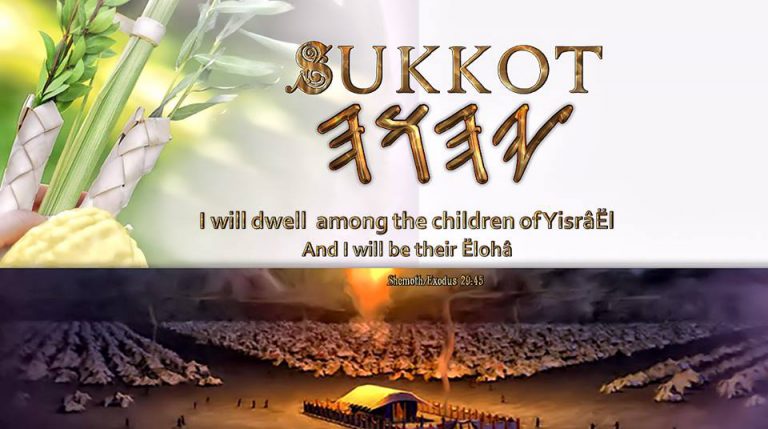


https://play.google.com/store/apps/details?id=com.RipCurrentInteractive.EnochCalendar
Description: This is a App to Convert the Gregorian Calendar to the Ancient Enoch Calendar.


A. 2015-Melchizedek-Yahushua-Solar-Calendar  

The “Melchizedek Biblical Solar Calendar” Dates for 2015 – And How To Calculate This Calendar Yourself In The Coming Years (If We Have No Internet!) By Rob Moore

2015-High-Days_Biblical-Solar-Calendar

YHWH Time schedule

The “Melchizedek Yahushua Solar Calendar” Dates for 2015 – And How To Calculate This Calendar Yourself In The Coming Years (If We Have No Internet!) As several requests have been received asking for the “Melchizedek Yahushua solar calendar” High Days for 2015, and in the event that we may not have the freedom of the Internet to share this kind of information much longer, the first part of this article is the 2015 calendar dates. In the second part is an overview of the principles required that will enable you to work out the calendar by yourself in the coming years. The Melchizedek Yahushua solar biblical calendar for the 2015 High Days is presented immediately below. I call it the Melchizedek Yahushua Solar calendar since it follows the Apostolic testimony of Yahushua’s sign of Jonah, his death and resurrection, by which we can identify the Feast of First Fruit, since He is our First Fruits (1 Cor 15:20). The calendar also incorporates the foundational principles of the Zadok priesthood testimony. The counting pattern of days is laid out in the left column of biblical day counts to the High dates and the nature of this solar calendar is that this pattern is unchanging for each and each year if one properly identifies the actual true sun equinox date, and then consequently the date of the biblical weekly Sabbath day. No intercalation of leap days or days is ever necessary – it works out exactly the same every year, year after year, unlike the Christian calendar which requires intercalation for leap years, or the Rabbinic calendar that requires a massive intercalation of a full 13th lunar month to be added every three years to simply bring their calendar (which becomes increasingly inaccurate each year) back into line with the agricultural seasons again. Consequently for a year out of every three, Judaism is observing their Passover in the winter and not the spring as required by the law of Moses! This year, 2015, by intercalation, the Rabbinic religious lunar calendar is placed back in close coincidence to the biblical solar calendar due to the adding of the 13th month to this passing year 2014-25. But next year 2015-16 and the year after that, if you compare the biblical solar calendar with the Rabbinic lunar calendar you will see just how much the Rabbinic calendar drifts towards starting in the winter season, revealing its completely unreliability when we know in truth that YHVH, the Creator, sets all things in perfect order .

Note that in this “Melchizedek Yahushua biblical solar calendar”, that the pattern count of all the days to the festivals (first two columns) will always be exactly the same every year, and it is the Gregorian calendar dates and days that move around and change each year. The Rabbinical calendar dates for Judaism’s high days are presented in the right hand column simply to for comparison to show how even though they identify Passover to be close this year, their prescription for the rest of the festivals goes their own way. This is because the Rabbinic identification of the weekly Sabbath is integrated to the Gregorian Saturday (so adjusted by Hillel II around 300 CE), whereas the “Melchizedek Yahushua biblical solar calendar” uses the principle of the Zadok testimony on how the weekly biblical Sabbath is identified from the occurrence of equinox itself. This distinction is really important if one is sincerely seeking to identify the biblical Feast of Weeks and the Day of Atonement – the two pinnacle High Days of YHVH’s commanded worship liturgy It needs to be emphasised that whilst this year, the Rabbinic calendar – because of their additional 13th month intercalation together with a rare periodic incident this year (the new moon happens to be coinciding with the occurrence of the vernal equinox this year) the Rabbinic Passover date for Passover approximates the “Melchizedek Yahushua Biblical Solar calendar” count to the Passover. BUT thereafter – the Rabbinic calendar identification of First Fruits and subsequent festivals etc changes accoriding to their own prescriptions in relation to their definition of the occurrence of the weekly Sabbath. Of course by the time one gets to the 7th month, the Rabbinic calendar is way short because of the lunar month count rather than the biblical month and the arrival of the autumnal equinox. In other years when the Rabbinics intercalate their additional 13th month there yet may be greater differences because the astronomical new moon may not be so closely associated with the occurrence of the vernal equinox. Is it not amazing that YHVH’s festivals are linked intimately with the agricultural seasons, yet many hold to a Rabbinical calendar which completely ignores the seasons and focuses instead on the moon – all the while claiming this to be the “law of Moses! Here then we discover a very important foundational principle of the biblical calendar demonstrated: – One needs the identification of both Day 1 of the biblical year as well as the identification of the weekly biblical Sabbath, to be able to identify when the biblical festivals will take place, and the biblical weekly Sabbath does not relate to the Gregorian Saturday. It is perhaps the strongest heavenly confirmation of the biblical prophets Yahushua and The Apostles, that redeemed Jacob is yet “in the exile” and the messianic era when there will be “the restoration of all things” in the coming covenant land, has not yet arrived! The “Melchizedek Yahushua solar calendar” formula is one, which works out precisely according to Leviticus 23 instructions and the testimony of Yahushua and is the same pattern of the counting of time every year without any intercalation of days or months or leap years. On the other hand both the Rabbinic and Gregorian calendars are moving around the place every year depending on their definition of days, weeks, months and their shortfalls in their methods of counting time that require intercalary adjustments to catch up with the seasons.

In the second part of this article, together with the spreadsheet template presented for this year, I lay out the essential principles how and what is required to be able to work out the “Melchizedek Yahushua solar calendar” for yourself in the coming years, just in case we are going into the labour pains of the righteous woman in the coming days and we will need to be able to do it correctly for ourselves. After all my studies on this subject over the years, I am persuaded that Abba has revealed all this at these late minutes in the age, so that we will each be able to participate with Him and His messengers in a very important coming Feast of Weeks and Day of Atonement, which is hidden from all but His remnant elect, in the midst of very dark days that will be across the globe. I understand the timing of this to be in the same vein as the narrative of the preparation before the ancient exodus (Exodus 10:21-23) 21 ¶ And YHVH said unto Moses, Stretch out thine hand toward heaven, that there may be darkness over the land of Egypt, even darkness which may be felt. 22 And Moses stretched forth his hand toward heaven; and there was a thick darkness in all the land of Egypt three days: 23 They saw not one another, neither rose any from his place for three days: but all the children of Israel had light in their dwellings. . By learning to work it for yourself you will learn much more about the amazing biblical calendar and how ordered it is, and I expect that in doing this, you will probably come to share my own experience, that beginning to actively work it out each for ourselves is a part of the process that Abba is calling each one whereby we will KNOW Him more intimately, especially given the days in which we live ( Phil 2:12.) Wherefore, my beloved, as ye have always obeyed, not as in my presence only, but now much more in my absence, work out your own salvation with fear and trembling. I pray you will be baruch from Shamayim above as you take hold of the High scriptural festivals this coming Year. Esteem and honor to our great and coming Soveriegn, Yahushua Melchizedek!

2015-Melchizedek-Calendar-Schedule click here for better view Now!


Capture Calendar1Capture calendar2


Everyday of life is a page of history of U

Working The Calendar Out By Yourself:

The Calendar Really Is A Hidden Mystery: The following is a synopsis of the principles from sincere study over the years, which enables the High Festival days to be discerned. The answer to identifying the biblical calendar yourself is that it really is a Divine revelation within reach of any who 1) have a sincere love for YHVH’s truth (2 Thess 2) and who have 2) the full scriptures in their hands, 3) who carefully follow Yahushua’s Divine authority as our Melchizedek King – High Priest Order, 4) who accept the Apostle’s testimony as trustworthy and authoritative, 5) who understand the testimony of the exiled Zadok priesthood (160 BCE –30 CE Qumran scrolls) concerning the solar biblical calendar and their formula for identifying the day of the biblical weekly Sabbath, and 6) know their testimony of the Pharisees who profaned the Temple in 160 BCE with the rebellious enforcement of the lunar calendar, which they brought from the Greeks and 7) who have a basic understanding of astronomy, the orbit of the earth around the sun, the ecliptic constellations, and how to the vernal and autumnal equinoxes can be easily identified. In history, the biblical calendar was deliberately replaced by the Judeo –Christian religious polemic many centuries ago each in their attempts to exert control over the “Kingdom of God” for themselves (Nicolaitanism).

First the Pharisees profaned the calendar of Judah in the century preceding the advent of Yahushua, then later the Roman Christian calendar emerged in 325 CE. In truth, the biblical calendar is only knowable by 1) the text of Leviticus 23, 2) the revelation of the Zadok testimony in the recently revealed Qumran texts, 3) trust and complete respect for the truth, accuracy and reliability of the Apostolic testimony of Yahushua as being of the Melchizedek King-High Priest Order, and especially the testimony of the precise the timing of when Yahushua both directed and observed his last Passover at the community of the “Water Carrier” (an exiled Zadok community), as precisely recorded in Luke 22 which was on the day immediately prior of the lunar based day of preparation for the Passover of the Rabbinic calendar with which they (the Pharisees) had gained control over the Temple. After more than 20 years of searching for the “ancient path”, knowing the constructed religious calendar of Christendom, and seeing all the calendar confusion in the so-called “Messianic / Hebraic roots movements”, I am persuaded that the sudden wake-up to the solar calendar that has been happening in the remnant across the globe in these last few seconds of the age, is indeed a most profound last days Divine miracle desperately necessary to the narrative of the prophesied “greater exodus” of the elect, and thus revelation from a loving Father. It is given to us through His Grace, and not because of our own academic prowess since few Christian or Rabbinic theologian academics are able to transcend their own traditional theologies on the matter. .

How do we know that we could not have come to this by our own understanding? For the reasons that while we could unravel the history of Rome and Protestantism’s religious calendars, originating way back to the 2nd century to Polycrates and the Quartodeciman disputes, and then the Council of Nicea in 325CE. The history of the impact of Rabbinicalism on Judah’s religious calendar was scandalously kept from the publicly under secret lock and key for more than 6 decades, because the only primary historical resource record we have of the history of Judah in the times of the Maccabees through to Yahushua (160 BCE to 30-70CE), is in the volumes of the Dead Sea Scroll Libraries , and it has only been through the continued struggles of certain people to be able get access to the scrolls, that the very recent public revelation of the Qumran libraries occurred in the year 2000 enabling a second generation of sincere scholars to begin to study and to publicly reveal the document contents. (For all we know some scrolls may still be being kept under certain lock and key ?) The scrolls reveal that there was an ancient religious understanding of the biblical calendar amongst Judah that was deliberately and totally obliterated from their religious memory under the hegemony of the Pharisee Rabbis. The scrolls testify to the history of the Pharisee Rabbinic destruction of the biblical calendar (beginning around 160-120 BCE) for all to read – especially laid bare for the remnant, whether Jew or Non-Jew who have love for YHVH’s truth, to search the matter out to see if it be so.

Thus the search to find and receive the revelation of the true biblical calendar is very much a personal heart issue requiring a deliberate walk that can be described as motivated by a sincere love for truth. According to 2 Thess 2:10 this condition is a prophesied precondition for the elect in the last days, since without that unique quality of character, YHVH has declared there will not be given revelation of His truth but that instead there will be a being given over to a great deception and the subsequent believing of a lie. It is in this sense that the conflicts we have all witnessed over the religious calendars in the Judeo-Christian religious polemic need to be discerned in these last prophetic days. The exiled Zadok priesthood testified that the foundational condition of all rebellion against YHVH, is to be found in the replacement of the biblical solar calendar with the lunar calendar which was originally instructed by the fallen angels, and which the Pharisees  forcefully implemented, to consolidate their hegemonic political and religious control over the ancient Temple and the ancient nation of Judah. Consequently it is not a small matter to expect that the issue of the religious calendar will be at the heart of the great deception in the last days, a deception which will be strongly promoted by the one whose coming is ”after the working of Satan” (2Thess 2:9), just as it was in the days of Antiochus, the Maccabee ruling elites, the Pharisees, as opposed to those who struggled for YHVH’s truth such as the Zadoks, John the Immerser, Yahushua Melchizedek, the Apostles and the remnant congregation of the New Covenant. Consequently while the elect has been deliberately kept blind to the truths on the biblical calendar for more than 2 thousand years, it is by the wonderful grace of Father YHVH, that His remnant be given increased understanding in the very last minutes of the age so that they are able to into worship of Him in “Spirit and in truth” together with the community of righteous angelic beings of heaven, all of whom who lso worship and honour Him in the Divine order of His biblical calendar. The ancient Zadok priesthood prophesied that in the very last days, immediately prior to the implementation of the Messianic Era and the “restoration of all things”, a communal restoration of the true biblical calendar and worship would again be restored to the remnant to reunite the worship of the remitment elect with the heavenly angelic hosts. Praise YHVH and Glory to Yahushua the Great Redeemer!

How To Work Out The Melchizedek Yahushua Solar Calendar

1. The biblical calendar is equinox based.

2. Mean Sun Equinox Dates versus The Identification Of True Sun Equinox dates Day 1 of the first month of the year is identified by the event of the true sun Vernal equinox. On our typical printed calendars the equinox date and time reported is a mean sun mathematical calculation and is not a true sun observation where the actual occurrence of the equinox occurs. Thus while our calendars give an indication, there can be a full days’ difference between the mean sun calculation and the actual sun dial observation – this can be seen in that if your calendar is reporting the equinox occurring in the night hours (Jerusalem time) then it is only possible that the actual true sun equinox will only be observable the next day, and cannot have occurred as the typical calendar reports during the night.

3. Using The Horizontal Sundial Experience with a good horizontal sun dial is best to do the observation of the equinoxes with confidence, and especially if you do not have access to the internet in the future! A horizontal sundial reveals the very day on which the equinox occurs and is observed by carefully identifying the occurrence of a straight line on a good (broad) sundial. The straight line must be read from the very edges of the sundial through the center. With small sundials, it is easy to make a mistake of reading it as having a straight line incidence and yet close inspection of the outside edges of the sundial (occurring early morning, late afternoon) might still be revealing a very slight curve to the line – meaning one may be a day early or (if it is going the other way – a day late). It is extremely important to identify the true straight line has occurred from early morning (sunrise) through late afternoon (sunset).

Below are some pictures of my horizontal sundial work on identifying the equinox:

• The sundial must point true north and not magnetic north. You need to practice getting the sundial appropriately position days before the actual day you will be measuring the equinox as you will not be able to change its position when started – if the sundial is off just a degree or so from true north achieving a straight line will be distorted and you could mistakenly miss identifying the actual day of the equinox because a sundial that is not correctly aligned will display something of a curve.

• The sundial must have a good ratio of pin height (shadow cast) to board breadth to make early morning and late evening readings possible and accurate

• In looking for the day of the equinox start hourly measuring the day before the mean sun calculation dates typically found on calendars – you may have to continue on to the day after the means usn calculation date on the calendar since the actual true sun observation of the equinox is very different form a mathematical estimate.  Make sure you are able to get early morning sun and late evening sun readings. Its on the very edges of the sun dial that a straight line can be perfectly measured, as even a day prior to the actual equinox the horizontal sun dial line will be slightly curved.

• As the middle of the day approaches (dependant of latitude) , you will need to increase the number of readings taken to every 30 minutes and down to every 10. Once the middle of the day approaches the movement of the shadow on the sun dial begins to accelerate, and you can miss an measurement if you are not alert.

• For more information on using a sundial to identify the equinox please see the article on my website: Prophecy Watch : 26 Jan 2013 How To Precisely Observe And Identify The Astronomical Equinox at the following link: http://www.inthatday.net/wpcontent/uploads/2013/archive/Watch/HowToObserveEquinox.html

Capture Sundai

However it is possible to predict the occurrence of the true sun equinox days in advance by carefully examining the mean sun calculations (mathematical estimates) that we have presented on our modern calendars, although we need to find the estimation for Jerusalem time. However in using a mean sun calculation one must carefully noting the time and date at which the occurrence is estimated and then if this is cited as occurring during the evening and night hours, then to know that the next day (daylight period) is the date on which the true sun observation of the equinox will actually be occurring and would be so properly observed on a horizontal sundial:  To get a record of the mean sun calculations as they occur in Jerusalem time, go to this link:

http://www.timeanddate.com/calendar/seasons.html?n=110 . (Remember to examine the dates and times carefully know they are mean calculations and not true incidences and work out when the true sun equinox would be occurring or you could be a day too early!) . Keep a copy of this page as a record for the future it presents the means sun calculations for many years to come.

4. Identifying Day 1 of The First and Seventh Months Download the mean sun calculations presented on the webpage at the above link (timeanddate.com) for Jerusalem Israel. These calculations can help you to know when you should be setting up your horizontal sundials if you want to directly observe the occurrence of the equinoxes yourself (I specifically felt convicted that Abba is calling us to practise doing the sun dial observation) or alternatively carefully work out what the True sun observations of the equinox will be from the mean sun estimates. On that webpage will be presented the calculations for both vernal and autumnal equinoxes. Examine the calculations to see if the true sun observations would actually be happening the next day. Once you have the actual true sun equinox dates, the Vernal equinox is day 1 of month of the biblical year, and the true sun equinox autumnal equinox

5. Identifying the Weekly Sabbath Once you know Day 1 of the biblical year, the Zadok formula for identifying the weekly Sabbath is that while the equinox is a sign of Day 1 of the month and the beginning of the year it is also the sign of day 4 of the biblical week. Count three days from day 1 and you will have identified the weekly biblical Sabbath. Identifying the weekly Sabbath is important to identify the count to the feast of Weeks. Without it, you will not know when to bgeing the counting of the 7 Sabbaths to the appointed time.

6. Setup a Spreadsheet (As In The Previous Template For 2015) with a simple consecutive numbering of days Follow the 2015 calendar diagram in the beginning of this article, which shows the biblical Calendar of the High Festival Days, mark in the weekly Sabbath Days, and the counting of all the days to the festivals according to the instructions of Leviticus 23, knowing that the Sabbath day sign mentioned in Leviticus 23:11 is the first weekly Sabbath that occurs during the 7 days of unleavened bread, and the day which immediately follows it is the Feast Of First Fruits, which fits the sign of Jonah – the Day of Yahushua’s resurrection which is 3 nights and days from the day of crucifixion that took place on the next day after His Passover meal with His disciples.. From the day immediately after the weekly Sabbath (the Day of First Fruits) count 7 Sabbaths / 50 days to find the day after the weekly Sabbath which is the Feast of Weeks.

7. Establising the Festivals in the 7th Month: Once having identified the true sun incidence of the autumnal equinox, you have found Day 1 of Month 7, which is the Feast of Trumpets. Count 10 days to the Day of Atonement and another 5 days to find the first day of Tabernacles. Count another 7 days to find the last days of tabernacles.

If its all to confusing simply identify the dates of the true sun equinoxes and use the spreadsheet template of columns 1 and 2 in the calendar layout I have made for this year 2015 – since the pattern of the count is exactly the same for every year you should have no difficulty. The only things that change are the associated Gregorian calendar dates and days of the week.

8. What About Identifying the Days In Each Month? From time to time I have been asked how can the days of the biblical months can be known. For some their emphasis on being able to know the dates of every month is so important that if not done to their satisfaction the simply reject the Biblical solar calendar out of hand. (in my view this insistence by some on identifying all the months in the year before the solar calendar can be acceptable to them is just a self-deceiving cover that they really do not want to let go of their “messianic movement” comfort submission zone to the authority of Rabbinicalism over their calendar, since the only reasons we are concerned about the biblical calendar is the worship of YHVH and therefore identifying His High Festival worship days. Knowing all the months does nothing for a people that is yet in exile and having to live their work life according to a Gregorian calendar.

However, if one really insists, it is in fact possible to identify the days of each of the 12 months (and there are never 13 months in the “Melchizedek Yahushua calendar” year – as the months are intimately linked to the annual circuit of the sun as it passes through the 12 ecliptic constellations (as perceived from earth) based on Gen 1:14 where the authoritative time keeping signs are definitively given as the sun and the stars. (The moon is not an authority in accurate timekeeping as it does qualify as an authority that “rules” the night because the moon is only in the night sky for some two weeks a month, every each month! The rest of the time it is somewhere around in the daytime sky! But the constellations are always there, and by them we can navigate and with the sun and the stars together we can navigate the earth with perfect time keeping to identify longitude accurately. As stated above, with the solar biblical calendar, the number of days in a biblical month is dependant on the earth’s annual orbit around the sun over the year in relation to the 12 signs (constellations) of stars on the ecliptic.

At significant periods in the history of man, the days of the annual solar year have changed, such as in the days Noah’s flood, because of changes in the earths orbit around the sun, and so the number of days occurring in a solar year changed, thereby affecting changes to the number of days in the months. But on the “Melchizedek Yahushua solar calendar” this is not a worry! The biblical High Festivals, weekly Sabbaths and even adjusted days in the m12 months of the year can be readily identified no matter how many days the soalr year is suddenly changed to! All we need to do is carefully look to the behaviour of the authoritative signs of Gen 1:14 as we move from vernal equinox to vernal equinox (the full solar year) and with the instructions of scripture we will be right!

Currently our solar year consists of 365.25 days (earth’s orbit around the sun), and the time taken for the sun to travel through each of the 12 ecliptic constellations define the biblical months – the months have days that compliment the solar year count for equinox to equinox and there is never a need for any intercalation adjustment or leap years! The matter of the .25 of a day is taken care of each as it is absorbed be the recelebration of the beginning of the year on the day on which than actual sun observance (by sundial) of the vernal equinox occurs! The Astronomical Months, As Determined By the Time The Sun Takes To Move Through The 12 Ecliptic Constellations are as Follows: (Note – these counts of days per month are precisely the same every year, and would only change with a great catastrophy that would cause the earth to change in its orbit around the sun.)

The first (astronomical) month currently has approximately 31 days and corresponds roughly to March 20 through April 19 on the Gregorian calendar. The second month currently has approximately 31 days and corresponds to roughly April 20 through May 20 on the Gregorian calendar. The third month currently has approximately 31 days and corresponds roughly to May 21 through June 20 on the Gregorian calendar. The fourth currently has approximately 32 days and corresponds roughly to June 21 through July 22 on the Gregorian calendar. The fifth month currently has approximately 31 days and corresponds roughly to July 23 through August 22 on the Gregorian calendar. The sixth month currently has approximately 31 days and corresponds roughly to August 23 through September 22 on the Gregorian calendar. The seventh month currently has approximately 30 days and corresponds roughly to September 23 through October 22 on the Gregorian calendar. The eighth month currently has approximately 31 days and corresponds roughly to October 23 through November 22 on the Gregorian calendar. The ninth month currently has approximately 29 days and corresponds roughly to November 23 through December 21 on the Gregorian calendar. The tenth month currently has approximately 29 days and corresponds roughly to December 22 through January 19 on the Gregorian calendar. The eleventh month currently has approximately 30 days and corresponds roughly to January 20 through February 18 on the Gregorian calendar. The twelfth month currently has approximately 29 or 30 days (depending on what we now call leap year) and corresponds roughly to February 19 through March 19 on the Gregorian calendar.

So with the “Melchizedek Yahushua solar (astronomical) calendar” – even if we had a catastrophe to the orbit of the earth and the days of the solar year on the earth changed to 400 or even 360 days a year – with the same formulae and patterns presented in this article we could still identify the equinoxes, the weekly Sabbaths, the biblical Feast days and even the 12 months with their new count of days – the pattern would still be in accord with the law of Moses (Lev. 23) and authoritatively intact for the correct identification of the High Festival days and the lawful order for the worship of YHVH – such is the depth of wonder of the order the Creator has  established. But yet men, on the contrary, always seem to desire to develop their own authoritative calendars, which in the event of a radical sudden change to the earths orbit – get radically out of bent out shape and confused over night and take years to unravel how their calendars have become unsynchronised with the seasons! Their theologians and scholars would go into panic for sure Today many are waking up to the fact that the Rabbinic lunar calendar is but a theological construction and neither reliable nor in accordance with creation!

I expect the Rabbis will be increasingly concerned with how people are waking up to the fact that the law of Moses does not instruct the observation of the Passover to take place in the late winter, rather than the spring, periodically every three years… But what will they do about it, given that the only alternative they have is to acknowledge the ancient Zadok testimony that they, The Pharisee Rabbis, are guilty of the profanement of the biblical lawful worship calendar, which they did when they took control for themselves of the Second Temple in Judea in the decades just prior to the first advent of the Great Teacher of Righteousness, Yahushua Melchizedek, the only One who is able – according to biblical credential – to take away the sins of His people and to restore Jacob to the biblical messianic era ! Be baruch In Yahushua Melchizedek! Our soon coming Sovereign!

Rob@inthatday.net  March 6th 2015

 http://www.inthatday.net/2015/03/the-melchizedek-biblical-solar-calendar-dates-for-2015-and-how-to-calculate-this-calendar-yourself-in-the-coming-years-if-we-have-no-internet/

Yahushua Calendar

  B. About Yahushua Melchizedek Calendar

Please  click this link for details:  https://perfectgiftorg.com/?p=1757

Additional info: According to Prof. Rachel Elior of the Hebrew University of Jerusalem, the Rabbis were involved in nothing less than “a reinvention of Judaism“…The short reason … she suggests, was “a dispute over the calendar… “scholars known as Pharisees who disputed the legitimacy of the Hasmonean priests and kings and who argued with the Zadokite priests about the solar calendar…“. from  https://perfectgiftorg.com/?p=2023

Prof_Rachel_Elior_Public_ Lecturer_Univ_Chicago_2014.mp3

C. About Enoch last dayTime-line (From Adam Year 1 to A New Heaven and New Earth) by Daniel de Caussin

also: click here for details  https://perfectgiftorg.com/?p=2254 

YHWH Time schedule

D.  How the Ancient Hebrew Calendar is Built:

The month by month’s guide below is modified with permission from the calendar frame work provided by Daniel de Caussin; we share the same way of counting of the year but we hold a different opinion on the counting of the weekly shabbat day! Please refer to his file this link here: https://www.facebook.com/groups/Enoch.prophecies/909233215774667/

“RECENT FINDINGS At Qumran in 1947, there were apocalyptic scrolls found, and among them the Books of Jubilees and the Second Mikdash writings of Enoch I which discuss the calendar and dating system by which these people lived.

Scholars had been attentive of the Apocryphal Calendar before this find, but interest was renewed with the discovery of these scrolls by which the Qumran sect lived. It is based on 364 days per year. The year is divided into four periods (to correspond to the four seasons of the year), of 13 weeks or 91 days in each period. There are 12 months in each year or a total of 52 weeks.

By using this exact measure and beginning the year on the 4th day of the week just after the vernal equinox, the Set Apart days fall exactly on the same day, in the same month, every year. This calendar warrants extensive study, as there are now numerous proofs it was the calendar used by Abraham, King Solomon, King David, and High Priest Zadok in the First Qodesh Mikdash.

A different calendar was used in the Second Commonwealth, but that Mikdash had no Presence, no Ark of the Covenant, and no means for its apostate priesthood to communicate directly with יהוה. In fact, it is recorded that 300 high priests during the second Mikdash period, died when they went into the Most Kodesh Place on Yom Kippur. Something, perhaps many things, were wrong with the Second Mikdash Cult. A team of scholars was appointed to study the scrolls in 1952. They became an elite and secretive clique. In 1991 this monopoly was effectively broken when the Huntington Library in California announced it would allow public access to its collection of Dead Sea Scrolls photographs.

This was soon followed by the publication of a Facsimile Edition by the Biblical Archaeology Society in Washington, D.C. Until this time scholars previously controlling access to the Scrolls had been publicly contending that there was nothing interesting in the remaining unpublished Scrolls and nothing throwing further light on Judaism and Christianity’s rise in Palestine. (The Dead Sea Scrolls Uncovered, Professor Robert Eisenman & Michael Wise).

for clarity, please go to this page: https://perfectgiftorg.com/?p=1794 :
The Zadokite Essene calendar, the calendar attested in I Enoch and the Book of Jubilees, consisted of a solar calendar of 364 days divided into seven-day weeks, twelve months of thirty days each except for one extra day in the last month of each quarter (Jaubert 1965:27; Pfeiffer 1969:64-65; Vanderkam 1998:55; Finegan 1998:44).
The Feast of Unleavened Bread, Feast of Trumpets, Feast of Tabernacles, and Feast of the Great Day (often seen as the eighth day of the Feast of Tabernacles), always began on the 4th day of the week ( There is NO Wednesday yet in the 1st century),
The feast of Passover actually start on the 3rd day (Tuesday) evening, as the Jews began days at evening not midnight (Jaubert 1965:10; Simon 1967:73).
Trumpets, Tabernacles, and the Great Day always occurred in the seventh month as set forth in the Law of Moses (Leviticus 23:24-44).
As Nisan 15, the annual Sabbath, or Passover Sabbath, marking the start of the seven-day Feast of Unleavened bread began at sunset the fourth day night, the Essene observance of the Passover Seder was always on the third day evening of the week  (Finegan 1998:43, 48).)

The Talmud does not explain this calendar exactly, but does mention the argument of the calendars between the Pharisees and Sadducees…

We (the Editors of this website) are observing according to the exact same principal as mentioned above. Once we identify the first day of the year is the 4th day of the week…hence we will know that 3 days later is the 7th Shabbat Day…In the Essene day, there is NO “Wednesday”…beginning the 1st day of the year on the 4th day of the week after verified the vernal equinox, the PassOver Feast days fall exactly on the same 4th day of the week, the 14th day in the same month, every year. Which bring us to the same Resurrection day every year: after our Messiah Yahushua was buried 3 days 3 nights, He arose before the sunset/before the ending of the 7th day weekly Shabbat! HalleluYah, HE is the Mater of our Shabbat!!

 How the Ancient Hebrew Calendar is Built

 NOTE:

To get a record of the mean sun calculations as they occur in Jerusalem time, go to this link: http://www.timeanddate.com/calendar/seasons.html?n=110 . (Remember to examine the dates and times carefully know that from the link, they are only mean calculations and not true incidences and work out when the true sun equinox would be occurring or you could be a day too early!) . Keep a copy of this page as a record for the future it presents the means sun calculations for many years to come. 

שבת – Sabbath On this calendar, every seventh day is called a sabbath. See h7676 Additionally, the word sabbath is also associated to the concepts of rest and cessation. See h7673 – 7676

High Sabbath or Sabbath’own – שבתון A Sabbath’own, see h7677, is a Great or High Sabbath, and it can also be a Solemn Sabbath. It may occur on a day that is not a seventh day Sabbath indicating that this day is a special day of rest or solemnity.

Solemn Assembly or Atsara – עצרה An Atsara, see h6116, is a Solemn Assembly. It is characterized as an assembly called to be solemn. To be solemn is to not be cheerful and a time in which there is deep sincerity within the people in that assembly.

Set Apart Convocation or Miqra Qodesh – קדש מקרא A Miqra Qodesh, see h4744 and h6944, or Set Apart Convocation is set up for gatherings to remember set-apart days. These are, by definition, large formal assemblies of people.

The first example of this is the day after passover calling for an assembly to remember the feast of Unleavened Bread. Call for many to appear or Ra’ah Paniym – פנים ראה Ex 23:14-17 Three times a year all males are commanded to appear before YHWH/Yah’oah. These times are outlined as the feasts of Unleavened Bread, Feast of Weeks of the firstfruits of wheat harvest, and In Gathering.

This Hebrew word ra’ah at h7200, has the feeling of to see something as in to feel, smell, behold, to perceive in the heart, and to hear a thing. In an assembly of this nature, all these things would be happening to the attendee. And the Hebrew word paniym at h6437, has the feeling of turning oneself as in to face a new direction, and as in to change one’s walk in a different direction. The idea was to turn one’s walk in life towards the path of YHWH/Yah’oah and the Torah (instructions). When we error from the mark, we err from the concept of love of Father, love of neighbor, and the concept of the family (father and mother). Therefore, these Ra’ah Paniym, were designed to realign the males so they could better guide their families and communities.

Time is running out

Month one

Step One

Let’s start building the Calendar starting in Exodus 12 where we are given in Torah that the first month has a first day.

Exodus 12: 1

And יהוה spoke to Mosheh and to Aharon in the land of Mitsrayim, saying, 2 “This month is the beginning of months for you; it is the first month of the year for you.We learn the first day begins on the Spring Equinox. We will revisit this later in this document.

Enoch 72:34 So as at the beginning the year comes back to its course where the day becomes longer, and each night becomes shorter. see also Ex 13:4, Ex 23:15, Ex 34:18, Deut 16:1, Enoch 72:6 After we verify the Spring Equinox, that day we start the calendar. as day one.

By using shadows on sticks in the ground the Spring Equinox can be verified, or go to this web site and type Jerusalem for the location. http://www.timeanddate.com/calendar/seasons.html?n=110 

Please note that the team producing this document and Hebrew translations, with prayer and by leadership of the Spirit of Truth, which is the hand of יהוה YHWH.

The days that come as the first day are special days to יהוה. Through Yahh, our Father Av has given us Torah to follow. Whenever we are given teachings, instructions, or direction, it is always designed for our benefit.

Month One

1

2

3

4

5

6

Weekly Shabbat

Day 1 of the new calendar year

Verified Spring Equinox

Notice that we don’t use the day names like we have on a Gregorian calendar for obvious reasons. These day names are heathen based names.

Fun Fact about the Day 31: the “intercalary.”

Enoch 75
And the leaders of the heads of the thousands, who are placed over the whole creation and over all the stars, have also to do with the four intercalary days, being inseparable from their office. According to the reckoning of the year, these render service on the four days, which are not counted in the calculation of the year.
2 On account of these men go wrong, for those luminaries truly render service on the world-stations, one in the first gate, one in the third gate of the heaven, one in the fourth gate, and one in the sixth gate, and the exactness of the year is accomplished through its separate three hundred and sixty-four stations.
Night and Day
Why does a day begin at sunset? The first clue is found in Genesis 1:5
… It became evening, and then it became the morrow. This was the first day of a multitude of days.
The stars or Angels are the leaders of the Calendar. They have been given a job, and by oath keep it in perfect and constant order. The Stars enter first.
Another clue comes from Enoch.
Enoch 82:8 He has power over night and day in the heaven to cause the light to give light to men from the sun, moon, and stars, and all the powers of the heaven, which revolve in their circular chariots. 9 These are the orders of the stars, which set in their places, and in their seasons, festivals, and months. 10 And these are the names of those who lead them, who watch that they enter at their times, in their orders, in their seasons, in their months, in their periods of dominion, and in their positions. 11 Their four leaders who divide the four parts of the year enter first; and after them the twelve leaders of the orders who divide the months; and for the three hundred and sixty days there are heads over thousands who divide the days; and for the four intercalary days there are the leaders which divide the four parts of the year.
Woe
Yet another clue comes in the form of a Great Woe. Woe to us! This is clear! Do not to use the “day”, or sun rising, as the start of the day. By using the sunrise as the start of the day, this is following the lead of the Treacherous Watchers!
Enoch 82:4 Blessed are all the righteous. Blessed are all those who walk in the way of righteousness and do not as the sinners, the treacherous Watchers in the reckoning of all their days in which the sun traverses the heaven entering into and departing from the gates for thirty days with the heads of thousands of the order of the stars, together with the four which are intercalated which divide the four portions of the year, which lead them and enter with them four days.
How do we know the First Day and Duration of a Year?
According to Enoch, a year has 364 days. Each year has 52 Sabbaths, every year for all generations. There are no leap days, or leap months. Other calendars count every day of the year. This requires the use of leap days as in a Gregorian calendar, leap months as in a Jewish Lunar-solar calendar.
The way to handle the fact that a year has 365.2422 days in a year is this difference of 1.2422 days is just waited out and not counted. We wait and observe the Spring Equinox to occur. The ancients required a constellation and the point where the sun rose through the constellation during the last observed equinox. When the Spring Equinox is confirmed, that day the new year begins. The two witnesses to this first day are the Stars and the Sun. 
You can see how the stars are used at Enoch 74:
12 The sun and the stars bring in all the years exactly, so that they do not advance or delay their position by a single day unto eternity, but complete the years with perfect justice in 364 days.
13 In three solar [and Sidereal] years there are 1,092 days [3 times 364], and in five years 1,820 days [5 times 364], and in eight years there are 2,912 days [8 times 364].

Thirteen weeks for each season and Four seasons, and a total of 52 weeks in the Year

Jubilee 6:23 And on the new moon(first day) of the first month, and on the new moon(first day) of the fourth month, and on the new moon(first day) of the seventh month, and on the new moon(first Day) of the tenth month are the days of remembrance, and the days of the seasons in the four divisions of the year.  These are written and ordained 24 as a testimony forever.  29 … each had thirteen weeks; from one to another (passed) their memorial, from the first to the second, and from the second to the third, and from the 30 third to the fourth. And all the days of the commandment will be two and fifty weeks of days, and (these will make) the entire year complete.
Another point to bring up from Enoch 74 is the fact that two methods of ensuring accuracy were employed. The solar and sidereal cycles are similar in duration. At Enoch 74:12 The Sun and the stars bring in all the years exactly, so that they do not advance or delay their position by a single day unto eternity, but complete the years with perfect justice in 364 days. A principle in the Hebrew language is that when you double something you are emphasizing its importance. So here we see that two methods are used for verification. This is because of the importance of this ancient calendar.
The Stars have a cycle used for calendars and time keeping. Their cycle is called a Sidereal cycle. The length of a sidereal day is 23.93446 hours. The length of a sidereal year is 365.25 days. Sidereal time is calculated from watching the stars and their relation to the revolution of the earth on its axis and the rotation of earth around the sun. Notice that the times for the day and the year are very similar to that of the solar cycle.
Two witnesses to confirm the first day
The consistency of the star’s location and the sun’s location are used as two witnesses to the first day of the calendar so that we all, from generation to generation, can observe the sabbath on the same seventh day, and the feast days on their appointed days and times.
The Duration of 24 hours
The Earth revolves around its axis at a fairly constant rate. Its rate is affected by earthquakes and other cosmic influences. Nevertheless, it does change, but the change is so small it is almost undetectable. A leap second was added in 1972, and 40 years later one in 2012. This is a testament to Father’s hand in this situation.
What is a Day?
The Hebrew word yom has several meanings. Using a Gesenius, a Benner, and a Klein Lexicon we see these meanings for the word יום: heat, the day, a day, a festival day, time, at that time, then, at some time, at the time in which – as in the word “when”. The definition of this word is important to consider because the word יום is used in Genesis 1:5 to describe the first day. It was called a yom even though the sun was not created. The sun has nothing to do with the usage of this term. The same is true for Genesis 1:8, and 13. In this case the first three days where counted as days. Perhaps by the precision of the earth’s rotation. YHWH/Yaha’oha was the light that was provided for those three days. His presence was the light source. As we read in the Revelation of John 22:5 And night shall be no more, and they shall have no need of a lamp or the light of the sun, because יהוה Elohim shall give them light. And they shall reign forever and ever.

Step two

Next step in understanding the Torah of the Calendar is in Leviticus. We are told that we are to work for six days and then on the seventh day we are to rest.

Leviticus 23 (from a translation of the Dead Sea Scrolls):

1 And יהוה  spoke by turning towards Moshe and commanded by saying,
2 speak by turning yourself towards the sons of Yisra’el.  Say to them as you motion towards them;  Your places where you assemble on a regular basis, יהוה  said, in order for you to be successful, call a meeting to read from the Scroll. Read to all those assembled in that place.  Call out and encourage them to come towards you.
Doing these things are Set Apart and are for reverence and adoration at that time during their assembly.
3 Six times you are to produce by labor, the service that is prescribed to a person.  And then on the seventh day, you are to return to your habitation to rest and cease from your prescribed work.

Use this day to consider what it takes to cease from our labor in an assembly with a reading from the Kadosh Scroll.

Whatsoever service is prescribed to anyone, you are not to labor over this anymore. Cease from your labor and adjust your focus towardsיהוה  with an idea that all things in the farm or home are done and complete for this day.  By adjusting your focus towards to, יהוה you can rest your mind in your assembly of persons that have come together for sitting.

This verse is part of a list of the various Angels and their main responsibilities.

Enoch 20:6  Saraqael, one of the set-apart Messengers, who is over those people which have a desire to keep Sabbath.

Just amazing. There is an Angel who is assigned to watch over those who desire to keep Sabbath.

Keeping the seventh day Sabbath as a separate day is for all people who want to keep it.

Isaiah 56:

3 “And let not the son of the foreigner who has joined himself to יהוה speak, saying, ‘יהוה has certainly separated me from His people,’ nor let the eunuch say, ‘Look I am a dry tree.’ ”
4 For thus said יהוה, “To the eunuchs who guard My Sabbaths, and have chosen what pleases Me, and hold fast to My covenant:
5 to them I shall give in My house and within My walls a place and a name better than that of sons and daughters – I give them an everlasting name that is not cut off.
6 “Also the sons of the foreigner who join themselves to יהוה, to serve Him, and to love the Name of יהוה, to be His servants, all who guard the Sabbath, and not profane it, and hold fast to My covenant –
7 them I shall bring to My set-apart mountain, and let them rejoice in My house of prayer. Their burnt offerings and their slaughtering’s  are accepted on My altar, for My house is called a house of prayer for all the peoples.”
8 The Master יהוה, who gathers the outcasts of Yisra’ĕl, declares, “I gather still others to him besides those who are gathered to him.”

 Difference between a Sabbath day and a day of Set Apart Convocation

In Leviticus 23:3 we receive Torah concerning rest on the seventh day and that we should read together on this seventh day, and that we should consider all work any of us have been prescribed to do as completed, and that we are to call out an encourage others to join in the reading of the Scroll, and to use this day as a day of reverence and adoration of all things our Father Av has provided to us through YHWH.  A Sabbath rest has been appointed for every seventh day throughout the year. Sabbath means rest, Sabbath does not mean seventh day. We have associated the seventh day and Sabbath because of the Torah to have a Sabbath on the Seventh day. Nevertheless, a day of Sabbath can be appointed on days that are not the seventh day. We see this at Leviticus 23.
27 “On the tenth day of this seventh month is the Day of Atonement. It shall be a set-apart gathering for you. And you shall afflict your beings, and shall bring an offering made by fire to יהוה.
28 “And you do no work on that same day, for it is the Day of Atonement, to make atonement for you before יהוה your Elohim.
29 “For any being who is not afflicted on that same day, he shall be cut off from his people.
30 “And any being who does any work on that same day, that being I shall destroy from the midst of his people.
31 “You do no work – a law forever throughout your generations in all your dwellings.
32 ‘It is a Sabbath of rest to you, and you shall afflict your beings. On the ninth day of the month at evening, from evening to evening, you observe your Sabbath.”
We see here in these verses that both the ninth day and the tenth day of Month Seven are appointed as a day of rest, a Sabbath day, and notice on the calendar that these days are not on the seventh day.
So what is the difference between a Sabbath and a Kadosh Convocation?  A Sabbath is a command directed towards an individual. The individual must rest from their prescribed work. The command of a Set Apart Convocation is directed towards an assembly of people. An assembly can praise Yahh in Hymn singing, Dance, and group reading of the Kadosh Scroll. We read that some Set Apart Convocations are also days where a Sabbath is commanded to have rest from our individually prescribed work. This is what we read above in Leviticus 23:32.
In both a Sabbath rest and during a Kodash Convocation, people did not sit around doing nothing. We have to be somewhat active to eat and drink and the animals need to eat and drink, too. In Leviticus 23:3 we read that the key to this rest day is the focus of our mind and heart. Our mind and heart are more precious than the act of sitting down.
Lev 23:3 Six times you are to produce by labor, the service that is prescribed to a person.  And then on the seventh day, you are to return to your habitation to rest and cease from your prescribed work.
Use this day to consider what it takes to cease from our labor in an assembly with a reading from the Set Apart Scroll.

Whatsoever service is prescribed to anyone, you are not to labor over this anymore. Cease from your labor and adjust your focus towards YHWH with an idea that all things in the farm or home are done and complete for this day.  By adjusting your focus towards YHWH, you can rest your mind in your assembly of persons that have come together for sitting.

So now we can build the Calendar in this second step. We will add the Sabbath day.

Month One

1

2

3

4

5

6

Sabbath

 1/364

Evening of Spring Equinox

 2/364

Work day

3/364

Work day

 4/364

Seventh day rest, Day of reading the Scroll

Fun Fact about the seventh day

It seems silly to say that the Shabbat day is always the Gregorian Saturday day. It is consistently the Shabbat day in a cycle of seven days. A year has 364 days. Note that 364/7=52. There are 52 Sabbaths in a year. The Torah is clear that every seven days, during the year, we have a Sabbath. To begin a calendar on any other day by not using a seven day period leading up to a Sabbath, is following a method that does not adhere to Torah instruction.

The focus of the Sabbath is the command from our Creator Father Av, that the seventh day of rest is after the sixth day of work.

The example at the creation, was six days of work, and then the rest.

Ex 20:9 “Six days you labour, and shall do all your work,
10 but the seventh day is a Sabbath of יהוה your Elohim. You do not do any work – you, nor your son, nor your daughter, nor your male servant, nor your female servant, nor your cattle, nor your stranger who is within your gates.
11 “For in six days יהוה made the heavens and the earth, the sea, and all that is in them, and rested the seventh day. Therefore יהוה baruch the Sabbath day and set it apart.

Here again in Exodus 20 we read that the focus is the number of days.

The word (day) יום in Hebrew can also mean a time period, or time itself, and the heat of the day, and to be warm, the opposite of night, a festival day.

The example we have in Genesis 1, is the use of the word day. A “day” was founded on the fact that a “day” is a time period established on the completion of one rotation of the earth on its axis. It has nothing to do with the sun’s appearance at all. We have proof of this in the first three creation days. The days were called days without a sun.

The point is, the seventh day is after a six day period, was to be the focus of the day of rest, is reiterated at Exodus 20:11, 31:15, 17, 32:12, 34:21, 35:2, Leviticus 23:3, Deuteronomy 5:13, Ezekiel 46:1, and Luke 13:14.


Step Three

Exodus 12 (from The Scriptures Version 1998):

1 And יהוה spoke to Mosheh and to Aharon in the land of Mitsrayim, saying,

2 “This month is the beginning of months for you, it is the first month of the year for you.

3 “Speak to all the congregation of Yisra’ĕl, saying, ‘On the tenth day of this month each one of them is to take for himself a lamb, according to the house of his father, a lamb for a household.

4 ‘And if the household is too small for the lamb, let him and his neighbor next to his house take it according to the number of the beings, according to each man’s need you make your count for the lamb.

5 ‘Let the lamb be a perfect one, a year old male. Take it from the sheep or from the goats.

6 ‘And you shall keep it until the fourteenth day of the same month. Then all the assembly of the congregation of Yisra’ĕl shall kill it between the evenings.

Let us first look at the three facts here; We are told to observe the First month, the tenth day of this month, and the fourteenth day of this month.

Month One

1

2

3

4

5

6

Sabbath

Day 1

Evening of Spring

Equinox

This day to Remember the Ark

Day 2

Work day

Day 3

Work day

Day 4

Seventh day rest, Day of reading the Scroll

Day 5

Work day

Day 6

Work day

Day 7

Work day

Day 8

Work day

Day 9

Work day

Day 10

Work day

Select a Lamb for Passover

Day 11

Seventh day rest, Day of reading the Scroll

In Exodus 12:3, we read that a lamb or a goat was to be selected. A perfect one year old male. This lamb is called a paschal lamb. This lamb is intended for פסח pronounced Pe-sa-kh. The kh is a guttural sound from the back of the throat. פסח means to pass over, to pass by or to spare. This word does have other uses; nevertheless, this is the word for the feast called Passover.

 We also read in the torah of the Passover observance at Exodus 12:14, Leviticus 23:5, Numbers 28:16, Deuteronomy 16:1, and in Jubilees 49:1.

 Passover and the feast of Unleavened Bread

To build the next line in the Ancient Hebrew Calendar, we need to read Leviticus 23 again.

Leviticus 23 (from a Translation of the Dead Sea Scrolls)

4 These things that follow are the set times of  YHWH/Yaha’oha. They are to come from the person who calls people towards them to read from the Qodesh Scroll. To be successful, what is desired is that you cry out to all the multitude at each of these set times.

5 In the beginning of the year in the first month in the fourteenth day of the month just after when you can distinguish the division which starts the day, when there is still enough light to see things after the sunset; This is the time for YHWH’s “Passover” of Sparing the first born.

6 On the Fifteenth day, in the beginning of the year, perceive in your mind a circle for dancing. This circle is like the unleavened bread which is YHWH/Yaha’oha. And for seven times, as in seven days, you are commanded to eat this unleavened bread.

7 On the first day call a Qodesh assembly, and let it come to pass, you are to subdue your working of the work that is prescribed to you, for it is a service of obligation not to labor over something.

8  In coming together, in order to be close, you will bring a sacrifice of healing, which is YHWH/Yaha’oha, seven times as in each of the seven days. And the day time of the seventh day is a Qodesh Convocation for you shall read the Qodesh Scroll and you are to subdue your working of the work that is prescribed to you, for it is a service of obligation not to labor over something on this day.

In Jubilee 6:24-25 ... And Noah ordained them for himself as feasts for the generations for ever, 25 so that they have become thereby a memorial unto him. And on the new moon (first day) of the first month he was bidden to make for himself an ark,

Month One

1

2

3

4

5

6

Sabbath

Day 30

Work day

Day 31

Work day

Day 1

Work day

Evening of Spring Equinox,

This day to Remember the Ark

Day 2

Work day

Day 3

Work day

Day 4

Seventh day rest, Day of reading the Scroll

Day 5

Work day

Day 6

Work day

Day 7

Work day

Day 8

Work day

Day 9

Work day

Day 10

Work day

Select a Lamb for Passover

Day 11

Seventh day rest, Day of reading the Scroll,

Day 12

Work Day

Day 13

Work Day,

Day 14

Work Day,

Roast a lamb in evening after sunset.

Day 15

Work day

After Sunset, High Shabbat

Eat Unleavened bread

Day 16

Rest Day Dancing day,

Eat Unleavened bread

Day 17

Work Day

Eat Unleavened bread

Day 18

Rest Day,

Sabbath day

Eat Unleavened bread

Step Four

We are going to add the last two lines in the Calendar for Month One. From the Spring Equinox to the last day we have 30 days.  We find this in Enoch 72:8-13 where we read of a cycle of days consisting of 30 days, then 30 days, then 31 days.

The year is divided into four seasons, each consisting of 91 days. The first two months of each season has 30 days and the last month of each season has 31 days. Each year has 364 days. These 364 days per year is done in prudent understanding and divine counsel, so that the calendar is always the same for generation to generation.

There is no leap days, or leap months. This is a common way to handle the fact that a year has 365.25 days in a year. So this difference of 1.25 days is just waited out and not counted. We wait and observe the Spring Equinox to occur. It requires Sunshine to confirm it. When the Spring Equinox is observed, that day begins the new year. We see how this is determined at Leviticus 23:5 … just after when you can distinguish the division which starts the day, when there is still enough light to see things after the sunset; this is the time for the YHWH’s Passover of Sparing the first born.

We now have added the appointed days we are to remember from generation to generation in Month one.

Remembrance Day, day 1

Day 1 is the day to remember Noah’s exit from the Ark and the covenant of not to eat blood.  Jubilees 6:1-12

Bring First Fruits, day 19

Day 19 we read this is the day to bring in your first fruits. Jubilee 15:1, and Jubilee 16:13-14 This day is a Qodesh Convocation. Leviticus 23:20-21 were we see the priest waves harvest sheaves, and two lambs that will be sacrificed.

Feasts of Weeks, and Feast of First Fruits, starts day 25

Day 25 is the First day of the Feast of Weeks. This feast lasts for 50 days. Another name for this last day of the feast is Pentecost. Jubilees 6:17-22, Exodus 34:22, and Leviticus 23:15-21 This day is also the Feast of First Fruits. We read this at Jubilee 6:21. This day is also the day for the Wave Offering and Burnt Offering of Grain, Incense, and Wine. We read of this in Leviticus 23:11-13. Day 25 is one of the three days that Males are required to have a convocation. We see this at Deuteronomy 16:16.

Next add the appointed days to the calendar.

Pentecost

Leviticus 23:15 ‘And from the morrow after the Sabbath, from the day that you brought the sheaf of the wave offering, you shall count for yourselves: seven completed Sabbaths.

16 ‘Until the morrow after the seventh Sabbath you count fifty days, then you shall bring a new grain offering to יהוה.

17 ‘Bring from your dwellings for a wave offering two loaves of bread, of two-tenths of an ĕphah of fine flour they are, baked with leaven, first-fruits to יהוה.

18 ‘And besides the bread, you shall bring seven lambs a year old, perfect ones, and one young bull and two rams. They are a burnt offering to יהוה, with their grain offering and their drink offerings, an offering made by fire for a sweet fragrance to יהוה.

19 ‘And you shall offer one male goat as a sin offering, and two male lambs a year old, as a peace offering.

20 ‘And the priest shall wave them, besides the bread of the first-fruits, as a wave offering before יהוה, besides the two lambs. They are set-apart to יהוה for the priest.

21 ‘And on this same day you shall proclaim a set-apart gathering for yourselves, you do no servile work on it – a law forever in all your dwellings throughout your generations.

Here is the complete Month one. 

Month One

1

2

3

4

5

6

Sabbath

Day 1

Work day

True sun Spring Equinox,

This day to Remember the Ark

Day 2

Work day

Day 3

Work day

Day 4

Seventh day rest, Day of reading the Scroll

Day 5

Work day

Day 6

Work day

Day 7

Work day

Day 8

Work day

Day 9

Work day

Day 10

Work day

Select a Lamb for Passover

Day 11

Seventh day rest, Day of reading the Scroll,

.

Day 12

Work Day

Day 13

Work Day,

Day 14

Work Day,

Passover Roast a lamb after sunset

Day 15

Work Day

Sacrifice

Lamb

After Sunset, High Shabbat

Eat Unleavened bread

Day 16

Rest Day,

Convocation for Dancing day,

Eat Unleavened bread

Day 17

Work Day,

Eat Unleavened bread

Day 18

Rest Day,

Sabbath day of meeting

Eat Unleavened bread

Day 19

Eat Unleavened bread

Wave Offering,

First day of Feast of Weeks and Feast of First Fruits

Day 20

Work day

Eat Unleavened bread

Day 21

Work day

Eat Unleavened bread

Day 22

Work day

Day 23

Work day

Day 24

Work day

Day 25

Rest Day,

Sabbath day of meeting

End of week one 1/7

Day 26

Work day

Day 27

Work day

Day 28

Work day

Day 29

Work day

Day 30

Work day

 Month Two

Step One

The second month starts, on the day after the end of the first month. Month Two that has 30 days.

Notice that it starts on the sixth day because Month One ends on the second day.

Month Two

1

2

3

4

5

6

Sabbath

Day 1

Work day

Day 2

Seventh day rest, Day of reading the Scroll

End of week two 2/7

Day 3

Work day

Day 4

Work day

Day 5

Work day

Day 6

Work day

Day 7

Work day

Day 8

Work day

Day 9

Seventh day rest, Day of reading the Scroll

End of week 3/7

Day 10

Work day

Day 11

Work day,

Day 12

Work day

Day 13

Work day

Day 14

Work day

Second Passover

Day 15

Work day

Day 16

Rest Day,

Sabbath day of meeting

End of week 4/7

Day 17

Work day

Day 18

Work day

Day 19

Work day

Day 20

Work day

Day 21

Work day

Day 22

Work day

Day 23

Rest Day,

Sabbath day of meeting

End of week 5/7

Day 24

Work day

Day 25

Work day

Day 26

Work day

Day 27

Work day

Day 28

Work day

Day 29

Work day

Day 30

Shabbat  day

End of week 6/7

 Step Two

Next we need to add the appointed day we are to remember from generation to generation. For Month Two we read in Number 9:6-11 that men that are unclean, or on a journey can celebrate Passover on Month Two on Day fourteen.

Numbers 9 (from The Scriptures 1998 version)

6 But there were men who were defiled for a being of a man, so that they were not able to perform the Passover on that day. So they came before Mosheh and Aharon that day,

7 and those men said to him, “We are defiled for the being of a man. Why are we withheld from bringing near the offering of יהוה at its appointed time among the children of Yisra’ĕl?”

8 And Mosheh said to them, “Wait, let me hear what יהוה commands concerning you.”

9 And יהוה spoke to Mosheh, saying,

10 “Speak to the children of Yisra’ĕl, saying, ‘When any male of you or your generations is unclean for a being, or is far away on a journey, he shall still perform the Passover of יהוה.

11 ‘On the fourteenth day of the second month, between the evenings, they perform it – with unleavened bread and bitter herbs they eat it.

In Numbers 9:11 we see a curious phrase, “between the evenings.” This is a traditional understanding of this term, from the Gesenius Lexicon; When the sun visibly dips behind the horizon, this is the first evening, and the second evening is the time while the sun’s light is still visible and all is dark, which is then called the night.

Doing something between the evenings, is the period when you can still see to do things. When slaughtering a lamb, you need to use a sharp knife and this requires some light to be safe in what you are doing.

To get an idea of what makes a man unclean, please read the entire chapters of Leviticus 11, Leviticus 13, and Numbers 5.

Month Three

Step One

The Months with 31 days

In months with 31 days, there is a technical term for this ‘Thirty First’ day; it is “intercalary.” The definition of this word is; A day that is inserted into a calendar to make it harmonize with the year. In some calendars these are leap days, and leap months. The Ancient Calendar given to Enoch does not have any leap days or leap months. It has always been the same each year, and will continue to be consistent from generation to generation.

 Fun Fact about Day 31

Enoch 75
And the leaders of the heads of the thousands, who are placed over the whole creation and over all the stars, have also to do with the four intercalary days, being inseparable from their office. According to the reckoning of the year, these render service on the four days, which are not counted in the calculation of the year.
2 On account of these men go wrong, for those luminaries truly render service on the world-stations, one in the first gate, one in the third gate of the heaven, one in the fourth gate, and one in the sixth gate, and the exactness of the year is accomplished through its separate three hundred and sixty-four stations.
Night and Day
Why does a day begin at sunset? The first clue is found in Genesis 1:5
… It became evening, and then it became the morrow. This was the first day of a multitude of days.
The stars or Angels are the leaders of the Calendar. They have been given a job, and by oath keep it in perfect and constant order. The Stars enter first.
Another clue comes from Enoch.
Enoch 82:8 He has power over night and day in the heaven to cause the light to give light to men from the sun, moon, and stars, and all the powers of the heaven, which revolve in their circular chariots. 9 These are the orders of the stars, which set in their places, and in their seasons, festivals, and months. 10 And these are the names of those who lead them, who watch that they enter at their times, in their orders, in their seasons, in their months, in their periods of dominion, and in their positions. 11 Their four leaders who divide the four parts of the year enter first; and after them the twelve leaders of the orders who divide the months; and for the three hundred and sixty days there are heads over thousands who divide the days; and for the four intercalary days there are the leaders which divide the four parts of the year.
Woe
Yet another clue comes in the form of a Great Woe. Woe to us! This is clear! Do not to use the “day”, or sun rising, as the start of the day. By using the sunrise as the start of the day, this is following the lead of the Treacherous Watchers!
Enoch 82:4 Baruch are all the righteous. Blessed are all those who walk in the way of righteousness and do not as the sinners, the treacherous Watchers in the reckoning of all their days in which the sun traverses the heaven entering into and departing from the gates for thirty days with the heads of thousands of the order of the stars, together with the four which are intercalated which divide the four portions of the year, which lead them and enter with them four days.
How do we know the First Day and Duration of a Year?
According to Enoch, a year has 364 days. Each year has 52 Sabbaths, every year for all generations. There are no leap days, or leap months. Other calendars count every day of the year. This requires the use of leap days as in a Gregorian calendar, leap months as in a Jewish Lunar-solar calendar.
The way to handle the fact that a year has 365.2422 days in a year is this difference of 1.2422 days is just waited out and not counted. We wait and observe the Spring Equinox to occur. The ancients required a constellation and the point where the sun rose through the constellation during the last observed equinox. When the Spring Equinox is confirmed, that evening at sunset the new year begins. The two witnesses to this first day are the Stars and the Sun. 
You can see how the stars are used at Enoch 74:
12 The sun and the stars bring in all the years exactly, so that they do not advance or delay their position by a single day unto eternity, but complete the years with perfect justice in 364 days.
13 In three solar [and Sidereal] years there are 1,092 days [3 times 364], and in five years 1,820 days [5 times 364], and in eight years there are 2,912 days [8 times 364].
Thirteen weeks for each season and Four seasons, and a total of 52 weeks in the Year
Jubilee 6:23 And on the new moon(first day) of the first month, and on the new moon(first day) of the fourth month, and on the new moon (First Day) of the seventh month, and on the new moon(First Day) of the tenth month are the days of remembrance, and the days of the seasons in the four divisions of the year.  These are written and ordained 24 as a testimony forever.  29 … each had thirteen weeks; from one to another (passed) their memorial, from the first to the second, and from the second to the third, and from the 30 third to the fourth. And all the days of the commandment will be two and fifty weeks of days, and (these will make) the entire year complete.
Another point to bring up from Enoch 74 is the fact that two methods of ensuring accuracy were employed. The solar and sidereal cycles are similar in duration. At Enoch 74:12 The Sun and the stars bring in all the years exactly, so that they do not advance or delay their position by a single day unto eternity, but complete the years with perfect justice in 364 days. A principle in the Hebrew language is that when you double something you are emphasizing its importance. So here we see that two methods are used for verification. This is because of the importance of this ancient calendar.
The Stars have a cycle used for calendars and time keeping. Their cycle is called a Sidereal cycle. The length of a sidereal day is 23.93446 hours. The length of a sidereal year is 365.25 days. Sidereal time is calculated from watching the stars and their relation to the revolution of the earth on its axis and the rotation of earth around the sun. Notice that the times for the day and the year are very similar to that of the solar cycle.
Two witnesses to confirm the first day
The consistency of the star’s location and the sun’s location are used as two witnesses to the first day of the calendar so that we all, from generation to generation, can observe the Sabbath on the same seventh day, and the feast days on their appointed days and times.
The Duration of 24 hours
The Earth revolves around its axis at a fairly constant rate. Its rate is affected by earthquakes and other cosmic influences. Nevertheless, it does change, but the change is so small it is almost undetectable. A leap second was added in 1972, and 40 years later one in 2012. This is a testament to Father’s hand in this situation.
What is a Day?
The Hebrew word yom has several meanings. Using a Gesenius, a Benner, and a Klein Lexicon we see these meanings for the word יום: heat, the day, a day, a festival day, time, at that time, then, at some time, at the time in which – as in the word “when”. The definition of this word is important to consider because the word יום is used in Genesis 1:5 to describe the first day. It was called a yom even though the sun was not created. The sun has nothing to do with the usage of this term. The same is true for Genesis 1:8, and 13. In this case the first three days where counted as days. Perhaps by the precision of the earth’s rotation. YHWH/ Yaha’oha was the light that was provided for those three days. His presence was the light source. As we read in the Revelation of John 22:5 And night shall be no more, and they shall have no need of a lamp or the light of the sun, because יהוה Elohim shall give them light. And they shall reign forever and ever.

Okay, after all that information, here is the Third Month.

Notice that is starts on Day 1 because the Month Two ends on the Day 7


Month Three


1

2

3

4

5

6

Sabbath

Day 1

Work day,

Remember

Exit from Ark, and not to eat blood

Day 2

Work day

Day 3

Work day

Day 4

Work day

Day 5

Work day

Day 6

Work day

Day 7

Seventh day rest, Day of reading the Scroll

End of week 7/7

Day 8

Rest day,

Day 50 of Feast of weeks,

Wave offerings,

Qodaesh

Convocation

Day 9

Work day

Day 10

Work day


Day 11

Work day

Day 12

Work day

Day 13

Work day

Day 14

Seventh day rest, Day of reading the Scroll

Day 15

Work day


Day 16

Work day

Day 17

Work day

Day 18

Work day,


Day 19

Work day,


Day 20

Work day

Day 21

Rest Day,

Sabbath day of meeting

Day 22

Work day,


Day 23

Work day

Day 24

Work day

Day 25

Work day

Day 26

Work day

Day 27

Work day

Day 28

Rest Day,

Sabbath day of meeting

Day 29

Work day

Day 30

Work day

Day 31

Work day


 Month Four

The first three months were the first quarter of the year. We call it Spring time. The First Day of  Month Four marks the beginning of the next quarter. We call it Summer. The calendar was used for religious and civil activities, and for farmers. For farmers, it was used to mark the time to accomplish activities required to have a successful harvest.

Step One

This is easy. It is repeating Month1. It is the same except for the appointed feast and remembrance days.

You will notice that each quarter repeats. Months 1-3 which are the first quarter, repeat into 4-6 which are the second quarter, and then 6-9 which are the third quarter, and lastly 10-12 which are the fourth quarter.

Month Four

1

2

3

4

5

6

Sabbath

Day 1

Work day This day to Remember the this Season, and the day the fountains in the Earth were closed

Day 2

Work day

Day 3

Work day

Day 4

Seventh day rest, Day of reading the Scroll

Day 5

Work day

Day 6

Work day

Day 7

Work day

Day 8

Work day

Day 9

Work day

Day 10

Work day

Day 11

Seventh day rest, Day of reading the Scroll,

.

Day 12

Work Day

Day 13

Work Day,

Day 14

Work Day,

Day 15

Work Day

Day 16

Work Day

Day 17

Work Day,

Day 18

Rest Day,

Sabbath day of meeting

Day 19

Work day

Day 20

Work day

Day 21

Work day

Day 22

Work day

Day 23

Work day

Day 24   Work day

Day 25

Seventh day rest, Day of reading the Scroll,

Day 26

Work day

Day 27

Work day

Day 28

Work day

Day 29

Work day

Day 30

Work day

 In Jubilee 6:23-26 we read the command to remember the first day of this month for two reasons. In Jubilees, and in other scripture, the Hebrew phrase new moon can also be translated as the new of the month, or what we would call the first day.

Jubilee 6:23 And on the new moon of the first month, and on the new moon of the fourth month, and on the new moon of the seventh month, and on the new moon of the tenth month are the days of remembrance, and the days of the seasons in the four divisions of the year. These are written and ordained
24 as a testimony for ever. And Noah ordained them for himself as feasts for the generations for ever,
25 so that they have become thereby a memorial unto him.

26 … And on the new moon of the fourth month the mouths of the depths of the abyss beneath were closed.

Lev 23:

12 ‘And on that day when you wave the sheaf, you shall prepare a male lamb a year old, a perfect one, as a burnt offering to יהוה,

13 and its grain offering: two-tenths of an ĕphah of fine flour mixed with oil, an offering made by fire to יהוה, a sweet fragrance, and its drink offering: one-fourth of a hin of wine.

14 ‘And you do not eat bread or roasted grain or fresh grain until the same day that you have brought an offering to your Elohim – a law forever throughout your generations in all your dwellings.

15 ‘And from the morrow after the Sabbath, from the day that you brought the sheaf of the wave offering, you shall count for yourselves: seven completed Sabbaths.

16 ‘Until the morrow after the seventh Sabbath you count fifty days, then you shall bring a new grain offering to יהוה.

17 ‘Bring from your dwellings for a wave offering two loaves of bread, of two-tenths of an ĕphah of fine flour they are, baked with leaven, first-fruits to יהוה.

18 ‘And besides the bread, you shall bring seven lambs a year old, perfect ones, and one young bull and two rams. They are a burnt offering to יהוה, with their grain offering and their drink offerings, an offering made by fire for a sweet fragrance to יהוה.

19 ‘And you shall offer one male goat as a sin offering, and two male lambs a year old, as a peace offering.

20 ‘And the priest shall wave them, besides the bread of the first-fruits, as a wave offering before יהוה, besides the two lambs. They are set-apart to יהוה for the priest.

21 ‘And on this same day you shall proclaim a set-apart gathering for yourselves, you do no servile work on it – a law forever in all your dwellings throughout your generations.

 Month Five

Step One

Copy and paste the calendar from month two. The day numbers are the same. That’s easy.

Month Five

1

2

3

4

5

6

Sabbath

Day 1

Work day

Day 2

Seventh day rest, Day of reading the Scroll

Day 3

Work day

Day 4

Work day

Day 5

Work day

Day 6

Work day

Day 7

Work day

Day 8

Work day

Day 9

Seventh day rest, Day of reading the Scroll

Day 10

Work day

Day 11

Work day,

Day 12

Work day

Day 13

Work day

Day 14

Work day

S

Day 15

Work day

Day 16

Rest Day,

Sabbath day of meeting

Day 17

Work day

Day 18

Work day

Day 19

Work day

Day 20

Work day

Day 21

Work day

Day 22

Work day

Day 23

Rest Day,

Sabbath day of meeting

Day 24

Work day

Day 25

Work day

Day 26

Work day

Day 27

Work day

Day 28

Work day

Day 29

Work day

Day 30

Shabbat  day

  Month Six

Step One

Copy and paste the calendar from Month Three. The day numbers are the same. That’s easy.


Month Six


1

2

3

4

5

6

Sabbath

Day 1

Work day,


Day 2

Work day

Day 3

Work day

Day 4

Work day

Day 5

Work day

Day 6

Work day

Day 7

Seventh day rest, Day of reading the Scroll


Day 8

Work Day


Day 9

Work day

Day 10

Work day


Day 11

Work day

Day 12

Work day

Day 13

Work day

Day 14

Seventh day rest, Day of reading the Scroll

Day 15

Work day


Day 16

Work day

Day 17

Work day

Day 18

Work day,


Day 19

Work day,


Day 20

Work day

Day 21

Rest Day,

Sabbath day of meeting

Day 22

Work day,


Day 23

Work day

Day 24

Work day

Day 25

Work day

Day 26

Work day

Day 27

Work day

Day 28

Rest Day,

Sabbath day of meeting

Day 29

Work day

Day 30

Work day

Day 31

Work day


Next add the appointed days to the calendar. There are no appointed days this Month Six. That’s easy!

Month Seven

Step One

Copy and paste Month One. The days are the same.

Note that Month Seven is the second set of three months which is an indication that this is the next season. We call it the Fall.

Month Seven

1

2

3

4

5

6

Sabbath

Day 1

Rest day, Qadosh

Convocation,

Day of Trumpets

This day to Remember the changing season, and the waters receding

Day 2

Work day

Day 3

Work day

Day 4

Seventh day rest, Day of reading the Scroll

Day 5

Work day

Day 6

Work day

Day 7

Work day

Day 8

Work day

Day 9

Work day

Day 10

Day of Atonement

Rest day, Kadosh

Convocation

Day 11

Seventh day rest, Day of reading the Scroll,

.

Day 12

Work Day

Day 13

Work Day,

Day 14

Work Day,

Day 15

Rest Day, Qadosh

 Convocation, first day Feast of Booths, Feast of in-gathering

Day 16

Work Day

Day 17

Work Day,

Day 18

Rest Day,

Sabbath day of meeting

Day 19

Work day

Day 20

Work day

Day 21

Work day

Day 22

Rest day, Kadosh

Convocation,

closing day of feasts

Day 23

Work day

Day 24   Work day

Day 25

Seventh day rest, Day of reading the Scroll,

Day 26

Work day

Day 27

Work day

Day 28

Work day

Day 29

Work day

Day 30

Work day

Next we add the appointed days. There are five days to add.

Trumpets, day 1

Leviticus 23:23 And יהוה spoke to Mosheh, saying,

24 “Speak to the children of Yisra’ĕl, saying, ‘In the seventh month, on the first day of the month, you have a rest, a remembrance of blowing of trumpets, a set-apart gathering.

25 ‘You do no servile work, and you shall bring an offering made by fire to יהוה.’ ”

Numbers 29: 1 ‘And in the seventh month, on the first day of the month, you have a set-apart gathering, you do no servile work, it is a day of blowing the trumpets for you.

2 ‘And you shall prepare a burnt offering as a sweet fragrance to יהוה: one young bull, one ram, seven lambs a year old, perfect ones,

3 and their grain offering: fine flour mixed with oil, three-tenths of an ĕphah for the bull, two-tenths for the ram,

4 and one-tenth for each of the seven lambs,

5 and one male goat as a sin offering, to make atonement for you,

6 besides the burnt offering with its grain offering for the New Moon (first day), the continual burnt offering with its grain offering, and their drink offerings, according to their right-ruling, as a sweet fragrance, an offering made by fire to יהוה.

Remembrance Day, day 1

Jubilee 5: 29 ... and on the new moon of the seventh month all the mouths of the abysses 30 of the earth were opened, and the water began to descend into the deep below.

Jubilee 6:23 And on the new moon (first day) of the first month, and on the new moon (first day) of the fourth month, and on the new moon (first day) of the seventh month, and on the new moon (first day) of the tenth month are the days of remembrance, and the days of the seasons in the four divisions of the year. These are written and ordained

24 as a testimony for ever.

26 …And on the new moon (first day) of the seventh month all the mouths of

27 the abysses of the earth were opened and the waters began to descend into them.

Yom Kapar, days 9-10

Notice that there are two days appointed for Yom Kapar. The first day is for preparation. It is a day of rest, or a sabbath. This is another example of a day of rest, or a day of sabbath that is appointed on a day that is not on the seventh day.

Leviticus 16:

1 And יהוה spoke to Mosheh after the death of the two sons of Aharon, as they drew near before יהוה, and died.

2 And יהוה said to Mosheh, “Speak to Aharon your brother not to come in at all times to the Set-apart Place inside the veil, before the lid of atonement which is on the ark, lest he die, because I appear in the cloud above the lid of atonement.

3 “With this Aharon should come into the Set-apart Place: with the blood of a young bull as a sin offering, and of a ram as a burnt offering.

4 “He should put on the set-apart linen long shirt, with linen trousers on his flesh, and gird himself with a linen girdle, and be dressed with the linen turban – they are set-apart garments. And he shall bathe his body in water, and shall put them on.

5 “And from the congregation of the children of Yisra’ĕl he takes two male goats as a sin offering, and one ram as a burnt offering.

6 “And Aharon shall bring the bull as a sin offering, which is for himself, and make atonement for himself and for his house.

7 “And he shall take the two goats and let them stand before יהוה at the door of the Tent of Meeting.

8 “And Aharon shall cast lots for the two goats, one lot for יהוה and the other lot for Azazel.

9 “And Aharon shall bring the goat on which the lot for יהוה fell, and shall prepare it as a sin offering.

10 “But the goat on which the lot for Azazel fell is caused to stand alive before יהוה, to make atonement upon it, to send it into the wilderness to Azazel.

11 “And Aharon shall bring the bull of the sin offering, which is for himself, and make atonement for himself and for his house, and shall slaughter the bull as the sin offering which is for himself,

12 and shall take a fire holder filled with burning coals of fire from the altar before יהוה, with his hands filled with sweet incense beaten fine, and shall bring it inside the veil.

13 “And he shall put the incense on the fire before יהוה, and the cloud of incense shall cover the lid of atonement which is on the Witness, lest he die.

14 “And he shall take some of the blood of the bull and sprinkle it with his finger on the lid of atonement on the east side, also in front of the lid of atonement he sprinkles some of the blood with his finger seven times.

15 “And he shall slaughter the goat of the sin offering, which is for the people, and shall bring its blood inside the veil, and shall do with that blood as he did with the blood of the bull, and sprinkle it on the lid of atonement and in front of the lid of atonement.

16 “And he shall make atonement for the Set-apart Place, because of the uncleanness of the children of Yisra’ĕl, and because of their transgressions in all their sins. And so he does for the Tent of Meeting which is dwelling with them in the midst of their uncleanness.

17 “And no man should be in the Tent of Meeting when he goes in to make atonement in the Set-apart Place, until he comes out. And he shall make atonement for himself, and for his household, and for all the assembly of Yisra’ĕl.

18 “And he shall go out to the altar that is before יהוה, and make atonement for it. And he shall take some of the blood of the bull and some of the blood of the goat, and put it on the horns of the altar all around.

19 “And he shall sprinkle some of the blood on it with his finger seven times, and cleanse it, and set it apart from the uncleanness of the children of Yisra’ĕl.

20 “And when he has finished atoning for the Set-apart Place, and the Tent of Meeting, and the altar, he shall bring the live goat.

21 “Then Aharon shall lay both his hands on the head of the live goat, and shall confess over it all the crookednesses of the children of Yisra’ĕl, and all their transgressions in all their sins, and shall put them on the head of the goat, and shall send it away into the wilderness by the hand of a fit man.

22 “And the goat shall bear on itself all their crookednesses, to a land cut off. Thus he shall send the goat away into the wilderness.

23 “Aharon shall then come into the Tent of Meeting, and shall take off the linen garments which he put on when he went into the Set-apart Place, and shall leave them there.

24 “And he shall bathe his body in water in the set-apart place, and shall put on his garments, and shall come out and prepare his burnt offering and the burnt offering of the people, and make atonement for himself and for the people,

25 and burn the fat of the sin offering on the altar.

26 “And he who sent away the goat to Azazel washes his garments, and shall bathe his body in water, and afterward he comes into the camp.

27 “And the bull for the sin offering and the goat for the sin offering, whose blood was brought in to make atonement in the Set-apart Place, is brought outside the camp. And they shall burn their skins, and their flesh, and their dung with fire.

28 “And he who burns them washes his garments, and shall bathe his body in water, and afterward he comes into the camp.

29 “And this shall be for you a law forever: In the seventh month, on the tenth day of the month, you afflict your beings, and do no work, the native or the stranger who sojourns among you.

30 “For on that day he makes atonement for you, to cleanse you, to be clean from all your sins before יהוה.

31 “It is a Sabbath of rest for you, and you shall afflict your beings – a law forever.

32 “And the priest, who is anointed and ordained to serve as priest in his father’s place, shall make atonement, and shall put on the linen garments, the set-apart garments,

33 and he shall make atonement for the Most Set-apart Place, and make atonement for the Tent of Meeting and for the altar, and make atonement for the priests and for all the people of the assembly.

34 “And this shall be for you a law forever, to make atonement for the children of Yisra’ĕl, for all their sins, once a year.” And he did as יהוה commanded Mosheh.

Leviticus 23: 26 And יהוה spoke to Mosheh, saying,

27 “On the tenth day of this seventh month is the Day of Atonement. It shall be a set-apart gathering for you. And you shall afflict your beings, and shall bring an offering made by fire to יהוה.

28 “And you do no work on that same day, for it is the Day of Atonement, to make atonement for you before יהוה your Elohim.

29 “For any being who is not afflicted on that same day, he shall be cut off from his people.

30 “And any being who does any work on that same day, that being I shall destroy from the midst of his people.

31 “You do no work – a law forever throughout your generations in all your dwellings.

32 ‘It is a Sabbath of rest to you, and you shall afflict your beings. On the ninth day of the month at evening, from evening to evening, you observe your Sabbath.”

Leviticus 16:31 from The Translation version
31 This is a day to stop all labor to celebrate the sabbath of the One who provides rest.  And you are to look and sigh out of a passionate expression of sorrow and grief.

You who has solemnly, and with a loud voice cried out when you realized you have done an action that causes a stain.

You who do these things, to celebrate the rest of the One who provides rest and cry out in sorrow for these stains, will find refreshment and bring life to those who pine for the laws and ordinances of Heaven.

In this translated version of Leviticus 16:31 above, notice that the word afflict is ענה and it has two definitions. The first one is used to describe; to sing, to call, to read, solemnly with a loud voice, to lift up the voice, to begin to speak, to answer, to signify h6030. The second definition is to make someone to labor, to exercise oneself in something, to be afflicted as in depressed and oppressed, to submit to someone, to fast h6031. On a day of rest we are not to work, so the second definition should not be used. This translation uses the first definition.

Numbers 29:7 ‘And on the tenth day of this seventh month you have a set-apart gathering, and you shall afflict your beings, you do no work.

8 ‘And you shall bring near a burnt offering to יהוה, a sweet fragrance: one young bull, one ram, seven lambs a year old, perfect ones they are for you,

9 and their grain offering: fine flour mixed with oil, three-tenths of an ĕphah for the bull, two-tenths for the one ram,

10 one-tenth for each of the seven lambs,

11 one male goat as a sin offering, besides the sin offering for atonement, the continual burnt offering with its grain offering, and their drink offerings.

Feast of Tabernacles (sukkot) and Feast of In-Gathering, days 15-22

Festival of Tabernacles (sukkot) days 15-21

Leviticus 23:33 And יהוה spoke to Mosheh, saying,

34 “Speak to the children of Yisra’ĕl, saying, ‘On the fifteenth day of this seventh month is the Festival of Booths for seven days to יהוה.

35 ‘On the first day is a set-apart gathering, you do no servile work.

36 ‘For seven days you bring an offering made by fire to יהוה. On the eighth day there shall be a set-apart gathering for you, and you shall bring an offering made by fire to יהוה. It is a closing festival, you do no servile work.

37 ‘These are the appointed times of יהוה which you proclaim as set-apart gatherings, to bring an offering made by fire to יהוה, a burnt offering and a grain offering, a slaughtering and drink offerings, as commanded for every day –

38 besides the Sabbaths of יהוה, and besides your gifts, and besides all your vows, and besides all your voluntary offerings which you give to יהוה.

Feast of In-Gathering days 15-21

Leviticus 23:

39 ‘On the fifteenth day of the seventh month, when you gather in the fruit of the land, observe the festival of יהוה for seven days. On the first day is a rest, and on the eighth day a rest.

40 ‘And you shall take for yourselves on the first day the fruit of good trees, branches of palm trees, twigs of leafy trees, and willows of the stream, and shall rejoice before יהוה your Elohim for seven days.

41 ‘And you shall observe it as a festival to יהוה for seven days in the year – a law forever in your generations. Observe it in the seventh month.

42 ‘Dwell in booths for seven days; all who are native Yisra’ĕlites dwell in booths,

43 so that your generations know that I made the children of Yisra’ĕl dwell in booths when I brought them out of the land of Mitsrayim. I am יהוה your Elohim.’ ”

Exodus 23 15 – and do not appear before Me empty-handed;

16 and the Festival of the Harvest, the first-fruits of your labours which you have sown in the field; and the Festival of the Ingathering at the outgoing of the year, when you have gathered in the fruit of your labours from the field.

17 “Three times in the year all your males are to appear before the Master יהוה.

Notice here in verse 15-17 that all males must attend, and they are not to show up empty handed and must contribute to the celebration.

Numbers 29:12 ‘And on the fifteenth day of the seventh month you have a set-apart gathering, you do no servile work. And you shall observe a festival to יהוה seven days,

Day 22 closing day of these two festivals is both a rest day and a Holy Convocation

Numbers 29:35 ‘On the eighth day you have an assembly, you do no servile work,

36 and you shall bring near a burnt offering, an offering made by fire, a sweet fragrance to יהוה: one bull, one ram, seven lambs a year old, perfect ones,

37 their grain offering and their drink offerings for the bull, for the ram, and for the lambs, by their number, according to the right-ruling,

38 and one goat as a sin offering, besides the continual burnt offering, its grain offering, and its drink offering.

Month 8

Step One

We need to copy and paste Month Two, because the days are the same. That’s easy. There are no feasts in this Month.

Month Eight

1

2

3

4

5

6

Sabbath

Day 1

Work day

Day 2

Seventh day rest, Day of reading the Scroll

Day 3

Work day

Day 4

Work day

Day 5

Work day

Day 6

Work day

Day 7

Work day

Day 8

Work day

Day 9

Seventh day rest, Day of reading the Scroll

Day 10

Work day

Day 11

Work day,

Day 12

Work day

Day 13

Work day

Day 14

Work day

S

Day 15

Work day

Day 16

Rest Day,

Sabbath day of meeting

Day 17

Work day

Day 18

Work day

Day 19

Work day

Day 20

Work day

Day 21

Work day

Day 22

Work day

Day 23

Rest Day,

Sabbath day of meeting

Day 24

Work day

Day 25

Work day

Day 26

Work day

Day 27

Work day

Day 28

Work day

Day 29

Work day

Day 30

Shabbat  day

Month 9

Step One

We need to copy and paste Month Three. That’s easy. There are no feasts for this Month.


Month Nine


1

2

3

4

5

6

Sabbath

Day 1

Work day,


Day 2

Work day

Day 3

Work day

Day 4

Work day

Day 5

Work day

Day 6

Work day

Day 7

Seventh day rest, Day of reading the Scroll


Day 8

Work Day


Day 9

Work day

Day 10

Work day


Day 11

Work day

Day 12

Work day

Day 13

Work day

Day 14

Seventh day rest, Day of reading the Scroll

Day 15

Work day


Day 16

Work day

Day 17

Work day

Day 18

Work day,


Day 19

Work day,


Day 20

Work day

Day 21

Rest Day,

Sabbath day of meeting

Day 22

Work day,


Day 23

Work day

Day 24

Work day

Day 25

Work day

Day 26

Work day

Day 27

Work day

Day 28

Rest Day,

Sabbath day of meeting

Day 29

Work day

Day 30

Work day

Day 31

Work day


Month 10

Step One

We need to copy and paste Month One, because the days are the same. There is only one remembrance day.

Month Ten

1

2

3

4

5

6

Sabbath

Day 1

Work day

This day to Remember the changing season, and the mountain tops

Day 2

Work day

Day 3

Work day

Day 4

Seventh day rest, Day of reading the Scroll

Day 5

Work day

Day 6

Work day

Day 7

Work day

Day 8

Work day

Day 9

Work day

Day 10 Work Day

Day 11

Seventh day rest, Day of reading the Scroll,

.

Day 12

Work Day

Day 13

Work Day,

Day 14

Work Day,

Day 15

Work Day,

Day 16

Work Day

Day 17

Work Day,

Day 18

Rest Day,

Sabbath day of meeting

Day 19

Work day

Day 20

Work day

Day 21

Work day

Day 22

Work day,

Day 23

Work day

Day 24   Work day

Day 25

Seventh day rest, Day of reading the Scroll,

Day 26

Work day

Day 27

Work day

Day 28

Work day

Day 29

Work day

Day 30

Work day

The tenth month is the last of four quarters. It is the beginning of the season we call winter.

Jubilee 6:23 And on the new moon of the first month, and on the new moon of the fourth month, and on the new moon of the seventh month, and on the new moon of the tenth month are the days of remembrance, and the days of the seasons in the four divisions of the year.  These are written and ordained 24 as a testimony for ever.

For it was on the first day of the tenth month that Noah saw the tops of the mountains.

Jubilee 5:30 … And on the new moon of the tenth month the tops of the mountains were seen, …

                                                          Month 11

Step One

We need to copy and paste Month Two, because the days are the same.  There are no days of appointment or remembrance this month.

Month Eleven

1

2

3

4

5

6

Sabbath

Day 1

Work day

Day 2

Seventh day rest, Day of reading the Scroll

Day 3

Work day

Day 4

Work day

Day 5

Work day

Day 6

Work day

Day 7

Work day

Day 8

Work day

Day 9

Seventh day rest, Day of reading the Scroll

Day 10

Work day

Day 11

Work day,

Day 12

Work day

Day 13

Work day

Day 14

Work day

S

Day 15

Work day

Day 16

Rest Day,

Sabbath day of meeting

Day 17

Work day

Day 18

Work day

Day 19

Work day

Day 20

Work day

Day 21

Work day

Day 22

Work day

Day 23

Rest Day,

Sabbath day of meeting

Day 24

Work day

Day 25

Work day

Day 26

Work day

Day 27

Work day

Day 28

Work day

Day 29

Work day

Day 30

Shabbat  day

Month 12

Step One

Copy and Paste Month Three, because the days are the same. There are no days of appointment or remembrance this month.


Month Tweive


1

2

3

4

5

6

Sabbath

Day 1

Work day,


Day 2

Work day

Day 3

Work day

Day 4

Work day

Day 5

Work day

Day 6

Work day

Day 7

Seventh day rest, Day of reading the Scroll


Day 8

Work Day


Day 9

Work day

Day 10

Work day


Day 11

Work day

Day 12

Work day

Day 13

Work day

Day 14

Seventh day rest, Day of reading the Scroll

Day 15

Work day


Day 16

Work day

Day 17

Work day

Day 18

Work day,


Day 19

Work day,


Day 20

Work day

Day 21

Rest Day,

Sabbath day of meeting

Day 22

Work day,


Day 23

Work day

Day 24

Work day

Day 25

Work day

Day 26

Work day

Day 27

Work day

Day 28

Rest Day,

Sabbath day of meeting

Day 29

Work day

Day 30

Work day

Day 31

Work day


 Time to Wait

Month 12, day 31 is the last day of the calendar, and it is the 364th day in the calendar.

So now we wait. In this waiting period we do not count the day number. There are actually 1.2422 days in this waiting period. It seems odd in a society that counts every minute as if they are precious, to have a waiting period that is not counted.

We simply wait it out, and confirm the Spring Equinox has occurred.  This waiting period becomes like a reset button on a timing device. When the Spring Equinox is confirmed,  we start Month One, Day 1.

This repeats for Generation, to Generation, and it never changes. This calendar is the same today, as it was in the Time of Enoch when he first received it from the Sky traveler/ the author.

Additional Items  

Command for Men to appear, three times

Exodus 34:21 “Six days you work, but on the seventh day you rest – in ploughing time and in harvest you rest.

22 “And perform the Festival of Weeks for yourself, of the first-fruits of wheat harvest, and the Festival of Ingathering at the turn of the year.

23 “Three times in the year all your men are to appear before the Master, יהוה, the Elohim of Yisra’ĕl,

 Command to wear Tzitziyot , days 1-364

Numbers 15:37 And יהוה spoke to Mosheh, saying,

38 “Speak to the children of Yisra’ĕl, and you shall say to them to make tzitziyot on the corners of their garments throughout their generations, and to put a blue cord in the tzitzit of the corners.

39 “And it shall be to you for a tzitzit, and you shall see it, and shall remember all the commands of יהוה and shall do them, and not search after your own heart and your own eyes after which you went whoring,

40 so that you remember, and shall do all My commands, and be set-apart unto your Elohim.

41 “I am יהוה your Elohim, who brought you out of the land of Mitsrayim, to be your Elohim. I am יהוה your Elohim.”

How to Determine the Spring Equinox

The most important thing to do is to determine the date and time of the Spring Equinox.

The easiest thing to do today is look it up from data provided by some astronomical service. Here is an example site: http://www.timeanddate.com/calendar/march-equinox.html Many sites let you enter your location. Remember that March 20th in the Americas is March 21st in Asia. This is due to the international date line.

<To get a record of the mean sun calculations as they occur in Jerusalem time, go to this link: http://www.timeanddate.com/calendar/seasons.html?n=110 . (Remember to examine the dates and times carefully know they are mean calculations and not true incidences and work out when the true sun equinox> :

http://www.timeanddate.com/calendar/seasons.html?n=110 

 Combining the Gregorian calendar 2014 and the Calendar Revealed to Enoch

For all practical reasons, I will show how to couple the Gregorian Calendar to the Calendar revealed to Enoch. This 2015 calendar set is relative to people who live east of the international date line. As in people living in North America. See below, calendars for people living west of the date line.

 2015 Melchizedek Solar Calendar Month to Month

Month One Using Calendar

2015

1

2

3

4

5

6

Sabbath

3/21 Day 1 of the year

Work day

True Sun Spring Equinox,

This day to Remember the Ark

3/22 Day 2

Work day

3/23 Day 3

Work day

3/24     Day 4

Seventh day rest, Day of reading the Scroll

E.  Explanation of Enoch’s calendar By Wayne Thibodeaux

also: https://perfectgiftorg.com/?p=2254

Set Apart-Spirit-dove

F. Taken from “THE JUBILEE CALENDAR” by Mikhael Bauer 

“….The Encyclopedia of Religion And Ethics records that even into the 9th Century C.E. remaining Zaddikim observed Solar months of 30 days, similar to this Egyptian Solar Calendar. The Zaddikim (called the Sadducees in the English Bible) were a sect formed of Priests, merchants, and aristocrats. Their name derives from Zadok, the high priest in the days of King David. Y’chezkel (Ezekiel 40:46; 43:19 & 44:10-15) selected this family as worthy of being entrusted with the control of the Mikdash. They were the conservative priestly group, holding to the older doctrines.

The Qumran Community, composed of these Zaddikim observed the Solar Jubilee Calendar.

Moshe had been educated as a prince in Egypt. His knowledge of the solar calendar was evidently passed to his brother Aharon; and this knowledge remained with Aharon and the priesthood. Egypt kept a year of 365 days. Every four years this calendar would fall one day short of the solar cycle. The Jubilee (solar) calendar, with 364 days, would fall five days short in the same period of time. However by observing the Biblical command concerning when to begin the year, this calendar would remain correct – and the High Holy Days would fall on the same day of the week every year.

………..

“The distinguished scholar Geza Vermes has written ‘To the (Qumran) Community this (the Lunar calendar) was an abomination of the Gentiles and directly counter to the certain Law from the mouth of G-d. It had itself (the Qumran Community) inherited, probably from priestly circles, a solar calendar based on the laws of the Great Light in heaven (Gen. 1:14) in which the year was divided into fifty-two weeks exactly; into, that is to say, four seasons of thirteen weeks'” (Pfeiffer, p. 75; Levy, 1983). Hebrew University Professor S. Talmon’s book, “The World of Qumran from Within,” contains a table outlining the Jubilee solar calendar, which, unlike the lunar calendar of Rabbinic Judaism, is remarkable for its regularity. Professor Talmon shows the first day of the New Year always falls on Wednesday ( the 4th day of the week; there is NO Wednesday in the 1st century). This meant that the Day of Atonement always fell on a Friday ( the 6th day of the week); Sukkot on a Wednesday( the 4th day of the week); Pesach on a Wednesday (the 4th day of the week); and the Feast of Weeks on a Sunday ( the 1st day of the week). Shemaryahu Talmon. The World of Qumran from Within (Jerusalem, 1989).

Found among the other scrolls at Qumran were the Book of Jubilees (Sefer Yobel) and the Book of Enoch; both of which explain the Hebrew version of the solar calendar. Until these scrolls were found at Qumran they had been only extant in the Ethiopic and Greek, since the early 1800’s. The Temple Scroll from Qumran affirms that this was the calendar used by the Community; besides being the calendar used by the Zaddikim (Sadducees). The Encyclopedia Judaica advises that the Falasha Jews use the calendar of the Book of Jubilees, and base their ritual observances on it (Vol. 10, p. 326). Kenneth A. Strand (Strand, pp. 33-45) advances persuasive arguments that “the 364 days fixed solar ‘priestly’ calendar… could well have been adopted by a segment of early (messianic Jews).” Since Shavuot/Pentecost always falls on “Sunday” ( the first day of the week, there is NO Sunday in the 1st century) on this calendar, Strand sees a possible inference in some gentile minds for the observance of “Sunday.”

If we can consider the Book of Jubilees as midrash, as it was undoubtedly intended, we find that the solar calendar consisted of 364 days, divided into four seasons of three months each, thirteen weeks to a season. Each month had thirty days, with one day intercalated for each of the four seasons. There were exactly fifty-two weeks in the year, the first day of the first month always falling on Wednesday (the 4th day of the week). Thus the festivals would always recur on exactly the same day of the week each year.

The year began on the fourth day of the week (Not necessary = Wednesday) because it was explicitly written in the opening chapter of Genesis: “And Elohim said, ‘Let there be lights in the firmament of the heavens to separate the day from the night; and let them be for signs and for seasons and for days and years…’ And it was so… And there was evening and there was morning, a fourth day” (vs. 14-19). A traditional explanation for beginning each year and season on the 4th day of the week is found in the Talmud (“Rosh Hashanah” 11a): according to tradition the world was created in the (first month – Abib), and as the recognized era is reckoned from that event, an attempt was made to calculate the date of the conjunction which began the first month of Abib. The result arrived at was 4th day of the week, 9h, 642p,… i.e. Wednesday, 3h. 35’40” after midnight.

So then, the ancient Hebrews, believing the first day of the first year would have begun on the 4th day of the week – began each calendar year on this day of the week.”

 ColorBuble

G. Regarding the translation of first day of the month “Rosh Chodesh     ” is the New Day and NOT the new Moon…

 A different Article attach here, Click for PDF : Chodesh means month NOT moon

  • Some evidence as to the importance of this apparent FORGOTTEN day… Rosh Chodesh is the name for the beginning of Every month in the Hebrew calendar. The Hebrew phrase Rosh Chodesh has been incorrectly translated “new moon” to allow the false rabbinic calendar to be accepted by the unknowing. The literal translation is “Head (Rosh) of the Month (Chodesh),” and is used in context as meaning new month. The Dead Sea Scrolls use this same phrase throughout the scrolls that lay out the solar calendar with its feasts. The word CHODESH is used over 256 times in the Old Testament and always refers to a MONTH, solar month, not a moon of any type. Numbers 28:11 And in the beginning of your MONTHS -Chodesh you shall offer a burnt offering to Eloah: two young bulls, and one ram, seven lambs of the first year without spot, Numbers 28:12 and three tenth parts of flour for a food offering, mixed with oil, for one bull, and two-tenth parts of flour for a food offering, mixed with oil, for one ram; Numbers 28:13 and a separate tenth part of flour mixed with oil for a food offering to one lamb, for a burnt offering of a sweet savor, a fire offering to Eloah. Numbers 28:14 And their drink offerings shall be half a hin of wine to a bull, and the third of a hin to a ram, and a fourth a hin to a lamb. This is the burnt offering of Every MONTH-Chodesh throughout the MONTHS-Chodesh of the year. Numbers 28:15 And one kid of the goats for a sin offering to Jahwah shall be prepared, besides the continual burnt offering and its drink offering. Numbers 29:6 besides the burnt offering of the MONTH-Chodesh, and its food offering, and the daily burnt offering, and its food offering, and their drink offerings, according to their ordinance, for a sweet savor, a fire offering to Eloah. 1Ch 23:31 And they were to offer all burnt sacrifices to Eloah in the Shabbat, in the Chodesh, and on the set feasts, by number, according to the order commanded to them, continually before Eloah, 1 Samuel 20:5 And David said to Jonathan, Behold, tomorrow is the Chodesh, and I should not fail to sit at table with the king. But let me go so that I may hide myself in the field until the third day at Evening. 1Samuel 20:27 And it happened on the next day, the second day of the Chodesh, David’s place was empty. And Saul said to his son Jonathan, Why does the son of Jesse not come to the meal, neither yesterday nor today? 1Samuel 20:34 and Jonathan rose from the table in fierce anger, and did not eat food on the second day of the Chodesh. For he was grieved for David, because his father had put him to shame.
  • Given the very first commandment to the Hebrew nation was one pertaining to the Rosh Chodesh should be an indication of its supreme importance. If this ordinance was of no importance there would have been no reason for its banning during the period of the Syrian-Greek persecution. As it was, the Rosh Chodesh was one of only three commandments whose observance was prohibited. The other two forbidden commandments were the Shabbat and circumcision, proof enough that the observance of the Rosh Chodesh had great significance. Observing the Rosh Chodesh is so important that Hosea is told by Elah that He will take away HIS Rosh Chodesh as one of the penalties for not obeying HIS WORD, WORSHIPING IDOLS and RELYING ON THE BEAST SYSTEM. Hosea 2:1 Speak to your brethren, Ammi (H5971 My People), and to your sister, Ruhamah (H7355 Shown Mercy upon)! Hosea 2:2 Plead with your mother! Plead! For she is not my wife, and I am not her husband… After much warning and pleading Elah has divorced His people due to their idolatry. …And I will lift away her harlotry from in front of me, and her adultery from between her breasts; Hosea 2:3 Lest I strip her naked, and set her as in the day that she was born, and make her as a wilderness, and set her like a dry land, and slay her with thirst. Hosea 2:4 And I will not have mercy upon her children; for they be the children of whoredoms. Hosea 2:5 For their mother hath played the harlot: she that conceived them hath done shamefully: for she said, I will go after my lovers, that give me my bread and my water, my wool and my flax, mine oil and my drink. Hosea 2:6 Therefore, behold, I will hedge up thy way with thorns, and make a wall, that she shall not find her paths. Hosea 2:7 And she shall follow after her lovers, but she shall not overtake them; and she shall seek them, but shall not find them: then shall she say, I will go and return to my first husband; for then was it better with me than now. Hosea 2:8 For she did not know that I gave her grain, and wine, and oil, and multiplied her silver and gold, which they prepared for Baal. Hosea 2:9 Therefore will I return, and take away my grain in the time thereof, and my wine in the season thereof, and will recover my wool and my flax given to cover her nakedness.
    Eloah removes His blessings and coverings, allowing His people to uncovered and unprotected. Hosea 2:10 And now will I discover her lewdness in the sight of her lovers, and none shall deliver her out of mine hand. Hosea 2:11 I will also cause all her joy to cease, her feast days, her ROSH CHODESH, and her SHABBAT, and ALL HER APPOINTED FEASTS. Hosea 2:12 And I will destroy her vines and her fig trees, of which she has said, They are my rewards that my lovers have given me. And I will make them a forest, and the beasts of the field shall eat them. Hosea 2:13 And I will visit on her the days of the Baals, in which she burned incense to them, and she adorned herself with her nose-rings and her jewels, and she went after her lovers and forgot Me, says Elah. Rosh Chodesh is neither a weekly Shabbat, a 6 day work day, nor is it an annual Feast Day with the exception of Yom Teruah. It is a day unto itself, which serves as a marker between the ending month and the new month. 2 Kings 4:17 And the woman conceived and bore a son at that time that Elisha had said to her, according to the time of life. 2 Kings 4:18 And the boy grew, and the day came that he went out to his father to the reapers. 2 Kings 4:19 And he said to his father, My head, my head! And he said to a lad, carry him to his mother. 2 Kings 4:20 And he carried him and brought him to his mother. And he sat on her knees until noon and died. 2 Kings 4:21 And she went up and laid him on the bed of the man of Eloah, and shut the door on him and went out. 2 Kings 4:22 And she called to her husband and said, Please send me one of the young men and one of the asses so that I may run to the man of Eloah and come again. 2 Kings 4:23 And he said, Why will you go to him today? It is neither Rosh Chodesh nor Shabbat. And she said, It is well. We see evidence here that both the Rosh Chodesh and Shabbat are referenced equally significant, but NOT THE SAME. Her husband said why will you go to him today? Why would he ask? Because it was a work day as they had been out in the field reaping- the people would have ceased from their normal labors to assemble in the synagogues to hear the Torah read on the Shabbat and Rosh Chodesh days.
    Ezekiel 46:1 Thus saith Eloah: The gate of the inner court that looks toward the east shall be shut the six working days; but on the Shabbat day it shall be opened, and in the day of the Rosh Chodesh it shall be opened. Ezekiel 46:2 And the prince shall enter by the way of the porch of the gate without, and shall stand by the post of the gate, and the priests shall prepare his burnt-offering and his peace-offerings, and he shall worship at the threshold of the gate; then he shall go forth; but the gate shall not be shut until the Evening. Ezekiel 46:3 Likewise the people of the land shall worship at the door of that gate before Eloah in the Shabbats and in the Rosh Chodesh. Ezekiel 46:4 And the burnt-offering that the prince shall offer unto Eloah shall be in the Shabbat day six lambs without blemish and a ram without blemish; Ezekiel 46:5 and the meal-offering shall be an ephah for the ram, and the meal-offering for the lambs as he is able to give, and a hin of oil to an ephah. Ezekiel 46:6 And in the day of the Rosh Chodesh it shall be a young bullock without blemish; and six lambs, and a ram; they shall be without blemish; Ezekiel 46:7 and he shall prepare a meal-offering, an ephah for the bullock, and an ephah for the ram, and for the lambs according as his means suffice, and a hin of oil to an ephah. Ezekiel 46:8 And when the prince shall enter, he shall go in by the way of the porch of the gate, and he shall go forth by the way thereof. Ezekiel 46:9 But when the people of the land shall come before Elah in the appointed seasons- Mo’edim, he that entereth by the way of the north gate to worship shall go forth by the way of the south gate; and he that entereth by the way of the south gate shall go forth by the way of the north gate; he shall not return by the way of the gate whereby he came in, but shall go forth straight before him. Ezekiel instructs us as to the sacrifices Eloah expected at the different Mo’edim. We can clearly see that the Rosh Chodesh has an addition of the young bullock. This marks this day as a set-aside day which is the leader for the following thirty days and Shabbat cycle.

This time line ( from the beginning of TIME Adam Year 1 to A new Heaven and New Earth Rev 21:1-4) is constructed hand in hand goes with the PDF – Ten Weeks Prophesy. These dates are estimations from what information we have. As the time of the end gets closer we need to look for the signs. Here is a collection from my notes. by  Time line 2015 March version  PDF Click here.


Cleansing the Earth by Fire  

Published on Aug 13, 2015  by Daniel de Caussin

The flood in Noah’s time, cleansed the Earth of the godlessness taught to mankind by the fallen Watchers. The Earth has been affected by this teaching again. This time the Earth will be cleansed with fire. This have been prophesied, so we have confidence it will be happening. We understand it to be soon.


1. 10 Weeks Prophecy of Enoch by  Daniel de Caussin


2. The Ten Weeks Prophecy of Enoch is amazing ( with interpretation by Wayne Thibodeaux )


3. Enoch Sevenfold instructions rev 1 by  Daniel de Caussin


4. Enoch last dayTime-line ( This file is for viewing in Excel software) by  Daniel de Caussin


5. Book of Enoch: Revised Enoch 9_23_2014 Editors: Daniel Duane, and Martha Ann de Caussin


 6. Explanation of Enoch_s calendar By Wayne Thibodeaux

7. From the sun to the moon (How the Calendar being changed…)

also: https://perfectgiftorg.com/?p=2023

 8. 2015 Melchizedek Solar Calendar Month to Month

P.S.The month by month’s guide above is modified with permission from the calendar frame work provided by Daniel de Caussin; we share the same way of counting of the year but we hold a different opinion on the counting of the weekly shabbat day! Please refer to his file this link here: https://www.facebook.com/groups/Enoch.prophecies/909233215774667/

9  2015 Yahushua Melchizedek Solar Calendar

The “Melchizedek Solar Calendar” Dates for 2015 – And How To Calculate This Calendar Yourself In The Coming Years (If We Have No Internet!) By Rob Moore

Enoch Sevenfold instructions version 1

by  Daniel de Caussin


Dear Brothers and Sisters, I was moved to speak about the Sevenfold
Spiritual Instructions of Enoch. Actually, there are two sets of
instructions; one is spiritual and the other earthly. At this time, I will
speak about the Spiritual instructions.

As with all commands or instructions; we are always given a way or
means to execute the command and comprehend the instruction. Our
Father wants us to succeed and places no impediment in our path to
success. In fact, He wants to yoke with us and show us how to do it.
This is like the experienced Ox is yoked with the inexperienced Ox until
the inexperienced learns how to pull the plow. The implied prayer here,
is that we accept the offer of this yoke and learn how to plow with Him.


Let’s start by reading from the Book of Jasher 3:24 “When at that time
Enoch heard this, he went and assembled all the inhabitants of the
earth, and taught them wisdom and knowledge and gave them divine
instructions, and he said to them, I have been required to ascend into
heaven, I therefore do not know the day of my going. And now therefore
I will teach you wisdom and knowledge and will give you instruction
before I leave you, how to act upon earth whereby you may live; and he
did so. And he taught them wisdom and knowledge, and gave them
instruction, and he reproved them, and he placed before them statutes
and judgments to do upon earth, and he made peace amongst them,
and he taught them everlasting life, and dwelt with them some time
teaching them all these things.”


So the question that is raised here is, “How can a man teach another
man everlasting life?”
By yoking with Yahu’sha we become like Him who was like the Father.
By loving and acting like the Father, the outcome is everlasting life.
The Fallen Watchers, on the other hand, deceived mankind. They
claimed they were teaching things that were needed for life. But in fact,
these things excluded the power of the Almighty. These things
1promoted godlessness. When mankind was formed they lived in the
Garden of Pleasure. Eden means pleasure. Man could have lived there a
long time under the guide of the Father.


The grievous fact is, the teaching of the Fallen Watchers started the
process of corruption. These things continue to this day and persecute
mankind. Enoch taught against these things that the Fallen Watchers
taught. He taught us how to ignore the godless teaching and how to
incorporate the things of Father Av Elohiym in our lives. When we
unlearn from the list of things that the Fallen Watchers taught, we need
to fill the void with right-thinking and right-doing. It’s an attitude; it’s a
way of life.


At Enoch 69:11 “For men were created exactly like the Messengers, to
the intent that they should continue pure and righteous, and death,
which destroys everything, could not have taken hold of them, but
through this their knowledge they are perishing, and through this
power, it is consuming me.”
The endeavor of Enoch was to turn around or reverse the teaching of
the Fallen Watchers. He was asked to reprimand them for teaching this
godlessness. Enoch 14:3 “As He created and gave to Mankind the power
of understanding the Word of Wisdom, so has He created me also and
given me the authority to reprimand the Fallen Watchers, the children
of heaven.”

This reminds me of Yahu’sha having power and authority over the
messengers that are in charge of the storm. This also reminds me of the
two witnesses that will have power and authority over the messengers
that are in charge of the wind and rain. We were made “for a little while”
lower than the angels. As sons of Father Av, we are crowned along with
Yahu’sha to rule over all things by becoming one with His teaching. His
name is One! He wants unity with all his creation.

The word Torah means, the teaching. The teaching of the Father is
2intended to be a guide like a finger pointing the way. Now think about a
Torah Scroll. The word of Father Av is wrapped around two spindles.
The tradition of the Jews is to call these spindles “Etz Cha-eem” or
Trees of Life. The question comes up how can we pluck from a tree and
eat Knowledge of Good and Evil and how can we eat Life? Deuteronomy
8:3 “…man does not live by bread alone, but by every Word that comes
from the mouth of Yaha’oha.”

To eat knowledge means that we accept an experience into our life. We
have five gates that allow access into our temple. It is through these
that we eat “experience.” These gates are; hearing, sight, smell, touch,
and taste. It is imperative that these gates are guarded. The guard
discerns what enters in. The Guard is the word of Father Av.
We know that, what is in a man’s heart, comes out of his mouth. Here
we see that what goes in affects our unity and everlasting life.
John 6:54 “He who eats My flesh and drinks My blood possesses
everlasting life, and I shall raise him up in the last day.” This is a call
to live in the personality and character of Yahu’sha the manifestation of
Yaha’oha the son of Father Av.

We know this from Enoch 14:3 “That mankind was created with the
power of understanding the Word of Wisdom.” Each command includes
the tools to accomplish the task. The Father does not set us up for
failure! He wants us to succeed!
We are all well aware of the five senses that need guarding against
godlessness. It is through these senses that godlessness communicates
to us. Godlessness is relentless and seeks entrance into our soul. Noah
was aware of this and exhorted his three sons and us, to guard our
souls against the teaching of the Fallen Watchers.

Enoch has described a sixth gate. This sixth gate the creator Yaha’oha
gave us when we were formed. He did this for our health, both of the
spirit and of the body; It is a gate that needs more attention than we
give it. When Satan, one of the enchanters, does not want you to know
3something, he will relentlessly teach that it does not exist. He will
poison the well so that you do not drink from it. Satan does not want
you to know about it because he does not use it to communicate to us.
That sixth sense is the ear we have that hears the Spirit of Truth. I will
repeat; The Father does not want us to fail. He provided us with the
tools for success. Enoch wrote that Yaha’oha created and gave to
Mankind the power of understanding the Word of Wisdom. We were
reminded in the scriptures that with these ears we are to hear the word
of Father Av, and through this ear, this sixth sense, we are to be taught
by the Spirit of Truth. Matthew 16:17 “Flesh and blood has not shown
this to you, but the Father in Heaven.” This hearing of the heart
becomes our sixth gate of communication to the Spirit of Truth, and
Yaha’oha.

So going back to the original question, “How can a man [Enoch] teach
another man everlasting life?” Take a look at the man Enoch. Enoch’s
life revolved around the teaching of wisdom and about passing it on. To
the Hebrew thinker, someone’s name described function. Enoch’s name
means – Dedicated, as in for a special purpose. The root word for this
name is: to train, to inaugurate. It seems reasonable to say that the
function of Enoch was that he was set apart or dedicated for the job of
training righteousness, and wisdom. This wisdom was against
godlessness, demons, and wickedness.


These are the divine instructions or divine wisdom given to our father
Enoch, who then passed it on to us.
The Sevenfold Spiritual Instructions start at Enoch 93:


Enoch 93:11-13 “[1st Instruction] For who is there, of all the children of
men, that is able to hear the voice of the Holy One without being
troubled?

[2nd Instruction] Who can think His thoughts?

[3rdInstruction] Who is there that can look upon all the works of heaven?
[4th Instruction] And how should there be one who could look into the
heaven,

[5th Instruction] and who is there that could understand the
4 things of heaven and see a soul, or a spirit and could tell between them,
[6th Instruction] or ascend and see all their ends and ponder them or
do like them?

[7th Instruction] Who is there of all men that could know
what is the breadth and the length of the earth, and to whom has been
shown the measure of all of them? Or is there any one who could
discern the length of the heaven and how great is its height, and upon
what it is founded, and how great is the number of the stars, and where
all the luminaries rest?


The single answer to all these questions is Yahu’sha. He can do all
these things. Nevertheless, Enoch was trying to teach his children
everlasting life. These questions correspond to the transformation of
our spirit.


We know that In the last days a change will take place for the set-apart
and elect, and the light of days will come upon them.
Enoch knew the gravity of what he was about to say so he commanded
his grandson Methuselah to gather all the family members so he could
personally say the things that needed to be heard. Enoch 91:1 “Now,
my son Methuselah, call to me all your brothers and gather together to
me all the sons of your mother; For the word calls me, and the spirit is
poured out upon me, that I may show you everything that will come on
you for ever.”

If the ears of our heart are opened, as was Enoch’s, and we yoke with
Eloha, as did Enoch, then we too can be like Yahu’sha. This is a higher
calling. The Hebrew word Shem means “name.” To the ancient Hebrew
this word had the inference of what we would call “personality or
character.” The Hebrew thinker uses names as descriptors, not as
simple identification like we western thinkers do. This leads us to
reconsider that to do something “in the name” means to do something
using the same personality. In essence, when we are asked to
do something “in the name” of Father Av, we are being asked to do this
with His personality. This is just like Yahu’sha did. Yahu’sha is the
expression of the Father Av.


INSTRUCTION 1 At Enoch 93:11 we read, “For who is there, of all the
children of men, that is able to hear the voice of the Holy One without
being troubled?”
We know Yahu’sha spent much time in communication with the Father
Av, he did not fear, he knew the plan from beginning to the end, he saw
the plan on the Scroll, and discussed it with our Father Av. John 1:1-5
KJV 1 In the beginning was the Word, and the Word was with God, and
the Word was God. 2 The same was in the beginning with God. 3 All
things were made by him; and without him was not any thing made
that was made. 4 In him was life; and the life was the light of men. 5
And the light shineth in darkness; and the darkness comprehended it
not.
Hearing the voice, reminds me of Exodus 19 when at the base of Mount
Sinai, the thunder, and the blast of the trumpet stirred up fear and
trembling in the Children of Israel. Do not fear the communication of
our Heavenly Father.
Enoch 14:24 “And until then I had been prostrate on my face,
trembling, and the Lord called me with His own mouth, and said to me:
‘Come here, Enoch, and hear my word.’”
Enoch 15:1 “And the Lord answered and said to me, and I heard His
voice: ‘Do not be afraid, Enoch, you man of right doing and writer of
what is right. Approach Me and hear my voice.’” Compare Rev 1:10-17
where John hears the voice like a trumpet and his fear overtook him. “I
fell at His feet as dead, and He [Yahu’sha] placed His right hand on me,
saying, “Do not be afraid…’”
So how do we hear the voice of the Father and not fear? Be confident of
what we can hear from the ear of our heart. When we develop this
means of communication we no longer fear. Be confident in this; that
when we do fear, our Father is there to pick us up. Enoch saw and
heard things that frightened him. Enoch heard and saw things that no
6man had ever heard before. Nevertheless, there was the voice that said,
“Do not fear Enoch.”

INSTRUCTION 2 Enoch 93:11 “Who can think His thoughts?”
Again the direct answer is Yahu’sha. But Enoch is teaching us this
Everlasting Life mindset. Do not fear to think like our Father Av. The
mindset is one that rejects and finds repugnant the godlessness the
Fallen Watchers taught. This mindset refutes the influence of demons
and sirens. This mindset stands fast against unrighteousness and does
not even go near to it. Those who can think His thoughts, are those
who take up the invitation to be like Him.
John 14:9 Yahu’sha said to him, “Have I been with you so long, and you
have not known Me, Philip? He who has seen Me has seen the Father,
and how do you say, ‘Show us the Father’?”
John 12:26 “If anyone serves Me, let him follow Me. And where I am,
there My servant also shall be. If anyone serves Me, the Father shall
value him.”
We have been commanded to follow or be like Yahu’sha, who in turn
was like the Father. To think like the Father is possible. The fact is, He
wants us to be One with Him, as in to be in Unity so that there is no
distinction between us. This understanding is written in John 17:10
“And all mine are thine, and thine are mine; and I am glorified in them.”
Actually, the entire chapter has the feeling of oneness of unity.
Remember when we are given a command we are always given the
means to accomplish it.

Enoch 104:12-13 “Then I know another mystery that books will be

given to the righteous, and the wise, to become a cause of joy and
uprightness and much wisdom. To them will the books be given. And
they will believe in them and rejoice over them. Then will all the
righteous, who have learned from them all the paths of uprightness, be
7rewarded.”
Who thinks His thoughts? The answer would be; Those who are
determined to change their lives into a life that follows righteousness.
Those who are aware of their vulnerability and guard themselves from
the teaching of the Fallen Watchers. Those who understand the
importance of having a relationship with the Father. Those who accept
the refiner’s fire and purify or cleanse first the inside. And those who
love His creation the way He does.
Brothers and Sisters, in these last days, those who can think His
thoughts are constructing an ark. Just like Noah was saved from the
flood, we shall be saved from tribulation and oppression of godlessness.
We will be saved by the word of Father Av in our hearts.

INSTRUCTION 3 Enoch 93:11 “Who is there that can look upon all the
works of heaven?”
Work is a curious word. We primarily see this as the labor of our hands
or a product of our hands.
In the scriptures the works from heaven tend to reference things that
show the Glory and Power of Father Av, and things that witness to His
Presence and His Leadership. These were mentioned in John 5 and 14.
With our hand, do the work required by our Heavenly Father.
Yes, the universe is a beautiful place, and can be considered as the
product of His hands. Nevertheless, the underlining beauty is the fact
that we live in and around divine order. This was mentioned in, Enoch
2:1 “Observe everything that takes place in the heaven. Note how they
do not change their orbits.” Many people are oblivious to the divine
order that has been established for us. This order is the product of the
works of heaven, and it is most magnificent!
The border of the water remains at a certain place, the course of the
8sun and moon remain the same. These are things we expect to happen.
Innocently, we do not consider that they do this by command of the
Creator. There is lightning, we see it, and then there is thunder, we
hear it. The speed of light is constant, and the speed of sound is
constant. This consistency is watched over by angels who have been
given, a command to keep things as they had been assigned. The wind
is directed by command and the clouds appear by ordinance. The
waters in the deep remain in their place by oath. All this order reflects
the glory, power, presence, and leadership of the Elohiym.
Enoch 5:2 “And all His works go on from year after year forever. All the
tasks that they accomplish for Him do not change, but accordingly, as
Eloha has appointed, so is it done.”
Another example of the glory, power, presence, and leadership of Father
Av, was when the Children of Israel were guided by a pillar of fire by
night. This brought light to the camp, low in resources for fire wood or
lamp oil. It brought warmth from the desert cold. It also served as a
beacon for the shepherds or those who needed to go out temporarily
from the camp. It would also serve as a warning to the enemy, “I am
Qana [guarding],” and I will look after my children as an eagle looks
after her nest. When enemies saw the pillar, they kept their distance.
When knowledge alone does not let you understand the works of
heaven, then how best to see or behold the Works of Heaven than each
time we see a rainbow and remember from whom it comes and the oath
that was pronounced. In Gen 9:13-16 we read about how the rainbow
shall be in the cloud, and He [Yaha’oha] shall see it…and remember the
command given to the waters in the deep parts of the earth to stay in
that place. The rainbow shows us and reminds us of the glory, power,
presence, and His leadership from Heaven. We have been given
understanding, wisdom, and knowledge concerning all this from the
word of our Father who promotes our success.

INSTRUCTION 4 Enoch 93:12 “And how should there be one who could
look into the heaven”
9Yaha’oha wants oneness between Himself and his creation. He wants
unity with us because Father Av desires it like one has a desire for
water deep inside that needs to be quenched. When we yoke with Him
we start to be like Him. This yoking trains us to work in unison. Look
to Heaven for all instructions.
A father is not independent. The father is part of a family unit made up
of the mother and the children. So again the question is how can we see
into the estate of the Elohiym? The answer has to do with the Hebraic
understanding of the word “one.” In an ancient Hebrew family tent,
there are two sections; the female side and the male side. Between the
two sections is hung a curtain. The curtain has the job of division, but
it also has the dual function of unifying the two sections. This is
possible because the wall faced both sections. It is a wall of separation
and a unifier. Imagine the earth as one section and heaven the other
section. Yahu’sha is that curtain between us, he unifies us.
One responsibility of a father is to train his children the way to do
things. Like the Torah points the way to do things. It is like the finger of
our Father pointing the way. This education, from our Father, is
accomplished by communication and observation. I can still hear my
grandfather saying, “Here let me show you.” I can hear my father
saying, “Now this is the way I do it.”
Observation comes from looking at something. Looking comes from our
eyes. Our eyes have a lens that projects the light onto the back of our
retina. There are light receptors that react to the light and relay their
reaction through our optic nerve and then to the brain. The brain then
assembles all that information and then we have the perception of the
outside world, which we call sight.
It is important to note that when the light enters the lens, it is projected
upside down. Our brain flips it upward. We also have a blind spot
where the optic nerve is located. Our brain fills in this blind spot and
we have no perception of this spot. We also have blood vessels on the
surface of the retina. Our brain makes a map of these vessels and again
10fills in the areas where the shadow from the blood vessels lie. We have
no perception of the blind spot, nor the blood vessels because the brain
does all the seeing that we perceive. Needless to say, the brain is a
powerful organ.
The brain does all our seeing. So if it’s the brain that does all the
seeing, do we need our eyes to see? In Acts 2 we have been promised
that in the last days we would receive visions. Enoch experienced this
and when he saw visions it frightened him. We are in preparation now,
so when we see visions we will not be afraid.
This vision sight becomes our seventh gate of communication.
Two of Yahu’sha’s Disciples were walking to Emmaus. As they walked,
their seventh gate was obscured so that as Yahu’sha joined them they
did not recognize Him. Then we read that at the appropriate time their
eyes were opened to see Him. Luke 24:31 “And their eyes were opened
and they recognized Him. And He disappeared from their sight.”
We have been told that our eyes will be opened.
Joel 2:28-29 “And it shall come to pass afterward, that I will pour out
my spirit upon all flesh; and your sons and your daughters shall
prophesy, your old men shall dream dreams, your young men shall see
visions: And also upon the servants and upon the handmaids in those
days will I pour out my spirit.”

INSTRUCTION 5 Enoch 93:12 “Who is there that could understand the
things of heaven and see a soul or a spirit and could tell between
them.”
How does heaven do it? If we were from heaven we would understand the
things of heaven. We would see a soul and a spirit the way the Lord of
Spirits sees them. See others as our Father see them. They are all
precious.
11It’s like when you visit a country you might ask how they do this or do
that, so you can fit in. You want to act like the citizens of the country you
are visiting.
We were not born in heaven. Therefore, we need to be naturalized to that
country. We have a process to do that here in the United States just like
most countries do. It starts with a desire to be a part of that country. You
need to be moved into taking action. It is a very strong desire that makes
you want to give up the land of your nativity and attach yourself to
another. Naturally you would justify this action by observing the benefits.
So let’s assume you made it. You are a citizen of heaven! Yeah! Now
what are you going to do when you consider a soul or a spirit? To whom
do they belong? Consider this that even Michael when contending with
the devil for the body of Moses acquiesced by saying, The Father rebuke
you. Michael the archangel, who is a native from heaven, did not judge
the devil because the devil is in the hands of the Father. The soul and
the spirit belong to the Lord of Spirits and are His responsibility alone.
If Michael did not tell or judge, then we are not in a position to do this
either. When we have put on Yahu’sha’s character and personality, we
are doing things in His name, and therefore have authority to deny
Satan a place in our heart. Na’hash blasphemed our Heavenly Father
and besides Eve, he taught many to go down the wrong road. Should we
blame the people this subtle teacher taught, or should we put up guard
against the teacher?

The ability to be a naturalized citizen of heaven requires Divine Love. A
Divine Love that has compassion for a person who is influenced by the
teachings of godlessness. Yahu’sha did say, forgive them because they
truly do not know what they are doing. A common thought is that the
term godless refers to people. We need to focus our thoughts away from
that type of thinking. The word godless refers to the Fallen Watchers. It
does not in any way shape or form refer to people. Are we in a position
to categorize and judge others with feelings of disdain? No. It is easier
to love at a higher level when we realize that those who “do not know
what they are doing” will eventually be taught by the righteous. At that
12point they will know exactly what they are supposed to do and be glad.
Compassion removes us from this “us against them” mindset. With
compassion there is no more “them” to disdain.

Does Divine Love allow us to consider between a soul and a spirit? No.
We may object to what a person chooses to do right now. Nevertheless,
we need to be steadfast and take the position and say, “Father Av
rebuke the influence of the Fallen Watchers in you!” In this case we
need to consider our interpersonal relationships. This is a key point. We
have interpersonal relationships where we believe strongly that the
solution for others is that they need to listen to our wisdom. Being
naturalized citizens of heaven, taking example of Michael, we should
not act that way. We give these things to Father Av who is capable to
handle the situation. In doing so, we prevent ourselves from taking on
a burden that belongs to the Father and does not belong to us.

INSTRUCTION 6 Enoch 93:12 “Or ascend and see all their ends and
ponder them or do like them?”
We are assured that Yahu’sha has ascended and is at the right hand of
His Father.
Yahu’sha knows all his people. They are the citizens of the realm of
heaven. We know this because He considers us as a flock of sheep. A
good shepherd knows his sheep and constantly keeps an eye on them.
He watches where they are so they do not even get close to danger. He
watches what they eat and leads them to good pasture. I have raised
sheep and I know that they will aimlessly wander and will eat things
they should not eat. Sheep become frightened at impending danger.
They start to call out, and the shepherd hears their cry. Then, springing
into action, the shepherd calls out and they hear His voice. The sheep
respond to the voice of their Shepherd calling them to safety. And that’s
a great thing! Desire in your heart a righteous end for all.
He who has ascended is watching over us because He knows our end if
13we are left un-shepherded. How does He understand our end? He
experienced it when He became like us when He descended to earth
and was born through a woman. He got to know firsthand what it was
like, to be a man. He learned our vulnerabilities and had compassion
for us. He had compassion because, on the contrary, the Fallen
Watchers discovered our vulnerability and took advantage of that to
teach us how to live without the power of Father Av. Yahu’sha knows,
first hand, that we cannot live without His power.

INSTRUCTION 7 Enoch 93:13 “Who is there of all men that could know
what is the breadth and the length of the earth, and to whom has been
shown the measure of all of them? Or is there any one who could
discern the length of the heaven and how great is its height, and upon
what it is founded, and how great is the number of the stars, and where
all the luminaries rest?”
Who better knows a building than the architect and the builder? They
know all the fine and hidden details because they were the ones who
drew up the architectural drawings with all its notes. Here again, the
answer to this question is Yahu’sha. It was Yahu’sha who saw the
length, width, and height because He was there when it was built. I am
sure there were many discussions until the plans on the print became a
reality. Time, as we know it, simply passed until what was planned to
be, was manifested before our eyes.
The messengers measured it with a cord and showed it to Enoch. If you
can measure something, it exists. You cannot measure an idea with a
cord. However, to Yaha’oha an idea is reality, even if it is not yet
manifested. The word of, the plan of, and the intension of Yaha’oha is
already reality when you consider His timelessness.

When we look into the word of Father Av we are looking at the blueprint
and see the length, width, and height of the earth. We are looking at the
print and we see that we are a part of that plan. This is what Yaha’oha
did when He listened to the Father’s instructions and then created. He
did a grand and marvelous thing to follow the plan. Be like the
14Creator and with all your heart and soul follow the instructions
from our Heavenly Father. After every day of creation, Yaha’oha
looked at the plan to confirm that he had done it according to the plan
on the Heavenly Scroll.
Another example of measuring to show its reality is in Ezekiel 40 – 43.
Yahu’sha measures the temple for Ezekiel in a vision. When we know
that we are a part of the plan we can see ourselves the way The Father
sees us. We are a part of the foundation of things. Understanding what
your made of, can expand your limits and your potential. For example,
here are two Hebrew words: Bara meaning filled, and Tselem meaning
the outline of or a shadow of something. Tselem is a representation of
the originals.
With these two words in mind we can reread this verse from Genesis,
“And Elohiym filled the man with his shadow, with his outline He filled
him, male and female He filled them.
So wait a minute! We are filled with a representation of the original?
Wow! Talk about potential!
Also consider this, when the tent stake is pressed into the earth, and
the rope is attached to the tent and to the stake, the rope is then pulled
tight. It is straight and it supports the walls of the tent. This
straightness and tightness is the Hebrew understanding of the word
translated as “righteousness.” Like the straight rope is a part of the
foundation of the tent, so also righteousness is a part of the foundation
of the plan of Yaha’oha.
So who can do these things? The chosen? A person like Enoch?
Yahu’sha only?

Our father Enoch asked his grandson Methuselah to gather all the
family together so he could speak to them concerning everlasting life.
Through Noah, we are the children of Enoch and his words apply to us.
We pray our eyes are opened like his were and that we are joined to
Eloha as he was. Eloha, is the facet of deity that is the oath maker and
15who yokes with us. Yahu’sha is that yoke and He is the experienced Ox
that is teaching us how to plow. We pull along with Him knowing that
all things are possible to those who ask. Let’s ask!

In conclusion I would like to say:
The intention of the Sevenfold Instructions is to gird us up so that we
surround ourselves with things from our Father Av, in order to fully
prepare us for what is to come.


In summary, here are the instructions:
1) Do not fear the communication of our Heavenly Father.
2) Do not fear to think like our Father Av.
3) With our hand, do the work required by our Heavenly Father.
4) Look to Heaven for all instructions.
5) See others as our Father see them.
6) Desire in your heart a righteous end for all.
7) Be like the Creator and with all your heart and soul follow the
instructions from our Heavenly Father.

Enoch was assigned to teach. He taught things that were shown to him
by the Right-Doing Messengers. He wrote these things down in a book
for future generations to read and to learn. These things taught against
the teachings of the Fallen Watchers. Enoch taught things that prepare
us to be confident and ready for that great and terrible day of the Lord,
so that, “Whosoever shall call on the name of the Savior YHWH shall be
delivered.”
Amien. HalleluYah!


WHY DID YAHOSHVA CALL THEM WOLVES IN SHEEP CLOTHING?

A MESSIANIC PERSPECTIVE by Thomas L. Cossette

WHY DID YAHOSHVA CALL THEM WOLVES IN SHEEP CLOTHING (PDF Version)

Just who was Yahoshva talking about in the gospel of John when he made the statement,” all those that came before me were thieves and robbers,” who was he really talking about? We know he was not talking about Moses and the prophets, Matthew 5:18-20 makes that perfectly clear. The answer is found in Deuteronomy 13:1-18. It is all about dressing up as one thing to look like another. This is how the wolves in sheep clothing subtlety accomplished practicing of pagan religion of the nations, only dressed up as Jewish.

This is also the reason for the epilate of Babylon the Great Mother of Harlots. It is those that refused to return from Babylon to Jerusalem in the time of Ezra and Nehemiah refusing to give up their foreign wives i.e. the practices of the religions of their captors in Babylon. The parable Ezekiel used to describe their kind was those that baked bread of mixed grains, cooked with the fuel of their own lies i.e. their own dung. (Ezekiel 4:9-17) When Nehemiah and Ezra and all those saints of that returning generation slept (passed on) those who Ezekiel prophesied about in condemnation then crept back into the land after the conquest of Alexander the Great. Such is the parable given by Yah’oshva in Matthew’s gospel 13:24-30 read it and compare it, with how things unfolded up to the time of Yah’oshva. In the gospel of Matthew chapter twenty three is probably the most scathing rebuke of these wolves in sheep clothing. Here Yah’oshva said of them; you tithe mint and rue and cumin. Yet omitted the more important parts of the Law justice mercy and faith…. This word faith is a very poor translation of the original word that word is fidelity.

(1) Going forward by the present Jewish calendar year the first of these wolves’ religious practices is, Purim ….though Purim appears as a story and celebration and Jewish patriotism and victory over her enemies. It also follows to the “T” the saga of Artimis (Diana of the Romans) how she and her devotees are persecuted then awarded permission by Zeus to slay their persecutors then break into celebration over the demise their enemies. Ezekiel said the priesthood by whom Messiah will come; is the sons of Zadok this priesthood never recognized Esther as scripture that priesthood was the Essene’s priesthood. The allegory concerning them is they were pushed out of Jerusalem becoming reduced to the likeness of a cottage (tool shed) in the back forty of a cucumber patch by the prophet Isaiah. Mordecai the inventor of Purim was a Benjaminite. Jacob’s prophecies of Benjamin’s performance in the last days are clear, all through Jewish history they live up to Jacob’s prophecy starting with Judges 19. Who else is of Benjamin besides Mordecai…Hillel of Babylon, the most renowned of Pharisees …his grandson, Gamaliel the Nasi of the Sanhedrin in Yeshua’s time. Who else followed Hillel’s/Gamaliel philosophy? Josephus Flavius, son of the last High Priest of Jerusalem, Matthias Theophilus, both also Pharisees. With war on the horizon in the fall of 62 A.D. Josephus leaves for Rome. He arrives in the spring of 63 A.D. has his audience with Nero in 64 AD. With the arrangements for his father’s appointment to high priest completed. The followers of the preacher from Galilee are immediately persecuted in Rome. Theophilus, Josephus father becomes High Priest in 65A.D.when letters reach Jerusalem from Rome. Upon his return Josephus is made general of the northern army of Galilee, which he promptly surrenders to Rome without a fight. In his writings Josephus blames the whole war on the Galileans. What followed was not part of Theophilus and Josephus plan. Outraged Zealots in Jerusalem kill Theophilus the High Priest, suspecting it a sell out by Josephus. Josephus runs into the arms of Vespasian for protection, proving the Zealot’s suspicions. Instead of war being averted all-out war breaks out leading to the destruction of Jerusalem. (Dan.9:26 & 27) Could all this alone by itself, be called a quirky coincidence a singular incident? Some extreme sceptics might say maybe, but being a singular incidence is not the case.

(2) These Benjaminites that began migrating back from Babylon circa post Alexander the Great also incorporate the 17th of Tammuz, into the Jewish feast calendar. First off Tammuz is the Babylonian god, the Torah teaches; the god’s of the nations are not to be named, honored or mentioned among the children of Israel. What a twist, these same who celebrate the 17th of Tammuz forbid the name of Yah’ovah to be spoken. Ezekiel writes of the abomination of the children of Israel weeping for Tammuz. The weeping for Tammuz was done at the summer solstice. The month the wolves in sheep clothing give to the month in which the summer solstice mostly falls in their calendar is Tammuz! On the 17th of Tammuz these wolves in sheep clothing claim they are weeping of the walls of Jerusalem falling to the Babylonians. Ezekiel also wrote in parable of these who baked their bread with mixed grains, also made portraits of the host of heaven in their sanctuaries. Just as these wolves in sheep clothing did in their synagogues in Israel, any tourist can see portraits of the Zodiac in their synagogues dating to the time of Yah’oshua. These wolves in sheep clothing claim they are honoring the twelve son of Israel. Nevertheless Hillel, Gamaliel, Theophilus, and Josephus and their entire ilk were still ignoring even the first of the Ten Commandments using this lamest of excuses. Yet fulfilling everything Ezekiel wrote concerning them. When John the Baptist rebuked them, saying, “Make straight “HIS” path” (notice he did not say, “your” path) he could have just as easily said the same thing, by saying bake your loaves with a single grain in your bread. All this alone of itself could be called a quirky coincidence, if it was a singular incident however we have just proven it is not a singular incidence.

(3) The next is Chanukkah, again what looks to be a celebration and victory for the Jewish people is in truth a cover to practice Zeus worship and make it look Jewish. The saga of Zeus is he begins a new order by over throwing his father as king of heaven. The story of Hanukkah parallels that saga to the “T.” As the story goes a Hellenized Priest of the line of Aaron named Jason also called Jesus deposes his brother Onias 3rd and begins to worship Zeus in the temple of Yah’ovah in Jerusalem. He is deposed by another priest not of the high priest’s line, named Meneleus. His father murdered Onias 4rd son Onias 3th flees to Egypt. The Seleucid king Antiochus Epiphanies then makes decrees that the Sabbath and circumcision are not to be practiced under the penalty of death. He then sends out officials to insure his decrees are being followed.

Upon entering the village of Modiin to enforce the decrees, a Gershonite priest named Matthias kills the Seleucid official. He and his sons flee to the hill country of Judea and begin a campaign against the Seleucids. His son Judas regains the temple but instead of reinstalling priests of the line of Zadok going back to Aaron, he allows the people to make him High Priest. His first order of business was to make a friendship pack with Rome. In a both prophetic and ironic twist he dies in battle against the Seleucids trying to take Bethlehem. His brother Jonathan somewhat quasi Hellenized succeeds him and bargains with a contender to the Seleucid throne named Alexander Balas in return for troops to Balas’ cause. Jonathan is granted the office of High Priest and semi autonomy, territory he gains from Alxander Balas’ opponents he is allowed to hold. At the same time the sons of Onias 4rd demands the return of the high priest office to its rightful administrators when deined he then unlawfully builds a protest temple in Egypt. However at least one of his sons or his sons, returned from Egypt and takes up residence in exile at Qumran, living within their designated family area according to the book of Numbers chapter three verse thirtyeight. They continue to insist on the return of the office high priest according to the Law of Moses, this is the beginning the Essene movement. This leader of the Essene movement is known as the Teacher of righteousness. Jonathan denies him the office of High Priest. Jonathan claims the lamp in the temple has burned for eight days on one day’s supply of oil, he claims this is a sign from Yah’ovah, of a new order of priesthood in Jerusalem.

The rightful High Priest brands him as the wicked priest and his successors as the wicked priesthood. The day this happens for the start of this new order is on Zeus’ mythological birthday and those events play out the Zeus saga. The same drama of Zeus’ story is played out by the Hasmoneaen priesthood. The Essene community often labels them as a brood of vipers. John the Baptist and Yah’oshva use the same epilate. After Jonathan seven other Hasmoneaens hold the office of High Priest and the title of king. (Matthew 12:40-45)

Herod the great replaces them with his own appointees. Not till the annexing of Judea by the Romans do the Hasmons again occupy the office of High Priest. Again what was made to look Jewish was in fact the theology of Zeus played out by usurper, and having to make the choice the Pharisees choose to support the usurpers rather than the rightful Priesthood. Yah’oshva says to them when they asked him for a sign from heaven, It is an evil and adulteress generation that seeketh after signs……(Deuteronomy 13:1-18) He goes on to say the men of Nineveh shall rise up and condemn this generation, because when they heard Jonah they repented. The queen of the south will rise up in judgment with this generation and shall condemn it. For she came from the utter most parts of the earth to learn from Solomon and greater than Solomon is here. Then in verse 43-45 of Matthew chapter 12 the exact scenario he gives is the exact scenario that took place in the Hanukkah history we just went through. Judas, the Maccabbee cleanses the temple of the compromising Hellenized evil spirit only to have it return in his far less zealous brother, the more corrupted deal making Jonathan, who brings in seven more demons eviler than himself, the seven other Hasmoneaen who ruled until the time of Herod. Yah’oshva then says; “Even so shall it be for this wicked generation.”

All these things were done in Jerusalem by those who controlled the temple in Yah’oshva’s time, and that is why Yah’oshva said; “Take heed, beware of the leaven of the Sadducees and Pharisees.” It is also because of these parables and idioms that he spoke which prompted his disciples to say to him…..”Master do you not know you have offended the authorities” His response was; every plant which my father has not planted will be up rooted. Don’t bother with them; “they are blind leaders of the blind”…….Wolves in sheep clothing subtly practicing pagan arts dress up to look Jewish.

Three places in Torah we are commanded, “Do not boil a kid in his mother’s milk. ”Exodus 23:19, Exodus 34:26 and in Dueronomy 14:21 in all the cases the issue is presentation to Ye-hey-way, not dietary. Exodus 23:19 and 34:26 this commandment is placed in in context to the feasts of Ya-hey-way and in Deuteronomy 14:21 it is commanded in reference to what constitutes an acceptable offering vs. an unclean offering. Diet has nothing to do with it.

In April of 1929 at Ras Shama also known as Ugarit, the complete worship instruct manual of Baal worship is unearthed, in it was found the ritual of boiling a kid in its mother’s milk. According to Torah preforming this act especial concerning presentation to Ya-hey-way is prohibited. Nothing of that cult can come near to presentations made to Ye-hey way. This is also echoed by the prophet Haggai 2:12-14. The feasts of Yah and presentation to Yah are sanctified no unclean thing can even touch the skirt thereof. If the boiling of a kid, a ritual of Baal is not to incorporated into ones presentation to Ya-hey-way, So also is the reenactment of the saga of Diana, under the disguise of Jewish nationalism it to is unclean, as is practicing the weeping for Tammuz under the disguise of weeping for the walls of Jerusalem, it too is uncleanness, as is worshipping the new order of Zeus under the guise of the new order of the Hasmons feast of dedication i.e. Hanukkah.(Matthew 23:27)

Obedience is better than sacrifice and rebellion is as the sin of witchcraft. Oh that there would be more Ezras and Nehemiahs in the land! Men willing to say we got that one wrong when they learned they had missed the feast of tabernacles for 600 years, they adjusted to obedience. Men ready today to say we got that one wrong! Let us adjust ourselves to that which is pleasing to our Elohim Yah’ovah, lest our worship become a seething mix of unclean bread and unlawful unclean offerings. Will you be a shepherd or a hireling will you face the wolves in sheep clothing to protect the sheep or run?

Practicing Torah is not the following of a religious theology per say. It is an exercise in critical thinking based on justice and deliberation weighting the issues equitably using the law given to Moses as our measuring stick of the covenant to discover the truth, then applying that truth to our everyday walk of life…that is following Torah. That is practicing righteousness.” Let no man deceive you he who practices righteousness is righteous even as Yah’oshua is righteous.” 1st John 3:7 John also wrote “take nothing from the gentiles so the truth is preserved.” That was Yah’oshua’s testimony to the authorities in Jerusalem and that was John’s to any that follow Yah’oshua, their testimonies bears all this out.

A more ironic thing in all this is, those that mixed all this into the Jewish faith, Purim, 17th of Tammuz and Hanukkah conceitedly shrug it off or ignore the facts, but howl the loudest about their counterparts mixing Christmas and Easter in their ritual. Their hypocrisy is astounding their conceit corrupts their judgment, the demagoguery of theology is the sin of idolatry and idolatry blinds the eyes. When Jacob spoke of the secret in Levi that his honor will not be united with……this is it, those in Levi that go alone with Benjamin in the last days will have no place with Jacob at the gathering.

 Relating study : Questioning Paul Book Manuscript December 13 2012 By Tom

Translate »