
Category

Qodesh Name

Category

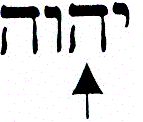
“Did you know that the Father’s name is revealed in the Son’s name? 72 times, the Father’s name (Yahuw) appears at the end of Hebrew names in the Tanakh. 27 times, the Father’s name (Yahuw) appears at the front of Hebrew names in the Tanakh. 72 + 27 = 99 But there is one name in the Tanakh, that has the Father’s name (Yahuw) IN THE MIDDLE OF THE NAME! And that one name represents the 100th sheep that has been lost, but will be found by our Shepherd!” By Maria Merola אריאל

 

Father’s Name Revealed in the Son’s name

By Maria Merola אריאל

( click link above to reach the writer )

For many years I had often wondered why I could not seem to find anything in the Tanakh (Old Testament) Scriptures relating to the parable that our Messiah told about the “one hundred sheep,” and the one that was lost (Matthew 18:12 & Luke 15:4).

However, on one fine day, I discovered that these “one hundred sheep” have been “hidden” from our eyes under Gentile names that were given to them by the English translators.

All along, the Heavenly Father knew who these “lost sheep” were, and they were not “lost” to him. They were only“lost” to their true identity as Yisraelites! 

In other words, they did not know who they were, because they did not know the name of their Heavenly Father.

Beloved, in these last days, the “lost sheep” are being discovered, and they are finding out who they really are! 
When these lost sheep from the Gentile nations begin to truly “know” the Heavenly Father (intimately), by his true“hidden name,” they will be found of him, and they will also come into their own true identity as “sons!”

I receive a lot of criticism, (even within the Hebraic Root’s Community), because I place an emphasis on using the correct name for our Heavenly Father and our Messiah. 

However, just so that you understand, I am not one who condemns people to the Lake of Fire for using the name “Jesus” or “Yeshua.” Neither do I condemn those who use Jehovah, Yehovah, or Yahweh for our Father’s name. 
I do believe that the Father is extending mercy for this season, (while people are trying to sift through all the confusion about his name). However, there will come a day when the Anti-Messiah will make it punishable by decapitation to use his true name. This is even stated in the Noahide Laws. See the links below to learn more:
Beware of the Noahide Laws

‘Yahweh’ not to be used in liturgy, songs and prayers, Cardinal Arinze says

When this happens, all counterfeit names for our Creator will be enforced by the beast, and people will have to choose whether to obey the Scriptures, (and face the death penalty); or to obey the Vatican Papal Beast by using vain empty titles for their generic gods.At that point, calling upon any counterfeit name (enforced by the beast), will mean that are worshiping, and obeying the beast.
To read more about how the Mark of the Beast will be implemented (to include decapitation) for using the true name of our Creator, see my other blog entitled: “The Hidden Character of Ha’Shem.”
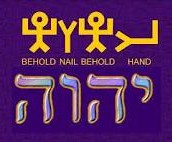
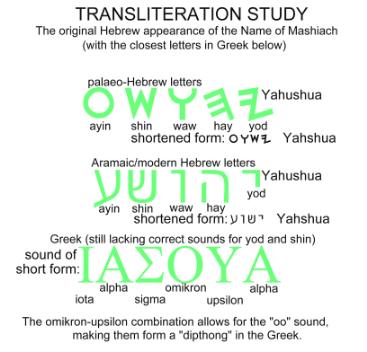
Our Messiah’s name is “Joshua” which is #3091 in the Strong’s Hebrew Concordance as “YeHoWshuwa” which is the modern rendering of this name. But in Ancient Hebrew it was “YaHuWshuwa” which means “YaHuWaH is salvation.”
So why do I make such a big deal about saying the Father’s name and the Son’s name correctly?
The real issue behind the name “Jesus” verses the true Hebrew name of our Messiah Yahuwshuwa is found in the story of Joseph and his lost brothers. When Pharaoh changed Joseph’s name to “Zaphnathpaaneah,” he became a savior to the Egyptians (Gentiles) because he saved them from a famine (Genesis 41:45). 
However, when his brothers came to buy grain, they did not recognize him under that name. When Joseph said to them “I am YaHuWceph” their eyes were opened to him (Genesis 45-3-4)!  

Our Heavenly Father’s name is “YaHuW,” and it is seen within 100 different names of Yisraelites in the Tanakh (Old Testament). This name “YaHuW” is embedded in Joseph’s name (see #3084 in the Hebrew Concordance), and it means “YaHuWaH shall increase.”
Joseph is a prophetic “type” of Messiah, and ten brothers (minus Benjamin), are symbolic of the Ten Northern Tribes of the “lost sheep” of the House of Ephrayim. These lost sheep were scattered to the four corners of the earth for their idolatry. 
When Joseph revealed the Father’s name (YaHuW) to them within his own name, their eyes were opened to him, and there was restored fellowship! 
Similarly, the lost sheep will not recognize their Messiah with the man-made name of “Jesus” or “Jehovah!” This is why YaHuWaH has revealed to me to call our Messiah by his real name which is “YaHuWshuwa” because it has the Father’s name in it! 
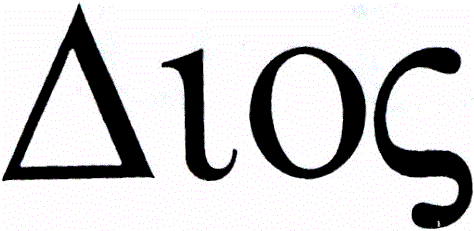
To learn more about the origin of the name “Jesus Christ” see my other blog entitled: “Does the Name “Jesus” Really Come from Zeus?”
Therefore, the Father is glorified in his Son! This is why in John 5:43 he said “I am come in my Father’s name.” He meant more than just his authority, because the Hebrew word for “name” (shem) means “a physical mark.” And so in order to bring the lost sheep home to their Messiah, we must use his real name which also reveals the Father’s name!
It is also important to note that the name “Zaphnathpaaneah” has a “double meaning” because Joseph was the one to inherit a “double portion” of his father Jacob’s blessing (Genesis 48:22) In Egyptian, the name “Zaphnathpaaneah” means “savior of the world,” but in Hebrew it means “a revealer of a secret!”
In these last days our Messiah is revealing his true name and his true identity to us so that we can be given our own true identity as Yisraelites!
See my other blog entitled: “My People Shall Know My Name!”

We are about to find these one hundred sheep in the in the Hebrew Old Testament aka“Tanakh,” by first finding out which ones the Heavenly Father has placed his own name. 
You are about to be blown away as  you discover that there are exactly 100 names in the Hebrew Tanakh (Old Testament) with the “Father’s name”embedded in them. We will first begin with all the names that have Father’s name at the end of their name.
The following charts are provided by this website:
http://www.yahushua.net/YAHUWAH/chapter_06.htm#72_Names_End_in_YAHU
The Name YaHuW (pronounced Yahu) appears 72 times at the end of names in the Hebrew Scriptures:

Strong’s #     Name Meaning Common Name
#29  Abiyahuw my Father is YaHuWaH Abijah
#138  Adoniyahuw my Master is YaHuWaH Adonijah
#223  Uriyahuw my flame is YaHuWaH Urijah
#274 Achazyahuw possession of YaHuWaH Ahaziah
#281 Achiyahuw my brother is YaHuWaH Ahijah
#452 Eliyahuw (my Elohiym is YaHuWaH Elijah
#558 Amatsyahuw strength of YaHuWaH Amaziah
#568 Amaryahuw promised of YaHuWaH Amariah
#683 Atsalyahuw reserved to YaHuWaH Azaliah
#1141 Benayahuw built up of YaHuWaH Benaiah
#1296 Berekyahuw kneel to YaHuWaH Berechiah
#1436 Gedalyahuw YaHuWaH is great Gedaliah
#1587 Gemaryahuw perfected by YaHuWaH Gemariah
#1735 Dodawahuw Love of YaHuWaH Dodavah
#1806 Delayahuw delivered by YaHuWaH Delaiah
#1936 Hodaywahuw majesty of YaHuWaH Hodevah
#2069 Zebadyahuw endurance of YaHuWaH Zebadiah
#2148 Zccharyahuw remembered by YaHuWaH Zechariah
#2396 Chizeqiyahuw my strength is YaHuWaH Hezekiah
#2518 Chiliqiyahuw my portion is YaHuWaH Hilkiah
#2608 Chananyahuw favored by YaHuWaH Hananiah
#2811 Chashabyahuw regarded by YaHuWaH Hashabiah
#2882 Tebalyahuw immersed by YaHuWaH Tebaliah
#2899 Towb Adoniyahuw pleasing to my Master YaHuW Tob-adonijah
#2900 Towbiyahuw my goodness is YaHuWaH Tobiah
#2970 Yaazanyahuw will be heard by YaHuWaH Jaazaniah
#2977 Yoshiyahuw my foundation is YaHuWaH Josiah
#3000 Yeberekyahuw kneeling to YaHuWaH Jebcrechiah
#3012 Yigdalyahuw magnified by YaHuWaH Igdaliah
#3153 Yezenyahuw adorned of YaHuWaH Jezaniah
#3165 Yechdiyahuw my unity is YaHuWaH Jehdeiah
#3169 Yechizqiyahuw my strength is YaHuWaH Hezekiah
#3203 Yekolyahuw YaHuWaH will enable Jecoliah
#3204 Yekonyahuw YaHuWaH will establish Jeconiah
#3269 Yaaziyahuw my boldness is YaHuWaH Jaaziah
#3404 Yeriyahuw taught by YaHuWaH Jeriah
#3414 Yirmeyahuw exalted of YaHuWaH Jeremiah
#3449 Yishiyahuw YaHuWaH will lend Ishiah, Isijahu
#3460 Yishmayahuw heard by YaHuWaH Ishmaiah
#3470 Yeshayahuw salvation of YaHuWaH Isaiah
#3562 Conanyahuw sustained by YaHuWaH Conaniah
#3659 Conyahuw stability by YaHuWaH Coniah
#3663 Kenanyahuw planted by YaHuWaH Chenaniah
#4321 Mikayahuw like YaHuWaH Michaiah
#4441 Malkiyahuw my king is YaHuWaH Malchiah
#4590 Maazyahuw rescue of YaHuWaH Maaziah
#4641 Maaseyahuw work of YaHuWaH Maaseiah
#4737 Miqncyahuw purchase of YaHuWaH Mikneiah
#4920 Meshelemyahuw repaid by YaHuWaH Meshelcmiah
#4983 Mattanyahuw present of YaHuWaH Mattaniah
#4993 Mattithyahuw gift of YaHuWaH Matthew
#5374 Neriyahuw my light is YaHuWaH Neriah
#5418 Nethanyahuw given by YaHuWaH Nethaniah
#5565 Semakyahuw supported by YaHuWaH Semachiah
#5662 Obadyahuw Servant of YaHuWaH Obadiah
#5718 Adayahuw continuing in YaHuWaH Adaiah
#5812 Azazyahuw (strength of YAHUWAH) Azaziah
#5818 Uzziyahuw my power is YaHuWaH Uzziah
#5838 Azaryahuw helped of YaHuWaH Azariah
#6271 Athalyahuw constrained by YaHuWaH Athaliah
#6305 Pedayahuw ransomed of YaHuWaH Pedaiah
#6410 Pelatyahuw delivered by YaHuWaH Pelatiah
#6667 Tsidekiyahuw YaHuWaH is righteous Zedekiah
#6846 Tsephanyahuw hidden by YaHuWaH Zephaniah
#6984 Qushayahuw entrapped of YaHuWaH Kushaiah
#7345 Rechabyahuw enlarged of YaHuWaH Rehabiah
#7425 Remalyahuw YaHuWaH has bedecked Remaliah
#7645 Shebanyahuw prospered by YaHuWaH Shebaniah
#7935 Shekanyahuw lodging of YaHuWaH Shecaniah
#8018 Shelemyahuw thank offering of YaHuWaH Shelemiah
#8098 Shemayahuw heard of YaHuWaH Shemaiali
#8114 Shemaryahuw hedged by YaHuWaH Shemariah
#8203 Shepharyahuw Oudged by YAHUWAH) Shephatiah
#8304 Serayahuw prevailed by YaHuWaH Seriah

The Name YaHuW versus YeHoW: The Great Talmudic Cover-Up
In the 10th Century a new grammatical rule was invented by the Hebrew Scribes called “the pre-tonal shortening rule.” This rule states that whenever the Father’s name (YaHuW) appears at the beginning of a name then it changes to “YeHoW.” But if it appears at the end of names then it can remain as “YaHuW.” Why was this done?
After the House of Judah (the Jewish people) came out of Babylonian Captivity, they were afraid that the Gentiles would take the sacred name of the Creator in vain, so they thought it was their duty to make the name of the Father against the law to pronounce. Here is what it says in the Talmud:
It is forbidden to read the glorious and terrible name as it is written, as the sages said “He that pronounces the name as it is written has no portion in the world to come.” Therefore it must be read as if it were written “Adonai,”—- (Mishnah Berurah 5:2).
Now we can begin to unravel the mystery behind how and why this “pre-tonal shortening rule” was invented. It was done so that the Creator’s name would not be pronounced as “YaHuW.” 

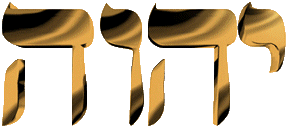
This is how we know that the name YeHoW (pronounced yay-ho) as seen in the name YeHoVaH or YeHoWaH is not the correct way to pronounce the Creator’s name.
In the original Hebrew Scriptures, names not only ended with “Yahuw,” but they also began with “Yahuw.” This was determined by comparing other languages like Arabic and Cuneiform.
Jehoahaz – An inscription of Tiglathpileser III records tribute being received from Iauhazi (mat) Ia-u-da-a.
‘Jehoahaz of Judah.’ —The Illustrated Bible Dictionary.
Jehoiachio—“In Babylon, Jehoiachin was treated as a royal hostage. He is named (Yau-kin) in Bab. tablets, dated 595 and 570 BC, as receiving rations at the court in company with his five sons.”—The Illustrated Bible Dictionary.
Jehonuthan—“The name occurs in Cuneiform records as Yahuw-natunnu.”—-Seventh-day Adventist BIBLE DICTIONARY.
Jehu—“Cuneiform Ia-u-a.” The New Brown-Driver-Briggs-Gesenius Hebrew English Lexicon. In Arabic, Jehu was pronounced “Yahuw.” See Hastings Dictionary of the Bible. All this evidence and more, suggest that “Yahuw” was used at the beginning of names, instead of the more Modern Jewish “Yehow” cover up of the set-apart name. Therefore, the 27 following names are restored to their original pronunciation.
27 Names in the Tanakh (Old Testament) Begin with YaHuW (Yahu)

Strong’s #     Name Meaning Common Name
#3057  Yahuwdiyah  a Jewess Jehudijah
#3058  Yahuw YaHuWaH is He Jehu
#3059  Yahuwachaz YaHuWaH seized Jehoahaz
#3060 Yahuwash YaHuWaH fired Jehoash
#3061 Yahuwd a name for Judea Jehud
#3063 Yahuwdah Praise YaHuWaH Genesis 29:35 Judah
#3064 Yahuwdiy a Jew, a descendant of Judah or Yahuwdah Jew
#3067 Yahuwdiyth Jewess-Jehudith, a Canaanitess Judith
#3068 YaHuWaH I AM THAT I AM Exodus 3:14 Jehovah
#3075 Yahuwzabad YaHuWaH-endowed Jehozabad
#3076 Yahuwchanan YaHuWaH-favored Jehohanan
#3077 Yahuwyada YaHuWaH-known Jehoiada
#3078 Yahuwyakin YaHuWaH-will establish Jehojakin
#3079 Yahuwyaqim YaHuWaH-will raise Jehoiakim
       
#3080 Yahuwyarib YaHuWaH-will contend Jehoiarib
#3081 Yahuwkal YaHuWaH-is able Jehucal
#3082 Yahuwnadab YaHuWaH-offers freely Jehonadab
#3083 Yahuwnathan YaHuWaH-given Jehonathan/Jonathan
#3084 Yahuwceph YaHuWaH-is adding Jehoceph/Joseph
#3085 Yahuwaddah YaHuWaH-adorned Jehoadah
#3086 Yahuwaddan YaHuWaH-pleased Jehoaddan
#3087 Yahuwtzadaq YaHuWaH-righteousness Jehozadak
#3088 Yahuwram YaHuWaH-raised Jehoram/Jerome
       
#3089 Yahuwsheba YaHuWaH-sworn Jehosheba
#3090 Yahuwshabath YaHuWaH has sworn Jehoshabeath
#3091 Yahuwshuwa YaHuWaH -Saviour Jehoshua/Joshua
#3092 Yahuwshaphat YaHuWAH -judged Jehoshaphat

The Father’s name is seen in the original Ancient Hebrew Scriptures only one time time with “Yahuw” in the middle as follows:
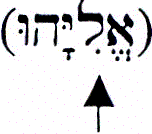
#454Elyhow`eynayel-ye-ho-ay-nah’ee; from 413 and 3068 and 5869; towards Jehovah (are) my eyes; Eljehoenai or Eljoenai, the name of seven Israelites:–Elihoenai, Elionai.
What is interesting is that this name Elyahuweynay means “My eyes are towards YaHuWaH.” Is it possible that the one lost sheep who our Messiah goes after is represented by the one who has the Father’s name hidden in the middle? And is it also possible that once their eyes are opened to his true name, their deafness and blindness will be healed?

Yisra’el has been deaf and blind to their maker and to their Messiah for more than two Millennia (Isaiah 29:18; 35:5; 43:8; Matthew 13:13-4; Acts 28:26). I believe that the name of the Father is the key to these lost sheep finding out who they really are. 
In totality, we can see the Creators name, YaHuW is in the original Hebrew scriptures as follows:
72 times at the end of names.
27 times at the beginning of names.
1 time in the middle of a name.

72 + 27 + 1 = 100!
Could it be that these two numbers in reverse (72 & 27) have to do with the Two Houses of Yisra’el? The 72 names would then represent the Ten Northern Tribes of the House of Ephrayim (who become the fullness of the Gentiles when they discover who they really are) and the smaller number would represent the Two Southern Tribes of the House of Yahuwdah (Judah). 
This would make sense, because it is the House of Yahuwdah (Judah or Jews) who changed the vowel points at the beginning of 27 names to YeHoW instead of YaHuW!
This reminds me of the parable of the “ninety-nine sheep” who are left so that Messiah can find that one who is lost:


Matthithyahuw (Matthew) 18:

11 For the Son of man is come to save that which was lost.
12 How think you? if a man have a hundred sheep, and one of them be gone astray, does he not leave the ninety and nine, and goes into the mountains, and seeks that which is gone astray?
13 And if so be that he find it, verily I say unto you, he rejoices more of that sheep, than of the ninety and nine which went not astray.
There are 100 names in the Tanakh (Old Testament) that contain our Heavenly Father’s name (YaHuW), and this represents the 100 sheep in this parable. But the one lost sheep is represented by the one name where the Father’s name appears in the middle of the name, and that one name is Elyahuw`eynay (Elihoenai). 
This name has been applied to seven different Yisraelites, and I believe this represents the seven congregations in the book of Revelation who have been grafted into the olive tree of Yisra’el.
So we have the 72 names of Yisraelites with “Yahuw” at the end, which I believe represents the Ten Northern Tribes of Ephrayim. But then we also have the 27 names that have the name “Yahuw” at the front of names, but the House of Yahuwdah (Judah) changed the vowel points to make it appear as “Yehow!”
This is why I believe that we can assimilate the 27 names to the Two Southern Tribes of the House of Judah. When we combine these two numbers, we get a total of 99 sheep! 

However, the one lost sheep is a picture of the one name of “Elyahuw`eynay” (Elihoenai),whose name has been applied to seven Yisraelites. This name of Elihoenai (#H454) is seen in the following passages: 1st Chronicles 3:23-24; 4:36; 7:8; 26:3; Ezra 8:4; 10:22 &27; Nehemiah 12:41.

In 1st Chronicles 26:3, Elyahuw`eynay (Elihoenai) is the seventh son of Meshelemyahuw who was a gatekeeper and his sons also were gatekeepers of the Tabernacle of Dawiyd. 
In Ezra 8:4, Elyahuw`eynay was among those who returned to Jerusalem out of the Babylonian Captivity. 
In Ezra 10:22 & 27, Elyahuw`eynay (Elihoenai) was among those who divorced their heathen wives who caused them to sin against YaHuWaH. In Nehemiah 12:41 Elyahuw`eynay (Elihoenai) was the name of a priest who blew trumpets in the House of Elohiym.

I believe that this name Elyahuw`eynay (Elihoenai) can possibly represent the seven assemblies in the book of Revelation who were former Gentiles, but through the blood covenant of Messiah, Yahuwshuwa, they were grafted into the House of Yisra’el.
There are also some other prophetic pictures that we can see about these numbers. You can add up the numbers as follows:

7 + 2 = 9  for 9 gifts of the Spirit in 1st Corinthians 12:4-11.
2 + 7 = 9 for 9 fruits of the Spirit in Galatians 5:22.

The 9 gifts of the spirit are usually emphasized by the larger group (72) because the House of Ephrayim (Christian Church) tends to emphasize the gifts of the spirit (manifestations) more than the fruit of the spirit. 

But the 9 fruit of the spirit is usually more apparent among the smaller group (27) for the House of Judah, for this group tends to emphasize “good deeds” more than manifestations. Obviously both elements are needed to have balance. We need to have fruit (deeds) and also gifts of the spirit in operation which is the evidence of the presence of YaHuWaH.

The #7 in scripture usually applies to the seven covenants evidenced by the seven colors of the rainbow. It also represents the seven-branch menorah, and the seven spirits of YaHuWaH in Isaiah 11:1-2; Revelation 4:5 & 5:6. There are also seven congregations in the book of Revelation and seven continents of the world (nations). 
The larger group represented by the #72 could mean that they (the seven congregations) will join themselves in the last days to the Two Southern Tribes of Judah as seen in Zechariah 8:23. 
The larger group represented by the #72 has the name of the Father at the “end of names” which could mean that they are the “last born” or the youngest, just like the younger brother in the story of the prodigal son in Luke 15. 

But the smaller group represented by the #27 (Judah), has the Father’s name at the front of names, but they disguised it with different vowel points. Judah was “born first” to Jacob, but in the last days, Ephrayim represented by the #72 (the larger group) are called “my firstborn” (Jeremiah 31:9).

In these last days, those of us who have an emphasis on the sacred name, are beginning to restore the correct vowel points to the Father’s name at the front of names as well as at the end of names. 
This could symbolize the “double portion blessing” of Yahuwceph (Joseph), for he is a type of Messiah who inherits both Houses of Yisra’el, the first and the last, the beginning and the ending. 
Yahuwshuwa came to represent both houses, and this is why he referred to himself in Revelation 1:8 as“The Aleph and Taw, (Alpha & Omega), the beginning and the ending.” 
Those who restore the Father’s name at the end of names as well as at the beginning of names represent the ones who inherit the double portion! 

In other words, they are the 27 + 72 = 99! The double portion blessing includes 9 fruits of the spirit as well as 9 gifts of the spirit!

To learn more details about the name of our Creator, see my other article entitled: “The Covenant Name of Salvation Revealed.”
instant PDF pls click here

Or COPY the PDF link below, and paste it on your browser

https://perfectgiftorg.com/wp-content/uploads/2019/07/7-14-2019-PDF-Revelation-of-YAHUWAH-Aloahiym’s-Light-in-Motion.pdf

Prayer

Father, all praise be to You, the Eternal YAHUWAH Aloahiym Aleph Tau, our Creator Father, and Yahushua, our Messiah Aloahiym Aleph Tau, one with the Father [John 10:30], Who has us kept us alive, sustained us, and enabled us to reach this moment in your plan for all of the eternity. Father, we know that our entire existence is a function of you alone, and that our salvation is only through Yahushua [Rev 5: 12-13], and that your love of us preceded our love for you [1 John 4:19]. We only have an existence, sustenance, and prosperity because of your love for us and your pleasure, and for no other reason [Rev 4:11]. Without an existence, we cannot give you the praise and thanks that you so richly deserve, and that is rightfully Yours. YAHUWAH, you inhabit the praises of your people, Israel [Psalm 22:3], and not our complaints [Phil 2: 14; James 3: 14-18]. We thank you, Father, for bringing forth all believers in you and of You to read this article, whereby you have revealed yourself to each and every one of us during our tenure here on the earth, to serve your purposes, and whereby the brilliance of your magnificent Light is tangibly apparent, and glowing in, around, and through each one of us [Psalm 91:1; Matt 6:22]. Even though we all have walked in times past in the darkness of Satan, according to the ways and course of this world, [Eph 2: 2], You have redeemed us for Your purposes, enabling us to witness and perceive who You are in us, and who we are in You, even allowing us to perceive the origin of our core existence (our respective spirits) as being of you (your divine Light)[1 John 1:5], and literally having our spirits with you in Shamayim [Eph 2:6] as joint heirs with Yahushua, the one and only Messiah [Rom 8:17; John 14:6], so as to accomplish Your perfect will (YAHUWAH’S Perfect Will = YAHUWAH’S pure, perfect divine Light) in and for each one of us [Eph 2:10]. You and you alone provide us with what we are in need of [Phil 4:19], and what we desire [Psalm 23:1]. Father, we ask that you Baruch each and every reader of this article by consuming our respective spirits, souls, and bodies, and manifesting your perfect, divine Light tangibly and recognizably as coming only from You as the sole, exclusive and Sovereign source [Isa 43:11, 15; 44:6; others], such that each person receive, ponder, and decisively act on this message as you have delivered it to me, and that each reader hereof would clearly and tangibly experience the explosion of your perfect, divine Light as the Perfect Gift of James 1:17 (active motion/movement = demonstration of power of the Ruach ha Qodesh), according to Your perfect will for each of us, in the manner in which you have revealed it here. We thank you, Father, for answered prayer. Amein. Shalom,

Eyd and Yahn EL Stephenson

http://www.perfectgiftorg.com/links

http://www.perfectgiftorg.com/register

Ascribe Greatness to our Elohim

By B. Earl Allen

I will publish the name of YAHUWAH: ascribe you greatness unto our Elohim.
Deuteronomy 32:3


YAHUWAH gave the word: great was the company of those that published it. 
Psalm 68:11


INTRODUCTION

Since all doctrine or religious beliefs ought to be sustained by Sola Scriptura (by scripture alone), the unique focus of this publication is to weigh the evidence and prove each point of the set-apart name from the Scriptures alone. The topic of the set-apart name has not been exempt from those being overly zealous about tradition for proof of the exact pronunciation.
This publication takes into consideration all of Scripture upon the subject, the original and exact pronunciation is attainable (Deut. 29:29), as the Lawgiver Himself declared from Mt. Sinai. Not taking what is on the surface of several Bibles, but sinking the shaft deep into the mine of truth, comparing Scriptural names, translations, also considering historical evidences, putting them in their proper setting, allowing Scripture to reign paramount.
This book also touches on the importance of the set-apart name, and also the example set forth by our Saviour, how He reverenced His Father’s name. He certainly was not ashamed of it, as many seem to be. Nor did He over use it, but by His life and example sought to bring honour to it.
The object of this publication is to show the part that the set-apart name plays in the great controversy between truth and error; exposing the counterfeit which is promoted by principalities, powers, and academics in high places. It is also to help guide the pilgrim on his journey to the Promise Land and to the honour of Him who loved us, and gave Himself for us.
B. Earl Allen
Chapter One/ Index

Chapter 1

The Set-Apart Name in the Three Angels Message

The first angel’s message is, “Fear Elohim, and give honour to Him; for the hour of His judgment is come: and worship Him that made heaven and earth, and the sea, and the fountains of waters.” Revelation 14:7

Some think that preaching the importance of keeping the seventh day Sabbath is the Three Angels Message. Yes, it definitely includes the Sabbath, but there is more involved. There are principles laid out in this message. “Fear Elohim” implies that many are not fearing enough to obey Him; this further implies all points of Scripture that the Creator has given us to obey.

Let’s use the seventh day Sabbath as an illustration. If man decides to sprinkle holy water on a day other than the seventh day Sabbath, and tries to say that it’s holy, which he has not the power to do, but might think he does; then if men honour this man made holy day, are they fearing Elohim? Of course not! This would be the fear of man, thus obeying because man might require it of you, even to the point of making it a law of the land. All of the afore-said about a man made holy day applies to Sunday keeping. Does it give honour to Elohim to observe a man made sabbath? No! Obedience is the highest form of worship! So if we obey a man made law, is this worship toward the Creator? Again a resounding “No!” Yet, this is what almost the whole Christian community is doing! Sunday is a day that man has set aside for worship, yet there is no Scriptural decree to make it a weekly sabbath. “Fear Elohim” means to tremble at His Word (see Isaiah 66:2).

In His Word there is a commandment that our Creator has given, “Remember the Sabbath day to keep it set-apart. Six days shall thou labour, and do all thy work: but the seventh day is the Sabbath of YAHUWAH thy Elohim.” Exodus 20:8-10

The principle of the Three Angels Message is this: Fearing Elohim means to get back to and obey the original, as given by the Creator Himself; and put away the man made commandments and doctrines.

The Sabbath is part of the Three Angels Message, and a major part; but the Three Angels Message includes the whole law.

The same principles apply to the observance of Christmas. No where in Scripture is there a statute requiring us to set aside December 25, as a day to honour the birth of our Saviour! To the contrary, Paul said, “ye do show the Sovereign’s death till He come.” I Cor. 11 26; not His birth till He come. It is in the hearts of millions to honour this papal holiday, while the holidays of our Creator are despised. But if we truly fear Elohim, we should obey His statutes, one which states: “Three times thou shalt keep a feast unto Me in the year.” Exodus 23:14. But do we really tremble at His Word? Or, do we fear man, and what he might think of us if we actually started obeying the Creator.

The principle is obeying the original commands given from our Creator, and putting away the man made statutes, that go contrary to His Word.

This principle also applies to the set-apart name. Our Creator has given the original set-apart name for us to reverence. He spoke it with His own mouth from Mount Sinai when He spoke the ten commandments. The whole assembly heard it. That name is the original! But through language and culture and time man has thought to change the original pronunciation. Therefore we need to discover the original, so we can get back to it, and put away the man made names for the Creator.

Really, if man makes up the name for the Creator, it is not much different from what the heathen used to do! The heathen would make up their god, and give it a name, and start worshipping it. In reality, making up a name for the Creator is not much different, it’s an attempt to create the Creator.

Is it the fear of Elohim to give Him a name? Yea, it is the fear of Elohim to honour the name that He has given. Let’s let Elohim be Elohim.

Part of fearing Elohim is to fear His name, as the Scripture says, “unite my heart to fear Thy name.” Psalm 86:11

“Then they that feared YAHUWAH spake often one to another: and YAHUWAH hearkened, and heard it, and a book of remembrance was written before Him for them that feared YAHUWAH, and that thought upon His name.” Malachi 3:16

Let’s give honour to Him also! “Not unto us, O YAHUWAH, not unto us, but unto Thy name give honour, for Thy mercy, and for Thy truth’s sake.” Psalm 115:1

“I will praise thee, O Sovereign my Elohim, with all my heart: and I will honour Thy name for evermore.” Psalm 86:12

“Who shall not fear thee, O YAHUWAH, and honour thy name? for Thou alone art set-apart: for all nations shall come and worship before Thee; for Thy judgments are made manifest.” Revelation 15:4

The question is, will we fear Him now, while there is probation time? Or, will we fear Him only when it’s too late?

Because the first angel’s message is not received, which is a message of truth, it is then that the second angel must sound, warning, “Babylon is fallen, is fallen, that great city, because she made all nations drink of the wine of the wrath of her fornication.” Revelation 14:8. This gives additional force to the first message, because it is an expose’ of man-made errors.

The third angel presses the same truth even further, declaring, “If any man worship (obey) the beast and his image, and receive his mark in his forehead, or in his hand, the same shall drink of the wine of the wrath of Elohim, which is poured out without mixture into the cup of His indignation; and he shall be tormented with fire and brimstone in the presence of the set-apart angels, and in the presence of the Lamb: and the smoke of their torment ascendeth up for ever and ever: and they have no rest day nor night, who worship the beast and his image, and whosoever receiveth the print of his name.” Revelation 14:11 Tyndale Bible

Ultimately, it is the rejection of truth that souls end up lost. If souls heeded the first message “Fear Elohim”, and worship (obey) Him, no one would have to be warned about worshipping the beast and his image. Paul stated; “all deceivableness of unrighteousness in them that perish; because they receive not the love of the truth, that they might be saved.” Paul continues, “and for this cause Elohim shall send them strong delusion, that they should believe a lie (something that is not the original): that they might be damned who believe not the truth, but had pleasure in unrighteousness.” II Thessalonians 2:10-12

“Give unto YAHUWAH the honour due unto His name; worship YAHUWAH in the beauty of being set-apart.” Ps. 29:2

“I am YAHUWAH: that is My name: My splendour will I not give to another, neither My praise to graven images.” (inventions of man) Isaiah 42:8

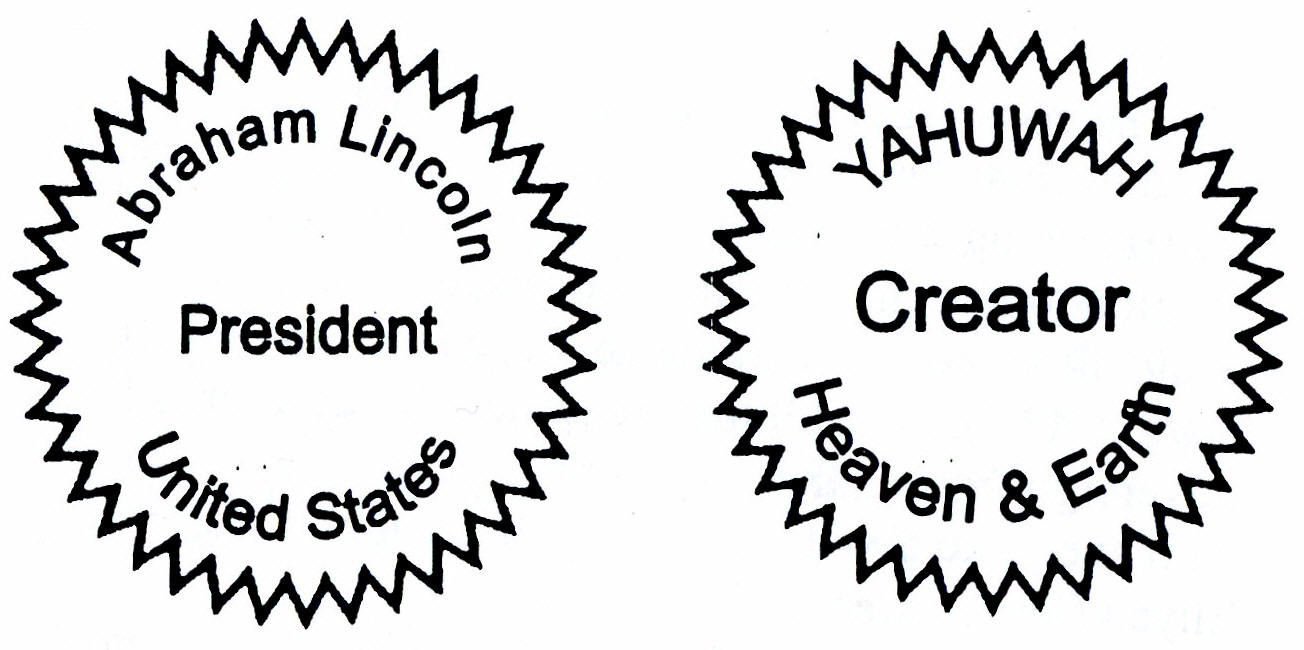
The fourth commandment contains the great seal. Compare the presidential seal below:

The Seal

A seal always contains the Name, Title and Jurisdiction.

Anciently, on the 10th day of the seventh month, the Hebrews faithfully observed the great Day of Atonement, which is a type of the great work of Judgment in the heavenly set-apart place, before tabernacling with YAHUSHUA forever. Anciently, on this day, after the ceremonies were completed, the high priest would proclaim the set-apart name, and pronounce a blessing upon the congregation; a type of what YAHUSHUA our heavenly high priest is doing. “I have declared unto them thy name, And will declare it: that the love wherewith thou hast loved Me may be in them, and I in them.” John 17:26.

When a bride is in the sealing of a marriage covenant, she takes on her husband’s name.

“They shall put My name upon the children of Israel and I will bless them.” Numbers 6:27

Chapter 2 / Index

Chapter 2

The Jewish Cover Up:
“Don’t Mention the Set-Apart Name!”

The conspiracy to cover up the set-apart name goes way back, even as far back as the days of Eliyah. The religious leaders thought that they would get along better with religiondom around them if they used a common title they could all agree on; Baal means Lord (see Hosea 2:16 margin KJV). After all, they reasoned the Creator is Lord or Sovereign; by this they could be in ecumenical harmony with everyone about them. Eliyah thought differently. To Eliyah truth mattered.

Even as far back as 787 B.C.E, Amos tried to show the children of Israel the folly of their reasoning about not mentioning the set-apart name. . . “Hold thy tongue: for we may not make mention of the name of YAHUWAH.” Amos 6:10.

When the Jews were carried into Babylon 606 B.C.E, many of the personal names had the element “yahu”, thus came the slanderous term “yahoo” for folk who seemed uncivilized like those barbaric beard-wearing Ju’s or Jews (Interesting to note, in the 1611 KJV is a word spelled “Iurie“, the modern KJV has “Jewry”, and Matthew is really Matithyahu).

Perhaps they meant well in covering up the name, because they were afraid the Babylonians might desecrate the set-apart name by using it in a profane way. This might seem like good logic at first, but the Jews went into captivity because they were not concerned with the name to begin with. The prophet Jeremiah rebuked the Jews about the time of the Babylonian captivity, for trying to cause the people to forget His name.

“How long shall this be in the heart of the prophets that prophecy lies? Yea, they are prophets (or preachers) of the deceit of their own heart; which think to cause My people to forget My name by their dreams which they tell every man to his neighbor, as their fathers have forgotten My name for Baal.” Jeremiah 23:26, 27

Satan and his evil angels hate hearing the set-apart name being praised and exalted. It has been his constant effort to remove the name, through culture and time, and slip in titles, that he might direct the worship to himself. “In Egypt, for example, the concept of the ‘concealed Name’ was extremely common.” The Encyclopedia of Occultism & Parapsychology

“In Gnostic thought, the concrete is resolved into the abstract. Personal names are replaced by terms of philosophy; mythological figures are changed into qualities and attributes and events into cosmic processes. [Hence, the personal name (YAHUWAH) becomes the attribute ‘Lord’.] In many religions the god represents a thing such as Aeolus, as personification of the wind. [Hence the personal name Lucifer becomes a thing ‘morning star’.]” (quoted in New Age Bible Versions)1

“In this New Age ‘name game’, new versions have substituted ‘titles’ which transport the reader to a list of Satan’s latest poison pen names.” New Age Bible Versions p. 14

The prophets of old wrote more about the last days than their own time. For they saw the big picture, that the things they were experiencing were only a foreshadow of the end times, or types for the last days (I Cor 10:11); thus Jeremiah was mostly talking about the end time preachers who cause the people to forget His name for Lord.

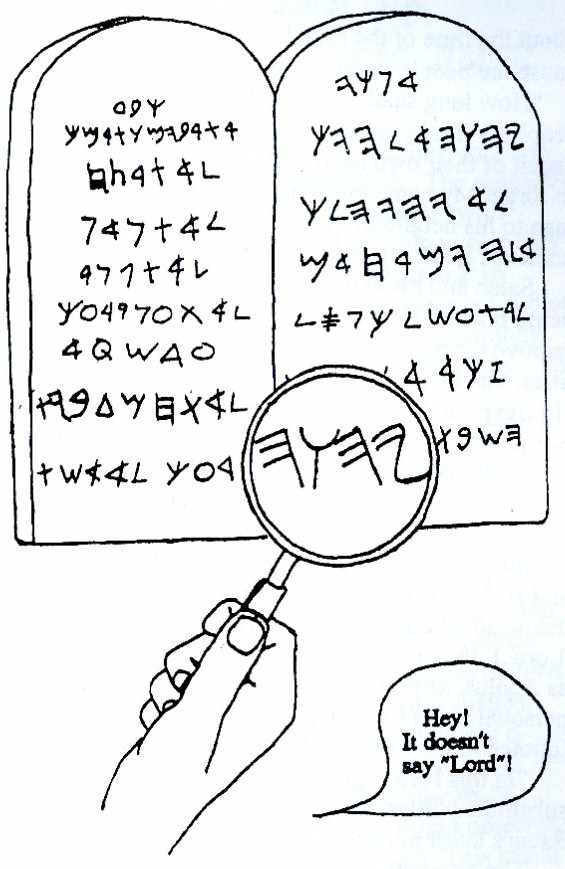
The Tablets

Baruch, the scribe of Jeremiah, wrote (mostly for the last days): “I will scatter them. For I knew that they would not hear Me: because it is a stiff-necked people: but in the land of their captivity they shall remember themselves, and shall know that I am YAHUWAH their Elohim: For I give them an heart, and ears to hear. And they shall praise Me in the land of their captivities, and think upon My name. “And for this cause Thou hast put Thy fear in our hearts, to the intent that we should call upon Thy name, and praise Thee in our captivity.” Baruch 2:29-32; 3:7 (KJV Apocrypha)

In the Messiah’s time, the Jews were still in this mode of not mentioning the Creator’s name. YAHUSHUA had constant controversy with the religious leaders and tried to show them that their traditions caused them to break the commandments.

One example of our Saviour uttering His Father’s name, was when He got up to read the scroll in the synagogue on Sabbath. He read from the prophet Isaiah. When He read the portion He bypassed all Jewish tradition and simply read the Scriptures just as they read. When He came to the tetragrammaton, He did not say “Adonai” or “Lord”, but simply spoke His Father’s name.

“The Spirit of YAHUWAH is upon Me, because He hath anointed Me to preach the good news to the poor; He hath sent Me to heal the brokenhearted, to preach deliverance to the captives, and recovering of sight to the blind, to set at liberty them that are bruised. To preach the acceptable year of YAHUWAH.” Luke 4:18, 19 (quoting from Isaiah 61:1, 2)

“And He closed the book, and He gave it again to the minister, and sat down. And the eyes of all them that were in the synagogue were fastened on Him.” Luke 4:20

Did He realize what He had just done? He transgressed the tradition of the elders. The Jews considered it blaspheme to speak the set-apart name, and thus the punishment of Lev. 24:16. The common people didn’t mind too much at first, they did think it was a bit brave of Him. But the synagogue leaders instigated things and ended up attempting to throw this radical Jew off the edge of the cliff for blaspheming and uttering the set-apart name, lest a plague should break out and everyone start mentioning the name.

Another place YAHUSHUA mentioned the name is in Matthew 22:44, quoting from Psalm 110:1; this is indicated in the English text by putting all capital letters “LORD”. This leads us to ask, “How many other times did He mention His Father’s name when quoting from the Old Testament?” Obviously every time! He was a “user of the true name” in His day. I’m sure He didn’t over use it, to the point of being obnoxious.

It is Scriptural to mention and praise the name of YAHUWAH, “by Thee only will we make mention of Thy name.” Isaiah 26:13

Another example of the Jews avoiding the name is in Mark 14, where YAHUSHUA is brought in before the high priest at His trial. The high priest asked, “Art thou the Messiah, the Son of the Blessed?” When he said “Blessed” it was to avoid the name. What was YAHUSHUA’s reply? The English says “I am”, but the Greek is the same as the Septuagint for Ex. 3:14, THE BEING. But YAHUSHUA was speaking Hebrew to the high priest and possibly said the set-apart name, at least the translation. It was as if YAHUSHUA corrected the high priest and said, “you mean YAHUWAH”.

But the response of the high priest gives it away also.

“Then the high priest rent his clothes, and said. What need we any further witnesses? Ye have heard the blasphemy: what think ye? And they all condemned Him to be guilty of death.” Mark 14:63-64

What was the counsel of Moses? “Because I will publish the name of YAHUWAH: ascribe ye greatness to our Elohim.” Deuteronomy 32:3

Martin Luther made a profound comment concerning this issue. “They [the Jews] now allege the name Yehovah to be unpronounceable; they do not know what they are talking about… If it can be written with pen and ink, why should it not be spoken, which is much better than being written with pen and ink.”

The name Yehovah came about as a result of an attempt, by the Jews, to cover up the set-apart name. Example: When a reader, in the King James Version, comes to “LORD God”, the Hebrew words and vowel points are “Yehowah Elohim”. But, instead of a Jewish person speaking the set-apart name, the scribes put vowel marks on the tetragrammaton to indicate for the reader, to say “Adonai Elohim”. But when a reader in the KJV comes across “Lord GOD” (as in Ezek. 33:27), in Hebrew is “Adonai Yehowih”, because in this instance the tetragrammaton has the vowel points of Elohim. Otherwise the Jewish reader would say “Adonai Adonai” [twice], so to avoid this, they vowel pointed it to indicate to the reader to say, “Adonai Elohim”. You will notice that the vowel marks on the Tetragrammaton in Ezek. 33:27 differ from the vowel marks used in Exodus 9:1.

Peter Galatin simply read the Hebrew as it was, without the special instruction to say Adonai. Thus, he must have thought he came upon a new revelation of how to pronounce the set-apart name. The message of Eliyah was to restore the set-apart name to its proper use.


Reference

1) The Encyclopedia of Religion & Ethics ed. James Hastings p. 223

Chapter 3/ Index

Chapter 3

The Elijah Message

What is the Elijah message? The Messiah said that “Eliyah truly shall first come and restore all things.” Mt. 17:11. Restore what things? Those things that have been forgotten! The prophet Malachi gives us some insights: “Behold, I will send you Eliyah the prophet before the coming of the great and dreadful day of YAHUWAH.” Malachi 4:5. As YAHUWAH’s mouth piece, what shall he come saying? “Remember ye the law of Mosheh My servant, which I commanded him in Horeb for all Israel, with the statutes and the judgments.” Malachi 4:4

“Repent ye therefore, and be converted, that your sins may be blotted out, when the times of refreshing shall come from the presence of YAHUWAH; and he shall send YAHUSHUA the Messiah, which before was preached unto you: whom the heavens must receive until the times of restitution of all things, which Elohim hath spoken by the mouth of all His set-apart prophets since the world began.” Acts 3:19-21

Not only does this include the seventh day Sabbath, but also the appointed festivals. Marriage is a heavenly institution; the land sabbaths, yea, all the statutes. Animal offerings are not listed in the statutes given from Mt. Sinai. The statutes are listed in Exodus 21-23 and repeated in Deuteronomy chapters 12 through 26.

Another thing that Eliyah is said to accomplish, is that he would “turn the heart of the fathers to the children, and the heart of the children to their fathers, lest I come and smite the earth with a curse.” Malachi 4:6

Not only does this apply to family relationships, but it also applies to our spiritual forefathers, like the reformers, who were bringing us step by step out of Babylon. How many hearts despise early American reformers who were real pioneers in the Scriptures (this is not the work of Eliyah). On the other hand, many have been turned off because those who pretend to uphold the reformers and pioneers, refuse to walk in advancing truth, using the reformers and pioneers as an excuse for not walking in further light. Evidently they have become comfortable with playing the game of church, nor can they appreciate the work the reformers and pioneers accomplished. If it were not for them, we would not be enjoying the blessings of the Sabbath truth and other truths, along with great reference works like Strong’s Concordance. We would have found ourselves as those in the Dark Ages without truth. Since that state of affairs, truth has been progressive.

“They that shall be of thee shall build the old waste places: thou shall raise up the foundations of many generations; and thou shalt be called, The repairer of the breach, The restorer of paths to dwell in.” Isaiah 58:12. We should understand more than the reformers and pioneers, because we should be building on the truths that we received from them as a blessed inheritance, instead of trying to abolish their works and trying to start over.

Not only does this apply to them, but to the Reformers who brought us out of the Dark Ages. They were witnesses to Catholicism’s abusive nature and terrible abominations. YAHUWAH did not reveal all His truths to them, but gave them enough truth to call them out from her.

The hearts of the forefathers were toward us! “YAHUWAH having provided some better thing for us, that they without us should not be made perfect.” Hebrews 11:40. They did their best to preserve the truths they did have, so that we would not be deceived by that false system of Satan.

This principle goes back even further to Columba, Patrick, Paul, Peter, John, the other apostles as well; even back to “father Abraham”, Shem, Noah, and yes Adam. Abraham observed the appointed times, even the Feast of Unleavened Bread, as Scripture bares out that YAHUWAH came and communed with Abraham (Gen. 12:1-3) at this appointed time, and “four hundred and thirty years (later), even to the selfsame day, it came to pass, that all the hosts of YAHUWAH went out of the land of Egypt.” Exodus 12:41 (see also Galatians 3:17).

This is no surprise, of course, for Scripture states; “Abraham obeyed My voice, and kept My charge, My commandments, My statutes, and My laws.” Gen. 26:5

What other message might Eliyah bring?

Remember how the children of Israel were tricked by their religious leaders into thinking Baal could send rain? Baal means “Lord” (see Hosea 2:16 margin). The religious leaders reasoned that they could have more influence with other nations around them if they mingled among them and used a common title they could all agree on. In this way, everyone could be in ecumenical harmony. The result, of course, was that the heathen converted them to their ways. But Eliyah believed that the Israelites needed to get back to calling the Creator by His name, the name that He had addressed Himself on Mt. Sinai, when He spoke the Ten Commandments. Thus, the idea came to him that there should be a confrontation on Mt. Carmel. The story is called “The Set-Apart Name Showdown.” Where Elijahu (I Kings 17:1 margin KJV) confronted the Israelites with a question, “How long halt ye between two opinions? if YAHUWAH be Elohim, follow Him: but if the Baal, then follow him.” And the people answered him not a word. I Kings 18:21. You know the story, when fire came down and consumed the wet sacrifice they acknowledged, “YAHUWAH, He is the Elohim; YAHUWAH, He is haElohim.”

This story applies, with great force, to our time as well, when Sabbath keepers want to use man made terminology for the Creator, so that they can blend well with other Christians who observe Sunday (a man made holy day). How long will ye halt between two thoughts: if YAHUWAH be Elohim serve Him, but if the Lord, serve him. “Fear YAHUWAH, and give honour to Him; for the hour of His judgment is come: and worship Him that made heaven, and earth, and the sea, and the fountains of water.” Revelation 14:7

The set-apart name is given for the purpose of distinguishing the Creator from other deities. The issue is TRUTH versus man made religion.

“Then they that feared YAHUWAH spake often one to another: and YAHUWAH hearkened, and heard it, and a book of remembrance was written before Him for them that feared YAHUWAH, and that thought upon His name. And they shall be Mine saith YAHUWAH of hosts, in that day when I make up My jewels; and I will spare them, as a man spareth his own son that serveth him. Then shall ye return, and discern between the righteous and the wicked, between him that serveth Elohim and him that serveth Him not.” Malachi 3:16-18

Chapter 4 / Index

Chapter 4

The 144,000
The Wise Virgins with Oil

We are told in the parable of the Ten Virgins, that “the foolish virgins took their lamps and took no oil with them: but the wise virgins took oil in their vessels with their lamps” Matthew 25:3, 4. What is the lamp? “Thy Word is a lamp unto my feet and a light unto my path.” Psalm 119:105. What is the oil? “My Spirit, saith YAHUWAH of hosts.” Zech. 4:6. “Oil for the light.” Ex. 25:6; 27:20 etc.

When we store up the Word in our vessels, the Set-Apart Spirit can bring all these things to our remembrance (John 14:26) and help us rightly divide the Word of Truth, and give us favour in the right path. Then when it comes to investigating a new topic, we should already be acquainted with certain passages that help us grasp the subject, having a goodly background.

“Thy name is as oil poured forth, therefore do the virgins love you.” Song of Solomon 1:3 [Shemen is translated “oil” about 164 times and “ointments about 13 times, compare also Isaiah 1:6 margin]

The 144,000 are called “virgins” because they have the unadulterated doctrine, the pure faith. We can glean a few of their characteristics from Revelation 14 and thus seek to be in that number. They definitely love the set-apart name, and understand it’s importance, for it is “in their foreheads.” John saw them on Mt. Zion, not the Mt. Zion on this earth, but the real Mt. Zion in heaven, because Scripture states they “were redeemed from the earth.” Revelation 14:3. This Mt. Zion in heaven is the same which Lucifer said, “I will exalt my throne above the stars of EL: I will sit also upon the mount of the congregation, in the sides of the north.” Isaiah 14:13

The Law (the third commandment being nailed)

“…set-apart and reverend is His Name.” Psalm 111:9

“The works of His hands are verity and judgment; all His commandments are sure. They stand fast forever and ever, and are done in truth and uprightness.” Psalm 111:7-8

“And in their mouth was found no guile: for they are without fault before the throne of Elohim.” Rev. 14:5 In other words, TRUTH was in their mouth. Their lives were the life of truth, because the Father’s character (His law) is in their minds, they received a seal to that effect, thus on their crowns, as John saw, was written, (Set-Apart to YHWH). In other words, because it was first “in” their foreheads, later they are blessed with privilege of wearing it on their crown where the name is then “on” their foreheads.

One thing for certain, these wise virgins were not incensed or bothered nor irritated by a name study. Nor are they irritated by brothers and sisters praising, and exalting, much less mentioning or singing the Father’s name, for that name is like music to their ears.

These are they which were not defiled with women.” Revelation 14:4. A woman is symbolic of a church, a pure church as in Jer. 6:2 or a corrupt church (Rev. 17:5) and her daughters. The 144,000 are not defiled with the various polluted churches and their errors; these follow the Lamb whithersoever He goeth. These do not look at the Bible through their denominational glasses, but instead, go by Sola Scriptura, letting Scripture be its own interpreter.

Ezra saw this same group of people that John saw. “I Esdras (Greek for Ezra) saw upon mount Zion a great people, whom I could not number, and they all praised YAHUWAH with songs. And in the midst of them there was a young man of a high stature, taller than all the rest, and upon every one of their heads He set crowns, and was more exalted, which I marveled at greatly. So I asked the angel, and said, “Sir, what are these?” He answered, and said unto me, “These be they that have put off the mortal clothing, and put on the immortal, and have confessed the Name of YAHUWAH: now are they crowned, and receive palms.” (II Esdras 2:42-45)

continuing in verse 46:

Then said I unto the angel, “What young person is it that crowneth them, and giveth them palms in their hands?” So he answered, and said unto me, “It is the Son of El, whom they have confessed in the world.” Then began I greatly to commend them, that stood so stiffly for the name of YAHUWAH.” (II Esdras 2:46-47). This book, II Esdras, is missing from the Catholic Bible; their II Esdras is actually the book of Nehemiah.

From both accounts of John and Ezra, we see how the set-apart name was important to this blessed group of people. To them, knowing the set-apart name was not frivolous, unimportant, useless or vain. Nor did it side track them from Sabbath observance; as a matter of fact, it helped them to actually keep the day set-apart, since the Sabbath is to be kept in honour of His set-apart name. We are told in Exodus 23 how to keep the Sabbath set-apart: “And in all things that I have said unto you be circumspect: and make no mention of the name of other elohim, neither let it be heard out of thy mouth.” Ex. 23:13

“A good name is better than precious oil.” Eccl. 7:1

“There is treasure to be desired and oil in the dwelling of the wise.” Proverbs 21:20

Chapter 5 / Index

Chapter 5

FOUR VOWELS?

Josephus the Jewish historian wrote that the set-apart name consisted of “four vowels” (Jewish Wars, 5. 5. 7.). Why did Josephus write this? Please consider the following thoughts.

Remember, Josephus was writing to a Greek audience! He first wrote his history [at least his notes] in Hebrew Aramaic (Antiquities 12.5. 1-4 footnotes; Against Apion 1. 9). After the Jewish/Roman war, he had time, and with long perseverance, he mastered the Greek language, and compiled his history in Koine Greek, which was the international language of the world at that time. Though it was the international language, do not think it was the every day language in Israel, for it was not!

Josephus frequently altered Hebrew names, spelling them after the fashion of the Greeks, “to please [his Greek] readers” (Antiquities 1. 5. 1.). Josephus describes the head-gear worn by the Levitical priest:

“Of this was a crown made, as far from the hinder part of the head to each of the temples; but this … did not cover the forehead, but it was covered by a golden plate, which had inscribed upon it the Name of (Elohim) in SET-APART CHARACTERS.” (Antiquities 3. 7. 6. set-apart title and emphasis added).

The term HOLY CHARACTERS, means not just Hebrew letters, but the ancient Hebrew, known as Paleo-Hebrew, used in the time of Moses, and David.

Anciently, even the Greek language, like the Hebrew, was written from right to left. Also, the ancient Greek letters were similar to Paleo Hebrew. Therefore, the ancient Greek would have written the set-apart name very similar to the ancient Hebrew, which appeared like this: YHWH. The Modern Greek equivalent would be written IHYH, and understood as IEUE. But do not think that this, in any wise, proves the pronunciation of the set-apart name. Josephus was writing to the Greeks, the equivalent of YHWH. It was from this [Greek form] that the heathen formed their Jeue, Jove, and Jeve (see Adam Clarke’s Commentary on Exodus 3:14)

It is true that the letters waw, hei, yod can function as vowel letters. Let us consider a few examples: the yod acts as a vowel in the words “Eli” (Mt 27:46) also #430 Elohim, #4899 Mashiach, ish (Gen 2:23 margin KJV) etc. Yet it also functions as a consonant in other words like #3050 Yah, #2968 ya ab etc. Sometimes it acts as a vowel and a consonant all in the same letter, as in Eliyah, where it is a double yod.

“The hei is stronger and firmer than aleph, and never loses it’s consonantal sound in a middle of a word . . . . On the other hand, at the end of a word it is always a mere vowel letter, unless expressly marked by Mappiq as a strong consonant.” (As in YAHH Yahh, and Eloah Eloahh) Gesenius’ Hebrew Grammarp. 81
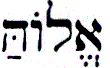
The waw waw also can act as a vowel in words like #452 Eliyahu, #3194 Yutah etc.. It also carries the “o” sound, as in #3117 yom. On the other hand, it acts like a consonant in words like #2331 chavah, actually the consonant is not a V, but as in Arabic, or as the English sound of “w”.

Sometimes the waw acts like a vowel and a consonant all in the same letter; they can also be consonants, depending on the usage.

Concerning the Set-Apart Name, the structure of the letters tell us that the yod is a consonant, as in the word YAH (Ps. 68:4 & Isa. 12:2; 26:4; 38:11 NKJV). Also the hei is a consonant, since “it never loses it’s consonantal sound in the middle of a word.” Gesenius’ Hebrew Grammar p. 81

Also, the waw waw always acts as a consonant when ending words waw hei (except in Eloah Eloahh). When Hebrew-words end with “uah” sound, it is expressed in Hebrew as waw-eyin-hei or waw-alef-hei; therefore, if the Hebrew word ends waw-hei, it will always act as a consonant, ending like “wah” or “weh” etc.

The final hei in YHWH is the vowel letter in the set-apart name, “at the end of a word it is always a mere vowel letter.” Gesenius’ Hebrew Grammar p. 81


Conclusion: When Josephus said “four vowels”, he was talking to his Greek audience trying to express the Tetragrammaton in a way that they would comprehend, trans-letter-ating from Paleo-HebrewPaleo Hebrew, which in Paleo Greek wasPaleo Greek, then into modern Greek, thus arriving with IHYH (literally IEUE.) But this does not in any way prove the pronunciation of the set-apart name.

Chapter 6 / Index

Chapter 6

Proving the Set-Apart Name from Scripture Alone!


The first letter in the set-apart name (YHWH) is a YOD; it can be seen in most Bibles just above Psalm 119:73.

The Saviour said, “Till heaven and earth pass, one YOD or one tittle shall in no wise pass from the torah, till all be fulfilled.” Matthew 5:18

When Bible translators put LORD in the place of the set-apart name (YHWH), they unknowingly attempted to make many YOD’s pass from the law. More specifically, when the Hebrew letter “Y” is turned into a “J”.

From my research, the “J” began to have a “g” sound in the English language about 1637, just after the King James Version came out. It was probably an attempt to out date this sharp sword. The King James Version later adjusted to keep up with the times. The “J” having a “g” sound, came about from the influence of the French, the long time enemy of Britain.

Noah Webster comments about the letter J: “This letter has been added to the English alphabet in modern days; the letter i being written formerly in words where j is now used. It seems to have had the sound of “y” in many words as it still has in the German.” 1828 American Dictionary

“JAH” the first part of the set-apart name is seen in the King James Version in Psalm 68:4, as in the word Hallelujah, meaning, “Praise ye YAH” as seen in the New King James Version in Psalm 68:4 & Isa. 12:2; 26:4; 38:11. Again, Noah Webster comments about this word HALLELUIAH: “This word is improperly written with j, in conformity with the Germans and other continental languages, in which j has the sound of y. But to pronounce the word with the English sound of j destroys it’s beauty. The like mistake of the sound of j in Jehovah, Jordan, Joseph, has perverted the true pronunciation, which was Yehovah, Yordan, Yoseph. This perversion must now be submitted to, but in Halleluiah it ought not to be tolerated.” 1828 American Dictionary

Any forester will tell you that J-rooted trees that have been forced or jammed into the ground by a careless tree planter will not grow well. When a dry spell comes along, often it is the J-rooted trees that die. Or, if the tree does live, the growth is really set back.

It is not the will of our Creator to be J-rooted; it is not His will that our spiritual growth should be set back or retarded by this J error. His will for us is to dig deep in Scripture and be rooted and grounded in the love of the truth. The old paths. (See Jeremiah 6:16)

“Those that be planted in the house of YAHUWAH shall flourish in the courts of our Elohim.” Psalm 92:13

When the spirit of Eliyah comes, the Set-Apart Spirit will cause us, “To appoint unto them that mourn in Zion, to give them beauty for ashes, the oil of joy for mourning, the garment of praise for the spirit of heaviness; that they might be called trees of righteousness, the planting of YAHUWAH, that He might be magnified.” Isaiah 61:3

The Paleo YOD (), which looks like a Flying J, had a Y sound!

The Messiah foretold that before His second coming, the spirit of Eliyah would first come, “and restore all things.” Matthew 17:11 & Malachi 4:5. Certainly the Y sound would be restored in the set-apart name.

A complete list of names from Strong’s Exhaustive Concordance that include the short form YAH in Israelite names:

137 Names with YAH

Strong’s #

Name

Common Name

#29

Abiyah

Abijah

#138

Adoniyah

Adonijah

#223

Uriyah

Uriah

#245

Azanyah

Azaniah

#274

Achazyah

Ahaziah

#281

Achiyah

Ahijah

#452

Eliyah

Elijah

#558

Amatsyah

Amaziah

#568

Amaryah

Amariah

#728

Amiyah

Araunah

#912

Bedeyah

Bedeiah

#964

Bizyothyah

Bizjothjah

#1141

Benayah

Benaiah

#1152

Besoclcyah

Besodciah

#1183

Bealyah

Bealiah

#1202

Baaseyah

Baaseiah

#1229

Baqbukyah

Bakbukjah

#1232

Buqqiyah

Bukkiah

#1256

Berayah

Beraiah

#1296

Berekyah

Bercchiah

#1332

Bithyah

Bithiah

#1436

Gedalyah

Gedaliah

#1587

Gemaryah

Gemariah

#1806

Delayah

Delaiah

#1937

Hode wah

Hodevah

#1938

Hodawyah

Hcdaviah

#1940

Hodiyah

Hodiah

#1941

Hodiyah

Hodiah

#1955

Hoshayah

Hoshaiah

#2069

Zebadynh

Zebadinh

#2148

Zckaryah

Zcchariah

#2252

Chabayah

Habaiah

#2396

Chizqiyah

Hezekiah

#2446

Chakalyah

Hachaliah

#25I8

Chilquiyah

Hilkiah

#2608

Chananyah

Hananiah

#2619

Chasadyah

Hasadiah

#2736

Charhayah

Harhaiah

#2811

Chashabyah

Hashabiah

#2813

Chahabneyah

Hashabniah

#2900

Tobiyah

Tobiah

#2970

Yaazanyah

Jaazaniah

#2977

Yoshiyah

Josiah

#2997

Yibneyah

Ibnciah

#2998

Yibniyah

Ibnijah

#3041

Yedideyah

Jedidiah

#3042

Yedayah

Jedaiah

#3048

Yedayah

Jedaiah

#3050

Yahh

JAH Psalm 68:4

#3056

Yahdai

Jehdai

#3057

Yahudiyah

Jehudijah

#3094

Yahalelel

Jehalelel

#3131

Yosiphyah

Josiphiah

#3143

Yoshibiyah

Josibiah

#3145

Yoshawyah

Joshaviah

#3150

Yizziyah

Jeziah

#3153

Yezanyah

Jezeniah

#3156

Yizrachyah

Izrahiah

#3167

Yachzeyah

Jahaziah

#3169

Yechizqiyah

Hezekiah

#3174

Yechiyah

Jehiah

#3203

Yckolyah

Jecoliah

#3204

Yekonyah

Jcconiah

#3298

Yaareshyah

Jaresiah

#2262

Chabatstsanyah

Habazaniah

#3301

Yiphdeyah

Iphedeiah

#2293

Chaggiyah

Haggiah

#3359

Yeqamyah

Jekamiah

#2382

Chazayah

Hazaiah

#3376

Yiriyah

Irijah

#3404

Yeriyah

Jerijah

#6411

Pelayah

Pelaiah

#3439

Yeshochayah

Jeshoaiah

#3449

Yishshiyah

Ishiah

#3460

Yishmayah

Ishmaiah

#3470

Yeshayah

Isaiah

#3663

Kenanyah

Chenaniah

#4153

Moadyah

Moadiah

#4179

Moriyah

Moriah

#4271

Machseyah

Maaseiah

#4320

Mikayah

Micah

#4424

Melaryah

Melatiah

#4441

Malkiyah

Malchiah

 #4573

Maadyah

Maadiah

#4590

Maazyah

Maaziah

#4641

Maaseyah

Maaseiah

#4677

Metsobayah

Mosobaite

#4811

Merayah

Meraiah

#4920

Meshelemyah

Meshelcmiah

#4983

Matlanyah

Mananiah

#4993

Mattithyah

Mattithiah

#5072

Nedabyah

Nedabiah

#5I29

Noadyah

Noadiah

#5166

Nechemyah

Nehemiah

#5294

Nearyah

Neariah

#5374

Neriyah

Neriah

#5418

Ncthanyah

Nethaniah

#5662

Obadyah

Obadiah

#5718

Adayah

Adaiah

#5818

Uzziyah

Uzziah

#5838

Azaryah

Azariah

#5839

Azaryah

Azariah

#6007

Amasyah

Amasiah

#6043

Anayah

Anaiah

#6055

Ananyah

Ananiah

#6070

Anthothiyah

Antothijnh

#6222

Asayah

Asaiah

#6265

Athayah

Alhaiah

#6271

Alhalyah

Athaliah

#6305

Pedayah

Pedaiah

#6410

Pelatyah

Pelatiah

#6494

Pcqachyah

Pekahiah

#6611

Pelhachyah

Pethakiah

#6645

Tsibyah

Zibiah

#6667

Tsidqiyah

Zedekiah

#6846

Tsephanyah

Zephaniah

#6870

Tseruyah

Zeruiah

#6964

Qolayah

Kolaiah

#7041

Qelayah

Kelaiah

#7211

Reayah

Reaiah

#7345

Rechabyah

Rehabiah

#7422

Ramyah

Ramiah

#7480

Reelayah

Reeliah

#7485

Raamyah

Raamiah

#7509

Rephayah

Rephaiah

#7634

Shobyah

Shachia

#7645

Shebanyah

Shebaniah

#7841

Shacharyah

Shechariah

#7935

Shekanyah

Shechaniah

#8018

Shelemyah

Shelemiah

#8098

Shemayah

Shcmaiah

#8114

Shemaryah

Shemariah

#8187

Shearyah

Shcariah

#8203

Shephaiyah

Shephaiiah

#8274

Sherebyah

Sherebiah

#8304

Scrayah

Seraiah

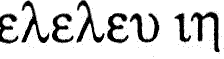
So far, we have established from Scripture that the first part of the set-apart name is YAH (from Ps. 68:4); there are 137 Israelite names with “yah”, and there is also the word Halleluyah. Therefore, the first part cannot be “Yeh”! It is interesting to note that the heathen or Greeks in their hymns, in honor of Apollo, began and ended with hallelu greek, eleleu Ie, a mere corruption of the Hebrew word Halleluyah (see Clarke’s Commentaryunder Revelation 19:1).

Also consider the “IE” in the first two letters of IHS which is actually IES in Greek!

Ies was also a surname for Bacchus.2

Another consideration is YEHWE ZOGBANU – In Dahomean mythology, a forest giant, which had thirty horns and was a threat to hunters.3

The “Yeh” and/or “Yeho” came in with the Jewish cover up of our Heavenly Father’s Name.

To be safe, let’s hold fast to the Scriptural YAH! YAH is the short form of the great set-apart name; an extended form is seen in the King James Version where the translators hid a clue for the true pronunciation in the very story of the set-apart name show down on Mt. Carmel. In the margin of I Kings 17:1, we see the name Elijahu. Translators tell us that the first part of this name “Eli”  means “my God” See Matthew 27:46. Thus, the last part jahu or yahu is in reference to the set-apart name. Elijah’s name means “my El or Elohim is YAHUWAH”.

The Saviour said, “It is also written in your law, that the testimony of two men is true” (John 8:17). Thus, the King James translators hid for us two witnesses that give us a clue to the true pronunciation of the set-apart name, not just one. Look in I Kings 18:3 margin, where we see the nameObadiahu, which name means “servant of YAHUWAH.” But there is more!

72 Names End in ‘YAHU’

Strong’s #

    Name

Meaning

Common Name

#29

 Abiyahu

(my Father is YAHUWAH)

Abijah

#138

 Adoniyahu

(my Master is YAHUWAH)

Adonijah

#223

 Uriyahu

(my flame is YAHUWAH)

Urijah

#274

Achazyahu

(possession of YAHUWAH)

Ahaziah

#281

Achiyahu

(my brother is YAHUWAH)

Ahijah

#452

Eliyahu

(my Elohim is YAHUWAH)

Elijah

#558

Amatsyahu

(strength of YAHUWAH)

Amaziah

#568

Amaryahu

(promised of YAHUWAH)

Amariah

#683

Atsalyahu

(reserved to YAHUWAH)

Azaliah

#1141

Benayahu

(built up of YAHUWAH)

Benaiah

#1296

Berekyahu

(kneel to YAHUWAH)

Berechiah

#1436

Gedalyahu

(YAHUWAH is great)

Gedaliah

#1587

Gemaryahu

(perfected by YAHUWAH)

Gemariah

#1735

Dodawahu

(Love of YAHUWAH)

Dodavah

#1806

Delayahu

(delivered by YAHUWAH)

Delaiah

#1936

Hodaywahu

(majesty of YAHUWAH)

Hodevah

#2069

Zebadyahu

(endurance of YAHUWAH)

Zebadiah

#2148

Zacharyahu

(remembered by YAHUWAH)

Zechariah

#2396

Chizeqiyahu

(my strength is YAHUWAH)

Hezekiah

#2518

Chiliqiyahu

(my portion is YAHUWAH)

Hilkiah

#2608

Chananyahu

(favored by YAHUWAH)

Hananiah

#2811

Chashabyahu

(regarded by YAHUWAH)

Hashabiah

#2882

Tebalyahu

(immersed by YAHUWAH)

Tebaliah

#2899

Tob Adoniyahu

(pleasing to my Master YAHU)

Tob-adonijah

#2900

Tobiyahu

(my goodness is YAHUWAH)

Tobiah

#2970

Yaazanyahu

(will be heard by YAHUWAH)

Jaazaniah

#2977

Yoshiyahu

(my foundation is YAHUWAH)

Josiah

#3000

Yeberekyahu

(kneeling to YAHUWAH)

Jebcrechiah

#3012

Yigdalyahu

(magnified by YAHUWAH)

Igdaliah

#3153

Yezenyahu

(adorned of YAHUWAH)

Jezaniah

#3165

Yechdiyahu

(my unity is YAHUWAH)

Jehdeiah

#3169

Yechizqiyahu

(my strength is YAHUWAH)

Hezekiah

#3203

Yekolyahu

(YAHUWAH will enable)

Jecoliah

#3204

Yekonyahu

(YAHUWAH will establish)

Jeconiah

#3269

Yaaziyahu

(my boldness is YAHUWAH)

Jaaziah

#3404

Yeriyahu

(taught by YAHUWAH)

Jeriah

#3414

Yirmeyahu

(exalted of YAHUWAH)

Jeremiah

#3449

Yishiyahu

(YAHUWAH will lend)

Ishiah, Isijahu

#3460

Yishmayahu

(heard by YAHUWAH)

Ishmaiah

#3470

Yeshayahu

(salvation of YAHUWAH)

Isaiah

#3562

Conanyahu

(sustained by YAHUWAH)

Conaniah

#3659

Conyahu

(stability by YAHUWAH)

Coniah

#3663

Kenanyahu

(planted by YAHUWAH)

Chenaniah

#4321

Mikayahu

(like YAHUWAH)

Michaiah

#4441

Malkiyahu

(my king is YAHUWAH)

Malchiah

#4590

Maazyahu

(rescue of YAHUWAH)

Maaziah

#4641

Maaseyahu

(work of YAHUWAH)

Maaseiah

#4737

Miqncyahu

(purchase of YAHUWAH)

Mikneiah

#4920

Meshelemyahu

(repaid by YAHUWAH)

Meshelcmiah

#4983

Mattanyahu

(present of YAHUWAH)

Mattaniah

#4993

Mattithyahu

(gift of YAHUWAH)

Matthew

#5374

Neriyahu

(my light is YAHUWAH)

Neriah

#5418

Nethanyahu

(given by YAHUWAH)

Nethaniah

#5565

Semakyahu

(supported by YAHUWAH)

Semachiah

#5662

Obadyahu

(Servant of YAHUWAH)

Obadiah

#5718

Adayahu

(continuing in YAHUWAH)

Adaiah

#5812

Azazyahu

(strength of YAHUWAH)

Azaziah

#5818

Uzziyahu

(my power is YAHUWAH)

Uzziah

#5838

Azaryahu

(helped of YAHUWAH)

Azariah

#6271

Athalyahu

(constrained by YAHUWAH)

Athaliah

#6305

Pedayahu

(ransomed of YAHUWAH)

Pedaiah

#6410

Pelatyahu

(delivered by YAHUWAH)

Pelatiah

#6667

Tsidekiyahu

(YAHUWAH is righteous)

Zedekiah

#6846

Tsephanyahu

(hidden by YAHUWAH)

Zephaniah

#6984

Qushayahu

(entrapped of YAHUWAH)

Kushaiah

#7345

Rechabyahu

(enlarged of YAHUWAH)

Rehabiah

#7425

Remalyahu

(protected by YAHUWAH)

Remaliah

#7645

Shebanyahu

(prospered by YAHUWAH)

Shebaniah

#7935

Shekanyahu

(lodging of YAHUWAH)

Shecaniah

#8018

Shelemyahu

(thank offering of YAHUWAH)

Shelemiah

#8098

Shemayahu

(heard of YAHUWAH)

Shemaiah

#8114

Shemaryahu

(hedged by YAHUWAH)

Shemariah

#8203

Shephatyahu

(judged by YAHUWAH)

Shephatiah

#8304

Serayahu

(prevailed by YAHUWAH)

Seriah

Anciently, names not only ended with “yahu”, but also began with “Yahu”; this was determined by comparing other languages like Arabic and Cuneiform.

Jehoahaz — “An inscription of Tiglathpileser III records tribute being received from Iauhazi (mat) Ia-u-da-a

‘Jehoahaz of Judah’. The Illustrated Bible Dictionary

Jehoiachio–“In Babylon, Jehoiachin was treated as a royal hostage. He is named (Yau-kin) in Bab. tablets, dated 595 and 570 BC, as receiving rations at the court in company with his five sons.” The Illustrated Bible Dictionary

Jehonuthan— “The name occurs in Cuneiform records as Yahu-natunnu.” Seventh-day Adventist BIBLE DICTIONARY

Jehu-– “Cuneiform Ia-u-a.” The New Brown-Driver-Briggs-Gesenius Hebrew English Lexicon. In Arabic, Jehu was pronounced “Yahu”. See Hastings Dictionary of the Bible. All this evidence and more, suggest that “Yahu” was used at the beginning of names, instead of the more modem Jewish “Yeho” cover up of the set-apart name. Therefore, the 27 following names are restored to their original pronunciation.

27 Names Begin with “YAHU”

Strong’s #

Name

Meaning

Common Name

#3057

 Yahudiyah

 (a Jewess)

Jehudijah

#3058

 Yahu

 (He exists)

Jehu

#3059

 Yahuachaz

 (YAHUWAH seized)

Jehoahaz

#3060

Yuhuash

 (YAHUWAH fired)

Jehoash

#3061

Yahud

 (a name for Judea)

Jehud

#3063

Yahudah

 (praise YAHUWAH Gen. 29:35 marg)

Judah

#3064

Yahudi

 (a Jew, a descendant of Yehudah)

Jew

#3067

 Yahudith

 (Jewess-Jehudith, a Canaanitess)

Judith

#3068

 YAHUWAH

 (I AM THAT I AM Ex 3:14)

Jehovah

#3075

 Yahuzabad

 (YAHUWAH-endowed)

Jehozabad

#3076

 Yahuchanan

 (YAHUWAH-favored)

Jehohanan

#3077

 Yahuyada

 (YAHUWAH-known)

Jehoiada

#3078

 Yahuyakin

 (YAHUWAH-will establish)

Jehoiada

#3079

 Yahuyaqim

 (YAHUWAH-will raise)

Jehoiakim

#3080

Yahuyarib

 (YAHUWAH-will contend)

Jehoiarib

#3081

Yahukal

 (YAHUWAH-is able)

Jehucal

#3082

Yohunadab

 (YAHUWAH-enlagessed)

Jehonadab

#3083

Yahunathan

 (YAHUWAH-given)

Jehonathan

#3084

Yahuseph

 (YAHUWAH-is adding)

Jehoscph

#3085

 Yahuaddah

 (YAHUWAH-adomed)

Jehoadah

#3086

 Yahuaddan

 (YAHUWAH-pleaaed)

Jehoaddan

#3087

 Yahutsadaq

 (YAHUWAH-righteouness)

Jehozadak

#3088

 Yahuram

 (YAHUWAH-raised)

Jehoram

#3089

 Yahusheba

 (YAHUWAH-sworn)

Jehosheba

#3090

Yahushabath

 (YAHUWAH hath sworn)

Jehoshabeath

#3091

YAHUSHUA

 (YAHUWAH-Saviour)

Jehoshua

#3092

Yahushaphat

 (YAHUWAH-judged)

Jehoshaphat

1 With “YAHU” in the Middle

#454 Elyahuenai (toward YAHUWAH are my eyes) – Elihoenai

    72 Times at the End
      27 Times at the Beginning
        1 Time in the Middle
    100 Times; names with YAHU

So far we have established YaHu from Scripture!

References

2) Come Out of Her My People by Chris Koster

3) Mythology Folklore & Symbols

Chapter 7 / Index 

Chapter 7

Next Letter

U, V or W?


Was the sixth Hebrew letter waw developed from two uu’s put together? Of course not! However, it is true that our English W developed from two uu’s or vv’s put together; this is why it is called double u. But we English speaking people have to use this letter W to convey the ancient sound ofwaw in Hebrew and w_arabic in Arabic etc.

The Oxford English Dictionary lists two columns worth of information about the English W, explaining how it developed from two uu’s put together, then a statement toward the end: “1869 ELLIS E.E. Pron, I. iii. 187 In Europe (w) is thought to be peculiar to England… In Arabic however (w) is quite at home.”


“. . . the sound of waw, a long time ago, wasn’t ‘vav’ at all; but ‘w’, and ‘w’ is weak. . . The Yemenite Jews of Arabia, who retain an ancient, correct and pure pronunciation of Hebrew, still pronounce the waw as ‘w’ -as does Arabic, the close sister language of Hebrew.” How the Hebrew LanguageGrew p. 29, 30

Why do many Jews today contend that the sixth letter of the Hebrew alphabet is a V? According to the Theological Wordbook of the Old Testament, and other reference materials, it is because of German influence. “The German (Ashkenazic) influence arose within the last 1800 years, after the Jews were dispersed in 135 CE. As Jewish communities gradually developed in Eastern, Central and Western Europe, German influence eventually made its mark on the Hebrew language.” The Sixth Letter is Waw (study by Voy Wilks 3/3/96)

There are, generally speaking, two main pronunciations: the Ashkenazi, or German, originated by Central and Eastern European Jews, carried to all countries to which those Jews have emigrated (Western Europe, America, etc.): and the Sephardi, or Spanish, used by the Jews of Spanish or Portuguese stock in Europe and America and also by Jews from Oriental countries. In all the universities and throughout Israel, the Sephardic pronunciation has been adopted, since it is generally believed that this is the pronunciation nearest to the original….” Biblical Hebrew p. 33 by Menahem Mansoor

The shape of the letter V came from the design on the back of the cobra.


But when did the sound “V” come into use? Consider the following argument! The original set-apart name was pronounced Yahuwah (which we will seek to prove in the continuation of this book). Clement of Alexandria (c.150-c.215) transliterated from the original set-apart name of the Hebrew language into Greek as Iaoue (Iaoue), the Greeks had a tendency to put an “e” on the end of names, as seen in the New Testament, which only the KJV points out. Names like Noe (Matt. 24:37), Osee (Rom 9:25), Jude (NT Book), Core (Jude 11) etc; which, according to the Old Testament, were Noah, Hosea, Judah, and Korah. But obviously Clement was transliterating from the Hebrew at a time when the waw had a W sound. Later on, Theodoret (c.390-455) and Epiphanius (c.315-404) transliterated the set-apart name as Iabe (Iabe); a couple of hundred years had passed since Clement, and they must have been transliterating at the time that the Hebrew had adopted the V.
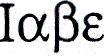


Original Hebrew Name: YAHUWAH

Clement transliterates into Greek: iaoe

Later Theodoret & Epiphanius:       iabe

Probably transliterating from Hebrew with “v”: YAH VAH

“From Latin v, which was at first bilabial (voiced like ‘b’ using the lips), but became labiodental (using the bottom lip to the teeth) in the 2d century A.D.”4

So, from the quote above, we learn that even in Latin the V did not come into use until the second century, and also comparing Clement with Theodoret and Epiphanius, using Iaoue and labe, we can see when this change of V came in. But the question we must ask is: “What pronunciation did waw have when the Creator spoke the ten commandments from Mt. Sinai? What about the Hebrew that Abraham spoke? Or Noah? Or Adam, which he had learned from YHWH Himself?” Obviously, it was the more ancient pronunciation that our English W conveys, which even the American Indians retained in their language from the original; for at one time, “the whole earth was of one language, and of one speech.” (Gen 11:1). Place names in America bare this out, such as Waxahachie Tex, Nowata Ok, Hiawassee Ga, Wewoka Ok, Iowa etc.

“…The Hebrew letter waw waw can function as a consonant or a vowel. When the waw is a consonant, it sounds like w, as in water, and usually has a vowel sign under it. . . When the waw functions as a vowel, it has the sound of o as in row or oo as in pool. With a dot above it, the waw sounds likeo as in row: waw_oh. With a dot in its center, the waw sounds like oo as in pool waw_oo. Note: This dot in the center of the waw is not a daghesh (a dot in the center that indicates that the letter is doubled, in such a case a vowel mark is also beneath that letter)… When a waw functions as a vowel, sounded o or oo, it does not have the sound of w as in water. The yod, like the waw, can be both vowel and consonant.” A Simple Approach To Old Testament Hebrew, p. 9

“The Semitic waw and yod are certainly, by usage, consonants; although by nature they are vowels, viz. u and i and consequently are consonantal vowels.” Gesenius’ Hebrew Grammar p. 26

There is a structural system in Hebrew, depending on the arrangement, whether it was a vowel or a consonant; which existed before vowel points were used, also during the time when the paleo-waw waw_paleo was used.

The point to be made is this: “Was our Creator influenced by the German (Ashkenazi) speech, when He delivered His name on Mt. Sinai?” Of course not! Man is notorious for altering that which has gone out of the Creator’s lips (Review Ps. 89:34). He made it plain, “I change not.” Malachi 3:6, thus we understand that the Creator was not the one who changed the waw_paleo to a vav. In the Father of lights, there “is no variableness, neither shadow of turning.” James 1:17; likewise with His only begotten Son “YAHUSHUA the Messiah the same yesterday, and today, and forever.” Hebrew 13:8.

Not only did the Jews change the waw (W) to vav (V), but in recent times have also changed the Hebrew B to V as well. Therefore, Abraham becomes Avraham, and Yacob becomes Yacov, Tel Abib becomes Tel Aviv, and everyone gets confused. Did we really need two v’s in Modern Hebrew?

So far, using Scripture and history, we have established YaHuW. But, the question might be asked, “Can the waw sustain the ‘u’ and the ‘w’ all in the same letter?” Consider the following illustration with the words Phuvah, (more accurate Phuwah) or should it be Puah? The same Hebrew word is transliterated both ways; even the Bible scholars were baffled as to the true way to transliterate from Hebrew on this point. This point needs to be understood, to understand the set-apart name.

Phuwah or Puah?

The waw, with a dot in the center and with a vowel sign under it waw.ah, is a “strengthened consonant” (the older term of doubling). “The waw_oo u is, however, easily to be recognized, since it cannot take a vowel before or under it.” Gesenius Hebrew Grammar p. 55

Genesis 46:13

Numbers 26:23

Version

Puah_Greek

Puah_Greek

LXX

Phua

Phua

Latin Vulgate

Phuva

Phuva

William Tyndale

Phuuah

Pua

Geneva Bible

Phuuah

Pua

1611 King James

Phuvah

Pua (Phuvah)

margin KJV

Puvah

Puah

New King James

Phuvah

Pua

Peshitta/Lamsa

Puvah

Puvah

RSV

Puvah

Puvah

ASV

Puah

Puah

NIV

Pua

Pua

NEB

Puah

Puah

TEB

Puvah

Puvah

Living Bible

Fuvah

Fuvah

Spanish/Velera

Puah

Puvah

NAB (Cath.)

Puvah

Puvah

New Jerusalem

Puwah

Puah

Book of Yahweh

Puw ‘ah (?)

Puwwah (OK)

The Scriptures 5


The Point Made With Phuwah: Tested, Tried and True

The translation, I AM THAT I AM, has three parts; therefore, the name has three parts (or syllables) and is vowel pointed YAHUWAH

Now, to give an explanation:

The letter *waw* does not carry the “oo” sound, because the markings are beneath the letter *he*:hoo. The waw.ah is doubled, indicated by the dot in the center and vowel mark beneath (Example, see Strong’s Heb. #2332). Now, this is how the “huw” and the “wah” are combined all in the same letter.

This may seem hard to comprehend, but it is absolutely proper Hebrew grammar. This same situation appears in many other names like Eliyahu. The “i” and the “y” are both indicated by a double "I" "Y" (yod):

 Eliyahu

The dot in the center of the double yod, with the vowel mark Qamets beneath it, indicates that this is a double yod. The dot beneath the lamed_dot (see arrow above) indicates that the first yod is a vowel, and the second yod is a consonant (Eliyahu).

Elihu (#453) has the same Hebrew letters as Eliyahu (#452), the only difference is a double yod. The vowel marking indicates that the yod has a vowel sound, else it would read Elyahu instead of Elihu. The same principle applies to the Tetragrammaton, as it does to Eliyahu; instead of the yod, the waw is doubled, but is written only once. The first waw is a vowel sound of (U), indicated by the hoo with three dots under it. The second waw is a consonant sound of “w”.

Thus, the name is perfectly transliterated Yah?wwah, written in English as Yahuwah. Compare Strong’s #6312

Proving the Set-Apart Name From
HEBREW GRAMMAR RULES

Josephus, the Jewish historian, seems to refer to the tetragrammaton as consisting of four vowels (Wars of the Jews, 5. 5. 7)

We already covered this in a previous chapter, but briefly, Josephus himself admitted to frequently altering Hebrew names, spelling them after the Greek fashion “to please [his Greek] readers.” (Antiquities 1.6. 1.)

“Why Josephus speaks of ‘four vowels’ is uncertain. The first and third letters are probably ‘by nature vowels’ (= i and u), though by usage, consonants (Gesenius, Heb. Grammar, ed. Cowley, pp. 26,45). He is perhaps thinking of a Greek form (iaue).” Wars of the Jews 5. 5. 7. footnote; edition Loeb Classical Library

The first letter in the set-apart name is a consonant, the “Y” in YAH, and in the word Halleluyah.

RULE #1 “hei can never be a vowel letter in the middle of a word.” Gesenius Hebrew Grammar p. 56.

YHWH_arrow

This means that this letter must be a consonant, and have a vowel following it, such as ‘ho’, ‘hu’ ‘he’, ‘ha’ etc.

RULE #2 Since the hei in the middle of a word is always a consonant, this means that in the set-apart name, there must be three syllables.

“The vowel letters hei,yod, waw, and Alef, as such, naturally do not close a syllable … On the other hand, syllables are closed by the consonantal waw and yodGesenius Hebrew Grammar p. 75

“Assimilation” usually takes place when one consonant, which closes a syllable, passes over into another, beginning the next syllable, and forms with it a strengthened letter.” Gesenius Hebrew Grammar p. 68

“Stade, Lehrb. der hebr. Gr., Lpz 1879, pp. 44, 103, rightly insists on the expression strengthened pronunciation instead of the older termdoubling, since the consonant in question is only written once. The common expression arises from the fact that in transcription a strengthened consonant can only be indicated by writing it as doubled.” Ibid p. 55 footnote

This means that in the set-apart name Yahuwah, the waw must be a consonant, because it closes a syllable and opens a new one; and therefore it becomes a strengthened consonant written double waw, or doubled.

“Waw with Deges (waw_oo) cannot, in our printed texts, be distinguished from waw pointed as Sureg (waw_oo); in the latter case the point should stand higher up. The waw_oo u is, however, easily to be recognized since it cannot take a vowel before or under it. Ibid p. 55 footnote

When a Hebrew word ends “waw_hei“, the waw is almost always a consonant after such an arrangement. Example: Strong’s Hebrew Dictionary lists no words that end with “uah” spelled in Hebrew waw_hei. The sound always ends waw_eyin, waw_eyin_hei, waw_alef_hei. However, there is an exception to the waw being a consonant after such an arrangement, that is Eloahh #433, and is spelled eloah, but please notice the hei_dot is dotted in the center, meaning that it is a consonant.

“A point in the bosom of hei_dot is called Mappiyq (mappeek). It occurs only in the final vowelless letter of a few words, and we have it represented by hh” Strong’s Concordance, Introduction to the Hebrew Dictionary.

RULE #3 Unless the hei is dotted with the Mappiyq, “at the end of a word, it is always a mere vowel letter.” Gesenius Hebrew Grammar p. 81

Yahuwah YAHUWAH fits all the Hebrew Grammar Rules!

References

4) Funk & Wagnal’s Encyclopedia (1934) under V

5) The Scriptures, by the Institute For Scripture Research

Chapter 8/ Index

Chapter 8

The Translation

I AM   WHO   I AM
AHAYAH   ASHER    AHAYAH

SAME MEANING

HAYAH  HUW    HAWAH
YAH   HUW    WAH

YAHUWAH

I AM THAT I AM Ex. 3:14. “This passage is intended to indicate the etymology of Jehovah [YAHUWAH], as understood by the Hebrews, no one has ventured to doubt.” Smith’s Bible Dictionary

“Etymologically . . . of the verb hawah (or hajah), signifying to be.” Funk & Wagnalls New Standard Encyclopedia (1934) under Jehovah Exists or Self Existing in the sense of: “yesterday, and today, and forever.” Hebrews 13:8

Various Bible Translations render Exodus 3:14 differently

I AM WHO I AM

New American Standard

I am what I am

The Living Bible

AHIAH ASHER HIGH

Peshitta / Lamsa

 am who I am

NIV

I am who am

Catholic Douay Version

I am who I am

Today’s English Version

I  AM; that is who I am

New English Bible

I am he who is

New Jerusalem Bible

I AM WHO I AM

Revised Standard Bible

A YAH- ASHER- A YAH

Holy Name Bible

I will be what I will to be

footnote (Holy Name Bible)

I am the Being

Septuagint

I will become whatsoever I please

Rotherham

I will be what I will be

William Tyndale

I AM THAT I AM

1599 Geneva Bible

I AM WHO I AM

New King James Version

I AM THAT I AM

King James Version

The note in the margin of the 1599 Geneva Bible sums it up well. “The [El] which ever have been, am and shall be: the [El] Almighty, by whom all things have their being, and the [El] of mercy, mindful of My promise.” Ex 3:14

Which is the most accurate is not what I wish to dwell on; the point is that from the Hebrew words AHAYAH ASHER AHAYAH, we can derive the true pronunciation of the set-apart name. It is the interpretation, definition, explanation, translation, or meaning of the set-apart name.

Though the Scofield Bible footnote on Gen. 2:4 uses Yahwe (?), it also states that the name is from “havah”, or more accurate “hawah”.

According to Gesenius Hebrew English Lexicon, pp.219-22, the Hebrew characters and vowel points used, one can see the NAME is derived from (hawah), and from (hayah), meaning to EXIST, SELF EXISTING.

“Many critics contend for Hebrew: Yahveh, some for Yahvah, and some for Yahaveh. It is generally derived from havah, an old form of haiah,meaning ‘He is’. The import of the name is explained in the book of Exodus: ‘And (Elohim) said unto Moses, I AM THAT I AM …’ (Ex. 3:14, thereby predicating self-existance in a sense in which it can be applied to no created being.” The American Peoples Encyclopedia Vol. II, page 599 (1952)

Many more references could be given as pointed out by Young’s and Strong’s Concordances, Funk & Wagnalls Encyclopedia, and Gesenius’ Hebrew English Lexicon, page 337, 338. The name is derived from hawah (ha WAH). Combining Yah with Wah, we have the first and last part of YAHUWAH.

A statement by Alexander MacWhorter of Yale University in his book, Memorial Name, published in 1857, harmonizes with this, as he said the NAME is derived from the Hebrew verb “havah”, the OLD FORM of “hayah”, meaning to EXIST or SELF EXISTING ONE. This passage from Exodus 3:14 has not two parts, but three. Many have not noticed the middle section of the translation I AM THAT I AM. In Hebrew Asher means: who, which, what, that, are, etc. Another Hebrew word that often means the same thing is #1931 huw. Huw also means: this or that, which (is), who and he etc.

Huw and asher often mean the same thing, or can interchange. Example: compare the following passages and usage’s of asher and huw.

“And Elohim saw every thing that (asher) He made, and, behold, it was very good.” Gen 1:31.

“And the gold of that (huw) land is good.” Gen. 2:12.

“Behold, Rebekah came out, who (asher) was born to Bethuel.” Gen. 24:15

“Now these are the generations of Esau, who (huw) is Edom.” Gen 36:1

See by these examples both asher and huw can interchange with each other!

THE TESTIMONY OF TWO MEN IS TRUE. (Jn. 8:17)

Not only does Moses give us a translation of the set-apart name, but so does the prophet John in the book of Revelation, which gives us a revelation of the set-apart name. Notice the marginal reference in Revelation 1:4 to Exodus 3:14, where the translators were hinting and telling us that this is another translation of the set-apart name. Although the true chronological arrangement of time, past, present and future, is found in Revelation 4:8, “which was, and is, and is to come.” See also the other passages of the same, in Revelation chapters 1:8; 11:17; 16:5. Some of the new versions omit “and art to come” in Rev. 11:17 & 16:5. John warned them not to take out any portion lest Elohim take away their part out of the book of life. See Revelation 22:19

Thus it becomes ultra important to have all three parts of the translation included as our proof for determining the true original set-apart name.

Which was,which is, and which isto come

# 1961 hayah; was, to exist, to be, come to pass
#1931 huw; he, which (is), who, that
#1933, 34 hawah; to be, to exist, come to pass

HAYAH   HUW   HAWAH

YAH   HUW   WAH

YAHUWAH

Now that we have carefully considered both translations, we can also begin the process of elimination. If the set-apart name were Yahowah, which might be a corruption of the set-apart name, but cannot be the original, for then the translation must read “I AM oh I AM” or “I Am alas I Am,” since the Hebrew word “how” #1930 (pronounced ho) and means Oh and/or alas.

Notice in the translation of Exodus 3:14, “I AM” is repeated, thus in the set-apart name YAH is repeated with WAH, both YAH and WAH mean basically the same thing. In Hebrew the Y and W can interchange and yet the same meaning is preserved. A couple of examples from Scripture are in order.

Take the name Dodavah, II Chronicles 20:37 (more proper Dodawah), which means love of Yah. Which part of this name means Yah? The wah of course! Let’s do another. Hodevah (more accurate Hodewah) means majesty of Yah. Again the testimony of two men is true.

Are there Hebrew words where the (yod) and the (waw) are interchangeable and the meaning remains the same or similar?

The translation of the Father’s Name is “I AM that I AM.” Notice that “I AM” is repeated. Since Strong’s H#1961 (hayah) and #1933-1934 (hawah) both mean “to exist,” His Name covers the aspect of His past, present and future existence. So, in the Father’s Name, Yah is repeated with Wah. Are the yod (y) and the waw (w) interchangeable? Let’s find out… Remember, Hebrew is read from right to left.

Sometimes scholars get it right though they come at it from a different angle.

“Among etymologies proposed, S. Mowinckel and J. Montgomery contend that the name is a compound, yahu or yahuwah, ‘O He!’. “6 (An Arabic angle). James Montgomery shows sort of a secondary translation in his study THE HEBREW DIVINE NAME AND THE PERSONAL PRONOUN HU, where he touches on the basic theme “I am YHWH” and it’s parallel, “I am He”.7 Tracing the Biblical references in Deuteronomy 32:39 for “I am He” to Isa. 41:4; 43:10, 13; 46:4; 48:12.

It is also interesting to note that when Judas and the band of officers came looking for YAHUSHUA in the garden of Gethsemane: “YAHUSHUA therefore knowing all things that should come upon Him, went forth, and said unto them, ‘Whom seek ye?’ They answered Him and said, ‘YAHUSHUA of Nazareth.’ YAHUSHUA saith unto them, ‘I am He….’ As soon then as He said unto them ‘I am He’, they went backward, and fell to the ground.” (John 18:5,6). The possibility does exist here that He spoke the set-apart name. The Greek words are the same as used in John 8:58, “Before Abraham was, I am,” which is the same Greek usage the Septuagint uses in Exodus 3:14, “THE BEING”. There is more from the book of John:

“If ye believe not that I am He, ye shall die in your sins.” John 8:24.

“When ye have lifted up the Son of man, then ye shall know that I am He.” Jn 8:28. See also Jn 4:26; 9:9; 13:19

The King James translators knew this, and thus italicized “He” to indicate this connection with Ex. 3:14.

The main thing this bares out is that “He” in Hebrew is “Hu”, thus verifying the element Hu instead of “Ho” in the set-apart name.

References

6) The New 20th-century Encyclopedia (2nd Ed.) of Religious Knowledge p. 886

7) Journal of Biblical Literature Vol. 1xiii, 1944, p. 161

Chapter 9 / Index

Chapter 9

Evidence for Yahweh

Several Early Greek Writers?

What’s wrong with the following statement? “Several early Greek writers of the Christian Church testify that the name was pronounced Yahweh.” The Modern Judaica Encyclopedia, Vol. 7 p. 679
YHWH YHWH is a Hebrew name!

On the surface the above quote sounds pious doesn’t it? Very few scholars detected anything. Who were these Greek writers?

“The pronunciation, Yahweh, is indicated by the transliteration of the name into Greek in early Christian literature. . .’by Clement of Alexandria, and by Theodoret. . . . Strictly speaking, Yahweh is the only name of god.” The New Bible Dictionary p. 478 by J.D. Douglas. Not mentioned in the quote, but also used for evidence for Yahweh, is Epiphanius (who wrote Iabe) and Origen who wrote (Iae).

The Catholic Church quoted fairly:”… Judging from Greek transcriptions, the Set-Apart Name .. . YHWH ought to be pronounced Yahweh.” 8

Gesenius stated in his Hebrew-Chaldee Lexicon “this same form appears on the gems of the Egyptian Gnostics as the name of God . . .[but these gems are not of the most remote antiquity; they are the work of heretics of the second and third centuries].” (brackets not supplied) under #3068 Jehovah

Clement of Alexandria was a teacher of the Gnostic’s; Origen was one of his students. The Masons and Catholics alike claim Clement, Origen, Theodoret and Epiphanius as the forefathers of their faith.

Simon Magus (Acts 8:9-24) was the father of Gnostic heresies, also pseudo-messiah, he was a teacher who went to Rome and taught angelology and astrology.

The school in Alexandria was mixing paganism in the true apostolic faith and promoting “sun worship.” It was the school of Gnosticism that prepared the way for the Papacy to be established. Constantine was also a Gnostic Christian. Some of their heretical beliefs:

Predestination from astrology! The body could never be saved! That prophets were not dependable for inspiration! They believed in magic!Believed in speaking in tongues like today’s charismatics, which does not edify believers in truth! Sprinkling instead of baptism by immersion! Sunday worship! Hatred for the Torah!

The Jesuits restored Gnosticism in the Council of Trent:

“The Society of Jesus proposed to subordinate the Holy Scriptures and in their place substitute the interpretations of the Bible by the ecclesiastical writers of the first centuries whom they call the ‘fathers’. All the errors and vagaries of the allegorizers who confused and darkened the first three centuries were selected. The first great papal council which assembled after the Reformation, the Council of Trent (A.D. 1545-1563), was dominated by the Jesuits. This assembly laid down the law, and no papal authority has dared since to dispute it.” Truth Triumphant p. 317

Why use Greek writers for evidence anyway? Greeks were notorious for altering Hebrew names.

Compare Hebrew and Greek Names

Notice the “a” ending in Hebrew vs. “e” in Greek!

HEBREW Base

KJV Text

GREEK Base

Abishua

I Chr. 8:2

Abisue

Douay

Adna

Ezra 10:30

Edne

Septuagint

Ahlra

Num. 1:15

Achirc

Septuagint

Ahoah

I Chr. 8:4

Ahoe

Douay

Ajah

Gen. 36:24

Aie

Septuagint

Arab

I Chr. 7:39

Aree

Douay

Arbah

Gen 35:27

Arbee

Douay

Bathsheba

II Sam. 11:3

Bethsabee

Douay

Betah

11 Sam. 8:8

Bete

Douay

Careah

II Kings 25:23

Caree

Douay

Chavah

Gen 3:20 marg

Eve

Elisha

I Kings 19:16

Elisaie

Septuagint

Elishua

II Sam 5:16

Elisuc

Septuagint

Gaba

Josh. 18:24

Gabee

Douay

Gilboa

I Sam 28:4

Gelboe

Douay

Gomorrah

Gen. 19:24

Gomorrhe

II Esd 2:8

Halah

II Kings 17:6

Alae

Septuagint

Hammedatha

Esther 3:1

Amadathes

Septuagint

Hashubah

I Chr. 3:20

Asube

Septuagint

*Ishua

Gen. 46:17

*Ieooova:

Possible LXX

Janohah

Josh. 16:6

Janoc

Douay

Jeremiah

II Chr. 36:21

Ieremie

II Mace 2:5

Jerah

I Chr. 1:20

Jare

Douay

Jehodiada

II Sam. 8:18

Jodae

Septuagint

Jehosheba

II Kings 11:2

Joscbcc

Septuagint

Jehoshua

I Chr. 7:27

Inoo\)£

Septuagint

Jeshua

Ezra 2:6

Inoove

Septuagint

Jephthah

Judg. 11:1

Jephte

Douay

Jimnah

Gen. 46:17

Jamne

Douay

Joppa

Ezra 3:7

Joppe

Douay

Joshah

I Chr. 4:34

Jose

Luke 3:29

Joshua

Exodus 17:9

Josue

Douay

Judah

Gen. 29:35

Jude

NT- Book

Kareah

Jer. 40:8

Caree

Douay

Korah

Num. 16:1

Core

Jude 11

Malchishua

I Chr. 8:33

Melchisue

Douay

Massa

Gen. 25:14

Masse

Septuagint

Mizzah

Gen. 36:13

Moze

Septuagint

Neziah

Ezra 2:54

Nasthie

Septuagint

Nobiah

Num. 32:42

Nobe

Douay

Noah

Gen. 6:29

Noe

Man. 24:37

Nogah

I Chr. 3:7

Nagge

Luke 3:25

Nophah

Num. 21:30

Nophe

Douay

Ho sea

Num 13:16

Osee

Rom. 9:25

Paruah

I Kings 4:17

Pharue

Douay

Paseah

I Chr. 4:12

Phesse

Douay

Pekah

II Kings 15:25

Phakee

Septuagint

Potipherah

Gen. 41:45

Patiphare

Douay

Reba

Num. 31:8

Rebe

Douay

Rephah

I Chr. 7:25

Raphe

Septuagint

Roma

(Greek #4516)

Rome

Acts 18:2

Salah

Gen. 10:24

Sale

Douay

Shammah

Gen. 36:13

Some

Septuagint

Sheba

II Sam. 20:1

Sabee

Septuagint

Shiloah

Isa. 8:6

Siloe

Douay

Shimeah

II Sam. 21:21

Samae

Douay

Shua

I Chr. 2:3

Sue

Douay

Tarah

Num. 33:27

Thare

Douay

Tebah

Gen. 22:24

Tabee

Douay

Tekoa

I Chr. 2:24

Thecoe

Septuagint

Telah

I Chr. 7:25

Thale

Douay

Terah

Gen. 11:24

Thare

Douay

Tobiah

Ezra 2:60

Tobie

I Mace. 5:13

Zanoah

Josh. 15:34

Zanoe

Douay

Zebah

Judg. 8:5

Zebee

Douay

Zechariah

OT Book

Zacharie

II Esd. 1:40

Zerah

II Chr. 14:9

Tare

Septuagint

The Roman Catholic Douay version was largely based on the Greek Septuagint and thus many names ended with an “e”.

Though the Greeks loved to walk around in white pretentious robes, our Creator labeled them as a kingdom with spots “like a leopard.” Dan. 7:6. Can the leopard change his spots? (Jer. 13:23). How then can they do good that are accustomed to do evil, including changing names? Our Creator knew that the Grecians would seek to remove the children of Israel far from their border! YAHUSHUA is coming back for a glorious congregation “not having spot, or wrinkle, or any such thing; but that it should be holy and without blemish.” Eph 5:27

In the last days our Creator said: “I will turn to the people a pure language.” For what purpose? “That they may call upon the name of YAHUWAH, to serve Him with one consent.” Zephaniah 3:9. What language should we consult to derive the true pronunciation of the set-apart name? Certainly not the Greek! However Scripture tells us which language it is.

Thus saith YAHUWAH of hosts, “In those days it shall come to pass, that ten men shall take hold out of all the languages of the nations, even shall take hold of the skirt of him that is a Yahudi, saying, ‘We will go with you: for we have heard that Elohim is with you.'” Zechariah 8:23. It seems strange that scholars only mention the evidence of the early Greek writers. Why do they not give all the other evidences?

The evidence from Origen is “Iae”, but this was also the name of a pagan god. In the Dictionary of World Mythology by Cotterell under Kuat, who is “The sun god in Kamaiuran mythology.” We find that “Iae” was the moon god, and brother to Kuat. Strange that Origen came up with this, when Clement his teacher used Iaoue.

“Clement, most famous of the Alexandrian college faculty and teacher of Origen, boasted that he would not teach Christianity unless it were mixed with pagan philosophy.” Truth Triumphant p. 47

The Greek language does not even have a “Y” sound, or an H sound in the middle of a word, nor a W, nor an “sh” sound. Neither did the Latin have a W sound, nor an “sh” sound. Therefore many early believers contended that the Messiah’s name could only be pronounced from the Hebrew correctly.

Celsus, a pagan editorialist who lived about 185 C. E., finds fault with Christians, and so reports that many of their beliefs are from Jews, paganism and folly. Upon reading through his book, however, it is obvious that what Celsus calls “Christian” is not always what we would call a believer today. Celsus lumps everybody together. Celsus is obviously categorizing together both those who claim to be Christians and those in the Faith once transmitted to the Apostles. Regardless of the distinction, he comments, “… they assume that by pronouncing the name of their teacher they are armored against the powers of the earth and air and that their God will send armies to protect them….And they are quite insistent on the efficacy of the name as a means of protection: pronounce it improperly, they say, and it is ineffective. Greek and Latin will not do; it must be said in a barbaric tongue to work.” Celsus, On the True Doctrine, [Joseph Hoffman, Translator, Oxford University Press, 1987] page 118.

Since Celsus ridicules the Jewish faith and the Jewish race, it seems he considered them to be the lowest forms of human life on earth. Thus, the language referred to as “barbaric” can be none other than Hebrew.

The fact is that the early Gnostic Greek writers did not speak according to the law and the testimony. How could they? They hated it. Thus they had no light in them. If you ask the Greek writers what the set-apart name is, you will get several different answers. Some would say, Iaoue, or Iape, or Iao, or Iae, or, Iaoth, or as Philo, the one who amalgamated Judaism and mythology producing Gnosticism said, the name was “leuo”. Does it seem like they really knew what the set-apart name was!?!

“Alexandria and Antioch were always antagonists, Alexandria presenting a mystical transcendentalism and promoting the allegorical interpretation of the Scriptures; Antioch insisting on the grammatico-historical interpretation of the Scriptures, and having no sympathy with mystical modes of thought.” A Manuel of Church History, Vol. 1, p. 297

This quotation shows a bit of the background of what we are dealing with concerning the name Yahweh. Clement of Alexandria said: “The name of God too, among the Greeks, contains four letters.” Stromata, Book V Chap. VI. The English text shows “Jave”.

Often, it can be seen in various literature like the Catholic Encyclopedia and The Jehovah Witness Bible- the elegant edition where they show the form “Jahve”. We have already seen how the “J” began having a “g” sound about the middle of the 17th century; before that it was a fancy i, often having a y sound. Earlier words with “J” were spelled with “I”, thus Jove would be spelled Iove and pronounced Yahve, the priests have introduced it to the Spanish community as Yave.

According to Noah Webster’s 1828 American Dictionary, under the word ALLELUIAH, we learn that “Io” is a corruption of Jah or Yah.

How Long Halt Ye Between Two Opinions?

“There are two opinions as to what was the actual pronunciation of the set-apart name while Hebrew was still a spoken language. On the one hand, we may gather from the contemporary Assyrian monuments that it was pronounced “Yahu.” Wherever an Israelitish name is met with in the cuneiform inscriptions which, like Jehu or Hezekiah is compounded with the heavenly title, the latter appears as Yahu; Jehu being Yahua, and Hezekiah Khazaki-yahu. Even according to the Masoretes it must be read Yeho (that is, Yahu) when it forms part of a proper name. The early Greek characters, wrote Iao (that is, Yaho). On the other hand, the four consonants, YHVH, can hardly have been pronounced otherwise, than as Yahveh; and this pronunciation is supported by the two Greek writers Theodoret and Epiphanios, who say that the word was sounded Yave. The form Yahveh, however, is incompatible with the form Yahu (Yeho), which appears in proper names.” The Century Cyclopedia (1900)

However, Professor Eerdman’s article showed that it is not safe to follow the Samaritan pronunciation advocated by Theodoret and Epiphanius, because the Samaritans were opposed to the Jewish way. “They built their own temple on Gerizim and had their own priesthood. They thwarted the Jews whenever they could. On the count of their attitude, we may safely assume that the Samaritans had their own [different] pronunciation of the holy name. For this reason the Samaritan pronunciation should not have been regarded [by modem scholars] as evidence for the Jewish pronunciation.” Quoted in The Good News Nov-Dec 1972 (Magazine of The World Wide Church of God).

References

8) The New Catholic Encyclopedia, Vol. 14 p. 1065

Chapter 10 / Index

                                      Chapter 1

                                              Modern Idolatry

                                  BAAL means LORD

                                             Hosea 2:16 margin KJV

“How long halt ye between two opinions? if YAHUWAH be Elohim, follow Him: but if haBaal (the Lord), then follow him.” 1 Kings 18:21

“Baal-gad” Joshua 11:17 means “Lord-god”

Gad = G-d

Pronounced Gawd, or God, and written Gad! See Isaiah 65:11 margin

#1408 “a Babylonian deity” of Fortune.

Strong’s Exhaustive Concordance

No wonder our money has the phrase

“IN GOD WE TRUST”

(that is the deity of fortune)

“I am YAHUWAH: that is My name: and My glory will I not give to another, neither My praise to graven images.” Isaiah 42:8

(Note: In Joshua 11:17, g-d is marked with Qamets)

Dios = Dios

Observe the Greek text of:

Acts 14:13

Which is translated “Jupiter”??

See also the Greek text of II Maccabees 6:2 The Hebrews died faithfully for not worshipping Dios. See the Maccabee story.

In the Greek text of Acts 28:11 is sons of zeus (Dioscuri), meaning “sons of Zeus”. The KJV translated it “Castor and Pollux”.
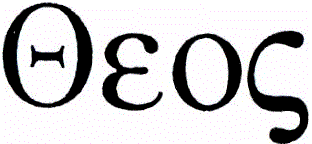

“For all the gods of the nations are idols: but YAHUWAH made the heavens.” Psalm 96:5

ZEUS = DEUS

= DEOS

= DIOS

= Theos (Theos)

“Thou shalt not make unto thee any graven image, or likeness of anything that is in heaven above…” Exodus 20:4

“Professing themselves to be wise, they became fools, and changed the glory of Elohim into an image.” Romans 1:23

“Only in a few localities, notably in Crete, does any form of the name Zeus survive, but the god still lives under the title Theos

[Theos], a title so conveniently equivocal, that the Christian can use it without heresy and square perfectly with the ancient pagan belief.” Greek and Roman Mythology, Appendix I, Survivals of Ancient Greek Divinities and Myths in Modern Greece, p. 312

“The early Christians (Messiahans) were called atheists because they denied the gods of the Greeks and Romans.” Funk & Wagnalls New Standard Enc.(Atheist)

Christ = Krishna

“Krsna, whose name is pronounced as Krsta in many parts of India at the present day.” Mythology of All Races, Vol. 6, p. 178

Mythology, Folklore and Symbols also show Krsta as a variant spelling of Krsna.

Russians spell Christ Christa (Pronounced Christa)

Khri also means white, or opening; Khris, the orb of the Sun. Krishna was the Hindu Sun god.” Morals and Dogma p. 78

Kriss Kringle means Christ child, (see the dictionaries) also used for Santa Clause years ago.

Christ is spelled Kristos; (Xristos) in Greek! “X stands for Christ, as in Xian. Christian; Xmas. Christmas.“ Noah Webster’s (1828) American Dictionary

“And they have no rest day nor night, who worship the beast and his image, and whosoever receiveth the mark of his name.” Revelation 14:11

X can also stand for Xpovos (Chronos) or Saturn.

Esus = Ecyc Mongolian for Jesus

=Isus Crotian & Romanian for Jesus

Eesoos   Eesoos, Russian for Jesus

=Esu (A god of trickery in Africa)

=Esu Isis in the Cuneiform language

=Esu (A principle title of Tammuz)

“Esu, one of the principle titles of Tammuz.” Mythology of All Races Vol. 5 p. 131

“Hesus. Also called Esus. In Celtic religion, he was the supreme god.” Dictionary of Pagan Religions

“The first Druids were the true children of the Magi, and their initiation came from Egypt and Chaldea; that is to say, from the pure sources of the primitive Kabalah. They adored the Trinity under the names Isis or Hesus, the Supreme Harmony; of Belen or Bel, which in Assyrian means Lord.” Morals & Dogma p. 103

“The three letters S S S (in Greek SSS) were the symbol of Isis, which is thus connected with 666.” Number in Scripture p. 49 by E.W. Bullinger
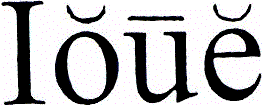

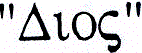
“And she shall bring forth a son, and thou shall call His name YAHUSHUA: for He shall save His people from their sins. Matthew 1:21

Ioue = Yahueh used by some


Jove = Jave Ante-Nicene Fathers

= Yave used by the Spanish

= Yahveh

= Yahweh by Christians

“I am YAHUWAH: that is My name: and My glory will I not give to another (name), neither My praise to graven images.” Isaiah 42:8

If you were going to counterfeit a one hundred dollar bill, wouldn’t you make it appear as close as you could to the real thing. Thus, any name that deviates at all from the original is a counterfeit! Which only appears to be genuine, but isn’t. It might take careful study!

“Between truth and error there is an irrepressible conflict. To uphold and defend the one is to attack and overthrow the other.” The Great Controversy, p. 126

The Scripture teaches that the deadly wound would be healed (Revelation 13:7), and upon its heads the “names” of blasphemy (Rev. 13:1 margin & 17:3).

In the end time scenario, the Scripture says of the beast, that “he opened his mouth in blasphemy against Elohim, to blaspheme His name, and His tabernacle, and them that dwell in heaven [including Moses and Eliyahu], “And it was given unto him to make war with the saints, and to overcome them; and power was given him over all kindreds, and tongues (languages), and nations.” Revelation 13:6, 7. But in the book of Daniel it brings out that while YAHUSHUA is in the Most Set-Apart place in the heavenly sanctuary before the Ancient of Days, “there was given Him dominion, and glory, and a kingdom, that all people, nations, and languages, should serve Him.” Dan. 7:14. Languages can serve YAHUSHUA by following the rules of transliteration, letter for letter, sound for sound, from the Hebrew as near as possible, regarding the set-apart name issue.

“I will turn to the people a pure language, that they may call upon the name of YAHUWAH, to serve Him with one consent.” Zeph. 3:9

It does seem strange that the name Dios can be perfectly preserved, letter for letter, sound for sound, from ancient Greece to modern day Mexicans. Why was not this same special care given to the name of the Creator of heaven and earth?!?

Today the Spanish call “Dios” the Creator, but in old time this was the name of Zeus or Jupiter. The Greek word behind “Jupiter” in Acts 14:13 is Dios, also the same of II Maccabees 6:2. Anciently the Hebrews would rather die than worship “Dios”, which they did; you can read about it in the Maccabee story. Also the Spanish call the Saviour Jesus, pronounced “Heh soos”; that’s odd, the supreme god of the Druids was called Hesus.


Why is this? “Jesuit missionaries played a crucial role in taking Catholicism to Asia, Africa, and Latin America. Jesuit scholars made contributions to philosophy, language studies, and especially theology.” Encyclopedia Americana

This explains why the precious Spanish folk call on these various gods.

Today the Spanish scholars and priests are teaching the set-apart name is Yave which is pronounced the same as Iove or Jove.

In 1672, Wilkins National Religion p. 51, “Believing but one supreme Deity, the Father of all subordinate powers:.. whom they call Jupiter or Jove, with plain reference to the Hebrew name Jehovah.” Oxford English Dictionary, under “Jove'”.

In the book Two Babylons by Alexander Hislop, it shows that “Jove” was used as the set-apart name, see pages 26 & 73.

The Catholic scholars and monks have no problem with the form Yahweh! As a matter of fact, they are evangelizing it! It is contained in their New Jerusalem Bible and in their New American Bible in Genesis 22:14 and Exodus 17:15 etc.

 In the Greek Dictionary of Strong’s Concordance #2203, we find that “Jove” is a name for Jupiter or Zeus!? Yet in Numbers 21:14 of Orginenis Hexapla, in the place of the tetragrammaton is found the word “Jovae”.

When the “a” comes before the “e” such as the above, it is a hint to the old style of their combining the letters such as, ae, as in “Judaea”; others spell it “Judea”, while the old good quality King James Versions combine them as “Judaea”.

The oldest form of Jove is spelled “Ioue”. If these four vowels are said fast enough, as today’s modem promoters teach, you will say “Yahweh!”

How can commandment keepers, living in the closing scenes of earth’s history, who profess to love the appearing of the Sovereign YAHUSHUA in the great clouds of glory, be sympathetic to a name that was invented or made up by men’s hands? Especially the Greeks and Gnostics, at that! How can we be sympathetic to the gods of the Romish church?

In Summary

So far we have considered if the last part of the name should have an “a” at the end or an “e”. Using Scripture alone, the translation suggests an “a” because “I AM” is repeated; therefore YAH would be repeated with WAH. The Greek evidence suggests a “WEH” ending.

But what about all the evidences and forms of the set-apart name from around the world other than the Greek? What about Latin scholars? What about Sabbath keepers in Western Europe? What about the Arabs? What about the American Indians and more? How is it that scholarship overlooks these evidences, and looks only to the Greek? The next several chapters will examine some of these other evidences.

Chapter 11 / Index

 Chapter 11

Testimonies to the Historic “a” Sound

At the End of the Set-Apart Name

At about 1516 Peter Galitin felt that he made a great discovery, that the set-apart name was more accurately pronounced IEHOVAH; from this point forward reformers felt they were on to a new revelation of the set-apart name. William Tyndale slipped it in his Bible of 1530 in a few places. Other Bibles like Coverdale, 1599 Geneva Bible, and the 1611 King James Version followed in succession. This was due to the learning of Hebrew by Peter Galitin, and reading the vowel points of the Masoretic Hebrew text.

The name Yehovah had the vowel points of another word, because Jewish scribes in the Dark Ages placed vowel points above and below the four letters to remind the reader to say Adonai (Lord) instead of the set-apart name. Peter Galitin did not know this, he just simply read it the way it was written.

But, before 1516 Roman scholars and theologians in the 1400’s and 1500’s used the form Jova, before that it was Iova, and before that it was Ioua,(Which form is seen in the Oxford English Dictionary under Jehovah). The sentence is in Latin, and reads:

“Non enim he quatuor liter YHWH si ut punctate sunti, legantur, Ioua reddunt: sed (ut ipsi optime nosti) Iehoua efficiunt].”

The sentence basically translates: “Not certain here of four letter YHWH (or) if in what manner to punctuate with marks the magnificent leger, Iouaredundant: apart from what manner He is able to do. Until then Iehova will suffice.”

Also a book called Origen’s Hexapla (not the original), but put together by Roman theologians in the 16th century, the text shows Jova Deus.

Also in 1278, Raymundus Martini came out with a book called Pugiofidei (Daggar of Faith), wherein he spelled the name Yohoua. Some time after, in 1303, Porchetus de Salvaticus completed a work called Victoria Porcheti adversus impios Hebraeos (Porchetus’ Victory Against the Ungodly Hebrews). In this book he also referred to the name spelling it variously Iohouah, lohoua and Ihouah.

It shall now be admitted that these forms are not necessarily from the best of sources, nor are they very old, but are from Catholic writers during the Dark Ages. Nevertheless, they are forms that existed, and should be brought to light for what ever purpose they might serve. The Reformation did not begin until about 1353, with John Wycliffe.

                                                    Chapter 12 / Index


Chapter 12

Ioua
Iona

Place names were very significant to the English Europeans; they were like landmarks for a memorial, that the generation to come might ask, “What does this name mean, and what significance does it have?” In this way, an important message could be passed on from one generation to the next.

In the law we are told, “Thou shalt not remove thy neighbor’s landmark, which they of old time have set.” Deuteronomy 19:14

The wicked move the ancient landmarks, as brought out in the book of Job: “Some remove the landmarks; they violently take away flocks and feed thereof” (Job 24:2). In this chapter you will probably be able to determine who the wicked crew was that altered the place name of Ioua to Iona, and why it was done.

“Place names and dedications of churches across Europe and its islands, demonstrate the extent to which these evangelists traveled.” The Celtic Church in Britain, p. 9

“IONA, the ordinary name of the island which was the great Christian (Messiahan) seminary of North Britain, is due to false derivation. The oldest form of the mime in the MSS. is Ioua, used as an adjective agreeing with insula. . . . Ioua was altered into Iona.” Folk Etymology, A Dictionary of Verbal Corruption’s or Words Perverted in Form or Meaning, by False Derivation p. 537 by A. Smythe Palmer

Did you know that there was something special about Iona? Oh yes, there was! For out of this place many ancient truths were preserved and proclaimed. Truths which have been forgotten, hidden away, burned up, axed etc. The great enemy and champion of error fought hard against this place because of its propagation of the Truth. “It is not an injustice to history to say that Scotland twice saved the world for the Reformation.”Truth Triumphant p. 116

A question we might ask ourselves: Which ancient truths were preserved at Iona? There were many, but, as this chapter will show, the two most prominent were the seventh-day Sabbath, and the great set-apart name of our Creator.

The headquarters of Iona was established by Columba the successor of Patrick. These two prominent figures have now been “sainted” by the Catholic church, but the truth is, that they were not Catholic; as a matter of fact, they contended against Catholicism. The Catholic church had to “saint” them in order for the church to find acceptance in the minds of the people, who dearly loved Patrick and Columba.

One testimony concerning Patrick was that he “spread everywhere the name of God without fear, confidently,” Celtic Church in Britain p. 53 by Leslie Hardinge.

Columba observed the commandment of our Creator, His seventh day Sabbath. The last hours of Columba are recorded as follows:

“Having continued his labors in Scotland thirty four years, he clearly and openly foretold his death and on Saturday, the ninth of June, said to his disciple Diermit: This day is called the Sabbath, that is, the day of rest, and such will it truly be to me; for it will put an end to my labors’.” Truth Triumphant p. 108

“Columba taught his followers never to receive as religious truth any doctrine not sustained by proofs drawn from the Sacred Writings.” Ibid p. 106

The followers of Columba did this very thing. One letter which has survived, and is generally attributed to Columbanus “dealt with the Hebrew festivals as well with the Sabbath, and shows an affinity with early Celtic practice in quoting solely from the Scriptures.” The Celtic Church in Britainp. 83

“Columba with his own hand copied three hundred New Testaments, as well as portions of the Old Testament. What must have been the output of Iona when all the workers assigned to making manuscripts produced their contributions?” Truth Triumphant p. 107

“The object of the writing was, of course, to multiply copies of the Scriptures. . . .There must have been at Iona a separate room or hut where the writing materials were kept; a library where those engaged in transcribing the Scriptures might work, where the polaires containing the finished copies hung on the walls and where the valuable manuscripts were kept.” Menzies, St. Columba of Iona p. 68, 70

“Iona was not a monastery, but a great mission institute. It can be likened to the schools of the prophets of the Old Testament. Truth Triumphant p. 105

“The name (Iona) is believed to be a misreading of Iova, Ioua, a name that occurs in old MSS.” Winstons Cumulative Loose Leaf Encyclopedia & Dictionary 1936

“The earliest form of the word has excellent authority, for it occurs many times in the life of Columba written by one of his successors as abbot within a century of his death. But it is always given as an adjective, Ioua Insula the island of Io.” Place Names of the English-Speaking World p. 158, by CM. Matthews

Noah Webster in his first American Dictionary (1828) under the word ALLELUIAH shows that “Io” is a corruption of Jah (see Psalm 68:4 KJV) as in the word Hallelujah, meaning, Praise ye YAH!

This short form of “Io” as the set-apart name can also be seen in the original 1611 King James Version where it is attached to such Biblical names as Ioshua, Iohn, Ioci, Ioab, Ionathan, Iosedech, Iochcbcd, Ioram, Ioseph, etc.

Strong’s Exhaustive Concordance shows the fuller form of some of these names as Yehoshua, Yehochanan, Yehonathan, Yehosedech, Yehoseph, Yehoram.

Ioua was a form of the set-apart name of our Creator. When the set-apart name YAHUWAH was carried or pronounced into the Greek, it became Ioua. Example, take for instance the name Jehu (originally Yahu) in the Septuagint it becomes “Iou”. Let’s do another, take “Yahudah” (Judah) in the Greek it is “Iouda”. Yahu, which is the first part of the set-apart name of our Creator, was reduced to “Iou” when transferring to Greek, then on to Latin and other European languages.

Before it was pronounced Iova, the o and u were sounded together, the “o” being silent. CM. Matthews in his book Place Names of the English-Speaking World continues on to call it “Iova”, which resembles “Iowa”. By the way, the Lewis & Clark map of 1814 refers to the Iowa river, spelling it “Ioua”, which is exactly as the island of Iona anciently.

Iona, the great Sabbitarian center, was the hightower, or defense from Catholicism, where the righteous could run to and be safe from persecution. It was called “the government of Ia.” J. O’Donovan, The Annals of Ireland, Three Fragments, Fragment II, year 704. Quoted in The Celtic Church in Britain p. 26, 95 by Leslie Hardinge

This supports the idea that the island of “Ioua”, being named after the Creator, Who worked through this place in making His truth known, showing that Iona originally Ioua is another historical testimony to the original “a” sound at the end of the set-apart name.

What Ever Became of Iona?

Iona was the “Lighthouse of Truth” in Europe through the centuries of the Dark Ages. It was the last great hold out against Catholicism, until the Reformation.

What became of this great Sabbitarian center?

Queen Margaret, with a zeal for the Roman church, set out to Romanize the ancient Celtic Church in Scotland.

“Margaret never hesitated to unite church and state. Like Constantine, she joined together that which (the Messiah) had put asunder. Beginning with a Sunday law, she proceeded to the demolition of the Celtic Church. How little does the public suspect that religious legislation to enforce Easter and Sunday has often been the method of choking out the life of a liberty loving church.” Truth Triumphant p. 112 (proper title restored)

Chapter 13 / Index

Chapter 13

Testimony from the American Indians

James Adair is the earliest source information concerning the American Indians. He observed several Israelite characteristics in the southern American Indians.

James Adair was a backwoods preacher that lived and traded with the Southern Indians some forty years; he was called, by various writers, an Englishman, a Scotchman, and an Irishman. He was of a noble birth, whose family was of Earldom. His book was first published in London in 1775, and the main reason he wrote this book was to give evidence to show that the Indians were the lost tribes of Israel.

In recent times many stones have been turned up in America with ancient writings on them. These writings were compared to writings in the old world, and have been identified. These writings were found to be Arabic, Basque, Celtic, Cuneiform, Egyptian, Gaelic, Greek, Iberian, Libyan, Norse Runic, Numidian, Phoenician, and yes, there is ancient Hebrew inscriptions as well. One of these inscriptions is the “Bat Creek Stone” discovered in Loudon County Tennessee….

 Bat Creek Stone

Usually interpreted “Only for the Yehudim” (Jews)

With inscriptions like this popping up, its easy to see how someone could come to such conclusions of the American Indians being the lost tribes of Israel, but James Adair had no rocks to go by.

Moses warned the Israelites that if they departed from the covenant faith that “YAHUWAH shall scatter thee among all people, from the one end of earth even unto the other.” Deuteronomy 28:64. Most scholars interpret this to mean everywhere but America.

It is not the burden of this book to belabor the point too long, but it is in order to at least mention some points, because they are so interesting.

The American Indians did practice certain aspects of the Hebrew religion. “Cotton Mather in Boston, in the course of a long series of extraordinary letters to the Royal Society in London, drew attention to the existence, in Connecticut, of a tribe of Indians which practiced circumcision.” America B.C. p. 17

Even today the Cherokee nation honors the 7th day of the week. The numbers 4 and 7 are sacred to them, largely because it is the fourth commandment that sanctifies the seventh day.

A few evidences that James Adair listed:

1) They constructed their place of worship so “that their backs are to the east, and faces to the west”, this is after “the Jerusalem copy”! Adair’s History of the American Indians p. 118

2) “They do not pay the least perceivable adoration to any images, or to dead persons; neither to the celestial luminaries, nor evil spirits, nor any created being whatsoever. They are utter strangers to all the gestures practiced by the pagans in their religious rites.” Ibid p.20

3) “The Germans among them, frequently say “Yah-yah”, as an affirmative, they call them Yah-yah Algeh, Those of the blasphemous speech’; which strongly hints to us, that they still retained a glimpse of the third moral command delivered at Sinai.” Ibid p.70

4) They “observed a weekly sabbath”. Ibid p. 79 [This Sabbath is the seventh-day, as the Cherokee observe and many Seminole, the same day which Jews observed]

5) When they go to war they always carried their “sacred ark” with them! Ibid p. 162

6) They rejoiced “at the appearance of the new moon.” Ibid p. 20

7) They “observed a year of jubilee”! Ibib p. 226

8) They used the word “HalleluYah” in their religious gatherings etc.

James Adair, throughout his book, notes the set-apart name used by these American Indians as Yo He Wah. Josiah Priest, in his book American Antiquities p. 76 bears out that this was from the Choctaw and Florida Indians.

I remember attending a Feast of Tabernacles down in Kerrville, Texas where we had a formal reading of the book of Deuteronomy, where persons would take turns reading from the Scriptures. When the readers came to capital LORD (which indicates in the King James Version where the tetragrammaton originally appeared in the Hebrew Scriptures), some readers would say Yahweh, while others would say YAHUWAH, but when one sister came to it, she was uncertain of the correct pronunciation, so she would simply say the four letters “Yod He Vav He”. Later on she began using “Yod He Waw He”. To me, it sounded much like what Adair heard, possibly through time the three letters “Yod He Waw” turned into Yo He Wah.

In the old world, the form YHW was used by Jews in Elephantine Egypt.9

Also worth noting is that James Adair mentioned the Hebrew word huw which Strong’s shows to be “huw“, which Adair transliterated as Hewa,meaning he or she. Adair did this because of the way it is vowel pointed.

Another statement by Adair is worth noting:

“It is plain that where the Indians have not been corrupted by foreigners, their customs and religious worship are nearly alike; and also that every different tribe, or nation of Indians, uses such-like divine proper name, and awful sounds, as Yah-WahHetovah,&c. being transpositions of the divine essential name, as our northern Indians often repeat in their religious dances. As the sound of Yah-wah jarred in Laudon’s ear, he called it Java, in resemblance to the Syriac and Greek method of expressing the tetragrammaton, from which Galatinus imposed it upon us, calling it Jehowah, instead of Yohewah.“History of the American Indians p. 218

Notice in the above statement the word “Java”, a Syriac and Greek way of expressing the tetragrammaton. The Syriac nor Greek have the letter “J” in their alpha-beta, nor do they have a “V”! It must have been a modem way of expressing it, just as the translators of the Ante-Nicene Fathers put “Jave” in the text of an early Greek writer. The reason for bringing this out, is that YAHUWAH would be transliterated correctly into Greek as Ioua instead of Iaue, as Josephus related to the Greeks, which he did say consisted of “four vowels”, which leaves out the “J” and the “V”!

To this day the Cherokee call the Creator “Yowa”, which does resemble “Iowa”, which would be a short form. J.C. Beltrami called the Iowa river the YAHOWA10 river, interesting to say the least.

Some have argued the Hebrew connection of the Hopi, that their ways were similar to the Baal worship of the Hebrews, the Kabalah connection. The Hopi have a word which describes from whence life first began, this word is “yayva”.

In the Book of the Hopi by Frank Waters, the Sun God is referred to as the Creator by the name “Taiowa”, a combination of Tau and iowa. The Paleo-Hebrew Tau Paleo Tau, is a symbol of the sun, also called the “MARK” or cross. The Hebrew Aleph and Tau are the first and last letters in the Hebrew alephbet. “Thus saith YAHUWAH the King of Israel, and His redeemer YAHUWAH of hosts; I am the first, and I am the last; and beside Me there is no Elohim.” Isaiah 44:6. The Greeks related it as Alpha and Omega as in Revelation 1:8. Other books refer to the Sun Spirit as Tawa. The Pueblo also call the creator godTawa.

“Yahoya” is the deity of Bear Clan at Shongopovi.11

The Chickasaw Indians call the Creator “Chihoowah”. In Arizona there is a county and tribe of Indians called “Yavapai”, meaning sun people, pai, meaning people, and Yava meaning sun. There are many examples throughout history of the sun being confused with the deity. These Indians literally make prayers to the sun. We know from Scripture, in Ezekicl 8 for example, that this is not only an error but an abomination. However, YAHUSHUA said that the sun was a symbol that pointed to Himself when He said, “I am the light of the world.” John 8:12. The sun is the light of this world, which enables us to see about us and not wander around in darkness. What the Catholic church has done is take something that is a symbol of YAHUSHUA, and worship the symbol instead of what the symbol represents, which is the Messiah Himself.

Another example is that the Saviour said, “If any man will come after Me let him deny himself, and take up his cross and follow Me.” Matthew 16:24. The Catholic takes this literally and wears a cross around their neck.

Obviously they are in darkness and have not seen the “Sun of righteousness.”

In Texas, the Catholic priests established the Alamo as a mission for the very purpose of “Christianizing” the Indians. These areas, near the border of Mexico, were heavily Catholicized! Thus, my point with the Yavapai Indians of Arizona. Yahushua’s missionaries are needed out west, to help correct these errors.

Another one that is a bit speculative, but worth considering, is another tribe in Arizona called Havasupai. While passing down the interstate in Arizona, and seeing the word “Havasu” on a sign, caused me to ponder a bit. I already knew that “pai” means “people”. So what is left is Havasu; then I thought, what if this “H” is an English translation from the Spanish “J”, that would make it appear more like Javasu. Then this Spanish “J” would lead us back to an old “I” or “Y” in the Old World.

Well sure enough, in doing some research into this, several writers expressed it like I thought they might.

Havasua Pai – Ewing in Great Divide, 203, Dec. 1892

Jabesua – Garces (1776). Diary, 340, 1900

Java Supais – Baxter in Harpers Mag., June 1882

Javeusa – Escudero, Noticius de Chihuahua, 228, 1834 (misquoting Garces)

Yabipals – Garces (1776), Diary, 340, 1900

Yavai Suppai – Arthur (1882) in Indian Aff. Rep., 297, 1886

Yavipai Jabesua – Bandelier in Arch, Inst. Papers III, 112, 1890

Yavipai Javesua – Orozco y Berra, Geog., 1864 (after Garces)

Yuva Supai – Corbusier in Am. Antiq., 276 Sept. 1886

Notice the “Jabesua”, the “Jabe” resembles the way Theodoret and Epiphanius expressed the tetragrammaton which was Iabe. Also notice “Yuva”, it is understood that “Yu” is a corruption of Yahu, the first part of the set-apart name. Example: the Arabs call Joseph “Yusef, though Strong’s has Yehoseph; originally it was Yahuseph.

“Havasupai”, we are told, means “the blue green people”, breaking it down:

Hava = Blue, Su = Green, Pai = people.

On the surface, this seems illogical. Why would anyone call themselves the Blue-green people? But there is a deeper two-fold meaning…

Blue represents “heaven”, as it is blue when you look up at a clear sky in the day time. Green represents the “earth”. Heaven came to earth, or YAHUWAH came to earth in YAHUSHUA (some sacred namers like to say Yahuahshua; I’ve even heard Yahweshua).

The ancients used to associate a virtuous idea with the set-apart name, and from this stemmed many words, like jus = law, judge, justice, jury, jurisprudence etc. Take for instance the name “Jupiter”; the “Ju” is a corruption of “Yahu”. A quick example: Judah, in Hebrew is Yahudah. The prophet/king Jehu (originally Yahu) in the Septuagint is “Iou”, the English text beside it has “Ju”. Jupiter was associated with “the heavens”, as many reference works bare out; yea, even the Bible in Acts 19:35, “the image which fell down from Jupiter”. Newer versions put “the image which fell down from heaven.”

Piter is the same as pater, pader, padre, fader, meaning father, in this way Jupiter would mean heavenly father. What the Romans did was make an image of what they thought god looked like, which is forbidden in the Ten Commandments. At first, it was intended to only represent what El was like; then a couple of hundred years ago, by and by, they start worshipping it. Idolatry usually doesn’t start over night, but I still say men are more in the “image of Elohim” than some statue. Give glory to Elohim, wear a beard!

Back to the subject:

David wrote, “the heavens shall declare His righteousness.” Ps. 50:6. The heavens are blue, but blue also represents “the law”. Lets finish the text, “for Elohim is judge Himself.” There are hints in Scripture that the Ten Commandments were written on sapphire stone from YAHUWAH’s very throne (see Ex. 24:10 & Ezek. 1:26). Dan means “judge”, and the stone in the breast plate, worn by the high priest of Israel for the tribe of Dan, was sapphire (Sapphire is the fifth stone listed Ex. 28:18 and Dan is the fifth son listed in Gen 29 & 30).

YAHUWAH also told Mosheh, “Bid the children of Israel to make fringes, and be sure that when you make it, put a “ribband of blue“, why? “that you may look upon it, and remember all the commandments of YAHUWAH, and do them; and that you seek not after your own heart and your own eyes, after which you use to go a whoring: that ye may remember, and do all My commandments.” Numbers 15:38,39.

Green also represents “living”, to be “alive” in YAHUSHUA. In the book of Revelation, chapter 9:4, the angel is commanded not to hurt “any green thing” or those written in the Book of Life, who have “life” in them. But the text continues, “but only those men which have not the seal of Elohim in their foreheads.” Rev 9:4.

They receive not the set-apart name which is part of the great seal, Name – YAHUWAH, Title – Creator, and Jurisdiction – Heaven & Earth, as brought out from the fourth commandment. Those who are not a green thing, receive not the love of the truth that they might be saved.

This is the hidden message of the Blue-green folks. This same concept is throughout Scripture. YAHUSHUA the Messiah told the rich young ruler and tells us today, “If thou wilt enter into LIFE, keep the commandments.” Matthew 19:17, with a reference to Leviticus 18:5

John also wrote, “Blessed are they that do His commandments, that they may have right to the tree of LIFE.” Revelation 22:14 KJV

There is also a large rock on Mystery Mountain near Los Lunas, New Mexico, which is inscribed with the ten commandments. Some scholars believe it to be some form of Paleo-Hebrew, others Phoenician Cyrus Gordon thought it to be Samaritan. The inscription is certainly authentic, as it was inscribed in a nearby stone, the documentation of a lunar eclipse; possibly how Los Lunas got it’s name. Researchers discovered that there was a lunar eclipse there in 107 B.C.E.

The set-apart name is inscribed therein as YHWH.

decalogue

The Testimony from the American Indians have one common thread that runs through them all, and that is the “a” sound at the ending of the set-apart name.

References

9) The New 20th Century Encyclopedia (2nd Ed.) of Religious Knowledge p. 886

10) A Pilgrim in Europe and America Vol. II p. 151 byJ.C. Beltrami (1828)

11) Book of the Hopi by Frank Waters

Chapter 14 / Index

Chapter 14

 The Karen of Burma

In 1795 an English diplomat visited Burma near Rangoon. The first encounter with a European’s white face electrified the people in that village. Like moths drawn to a lamp they swarmed around the diplomat, who recoiled slightly as wiry brown hands reached out to touch his arms and cheeks.

The Burmese guide spoke disparagingly of the Karen, they’re just wild hill people given to stealing and fighting, which was not entirely true. The Karen were in fact the most progressive of Burma’s many tribal peoples. Burmese, however, had abused and exploited the Karen for centuries.

The Burmese Buddhists could not forgive the Karen minority for stubbornly adhering to their own folk religion in the face of unremitting attempts by the Burmese to make Buddhists of them!

The Englishman, in any case, was no longer listening to his guide. Cheerful Karen voices now charmed his ears. Every man, woman, and child around him glowed with radiant welcome. How refreshingly different, he thought, from the usual Burmese crowd’s aloofness toward foreigners.

A Karen man who could speak Burmese explained something to the guide.

“This is most interesting,” the guide said, “these tribesmen think you may be a certain ‘white brother’ whom they as a people have been expecting from time immemorial!”

“How curious,” replied the diplomat. “Ask them what this ‘white brother’ is supposed to do when he arrives.”

“He’s supposed to bring them a book,” the guide said. “A book just like one their forefathers lost long ago. They are asking-with bated breath-‘hasn’t he brought it’?” “Ho! Ho!” the Englishman guffawed. “And who, pray tell, is the author whose book has power to charm illiterate folk like these?”

“They say the author is Y’wa–the Supreme God.” To make a long story short, these Karen were greatly disappointed that he had not brought the book that, through many years of traditional teaching, had been passed down. Returning to the newly-established British embassy in Rangoon, the diplomat reported his strange experience in the Karen village to his superior, Lieutenant Colonel Michael Symes. Symes in turn, mentioned it in a manuscript entitled An Account of an Embassy to the Kingdom of Ava in the Year 1795, published 32 years later in Edinburgh, Scotland.

Thus the Karen nation was poised like an 800,000 member welcoming party, ready for the first unsuspecting missionary who approached them with a Bible and a message from YAHUWAH. Whoever it proved to be, he was destined to enjoy one of history’s greatest privileges! This story is taken from the book Eternity In Their Hearts by Don Richardson p. 73, 74

The Karen of Burma have been a special interest to missionaries, because of what they call the Creator. William Spicer, a Seventh-day Adventist missionary, documents this name the Karen called the Creator as “Yuan” in Miracles of Modern Missions p. 178. The Encyclopedia Britannica and Don Richardson in his book documents what it sounded like to them as “Y’wa”. But really what the Karen sounded out is actually a blend of both “Yuwah”. Sound them out, they all sound nearly the same.

Now a real bona fide corruption of the set-apart name easily comes into focus. The original set-apart name that our Father and Creator spoke from Mt. Sinai was YAHUWAH, which is easily proven from Scripture alone. Throughout the ancient world, over and over, we see how “Yahu” got corrupted to “Yu”, and even “Yo” (the Cherokee version as Yowa). Example, Yahuseph in Arabic is Yusef (and Hebrew Yoseph), Yahuchanan (original Hebrew of Iohn or John) became Juan in Spanish. Thus, we can see how Yuwah was corrupted from Yahuwah.

Yuwa is another historical testimony to the “wah” sound at the end of the set-apart name, instead of the “weh” sound. This one is from a really good source.

Chapter 15 / IndeX


                                                      Chapter 15

                                                               FROM THE ARABS

A friend from New Mexico sent me a little booklet from the Islamic Propagation Center in Saudi Arabia entitled What is His Name? by Ahmed Deedat. He promotes the Islamic faith of worshipping Allah; some believe this is a variation of Ellah, Eloah. In the book he quotes Ellen G. White the prophetess of the early Seventh-day Adventist church;

“Learned men had in some instances changed the words, [of Scripture] thinking that they were making it plain, when in reality they were mystifying that which was plain.” Early Writings p. 220, 221

This is mainly referring to the change of the name, to Lord etc.

His book attacks Christianity (which Rome is the heart of), because of its paganism borrowed from Mithraism, Druidism, Essenism and Gnostiism. I don’t agree with everything in this little booklet, but the point I wanted to make is that he (an Arab) showed the name to be “Ya Huwa”.

Back when I lived in Texas, a friend of mine, Bill Matheson and I, made a visit to the Dallas Theological Seminary Library, where I introduced him to a lady that worked there, that spoke Arabic. I asked her what something read in Arabic, and she told me. During the conversation, brother Bill asked her how she read the set-apart name from her Arabic Bible in Exodus 6:3. Without hesitation she said, “Ya Huwa”. Bill replied, “Yahuwah”? She said, “No, it’s Ya Huwa”. She pointed out how the accent was a little bit different.

We were somewhat amazed, and thought it quite interesting, that they didn’t try covering it up, like the Jews.

Summary of the Historic Testimonies of a “wah” Sound
at the End of the Name

Yava – Arizona Indians

Iaua / Yaua – Syriac, Greek and Assyrian

Ioua / Iova – Sabbitarians on Iona 7th century

Jova – Roman scholars

Yova – Turks

Yowa – Cherokee Indians

Yuah /Y’wa /Yuwa -Karen of Burma

Yuva – Corbusier refers to the Havasupai

Yuva – The word young in Sanskrit,(tying in

Jeva – Hottinge. with juvenile & Jove)

Tawa / Taiowa – Pueblo, Hopi

Yo He Wah – Adair’s History of American Indians p.218

Yohoua – Raymundus Martini 1278 C.E. Iohouah – Porchetus de Salvations 1303 C.E

lehovah – Peter Galitinus 1516 C.E.

Yahoyah – deity of Bear Clan at Shongopovi

Chihoowah – Chickasaw Indians

Ya Huwa – Arabs

Yehuwa – Indonesian

Greek Writers

Iccode – Clement of Alexandria

Iape – Theodoret & Epiphanius

Iae – Origen

Iao -Iranaeus

Ieuo – Philo

Jove – Homer

Jave – Ante-Nicene Fathers

Chapter 16 / Index

                                  Chapter 16

                                             The Charge of Being Feminine

Some of the advocates of the name Yahweh have charged the name of YAHUWAH to be feminine, because that in many Hebrew words the “ah” ending denotes femininity; an example is Proverbs 8. Translators noticed the feminine ending throughout many of the words, and thus the personification of Wisdom was made feminine. But this does not always apply! For there are 137 names that end with “yah”, but the Advocates of Yahweh dismiss this because it is the short form of the set-apart name.

The name Jonah was used as an example, because it means dove, and the word dove is assigned feminine gender.

What about all the other male names that end in “ah”? Did they forget to notice these?

#5734

Adnah

II Chr. 17:14

#5933

Alvah

Gen. 36:40 Interchangeable with Alyah

# 841

Asarclah

I Chr. 25:2

#1196

Baanah

II Sam. 4:2

# 880

Beerah

I Chr. 5:6

#1294

Berachah

I Chr. 12:3

#1083

Bilgah

I Chr. 24:14

# 946

Bunah

I Chr. 2:25

#1853

Diklah

Gen. 10:27

#1735

Dodavah

II Chr. 20:37 -meaning “love of Yah”

#1746

Dumah

Gen. 25:14

# 497

Eladah

I Chr. 7:20

# 501

Elasah

Ezra 10:22

# 448

Eliathah

I Chr. 25:4

# 473

Elishah

Gen 10:6

# 511

Elkanah

Ex. 6:24

# 433

Eloah, Elah

Dan. 2:37 title of YHWH, The Deity

#2726

Harbonah

Esther 7:9

#5574

Hasenuah

I Chr. 9:7

#2807

Hushabah

I Chr. 3:20

#2641

Hasrah

II Chr. 34:22

#5574

Hassenaah

Neh. 3:3

#2341

Havilah

Gen. 10:7

#1937

Hodevah

Neh. 7:43 – means “majesty of Yah”

#2647

Huppah

I Chr. 24:13

#2364

Hushah

I Chr. 4:4

#3229

Imlah

I Kings 22:8

#3232

Imnah

I Chr. 7:30

#3236

Imrah

I Chr. 9:4

#3438

Ishwah

Gen. 46:17

#3472

Ispah

I Chr. 8:16

#3495

Ithmah

I Chr. 11:46

#3291

Jaakobah

I Chr. 4:36

#3170

Jahzerah

I Chr. 9:12

#3085

Jehoadah

I Chr. 8:36

#3160

Jehubbah

I Chr. 7:34

#3480

Jesharelah

I Chr. 25:14

#3232

Imnah

Gen. 46:17

#3139

Jorah

Ezra 2:18

#3144

Joshah

I Chr. 4:34

#3063

Judah

Gen. 29:35

#6929

Kedemah

Gen. 25:15

#3935

Laadah

I Chr. 4:21

#3838

Lebanah

Ezra 2:45

#3922

Lecah

I Chr. 4:21

#4244

Mahalah

I Chr. 7:18

#4992

Mattathah

Ezra 10:33 – means “gift of Yah”

#4925

Mishmannah

I Chr. 12:10

#4199

Mizzah

Gen. 36:13

#5052

Nogah

I Chr. 3:7

#6513

Phurah

Judg. 7:10

#6312

Phuvah

Gen. 46:13

#6462

Pispah

I Chr. 7:38

#7441

Rinnah

I Chr. 4:20

#5454

Sabtah

Gen. 10:7

#8072

Samlah

Gen. 36:36

#5574

Senuah

Neh. 11:9

#8048

Shammah

II Sam. 5:14

#7956

Shelah

Gen. 38:5

#8616

Tikvah

II Kings 22:14

#8425

Togarmah

Gen. 10:3

#2155

Zimmah

I Chr. 6:20

#2125

Zizah

I Chr. 23:11

Also words like:

#7497

giant

“raphah”

#6213

warrior

“asah” I Kings 12:21

#6822

watchman

“tsaphah”

#6635

soldier

“tsebaah

#4139

circumcision

“muwlah”

#3712

branch

“kippah”

So, does the “ah” ending make these giants, warriors, watchmen soldiers and circumcisions, female? No!

The set-apart name, you could say ends with “Yah”, but in the form “wah”. Since I AM THAT I AM is the translation, it stands to reason the set-apart name has three parts, since I AM is repeated. Therefore, “wah” the last portion stands for “yah”. The set-apart name is the tetragrammaton (four letters) YHWH, not YHYH, nor a pentegrammaton (five letters) YHUYH. Therefore the set-apart name cannot be Yahuyah, for the waw blends with the middle part “huw”, whereas the yod does not, which we already learned in Hebrew grammar rules. Yah huw wah. Yahuwah!

Yahuwah therefore is not feminine. If the set-apart name were Yahuah, then the gainsayers might have a point. Yahuah however could be a perfect Latin transliteration, since the Latin has no “w” to express the Hebrew.

But even if the ending of Yahuwah were feminine, does that somehow make the name of Yahweh correct? The “HU” part of YAHUWAH is masculine as Hu means He,which is lacking in Yahweh.

In the Old Testament, more than one person acted in the set-apart name. The Son of Elohim was also called by the name of YAHUWAH in His pre-existence. A quick example is in Exodus 3:2, “The angel of YAHUWAH appeared unto him.” Further down in verse four it says, “And when YAHUWAH saw that, he turned aside to see, Elohim called unto him out of the midst of the bush.”

Consider also Matt. 28:20, “Baptizing them in the name (singular) of the Father, and of the Son , and of the Holy Spirit.”

So I suspect the Set-Apart Spirit is also named with the set-apart name, and/or acts in the name of YAHUSHUA (Jn. 14:18 &16:13), the Family name (Eph. 3:14,15).

“Hear, 0 Israel: YAHUWAH our Elohim (plural) is united YAHUWAH.” Deut. 6:4

Chapter 17 / Index


                                   Chapter 17

                                      The Messiah’s Original Name!

If you were a treasure seeker, how would you go about trying to find those treasures? Would you expect to find them lying on the surface? Not usually! Treasures usually have to be dug for.

If you knew there was oil under the ground, would it not be worth drilling for? Of course it would be!

So often the religious world just surface read the Scriptures, and too often the cheap rocks on the surface mean more to them than the gold nugget.

The name “Jesus” is a name that is on the surface of the Bible. But, when you dig a little deeper into this subject, something very precious and profound comes out.

The Saviour Himself spoke to Saul on the road to Damascus, and Saul said, “Who art thou Master?”. The Messiah did not say, “I am Jesus whom thou persecutest.” Acts 26:15; though this is on the surface. By digging a little deeper, we understand that He did not say “Jesus”, for it is recorded that the Saviour spoke “in the Hebrew tongue” (Acts 26:14). Neither did Messiah stop in the middle of His sentence, speak a Greek-Latin name, and then resume in Hebrew.

So the question arises, “What was the Saviour’s name in the Hebrew tongue?” Scripture asks the same question! “What is His name, and what is His son’s name if thou canst tell?” (Prov. 30:4). The next verse gives the clue, taking all of Scripture into account upon the subject, the honest in heart will find it.

The name Jesus is translated from Greek manuscripts from “Iesous”, the same word that describes “Joshua” in Acts 7:45 and Hebrews 4:8; butJoshua is usually found in the margin of the KJV. The New Age bible version restores “Joshua” to these texts, but did not restore the Saviour’s name, because they did not want to confuse everyone with the facts! [Does that make sense to you?]

What does this mean? It means that Joshua and the Messiah had the same name! Which was? Well we have a list. In the Septuagint the name of Joshua is transliterated in a variety of forms, the same with the Saviour in the New Testament, such as, Iesoi, Iesou, Iesouv, Iesous, and Iesoue(Ezra 2:6). Why do we arbitrarily choose “Iesous” as the one to transliterate from? Even the Greek New Testament shows Iesoun (Iesoun) in Matthew 1:21, yet, you never hear the Saviour called Jesun.

The question still remains. Which name is the only one under heaven given to men whereby we must be saved? The Greeks gave us quite a list!

In the KJV, Joshua is spelled Jeshua (Nehemiah 8:17), Joshua (Exodus 17:9), and Jehoshua (Numbers 13:16). Was it Jeshua? Well, let’s dig a little deeper! Though the “J” is on the surface, we know that it should have a “Y” sound, as in the Hebrew. Example, Hallelujah, where the “J” has a “Y” sound. OK Yeshua. Was Yeshua the original which Gabriel delivered to Yoseph and Miriam? Let’s dig a little deeper and find out! The Messiah said, “I am come in My Father’s name” (John 5:43). The Torah also prophesied that “My name is in Him.” Ex. 23:21. In other words, part of the set-apart name must be a part of the Messiah’s name. David also said, concerning the Messiah, of which Solomon was a type, “He shall be as a son to continue His Father’s name forever.” Psalm 72:17 margin

In the name Jehoshua, we at least see the concept of the Father’s name being involved, which most know as Jehovah. But we have already learned that the original set-apart name was, and is YAHUWAH; therefore the Saviour’s name, which was delivered by Gabriel, was YAHUSHUA.

Originally, Joshua’s name was spelled Yahushua (Deut. 3:21 & Judges 2:7); but after the children of Israel came out of Babylonian captivity (536 BCE) Joshua’s name was shortened (at least in the manuscripts of Ezra) to Yeshua. The Israelites might have changed, but our Creator said, “I change not.” Malachi 3:6
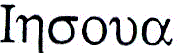
The angel Gabriel was not subject to Babylonian corruption through culture and time. No, Gabriel’s job was to deliver a message from the Father Himself. Woe unto Gabriel if he should alter it! Gabriel was a faithful messenger and delivered the original “Yahu” in Messiah’s name. The Messiah seemed as one who would restore Israel back to its former splendour when many used the element “yahu” in their names, before the Babylonian captivity. It is true that Yeshua was a common name in Israel in the time of Messiah, but YAHUSHUA was not.

If you were to have a son, and you being the parent, name your son Brent, and your neighbor comes along and says his name is Bert, you first try to be nice and cordial and reply to your neighbor, “we named him Brent”. But the neighbor says, “well, I named him Bert!” Then, you draw a breath and think for a moment. Then you try to explain kindly as possible to your neighbor, helping him to understand. “I am the parent, this is my son! I have named him Brent.” But the neighbor is quite insistent that his name is Bert. How would you begin to feel toward your neighbor? You know that he or she is out of line; this is your son and you named him. What to do?

This is the same situation our heavenly Father finds Himself in! He sent His angel Gabriel to Yoseph and Miriam; no human gave the name, not even Yoseph or Miriam, and woe to Gabriel if He should alter it!

The Saviour’s original name has been under serious attack, for Satan hates it.

Aquila was “celebrated for a very literal and accurate translation of the Old Testament into Greek.” Encyclopedia Britannica

He recorded the name Joshua in Greek as Iesoua (Iesoua), a perfect transliteration of the Hebrew Yeshua. This can be seen in Origen’s Hexapla in Deut. 1:38. This shows that it was at least possible for Greeks to transliterate correctly, it’s just that they wouldn’t. This form from Aquila is never noticed or mentioned by modern scholarship. Why?
If the Greeks were true to transliteration to begin with, we would never have had so much controversy concerning the Saviour’s name. But that’s just the way it is in this life, that truth must be controversial; for Satan, working through humans, has made error popular, and very credible and sometimes prestigious. Nevertheless, the long continuation of time cannot make error into truth.

Paul “spake boldly in the name of the Sovereign YAHUSHUA, and disputed against the Grecians: but they went about to slay him.” Acts 9:29

YAHUSHUA told Paul; “rise, stand upon thy feet: for I have appeared unto thee for this purpose, to make thee a minister and a witness both of these things which thou hast seen, and of those things in the which I will appear unto thee; delivering thee from the people, from the Gentiles, unto whom now I send thee, to open their eyes, and turn them from darkness to light, and from the power of Satan unto Elohim, that they may receive forgiveness of sins, and inheritance among them which are set-apart by faith that is in Me.” Acts 26:16-18

Paul further stated, “I was not disobedient unto the heavenly vision.” Acts 26:19

Scripture shows a bit of the controversy between truth and the Grecian name game, which existed in Paul’s day (see Acts 18:15).

Greek may have been the international language of the world, but it was not the national language used in Israel. Josephus, the Jewish historian, shows how learning the Greek language was discouraged in Israel. (Antiquities of the Jews Book XX chapter 11 par. 2)

Even the Bible shows how Greeks were despised by the Jews (Acts 21:28).

While our Saviour was upon this earth, He was called by the Hebrew name YAHUSHUA. Can you imagine the kind of look that would have come across the face of the priest in the temple if Mirium had told the priest His name is “Jesus”? It surely would have startled him, and would have thought that they were rebellious Jews trying to bring in the Greek culture. But when the priest heard YAHUSHUA, he must have pondered the greatness of the child to be named after the heavenly Father (meaning YAHUWAH’s Salvation).

“Neither is there salvation in any other: For there is none other name under heaven given among men whereby we must be saved.” Acts 4:12

The Germans, the Greeks, the Romans, the Spanish, the Britons, the Africans etc, are all under heaven.

If folks only knew how Satan hates the Saviour’s name and deliberately destroyed all the early manuscripts. The manuscripts had to either conform to Satan’s Grecian name game, or be destroyed. But the Truth can be discovered by taking the Bible as a whole; not surface reading, but digging as for hidden treasure. As veins of precious ore are hidden under the surface of the earth, so also are spiritual riches concealed in passages of Scripture, and it requires mental effort and prayerful attention to discover the hidden meaning of the Word of Elohim. Let every student who values the heavenly treasures, put to the stretch his mental and spiritual powers, and sink the shaft deep into the mine of truth, that he or she may obtain the celestial gold . . . that wisdom which will make us wise unto salvation.

Paul stated the reason people find themselves in a strong delusion, is “because they receive not the love of the truth, that they might be saved.” II Thes 2:10

Chawah (Eve) was not condemned for believing the lie of the serpent, rather she was condemned for not believing the truth. That is, not believing what Elohim had said.

Our hearts should naturally love the Saviour’s original name, simply because it is His name. How can we say we love Him, and have a bad attitude toward His original name! We ought to love Him for what He has done for us, and for who He is: YAHUWAH’s Salvation.

Paul spoke expressly that in the latter times men would be “ever learning, and never able to come to the knowledge of the truth.” II Tim. 3:7

The truth is the original; and what is not the original is a counterfeit.

“Acknowledging the truth which is after righteousness.” Titus 1:1

Paul told Timothy: “In meekness instructing those that oppose themselves; if Elohim possibly will give them repentance to the acknowledging of the truth.” II Tim. 2:25.

In other words, if we wish to show ourselves repentant toward our Creator, this can only be done by our acknowledging of the truth.

Chapter 18 / Index

                                         Chapter 18

                                                    The Two Witnesses

The historic application of the two witnesses were the Old and New Testament. Since the 1260 days (years) applied to the Dark Ages, then this view is not incorrect. But as the 1260 literal days pre-eminently apply to the last days just prior to the appearing of the Son of Man, then the Two Witnesses must also have another pre-eminent application for the latter days.

The Two Witnesses are also called “the two olive trees” and the “two candlesticks”, “that stand by the Sovereign of the whole earth.” Zech. 4:14. This title Lord or Adonai usually applies to the Son of YAHUWAH throughout the Old Testament. Since YAHUSHUA is in the heavenly sanctuary, it stands to reason that these two witnesses are also represented in the earthly sanctuary, which served unto the example of heavenly things (Hebrews 8:5), thereby locating them in the heavenly sanctuary, standing by YAHUSHUA. Zechariah stated: “These are the two sons of oil.” Zech. 4:14 margin KJV.

In YAHUWAH’s temple, made by Solomon, the Scripture states that “within the oracle he made two cherubim of olive tree (ring a bell?) each ten cubits high.” (I Kings 6:23) The margin states the Hebrew more accurately “trees of oil”.

Moses is in heaven, and Eliyahu is in heaven, and evidently they have a work that they do there. From reading Zechariah 4:12, they possibly produce oil which keeps the seven branched candlestick burning. “Oil for the light.” Ex. 25:6. The seven branched candlestick represents something in heaven. It says within Hebrews 8:5…

…as Moses was admonished of Elohim when he was about to make the tabernacle: “for, see” saith He, “that thou make all things according to the pattern shewed thee in the mount.”

The candlestick represents “the seven spirits which are before His throne.” Rev 1:4. “The seven spirits of Elohim (are) sent forth into all the earth.” Rev. 5:6. “Who maketh His angels spirits; His ministers a flaming fire.” Psalm 104:4.

Now, the Three Angels Message are not three literal angels, but three proclamations, messages and/or movements; but it is the people who give them. This is possibly also the case with the two witnesses. It is a message or proclamation and/or movements; people with a certain message. What was the message of Moses? The prophet Malachi gives us some insight, “Remember ye the law of Moses My servant, which I commanded him in Horeb for all Israel, with statutes and judgments. Behold, I will send Eliyahu the prophet before the coming of the great and dreadful day of YAHUWAH.” Malachi 4:4, 5. Strange how he mentions both of them together like this. Eliyahu is known for the set-apart name showdown upon Mt. Carmel, where the people of Elohim were tricked by their religious leaders to call upon a common title (Baal means Lord – Hosea 2:16 margin), thus they could be in ecumenical harmony with the churches around them. But Eliyahu burdened with a message of restoration of the true worship, thus acknowledging, praising and honoring the Creator’s majestic name.

And Eliyahu came unto all the people, and said, “How long halt ye between to opinions? if YAHUWAH be Elohim, follow Him: but if haBaal (the Lord), then follow him. And the people answered him not a word.” I Kings 18:27

If this true worship is followed, it shall turn the heart of the fathers to the children, and the heart of the children to the fathers. If the message is not received, I YAHUWAH will smite the earth with a curse. (Malachi 4:6)

“These have power to shut heaven, that it rain not in the days of their prophecy: and have power over waters to turn them to blood, and smite the earth with all plagues, as often as they will.” Revelation 11:6. This passage is a wide open hint to who the Two Witnesses are! Read it again! Does it ring a bell? Remember that it didn’t rain in the days of Eliyah? Remember the plagues of Egypt with Mosheh?

The Two Witnesses are the Two Sons of Oil. So how does the oil tie in with the message? Consider the following passages carefully!

Your name is as oil poured forth, therefore do the (wise) virgins love you.” Song of Solomon 1:3 ASV. Thus the names of the Father and His Son are likened unto oil. “A good name is better than precious oil.” The Parson 7:1 ASV

“Oil to make his face to shine.” Psalm 104:15 “Wisdom maketh his face to shine.” The Preacher 8:1 Thus oil is also likened unto “wisdom”. What does Scripture associate with wisdom? Moses said concerning the statutes and judgments: “this is your wisdom and your understanding in the sight of the nations.” Deut. 4:6. Also “the man of wisdom shall see Thy name.” Micah 6:9.

There isn’t that much problem with folks acknowledging the statutes, except when it comes to the Feast Days, and because folks wish not to embrace the Feast days as part of the covenant given at Mt. Sinai (see Exodus 23:14-17), they feel that they must try to rationalize away not only the Feast days, but all the statutes, since they rise and fall together [Note, the animal sacrifices were not given on Mt. Sinai, but from the cloudy pillar above the tabernacle later on, see Lev. 1:1 and onward]. Therefore you could sum up the Two Witnesses, Moses and Eliyahu, in the two messages, “the Set-Apart name and the Feast days.”

Moses admonished the children of Israel to observe the statutes and judgments “that ye should do so in the land whither ye go to possess it.” Deuteronomy 4:5. A type of entering heaven! Today this same message is designed to prepare modern Israel to enter the Promise Land (the New Earth). “And they that love thy name shall dwell therein,” Ps. 69:36. As men, women, and children proclaim the good news, YAHUWAH will open the eyes of the blind to see His statutes. The animating Spirit of Elohim, working through human agencies, leads the believers to be of one mind, one soul, unitedly loving Elohim and keeping His commandments—preparing here below for translation. This is what the angel of Revelation 18 will accomplish.

Moses told, in the plainest of speech, “My doctrine shall drop as the (latter) rain, my speech shall distill as the dew . .. Because I will publish the name of YAHUWAH: ascribe ye greatness to our Elohim.” Deut. 32:2, 3

It remains to be seen if these Two Witnesses actually come from heaven and walk among men. That possibility does exist; they did appear upon the mount of transfiguration with YAHUSHUA (Matthew 17:2). It probably would not be necessary, since we have the writings of Moses and the prophets. If we do not believe them, neither would we be persuaded though one rise from the dead.

The Scripture has already foretold that the majority will reject their messages, yet because they are messages of truth, they will triumph and rise again. Let Scripture be true and every man a liar, “that the testimony of two men is true.” John 8:17

Chapter 19 / Index

Chapter 19

Power of the Set-Apart Name

“He came unto His own, and His own received Him not. But as many as received Him, to them gave He power to become the sons of Elohim, even to them that believe on His name.” John 1:11, 12

Even the seventy disciples of YAHUSHUA testified, saying, “Master, even the devils are subject unto us through Thy name.” Luke 10:17

The Set-Apart Name messages will be one of the most powerful messages here in these last days. How do I know? The Scriptures are full of types and their anti-types. Paul said, “All these things happened unto them for ensamples [or types, margin]: and they are written for our admonition, upon whom the ends of the world are come.” I Corinthians 10:11

Remember David, the shepherd boy, he came to bring some food to his brothers who were fighting against the Philistines. But lo, they had stopped fighting against the Philistines because of a big giant, called Goliath. David said, “Who is this uncircumcised Philistine, that he should defy the armies of the living Elohim?” I Samuel 17:26

So, to make a long story short, David took his sling and picked up five smooth stones, (of course he only needed one).

Goliath makes a death decree upon David and cursed David by his Elohim. (I Samuel 17:43,44). David overlooked these threats by faith and says, “Thou comest to me with a sword, and with a spear, and a shield: but I come to thee in the Name of YAHUWAH of hosts, the Elohim of the armies of Israel, whom thou hast defied ” I Samuel 17:45.

What happened? David put one little stone in his sling, and the sling went round and round and round and round, and one little stone went up in the air and the giant came a tumbling down!

This “stone” represents what? The Set-Apart Name! This was the stone that was set at naught by the soldiers.

“Because I will publish the name of YAHUWAH: ascribe ye greatness unto our Elohim. He is the Rock.” Deuteronomy 32: 3,4

“Their rock is not our Rock.” Deut. 32:31. For they literally worship rocks, which is an abomination (Rev. 9:20). David took what represented the set-apart name and hurled it right into the forehead of the giant. What happened? He died! The giant represents who? That’s right, the Devil!

Martin Luther wrote in his song, “A Mighty Fortress” (compare Proverbs 18:10): “And though this world, with devils filled, should threaten to un-do us, we will not fear, for (YAH) hath willed His truth to triumph through us. The prince of darkness grim, we tremble not for him; his rage we can endure for lo his doom is sure, one little word shall fell him.”

That one little word which will overthrow the Devil is the SET-APART NAME. (“In My name shall they cast out devils.” Mark 16:17)

Nimrod the mighty hunter, who also represents the Devil, was a threat to the inhabitants of the then known world. His system of religion was in defiance of heaven, but it was “Shem” (Whose name in Hebrew means name) that slew Nimrod, that giant of a man! (see The The Two Babylons p. 63-66). Again we sec how the name overthrew the giant.

When Kepha and John were asked, “By what power, or by what name have ye done this?” Kepha replied, “By the name of YAHUSHUA the Messiah of Nazareth … This is the stone which was set at naught of you builders (reformers), which is become the head of the corner.

“Neither is there salvation in any other: for there is none other NAME under heaven given among men, whereby we must be saved.” Acts 4:7, 10-12

All of these Old Testament stories point to a greater event about to happen! There is this great big giant image, which was in the making all the way back from Babylon, Media-Persia, Greece, Rome, and the ten divisions of Rome.

Daniel said to king Nebuchadnezzar, “Thou art this head of gold. And after thee shall arise another kingdom inferior to thee (which was Media-Persia see Dan. 5:31) and another third kingdom of brass, which shall bear rule over all the earth.” Daniel 2:39. Which kingdom conquered Media-Persia? That’s right, Greece! Daniel 8:20,21.

The fourth kingdom, we all know, was the Roman empire; and the ten toes, part of iron and part of clay, are the ten divisions of Rome.

Hitler nor Napoleon could ever conquer all of Europe because of these very words of Scripture: “they shall mingle themselves with the seed of man: but they shall not cleave one to another, even as iron is not mixed with clay.” Daniel 2:43. That is powerful! That is why Europe is not united even now! The New World Order will never be completely set up because of these words.

As the New World Order pushes to be completely set up, and becomes partly strong, YAHUWAH will pour out plagues, and it will be partly broken (Dan. 2:42)

Watch out for that stone! It’s coming! Boom! Smash!

“A stone was cut out with out hands, which smote the image upon his feet that were of iron and clay and brake them in pieces.” Dan. 2:34

The authority of the Kingdom of YAHUWAH “shall never be destroyed: and the Kingdom thereof shall not be left to another people, but it shall break in pieces and consume all these kingdoms, and it shall stand forever.” Daniel 2:44 margin

“For as much as thou sawest that the stone was cut out of the mountain without hands, and it brake in pieces the iron, the brass, the clay, the silver, and the gold; the great Eloah hath made known to the king what shall come to pass hereafter: and the dream is certain, and the interpretation thereof is sure.” Daniel 2:45

So let us identify ourselves with this Rock, the Set-Apart Name, the Name “of whom the whole family in heaven and earth is named.” Ephesians 3:15. The Kingdom of YAHUWAH!

“Whosoever shall fall upon that stone shall be broken; but on whomsoever it shall fall, it will grind him to powder.” Luke 20:18

The Scripture hath said, “The wicked are not so (like a tree planted by the rivers of waters, who meditate in the law day and night), but are like the chaff which the wind driveth away. Therefore the wicked shall not stand in the judgment, nor sinners in the congregation of the righteous. For YAHUWAH knoweth the way of the righteous: but the way of the wicked shall perish.” Psalm 1:4, 6

Let us not occupy the seat of the scornful concerning the set-apart name. Whoever thought the Name was vain?

Christendom (Babylon) is mad upon their idols, but the set-apart name will overthrow Babylon.

Chapter 20 / Index

 Chapter 20            Publish the Name of Yahuwah

When YAHUWAH roars out of New Jerusalem (Jo-el 3:16), and shakes the heavens and the earth (Hag. 2:6) and delivers the everlasting covenant to His people on Judgment day (literally speaks the Ten Commandments), which name will He use to identify Himself? Jehovah? Which no one heard of before 1500 of the current era. Yahweh? The Greek version! Or, Yahvah? Or, will everyone hear the pronunciation they like best. Are we so slow to understand that truth is eternal?

“Every new truth has made its way against hatred and opposition; those who were blessed with its light were tempted and tried. (YAHUWAH) gives a special truth for the people in an emergency. Who dare refuse to publish it? He commands His servants to present the last invitation of mercy to the world. They cannot remain silent, except at the peril of their souls.” Great Controversy p. 609

From the conclusion of this book, the Father will utter the only name sustained by taking all of Scripture into account on the subject, the proof drawn from Scripture alone! Which is YAHUWAH, that all will hear on Judgment day, like it was on Mt. Sinai.

Moses said, “Because I will publish the name of YAHUWAH: ascribe ye greatness unto our Elohim.” Deuteronomy 32:3.

How can we “give glory unto Him” if we refuse to ascribe greatness unto our Elohim by refusing to publish the name of YAHUWAH?

“For You have made great Your Word, Your Name, above all.” Psalm 138:2 (ISR). Every point has been made by using Scripture alone.

“The Sovereign gave the word”, may the next portion of the verse be fulfilled in your life, “great was the company of those that published it.” Ps. 68:11

Therefore publish the name of YAHUWAH in the books, the Bibles, the hymnals, tracts. “Say among the heathen that YAHUWAH reigneth.” Psalm 96:10

“YAHUWAH reigneth; let the earth rejoice; let the great isles be glad thereof.

“Confounded be all they that serve graven images, that boast themselves of idols: worship him, all ye elohim.” Psalm 97:1

“Fear YAHUWAH, give honour unto Him for the hour of His judgment is come.” Rev 14:7.

“Give unto YAHUWAH the honour due unto His name.” Ps. 29:2

“O magnify YAHUWAH with me, and let us exalt His name together.” Psalm 34:3

“Let them praise thy great and terrible name; for it is set-apart.” Psalm 99:3

May the praise to YAHUWAH swell from nation to nation, from island to island, from hill to hill, till the whole world resounds with praise and glory due to His holy name.

HalleluYAH!

By B. Earl Allen

References

1) The Encyclopedia of Religion & Ethics ed. James Hastings p. 223

2) Come Out of Her My People by Chris Koster

3) Mythology Folklore & Symbols

4) Funk & Wagnal’s Encyclopedia (1934) under V

5) The Scriptures, by the Institute For Scripture Research

6) The New 20th-century Encyclopedia (2nd Ed.) of Religious Knowledge p. 886

7) Journal of Biblical Literature Vol. 1xiii, 1944, p. 161

8) The New Catholic Encyclopedia, Vol. 14 p. 1065

9) The New 20th Century Encyclopedia (2nd Ed.) of Religious Knowledge p. 886

10) A Pilgrim in Europe and America Vol. II p. 151 byJ.C. Beltrami (1828)

11) Book of the Hopi by Frank Waters

Index


Anoint, Anointed & Anointing Pt.1 & 2


Published on Feb 5, 2015

This is a shorter version for MP3 audio recording of Pt.1 & 2.of the message Messiah,Messia’s, Mashiyach, or Christ-Christo-Khristos, revealing the Hebrew understanding of each word and the Greek root words found in part 3, this is a video of a compressed copy short version. But to get a more fuller understanding watch Part 1.& 2. by Eliyahu

Messiah,Messia’s,Mashiyach,vs Christ,Khristos Pt.1 & 2

Published on Feb 8, 2015

This is the full edited Version of Part 1 and 2 of the Teaching on the topic word study with detail depth Hebrew words Viewed on screen of Anoint, Anointing & Anointing for the Mashach,Mashiyach,Moshiyach different types of Anointings in our Hebrew scriptures Naturally Automatically understood by Hebrew readers of what each word means, and what does the word in Latin Christ Christo and Kristos in Greek really mean ??
come and join us to find out how many are divided because of a lack of Knowledge.by Etymologist Eliyahu.

Messiah,Messia’s,Mashiyach vs Christ Khristos Pt.3

Published on Feb 9, 2015

Part 3 full edited version for MP4 & MP3 copies, of the completion of the message; Messiah,Messia’s,Mashiyach or Christ-Kristos, and whats the difference of the words-Messiah- Mashach- Moshiyach-Anointings, in the Greek, and what does Yahushua-Yahusha-Have to Fulfill and finish for all the House’s of Yisrael and Yehudim to accept Him as their Messiah. and why they don’t at this moment except any scriptural insight of Yahushua as their messiah, and what scriptural standing they stand on to not except Yahushua as the Messiah of Yisrael come and watch this detail verse by verse teaching exposing what has mislead many from the off shoots of Catholicism and in all forms of Christianity that don’t recheck what they have learned from whom they call the forefathers of their belief.


Principalities & Powers Exposed Pt.1

Principalities & Powers Exposed Pt.1

Published on Feb 13, 2015

This video by Etymologists Eliyahu is a edited remix of a old video with old words He does not use any more but is still Tov to share with others that are coming out. Eliyahu exposes the words commenly used by most religious groups today-and how words of the Principalities have slipped into the English language in Greek-Latin-Germanic-forms over clean Greek words and some not so clean to get the believers to speak their language of the rulers of this age controlling the education systems around the world. we’re exposing the strong holds on our tongue and words that show the fruit of these rulers of darkness active in the places’s of religious groups of worship on all sides of the fence and as Followers of Yah we need to be the called out ones to have a clean lip and tongue as a example for others and to fight these Principalities with the clean Hebrew words to have more authority in our prayers.

          Principalities & Powers Exposed Pt.2

                             https://www.youtube.com/watch?v=gi1Sk0kc2vE


Published on Feb 16, 2015

Part 2 of a teaching done years ago is so up to date of what’s happening right now in the spirituality of society so we remixed it with Greek and Hebrew words for a powerful message to the Fallowers of Yah to walk in this end time Anointing and Power of the Ruach of Yahuah against the evil principalities operating in the religious systems of today, Come and join in to hear this message with a live audience in the Upper room at Eagles Haven Congregation with Elder and Etymologist Eliyahu.

Do We Really Know the Pronunciation?

Study compiled by YermeYah

http://yahushua.net/YAHUWAH/preface.htm

Below is the name of the Almighty written in Hebrew. It seems to be an accepted fact that the correct pronunciation of His name is “Yahweh”. This is apparently so because “most scholars” say that this pronunciation is correct. But what are the facts?

YHWH 

Do We Really Know the Pronunciation?

Proverbs 25:2 It is the honor of the Almighty to conceal a thing; But the honor of kings is to search out a matter.

Biblical Hebrew is a difficult subject for most of us. We therefore usually rely on research done by others, and trust that their conclusions are correct. When something is controversial, like the origin of the heavenly Father’s name, most of us usually accept the conclusion of those scholars who are in the majority, without actually checking out their research for ourselves. Why is this? The reason seems to be that people are intimidated by the technical nature of ancient Hebrew. But, does this need to be the case? Let’s take a look at the facts surrounding the Heavenly Father’s Name…

In Strong’s Concordance, it states that (YHWH), Hebrew 3068, comes from the verb root hyh (hayah), Hebrew 1961 [the verb “to be”]. That is impossible however, since the tetragrammaton would then be spelled *yhyh *(yhyh) instead of YHWH (YHWH). [*third person masculine singular imperfect form]

The Theological Word Book of the Old Testament (word #484) says that hwh (hawah) is the older form of this verb root. In the same article, it says, “An alternative of the pronunciation of the tetragrammaton should be mentioned. Actually, there is a problem with the pronunciation “Yahweh.” It is a strange combination of old and late elements. The first extra-biblical occurrence of the name is in the Moabite Stone of about 850 b.c. At that time, vowel letters were just beginning to be used in Hebrew. If (YHWH) represents a spelling earlier than 900 b.c. (as would seem most likely), the final h (h) would have been pronounced.”

The pronunciation Yahweh indeed comes from the verb root hwh (hawah), but this is not the most ancient form of the verb “to be”. Prior to this, the verb  was spelled hwy (hwy). This root also would be impossible for the tetragrammaton, since it would give a spelling of yhwy (yhwy) instead of (YHWH).

In the “Biblical Archaeology Review” of Sept – Oct ’94, Anson F. Rainey, a professor of Semitic linguistics at Tel Aviv University, confirms this. He states, “A form like yahweh developed from yahwiyu [yhwy]” (editor’s note: Yahwiyu is a hypothetical pronunciation).

It can be seen that Anson Rainey shows, by implication, that the Hebrew spelling of the tetragrammaton was originally different than it is at present. This however, would not be in line with the statement found at Exodus 3:15. Here, says…

“this [YHWH] is my name for ever, and this is my memorial unto all generations.”

In the book, “A Grammar for Biblical Hebrew” by C.L. Seow, it states that nouns with an “eh” ending originally ended with a (w) or a (y).

Since we do not believe that the name of the Almighty has changed in spelling or pronunciation, we do not believe that his name can have the pronunciation of yahweh. In other words, even though words in the Hebrew language have changed or evolved, we do not believe that this is true of the Heavenly Father’s name. Also, even if it were possible for the spelling of the tetragrammaton to have changed, the pronunciation still would not have originally been yahweh.

Another excerpt from the Theological Word Book of the Old Testament, under #484, says: “The “w” of Yahweh, represents a pre-mosaic pronunciation but the final “eh” represents probably a post-davidic form. In view of these problems it may be best simply to say that (YHWH) does not come from the verb hwh (hawah) (presumably hwy hawaya in its early form) at all. There are many places in the OT where it is now recognized that the parallel of a name and its meaning is not necessarily etymological. For instance, 1st Samuel 1:20 probably does not mean that the name Samuel is derived from the verb‘shama’ “to hear.” Genesis 11:9 does not mean that Babel comes from the verb babel “confusion” but only that the two words sound something alike. Likewise Jacob is said to mean both “heel” (Gen 25:26) and “supplanter” (Gen 27:36). There are many other examples of this device which is to be taken as paronomasia, a play on words, rather than an etymology. Therefore, we may well hold that YHWH does not come from the verb hawa which is cited in the first person ‘ehyeh’ “I will be, “but is an old word of unknown origin which sounded something like what the verb hawa sounded in Moses’ day. In this case we do not know what the pronunciation was; we can only speculate. However, if the word were spelled with four letters in Moses’ day, we would expect it to have had more than two syllables, for at that period there were no vowel letters [written]. All letters were sounded”. [including the final hei.gif (866 bytes) (h), whereas the final “h” in the pronunciation “Yahweh” is silent, meaning that it is used as a vowel]

So what about the pronunciation Yahweh?

In our search for truth, we do not want to leave any stone unturned. The following information is something that needs to be prayerfully considered. 

In Roman mythology, the idol “Jupiter” is the same as the idol “Zeus” in Greek mythology. According to Latin grammar, Jove is the ablative case of Jupiter. In Classical Latin, the pronunciation of Jove (Iove) is Y-A-W-E, with the “j” (i) sounding like a “y”, the “o” being a short sound [like the “o” in “Bob”] the “v” sounds like a “w”, and the “e” sounds like “eh”. These sounds can be verified at the following sites: 

Latin Pronunciation one

Latin Pronunciation two

The Oxford Latin Dictionary, under the heading “Iuppiter” [Jupiter] shows that it originates from dieu = god, pater = father with other Latin forms dies, deus [Greek “Zeus”]. This dictionary spells Jove as 4 vowels “Ioue”, which is reminiscent of Josephus’ claim of the tetragrammaton being 4 vowels [supposedly Iaue].

The following is taken from an article entitled, “Paradox of the Anonymous Name” by Gérard GERTOUX, a Hebrew scholar in France, a specialist of the Tetragram; He has been president of the Association Biblique de Recherche d’Anciens Manuscrits since 1991…

Flavius Josephus, who understood the priesthood of this time very well, made it clear that at the time the Romans attacked the Temple, the Jews called upon the fear-inspiring name of [Elohim] (The Jewish War V:438). He wrote he had no right to reveal this name to his reader (Jewish Antiquities II:275), however he did give information of primary importance on the very pronunciation he wanted to conceal. However, in his work The Jewish War V:235 he stated: «The high priest had his head dressed with a tiara of fine linen embroidered with a purple border, and surrounded by another crown in gold which had in relief the sacred letters; these ones are four vowels» This description is excellent; moreover, it completes the one found in Exodus 28:36-39. However, as we know, there are no vowels in Hebrew, but only consonants. Regrettably, instead of explaining this apparent abnormality, certain commentators (influenced by the form Yahweh) mislead the readers of Josephus by indicating in a note, that this reading was IAUE. Now, it is obvious that the ‘sacred letters’ indicated the Tetragram written in paleo-Hebrew, not Greek. Furthermore, in Hebrew these consonants Y, W, H, do serve as vowels; they are in fact called ‘mothers of reading’ (matres lectionis). The writings of Qumrân show that in the first century Y used as vowel served only to indicate the sounds I and É, W served only for the sounds Ô and U, and a final H served for the sound A. These equivalences may be verified in thousands of words. Additionally, the H was used as a vowel only at the end of words, never within them. So, to read the name YHWH as four vowels would be IHUA that is IEUA, because between two vowels, the H is heard as a slight E. 

The preceding was taken from an article entitled “Paradox of the Anonymous Name”, located at:

http://digilander.libero.it/domingo7/Gertoux.htm 

A translation of the Bible called, “The Word of Yahweh” (first edition), from the Assembly of Yahweh, in Eaton Rapids, Michigan, has the following footnote. It is found on page 1106 and is a footnote for Acts 14:12. It is footnote #81 and is for the word “Jupiter”. It reads as follows:

The Greek text has Zeus here. Some English translations say Jupiter, which is Latin. The Aramaic text says, “Mariah Elaha”! It is interesting to note that “Jove” is another name for Jupiter, and would be written “IOUE” [Latin], which is close to “IAUE” [Greek]. Josephus, a historian of Yahshua’s time, said that the name of our Heavenly Father is written as four vowels: “IAUE”!

So, what we have established thus far, is the fact that the original pronunciation of the Heavenly Father was probably not “yawe or yaway”, whereas the pronunciation of “Jove”, the idol of the Romans, was very likely pronounced “yawe or yaway”. We need to prayerfully ask for wisdom concerning this matter.

What is the Correct Pronunciation?

If the name is not from the verb root hwh (hawah), how should it then be pronounced? It is a fact that anciently, each of the 4 letters of the Tetragrammaton would have been pronounced as consonants, with the final H (hei) being sharply audible (Weingreen, author of, “A Practical Grammar for Classical Hebrew”).

The question is, what vowels accompanied these 4 consonants? It says in Gesenius’ Hebrew Grammar, Page 35, Section 7:1, “The original vowels in Hebrew [understood, not written], as in the other Semitic tongues, are a, i, u. [The vowels] e and o always arise from an obscuring or contraction of these three pure sounds.”

Therefore, since the name YHWH is the most ancient of all names, it seems unlikely that it would contain either of the vowel sounds ‘e’ or ‘o’.

It also shows in biblical Hebrew Grammar books that gutturals (such as h) have a preference for an “ah” vowel before them, and sometimes after them (see: A Grammar for Biblical Hebrew p.280). There is strong evidence for “Yah” at the beginning of . The form YHU (YaHU) is often found at both the beginning and ending of many ancient personal names in Hebrew. The pronunciation YaHuWaH is a definite possibility. The only way to be sure however, will be for Almighty Himself to reveal it. We hope that you will commit this matter to serious prayer.

In conclusion, let us keep in mind, that however we pronounce the tetragrammaton, the most important thing for us to do, is to show that we love YHWH by keeping his commandments: 

Psalm 111:10 The fear of YHWH is the beginning of wisdom: a good understanding have all they that do his commandments: his praise endureth for ever.

Study compiled by YermeYah

Another study about the pronunciation

Questions or Comments

Home

Last updated: 4th day, 2nd month, 2007


The Branch Crown Kohan Yahushua

Published on Jan 25, 2015

Etymologist Eliyahu shares this message showing the detail of Zach. chapters 3,4,5,6: and the Hebrew depth of the Naba of the Mashiyach’s Name then and Now totally related to the Hebrew No3.h3091 and  G2424,Yahushua-Yahusha, and the simple understanding of the normal Hebrew words for Salvation,save,saved,saving,etc.
commonly used in Yisrael in our everyday conversation still today, and how in Israel they pronounce the name for Joshua in Hebrew. This video is a Hebrew and Greek in depth teach that will help one coming out of the J word religious systems of today have a solid Foundation and Emunah in the stand in our one and only Hebrew Mashiyach Yahushua.

https://www.youtube.com/watch?v=xEJuUG1N5F8

Etymologist And researcher Eliyahu show’s the details of His Name from Luke 1:31,2:21; Not jesus iesus G2424 Roman Catholic to H3091 Joshua English, to Yahushua, How most Christians Preachers miss the fact that Moses Mosheh change Hoshea= H1954 name to Yah=H3068 short YaHH=H3050 to equal=H3091= Ye^H Oshea Yahushua .A powerful in-depth teaching showing the Greek and Hebrew comparison and looking carefully at the Phonetic sound of the correct spelling and the correct sound of His Name Shem. from Greek 2424 to h3091 And how religious leaders are still teaching Preconceived ideas with out checking for themselves. We do not put down any one that is using Latin letters to speak our Messiah’s true Name and say that one group is better then the other on their spelling with love we need to be in Unity as we come out of the pagan name iesus.

To learn the real name of our Savior, go look at the Hebrew letters for the spelling of “Joshua”:  yod-hay-uau-shin-ayin    (It isn’t rocket surgery you know). Both had the Hebrew name:  YAHUSHA (spelled twice in the TaNaK as YAHUSHUA).  The Greek alphabet cannot transliterate this word, and “Latinizing” the Greek form only makes it freakier.  The Name of our Savior contains the Name of our Creator, because He is our Creator, and His Name is His identification (His identity is wrapped-up in His Name. 

YAH  = “I am”  . . .   so, Yahusha (or Yahushua) literally means “I am your salvation” as well as “Yah is our salvation”.  He is the everlasting Father,  and El Shaddai (Is. 6:9, Rev. 1).

    The Savior is in fact the Being that revealed His Name as Yahu(vv)ah  —  there’s no argument there in the least (He is the “Alef and the Tau”).  We use the spelling Yahusha or Yahushua because it states the Name and function or role the messenger Gabri’el provided.   We find that Scripture records the practice of giving names, and commonly the chosen name will provide a description or attribute of the individual.    Because Gabriel included the phrase, “for he shall save his people from their sins”, it is obvious that there was a distinctive meaning in the Name carrying the idea of salvation, from the root yasha.  Also, the Name chosen aligns with the meaning of the name of the man that brought Israel into the promised land (called Joshua by tradition).
The Greek texts at Hebrews 4 and Acts 7 both indicate the spelling to be identical for both the Mashiach and the successor of Mosheh:  IESOUS (in the Greek letters).  Therefore, all we have to do is go to the Hebrew texts, find the spelling of the name of the man that succeeded Mosheh, and we have found the Savior’s Name perfectly preserved  ~  and based on the texts of Shemoth (Exodus).  Logical deduction brings this out.   The Name “Yahushua” describes the FUNCTION or ROLE that our Creator has become. To ignore this function/role, we have to overlook the phrase included by Gabriel when the Name was given:
 
 “But while he thought on these things, behold, the angel of (Yahu(uu)ah) appeared unto him in a dream, saying, Yoseph, you son of David, fear not to take unto youMiryam your wife: for that which is conceived in her is of the (Ruach haQodesh).  And she shall bring forth a son, and you shall call His Name (Yahushua):  for he shall save  (DELIVER) his people from their sins.   Now all this was done, that it might be fulfilled which was spoken of (Yahuwah) by the prophet, saying,
‘Behold, a virgin shall be with child, and shall bring forth a son, and they shall call his name Emmanuel’, which being interpreted is, (Eloah) with us.
Then Yoseph being raised from sleep did as the angel of (Yahu(uu)ah) had bidden him, and took unto him his wife:  And knew her not till she had brought forth her firstborn son: and he called his name (Yahusha).”    Matt 1:20-25

“Yeshua” Or “Yahushua”?   “Joshua” isn’t quite right; and “Yeshua” is still pretty far off, because Gabriel’s explanation of the Name at Luke 1:21 describes the function (salvation) along with Who is providing that salvation.

You will soon learn that the form “JESUS” is derived directly from “YESHU“, explained below.   What “YESHU” means will change your thinking about this radically.   In the Talmud, unbelieving Yahudim hatefully recorded the Name of the Mashiach of Yisrael as “YESHU”, often seen spelled today as “Jeschu”.

Q:    Where did we get the form “JESUS” from?

A:   The Jesuits    (They defend the form using the Greek and Latin, hoping you’ll never discover what you are about to read):   

The form “YESHUA” is from the acronym “YESHU”, a mutilation of Yahushua’s Name used by unbelieving Yahudim during the late 1st and 2nd century CE.    The letters in “YESHU” stood for the sentence, “may his name be blotted out”  (from the scroll of life).    This “Yeshu” acronym is the real root of the form “JESUS”, after going through Greek, then Latin:

YESHU   (remember, this is an acronym, meaning “may his name be blotted out”, referring to the scroll of life).   A rabbinic word-play, from the original Hebrew words:

“Yemach Shmo u‘Zikro”    NOTE:   There’s not actually a letter “W” in the Hebrew alef-beth;  the letter “W” is a rather new letter to our own alpha-beta.   It’s called a “DOUBLE-U” for a reason;   our letter “U” is a perfect match with the sixth letter of the Hebrew alef-beth, now called a “WAW”.   (More accurately a “UAU”). 

Acronyms are abbreviated messages, like “SCUBA” stands for “self contained underwater breathing apparatus”.

YESU   IESOU  –  Going into Greek, the letter “Y” became an IOTA because Greek has no “Y”;   also, the sound of “SH” was lost, because Greek has no letters to make this sound.      The letter combination “OU” is a diphthong, arising from the Greek attempt to transliterate the sound “OO” as in “woof”.   Our letter “U” and the Hebrew letter “WAW”  does this easily. JESU is used also.

YESOUS  IESOU  took on an ending “S” to form IESOUS, since the Greek wanted to render the word masculine with the ending “S”.  Going to Latin, the diphthong “OU” became “U”.

JESUS  In the early 1530’s, the letter “J” developed, causing a tail on proper names beginning with the letter ” i “, and words used at the beginning of sentences.   This “J” is really the letter “IOTA”.   Many European languages pronounce “J” as the letter ” i “, or a “Y” sound.   They even spell Yugoslavia this way:  “Jugoslavia”.

Now you know.   Tell everyone you know, and don’t allow the Jesuits to succeed at this horrifying deception.   Yeh-Zeus is not our Messiah;    (The true name, Yahushua, means Yah-is our-salvation)

To see the reactions of seminary-trained men on this topic, read them at:   www.fossilizedcustoms.com/critic.html 

*YahuwehShua:  This is a form being seen recently among many Natsarim, and would be difficult if not impossible to find in the TaNaKh or any other Hebrew texts, although it is essentially exactly what “Yahushua” means and stands for, “Yahuah is our salvation”.  If it were to exist in Hebrew, it would be spelled like this: 

YOD-HAY-UAU-HAY-SHIN-UAU-AYIN, or

YOD-HAY-UAU-HAY-SHIN-AYIN

There is no letter “W” in the Hebrew, since the letter “double-U” came into existence in western Europe during the 13th century, and even then only in certain areas;  Sweden just added the letter “W” to their alphabet in 2007, even though the rest of the world has been spelling their country with the letter for centuries.  The words they use this letter in are borrowed from other languages.  The Hebrew letter commonly seen as “waw” is more accurately expressed as a “UAU”, since it conveys the sound of “U”, and sometimes “O”.  When the letter “hay” is followed by a “uau”, the sound is to be “OO”, as we hear in “hallelu Yah”.  That “u” sound you hear in “hallelu Yah” is the letter “uau”.

Certainly, Yahuah is our salvation, our only Savior, for He Himself took on the form of human flesh, offering that flesh as atonement for all the sins of mankind, once for all.  Yahushua revealed the Father to us, and His chasid (lovingkindness) that endures forever.

1Th 4:8   “Therefore he who rejects this does not reject man, but Elohim, Who also gives us His Set-apart Spirit.”

Col 1:12-15:    “. . . giving thanks to the Father who has made us fit to share in the inheritance of the set-apart ones in the light, Who has delivered us from the authority of darkness, and transferred us into the reign of the Son of His love, in whom we have redemption through His blood, the forgiveness of sins, Who is the likeness of the invisible Elohim, the first-born of all creation.”

When I began researching the tetragrammaton, all the resources pointed to the Jewish Encyclopedia as their credibility.
This also is the source for their comments regarding the statements like “the actual pronunciation has been lost” . . . .  and other comments about how it should NEVER be uttered aloud.   Then, the Jewish Encyclopedia declares that “YAHWEH” is perhaps the closest rendering that can be made, given what we know now. 
But, as I went to the Hebrew alef-beth to learn how to make the letter sounds for different words, I discovered that the letter that is CALLED “waw” by name is really more like our letter “U”. 
The thing is, the Hebrew alef-beth has no letter “W” (double-U)  –  the letter “W” is less than 400 years old itself.  This made me ponder why they would divert the four letters (which Yosephus declares are VOWELS), so as to be impossible to pronounce by inserting a letter that never existed, nor does it exist now, in the Hebrew.  There’s simply no letter “W”.
So, I asked myself why might this be.  AH!  They don’t want anyone pronouncing the true Name!   And, the authors of the articles in the Jewish Encyclopedias are JEWISH ORTHODOX RABBIS, who revere the TALMUD, which prescribes the death-penalty for uttering the Name aloud.
Then, it was simply a matter of looking at all the situations where the letter we call “waw” is used in other Hebrew words.  We see the “waw” in the phrase “hallelu Yah”, where the “u” is this letter. 
Also, in the spelling of the tribe known as “Yahudah”, the same letter is giving us that “u” sound.  The letters are symbols for SOUNDS.
The secret is simple:  “YAHUDAH” is spelled YOD–HAY–UAU–DALETH–HAY.
Notice the four letters in this five-lettered word.   It’s as simple as saying “YAHUDAH”, without the sound of the letter “D”:  YAHUAH.
With no letter “W”, it’s amazing these “scholars” managed to pull this fraud on so many people for so long, eh?

Further study of the original letters:  palaeo-Hebrew, Babylonian-Hebrew, and Greek transliteration:

The question was posed,   “Can we transliterate Messiah’s Name (Yahshua) back into the Greek?”

   The answer to this question is, not accurately;  but let’s investigate why that is.    Going through the motions will help us appreciate the difficulty getting alphabets to interface with one another, and perhaps help emphasize the importance of putting our trust in the original autographs, not the transitional language of Greek.   Mashiach Yahushua was not given a Greek name, but a well-recognized Hebrew Name, yod-hay-uau-shin-ayin, and spelled yod-shin-uau-ayin in it’s shortened form.   One has to understand the distinction between transliteration and translation.

   I think it’s a good idea for us all to take a little time looking at the results of the “reverse transliteration” process,  to help us get closer to some names and words; however the “flaw” is thinking we can reach through foreign alphabets which have intermediate distortions of letters, and grammar rules which have no application to the original language.  But, for the fun of it, it’s not a bad idea at all. 

The following are Greek letters, written as words, but basically equivalent to the Latin letters,IASOUA: IASOUA:
IOTA,   ALPHA,  SIGMA,  OMIKRON,  UPSILON,  ALPHA
   This word, “IASOUA” is the best one can do to transliterate the Name “YAHSHUA” into the Greek alphabet. 
The lack of a letter “Y” means they have to use their letter IOTA, and they have no “SH” sound at all, so the
letter SIGMA has to do.  To make the matter even worse, they tried to make the word “masculine”, according to
the Greek grammer rules, so this adds an ending letter “S”.   They should have wound up with this:IASOUAS    But, they wrote the Messiah’s Name as  IESOUS.   Notice the letter “E” instead of “A”.  They were eliminating the “YAH” sound, and retaining the sound of their female healing deity, IESO.

   I wanted to take the word “DUDE” and transliterate it into Hebrew.  Oddly enough, taking this word to the Hebrew alphabet simply involves 3 letters:  dalet-uau-dalet  —  which spells the name of the famous king of Israel known as “DAVID”.   In Hebrew, we have been led to believe this word is the name “DAVID”, or even “DAWID”.   Actually, either of these transliterations could be slightly off, or different from the original word meaning “beloved” in Hebrew.   It may be that the sound of the Hebrew letters, dalet-uau-dalet, is in fact, “DUDE”, or “DA’UD“.    It is very closely associated, it seems, with the Hebrew word for “breast”, “DAD” (with a short sounding letter “A”).    There are plenty of Arabian folks running around, probably Ishmaelites (Hagar’s descendants), and even some Edomites (Esau’s descendants, Edomim), who are called by Hebrew names;  one you may see often is “YUSEF”, or YOSEF.   Another name that is popular with these Arabs is DA’UD.  So, perhaps my theory that the Hebrew letter we call “waw” (uau) is far from being anything like our modern letter “W”, and is more like our familiar letter “U”.   “W” is called “double-U”;  so maybe we need to think of the “waw” as a single “U”, since it seems to sound like one in so many Hebrew words.  

   The letter “W” is recent, only coming into existence in the 1300’s;  so the actual letter in the Hebrew is closer to being what we know as the letter “U”.  The phrase “HALLELU YAH” uses this same Hebrew letter called “waw” to give the “U” sound.  The name of the tribe “YAHUDAH” gives us the same result (yod-hay-uau-dalet-hay)  — and this is the same spelling, and order, for the Creator’s personal Name, with the addition of the letter dalet.  Perhaps instead of calling it a “waw”, we need to call it a “UAU”.

    If we go to the Greek language, and attempt to spell YAHSHUA, the first thing we notice is that we cannot do it for the lack of two letter/sounds:  the Y and the SH.   But, if we had to come as close as we possibly could, it would still wind up like trying to play a symphony on a 4-string banjo.   It would have to begin with the Greek letter IOTA, then to simulate the vowel sound in “YAH” the second Greek letter would have to be an ALPHA.   Clement of Alexandria spelled YAHUAH (yod-hay-waw-hay) with the Greek letters IAOUE.
   So, we have the first letters in the Greek being IA.   The next step is to make the only choice left to us for the “SH” sound:  SIGMA.  Finally, I would choose the final letters as UPSILON and ALPHA.  You can see these Greek letters and their sounds at the following website:  http://www.ibiblio.org/koine/greek/lessons/alphabet.html 
 
   Perhaps the upsilon alone would not be enough, but to make the sound of the Hebrew waw (oo as in “food”), we would need to link it with the omikron to make a “dipthong”, OU, then add the ending sound A (alpha).  It would be best to simply ignore the Greek rule to make the word masculine (this would add an ending “S”). 
 
   Now we have the Greek letters IOTA, ALPHA, SIGMA, OMIKRON, UPSILON, ALPHA.  The only aberrations this leaves is the first letter IOTA, and the SIGMA.  This only makes the best attempt to sound the SHORT form of Mashiach’s full-blown Name (YAHUSHUA), shortening it to YAHSHUA (or the popularized Y’shua).  The best the Greek can do is make it sound something like “IASUA” (if we transliterate the Greek into Latin letters, like the ones we use in English, which is frighteningly close to IESU, based on YESHU described above.
 

   Writing is perhaps the most important human invention;  but it’s objective is to record/document the sounds of letters.   Where we lose information and accuracy is where alphabets interface with one another.   The Greek language is nothing short of a meat grinder to certain letter sounds.   So, we each should study enough to answer the question, “Can we transliterate Messiah’s Name (Yahshua) back into the Greek?”    The more I’ve looked into it, the answer is no;  it’s just a matter of how much mutilation a person is willing to accept — toward the Name above all names.     Scholars, etymology experts, and theologians will not disagree with you about other Hebrew names’ true transliterations.  “James” is really “Ya’aqob”, “John” is really “Yahuchanon”, and “Isaiah” is really “Yesha Yahu”.  But, when you want to use the correct Name for the Mashiach of Israel, they may get red-faced and defensive of their “Jesus” derived from YESHU.  Could there be a spiritual stronghold involved in the use of the word “Jesus”? If you know it to be a lie, then stop calling your Mashiach this false name.  Call Him by His real Name, the Name above all names: YAHUSHUA.  It’s the same spelling in Hebrew (YOD-HAY-WAW-SHIN-AYIN) used for the successor of Mosheh whom they call “Joshua”, as anyone can see even the Greek letters match for both at Acts 7 and Hebrews 4.

     Most all seminary-trained folks are still cruising down the road explaining things in terms of what they refer to as the “New Testament Language” (Greek).  So, they’re blocking the vital source of all Truth, Hebrew; and until they can break with this mental block, they will remain a prisoner, and  “a student of the New Testament Language.”  What is the language of Israel?

    Yahuah is not Greek, and neither is Yahushua.   His Name and His language is Hebrew.  The Jesuits approach the issue of the Name from only the Greek, dissecting the fine points of the letters, exactly as most all seminary-trained folks have been programmed to do.

   The Name of our Mashiach is provided by the Greek translation, but only because it points to the fact that Mosheh’s successor and our Mashiach’s Name use the same letters in Greek.
Hebrews 4 and Acts 7 contain the evidence of this.  Our Mashiach was named Yahushua, and the Israelite leader that brought the children of Israel into the Land was also named Yahushua.
Both mens’ names are rendered as IESOUS in the Greek, so all we have to do is look up the real Hebrew spelling for the man translators have called “Joshua”, and we’ve found the precious treasure we’ve been seeking.   We don’t need to investigate the fine points of HETA and EPSILON  –  these things are rendered irrelevant.  Yahushua’s Name is Hebrew, so that’s where we need to look.  It means Yah – is our – salvation.   IESOUS has no meaning in Hebrew, unless “horse” is part of the meaning (SOOS, the Hebrew word for “horse”).  “SUS” is Latin for PIG.   Zus/Zeus may have some meaning to the Greeks, but not to Israel.  

Our Husband’s Name is not Greek.

    At Ezra 2:2, the name Y’shua appears among a list of many other names.  There is no

indication that the Mashiach or His Name is associated with that specific spelling, yod-shin-uau-ayin.
 
    Another name used in Scripture is “Shua”.  Again, there’s nothing to become agitated over with that either.   The name Y’shua and Shua both share the common root, yasha, meaning rescue, save, or help.
 
    The definition of “SHUA”, #7770, is given as “a cry for HELP” (rescue, save, deliver); and this is from a ROOT, the word YASHA, spelled yod-shin-ayin #3467. So, upon closer scrutiny it is simple to understand when the connection to the root is properly applied to it.  Often a primary root is overlooked, but in this case the root YASHA gives the component “SHA” its meaning, to save. “SHA” is a component in the Name YAHUSHUA (found 2 times), and YAHUSHA (found 216 times).
 
    The Greek language serves to confirm one clear thing about the true Name of our Mashiach:  Acts 7 and Hebrews 4 both point to the fact that the Name is spelled yod-hay-uau-shin-ayin.  This is simply because both “JESUS” and “JOSHUA” have the underlying letters, IESOUS.  The Talmud would like us to believe that His Name is spelled JESCHU, based on YESHU, the acronym for yemach shmo u’zikro, “may his name be blotted out”. 
 
    The debate on how to pronounce the Greek letters H (heta) or E (epsilon) should not even be on the table.  The Name is not Greek, nor is it able to be transliterated using the Greek language.  All scholars realize this is a fact.  Greek is unable to convey the sounds necessary for the Name, so to consider it as a viable source, or even as a reasonable transitional language, is a huge mistake to make.

YHWH:  Yod Hay Uaw Hay  The 4 letters (“Tetragrammaton” is Greek, “four letters”).

The letter “W” (double-U) should really only be the Hebrew letter “uau” because the “W” came into use about the 13th century.  Clement of Alexandria transliterated Yahuah in Greek:  IAOUE.  How is it best pronounced?   See link below for more details on the Name:

 WHAT IS THE NAME OF THE CREATOR OF THE UNIVERSE, AND HOW IS IT BEST PRONOUNCED? 

 Wikipedia:  Blotted-out “Yahushua”   TRUE NAME DELETED FROM SITE!

The GREEK language is commonly used to misdirect our attention AWAY from the true Name;  to see this argument debated, visit the following web page:

 www.fossilizedcustoms.com/critic.html 


Is Sunday the First Day of The Week Sabbath in the Greek?


https://www.youtube.com/watch?v=FcDF4zcMEtY&index=2&list=PL17E7F590FB0F2A66

  This playlist displays:


Exposing Principalities & Powers Rulers of darkness of this world operating in the Christian Circe’s Church’s and religions of this world System, Age,Unveiling the Replacement Theology codex’s to replace YHWH YHUH and Yahushua Ha Mashiyach and all Kodesh words to words and language of the frequency sounds of pagan deities of the principalities in the spiritual realm. To get the lost house of Yisarel that does not know their Yisrael that has power authority in their words and tongue NOT to speak out words of Ha Shatan’s words any more.

Pharisee’s, Sadducee’s or Notzrim- Nazoraean Sect’s


What is the greatest conspiracy of all time? Is it the assassination of president John F. Kennedy? Or the tragic death of princess Diana? Chem-Trails? How about deadly fluoride in the water? Or, could it be all the secret elites?

NO, in order for to find the greatest conspiracy of all time we must go back, WAY back to the ancient of days just to find it!

www.FollowersofYah.com

The Great Conspiracy Part 1 (Click Picture)

The Noahide Laws: The Imposter — FollowersofYah.com (Click Picture)

The Noahide Laws

Calling All Temple Builders HD (Full Movie)

Are you temple building? Or have you gotten lazy? (click picture)
—————————————-­—————————————-­———–

We want to give a huge thank you to our new narrators (Stephen Schmidt and Craig Stevenson) who did an awesome job narrating this movie. If it was not them, this movie would not have been as good! What a true blessing they both were.


Introduction: The Imposter — By FollowersofYah.com

 FollowersofYah.com, This is the most anticipated film of our entire service in the FOY Ministry. Taken from the popular book titled, ‘The Imposter’ written by L. McGuire, (c) 2008 FOY Publications has blessed thousands. Therefore, the FOY Ministry felt that a DVD was a must to produce. After much hard works and long months, we are blessed to present you ‘The Imposter DVD’, written by L. McGuire.WARNING: This film is not sugar coated to please all who watch. Some may find this film offensive, nevertheless the truth must be told!The Imposter, Mesengers of Light, Wolves in Sheeps clothing, Lukewarm, World Leaders, FollowersofYah.com, FOY Publication, L. McGuire, F. Martin, Yahuwah, Yahushua, Lost Sheep, Vineyard, Rams Horn, Besorah, Good News, Judgement, Kepha, Peter, Guillotine, Mashiach, Messiah, God, Lord, Jesus, Christ, watchmen, warning, DVD,

They Have Despised My Name (Part 1)

By FollowersofYah.com


Throughout the generations there have always been wolves in sheep’s clothing, creating new laws that are nothing more than “Traditions of Men”. Yahushua our Messiah spoke against these traditions and so did His followers. As many traditions as there were, there is one that Yahuwah completely abhors. What is this tradition? Is it still lingering today? As shocking and sad as it is, many do indeed uphold this tradition without even realizing it. Are you one of them?


Restoring The Creator’s Name: Ha’shem Revealed

Thumbnail

By http://www.messengerofthename.com/

 The Creator of all things revealed his name a staggering 6828+ times in the TaNaK called the “old testament”. Through the years his name has been “banned” from use and covered with replacements terms such as “lord” and “god”. However his true name is commanded to be used even if it means death. This video will reveal the truth regarding the Name of the Almighty.

“What is His Son’s Name?” Full Length Version!

 This video is designed not to attack but to inform concerning the true name of the Son of YaHuWaH. In this video I will explain the etmology of the name of Yahushua. I will explain the meaning of the name and the letters, I also explain the pronounciation and why it cannot be : Yahshua, Yeshua, Y’shua, Yehoshua, Yahusha, etc. Please take the time to review the information provided and to pray to the Father YaHuWaH concerning his Son’s name.


Translate »