Category

Featured

Category

The book of Jubilees is the earliest source to connect Shavuot to the Sinai covenant

by Prof.Michael Segal

The holiday of Shavuot is unique among the biblical festivals in two respects. First, it is the only holiday without its own set date in any calendar; its celebration is determined by counting from another event (the bringing of the omer or wave offering) whose date is also ambiguous (Lev 23:15-16; Deut 16:9). Second, it is the only holiday which has no historical context or event explicitly associated with the origins of its observance.[1] In rabbinic literature, by contrast, the holiday is anchored both calendrically, on the sixth of Sivan, and historically as a celebration of matan Torah, the giving of the Torah. When and how did these ideas develop?

The earliest source for a set date for the festival and its connection to the Sinaitic revelation, is Jubilees, a Jewish work composed in the second century BCE. The entire book is presented as a revelation to Moses on Mt. Sinai, through an angelic intermediary referred to as the Angel of Presence (מלאך הפנים).

This book, preserved in about 15 fragmentary copies in the Dead Sea scrolls,[2] presents a rewriting of Genesis and Exodus, enriching them with additional material, often reflecting both halachic and/or chronological concerns. Legal passages are added to the patriarchal narratives, and all of the events in these books are dated according to a heptadic (based on the number seven) chronological framework of years, “weeks” of years, and “jubilees” = 49 years.

The Date of Shavuot and the Meaning of “The Day after Shabbat”

The date for Shavuot in Jubilees—the date the holiday was celebrated in the Qumran community—is the 15th of the third month, Sivan, nine days later than the rabbinic practice. In accordance with the 364 day solar calendar used in Jubilees (see my TABS essay, “The Jewish Calendar of Jubilees” for details), the holiday fell on Sunday every year. This date for the Shavuot festival reflects a specific reading of the biblical text, which sheds light on a well-known passage from rabbinic literature.

Leviticus 23:15 assigns the beginning of the seven-week period that culminates in the festival of first-fruits to the day of bringing of the wave offering (omer), specified to take place on ממחרת השבת, the day after “Shabbat” (Lev 23:11). The precise identification of this day was the subject of intense polemics between Jewish groups in the late Second Temple period, who debated how to interpret the term “Shabbat.” As related in rabbinic literature, the Pharisees interpreted the term Shabbat to refer to the first day of the Matzot festival, and thus “the day after Shabbat” to refer to its second day. The Boethusians (a Second Temple sectarian group referred to in rabbinic sources, often disagreeing with the Pharisees on issues of calendar), on the other hand, took Shabbat, as in the vast majority of instances throughout the Bible, to refer to the weekly Shabbat (= Saturday). According to this, “the day after Shabbat” would refer to a Sunday.[3]

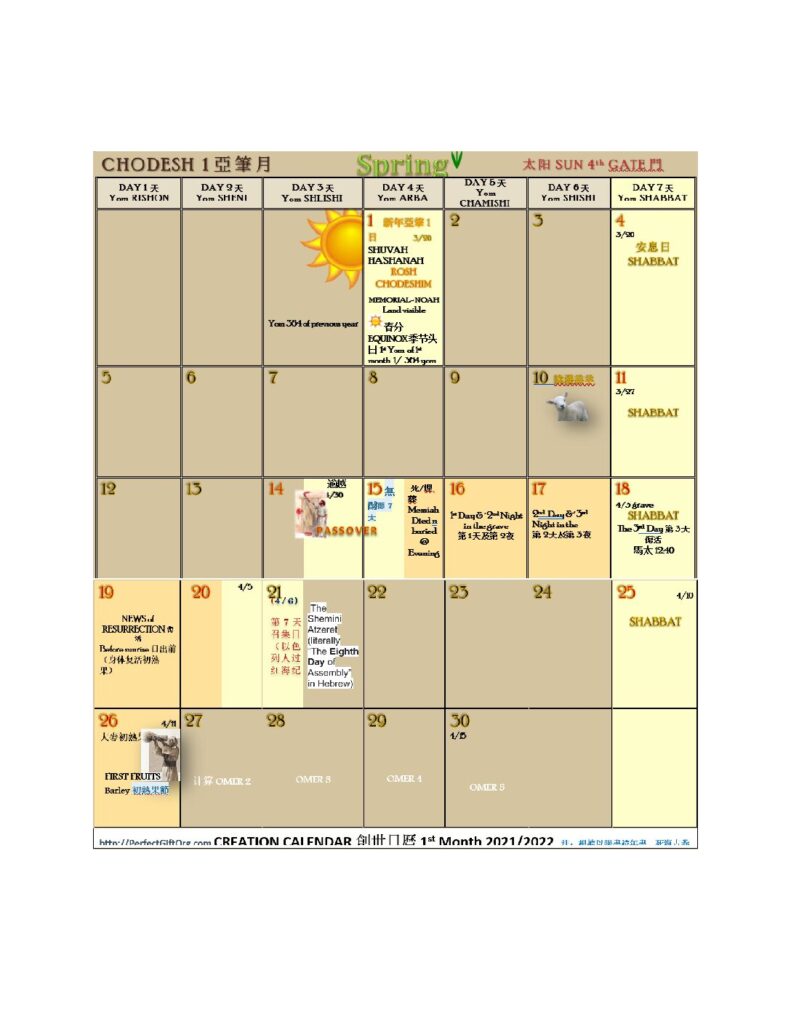
According to the Jubilees calendar, if we count seven weeks back from the 15th of the 3rd month, we arrive at Sunday, the 26th of the 1st month, as the day of the wave-offering. This date is the first Sunday following the seven-day Matzot festival (1/15–21), and reflects a literal translation of the expression “the day after Shabbat.” The count begins after the conclusion of the matzot festival since the description of this event follows the completion of the description of the previous festival (Lev 23:5-8).

Scholars debate whether the position attributed to the Boethusians is identical to that found in Jubilees and Qumran, since it is unclear whether they understood the “morrow after Shabbat” as a reference to the Sunday immediately following the matzot festival (as in Jubilees) or the one during the festival itself (as the Samaritans and Karaites do).[4] Both interpretations are fundamentally different from the rabbis, who understood that word “Shabbat” in “the day after Shabbat” as “festival,” specifically the first day of the festival.[5]

Jacob Celebrates Shavuot

In addition to having an exact date for Shavuot, Jubilees also adds an important theme to the holiday, the theme of covenant. This can be seen by looking at what transpires on Shavuot in the book—indeed, a major characteristic of Jubilees as it rewrites sections of Genesis and Exodus is the manner in which it anchors laws that only appear later in the Torah. In Jubilees 44, the date of Shavuot can be determined based upon the chronological data in the rewritten account of Jacob’s descent to Egypt (cf. Gen 46):

44:1 Israel set out from Hebron, from his house, on the first of the third month. He went by way of the well of the oath and offered a sacrifice to the Almighty YHWH of his father Isaac on the seventh of this month. 44:2 When Jacob remembered the dream that he had seen in Bethel, he was afraid to go down to Egypt. 44:3 But as he was thinking about sending word to Joseph that he should come to him and that he would not go down, he remained there for seven days on the chance that he would see a vision (about) whether he should remain or go down. 44:4 He celebrated the harvest festival—the first fruits of grain—with old grain because in all the land of Canaan there was not even a handful of seed in the land since the famine affected all the animals, the cattle, the birds, and mankind as well. 44:5 On the sixteenth the YaHuWaH appeared to him and said to him: ‘Jacob, Jacob’…

The passage opens at the beginning of the third month. Following Jacob’s arrival in Beersheba on the seventh of the third month, he remained there for seven days hoping to receive a vision about whether he should indeed go down to Egypt. This seven-day period is followed by “the harvest festival – the firstfruits of grain” in v. 4, immediately followed by the divine revelation on the 16th (v. 5). Thus, the “harvest festival” fell on the 15th of the month, after the seven-day sojourn (until the 14th) and immediately prior to the revelation on the 16th.

Abram’s Shavuot Revelation

Similarly, Abraham received the revelation concerning circumcision in “the middle of the third month”: “During the fifth year of the fourth week of this jubilee —in the third month, in the middle of the month—Abram celebrated the festival of the first fruits of the wheat harvest” (15:1). The celebration of this festival on the 15th of the month corresponds to the dates of the festivals of Matzot and Sukkot, according to the Torah, which take place on the 15th of the first and seventh months respectively.

Jubilees dates additional events to the 15th of the 3rd month:

a. 14:10 – covenant between the pieces (ברית בין הבתרים)
b. 16:13 – birth of Isaac (fulfillment of promise in chapter 15)
c. 29:7 – covenant with Laban

Thus, every significant event in Genesis that is associated with covenant is explicitly associated with the date of the “festival of harvest.”[6]

Shavuot and the Covenant with Noah

An extended passage following the flood narrative explicitly expresses the conception of Shavuot as the festival of covenant. The story concludes with a covenant between Noah and The Almighty YHWH in which He commits to never again destroy humanity through a Flood, while Noah and his sons swear not to consume the blood of animate beings:

6:17 For this reason it has been ordained and written on the heavenly tablets that they should celebrate the festival of weeks during this month—once a year—to renew the covenant each and every year.

The purpose of the annual celebration of Shavuot is to renew the covenant between The Almighty Creator and Israel,[7] a theme decidedly similar to the celebration of matan Torah found in rabbinic sources. However, there is a fundamental difference between the two conceptions.

Shavuot as a Covenant Going Back to the Time of Creation

According to Jubilees, the national covenant between The Almighty YaHuWaH and Israel was not first established at Sinai, but existed from the dawn of time, when Israel was already chosen as God’s nation in the first week of creation (2:19–21):[8]

19 ויאמר לנו הנה אני מבדיל לי]
עם בתווך עממי ו[שבתו הם וקדשתי אתם לי לעם וברכתים והיו עמי והייתי לאלהיהם] 20 ובחר בזרע יעקב ב[כל מאשר ראיתי וכתבתי אתו לי לבן בכור וקדשת אתו לי] לעולם ועד ואת היום ה[שביעי אגיד להם לשובתם בומכל 21 כאשר ברכם וקדשם לו לעם סגולה]
מכל הגוים ולהיות יחד[ עמנו שובתים

19 He said to us: “I will now separate for myself] a people among my nations. And [they will keep Sabbath. I will sanctify them as my people, and I will bless them. They will be my people and I will be their Eloah.”] 20And he chose the descendants of Jacob among [all of those whom I have seen. I have recorded them as my first-born son and have sanctified them for myself] for all the age(s) of eternity. The [seventh] day [I will tell them so that they may keep Sabbath on it from everything, 21 as he blessed them and sanctified them for himself as a special people] out of all the nations and to be [keeping Sabbath] together [with us.

This accords with a deterministic, dualistic worldview expressed in a number of passages throughout Jubilees, according to which the status of Israel and the nations (and their heavenly angelic counterparts) was established by our Creator the Almighty YHWH as an integral part of the cosmos. Although Israel did not exist until over twenty generations later, its special position was determined in advance.

The existence of the covenant from the time of creation necessitated the existence of commandments, which are the stipulations of this covenant, and thus Jubilees posits that many commandments were already given prior to Mount Sinai. Similarly, the covenant festival was relevant from the dawn of time as well: first observed by angelic beings in heaven from creation,[9] until the time of Noah when it was first observed by human beings. It was then celebrated off and on until it was commanded at Mount Sinai:

6:18 This entire festival had been celebrated in heaven from the time of creation until the lifetime of Noah—for 26 jubilees and five weeks of years [=1309]. Then Noah and his sons kept it for seven jubilees and one week of years until Noah’s death [=350 years]. From the day of Noah’s death his sons corrupted (it) until Abraham’s lifetime and were eating blood. 6:19 Abraham alone kept (it), and his sons Isaac and Jacob kept it until your lifetime. During your lifetime the Israelites had forgotten (it) until I renewed (it) for them at this mountain.

חג השבועת in Jubilees thus commemorates this eternal covenant, which began in the first week of history and was renewed over time. The Sinaitic revelation is the culmination of a process, but is not the sole covenantal event at the heart of this festival.

Festival of Weeks שָׁבֻעוֹת or Oaths שְׁבוּעוֹת

The covenantal nature of the festival may also be reflected when, only a few verses later, the dual nature of the holiday is expressed: “because it is the festival of weeks and it is the festival of first fruits. This festival is twofold and of two kinds” (6:21, according to the Ge`ez translation).[10] The theme of the holiday as the “festival of first fruits” refers to the agricultural context of the holiday, reflecting the biblical descriptions of its observance.

At first, this would seem to be true of the reference to the “festival of weeks,” which is also a biblical theme surrounding this holiday. Nevertheless, due to the overwhelming emphasis on covenant in this passage, including the mention of oaths made by Noah and his sons, and subsequently commanded in the time of Moses, numerous scholars have suggested that the original Hebrew text of Jubilees (based upon the retroversion of the Ge`ez back into Hebrew) should be vocalized as חג השְבועות “the festival of oaths,”[11] reflecting the covenantal aspect of the holiday.

Conclusion

Shavuot in Jubilees may seem quite different from the festival as practiced by Rabbinic Jews nowadays. The dates are not identical, and even the nature of the covenants celebrated reflect different conceptions. At the same time, the Book of Jubilees offers important hints for the development of the conception of Shavuot in rabbinic literature as a festival with a set time that is associated with the giving of the Torah.

View Footnotes:

  1. The Sinaitic revelation is dated to the 3rd month (Exod 19:1), but there is no mention of a specific date in the month. Furthermore, there is no reference to this event in the various festival laws (Exod 23:16; Lev 23:15–22; Num 28:26–31; Deut 16:9–12), which all address the agricultural aspects of the festival.
  2. Due to their fragmentary state, these scrolls provide evidence for only a small fraction of the text in its original Hebrew. It was translated from Hebrew into Greek, and from Greek into Latin and Ge`ez (ancient Ethiopic). The book is preserved in its entirety only in Ge`ez, in multiple manuscripts, and therefore all modern editions of this book are based upon that ancient translation. For a Hebrew version of the text, see the translation of M. Goldmann in הספרים החיצונים (ed. A. Kahana). The English translation of R.H. Charles is available online: http://www.earlyjewishwritings.com/jubilees.html
  3. Cf. b. Menachot 65a-66a; Scholion to Megillat Ta`anit for the 8th day of Nisan (in MS Parma, the opposing position is attributed to the Sadducees; cf. the edition of Vered Noam (Yad Ben-Zvi, 2003), pp. 174-175; see also m.Hagiga 2:4.
  4. The questions posed on the Boethusians’ position in Rabbinic sources imply that it was the Shabbat during the festival. At the same time, it is possible that the later discussions were no longer aware of the precise details of their calendar, beyond the debate of whether Shabbat referred to Saturday or a festival day. For more on Samaritan Shavuot, see Benyamim Tsedaka’s TABS essay, “The Samaritan Shavuot: A Seven-Day Celebration of the Feast of Weeks.”
  5. See Targums Onqelos, Neofiti, Pseudo-Jonathan, Genizah ms F to Lev 23:11, 15; Sifra Emor 12: 1–2; b. Menachot 65-66. This interpretation leads to the anomaly that in Lev 23:16, the term שבת in the expression ממחרת השבת needs to be understood differently as “week”; cf. the Targums to Lev 23:16. The motivation for this interpretation was perhaps to anchor Shavuot to a specific date, which was only possible according to the lunar-solar calendar if the date of the wave offering was set according to a specific date (the 16th of the 1st month), and not to a day of the week. This move still theoretically allowed for a limited shift of the date (between the 5th and 7th of Sivan), since the specific date each year was still dependent upon the lengths of the months of Nissan and Iyyar, which could each have been either 29 or 30 days long.
  6. An additional event dated to the 15th of the 3rd month is the birth of Judah (28:15). It is unclear whether this reflects the covenantal status of the tribe of Judah, associated with the Davidic line. Alternatively, it is similar to other instances in Jubilees in which the births of significant characters are dated to important dates on the Jubilees calendar; cf. e.g. the births of Levi on the 1st of the 1st month (28:14), and Joseph on the 1st of the 4th month (28:24).
  7. The Qumran sect observed an annual ceremony of covenant renewal (cf 1QS II-III), which is dated to the third month in a manuscript of the Damascus Document from Qumran Cave 4 (4Q266 11, 17). 2Chr 15:10–15 may reflect an earlier (than Jubilees) source of a covenant renewal in the third month.
  8. This text was preserved in Hebrew at Qumran (4QJubileesa [4Q216] vii 9–13 [eds. VanderKam and Milik; DJD 19], pp. 19–20), with the missing words reconstructed according to the Ge`ez version.
  9. Similarly, according to Jubilees, the angels of presence and angels of holiness celebrated the Sabbath from the dawn of time (2:18), and were created circumcised (15:27), both also described in the Torah as covenantal signs.
  10. The text of this verse has not been preserved in any of the copies of Jubilees from the Dead Sea scrolls.
  11. Since texts in the ancient world did not use vocalization (a practice continued until today in the writing of Torah scrolls), the difference between “weeks” and “oaths” would only be in reflected in how one read and interpreted the text. According to the suggestion here, a Greek translator did not understand the nuance of the original author (Jubilees was translated from Hebrew into Greek, and from Greek into Ge`ez [a dialect of Ethiopic] and Latin).
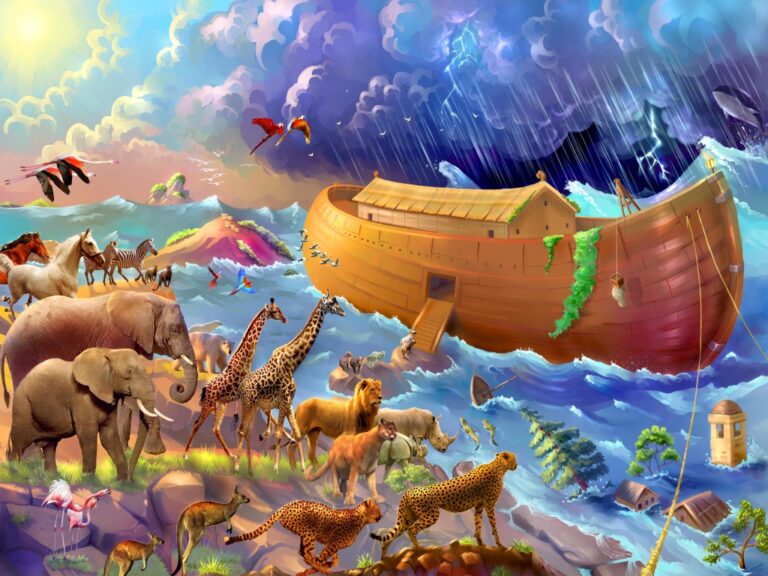
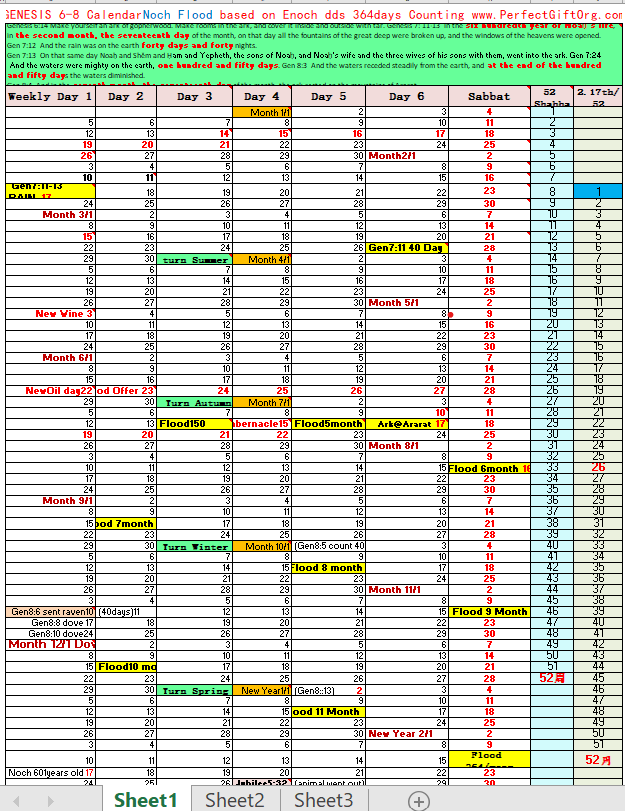
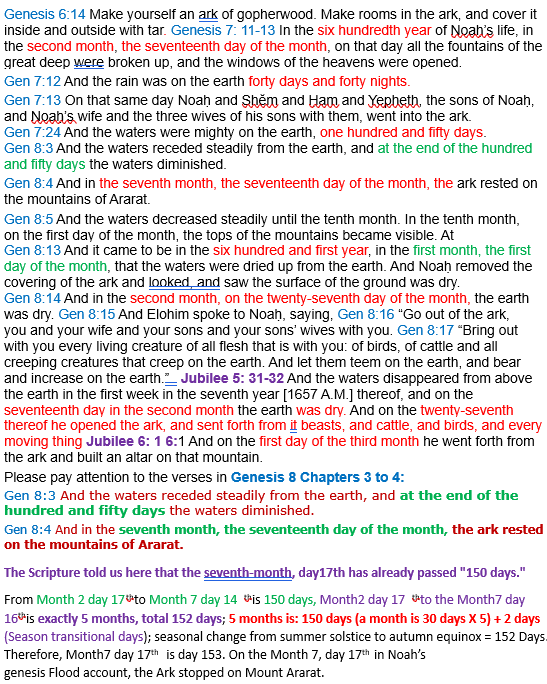
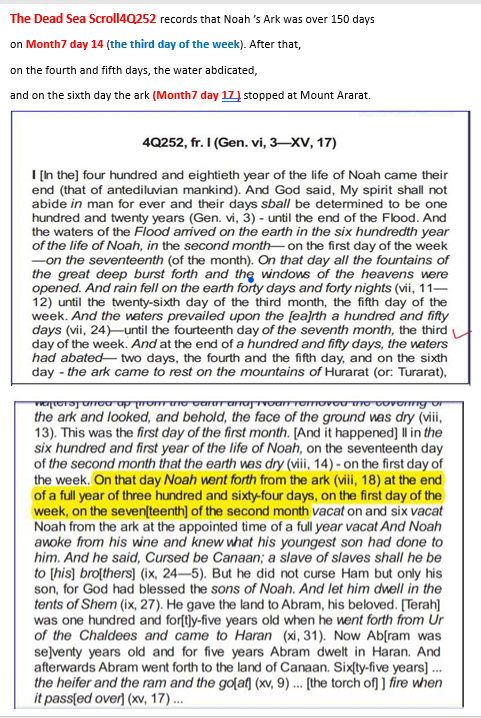
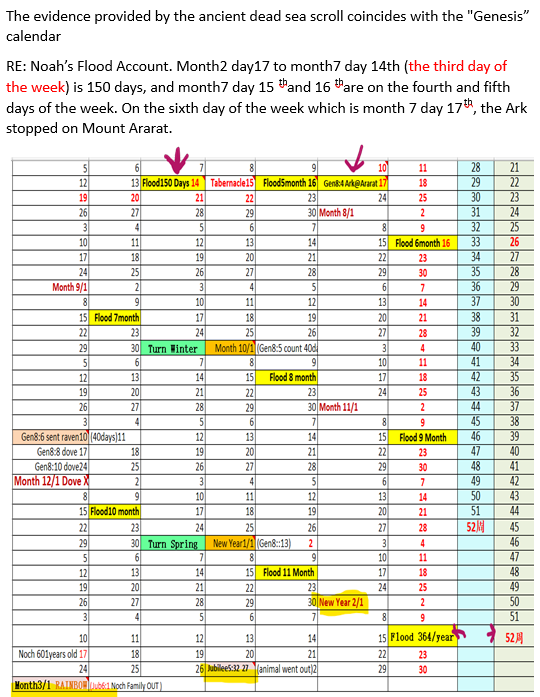
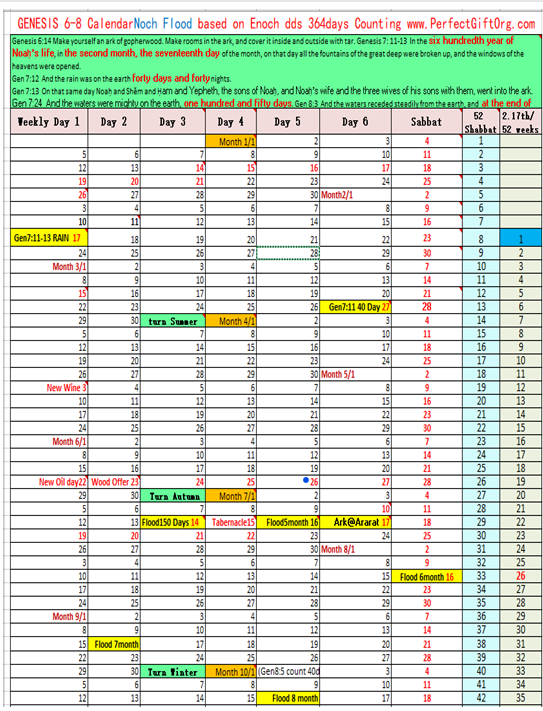
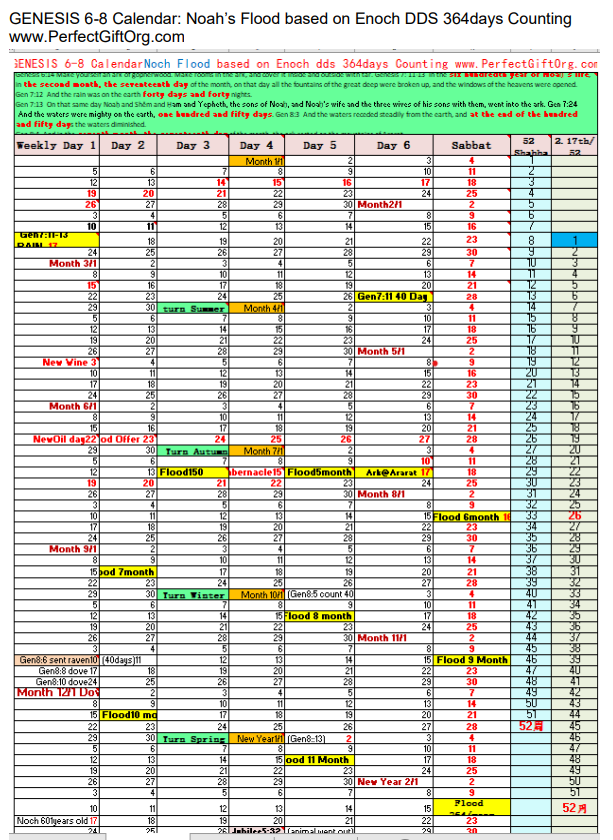
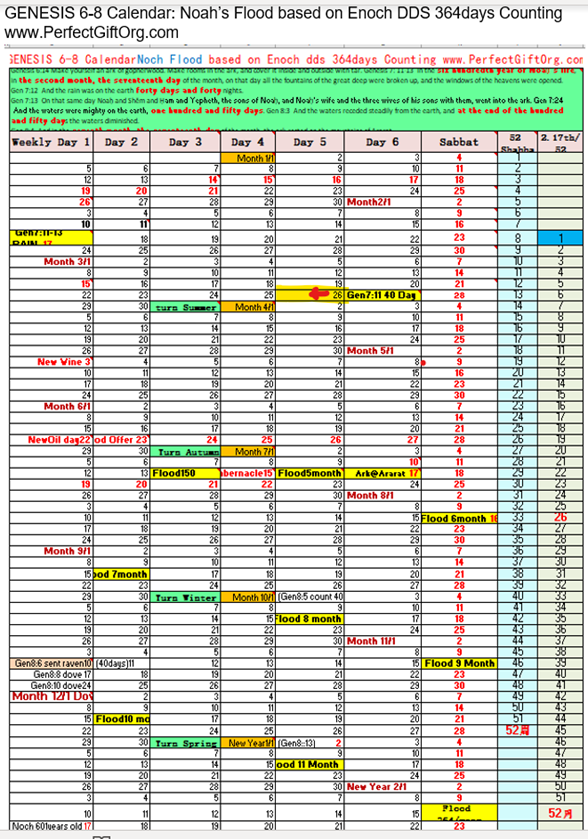
https://perfectgiftorg.com/wp-content/uploads/2021/04/GENESIS-6-8-Calendar-Noah-Flood-based-on-Enoch-DSS-364days-Counting.pdf

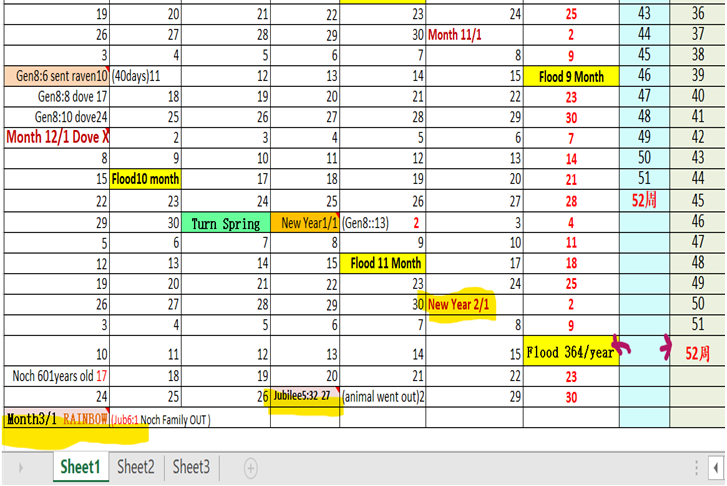
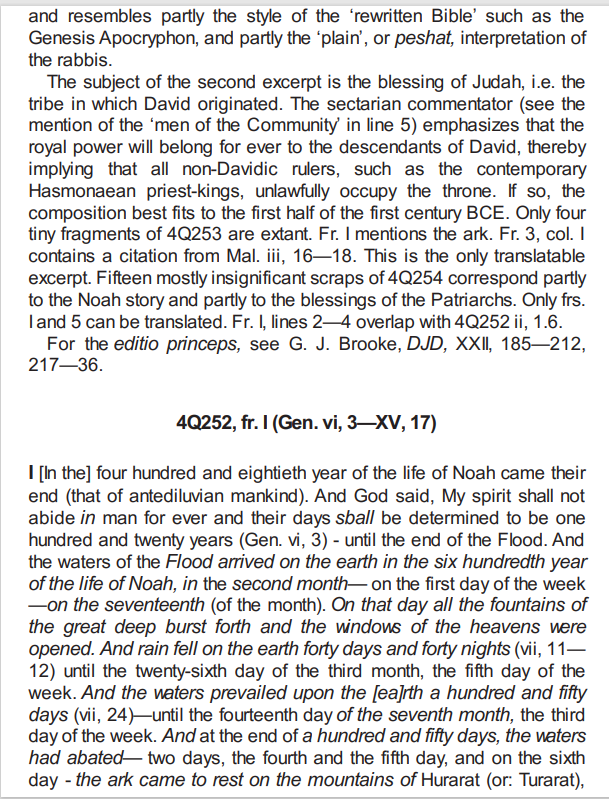
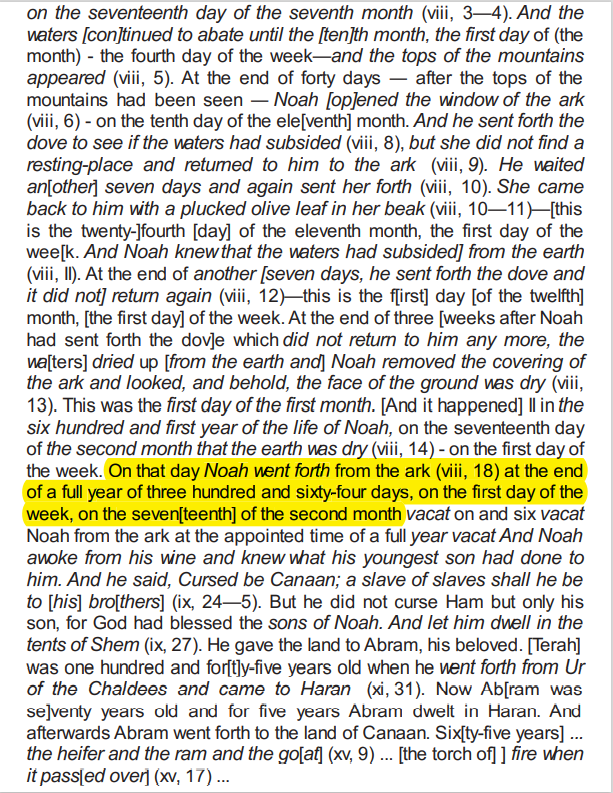
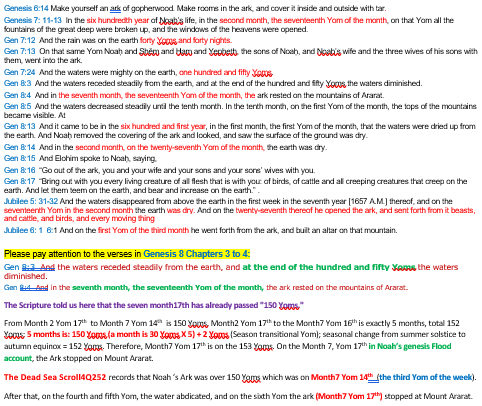
This PDF is more as to a quick response to the Yahad’s group, Stephen Kraner’s quest on: ” If there is a better understanding as to WHY the 27th day of the second month is the completion of the flood, I am open to an explanation.” In the below PDF, the 17th on the 2nd Month is NOAH’s 601 birthday, and it is exactly 364 days /Yearly, an anniversary day, a TIME Marker of Noah, he was observing the 364 days Calendar! Even though the earth was dry, he waited for another 10 days till YHWH said it was safe to get out of the ARK. However, according to Jubilee, he only let most of the animals out on the 27th on the second month , and he himself as well as his whole family, Officially, they waited till 1st day of the 3rd Month and got out from the ARK by setting up an altar to יהוה, [YHWH ‘s Covenant with Noah]Gen 8:20 And Noah built an altar to יהוה, and took of every clean beast and of every clean bird, and offered burnt offerings on the altar. Jubilee 5:31-32… and on the seventeenth day in the second month the earth was dry. And on the twenty-seventh thereof he opened the ark, and sent forth from it beasts, and cattle, and birds, and every moving thing Jubilee 6: 1 6:1 And on the first day of the third month he went forth from the ark, and built an altar on that mountain.

Noah Observed 364days yearly calendar recorded in Jubilee’s account

Gen 6:5 And יהוה saw that the wickedness of man was great in the earth, and that every inclination of the thoughts of his heart was only evil continually.

Gen 6:6 And יהוה was sorry that He had made man on the earth, and He was grieved in His heart.

Gen 6:7 And יהוה said, “I am going to wipe off man whom I have created from the face of the earth, both man and beast, creeping creature and birds of the heavens, for I am sorry that I have made them.”

Gen 6:8 But Noaḥ found favor in the eyes of יהוה.

Noah and the Flood

Gen 6:9 This is the genealogy of Noaḥ.

Noaḥ was a righteous man, perfect in his generations. Noaḥ walked with Eloah.

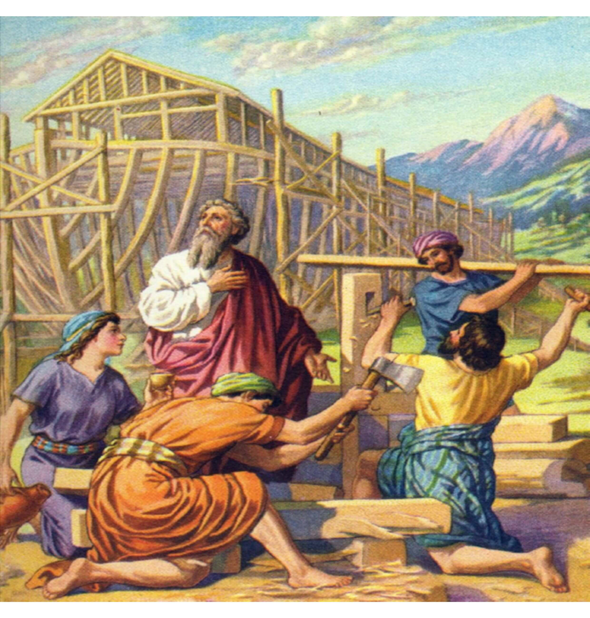
21 And He commanded Noah to make him an ark, that he might save himself from the waters of the flood.

22 And Noah made the ark in all respects as He commanded him, in the twenty-seventh jubilee of years, in the fifth week in the fifth year (on the new month of the first month). [1307 A.M.]
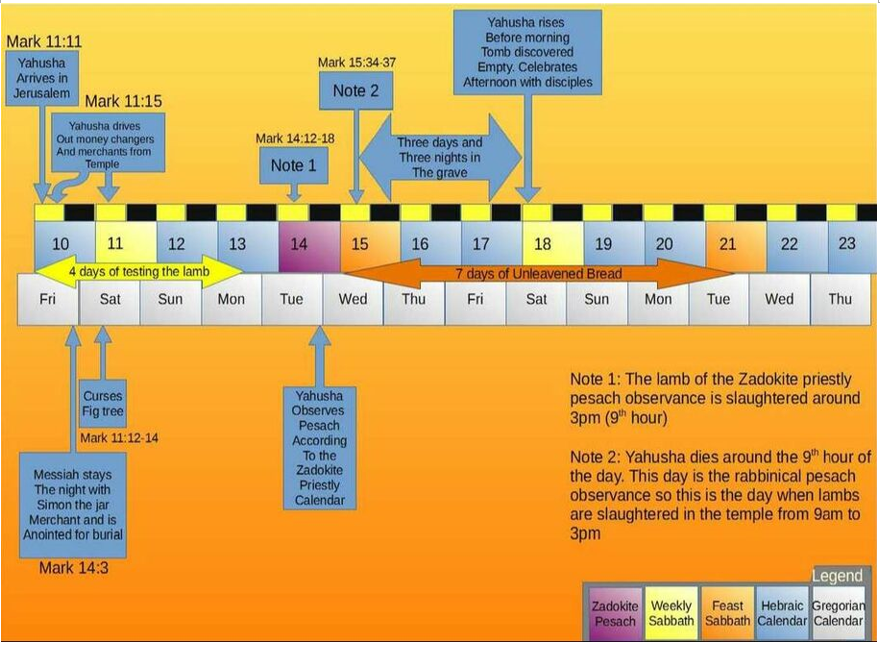
23 And he entered in the sixth (year) thereof, [1308 A.M.] in the second month, on the new month ( 1st ) of the second month, till the sixteenth; and he entered, and all that we brought to him, into the ark, and YAHUWAH closed it from without on the seventeenth evening.
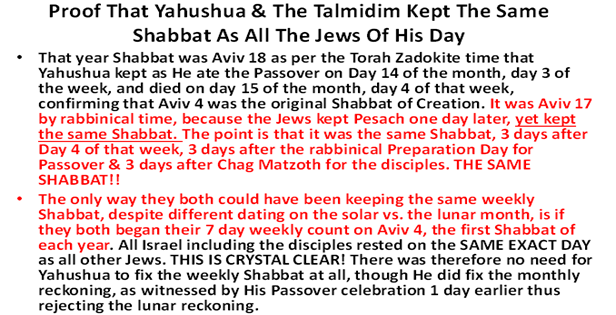
24 And YAHUWAH opened seven flood-gates of heaven, And the mouths of the fountains of the great deep, seven mouths in number

25 And the flood-gates began to pour down water from the heaven forty days and forty nights, And the fountains of the deep also sent up waters, until the whole world was full of water.

26 And the waters increased upon the earth: Fifteen cubits did the waters rise above all the high mountains, And the ark was lift up above the earth, And it moved upon the face of the waters.

27 And the water prevailed on the face of the earth five months -one hundred and fifty days.

28 And the ark went and rested on the top of Lubar, one of the mountains of Ararat.

29 And (on the new month) in the fourth month the fountains of the great deep were closed and the flood-gates of heaven were restrained; and on the new month of the seventh month all the mouths of the abysses of the earth were opened, and the water began to descend into the deep below

30 And on the new month of the tenth month the tops of the mountains were seen, and on the new month of the first month the earth became visible.

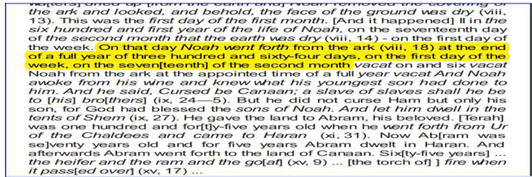
31 And the waters disappeared from above the earth in the fifth week in the seventh year [1309 A.M.] thereof, and on the seventeenth day in the second month the earth was dry.

32 And on the twenty-seventh thereof he opened the ark, and sent forth from it beasts, and cattle, and birds, and every moving thing.

JUBILEE 6

Noah Went Forth from The Ark And Made Atonement

1 And on the new month of the third month he went forth from the ark, and built an altar on that mountain.

2 And he made atonement for the earth and took a kid and made atonement by its blood for all the guilt of the earth; for everything that had been on it had been destroyed, save those that were in the ark with Noah.

4 And YAHUWAH smelt the goodly savior, and He made a covenant with him that there should not be any more a flood to destroy the earth; that all the days of the earth seedtime and harvest should never cease; cold and heat, and summer and winter, and day and night should not change their order, nor cease forever.

15 And He gave to Noah and his sons a sign that there should not again be a flood on the earth.

16 He set His bow in the cloud for a sign of the eternal covenant that there should not again be a flood on the earth to destroy it all the days of the earth.

17 For this reason it is ordained and written on the heavenly tablets, that they should celebrate the “Feast of Weeks” in this month once a year, to renew the covenant every year.

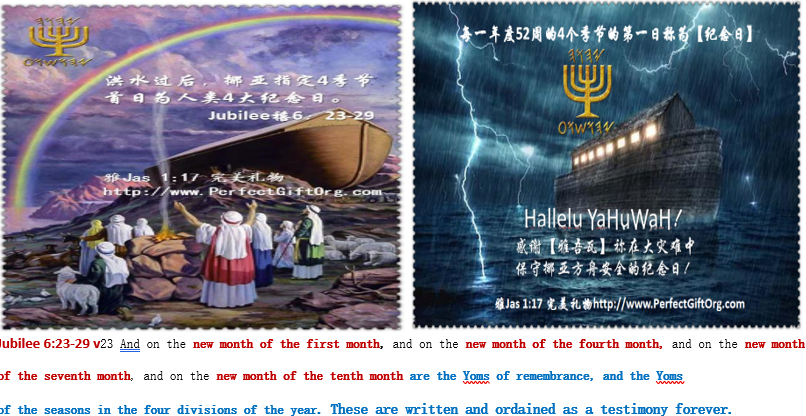
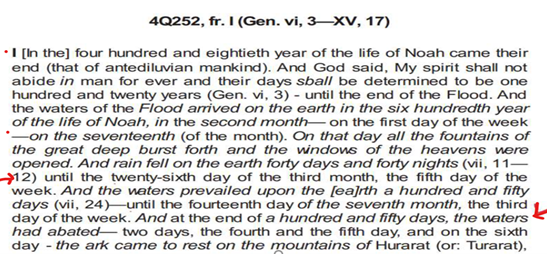
23 And on the new month of the first month, and on the new month of the fourth month, and on the new month of the seventh month, and on the new month of the tenth month are the days of remembrance, and the days of the seasons in the four divisions of the year. These are written and ordained as a testimony forever.

24 And Noah ordained them for himself as feasts for the generations forever, so that they have become thereby a memorial unto him

25 And on the new month of the first month he was bidden to make for himself an ark, and on that (day) the earth became dry and he opened (the ark)and saw the earth.

26 And on the new month of the fourth month the mouths of the depths of the abyss beneath were closed. And on the new month of the seventh month all the mouths of the abysses of the earth were opened, and the waters began to descend into them.

27 And on the new month of the tenth month the tops of the mountains were seen, and Noah was glad

28 And on this account, he ordained them for himself as feasts for a memorial forever, and thus are they ordained.

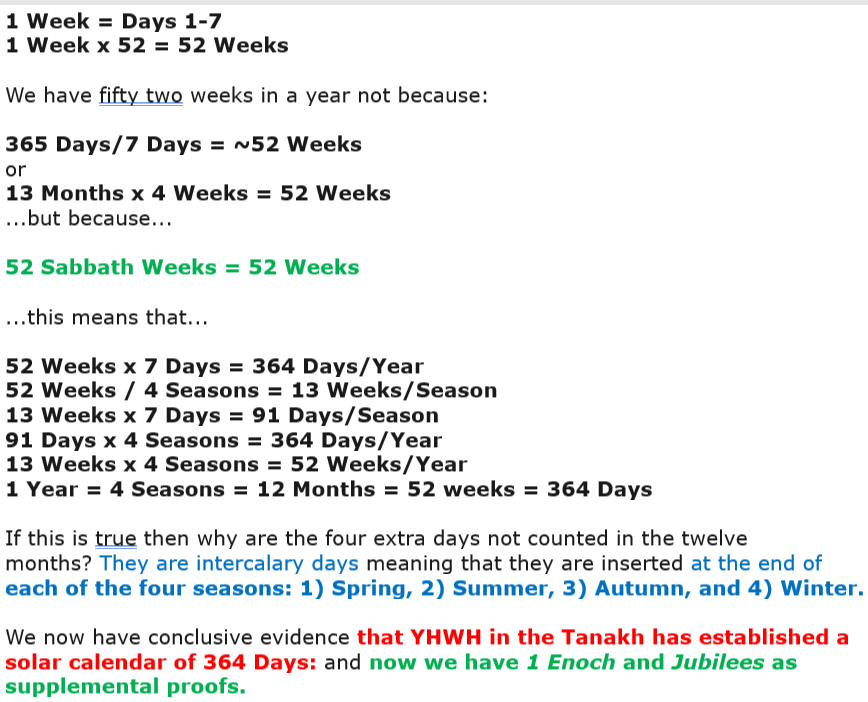
29 And they placed them on the heavenly tablets, each had thirteen weeks; from one to another (passed) their memorial, from the first to the second, and from the second to the third, and from the third to the fourth

30 And all the days of the commandment will be fifty two weeks of days, and (these will make) the entire year complete. Thus it is engraved and ordained on the heavenly tablets.

31 And there is no neglecting (this commandment) for a single year or from year to year

32 And command you the children of Yisrael that they observe the years according to this reckoning- three hundred and sixty-four days, and (these) will constitute a complete year, and they will not disturb its time from its days and from its feasts; for everything will fall out in them according to their testimony, and they will not leave out any day nor disturb any feasts.

33 But if they do neglect and do not observe them according to His commandment, then they will disturb all their seasons and the years will be dislodged from this (order), [and they will disturb the seasons and the years will be dislodged] and they will neglect their ordinances. They will not find the path of the years, and will forget the new months, and seasons, and Shabbats and they will go wrong as to all the order of the years.

35 For I know and from henceforth will I declare it unto you, and it is not of my own devising; for the book is written before me, and on the heavenly tablets the division of days is ordained, lest they forget the feasts of the covenant and walk according to the feasts of the Gentiles after their error and after their ignorance.

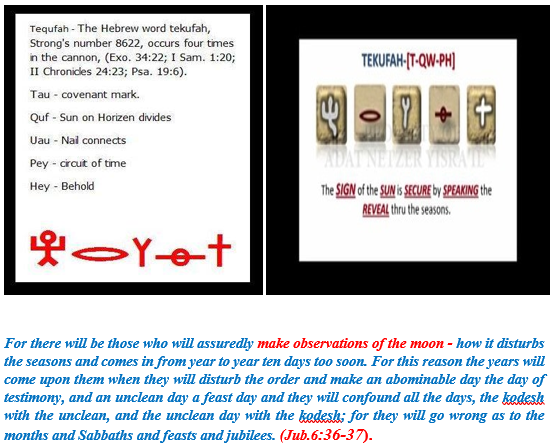
36 For there will be those who will assuredly make observations of the moon-how it disturbs the seasons and comes in from year to year ten days too soon.

37 For this reason the years will come upon them when they will disturb (the order), and make an abominable (day) the day of testimony, and an unclean day a feast day, and they will confound all the days, the kodesh with the unclean, and the unclean day with the kodesh; for they will go wrong as to the months and Shabbats and feasts and jubilees.

38 For this reason I command and testify to you that you may testify to them; for after your death your children will disturb them, so that they will not make the year three hundred and sixty-four days only, and for this reason they will go wrong as to the new months and seasons and Shabbats and festivals, and they will eat all kinds of blood with all kinds of flesh

https://perfectgiftorg.com/wp-content/uploads/2021/04/2021-Noah-Ark-Proof-of-364-Day-Solar-Day-Calendar.pdf
Proof Of 364 Day Solar Calendar In The Bible (without Quoting 1 Enoch Or Jubilees)

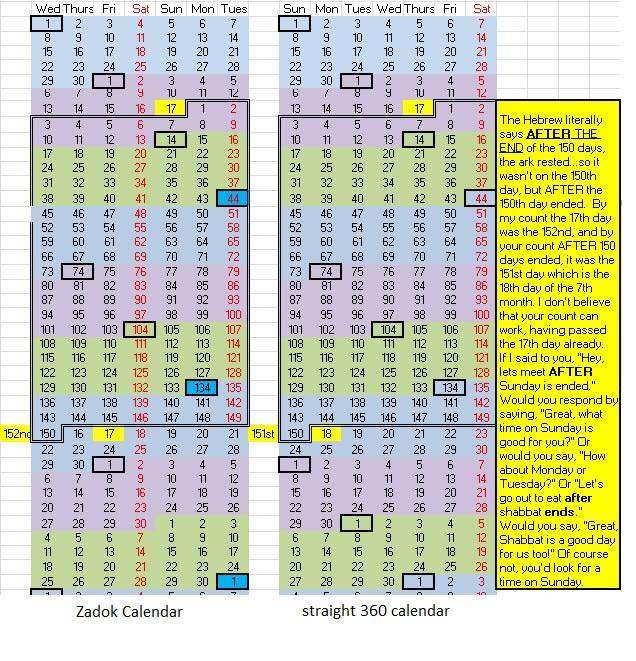
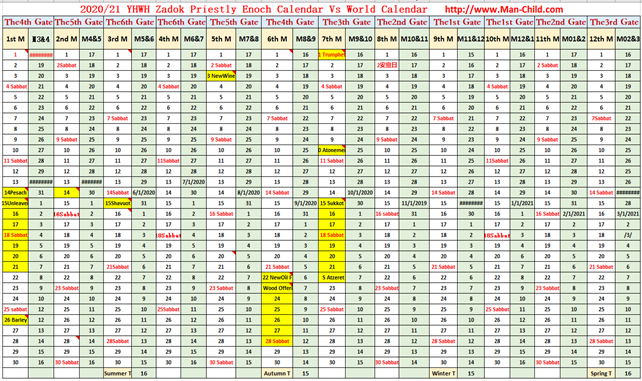
A comparison of the below two calendars:

on the right is a 364 days Zadok calendar and

on the left is a 360days year with 30 days each month Calendar

A Quick revision of the distinctive features of the Zadokite Priestly Order Calendar:

Attached are some interesting discussions over the Enoch Zadokite Solar Calendar and moon based calendar

JUBILEES 2    1 And the malak of the presence spoke to Mosheh according to the word of YAHUWAH, saying: Write the complete history of the creation, how in six days YAHUWAH ALMIGHTY finished all His works and all that He created, and kept Shabbat on the seventh day and hallowed it for all ages, and appointed it as a sign for all His works.

17 And He gave us a great sign, the Shabbat day, that we should work six days, but keep Shabbat on the seventh day from all work.

18 And all the malakim of the presence, and all the malakim of sanctification, these two great classes –He has bidden us to keep the Shabbat with Him in heaven and on earth.

28 And every one who observes it and keeps Shabbat thereon from all his work, will be kodesh and Baruch throughout all days like unto us.

32 And the Creator of all things baruch this day which HE had created for barakah and making it kodesh and splendid above all days.

Throughout history,, today we can look to the Jews, who have tracked and kept the seventh-day Sabbath for millennia and be confident that our current Saturday is the seventh day of the week, on the same weekly cycle that has been in place since the beginning of creation—a cycle established and confirmed by The Most High YAHUWAH Himself.

https://perfectgiftorg.com/wp-content/uploads/2021/04/Is-Saturday-the-Seventh-6.pdf

Interesting Video: Even Beavers know when it is the Sabbath- Saturday. A16 years documentary !

Calendars printed in the United States put Saturday as the seventh day, but in Europe and other places in the world, Sunday is shown as the seventh day. So how can we be sure?

The seven-day weekly cycle is not tied to any patterns or alignments of the sun, moon, or stars. It is a non-stop serial counting of days, one after the other. Scripture tells us the cycle was established by The Most High YAHUWAH. After six days of creation, The Most High YAHUWAH rested on the seventh day (Genesis 2:1-2). Since then, the counting off days in groups of sevens—with each group called a week and every seventh day designated as a day of rest—has continued unbroken up to our own time.

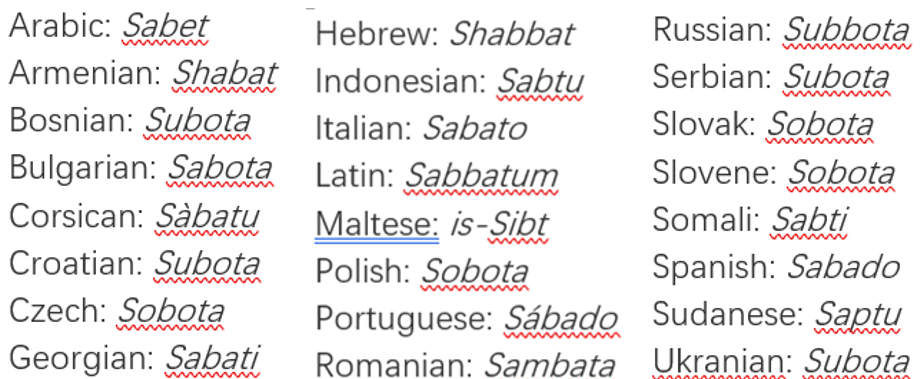
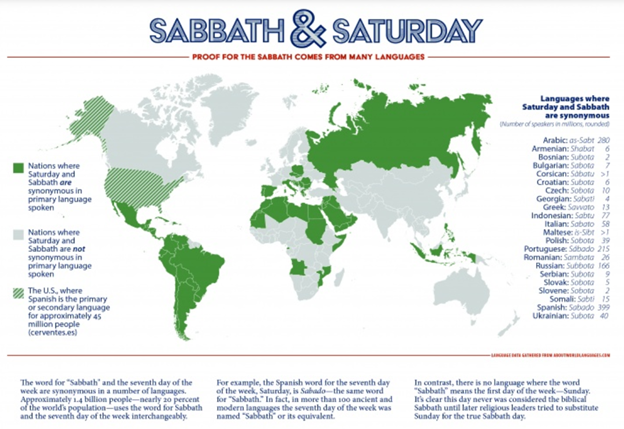
English-speaking countries call the seventh day Saturday, but the word for that day in many languages indicates its origins as the biblical day of rest. For example, the seventh day in Spanish is called Sabado (coming from the Hebrew shabbat). This too is made plain on printed calendars in those languages.

Language reflects the customs of the culture that speaks it. Nearly every culture, from Babylon through modern times, rested on the seventh day. As languages developed, the name for the seventh day of the week remained “rest day.” In the mid-19th century, Dr. William Meade Jones created this “Chart of the Week,” listing the name for the seventh day in 160 languages, including some of the most ancient (shown below). Babylonian, in use hundreds of years before Abraham or the giving of the Ten Commandments at Sinai, calls the seventh day of the week sa-ba-tu, meaning “rest day.”

https://www.sabbathtruth.com/free-resources/article-library/story/id/912/t/which-day-of-the-week-is-the-sabbath-

Such widespread use of forms of the word Sabbath for the seventh day of the week, Saturday, is clear evidence that speakers of these languages understood which day is the Sabbath.

Likewise, the fact that in no language do we see “Sabbath” similarly linked with Sunday, the first day of the week, is an obvious confirmation that this day never was considered the biblical Sabbath until later religious leaders tried to substitute Sunday for the true Sabbath day.

https://perfectgiftorg.com/wp-content/uploads/2021/04/Is-Saturday-the-Seventh-1.pdf


Which day of the week is the biblical Sabbath? It is clear from the names for the seventh day of the week, Saturday, in many languages.

Could we have lost our place?

If you have ever tried to count off numbers in a sequence you know how easy it is to lose your place. Could this have happened with the counting of the seventh day? After all, it has been a very long time since The Most High YAHUWAH established the first day of rest.

If the sequence had gotten all jumbled up sometime between the first day of rest and the Exodus of Israel out of Egypt, the true seventh day was clearly reestablished by the time the Ten Commandments were given.

We can conclude confidently that our current Saturday is the seventh day of the week, on the same weekly cycle that has been in place since the beginning of creation—a cycle established and confirmed by The Most High YAHUWAH Himself.

In the wilderness, The Most High YAHUWAH fed the people of Israel with manna. The manna would appear on the ground every day except the seventh day, the day of rest (Exodus 16:14-30). This sequence would repeat every seven days, over and over for 40 years. The weekly cycle of manna only stopped when Israel entered the promised land. Four decades of repetition is plenty of time to clearly establish which day was the day of rest.

If the Sabbath had somehow been lost between creation and the exodus, 40 years of weekly miracles would have definitely reestablished.

Did Israel ever lose track of the seventh day?

The Exodus was still an exceedingly long time in the past. Plus, Israel went through many periods of turmoil, forgetfulness of The Most High YAHUWAH, invasion, deportation, etc. Could Israel—and later the Jewish people—have mixed up the sequence of counting the seven-day weekly cycle through all that?

Yahushua Messiah, the very Word of The Most High YAHUWAH, put off the Esteem and Honor He shared with the Father and was born a flesh and blood human being. He was the “Master of the Sabbath” (Matthew 12:1-8; Mark 2:23-28; Luke 6:1-5). Yahushua Messiah would have known if He, or His fellow Jews, had the sequence of the seventh day messed up.

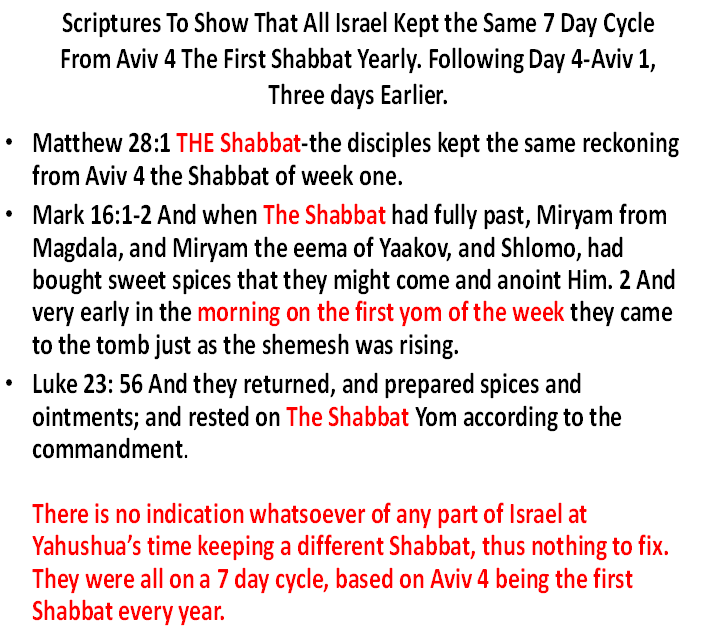
The record of Yahushua Messiah’ life shows He rested on the seventh day in obedience to the commandment (John 15:10). Yahushua Messiah observed the day of rest on the same day of the week as His fellow Jews. The religious authorities of the day may have disputed what types of activities were appropriate for observing the seventh day as a day of rest, but not which day of the week it was.

Yahushua Messiah’s obedience to the Fourth Commandment confirmed the seventh day as kept by the Jews was the correct day.

Did the Jewish people lose track of the seventh day after Yahushua Messiah’s death?

Years before the time of Yahushua Messiah’s death, and in the centuries since, the Jewish people have been widely dispersed throughout the Middle East and Europe. Wherever they have gone, they have fiercely guarded the observance of the seven-day weekly cycle so they might never break the Fourth Commandment.

It is possible to consider that isolated pockets of Jews may have lost track of the weekly cycle due to some local turmoil, but such an error would have quickly been corrected by comparing notes with the many other Jewish communities in other countries and continents—communities which had not experienced any interruption or disruption in the seven-day weekly cycle.

However, there is not any historical record of any dispute among any Jewish groups that the day we call Saturday is the seventh day of the weekly cycle, The Most High YAHUWAH’s day of rest. The Jewish people have successfully kept the original seven-day weekly cycle intact.

 Now, one last question that sometimes comes up:

Did the change to the Gregorian calendar in 1582 lose track of the seventh day?

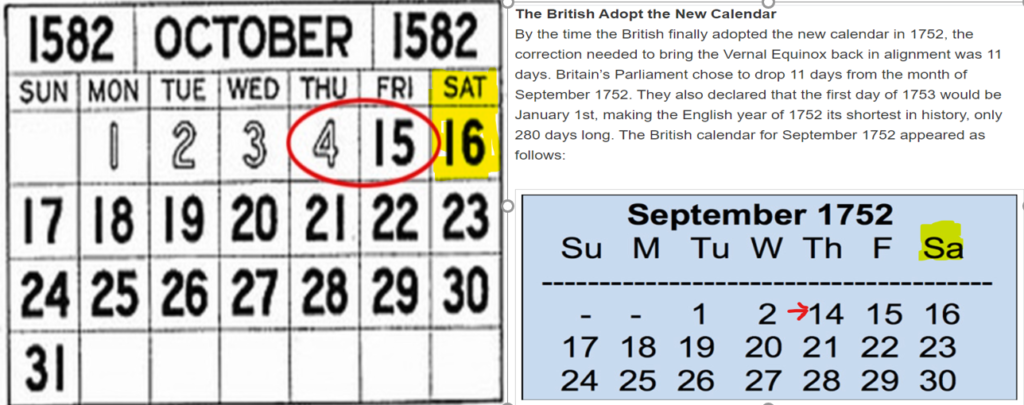
From 46 B.C. up to A.D. 1582, the Western world used what is called the Julian calendar. It was a vast improvement over the previous Roman calendars because it finally kept the months in sync with the seasons. However, after many centuries even the Julian calendar was about 10 days out of sync with the solar system.

In 1582 the old Julian calendar was replaced with the new, improved Gregorian calendar, which is the calendar system we still use today. At the time of the change to the new calendar system, those 10 days were simply dropped out of the calendar to get the dating system of the calendar back in sync with the solar system. It was Thursday, Oct. 4, 1582, and the next day, Friday, should have been Oct. 5. However, the new calendar made the next day Oct. 15 instead.

That change had no impact on the seven-day weekly cycle. Whether that following Friday was numbered as the 5th of the month or the 15th of the month, it was still the sixth day of the week, and the day that followed was still the seventh day of the week.

Even today we constantly add a day into our calendar every four years. We call it a “leap year.” Changing the number of days in a calendar month does not alter the weekly cycle—there is no six-day week, or eight-day week.

So, we can conclude confidently that our current Saturday is the seventh day of the week, on the same weekly cycle that has been in place since the beginning of creation—a cycle established and confirmed by The Most High YAHUWAH Himself.

Correspondence between Biblical numbers and astronomy

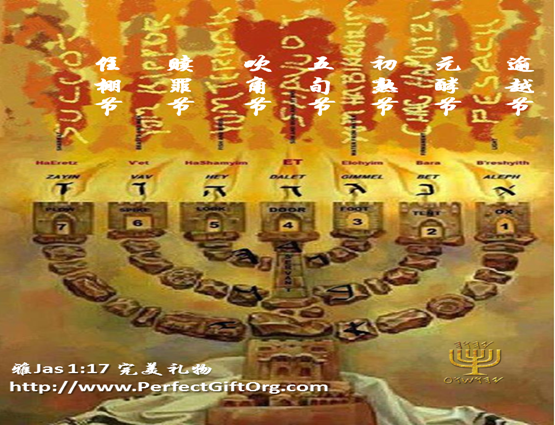
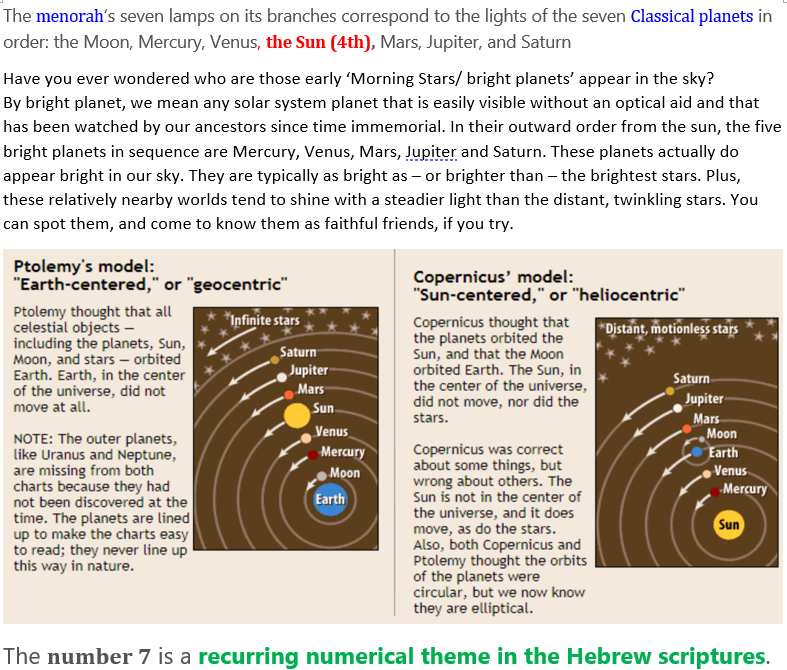
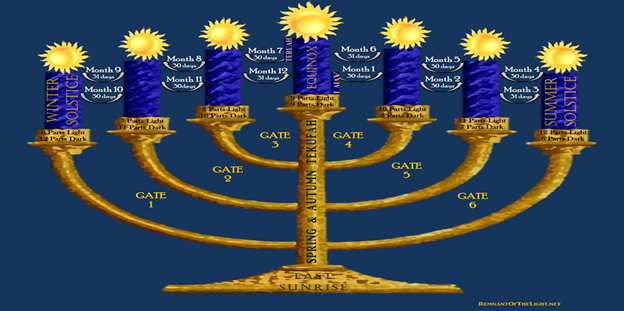
The number 7 is a recurring numerical theme in the Hebrew scriptures. The menorah‘s seven lamps on its branches correspond to the lights of the seven Classical planets: the Moon, Mercury, Venus, the Sun (4th), Mars, Jupiter, and Saturn. Hebrew mysticism recognized their great importance. Therefore, along with the four lunar phases being slightly over seven days (~7.4 days) each, the number 7 was held in very high regard. The Torah reflects this with Bereishit (Book of Genesis 1:1) being seven words and twenty-eight letters (7×4) in its original Hebrew. This is “YHWH’s signature“.[citation needed]

“And Aloah said, ‘Let there be lights in the heavens to separate the day from the night, and let them serve as signs to mark seasons, days, years and festivals’...the 4th day (of 7).”[16]

In many languages, the names of the days of the week are derived from the names of the seven planets; each day was consecrated to the particular planet that ruled during the early hours of the morning. While Talmudists were familiar with the planets and their characteristics in astrology, they opposed their worship to any planet, so weekdays are not named them in Hebrew besides for the Sabbath. Instead, they are referred to by number.

https://en.wikipedia.org/wiki/Classical_planet

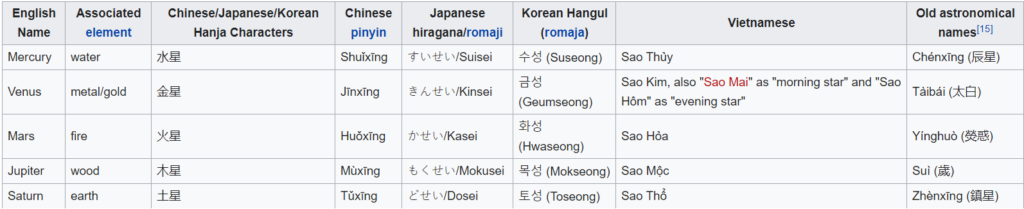
The ancient Chinese called the Heavenly “Seven Governments”, which means the sun, the moon plus the five stars of gold, wood, water, fire, and earth. Coincidentally, the West also names the seven days of the week after the “seven planets”.

The meaning of the names of the five planets, one star and one moon [planetary satellite] are:[33]

  •  שבתאי, Saturn
    • Meaning: “the restful one,” whose name is parallel to that of the Sabbath; the Seventh-day; the day of rest. Esoterically, Shabbatai שבתאי embodies Time itself. In the midst of time’s passage,  Shabbatai שבתאי remains still and silent, drawing all endeavors to a close.
  • 6th Day. Tzedeq צדק, Jupiter
    • Meaning: “righteousness”, as Jupiter is the embodiment of divine influx.
  • 5th Day Ma’adim מאדים, Mars
    • Meaning: “the red one”
  • 4th Day Ḥammah חמה, the Sun
    • Meaning: “the hot one”
  • 3rd Day  Kokhevet כוכבת, Nogah נוגה or Kokhav-Nogah כוכב נוגה, Venus
    • Meanings: “the she-planet,” “the bright one,” or “the bright planet,” respectively
  • 2nd Day  Kokhav כוכב, Mercury
    • Meaning: “the planet,” since Mercury is the Principle of planetary influence, in and of itself. The Mercurial principle is that of multipotency. It embodies our means of adaptation and represents the many facets of existence. In being deemed simply as “the planet”, Mercury is presented as a blank slate; an open-ended modality of being.
  • 1st Day  Levanah לבנה, the Moon
    • Meaning: “the white one”

Names of weekdays

The names for the days of the week are simply the day number within the week, with Shabbat being the seventh day. In Hebrew, these names may be abbreviated using the numerical value of the Hebrew letters, for example יום א׳‎ (Day 1, or Yom Rishon (יום ראשון‎)):

  1. Yom Rishon – יום ראשון‎ (abbreviated יום א׳‎), meaning “first day” [corresponds to Sunday]
  2. Yom Sheni – יום שני‎ (abbr. יום ב׳‎) meaning “second day” [corresponds to Monday]
  3. Yom Shlishi – יום שלישי‎ (abbr. יום ג׳‎) meaning “third day” [corresponds to Tuesday]
  4. Yom Reviʻi – יום רביעי‎ (abbr. יום ד׳‎) meaning “fourth day” [corresponds to Wednesday]
  5. Yom Chamishi – יום חמישי‎ (abbr. יום ה׳‎) = “fifth day” [corresponds to Thursday]
  6. Yom Shishi – יום שישי‎ (abbr. יום ו׳‎) meaning “sixth day” [corresponds to Friday]
  7. Yom Shabbat – יום שבת‎ (abbr. יום ש׳‎), or more usually, simply Shabbat – שבת‎ meaning “rest day” [corresponds to Saturday]

The names of the days of the week are modeled on the seven days mentioned in the creation story (Genesis 1). For example, Genesis 1:8 “… And there was evening and there was morning, a second day” corresponds to Yom Sheni meaning “second day”. (However, for days 1, 6, and 7 the modern name differs slightly from the version in Genesis.)

The seventh day, Shabbat, as its Hebrew name indicates, is a day of rest in Judaism. In Talmudic Hebrew, the word Shabbat (שַׁבָּת‎) can also mean “week”,[10] so that in ritual liturgy a phrase like “Yom Reviʻi beShabbat” means “the fourth day in the week”.[11] (Genesis 1:26-31; Genesis 2:1-3).

Did Yahushua Messiah keep the seventh day Shabbat?

Yahushua Messiah Himself obeyed Torah teaching and He has emphasized its importance in this notion. “The Sabbath was made for man, and not man for the Sabbath,” He explained to some who completely misunderstood its intent and purpose (Mark 2:27). He clarified the great underlying principle of the Sabbath day that so many have missed through the centuries: The Sabbath, far from enforcing a tiresome bondage or sanctioning a list of forbidden activities, is something The Most High YAHUWAH made for man/all mankind not just for the Jews! It was sanctified—Set Apart—when mankind was made, with The Most High YAHUWAH creating Adam and Eve on the sixth day of creation week and hence creating the Sabbath on the following day by setting that day apart.  

The Disciples Kept the Sabbath mentioned 85 Times within the book of Acts      There are many scriptures that verify the Sabbath day being the 7th day of the week. All throughout the ‘New testament’, the first day of the week is called “The first day of the week” and the 7th day of the week is called “The Sabbath”. This fact alone should prove when the Sabbath truly is. Click link above. http://www.eliyah.com/85times.html

https://perfectgiftorg.com/undeniable-proof-that-the-resurrection-was-on-shabbat-morning/

Other reasons why Saturday is the true Shabbat:

Other reasons why Saturday is the true Shabbat:

1. History tell us that Catholics have opposed the Jewish Sabbath(Saturday), and believers have continuously observed Sunday since 321 A.D.

2. Historians have kept calendar records fairly faithfully;

3. A number of Christian groups/sects observed the seventh day Sabbath(Saturday) for some or all of their history. These include: the Waldensians, the Scotts, the Albigensian, the Martoma Christians in southern India; and the Abyssinians of Ethiopia. A prince of Ethiopia, who was in exile in the United States, attempted to teach his people FROM WORDS IN THEIR OWN MOTHER TONGUE, that Ethiopia had anciently observed the Sabbath (Saturday) and the Biblical Feasts.

4. According to the Dead Sea Scrolls, there was a change in the Temple from a solar calendar to a lunar calendar, but WITHOUT AFFECTING THE TIMING OF THE SEVENTH DAY SABBATH.

0ur Testimony on keeping the seventh day Shabbat with DSS Enoch Priestly Calendar:

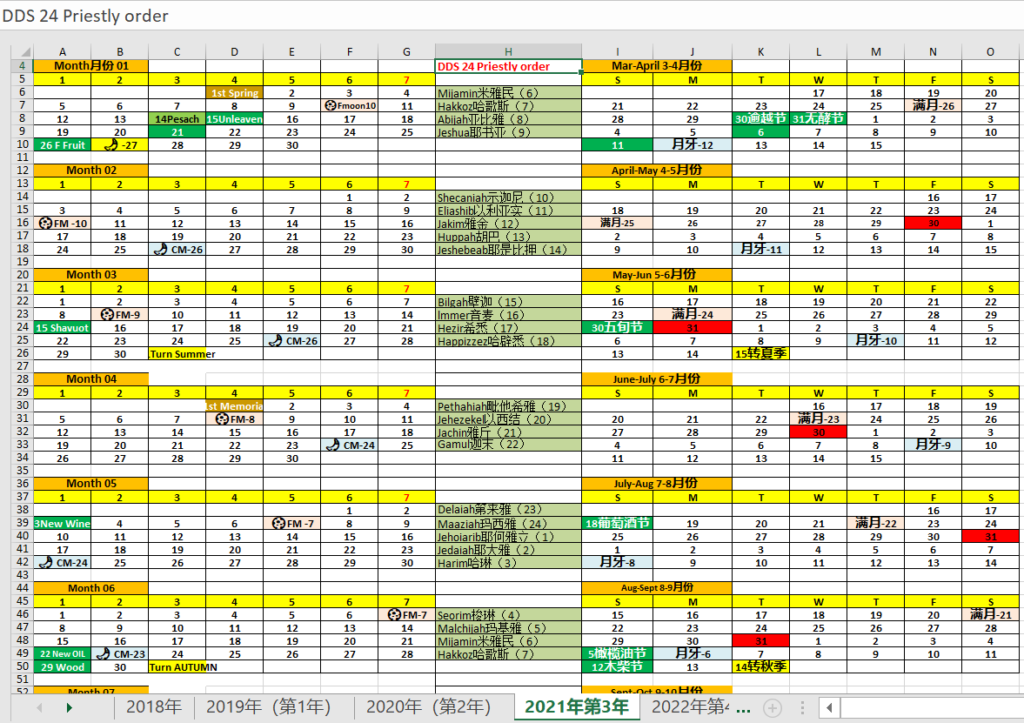
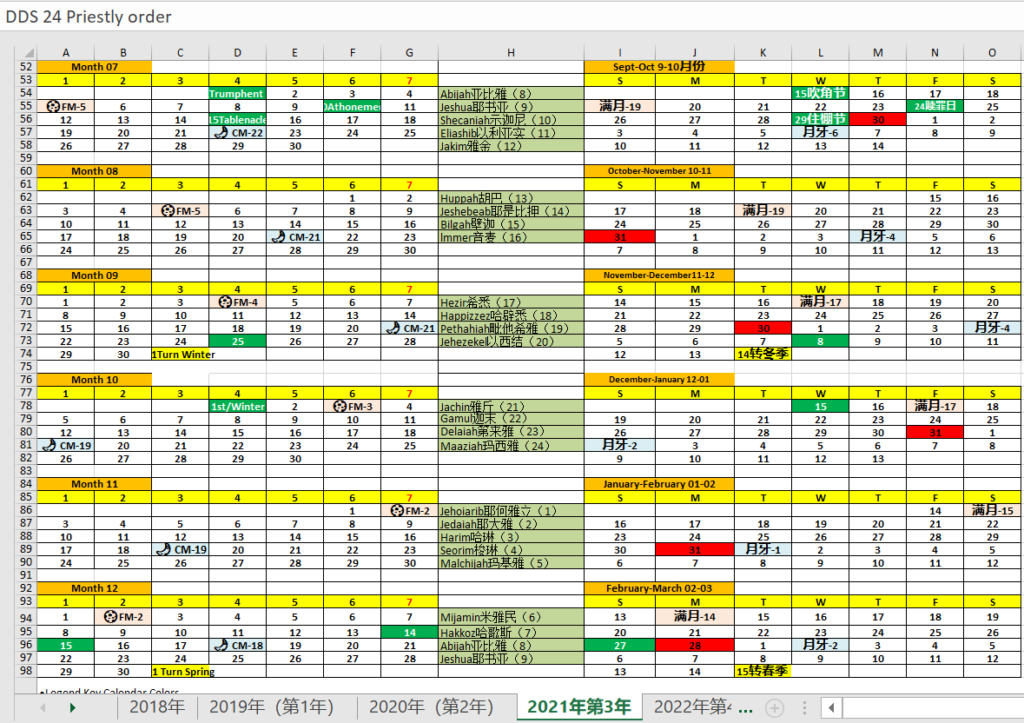
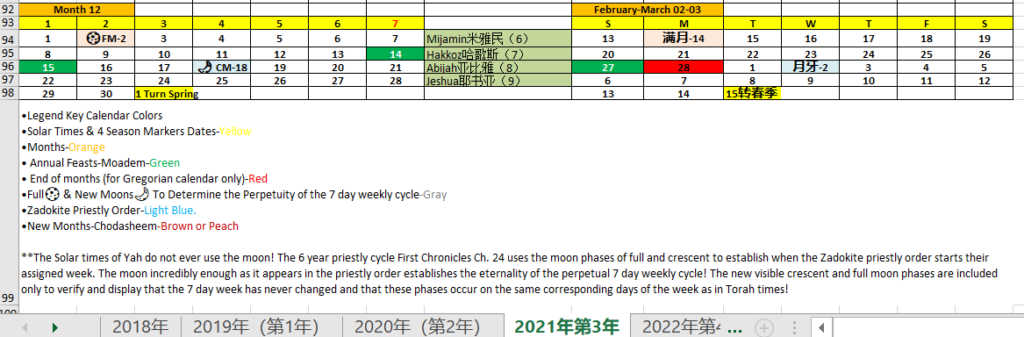
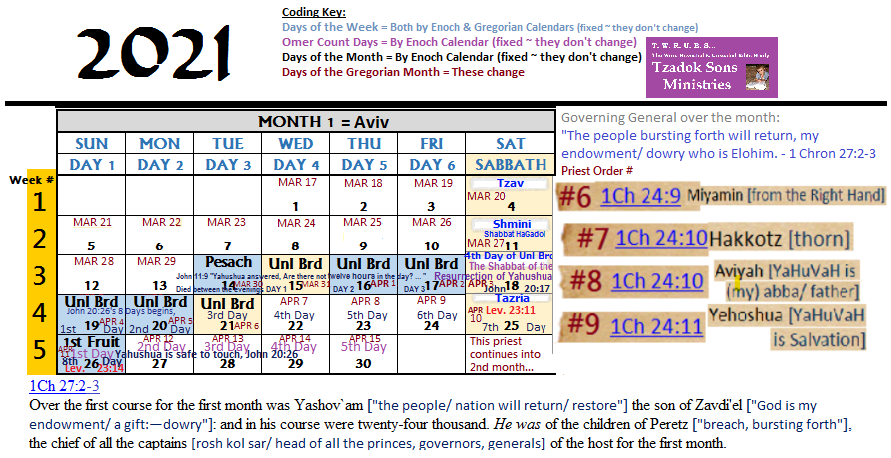
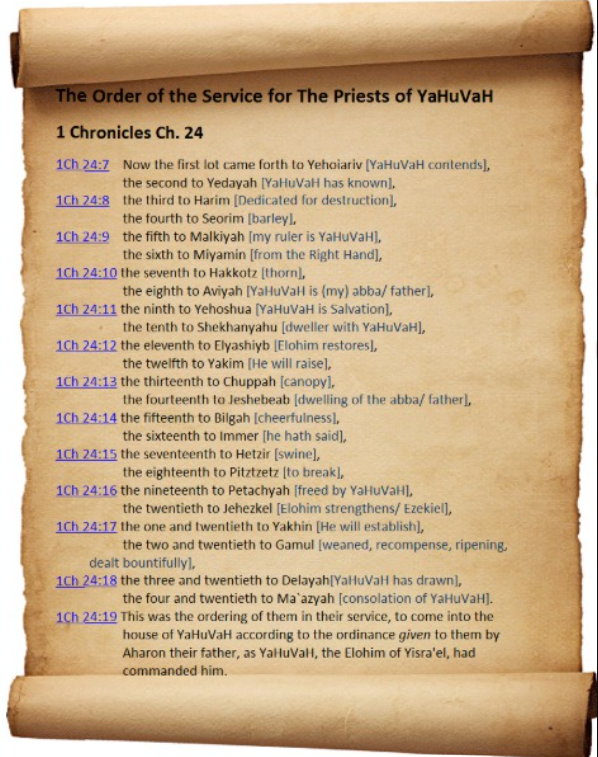
We have been very delighted after almost 6 years we have been following the calendar only 364 days 52 Shabbat on the current 7 days a week, Shabbat on Sat-day without breaking it, yet last few years as we checked and compare with the 6 years Priestly order as to who are on duty that Shabbat, whether that Shabbat shall have a full moon or not, miraculously, it has matched all the 6 years DSS finding continuously.  This means that we are keeping the same Shabbat with those Zadokite Priests as well as our Messiah in His time 2000+ years ago!  Details on how to read the 6 years priestly order chart please visit our webpage:https://perfectgiftorg.com/the-times-of-torah-enoch-the-order-of-malki-tzedek-2019/ and  https://perfectgiftorg.com/2021-2022-calendar-based-on-dds-priestly-order-6-years-calendar-excel-spreadsheet/

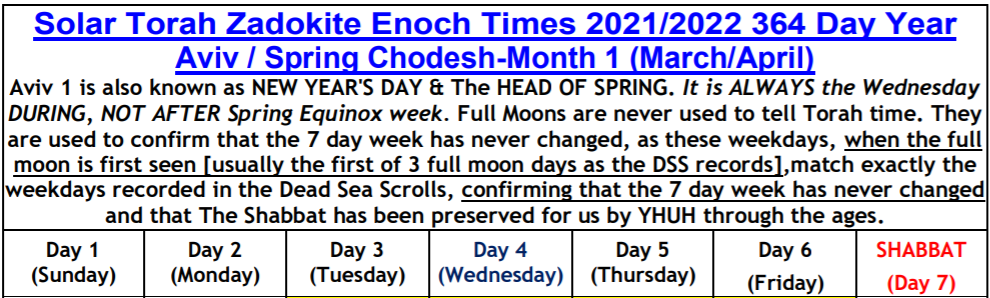
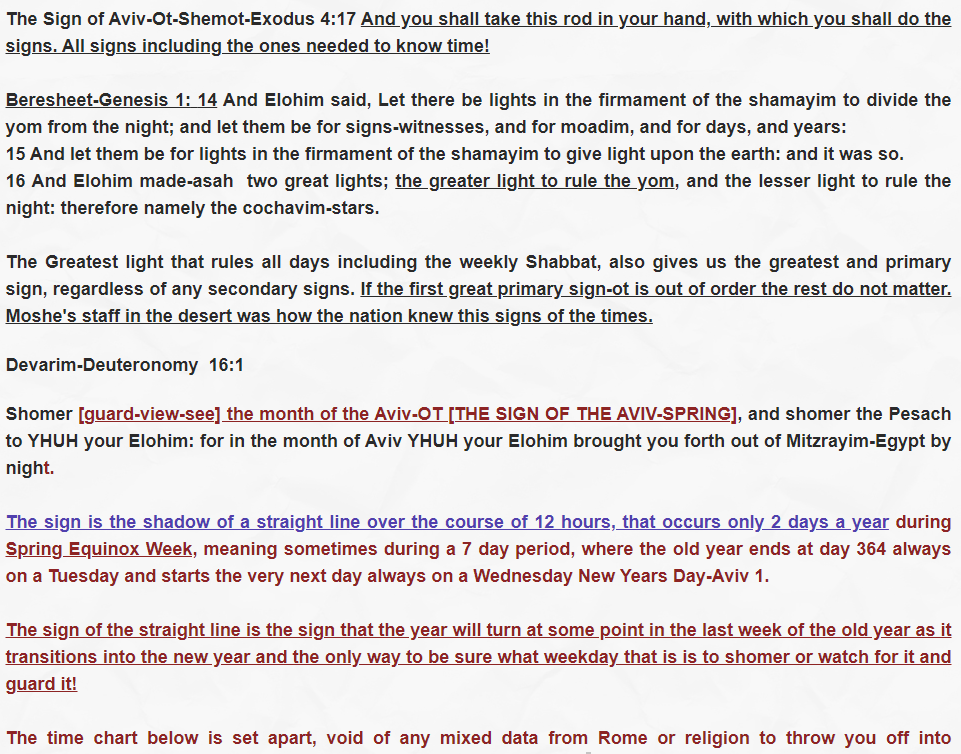
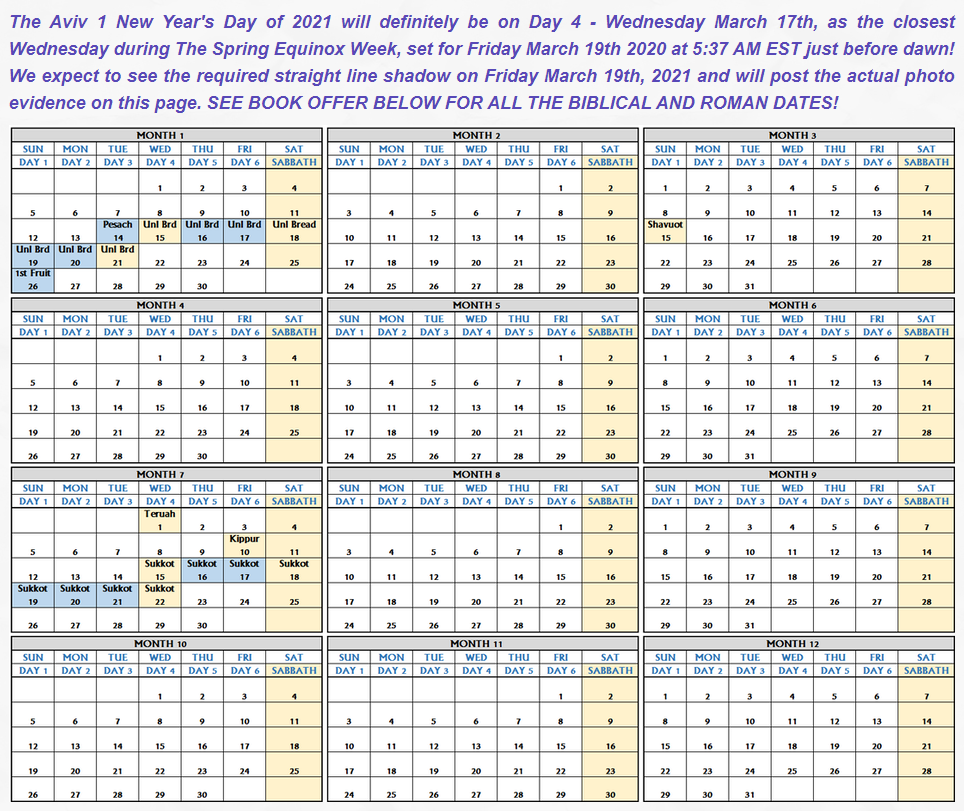
With YaHuWaH Priestly Calendar from DSS, the Spring Equinox falls during the last week of the old year annually, so it is not ever necessary to wait for the following Wednesday, or go back to a prior Wednesday, as that would throw everything off, including the weekday moon phases recorded by the true Zadokite priests! The Sign of the Spring Equinox, the straight line of shadows from sunrise to sunset, will occur somewhere within the 7 days OF THE EQUINOX WEEK that transits the old year [day 364] to the new one on Aviv 1!

The lunar phases confirm the year of the cycle we are in. Aviv 1 has a full moon in years 1 & 4 and again on year one of the new priestly cycle. The priestly order was based on calculation of lunar phases, not the 2nd or 3rd day of a 2–3-day full moon and NEVER BY OBSERVATION OF THE MOON.

REMEMBER JUBILEES 6 & OTHER PLACES FORBID ANY USE OF THE MOON TO DETERMINE TIME. WE FOLLOW A SOLAR ONLY CALENDAR! WE ARE MERELY SHOWING HOW THE PHASES APPEARED ON THE SAME DAY OF THE WEEK 2,000 YEARS AGO, AS THEY DO TODAY, SHOWING US THAT THE SHABBAT OF THAT DAY REMAINS THE SAME TODAY WITH THE HEATHEN NAME OF SATURDAY.

****Gregorian dates change year to year regardless of Torah patterns. Roman data-dates need to be ignored and shunned every year!

****The Torah priestly cycles NEVER CHANGE & are as follows: Years 1-4 same, Years 2-5 same, Years 3-6 same.

****If we start every year on Day 4 – Modern Wednesday every year will end on a 3rd Day-Tuesday and will be exactly 364 days as required by Torah & Enoch! For now, we only tracked and matched the DDS 6 years priestly calendar according to Enoch with only and straightly 364 days yearly with 52 “Shabbats” not weeks, and the 1st day, we only start the year on the 4th day of the first week of the new year… by doing it, we discovered that we are observing the exact same day same month and the same 6 years uninterrupted priestly order ( for example, this year 2021/2022 is the 3rd year of this priestly order circle) , hence, even though after 2000+ years between us and them, we are sharing the same calendar even with the moon position monthly with the same priest on duty every 6 years circle!!!! ( https://perfectgiftorg.com/2021-2022-calendar-based-on-dds-priestly-order-6-years-calendar-excel-spreadsheet/ ) And this was supported with scripture records as well as Jewish history when they mentioned a particular priestly order was on duty at that day of that month! And because of this, we also know how to identify the sabbatical years and Jubilee years according to the scriptures. ( https://perfectgiftorg.com/is-2022-or-2024-the-120th-jubilee-in-yhwh-dss-calendar/ )The numbers match perfectly! We have also tried scriptural studies on “dates” with this calendar exercise in Chinese ( https://perfectgiftorg.com/wp-content/uploads/2021/02/GENESIS-6-8-Calendar-Noah-Flood-based-on-Enoch-DDS-364days-Counting.pdf ), the counting of days match perfectly without breaking the Shabbat year to year.  We will try to describe it in English in this coming Year of YHWH! Amein.

https://perfectgiftorg.com/wp-content/uploads/2021/04/Is-Saturday-the-Seventh-6.pdf

Dead Sea Scrolls Calendar Footnote

https://perfectgiftorg.com/wp-content/uploads/2021/02/Dead-Sea-Scrolls-Calendar-Footnotes.pdf

Dear readers, our site has had encountered a sever crash in December 2019, and it took us a few month to finally restored the site minimally. The functionalities of the editorial operation have been compromised and has caused us great difficulty in uploading new post. We also notice that the cyber attack against us is still active and blocking readers from visiting us since then. Please bear with us for slow responses and pray for us to advance in this cause for MessiYAH YAHUSHUA in this coming year. HalleluYAH, HE Reigns!

Attached below here is a quick reply to one of our readers most recent question that concerning the subject of DSS Enoch calendar issue, and which is also the most concerned subject that many of you have been asking, here is the reply:

Dear beloved brother, a quick reply to inform you that we are on the same page:

  1. YES. The day begins in the morning Check this out! https://perfectgiftorg.com/hayom-%e2%80%90-the-day/
  2. YES. The MessiYAH was lay in the heart of the earth in day time before HE was placed in the grave! YES, HE was raised on the 3rd day!
    Please refer to our updated article with the same subject.
    https://perfectgiftorg.com/?p=3741
  3. You are correct, we should do one latest summary of our final research on this calendar subject matter. Sorry for the confusing researched papers ( published articles ) throughout the years that have been “improved/changed” as our understanding shifted. For now, we only tracked and matched the DDS 6 years priestly calendar according to Enoch with only and straightly 364 days yearly with 52 “Shabbats” not weeks, and the 1st day, we only start the year on the 4th day of the first week of the new year… by doing it, we discovered that we are observing the exact same day same month and the same 6 years uninterrupted priestly order ( for example, this coming year 2021/20222 is the 3rd year of this priestly order circle) , hence, even though after 2000+ years between us and them, we are sharing the same calendar even with the moon position monthly with the same priest on duty every 6 years circle!!!! And this was supported with scripture records as well as Jewish history when they mentioned of particular priestly order was on duty at that day of that month! And because of this, we also know how to identify the sabbatical years and Jubilee years according to the scriptures. The numbers match perfectly! We have done this exercise in Chinese, will try to describe it in English for this coming new Year of YHWH! Amein.

P.S. we have been active on social media groups instead of publishing new post on this site since DEC 2019 after we have encountered multiple cyber crashes on this site!
Todah Rabah Thank you for leaving your comment here.

Additional proof that our calendar is corresponding to the exactly same calendar that Noah was using on the Flood account recorded in the book of Genesis:

GENESIS 6-8 Calendar Noah Flood based on Enoch DDS 364days Counting.pdf


Commentary on SIN, and the State of our Nation (USA)

@6-2-20 By:  Edward A. Young, Ministry of Aloahiym

https://perfectgiftorg.com/wp-content/uploads/2020/06/6-2-20-Commentary-on-SIN-and-the-State-of-our-Nation-USA-5.pdf

Speaking in reference to this country (USA), we are under the judgment of YAHUWAH Aloahiym.  We have sinned and done wickedly ignoring His righteous laws:  practicing lawlessness; murdering  millions of innocent babies; practicing evil sexual immorality and then passing laws to protect those who commit these abominations; practicing of extortion by corrupting the money system and then using it to create the bondage of debt; to name only a few.

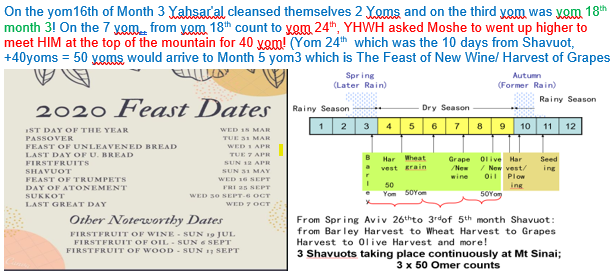
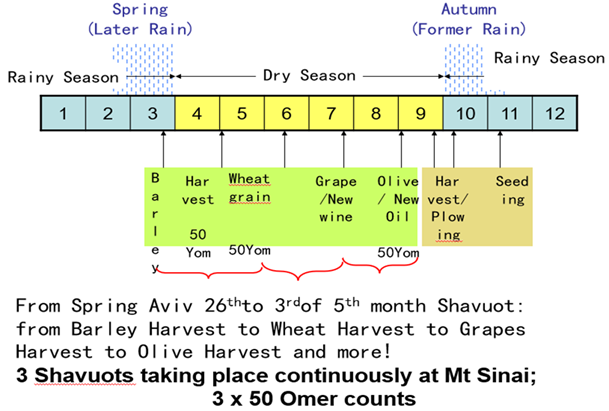
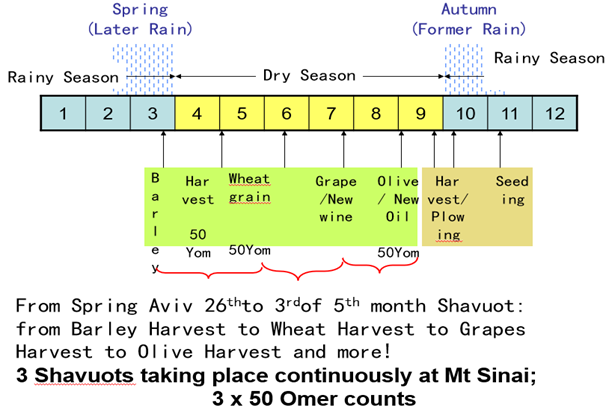
3 x 50 Omer counts From Harvest to Harvest to Harvest to Harvest

By Eyd &YahnEl Stephenson

Our First Fruit Offering to ABBA YaHuWaH in this Shavuot 2020 May 31st : The Covenant of Mt Sinai and the promise of the releasing / raining down HIS Ruach/Spirit in this appointed time and season.🌈🙏♥️HalleluYAH

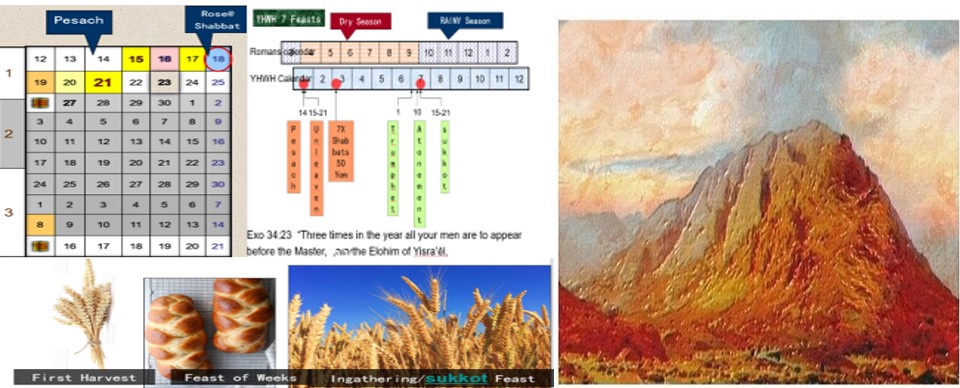
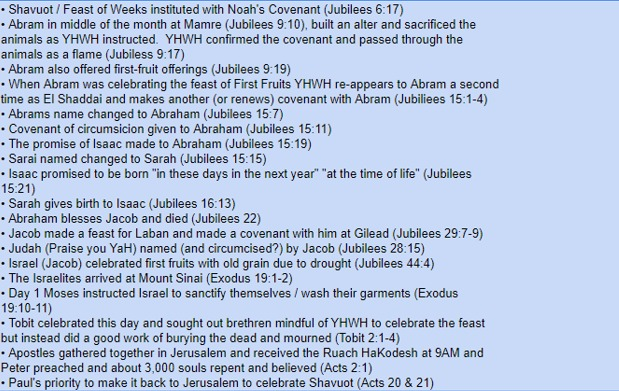
What had happened at Mt Sinai, between the feast of Shavuot, the 50 Omer count on the Yom15th of Month 3 to the 3rd Yom of Month 5, Feast of New Wine: 7X7+1 =50 Yoms count (7 weeks/shabbats) Festival?

3 Shavuot continuously at Mt Sinai 3 x 50 Omer counts ( PDF )

Initial information was excerpted from the document: https://perfectgiftorg.com/__trashed/ [What covenants are commemorated on Yom 15th of Month 3? From what Yom we are instructed to start the 50 omer counts in the Scriptures? ]

The Qumran community were Zadokites who YHWH says never erred (Ezek.48:11): they began the count of the Omer from the 26th day Aviv and not from any Sabbath within the week of Matzah. They were advocates of the solar calendar, believing this to be the calendar against which the heavenly host established sacred time and sacred service, a belief that is confirmed in the books of Jubilees and Enoch. They were also the temple administers and must have had the correct timing for Shavuot. Only a solar calendar acknowledging the relevance of the vernal equinox facilitates the correct timing for the Festival of Shavuot, being the 15th of the third month and for this date to be a day after a Sabbath.

The below message in purple was partially quoted from the comment by Sholiach Moshe Yoseph Koniuchowsky on https://perfectgiftorg.com/__trashed/ “Exodus 19 shows us that they arrived at Mt. Sinai on Yom 15 Month 3, Yom 15 is the same Yom they left Egypt. Three Yoms [# of new life-resurrection] of washing and preparation bring us to the 18th. The 18th back in Aviv was also the YOM OF LIFE on Shabbat MORNING before dawn when Messiah ROSE and gave us all eternal life. Both the written and The Living Torah were given in the early morning of the 18th, not at NIGHT! Messiah Yahushua also died on Aviv 15, freeing us from sin, the exact Yom we left Egypt and were set free in Aviv and also the exact Yom we arrived as a free people on Mt. Sinai the 15th!!! Only the Torah Solar calendar fits like a glove and needs no added fictional details or unreliable human eyes looking to an often unseen MOON, to justify things. To unknowingly follow the moon is to in essence be blindly led by the rabbinic anti-Messiah movement, that also rejects revelation given on Month 3 Yom 16, regarding time, rather trusting their own blind eyes! [ Jubilee1:1 And it came to pass in the first year of the exodus of the children of Yashar’al out of Egypt, in the third month, on the sixteenth Yom of the month, [2450 Anno Mundi] that YAHUWAH spoke to Mosheh, saying: ‘Come up to Me on the Mount, and I will give you two tables of stone of the Torah and of the commandment, which I have written, that you may teach them.’] The times of heaven are based on heavenly mathematics and remains so vital that it was initially given to Moses and Israel on the 16th Yom of Month 3, the Yom after arriving at Sinai and 2 Yoms before the entire Torah. Think of that! YHUH wanted to make sure that we had the time right before the feasts were renewed! All of you can stop guessing and entertaining different calendars or shall we say calendar-confusion, if we simply receive the math of heaven revealed to Moses as a revelatory gift with just a mustard seed of Emunah, needing no sightings or man’s mathematics. It is far less confusing to accept the revelation; all of it, between the 15th and 18th as our gift! “ …end

Date03-15th    Important records in the ScripturesNote

And this whole festival was celebrated in heaven from the Yom of creation till the Yoms of Noach – twenty-six jubilees and five weeks of years and Noach and his sons observed it for seven jubilees and one week of years, till the Yom of Noach’s death, and from the Yom of Noach’s death his sons did away with it until the Yoms of Abraham, and they ate blood. But Abraham observed it, and Yitzchak and Ya’akov observed it until your Yoms, and in your Yoms the children of Israel forgot it until you celebrated it anew on this mountain. (Jub.6:18-19).

Hence, from the record of our scriptures, they agreed to sign a covenant with YHWH which is different from their ancestors on the month 3 yom 15th: EXO 19:1-8 stated that it was on the month 3 yom 15th Yashar’al agreed and made a Solemn Covenant with YHWH: Exo 19:4 ‘You have seen what I did to the Mitsrites, and how I bore you on eagles’ wings and brought you to Myself. Exo 19:5 ‘And now, if you diligently obey My voice, and shall guard My covenant, then you shall be My treasured possession above all the peoples – for all the earth is Mine –Exo 19:6 ‘and you shall be to Me a reign of priests and a set-apart nation.’ Those are the words which you are to speak to the children of Yashar’al.” Exo 19:7 And Mosheh came and called for the elders of the people, and set before them all these words which יהוה commanded him. Exo 19:8 And all the people answered together and said, “All that יהוה has spoken we shall do.” So Mosheh brought back the words of the people to יהוה. 💕 On that Yom, Yashar’al accepted/committed to YAHUWAH’s proposal before going through the grand ceremony of the details of the content of the Torah being given yet! EXO 19:1In the third month after the children of Yisra’Ãl had come out of the land of Mitsrayim, on this Yom (The same yom) they came to the Wilderness of Sinai
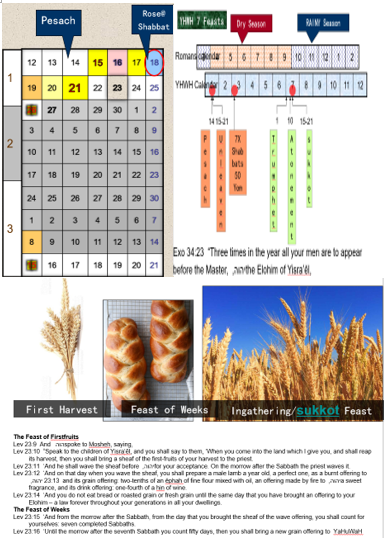
EXO 19 In the third month after the children of Yisra’Ãl had come out of the land of Mitsrayim, on this Yom (The same yom) they came to the Wilderness of Sinai
Date 03-15th Important Records in the Scriptures Note
Date03-16th Important Records in the ScriptureNote

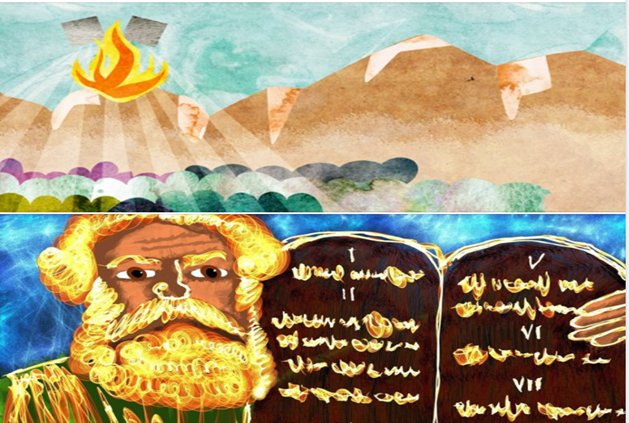
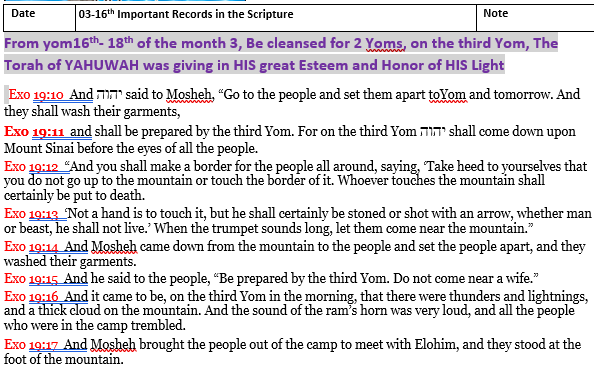
After that yom of covenant onYom 15th of month 3, on the yom16th of month 3, YHWH called Mosheh to the mountain to discuss HIS detail plan of the giving and the contents of the TORAH!  Exo 19:9-13  And יהוה said to Mosheh, “See, I am coming to you in the thick cloud so that the people hear when I speak with you and believe you forever.” And Mosheh reported the words of the people to יהוה. Exo 19:10  And יהוה said to Mosheh, “Go to the people and set them apart today and tomorrow. And they shall wash their garments, Exo 19:11  and shall be prepared by the third Yom. For on the third-Yom יהוה shall come down upon Mount Sinai before the eyes of all the people. etc ”    The Book of Jubilee was written for this purpose, it stated that on month 3 yom 16th, after  Yashar’al agreed to trust and obey YHWH whatever HE said; YHWH began to give the detail instructions of the content of TORAH to them.  JUBILEES 1 YAHUWAH Call Mosheh up to the Mountain to give the account of the division of the Yoms   Jubilee1:1 And it came to pass in the first year of the exodus of the children of Yasharal out of Egypt, in the third month, on the sixteenth Yom of the month, [2450 Anno Mundi] that YAHUWAH spoke to Mosheh, saying: ‘Come up to Me on the Mount, and I will give you two tables of stone of the Torah and of the commandment, which I have written, that you may teach them.‘ Jubilee was written for this purpose: This is the history of the division of the Yoms of the Torah and of the testimony, of the events of the years, of their (year) weeks, festivals of the covenant, of their Shabbats, of their Jubilees throughout all the years of the world, as YAHUWAH spoke to Mosheh on Mount Sinai when he went up to receive the tables of the Torah and of the commandment, according to the voice of YAHUWAH as HE said to him, ‘Go up to the top of the Mountain.‘https://perfectgiftorg.com/moses-makes-seven-trips-up-and-down-mt-sinai/

A quote from the above article/link: ” We have discovered that scripture is knitted together by EIGHT COVENANTS YAHUWAH made through 5 men (Noah, Abraham x2, Moses x3, David, Yahushua) in an unfolding fashion, of which each of the first seven (covenants) were all parts of one covenant and each played a specific function in this first marriage (a COVENANT is a MARRIAGE UNION) between YAHUWAH and Abraham’s descendants that failed time and time again due to man’s unregenerate nature always disobedient to their covenant. A covenant has a contractual structure to it. In fact, a modern-Yom contract originates from ancient blood covenant, which is what we see take place both at Mt Sinai and 1500 years later with the death of our Savior. The ReNewed Covenant (of which also has a contractual structure) and blood shed of the Savior is directly connected to these seven trips Moses made. A CONTRACT has 4 elements:

An OFFER

An ACCEPTANCE

TERMS AND CONDITIONS, including a ceremony with blood ratification

SIGNATURE (a COVENANT is signed in BLOOD)

A modern-Yom Wedding in our culture is followed by a ceremonial reception where the Bride and Bridegroom share their first COVENANT MEAL as Husband and Wife. This also is modeled after the ancient blood covenant. We will see this occur at Mt Sinai as well. The speaking of THE TEN WORDS (often translated as Ten “COMMANDMENTS”) was, and still is, the eternal marriage conditions between YAHUWAH and Abraham’s descendants, which includes those of us in Yahushua/Messiah — the WORD/TEN WORDS made flesh. This wedding Yom 3500 years ago is also known as THE YOM OF THE ASSEMBLY (also translated incorrectly as the word “church”).  Now, since you and I in Yahushua/Messiah are Abraham’s descendants as were they of this first covenant arrangement, every topic and theme of scripture and the entire ReNewed Covenant must be interpreted through what happened here at the Yom of the Assembly and subsequent 100 Yoms following. (From harvest to harvest: another set of 50 Yoms from month3 yom 15th  is The Feast of new wine; the third set of 50 yoms is the feast of New Oil)

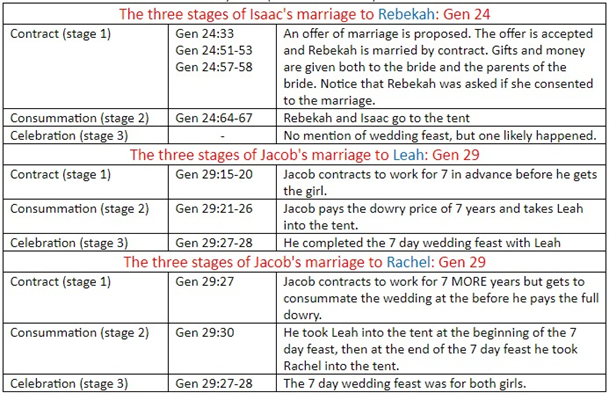
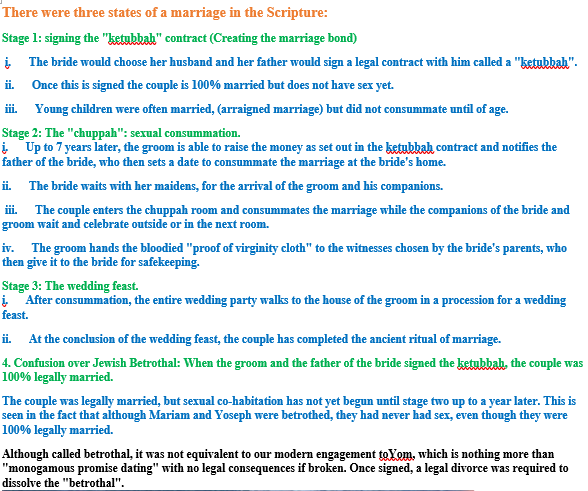
Another way of understanding the event happened on Mt Sinai: the Jewish wedding 3 stages:

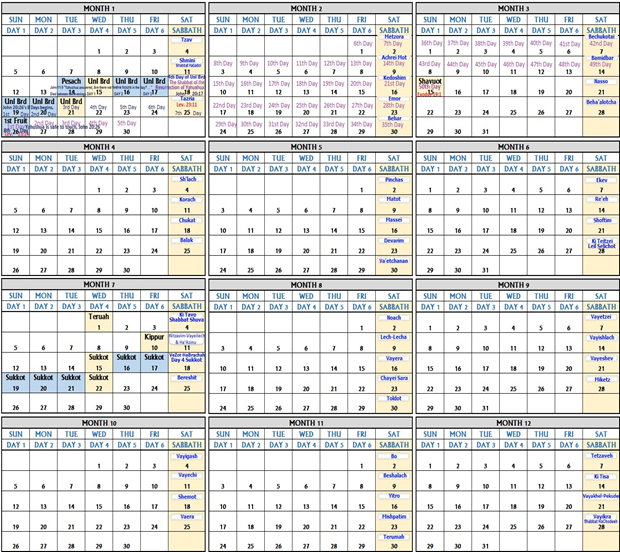
On the yom16th -18th of the month 3 in Yahuwah 364 yom Calendar:

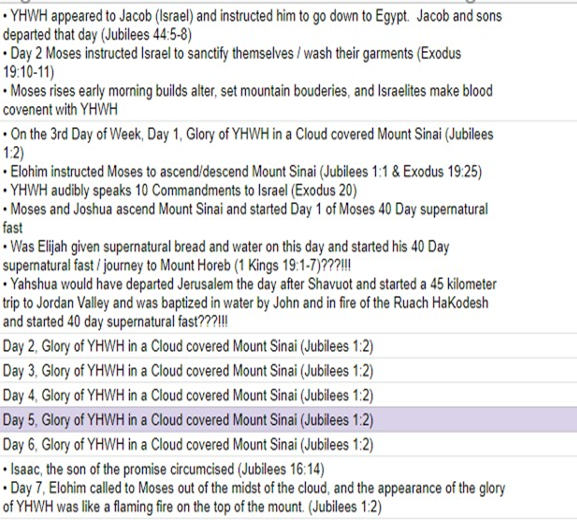
03/19: Yom2 Clouds Cover Mount Sinai   
Exo 24:9 And Mosheh went up, also Aharon, Naḏaḇ, and Aḇihu, and seventy of the elders of Yisra’ĕl,      
03/20 Yom 3 Clouds Cover Mount Sinai
03/21  Yom 4 Clouds Cover Mount Sinai
03/22  Yom 5 Clouds Cover Mount Sinai
03/23  Yom 6 Clouds Cover Mount Sinai
03/24 Yom7 Clouds Cover Mount Sinai
Exo 24:10  and they saw the Elohim of Yisra’ĕl, and under His feet like a paved work of sapphire stone, and like the heavens for brightness. Exo 24:11  Yet He did not stretch out His hand against the chiefs of the children of Yisra’ĕl! And they saw Elohim, and they ate and drank. Exo 24:12  And יהוה said to Mosheh, “Come up to Me on the mountain and be there, while I give you tablets of stone, and the Torah and the command which I have written, to teach them.” Exo 24:13 And Mosheh arose with his assistant Yahoshua, and Mosheh went up to the mountain of Elohim. Exo 24:14 And he said to the elders, “Wait here for us until we come back to you. And see, Aharon and Ḥur are with you. Whoever has mattered, let him go to them.” Exo 24:15 And Mosheh went up into the mountain, and a cloud covered the mountain. Exo 24:16 And the esteem of יהוה dwelt on Mount Sinai, and the cloud covered it for six Yoms. And on the seventh Yom, He called to Mosheh out of the midst of the cloud. Exo 24:17 And the appearance of the esteem of יהוה was like a consuming fire on the top of the mountain, before the eyes of the children of Yisra’ĕl. Exo 24:18  And Mosheh went into the midst of the cloud and went up into the mountain. And it came to be that Mosheh was on the mountain forty Yoms and forty nights.

Yom 26/3rd Month:  Noah’s the 40th Yom of rain
Yom 1st Month 4 and together with al 4 seasonal memorial Yom Jubilee 16:1-4 The Malakim appear unto Abraham 1 And on the new month of the fourth month we appeared unto Abraham, at the oak of Mamre, and we talked with him, and we announced to him that a son would be given to him by Sarah his wife. 2 And Sarah laughed, for she heard that we had spoken these words with Abraham, and we admonished her, and she became afraid and denied that she had laughed on account of the words.3 And we told her the name of her son, as his name is ordained and written in the heavenly tablets (i.e.) Yitschaq, 4 And that when we returned to her at a set time, she would have conceived a son.  
Jubilee 29:15-16 And he sent to his father Yitschaq of all his substance, clothing, and food, and meat, and drink, and milk, and butter, and cheese, and some dates of the valley. 16 And to his mother, Rebecca also four times a year, between the times of the months, between plowing and reaping, and between autumn and the rain (season) and between winter and spring, to the tower of Abraham.
  Jubilee 6:23-29 23 And on the new month of the first month, and on the new month of the fourth month, and on the new month of the seventh month, and on the new month of the tenth month are the Yoms of remembrance and the Yoms of the seasons in the four divisions of the year. These are written and ordained as a testimony forever. 24 And Noah ordained them for himself as feasts for the generations for ever, so that they have become thereby a memorial unto him. 25 And on the new month of the first month he was bidden to make for himself an ark, and on that (yom) the earth became dry and he opened (the ark) and saw the earth. 26 And on the new month of the fourth month, the mouths of the depths of the abyss beneath were closed. And on the new month of the seventh month, all the mouths of the abysses of the earth were opened, and the waters began to descend into them 27 And on the new month of the tenth month the tops of the mountains were seen, and Noah was glad.
28 And on this account he ordained them for himself as feasts for a memorial for ever, and thus are they ordained 29 And they placed them on the heavenly tablets, each had thirteen weeks; from one to another (passed) their memorial, from the first to the second, and from the second to the third, and from the third to the fourth
Jubilee 3;32 And on the new month of the fourth month, Adam and his wife went forth from the Garden of Eden, and they dwelt in the land of Elda in the land of their creation.  

Genesis 8: 22, “As long as the Earth endures, seed time and harvest, cold and heat, Summer and Winter, Day and Night will never cease.”

Dead Sea Scroll Parchment 4Q409. Frag.1 Col.1—
“Praise and Baruch on the Days of the First Fruits of Wheat, of New Wine and Fresh Oil, with the New Cereal Offering and Baruch His Kadosh Name. Praise and Baruch on the Days of the Festival of Woods, with the Offering of Woods as a burnt offering, and Baruch His Name. Praise and Baruch on the DAY OF REMEMBRANCE with a blast on the Rams Horn. Baruch YAHUWAH, YAH of all. Praise and Baruch …and Baruch His Kadosh Name. and Baruch YAHUWAH, YAH of all. Praise and Baruch on these days.. Praise and Baruch and give Thanks….. Praise and Baruch and give Thanks with tree branches.”

Jubilee 6:23-29  v28 And on this account he ordained them for himself as feasts for a memorial forever, and thus are they ordained 29 And they placed them on the heavenly tablets, each had thirteen weeks; from one to another (passed) their memorial, from the first to the second, and from the second to the third, and from the third to the fourth

instant PDF pls click here

Or COPY the PDF link below, and paste it on your browser

https://perfectgiftorg.com/wp-content/uploads/2019/07/7-14-2019-PDF-Revelation-of-YAHUWAH-Aloahiym’s-Light-in-Motion.pdf

Prayer

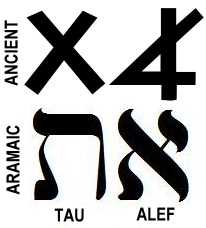
Father, all praise be to You, the Eternal YAHUWAH Aloahiym Aleph Tau, our Creator Father, and Yahushua, our Messiah Aloahiym Aleph Tau, one with the Father [John 10:30], Who has us kept us alive, sustained us, and enabled us to reach this moment in your plan for all of the eternity. Father, we know that our entire existence is a function of you alone, and that our salvation is only through Yahushua [Rev 5: 12-13], and that your love of us preceded our love for you [1 John 4:19]. We only have an existence, sustenance, and prosperity because of your love for us and your pleasure, and for no other reason [Rev 4:11]. Without an existence, we cannot give you the praise and thanks that you so richly deserve, and that is rightfully Yours. YAHUWAH, you inhabit the praises of your people, Israel [Psalm 22:3], and not our complaints [Phil 2: 14; James 3: 14-18]. We thank you, Father, for bringing forth all believers in you and of You to read this article, whereby you have revealed yourself to each and every one of us during our tenure here on the earth, to serve your purposes, and whereby the brilliance of your magnificent Light is tangibly apparent, and glowing in, around, and through each one of us [Psalm 91:1; Matt 6:22]. Even though we all have walked in times past in the darkness of Satan, according to the ways and course of this world, [Eph 2: 2], You have redeemed us for Your purposes, enabling us to witness and perceive who You are in us, and who we are in You, even allowing us to perceive the origin of our core existence (our respective spirits) as being of you (your divine Light)[1 John 1:5], and literally having our spirits with you in Shamayim [Eph 2:6] as joint heirs with Yahushua, the one and only Messiah [Rom 8:17; John 14:6], so as to accomplish Your perfect will (YAHUWAH’S Perfect Will = YAHUWAH’S pure, perfect divine Light) in and for each one of us [Eph 2:10]. You and you alone provide us with what we are in need of [Phil 4:19], and what we desire [Psalm 23:1]. Father, we ask that you Baruch each and every reader of this article by consuming our respective spirits, souls, and bodies, and manifesting your perfect, divine Light tangibly and recognizably as coming only from You as the sole, exclusive and Sovereign source [Isa 43:11, 15; 44:6; others], such that each person receive, ponder, and decisively act on this message as you have delivered it to me, and that each reader hereof would clearly and tangibly experience the explosion of your perfect, divine Light as the Perfect Gift of James 1:17 (active motion/movement = demonstration of power of the Ruach ha Qodesh), according to Your perfect will for each of us, in the manner in which you have revealed it here. We thank you, Father, for answered prayer. Amein. Shalom,

Eyd and Yahn EL Stephenson

http://www.perfectgiftorg.com/links

http://www.perfectgiftorg.com/register

When and what the Festival of Shavuot Memorializes

By Clifford Fearnley

Introduction

“And from the morrow after the Sabbath, from the day that you brought the sheaf of the wave offering, you shall count for yourselves: seven completed Sabbaths. Until the morrow after the seventh Sabbath you count fifty days, then you shall bring a new grain offering to YHWH. Bring from your dwellings for a wave offering two loaves of bread, of two-tenths of an ephah of fine flour they are, baked with leaven, first-fruits to YHWH.” (Lev.23:15-17).

When it comes to this particular Festival, Scripture is vague; we are left in doubt about its timing and what it represents. We are told to count a definite period starting from the day after a Sabbath but Scripture is unclear which Sabbath, similarly we are told to wave two loaves of bread but not told why or what they symbolize.

We associate Shavuot with the giving of the Torah at Mt. Sinai, the waving of the first fruits of the wheat harvest and the outpouring of the Ruach HaKodesh (Acts 2) but are we celebrating correctly? Not if we are to take any notice of the past, the ancients celebrated this Festival well before the Sinai event and certainly before what is described in Acts 2. Thus the Festival of Shavuot was celebrated before some of the events we believe it to represent. Now doesn’t that realization create a paradigm shift in our understanding? Another issue for us is how did the ancients calculate the Count of the Omer and date Shavuot.

When Scripture fails to provide the answers we should not, indeed, according to Mashiach (Matt.15:9) we must not, make up our own rules, thus with respect to;

  1. The Correct Date for Shavuot and
  2. What Shavuot Memorialises

we have to search other avenues of information: we are forced to look beyond the Scriptures and consider literature that was never canonised.

The extra-canonical information we will be considering is from; the Dead Sea scrolls and the book of Jubilees with some references to the book of Enoch. Oftentimes these two books are viewed with a jaundiced eye merely because they were never canonized. Yet the books of Jubilees and Enoch were, in both cases, recited to the recipient by a Malak; a heavenly messenger of YHWH, this itself is a compelling argument for these two books to be considered in the same vein as the Scriptures.1 It is astonishing that lower man could award himself the authority to decide information from a divine source was unworthy of the canon. Man’s decision to exclude this literature was not so much because it lacked credibility but more likely because it obstructed a particular agenda/philosophy.

From the three sources: the Dead Sea Scrolls, the book of Enoch and the book of Jubilees we are, insofar as this festival is concerned, able to resolve the above issues and ascertain the true date for Shavuot and what this celebration is about.

Dating Shavuot

“Speak to the children of Israel, and you shall say to them, ‘When you come into the land which I give you, and shall reap its harvest, then you shall bring a sheaf of the first-fruits of your harvest to the priest and he shall wave the sheaf before YHWH for your acceptance. On the morrow, after the Sabbath, the priest waves it.” (Lev.23:10-11)

“And from the morrow after the Sabbath, from the day that you brought the sheaf of the wave offering, you shall count for yourselves: seven completed Sabbaths. ‘Until the morrow after the

1 Refer to the separate article ‘Exclusivity Or Not of the Canon of Scripture’ found at www.undertorah.com under Miscellaneous articles

seventh Sabbath you count fifty days, then you shall bring a new grain offering to YHWH.” (Lev.23:15-16).

The period specified in Lev.23:15-16 is commonly referred to as the Counting of the Omer. As the verse instructs the Omer period is to start and finish on the day after a Sabbath and is to comprise seven Sabbaths, these facts are very clear. Less clear is from which Sabbath the counting is to begin.

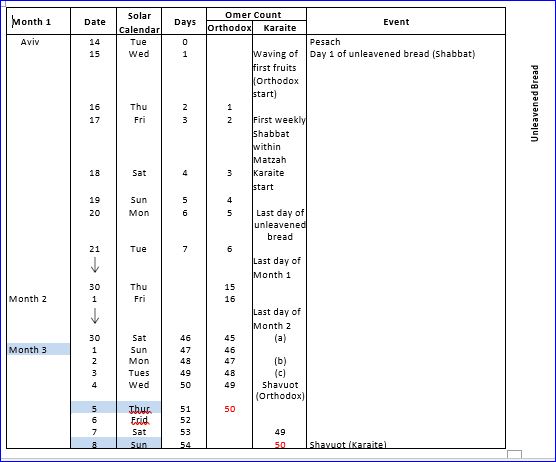
Where to start the Count of the Omer is an issue of contention within Judaism. The Karaites start the 50 day count from the Sunday falling within the week of unleavened bread, whilst others of Orthodox following commence the counting from the second day of unleavened bread. So which is correct, could it be neither is correct? There is a verse from Exodus that is generally overlooked, yet it does impact on this issue,

In the third month, when the children of Israel were gone forth out of the land of Egypt, the same day came they into the wilderness of Sinai. (Exod.19:1)

The phrase ‘the same day’ is translated ‘on that day’ in some scriptures. Whatever translation is used the use of the word ‘same’ in this verse is ambiguous and may be interpreted as meaning any of the following;

  1. The first day of the third month,
  2. The third day of the third month,
  3. The same day of the week as that on which they left Egypt,
  4. The same date of the month they left Egypt.

Taking (a)–(d) into consideration, the rules of neither the Karaites nor the Orthodox satisfy any of these alternatives,

Month 1 Date Solar Calendar Da ys Omer Count Event
Orthodox Karaite
Aviv 14 Tue 0     Pesach
  15 Wed 1     Day 1 of unleavened bread (Shabbat)
  16 Thu 2 1   Waving of first fruits (Orthodox start)
  17 Fri 3 2    
  18 Sat 4 3   First weekly Shabbat within Matzah
  19 Sun 5 4 1 Karaite start
  20 Mon 6 5 2  
  21 Tue 7 6 3 Last day of unleavened bread
             
  30 Thu   15 12 Last day of Month 1
Month 2 1 Fri   16 13  
             
  30 Sat 46 45 42 Last day of Month 2
Month 3 1 Sun 47 46 43 (a)
  2 Mon 48 47 44  
3 Tues 49 48 45 (b)
4 Wed 50 49 46 (c)
5 Thur 51 50 47 Shavuot (Orthodox)
6 Frid 52   48  
7 Sat 53   49  
8 Sun 54   50 Shavuot (Karaite)

Neither method of counting satisfies any of the conditions in (a) – (d), thus both philosophies ignore Exod.19:1.

Not only does neither teaching satisfy Scripture but neither Judaic authority can prove what they preach, so how can anyone have confidence in what they are advocating?

So concerning the dating of Shavuot let us consider what is said in the book of Jubilees

And in the fifth year of the fourth week of this jubilee in the third month, in the middle of the month, Abram celebrated the first fruits of the grain harvest. (Jub.15:1).

All of the non-canonical literature we are using recognises a 364 day year comprising 12 months of 30 days with four additional days added at the head of each quarter/season. Thus when it says the middle of the third month it is referring to the 15th of the third month which, on the 364 day solar calendar is the 75th day of the year. Now let us refer to an earlier chapter from Jubilees; chapter six. To save time and space I have abridged what is written but have kept sufficient not to lose the context. We are only interested in the first half of the chapter which concerns the end of the flood and Noach’s exit from the ark. It is important to realise that the book of Jubilees was dictated to Moshe by a malak (a heavenly messenger) and Moshe is learning what happened concerning Noach,

And He gave to Noach and his sons a sign that there should not again be a flood upon the earth. He set His bow in the cloud for a sign of the eternal covenant that there should not again be a flood on the earth to destroy it all the days of the earth. For this reason it is ordained and written on the heavenly tablets, that they should celebrate the Feast of Shavuot in this month once a year…..(Jub.6:15-17)

And this whole festival was celebrated in heaven from the day of creation till the days of Noach – twenty six jubilees and five weeks of years and Noach and his sons observed it for seven jubilees and one week of years, till the day of Noach’s death, and from the day of Noach’s death his sons did away with it until the days of Abraham, and they ate blood. But Abraham observed it, and Yitzchak

 and Ya’akov observed it until your days, and in your days the children of Israel forgot it until you celebrated it anew on this mountain. (Jub.6:18-19).

Reading Jub.15:1 with the above, clearly it was the Festival of Shavuot that Avraham and his sons celebrated on the 15th of the third month. We are told that the festival was observed by the patriarchs, subsequently forgotten and re-instituted with Moshe. What is more the patriarchs could not have been wrong with the timing because we are told that this, as are other moedim, was written down on heavenly tablets and they would not have  been allowed to celebrate it incorrectly.

The 15th of the third month is the 75th day of the year which means the start of the Count of the Omer is from the 26th day of the year (inclusive counting), which falls outside the week of unleavened bread. What this means is that we must use a calendar in which the 26th and 75th days fall immediately after a Sabbath, which is only possible using a solar calendar which recognises the equinoxes. As far as I am aware no other calendar is able to satisfy this requisite.2

Starting the count of the Omer from the day after the first Sabbath after the week of Matzah is alien to most but the accuracy of doing so becomes clearer when we realise the ancients considered Pesach and the week of Matzah as a single celebration. Consider how Moshe phrases his instructions concerning this festival,

Guard the month of Aḇiḇ, and perform the Passover to YHWH your Elohim, for in the month of Abib YHWH your Elohim brought you out of Mitsrayim by night. And you shall slaughter the Passover to YHWH your Elohim, from the flock and the herd, in the place where YHWH chooses to put His Name. Eat no leavened bread with it. For seven days you eat unleavened bread with it, bread of affliction, because you came out of the land of Mitsrayim in haste – so that you remember the day in which you came out of the land of Mitsrayim, all the days of your life. And no leaven should be seen with you in

2 More is explained on this point in the separate article ‘Which is YHWH’s Calendar.’

all your border for seven days, neither should any of the meat which you slaughter in the evening on the first day stay all night until morning. (Deut.16:1-4)

This passage clearly shows that Moshe did not consider the Pesach a separate celebration to Matzah. The Jewish historian Josephus in his Antiquities of the Jews refers to the ‘Pesach week’ and also talks of the eight days of unleavened bread which has to include Pesach. Josephus would be talking in terms of what was customary within Jewish society. Scroll 4Q325 of the Dead Sea Scrolls describing the priestly family in service at the time of the Pesach talks in terms of an eight day Pesach. I do not have the audacity to say I know better  than Abraham, Yitzchak, Ya’akov, Moshe and the Zadokite Qumran community. In the gospel, Pesach is referred to as being on the first day of ‘Feast of unleavened bread’ (Matt.26:17). Even the Jews today refer to the 15th Abib to be the second day of Pesach and talk in terms of ‘the days (not day) of Pesach. Clearly the concept that Pesach included the week of Matzah is overwhelming and concurs with the Zadokite understanding that the phrase, ‘And from the morrow after the Sabbath’ refers to the first Sabbath after the completion of the week of Matzah.

Did Mashiach’s Death and Resurrection Effect the Date of Shavuot?

Did Mashiach’s death, resurrection and ascension affect the count of the Omer? Are we to correlate the waving of the first fruits of the crop with the first fruits of the resurrection, are they synonymous? When we collect together the following three elements: 1) that Deut.4:2 commands that the Torah is not to be meddled with, 2) Jubilees categorically states that the correct date of Shavuot 15/3 is ordained on heavenly tablets and 3) we are told Mashiach never sinned therefore He never transgressed Torah. How then could He implement a change to YHWH’s calendar? What is more, at His Pesach Mashiach specifically said this is the blood of the new covenant not new calendar. If His death and resurrection was to change YHWH’s calendar He had the ideal opportunity to confirm this when referring to the sign of Jonah (Matt.12:39-40). Nowhere does Mashiach mention any impending change to YHWH’s calendar as a result of His death and resurrection and nowhere does Scripture use the terms ‘first fruit of the harvest’ and ‘first fruits of the resurrection’ synonymously, if this was to be correct we would have to enquire how is the second waving of the harvest at Shavuot synonymous of resurrection?

What the Festival of Shavuot Memorializes

Other than to infer thanksgiving for a successful harvest, the Scriptures provide no explanation for this celebration. Today we attach several events to this festival; First Fruits of the harvest, the giving of the Torah at Sinai and the giving of the Ruach Hakodesh (Holy Spirit) as described in Acts 2. However, as mentioned in the Introduction, this Festival was celebrated centuries before these events. So what exactly were the ancients celebrating and should we be celebrating likewise?

The book of Jubilees shows us that YHWH chose the date of Shavuot; the 15th of the third month to enact several very salient events,

And He gave to Noach and his sons a sign that there should not again be a flood on the earth. And He set His bow in the cloud for a sign of the eternal covenant that there should not again be a flood on the earth to destroy it all the days of the earth. For this reason it is ordained and written on the heavenly tablets, that they should celebrate the ‘Feast of Weeks’ in this month once a year, to renew the covenant every year. (Jub.6:15-17)

It was on Shavuot that YHWH made a solemn promise with creation to never flood the earth again and it is commanded for us to renew/refresh/remember YHWH’s promise at this time every year. Then we have the following additional covenants enacted on this date. To save space I have abridged both abstracts,

Jubilees chapter 14;

1After these things, in the fourth year of this week, on the New Moon of the third month, the word of YHWH came to Abram in a dream saying “Fear not Abram: I am your defender and your reward will be exceedingly great…9 And He said unto him, “Take Me a heifer of three years, and a goat of three

years, and a sheep of three years, and a turtle dove, and a pigeon.” 10 And he took all these in the middle of the month.

Jubilees chapter 15;

1And in the fifth year of the fourth week of this jubilee in the third month, in the middle of the month, Abram celebrated the feast of the first fruits. 2And he offered new offerings on the alter, the first fruits of the produce unto YHWH, an heifer and a goat and a sheep on the alter as a burnt sacrifice unto YHWH; their fruit offerings and their drink offerings he offered upon the alter with frankincense. 3And YHWH appeared to Abram and said to him, 4“I am YHWH almighty; approve yourself before Me and be you perfect. And I will make My covenant between Me and you and I will multiply you exceedingly.” 5And Abram fell on his face and YHWH talked with him, and said, 6“Behold My ordinance is with you, and you shall be the father of many nations..9”And I shall establish My covenant between Me and you and your seed after you throughout their generations, for an eternal covenant so that I may be an Elohim unto you and your seed after you. 11And YHWH said unto Abraham, “And as for you do you guard My covenant, you and your seed after you and you circumcise every male after you.

Note there is no mention of two loaves of leavened bread, as we will see there was no need of such symbolism until later.

So, insofar as this festival is concerned what we have so far is,

  1. YHWH’s covenant promise never again to flood the earth
  2. YHWH’s covenant with Abram
  3. The covenant of circumcision

Feast of Weeks

  • Waving of first Fruits                                                                                             Feast of First Fruits

Thus the Festival of Shavuot has two elements, a fact confirmed by Jubilees,

For it is the ‘Feast of Weeks’ and the ‘Feast of First Fruits:’ this feast is twofold and of a double nature: according to what is written and engraved concerning it. (Jub.6:21).

Clearly it was covenant that the ancients attached to this Festival, even the element of ‘First Fruits’ has covenantal implications as we will see. But we cannot ignore the covenantal element associated with the outpouring of the Ruach Hakodesh upon the disciples also at Shavuot. So post Sinai what we have for Shavuot is,

  1. YHWH’s covenant promise never again to flood the earth
  2. YHWH’s covenant with Abram
  3. The covenant of circumcision
  4. The command to wave two loaves of leavened bread
  5. The earthly institution of the new covenant : Acts 2

Feast of Weeks

  • Waving of first Fruits                                                                                               Feast of First Fruits

It could be argued that item 5 should not be included because Mashiach introduced the new covenant at  Pesach not Shavuot however we must remember that the new covenant is the ‘Gospel’ of Mashiach and it was inaugurated at Shavuot.

The question we now have is, are we transgressing Deut.4:2 by adding to this celebration? I don’t believe so. Clearly Shavuot is YHWH’s appointed time to celebrate His covenants a fact confirmed by Jubilees. Items 1,2

and 3 were always a part of Torah indeed they were written on heavenly tablets and YHWH Himself added item 4 with the giving of the Torah at Sinai. The principle here is that Shavuot is the time of a refreshing of YHWH’s covenants and He tells us specifically which covenants are to be celebrated, that is those given on this date. Note again the following passage from Jubilees which states that Moshe celebrated this feast in the same manner as did the patriarchs,

And this whole festival was celebrated in heaven from the day of creation till the days of Noach – twenty six jubilees and five weeks of years and Noach and his sons observed it for seven jubilees and one week of years, till the day of Noach’s death, and from the day of Noach’s death his sons did away with it until the days of Abraham, and they ate blood. But Abraham observed it, and Yitzchak and Ya’akov observed it until your days, and in your days the children of Israel forgot it until you celebrated it anew on this mountain. (Jub.6:18-19).

What all this reveals is that the cannon of Scripture is, on its own, inadequate for us to correctly observe Shavuot and proves the necessity of studying extra canonical literature.

Feast of Weeks

But what of the new covenant ordained by Mashiach should this be added to Shavuot? I would say no because this covenant was ordained at a different time and has its own specific celebration – Pesach. However, I have included this covenant in the Appendix for those who may wish not to exclude it.

The book of Jubilees leaves us in no doubt that this festival is for covenant remembrance. Unfortunately this element of Shavuot is lost today because following Judaism many are starting the count of the Omer from the wrong Sabbath and unable to attach any relevance of the 15th of the third month consequently the connection between Shavuot and covenant is lost.

Feast of First Fruits

We know that this part of the ceremony is to give thanks to YHWH for a blessed harvest which is to be symbolised by waving two loaves of wheat bread. But why this specific symbolisation, why not just wave the first sheaf of the harvest as with the barley first fruits? It is because of what the loaves represent and the intrinsic connection this festival has with covenant. However, because most have failed to recognise this connection there is confusion about what the two loaves actually symbolise. Some say the two houses of Israel: others say Jew and Gentile, whilst a third opinion is that the two loaves represent righteousness and unrighteousness. When we consider the two loaves are identical this latter opinion is illogical: how can two identical objects represent two opposites. The same philosophy can be applied to the claim Jew and Gentile. Whilst these may not be opposites they are far from identical. When we consider that this festival is about the refreshing/remembrance of covenants, it is obvious that the gentiles cannot be represented in this ceremony. YHWH never made any covenants with the Gentile nations, He only ever covenanted with Israel. As the apostle says, Gentiles wanting covenant benefits must be grafted into Israel. So Gentiles cannot be represented in this waving of First Fruits. The only alternative left is for the two loaves to be symbolic of the two houses of Israel. In other words a complete Israel is YHWH’s first fruits, a fact confirmed by Jeremiah,

Holy is Israel to YHWH the first-fruits of His increase. (Jer.2:3)

But identifying what the loaves most probably represent does not explain the reason for the symbolism commanded by YHWH. Could there be several messages in this; 1) The leavened state of the loaves is a reminder that Israel will remain in a sinful condition until they accept Mashiach and His atoning sacrifice which will happen on His return (Zach.12:10-11), when all covenant promises concerning Abram’s descendants will be fulfilled. 2) Irrespective of Israel’s unrighteous condition YHWH still provides for them in remembrance of His words to the prophet (Isa. 49:15-16). 3) That Israel will remain divided until YHWH collects His body of believers at the end of this age and 4) it is a demonstration of YHWH’s accessibility, even for sinners (Isa.55:7).

With all of the above in mind how should we celebrate Shavuot? I have attached an appendix at the end of this article which provides some guidance for those who wish to make use of it.

A Further Comment on Jub.6:18-19

And this whole festival was celebrated in heaven from the day of creation till the days of Noach – twenty six jubilees and five weeks of years and Noach and his sons observed it for seven jubilees and one week of years, till the day of Noach’s death, and from the day of Noach’s death his sons did away with it until the days of Abraham, and they ate blood. But Abraham observed it, and Yitzchak and Ya’akov observed it until your days, and in your days the children of Israel forgot it until you celebrated it anew on this mountain. (Jub.6:18-19).

This passage says that YHWH’s commandment never again to flood the earth was celebrated in heaven from the time of creation, that is, it was celebrated before it was given to Noach. The book of Jubilees leaves us in no doubt of YHWH’s omniscience and that all of YHWH’s commandments and rules for humanity were preordained and celebrated by the heavenly host in advance of YHWH declaring them on earth.

As an aside, this passage also provides proof of the synchronisation between heavenly worship and earthly worship. In her book on the Dead Sea Scrolls titled ‘The Three Temples’ Rachel Ellior explains how the scrolls describe the interaction between the malakim and the temple priests thus, when we read the closing phrase of Jubilees 3:21; ‘They should keep Sabbath with us’ we can take this phrase literally. Whilst the above passage tells us that the celebration was ceased on earth there is no reason to believe heavenly worship was affected by this earthly cessation. What would have stopped was worship synchronisation between the two realms.

Conclusion

The Qumran community were Zadokites who YHWH says never erred (Ezek.48:11): they began the count of the Omer from the 26th day and not from any Sabbath within the week of Matzah. They were advocates of the solar calendar, believing this to be the calendar against which the heavenly host established sacred time and sacred service, a belief that is confirmed in the books of Jubilees and Enoch. They were also the temple administers and must have had the correct timing for Shavuot. Only a solar calendar acknowledging the relevance of the vernal equinox facilitates the correct timing for the Festival of Shavuot, being the 15th of the third month and for this date to be a day after a Sabbath.

The timing of YHWH’s comment to Ezekiel cannot be over-looked. Ezekiel lived during the period spanning the first and second temples and the temple administrators at this time were the Zadokite priests. Thus when YHWH says they ‘never erred’ He can only be referring to their performance as the temple administrators.

It was because the temple priests accepted a lunar calendar which precluded not only the correct observance of the festival of Shavuot but also the observance of the other festivals on the correct days, that the Zadokite priests separated from the temple and formed the Qumran community.3 This defilement was prophesied in the book of Jubilees,

For there will be those who will assuredly make observations of the moon – how it disturbs the seasons and comes in from year to year ten days too soon. For this reason the years will come upon them when they will disturb the order and make an abominable day the day of testimony, and an unclean day a feast day and they will confound all the days, the kodesh with the unclean, and the unclean day with the kodesh; for they will go wrong as to the months and Sabbaths and feasts and jubilees. (Jub.6:36-37).

Remember these words were spoken by a malak of YHWH to Moshe and probably first penned by Moshe himself.

3 More is explained about the cessation of the Zadokite priests in the separate article ‘Which is YHWH’s Calendar.’

As said in the Introduction, Scripture is vague insofar as this festival is concerned, thankfully the book of Jubilees and the Dead Sea Scrolls plug the holes left by the Scriptures and gives us the true date and the true principles behind this festival. YHWH promised the outpouring of His Ruach in the end times. We are being blessed today as YHWH reveals more of His truth. But when His truth requires us to undo old beliefs and philosophies are we humble enough to do so, or are we going to let pride stand in the way? Nowhere in the Scriptures is pride spoken of in a positive context.

Clifford Fearnley 2019

APPENDIX

Accepting the emphasis of Shavuot is covenant renewal the following is purely a suggested procedure and liturgy for celebrating this feast;

Part 1: Festival of Weeks

The following passages referencing the individual covenants are suggested reading;

  • Rainbow covenant and events leading up to it: Gen.6:9-9:17
    • Abrahamic covenant starting with the initial promise YHWH made to Abram. This promise is the ‘head’ of all the subsequent covenants made with Israel:

I. Gen.12:1-3

II. Gen.15:1-21. YHWH reiterated this covenant with Abraham’s descendants Yitzchak, Gen.26:1-5 and Ya’akov, Gen.35:9-12.

  • Covenant of circumcision: Gen.17:1-14
    • Giving of the Torah at Sinai: Exod.19:1-22:17,(for brevity I restrict this section), Gen.24:4-8

I would conclude the Old Testament provisions with the passages detailing the blessings and curses recited on Mounts Gerizim and Eybal Deut.28:1-68

  • Institution of the new covenant: Matt.26:26-29, Acts2:1-4

After revising the individual covenants it is incumbent upon all of us to reconfirm our continuance in covenant with YHWH and you may like to follow my directive for all partaking of this celebration to recite the following,

“At this time as commanded by YHWH I reconfirm my partnership in all of the covenants YHWH Eloheinu (YHWH my Elohim) has offered me through Abraham, Yitzchak and Ya’akov and in the new covenant sealed with the blood of Yahusha HaMashiach.”

Part 2: Festival of First Fruits

Scripture only details the waving of two loaves of leavened bread without identifying what the loaves symbolise, thus, insofar as Scripture is concerned, it is difficult to adopt a liturgy corresponding to this action. The following is proposed in harmony with the explanation offered in the attached article and for those in agreement it may be advantageous to revisit this section of the article.

Today YHWH’s Israel, the impending Israel of the millennium will be a community of believers in Mashiach. So for those who have repented and accepted Mashiach do the two unleavened loaves have any significance? Insofar as the loaves symbolize the unrighteous condition of the House of Ya’akov the answer is no: the body of Mashiach has no relationship with a disobedient Israel. However, as stated in the article, within this symbolism there is the acknowledgment of YHWH’s ever existing grace irrespective of human weakness and it is this element that we should never forget. So, as instructed in Leviticus, the host should wave the two loaves and all partaking may recite words such as these,

“Heavenly Father: YHWH Eloheinu, we are forever wretched and so we come before you always in repentance, undeserving of your grace and favor and so we give thanks that you are a compassionate Elohim who promises to hear the cries of a repentant heart. Thank you Yahushua Mashiach.”

I stress the above is a suggested format only.

P.S. Editor’s note:

The scripture uses the phrase “on (or in) the same day”. The same day as to what? The Hebrew is as unambiguous as the English translation:

it is “in the same day” -(


) that the children of Israel had gone out of the land of Egypt. To what day does this phrase refer?

“So you shall observe the Feast of Unleavened Bread, for on this same day I will have brought your armies out of the land of Egypt” (Exodus 12:17).

Clearly, the reference is to the first day of Unleavened Bread, Nisan 15. Notice in Exodus 12:17 the use of the phrase “same day”

(     

                      ) just as Exodus 19:1 uses “in the same day” (    

                        ). Repeatedly in the account of the exodus, the day (yom)

the Israelites went out of Egypt is used with the demonstrative adjective.

“And Moses said to the people: Remember this day (     

                             ) [        

                               is just the untranslatable accusative

marker] in which you went out of Egypt, out of the house of bondage; for by strength of the hand of YHWH brought you out of this place.

No leavened bread shall be eaten.”On this day you are going out, in the month Abib” (Exodus 13:3-4).

41 “And it came to pass at the end of the four hundred and thirty years — on that very same day (           

                                                                                                                                                                                                       literally,

“in the bone [i.e. substance] of this day) — it came to pass that all the armies of the LORD went out from the land of Egypt” (Exodus 12:41).

51 “And it came to pass, on that very same day (   

                                             ), that the YHWH brought the children of Israel out

of the land of Egypt according to their armies” (Exodus 12:51).

It should be clear that when all of these passages use the phrase      

                                             in some form and all clearly refer to the 15th of Nisan

the day of the Israelites’ departure from Egypt, then Exodus 19:1 means that they came to the wilderness of Sinai on the fifteenth day of the third month.
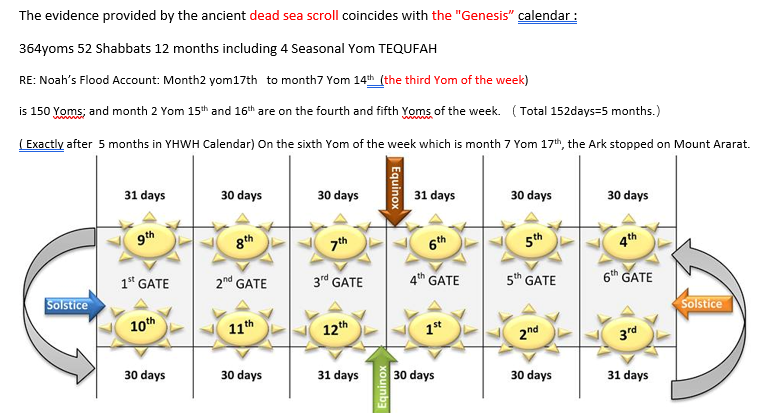
Learning Paleo Hebrew by Bet HaShem Midrash

Aleph Bayit Learning Paleo Hebrew.pdf file:///C:/Users/YahnEl/Downloads/2019%20Aleph%20Bayit%20Learning%20Paleo%20Hebrew.pdf

TABLE             CONTENTS

Introduction………………………………………………………………………………. 4

Part One, The Story of the Letters……………………………………………… 5

Part Two, The Letters………………………………………………………………… 9

The Garden of Letters……………………………………………………….. 11

Basic Meanings of the Letters…………………………………………… 18

Alephbayit Tables 1-5……………………………………………….. 18-21

Part Three, Combining Letters………………………………………………… 22

Word Formations……………………………………………………………………. 27

Names……………………………………………………………………………………. 29

The Message of YahúWah…………………………………………………………….. 31-34

Footnotes……………………………………………………………………………….. 35

Appendix:………………………………………………………………………. 36-44

The Tables of the Alphabets………………………………………………………………………….. 36-37

Letters of Ancient and Modern Alphabets………………………………………………………….. 38

Chart of the 22 Scrolls of The Letters/The Scriptures…………………………………………. 39

Chart of the Pairs of Letters: The 12 Houses of Alehim (Elohim)………………………. 40

Chart of the States of Light:…………………………………………………………………………. 41-42

The Cardinals of Aleph to Yud……………………………………………………………………………………………………… 41

The Cardinals of Zayin to Oyin………………………………………………………………………….. 41

The Cardinals Lamed to Shayin…………………………………………………………………………. 42

22 Letters of Totality………………………………………………………………………………………….. 43

Numerical Associations of the Letters………………………………………………………………… 44

The Song of the Aleph Bayit………………………………………………………………………………. 45

The Fiery Body of the Letters…………………………………………………………………………….. 46

INTRODUCTION

THE AlephBayit

Have you ever wondered why the Letters of the AlephBayit are in a certain order, and

why it is important to learn the AlephBayit in that order? Have you ever wondered why the letters are shaped as they are and what their shapes mean, or desired to understand the reasons for combining letters together to form words?

We are rewarded for learning and for being able to recite the Letters. The order of the Letters is used throughout one’s life—in our communications, work, and in our storage and retrieval of information. The arrangement of the Letters contain many wonders and are the means to proceed into Life.

The letters are called after the first two characters, A/A/Aleph/Alpha and B/B/Bayit/Bet—the AlephBayit. The first AlephBayit of humanity, commonly shared by the Ovri/Hebrew, Phoenician, Aramaic, and Samaritan peoples,1 is comprised of twenty-two characters. In this original order of letters, individual letters are used in more than one way and convey more than one sense.2 These  twenty-two characters provided the basic framework for the Greek alphabet, which in turn was borrowed by the Romans, from whose innovations the alphabet symbols of the modern, Western World are derived. See Appendix: The Table of the Alphabets pg 36-37.

Although the shapes and sounds of the letters and their arrangement in sequence have varied somewhat from the original AlephBayit across the millennia of adaptation, the underlying meaning and basic order of the original twenty-two letters remain. From these twenty-two signs, we have developed multi-systems of communication and have filled countless volumes of books and libraries.

The original twenty-two letters are not strangers to us. They are hieroglyphic symbols for the Principles underlying all forms. Their meanings are understood in every age and from every perspective.

Not only do the characters represent various human body parts,3 animal forms and functions, plants, heavenly bodies, and the social positions of humankind, they correspond to the 22 amino acids and the 22 like pairs of chromosomes common to humanity. We continually encounter the letters, both internally and externally. Therefore, we stand to benefit greatly by consciously renewing our acquaintance with these structures of Light.

The order of the Letters provides a framework for literature. The Scriptures contain 22 scrolls, from Sepher Maaseh Bereshith/Genesis to Dibre Hayamin/Chronicles.4 There is one scroll for each letter of the AlephBayit arranged in accordance with the progressive meaning of the letters. Each scroll’s assigned letter is understood to be emblematic of the scroll’s contents. See Appendix: Chart of the 22 Scrolls of the Letters, pg 39.

The Stories in scriptures are told via acrostic writings of the AlephBayit. Each scroll or book is a message of a Letter. Within the various scrolls of the Ovri texts, there are numerous AlephBayit acrostics, showing the importance of the AlephBayit in the minds of its writers/compilers. Tehillah/Psalm 119 is divided into twenty-two stanzas—one for each letter of the AlephBayit—and recounts a progression from the conception of righteousness unto perpetual renewal. In this surviving testimony to the AlephBayit’s order and endorsement, each stanza corresponds to the meanings of the AlephBayit letter that begins both the stanza, itself, and also the eight verses that comprise each stanza.5 Additionally, various types of acrostic writing6 found elsewhere in the Bible7 and in the siddur (prayer book), including songs and poetry, are based on the order of the Letters.8

The order of the AlephBayit characters tells a special story—a story that has been “hidden” to many, but nonetheless, a story that has been historically and universally accepted. The understanding of this story is like receiving a very special gift—a gift that belongs to all humankind; for the AlephBayit tells The Story of Life and the Totality of All in One.

THE MESSAGE OF THE NAME YHWH

Aleph Bayit Learning Paleo Hebrew.pdf file:///C:/Users/YahnEl/Downloads/2019%20Aleph%20Bayit%20Learning%20Paleo%20Hebrew.pdf


Translate »