Part 1 PDF 5-20-16 So . . . What of Sin, and what of the Righteousness of Aloahiym
” Excerpt from Section 1, Part 3 of the Book on the Man Child of Rev 12:5 . . . Every living soul on the face of the planet is but one breath and one heartbeat away from all of eternity [Psalm 8:4; Isa 37:36; 40: 6-8, 17; 1 Pet 1:24-25; James 4:14-15; Luke 12:20; others].”
Heb 1:3 (Yahushua) Who being the brightness of his Esteem and Honor, and the express image of His person, and upholding all things by the word of His power, when He had by Himself purged our sins, sat down on the right hand of the Majesty on high (YAHUWAH); [See Psalm 75:3]
Heb 1:8-9 But unto the Son he saith, Thy throne, O Aloahiym, is for ever and ever: a sceptre of Righteousness is the sceptre of thy kingdom (reign). Thou hast loved Righteousness, and hated iniquity; therefore Aloahiym, even thy Aloahiym, hath anointed thee with the oil of gladness above thy fellows [See 1 Sam 2:6-10; Psalm 45: 6-7; John 17:17].
This message is in three (3) parts, and is certain to challenge the flesh of each and every reader. As always, please turn to the Sovereign Counsel of YAHUWAH Aloahiym for authenticity of Truth, before rendering acceptance or rejection of this message, in whole or in part. YAHUWAH alone is the ultimate and final authority, and it is His witness that counts; not that of man. [See John 3:11; 2 Cor 4: 3-6; Heb 2:4; 1 John 5:9].
Shalom. – –
Eyd & Yahn EL Stephenson
Part 1 PDF 5-20-16 So . . . What of Sin, and what of the Righteousness of Aloahiym
Part 2 PDF 5-20-16 So . . . What of Sin, and what of the Righteousness of Aloahiym
Part 3 5-20-16 So, What of Sin, and what of the Righteousness of Aloahiym
Download PDF for easy reading: Open Vision and Personal Revelation By Eyd
Excerpt from Section 2 Part 3 of the Book of the Man Child, this website.
The time was about 2:00 a.m. and I was lying in bed with my wife. Suddenly, I found myself at the foot of the execution stake staring up at the face of Yahushua. The surroundings, the sky and the atmosphere were dark and gloomy, although there was sufficient light to make out the details of the scene before me. Several people were standing nearby and weeping bitterly, although I could not recognize their identity; which was rather amusing, since I did not know how to recognize them anyway. The women were all wearing a head covering of various types, much like you would see in any film depicting that era or in the news media of today in certain regions of the world. There were also men present but indistinguishable (as to who they were) in appearance. In the background were the hills and mountains surrounding Jerusalem, and the despair and state of darkness of the world’s condition was very apparent and tangible.
I was standing close (only a few feet) to Yahushua Who was impelled on the stake when I looked up into His face. At first, His head was turned away from me and I saw Him looking out over the people below Him. Then He turned His head towards me directly, looked down and simply stared at me, not speaking. His face and body had plainly been butchered; with a great deal of His beard having been literally torn (ripped) out of His face. His body while still having a distinguishable form appeared more like a bloody mass of meat that had been savagely pulverized, and ripped open in certain areas. No scene in any movie or any description in a book has ever captured the evidence of the absolute barbaric cruelty, torture, and bloodshed of the Messiah that I was witnessing first hand.
As He stared at me and His eyes fixed on my own, I could see the whites of His eyes and His pupils against the backdrop and release of blood covering His face; the crown of thorns placed on His head (that had been savagely battered and was also covered in blood). This wasn’t just an execution; the Messiah’s condition before dying had been the result of a blood-thirsty psychotic mob comprised of both Roman soldiers and civilians alike that had thoroughly enjoyed and were delighted in the sight of a man’s torturous abuse and subsequent death following thereafter. The reality that He was (is) the Messiah gave these insidious individuals even more pleasure.
This mob, now fragmented, was mixed with other people who were truly recognizing the severity and solemn meaning of that moment in the history of man. The ones who understood this, stood silent and were in tears with a look of astonishment on their faces; their bewildered looks clearly communicating the surprise, shock, and curiosity of what Aloahiym was about to do next to the whole of mankind; and silently praying that they would somehow be exempt from His judgment. Although they had personally heard the message of Yahushua as and when
He declared it, these people knew that the consequences for man’s actions (as a whole) towards the one and only Messiah that they had been expecting and waiting for were about to be realized [See Matt 23: 33-38; Heb 2:2-5; 6:5; 10:29; 12:25]. The mob members that were frolicking around in the aftermath of His torture and slaughter had no clue of this, continuing in their folly with a complete and total disconnection from even common civility, let alone righteousness and any sense of Aloahiym’s divine reality. These people were in and had become a part of the darkness of evil, the product of their own respective decisions and free will; yet Yahushua had forgiven them [Luke 23:34].
As He was hanging on the execution stake and gazing down into my eyes, there was the absolute conveyance of undefiled and certain unmitigated understanding of the voluntary sacrifice of His life that He was making right then and there in real terms in front of my eyes. The sacrifice of His own life was for my sake and benefit, as well as that of all mankind. This was the express purpose that He had come to the earth; to die as a sacrifice for all of man’s sins dating back to Adam and the Garden [Gen 3:15; 1 John 3:8]. He became sin, the curse itself [Gal 3:13] so that man, subject to his individual willingness, would no longer be separated from the One, true, YAHUWAH Aloahiym that had given man his respective existence in the first place. Yahushua was (is) the express image and likeness of YAHUWAH [Col 1:15; Hebs 1:3; other] having stepped out and coming forth from YAHUWAH [John 16:28; 13:3] for the purpose at hand [John 3:16-17; 1 John 3:8; others], and Who had now completed His assignment [John 19:30]. The stage was now set for man to play his part in the drama of life as YAHUWAH has purposed it. Man was to accept the sacrifice of Yahushua, or he (she) would not. The choice was given to man to make this decision, and by this decision, man either lived or he died; however, it was his or hers alone to make.
This wasn’t just history in the making as it would appear in the natural; this was the distinction between the divine hai of YAHUWAH Aloahiym in direct contrast to all that is NOT of YAHUWAH pointedly demonstrating the fulfillment of John 3:18-20. Given man’s predisposition (through his carnal nature) to attempt to take control of Aloahiym’s creation, and to exercise authority and dominion over all the earth without the righteousness, love, compassion, and divine counsel with prudent understanding and other attributes of the Father in each and every facet of (man’s) life, the scene was a vivid and candid portrayal of what YAHUWAH had foretold for centuries through the Scriptures of the evil in man’s soul where man runs from the Light instead of into it. The eye-witness of the acceptance of this evil by those of the mob that were present and had been a part of the execution would turn any mortal being with the promise of salvation into a rotten sack of hopelessness and despair. Therein, I remembered the open vision described in Part 1, Page 11, entitled: “Second Open Vision, Summer, 2007”, and the torment and stark terror on the faces of the people revealed to me who had made the wrong
choices and decisions in their life . . . when they had had the opportunity; never expecting the consequences of those decisions to catch up with them.
As He gazed down at me is silence, there was the clear and concise message from Yahushua ha Massiach:
What direction am I leading you in, My son, and what is the price? What price are you willing to pay? Will you pay the price that must be paid? I have suffered and am about to die for you, out of My great love for you, releasing you forever from the bondage of sin and the hold of the enemy on your soul. Will you not perceive and recognize it, and come with Me to My Father Who is also your Father? I (He) await you and all whom are willing to make the same sacrifice of their lives!
[Matt 10:38-39; 11:27; John 17:26; Heb 3:14; Rev 12:11; 14:1-5, 12; 22: 4, 12-14]
This was a deeply personal, in-your-face vision, and did not last long, but will remain with me forever. I have tried to encapsulate the essence of this experience in a short, succinct manner; but words simply do not come close. I encourage all persons to examine their hearts, thoughts, motives, and true desires. Are they truly of our Messiah . . . in substance? Or are these elements a thin veil for emotional satisfaction, soulish delusion, and stubborn embrace for more of the flesh? The Messiah’s comments at the end of His ordeal bring forth the reality of His death at the hands of those He came to save [Heb 12:2-4, 16-17; 9:28; Prov 1:24-31; Rev 14:4-5].

Additional Bonus for the study of How did our Messiah died? On the Cross or on the Tree?
1. http://www.yaim.org/web/literature/other-topics/163-didyahshuadieona
2. http://www.albatrus.org/english/religions/pagan/was_jesus_crucified_on_cross.htm
3. http://hope-of-israel.org.nz/cructree.html
4. http://www.theologynetwork.org/biblical-studies/the-messiah-who-was-cursed-on-the-tree.htm
5.The_Alef_&_Taw_ebook ( The Alef & Taw: The Red Heifer & the Two Sticks By By Maria Merola )
The_Alef_&_Taw_ebook (Click here for the full message)
The Alef & Taw: The Red Heifer & the Two Sticks
By Maria Merola אריאל
© Copyright Double Portion Inheritance, March 2011
http://www.DoublePortionInheritance.com
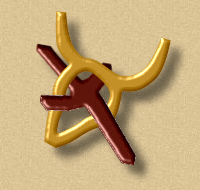
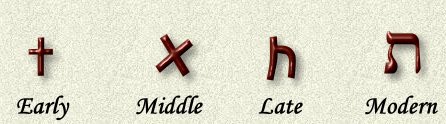
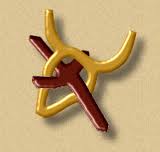
Pictured here is the first and last letter of the Hebrew Alphabet known as the “Alef & Taw.” These two letters represent eternity or (the beginning and the end). They were created from the beginning by YaHuWaH at Creation. In the original Hebrew Scriptures we can actually see these letters in the text but the English translators left them out:
Bereshiyth (Genesis) 1:1
In the beginning Elohiym created את [Alef & Taw] the heaven and ואת [Waw, Alef & Taw] the earth.
Satan hi-jacked these symbols later on and used them for pagan sun-god worship, but long before that, YaHuWaH used them in the Hebrew Alphabet to illustrate a prophetic picture of our Messiah as the sacrificial animal (the red heifer) being nailed to a cross!
After the Exodus when the children of Yisra’el were in the wilderness, they began to murmur and complain against YaHuWaH, and so he sent fiery serpents to bite them and many of them died (Numbers 21:6). But many of them began to repent and when they did, YaHuWaH instructed Mosheh to make a pole and put a fiery serpent on the pole for them to look upon and then they would not die from being bitten by the serpent. This was a prophetic shadow picture of the future Messiah who would later on become a curse for us (John 3:14). But later on this image of the serpent on a pole became an idol that was used for worship and YaHuWaH was against this. The Yisra’elites also began to worship a graven image of the calf (as seen in this image of the alef or the ox head), and because of this, he broke the first covenant that he made with them when Mosheh broke the first set of stone tablets (Exodus 32:19). Later on in history, even the Christian Churches began to worship and bow down to this image of the Taw as a wooden cross. These symbols were always meant to symbolize our Messiah, but we are commanded not to bow down and serve these images (Exodus 20:5). They only serve as illustrations for us—nothing more. We are commanded not to worship YaHuWaH through graven images or created things.
In this illustration of the “Alef & Taw,” in it’s earliest ancient form it shows us a picture of the Red Heifer (the ox head) being nailed to the “two sticks” of Ezekiel 37:16 (the stick of Ephrayim & Judah). Messiah is the “Alef & Taw” which means “the first and the last” or “the beginning and the ending” (Revelation 1:8; 1:11; 21:6; 22:13). The last Hebrew letter, “the Taw” is shaped like a cross because it means that we must come to the “end” of the old sinful nature. In Psalms 51:5 David declared “Behold I was shapen in iniquity; and in sin did my mother conceive me.”
Our Mashiyach (Messiah) came to put an end to this sinful nature—not the Mosaic Law! This is precisely why Yahuwshuwa commanded us to “deny ourselves, take up our cross” (stauros) daily and to follow him (Matthew 16:24). Later on in this article, you are going to see that the furniture in the Tabernacle of Mosheh (Moses) from an aerial view, is arranged in the shape of a cross and it brings us to the “end” of the sinful man!
Yahuwshuwa will not automatically cleanse everyone with his blood without repentance. We have to make the journey through the pattern of the Tabernacle which teaches us how to die to self!
When we reach the “end” of the Tabernacle in the Holy of Holies, we die! Any priest who had unrepentant sin would die there in the Holy of Holies. Therefore, our Messiah made the journey for us! The book of Revelation was spoken to the Apostle Yahuwchanon (John) “in the Hebrew tongue”(Revelation 9:11, 16:16), but later on it was translated into Greek. And so in the Greek translation of the book of Revelation, Messiah referred to himself as the “Alpha & Omega,” which is the first and last letter of the Greek alphabet. But in Hebrew (which is the language John the Apostle spoke and wrote in) he would have said this to Yahuwchanon (John):
Chazown (Revelation) 1:8 I am the Alef and the Taw, the Beginning and Ending, says יהוה YaHuWaH which is, and which was, and which is to come, the Almighty.
As you can see above, our Messiah was revealing himself as YaHuWaH in his resurrected state!
Chazown (Revelation) 1:9 I, Yahuwcḥanon (John), who also am your brother and companion in tribulation, and in the kingdom and patience of יהושׁוע Yahuwshuwa Mashiyach, was in the island that is called Patmos for the Word of Elohiym and for the testimony of יהושׁוע Yahuwshuwa Mashiyach.
Chazown (Revelation) 1:11 “….I am the Alef and the Taw, the First and the Last.”
What is even more interesting is that the word “Taw” is the Hebrew word for “mark” as seen in Ezekiel 9 and it is a mark that Elohiym puts on the foreheads of his elect who are sealed. The letters in the word“Taw” even tell a message:
Taw, Alef, Waw
This means: “the cross, the sacrificial animal, and the nail.”
The Apostle Sha’uwl (Paul) spoke of this “mark” as being a “mark” that he bore in his own body:
Galatiym (Galatian) 6:17 From henceforth let no man trouble me: for I bear in my body the marks of יהוה YaHuWaH יהושׁוע Yahuwshuwa.
http://www.ancient-hebrew.org/3_taw.html 
The above link shows an illustration of how the progression of the letter “Taw” (Tav) has undergone changes over the centuries. What we see here is that the“cross” or the “Taw” is a picture of self-denial.
We are shown in these two letters that the Alef represents our “animal-like” nature which is sinful and prone to its own desires of the flesh. But when we kill this “animal-like” nature, by denying ourselves daily, we are then able to walk by the power of the resurrected Mashiyach (Messiah), which is the power of the Ruwach ha’Qodesh (Holy Spirit).
Two different Greek words are used to describe the instrument upon which our Mashiyach was crucified. The first Greek word that we see for “cross” is as follows:
#4716: Stauros: a stake or post (as set upright), i.e. (specially), a pole or cross (as an instrument of capital punishment); figuratively, exposure to death, i.e. self-denial; by implication, the atonement of Messiah:—-cross.
But there is another word that we see in the Strong’s Greek Concordance in the book of Acts where it says that our Messiah was nailed to a tree. We see this word for “tree” in Acts 5:30, 10:39, & 13:29 as the follows:
#3586 Xylon: a beam from which any one is suspended, a gibbet, a cross; a log or timber with holes in which the feet, hands, neck of prisoners were inserted and fastened with thongs; a fetter, or shackle for the feet.
What this means is that there were actually two different pieces of wood!
The piece that he carried across his shoulder was the “Xylon” which was a “cross-beam.” But the piece that was already standing at the execution site was the “Stauros” or the upright pole! Hence, he was crucified on the TAW (a cross shaped instrument). Messiah became a “curse” for us as he nailed “Tammuz”(sun-god worship) to the Tree!
The image of the cross was created by YaHuWaH himself at Creation:
Bereshiyth (Genesis) 1:1
In the beginning ELohiym created את the heaven and ואת the earth.
As you can see, in the beginning our Creator made the Alef & the Taw! This means that he created the Hebrew Alphabet, but he also prepared a human body for our Messiah from the beginning:
Ibriym (Hebrews) 10:5 Wherefore when he comes into the world, he says, Sacrifice and offering you would not, but a body have you prepared for me:
Ibriym (Hebrews) 4:3 For we which have believed do enter into rest, as he said, As I have sworn in my wrath, if they shall enter into my rest: although the works were finished from the foundation of the world.
Ibriym (Hebrews) 9:26 For then must he often have suffered since the foundation of the world: but now once in the end of the world has he appeared to put away sin by the sacrifice of himself.
Chazown (Revelation) 13:8 And all that dwell upon the earth shall worship him, whose names are not written in the book of life of the Lamb slain from the foundation of the world.
1st Keefa (Peter) 1:
19 But with the precious blood of Mashiyach, as of a lamb without blemish and without spot:
20 Who verily was foreordained before the foundation of the world, but was manifest in these last times for you…
As you can see from the above scriptures, Yahuwshuwa Mashiyach was always in eternity past the “lamb slain from the foundation of the world!” This means that in eternity, he is the sacrificial lamb in the past, the present and the future! Now we know why Satan hi-jacked this symbol as an object of worship for the pagan sun-god Tammuz! But Satan had no idea that by doing this, he was creating the very instrument upon which his own kingdom would be demolished!
Much like Haman in the Persian Empire (Esther 7:9-10) who prepared the gallows for Mordechai the Jew, we see that Satan made a Roman Cross for Messiah to be crucified upon and as a result, his own Kingdom was destroyed!
The image of the “cross” was made of “two sticks” or “two poles” for many prophetic reasons. We can also see that these two sticks demonstrate “Two Houses of Yisra’el” and “the two greatest commandments.”
Vertical Love for YaHuWaH & Horizontal Love for Our Neighbor:
Marqos (Mark) 12:
30 And you shall love YHWH your Elohiym with all your heart, and with all your soul, and with all your mind, and with all your strength: this is the first commandment.
31 And the second is like, namely this, you shall love your neighbour as yourself. There is none other commandment greater than these.
Creation Testifies to the Taw (Tav) or “Cross” of our Messiah
Pictured here is a “Laminin” cell that looks like a cross!
Laminins are a family of proteins that are an integral part of the structural scaffolding of basement membranes in almost every human and animal tissue. You see, Laminins are what hold us together—literally. They are cell adhesion molecules. They are what holds one cell of our bodies to the next cell. Without them, we would literally fall apart. If you look up “Laminin” in any scientific or medical piece of literature, this is what you will see!
The Body of Messiah (The Two Houses of Yisra’el) are literally held together by his one sacrifice on the Taw or Cross! The Apostle Sha’uwl (Paul) also illustrated this in his letter to the Ephesians:
Ephsiym (Ephesians) 2:15-16 Having abolished in his flesh the enmity, even the law of commandments contained in ordinances;for to make in himself of two one new man, so making peace; And that he might reconcile both unto Elohiym in one body by the cross, having slain the enmity thereby.
Our Messiah embodied the Two Houses of Yisra’el by becoming as “the least” (the last) at his first coming (Messiah Ben Joseph), but then he resurrected and became “the first born” over all creation (Colossians 1:15). He humbled himself and became as the least among us.
In his role as Yahuwceph (Joseph) he was portrayed as “the suffering servant.” But when he returns, he will be as the “first” as Messiah Ben David, (the conquering reigning king). He will then bring together the Two Houses of Yisra’el as the “first & the last.” There will no longer be competition in his house because both Houses will become one stick, (one olive tree) when the remnants from these “two houses” become born-again into incorruption (immortality), they will both be his “first born” as Yisra’el.
Hence, he made the “two sticks” of Yahuwdah (Judah) & Ephrayim one stick or one tree in his hand! What is even more revealing is that when you look up this Hebrew word for “stick” in the prophecy of Ezekiel 37:16, the word is “eytz” which means “tree.” And so two trees were used to make the Two Houses of Yisra’el one again!
The first time that Yisra’el is likened unto an olive tree spoken of by the prophet Jeremiah:
Yirmeyahuw (Jeremiah) 11:16 YHWH called your name, A green olive tree, fair, and of goodly fruit: with the noise of a great tumult he has kindled fire upon it, and the branches of it are broken.
But this one olive tree became two separate olive trees in 1st Kings 12, when Judah & Ephrayim became two separate nations under King Jeroboam & King Rehoboam. This gives clarity now for the entire purpose for our Mashiyach (Messiah), Yahuwshuwa coming to earth at his first coming as it is explained perfectly by the Apostle Sha’uwl (Paul):
Ephsiym (Ephesians) 2:
11 Wherefore remember, that you being in time past Goyim (Gentiles) in the flesh, who are called Uncircumcision by that which is called the Circumcision in the flesh made by hands;
12 That at that time you were without Mashiyach (Messiah), being aliens from the commonwealth of Yisra’el, and strangers from the covenants of promise, having no hope, and without Elohiym in the world:
13 But now in Mashiyach (Messiah), Yahuwshuwa you who sometimes were far off are made near by the blood of Mashiyach.
14 For he is our peace, who has made both one, and has broken down the middle wall of partition between us;
15 Having abolished in his flesh the enmity, even the law of commandments contained in ordinances(dogma); for to make in himself of two one new man, so making peace;
16 And that he might reconcile both unto Elohiym in one body by the cross, having slain the enmity thereby:
17 And came and preached peace to you which were afar off, and to them that were near.
What were these “ordinances” that kept the “Two Houses” of Yisra’el separated? It was because YaHuWaH divorced the Ten Northern Tribes of Yisra’el, (Jeremiah 3:8), that the Rabbis thought they had to keep these tribes from being allowed to come back into covenant. Therefore, these Rabbis invented man-made “ordinances” that would enforce the building of a wall around the outer court of the temple. This would which would prevent these estranged tribes from being allowed to come into the Temple of YaHuWaH. And so the Greek word for “ordinances” that the Apostle Paul used in Ephesians 2:15 is “dogma” which means “a man-made decree.” The Rabbis made extra laws that were against the Towrah that kept these Gentiles from being allowed to come into the outer court of the temple so that they could “hear the Law of Mosheh” and be saved! The “enmity” (hatred between these two houses) was therefore caused by the sins of the divorced tribes and their idolatry. But also it was the sins of these Rabbis, whereby they introduced such a law that would keep the Gentiles “afar off” from the covenants of promise.
Messiah abolished not the Mosaic Law (Towrah) but he abolished the “enmity” (the hatred brought on by the sinful nature) that existed between both Houses of Yisra’el. The sinful nature is what caused these Rabbis to invent these “ordinances” which were against the Gentiles (the divorced tribes).
The Two Sticks or Trees of Ephrayim & Yahuwdah
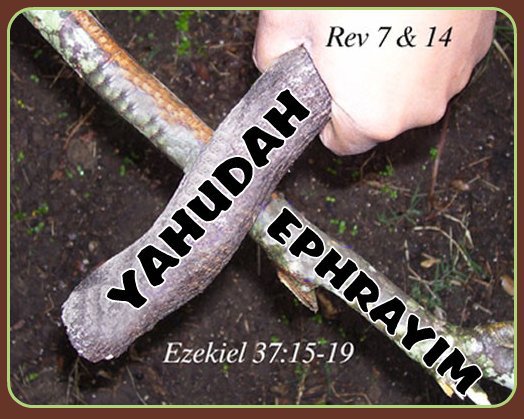
As we can see from this illustration, there is a very good reason why YaHuWaH created the last letter in the Hebrew Alphabet (Taw) to be in the shape of a “cross.” He was illustrating through his Hebrew letter, the “Two Houses of Yisra’el” being made “one body by the cross!”Our Messiah was crucified on “two sticks” because his hands were stretched out, and this symbolizes our horizontal relationship with one another. But the other stick for his feet symbolizes our vertical relationship with the Father. These “two sticks” also illustrate for us the two greatest commandments in the Towrah (Matthew 22:36-40). Our Messiah was asked which are the two greatest commandments in the Mosaic Law (Towrah), and here is what he said:
“You shall love YHWH your Elohiym with all your heart, and with all your soul, and with all your mind” (Matthew 22:37).
“And the second is like unto it, You shall love your neighbour as yourself” (Matthew 22:39).
You will notice that the first and greatest of all commandments involves loving YaHuWaH, and this is our vertical relationship with him! But then the second greatest commandment involves loving others, and this is a horizontal relationship!
And so Messiah was nailed to a Taw which was made out of two trees or two sticks for the Two Houses of Yisra’el!
Messiah has reconciled Ephrayim & Yahuwdah, (Jew & Gentile) by the Taw or Cross!
Even though the pagans hi-jacked this symbol and used it as an object of worship for the cross of Tammuz and Mithra, before the foundations of the world, YaHuWaH ordained that this letter, the “Taw” would be the mark that he marks his elect with in their foreheads (see Ezekiel 9 & Revelation 7). All those who receive a “mark” in their foreheads receive the “Taw.”
Yechezqel (Ezekiel) 9:4 And YHWH said unto him, Go through the midst of the city, through the midst of Yerushalayim (Jerusalem), and והתוית set a mark ואת [Waw, Alef & Taw] upon the foreheads of the men that sigh and that cry for all the abominations that be done in the midst thereof.
You will notice two words above: Tavah and Tav.
The word Tavah means “to mark out” and Tav means “a mark.” Hence what it really says is: “mark out a mark upon the foreheads of the men that sigh and cry for all the abominations that be done in the midst thereof.”
As you can see, those who are against the abominations mentioned in Ezekiel 8 (pagan sun-god worship) receive a mark in their foreheads! What is this “mark?”In the Strong’s Hebrew Concordance, the word for mark in the above verse is seen as follows:
# 8420 tav tawv from 8427; a mark; by implication, a signature:–desire, mark;
#8427 tavah taw-vaw’ a primitive root; to mark out, i.e. (primitive) scratch or (definite) imprint:–scrabble, set (a mark).
The phrase: “mark out והתוית a mark ואת” is telling us a story:
Waw (nail or tent peg), Hey (Breath or Spirit of YHWH), Taw (cross), Waw (nail or tent peg), Yod (arm of YHWH), Taw (cross). This word “tavah” contains the Hebrew letters above and it is saying that there are two nails (for his hands and feet). There are also two tent pegs for the Two Houses of Yisra’el or two tents of Jacob. And by the inspiration (breath) of YaHuWaH, Messiah (who is the arm of YaHuWaH) was sent to die on the two sticks (the cross or the taw) for the Two Houses of Yisra’el! And those who have faith in his finished work on the cross (taw) are the ones who receive his mark!
The Xylon or Cross Beam is the Burden of Ephrayim
Pictured here is the “xylon” or cross-beam that our Messiah carried to the “stauros” or execution stake that was already standing there as a permanent structure for the prisoners to be hung upon. Messiah carried only the “cross-beam” across his shoulders and then when he arrived, they attached the “cross- beam” to the upright pole or stake (which remained permanently in the ground and reused for other prisoners to be executed on).
As I mentioned earlier, two different Greek words are used to describe the execution stake that our Messiah was crucified on. The word for “cross” in the Strong’s Concordance is “stauros” and it means “a stake, or pole.” But another word is used for the word “tree” fromActs 5:30; Acts 10:39 & Acts 13:29. That word for “tree” is “xylon” which means a “cross-beam.” The word “stauros” also means “self-denial” and so this gives more meaning behind some of the statements that the Apostle Sha’uwl (Paul) made:
1st Qorintiym (Corinthians) 1:18 For the preaching of the two sticks [cross] is to them that perish foolishness; but unto us which are saved it is the power of Elohiym.
Sha’uwl (Paul) was stating that he was preaching a message of self-denial! He was not speaking about an object that people wear around their necks. We are not supposed to make the cross into an object of worship or treat it like a “good luck charm.”
The image of the “cross” was made of “two sticks” or “two trees.” Do you see how this all points to Two Houses of Yisra’el & the Two Greatest Commandments? You see, the Yahuwdiy (Jews) are more focused on their vertical love for YaHuWaH, which is why the emphasize the first four commandments out of the Ten Commandments. But the Goyim (Gentiles) are more focused on their horizontal love their neighbor. This is also seen in the parable of the “Good Samaritan” in Luke 10:30-37. The Samaritan (Gentile) cared for a complete stranger who was beaten and left for dead on the side of the road, while the Levite was too preoccupied with religious things to care for the stranger.
Messiah bore our burdens for us in the same way that Simon of Cyrene (a Gentile) carried his burden for him:
Matthithyahuw (Matthew) 11:
28 Come unto me, all you that labour and are heavy laden, and I will give you rest.
29 Take my yoke upon you, and learn of me; for I am meek and lowly in heart: and you shall find rest unto your souls.
30 For my yoke is easy, and my burden is light.
Messiah did not add any heavy yoke to the Towrah of Mosheh like the Pharisees did. He makes it easy and enjoyable to keep his commandments!
What is prophetic about this picture? Well, what we see here is that the “stauros” that was already standing there at the execution site represents the House of Yahuwdah (Judah)—-the stick that was already at home in Jerusalem. But the “stick” who was “afar off” was Ephrayim (the prodigal son). And so Messiah came for those Ten Northern Tribes who were “afar off” and he made the journey for them by carrying the “stick” of Ephrayim to the “stick” of Yahuwdah (Judah) in order to make them “one stick” by the cross or Taw! Simone of Cyrene being a Gentile is yet another clue!
The stick of Ephrayim was the stick that he carried! The stick of Yahuwdah was already standing there!
The Burden or Yoke of Ephrayim Made Easy & Light
Pictured here to the right are two oxen that are “yoked” together. The Ten Northern Tribes of Yisra’el who were divorced by YaHuWaH became known as“Ephrayim” because it was Yahuwceph’s (Joseph’s) son Ephrayim who became their tribal leader according to Bereshiyth (Genesis) 48:18-22.
Ephrayim was born in Egypt and he was accustomed to being in bondage, or slavery to paganism and idolatry. That is why often times in scripture, we see that Ephrayim is likened unto a bull or a heifer who is under a heavy yoke of bondage (Howshea 10:11).
Why is he in bondage? It is because the Two Southern Tribes (Judah & Benjamin) or the Jews added extra man-made laws to the Torah of Moses which is called “the oral law” or the Talmud. And so Ephrayim decided that it was too burdensome to keep the commandments. This is why in 1st Kings 12, the two houses of Yisra’el (Ephrayim & Yahuwdah) split under King Jeroboam & King Rehoboam. King Solomon had placed heavy tax burdens on the people of Yisra’el, but after he died, his son Rehoboam refused to lighten their taxes. And so this is why the Two Houses of Yisra’el split. This is a metaphor for what happened later on in history when the House of Judah placed heavy religious burdens on the people of Yisra’el as well.
As a result, King Jeroboam invented pagan holidays patterned after Ba’al and he set up a golden calf at Mount Ephrayim and at Dan. To this day, many born-again Christians fall under the covering of “Ephrayim” because they keep the pagan holidays of Ba’al (Christmas, Easter, Halloween, Valentine’s Day, St. Patrick’s Day etc.).
What was our Messiah’s mission at his first coming? He came as “Messiah Ben Joseph” (the suffering servant) in order to bring the “Ten Lost Tribes” of Yisra’el back to the Father’s instructions (Towrah). And so Messiah “bore the burden of Ephrayim” across his shoulder when he journeyed to the stauros (pole) as he carried the “cross-beam” for Ephrayim. This cross-beam was a burden across his shoulders, just like in the picture of these oxen that are yoked with a burden across their shoulders!
As we can see from the prophetic verses below, the House of Ephrayim are non-Jewish believers who are still in bondage to their stiff-necked rebellion against the Father’s instructions (Torah):
Howshea 10:11 And Ephrayim is as a heifer that is taught, and loves to tread out the corn; but I passed over upon her fair neck: I will make Ephrayim to ride; Yahuwdah (Judah) shall plow, and Ya’aqob (Jacob) shall break his clods.
Debariym (Deuteronomy) 33:17 His glory is like the firstling of his bullock, and his horns are like the horns of unicorns: with them he shall push the people together to the ends of the earth: and they are the ten thousands of Ephrayim, and they are the thousands of Manasseh.
As one can see, because Ephrayim was born in Egypt, he is accustomed to being in bondage to pagan idolatry. But this prophecy reveals that Yahuwdah (Judah) will plow the harvest field for Ephrayim and the sons of Ya’aqob (Jacob) will make the soil ready for the seeds. They will join in the last days to help Ephrayim’s burden and make it light!
Yirmeyahuw (Jeremiah) 31:18 I have surely heard Ephrayim bemoaning himself thus; You have chastised me, and I was chastised, as a bullock unaccustomed to the yoke: turn you me, and I shall be turned; for you are YHWH my Elohiym.
Once again, we see that Ephrayim is being chastised because he thinks of the Mosaic Law as being a big burden on his shoulders. He still does not realize that Messiah carried his burden and made it easy and light for him to obey Towrah by the power of the Holy Spirit!
Below, in Yirmeyahuw (Jeremiah), we see a prophecy about how Ephrayim sees the Mosaic Law (Torah) or the commandments of YaHuWaH as being burdensome instead of a delight. But the prophet Yirmeyahuw (Jeremiah) prophesied that the day would come when Ephrayim would no longer say “the burden of YaHuWaH” for he will begin to obey the Towrah with joy!
Yirmeyahuw (Jeremiah) 23:36 And the burden of YHWH shall you mention no more: for every man’s word shall be his burden; for you have perverted the words of the living Elohiym, of YHWH of hosts our Elohiym.
Yirmeyahuw (Jeremiah) 23:38 But since you say, The burden of YHWH; therefore thus says YHWH; Because you say this word, The burden of YHWH, and I have sent unto you, saying, You shall not say, The burden of YHWH;
Our Messiah Yahuwshuwa carried a “cross-beam” across his shoulders to the stake (pole) that was already standing there at the place called “The Skull” for Ephrayim! The burden he carried is for Ephrayim who needs to be delivered from bondage to his lawlessness and his, Anti-Towrah ways!
Mattithyahuw (Matthew) 11:30 For my yoke is easy, and my burden is light.
Pictured here is a yoke.
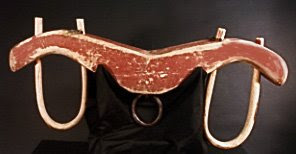
This is what is used to yoke together two animals in the field who plow together. This is what the Apostle Sha’ul (Paul) meant when he warned us not to be “unequally yoked together with unbelievers”:
2nd Qorintiym (Corinthians) 6:14 Be you not unequally yoked together with unbelievers: for what fellowship has righteousness with unrighteousness? and what communion has light with darkness?
If we yoke together two oxen or two donkeys, they work well together. But if we yoke one donkey and one ox or bull, then they will not be compatible and nothing will get done! The field will not get plowed. A donkey and a lamb are both used to symbolize the “first born” of the House of Judah (Genesis 49:11, Exodus 13:13 & Zechariah 9:9). But the bull is symbolic of Ephrayim (the ten lost tribes) according toHowshea 4:16 & 10:11.
Sheep are obedient and they obey the voice of the shepherd. But bulls and donkeys are stubborn and stiff-necked as they need to be yoked in order to be made to obedient so that they can plow. But a bull and a donkey usually cannot be yoked together for they are “unequally yoked.“ Our Messiah performed the role of the “Passover Lamb“ during Passover, but he also performed the role of the “Red Heifer“ which is the only sacrifice that is to be down outside of the camp! The Red Heifer sacrifice was done by the priests in the temple when the altar became defiled. They had to escort the heifer out of the camp, kill the heifer and then burn the heifer down to ashes. Then they would mix the ashes of the heifer with water and they would use that as a cleansing solution to cleanse the articles of the temple and the altar. The instructions are found in Numbers 19.

The Red Heifer had to be perfect and not one white hair could be found on this heifer. It had to be without spot or blemish. The instructions for Yom Kippur are found in Leviticus 16, where the priest in the temple had to first sanctify himself with a Bull (Heifer) sacrifice, and then he killed the Sacrificial Goat for the nation of Yisra’el. His final act was to mix the blood of the Heifer (or the bull) with the blood of the Yom Kippur Goat and then he would sprinkle the mixed blood together on the altar! Beloved do you know what that symbolizes? It means that when our Messiah returns on the Day of Vengeance (which will be on Yom Kippur), he will make the two families or the Two Houses of Yisra’el one house, one family, one blood, one bride, one stick in the hand of YaHuWaH!
In other words, the blood of the Heifer symbolizes the House of Ephrayim and the blood the Yom Kippur Goat symbolizes the House of Yahuwdah (Judah). The prophecy of Ezekiel 37:16-18 will be fulfilled on that day!
Two Trees for Two Houses of Yisra’el
This picture is an excellent representation of how Messiah was nailed to “two trees.” One tree (the vertical one) was for Yahuwdah as the House of Yahuwdah was already standing before YaHuWaH as they were still at least observing the Sabbaths and the covenant to some degree. The vertical tree is also symbolic of our vertical relationship with the Father as seen in the greatest commandment which is to “love YaHuWaH with all of your heart, mind, soul and strength.”
The house of Yahuwdah was already keeping the first 4 commandments out of the 10, but they often neglected the other 6 commandments to “love your neighbor as yourself.” Our Messiah, however had many rebukes for the Scribes & Pharisees who “added” many traditions to the Towrah and thus making it more difficult for the other lost tribes to keep.
But the other lost tribes were no longer keeping the Sabbaths and biblical feast days as commanded by YaHuWaH. And so they were “afar off” from the covenant. This is why Messiah made that journey and carried that other “tree” across his shoulders (the xylon) as he was carrying the “stick of Ephrayim”(Ezekiel 37:16-19). This stick was the horizontal tree for our horizontal relationship with our fellow man. The 2nd greatest commandment tells us to “love your neighbor as yourself.”
The Gentiles were not obeying the first 4 commandments out of the 10, but often-times they demonstrated more love for their fellow man (as previously mentioned) in the parable of the good Samaritan.
When our Messiah finally arrived at the place where the stauros (stake) was standing, he had the xylon (cross beam) across his shoulders and this was fastened to the already standing stauros (representing Judah).
This is how he demonstrated the two sticks of Yahuwdah & Ephrayim as one stick or one tree in his hand! He used two trees to make the two houses of Yisra’el one again!
Pictured here is the way that the lamb was cooked in ancient times at the very first Passover and beyond.
ANCIENT WAY OF COOKING PASSOVER LAMB
The Passover Lamb was crucified (impaled) on an execution stake, and then its intestines, called the “Crown of Shame” was placed on its head every Passover.
More information at:
http://www.holidaysvsholydays.com/ and
http://www.hisloveisinhislaw.com/
The Fiery Serpent on the Pole
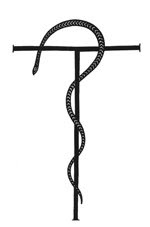
When the children of Yisra’el in the wilderness complained and murmured against YaHuWaH Elohiym and against his anointed servant Mosheh, they were punished by YaHuWaH who sent fiery serpents to bite the people as a punishment:
Bemidbar (Numbers)21:
5 And the people spoke against Elohiym, and against Mosheh, Wherefore have you brought us up out of Egypt to die in the wilderness? for there is no bread, neither is there any water; and our soul loaths this light bread.
6 And YHWH sent fiery serpents among the people, and they bit the people; and much people of Yisra’el died.
7 Therefore the people came to Mosheh, and said, We have sinned, for we have spoken against YHWH, and against you; pray unto YHWH, that he takes away the serpents from us. And Mosheh prayed for the people.
8 And the YHWH said unto Mosheh, Make you a fiery serpent, and set it upon a pole: and it shall come to pass, that every one that is bitten, when he looks upon it, shall live.
9 And Mosheh made a serpent of brass, and put it upon a pole, and it came to pass, that if a serpent had bitten any man, when he beheld the serpent of brass, he lived.
YaHuWaH commanded Mosheh to place a fiery serpent on a pole and the children of Yisra’el would look upon it as a future picture of Messiah who would become a “curse” for us and then they would live.
The Apostle Yahuwchanon (John) also recognized this as a prophetic symbol of Messiah:
Yahuwchanon (John) 3:14 And as Mosheh lifted up the serpent in the wilderness, even so must the Son of man be lifted up:
As you can see by the illustration above the “pole” that is shown looks like a cross, not just an ordinary straight pole. But how can we be sure that it was a “cross” and not just a pole?
We can see in the Ancient Paleo Hebrew pictograph letters what it says in Numbers 21:8:
Numbers 21:8 ויאמר H559 יהוה H3068 אל H413 משׁה H4872 עשׂה H6213 לך שׂרף H8314 ושׂים H7760 אתו H853 על H5921 נס H5251והיה H1961 כל H3605 הנשׁוך H5391 וראה H7200 אתו H853 וחי׃ H2425
Numbers 21:8 ויאמר יהוה אל־משׁה עשׂה לך שׂרף ושׂים אתו על־נס והיה כל־הנשׁוך וראה אתו וחי׃
Bemidbar (Numbers)21:8 And יהוה said to Mosheh, “Make a fiery serpent, and set it on a pole [Alef & Taw]. And it shall be that everyone who is bitten, when he looks at it, shall live.”
The word used in Numbers 21:8 for pole is the Hebrew Strong’s Word:
#5251 nec
1) something lifted up, standard, signal, signal pole, ensign, banner, sign, sail
a) standard (as rallying point), signal
b) standard (pole)
c) ensign, signal
What you will notice is that the English word for “pole” does not exist in the Ancient Hebrew. Instead the word for Alef & Taw is shown where the translators placed the word “pole” instead:
# 853 ‘eth ayth apparent contracted from 226 in the demonstrative sense of entity; properly, self (but generally used to point out more definitely the object of a verb or preposition, even or namely):–(as such unrepresented in English).
As you can see it says that this word #853 ayth for Alef & Taw is UNREPRESENTED IN ENGLISH! The English translators did not know what to do with these Hebrew letters, so they placed the word “pole”there instead!
Here is what is shown in Numbers 21:8 instead of the word pole in Paleo Pictographs:
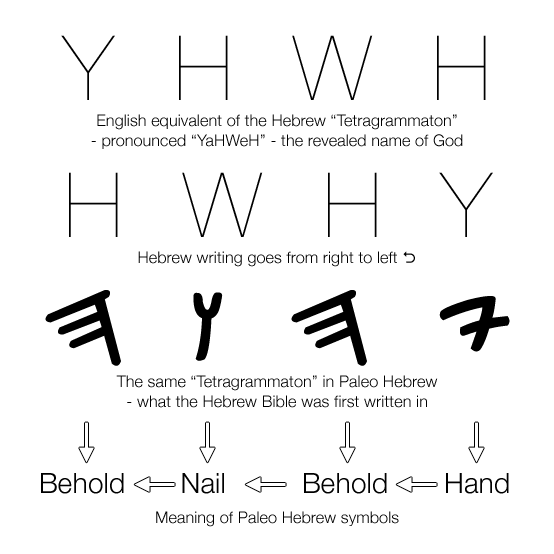
ואת Waw (the nail), Alef (the red heifer) & Taw (the cross or two sticks).
Whenever the Alef & Taw is in the original Hebrew text it does not appear in our English Bibles–it is not represented!
Hence the “pole” is actually the Alef & Taw with the serpent wrapped around it!
Pictured above is a close-up picture of the word used in Ancient Paleo Hebrew for the word “pole” inNumbers 21:8. The word in our English translation says “pole” but in the original Hebrew Pictograph, it is an Alef, Taw, Waw—in other words, the Red Heifer, the Cross, and the Nail!
The “pole” that Mosheh erected with the serpent for the Yisra’elites to look upon was the Cross or the Taw!
The Hellenic P46 Manuscript of the Briyth Chadashah (New Testament) shows that the word for “cross” is actually the term “two sticks.” This is precisely what the Spirit of YaHuWaH had been showing me all along!
1st Qorintiym (Corinthians) 1:17-18 from 2nd Century C.E. Hellenic P46 with place-markers accurately interpreted
by John Yahuwchanan Robertson 
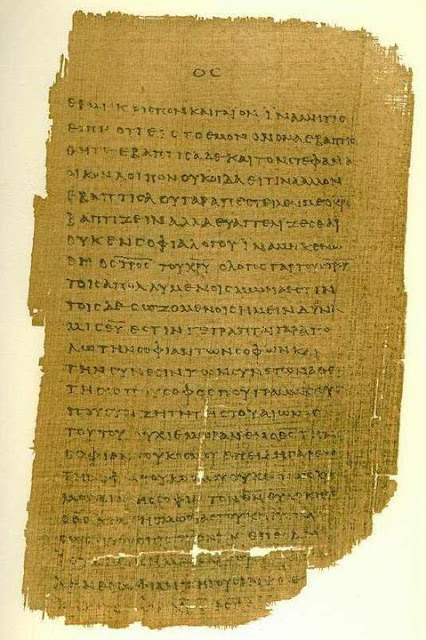
17 ου γαρ απεστειλεν με ο χρς βαπτιζειν αλλα ευαγγελιζεσθαι ουκ εν σοφια λογου ινα μη κενωθη ο στρος του χρυ.
17 For Mashiyach (χρς) did not send me to baptize, but to preach the Good News, not in wisdom of speech, lest the two sticks (στρος) of Mashiyach (χρς) should be made of no effect.
18 ο λογος γαρ του στρου τοις απολλυμενοις μωρια εστιν τοις δε σωζομενοις ημειν δυναμις θυ εστιν
18 For the preaching of the two sticks (στρου) is to those that perish foolishness, but to “The Ones Being Saved” it is the power of Aluwhiym (θυ).
The Righteous Branch Brings Both Houses of Yisra’el Together
You will notice that the illustration of the two branches or two sticks resembles the Hebrew letter “Waw” (Vav) which is a “nail” or a “tent peg.” This is how Messiah brings back together these “two sticks” into one stick (Ezekiel 37:15-19). The two houses of Yisra’el together act as a “tent peg” that holds the House of YaHuWaH together!
The Apostle Sha’uwl (Paul) also spoke of these two branches in Romans 11. He referred to the “wild branches” (Ephrayim & Gentile companions) and he referred to the “natural branches” as (Yahuwdah & companions).
Do you also notice that these two sticks also resemble a cross? This is why I believe that our Messiah was nailed not to just one pole but two poles!
Yirmeyahuw (Jeremiah) 23:5 Behold, the days come, says YHWH, that I will raise unto Dawiyd (David) a Righteous Branch, and a King shall reign and prosper, and shall execute judgment and justice in the earth.
Yirmeyahuw (Jeremiah 33:15) In those days, and at that time, will I cause the Branch of Righteousness to grow up unto David; and he shall execute judgment and righteousness in the land.
Horizontal & Vertical Meet
Many people in the Messianic and Hebraic Roots Movement are offended at the Roman symbol called “the cross,” because it was used as a pagan symbol for Tammuz and Mithras. But long before the pagans hi-jacked this symbol, it was used as an illustration for the Alef & Taw.
In our Messiah’s name there are 6 Paleo Hebrew Letters and they are seen with “two nails.”
Yod, Hey, Waw, Shin, Waw, Ayin.
יהושׁוע
The number “6” is the number for mankind because YaHuWaH created Adam (man) on the 6th day. Yahuwshuwa died as “the son of Man.”
There are also 6 Commandments that teach us how to love our fellow-man, to correspond with the 6 Hebrew letters to the name of Messiah YaHuWShuWA (YHWSWA).
Within these 10 commandments, the first 4 of these commandments teach us how to Love YaHuWaH. And since there are also 4 Hebrew letters to the Father’s name, we can see yet another pattern as follows:
Yod, Hey, Waw, Hey
יהוה
And so we can see that the first 4 commandments out of the 10 teach us how to love YaHuWaH. And the latter 6 commandments out of the 10 teach us how to love our fellow man. 4 letters for YaHuWaH + 6 letters for YaHuWShuWA = 10 commandments. The illustration of the Taw (cross) therefore depicts a vertical pole which represents the vertical relationship between the Father and the Son as well as our relationship with the Heavenly Father. The horizontal pole represents the horizontal relationship between those in the body of Messiah with one another. It also represents the earthly priesthood of Levites (horizontal), and the eternal (heavenly) priesthood of Melchizedek which is vertical.
And so the Alef & Taw perfectly unites Father and Son, and the “Two Houses of Yisra’el!” These are the two sticks (trees) of Ephrayim & Yahuwdah (Judah)!
The Congregation in the Wilderness Arranged in the Shape of a Cross or The Taw
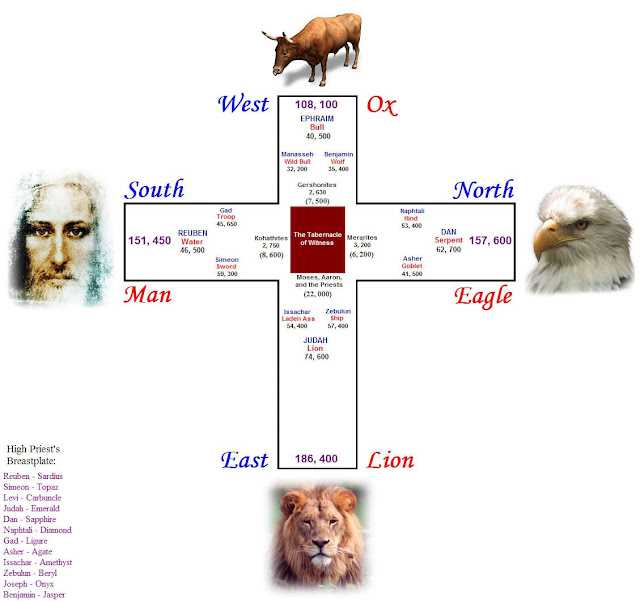
Pictured above, we see that the 12 Tribes of Yisra’el were arranged in the shape of a “cross” or a “Taw” in the wilderness. Each of the 4 creatures shown above are also mentioned in Ezekiel 1:10 as “the living creatures.” The fact that Messiah was nailed to two trees that were in the shape of a “Taw” (two crossed sticks) is highly significant because this once again shows that his bride (Yisra’el) is his body, and he bore our sins upon his own body:
1st Keefa (Peter) 2:24 Who his own self bare our sins in his own body on the tree, that we, being dead to sins, should live unto righteousness: by whose stripes you were healed.
Romiym (Romans) 12:5 So we, being many, are one body in Messiah, and every one members one of another.
Once again we see that the bride—the body of Messiah is joined by the two crossed sticks or the Taw!
The Stake or Pole?
The Jehovah’s Witnesses are the main proponents of the belief that our Messiah Yahuwshuwa died on an upright pole and not a cross or two sticks. Those who would argue that our Messiah was nailed to a single pole or a stake think that the “cross” is a pagan symbol.
But even the “Asherah Pole” is a pagan symbol used to worship a pagan fertility goddess known as “Asherah.” We are commanded in scripture to destroy these Asherah Poles! (Exodus 34:13, Deuteronomy 7:5, 12:3, 2nd Chronicles 31:1).
Pictured here is an illustration that the Jehovah’s Witnesses use to try to “prove” that Messiah was executed on a pole. But Messiah carried his own cross to the place of execution:
Mattithyahuw (Matthew) 27:32 And as they came out, they found a man of Cyrene, Simon by name: him they compelled to bear his cross.
And so what did he carry if the stake was already standing there as a permanent structure? The Romans did not use a different pole or a stake every time they executed a new prisoner. The pole or stake was permanently in the ground like a modern telephone pole. It had to be secured into the ground with rocks and mortar and driven deep into the ground for stability. They did not do this every time they had to crucify another prisoner. Messiah did not carry his own pole to the place of execution. He carried a “cross-beam” across his shoulders and then it was fastened to the stauros that was already standing there as a permanent structure.
Wasn’t the Cross a Symbol of Tammuz the Sun-god?
Some would argue that the Cross is a pagan symbol for Tammuz.
Pictured here is the difference between the cross of Ba’al or Tammuz which is more like a “plus sign” enclosed in a circle for the pagan sun-god versus the cross of our Messiah which is the last letter in the Hebrew Alphabet known as the “Taw.”
The Taw (cross) was never meant to symbolize sun-god worship. The brightest star in the solar system is the sun, and Yahuwshuwa is described as the “the sun of righteousness” (Malachi 4:2) and he is also “the bright and morning star” (Revelation 22:16). But Satan wants to steal worship away from Yahuwshuwa and he wants us to believe that he is the “bright and morning star” (see Isaiah 14:12 in all modern translations). The modern versions say that the “morning star” fell from heaven, implying that it was Messiah who fell from heaven.
But the King James Version uses the Hebrew Masoretic text which says “heylel ben shachar” fell from heaven. This is Hebrew for the English title “son of the morning.” This is accurate, because it means that Lucifer (Heylel) was merely a “son” (a created being). The modern translations like NIV, NASB, CJB use the Greek Septuagint which says “boker kokab” (the morning star). This is incorrect as the Gnostics are deliberately deviating from the Hebrew TaNaKh by calling Lucifer “the morning star.”
It is Messiah Yahuwshuwa who is the bright and morning star–not Lucifer:
Chazown (Revelation) 2:28 And I will give him the morning star.
Chazown (Revelation) 22:16 I Yahuwshuwa have sent my angel to testify unto you these things in the congregations. I am the root and the offspring of Dawiyd (David), and the bright and morning star.
This prophecy about Messiah being “the sun of righteousness” is not a mis-print, nor is it a Catholic interpolation (as some have supposed):
Malakiy (Malachi) 4:2 But unto you that fear my name shall the Sun of righteousness arise with healing in his wings; and you shall go forth, and grow up as calves of the stall.
The reason why Messiah is being referred to here as “the sun” is because he came to us in the 4th Millennium (the 4th day of creation). YaHuWaH also created the sun on the 4th day of creation. Messiah is also described as the “bright and morning star” which is the brightest star in the solar system (the sun). Now we know the reason why sun-god worship is a sin.
It is because Satan wants to take the place of Messiah by having people worship the “object” which is the sun itself rather than the one who created the sun. Messiah also comes from the Tribe of Yahuwdah (Judah) and Judah was the 4th son born to Jacob & Leah. Messiah was also crucified on the 4th day of the week (Wednesday).
There is a fine line between seeing our Messiah in metaphors within creation and worshiping those created things. In Romans 1:25 we are told to worship the Creator instead of the created things in nature.
THE CRUCIFIX IS AN OCCULT TALISMAN USED IN SATANISM 
The Crucifix is used in Satanic Rituals and should NEVER be displayed by believers in any way, shape or form!
The crucifix denies the power of the resurrection and leaves our Messiah DEAD ON THE CROSS!
The Roman Catholic Mass is Blasphemy:
Vatican council page 102 states: “…for in the sacrifice of the Mass, our Lord is immolated.” Webster’s dictionary says: “immolate means to kill as a sacrificial victim.”
But scripture tells us: Hebrew 6:6 “…seeing they crucify to themselves the Son of Elohiym afresh and put him to an open shame.”
To crucify our Savior afresh is to put him to open shame!
LOUIS BOURDALOUE, a Jesuit Catholic priest who authored the book “The Passion of the Christ” was born at Bourges France in 1632. An excerpt of his book reveals that the Catholic Church “crucifies” our Master over and over again at each and every mass:
The passion of Jesus Christ, however sorrowful and ignominious it may appear to us, must nevertheless have been to Jesus Christ Himself an object of delight, since this God-man, by a wonderful secret of His wisdom and love, has willed that the mystery of it shall be continued and solemnly renewed in His Church until the final consummation of the world. For what is the Eucharist but a perpetual repetition of the Savior’s passion, and what has the Savior supposed in instituting it, but that whatever passed at Calvary is not only represented but consummated on our altars? That is to say, that He is still performing the functions of the victim anew, and is every moment virtually sacrificed, as though it were not sufficient that He should have suffered once; at least that His love, as powerful as it is free, has given to His adorable sufferings that character of perpetuity which they have in the Sacrament, and which renders them so salutary to us.
This is blasphemy! This Jesuit Priest readily admits that the Eucharist is a perpetual repetition of Messiah’s suffering!
If Yahuwshuwa (Jesus) is still performing the functions of the victim anew, and is at every moment virtually sacrificed as though it were not sufficient that he should have suffered once, then why were his last words on the cross “It is finished?” And why does the word of Yah tell us that he “died unto sin once?”
The Greek translation for “finished” is tetelestai, which means, “paid in full.” The finality of Messiah’s finished work on the Taw (cross) has been confirmed by the tearing of the temple curtain that veiled the earthly sanctuary (the Holy of Holies) from sinful man, thus signifying that access to YaHuWaH Elohiym had been restored at that precise moment (Mark 15:38).
1994 Catholic Catechism:
#1366: “The Eucharist is thus a sacrifice because it represents [makes present] the sacrifice of the cross…and because it applies its fruit…the forgiveness of the sins we daily commit.”
#1367: “The sacrifice of Christ and the sacrifice of the Eucharist are one single sacrifice: the victim is one and the same: the same now offers through the ministry of priests, who then offered himself on the cross; only the manner of offering is different. In this divine sacrifice which is celebrated in the Mass, the same Christ who offered himself once in a bloody manner on the altar of the cross is contained and is offered in an unbloody manner.”
What is the point of Yahuwshuwa offering himself in an unbloody manner if he says that without the shedding of blood there is no remission for sin? It is the “shedding of his blood” that purged our sins:
Ibriym (Hebrews) 9:22 And almost all things are by the law purged with blood; and without shedding of blood is no remission.
If the Catechism states that Yahuwshuwa (Jesus) must be offered daily for the sins we commit daily, yet it is done in an unbloody manner, then it is done in vain!
Romiym (Romans) 6:9-10 Knowing that Mashiyach being raised from the dead dies no more; death has no more dominion over him. For in that he died, he died unto sin once: but in that he lives, he lives unto Elohiym.
Messiah’s sacrifice on the Taw (cross) was a “once and for all” event able to atone for our past, present and future sins! Here, scripture shows us that under the Briyth Chadashah (Renewed Covenant), Yahuwshuwa does not have to “offer himself often” as the Catholic Catechism falsely teaches:
Ibriym (Hebrews) 9:25 Nor yet that he should offer himself often, as the high priest enters into the holy place every year with blood of others.
Ibriym (Hebrews) 9:26-28 For then must he often have suffered since the foundation of the world: but now once in the end of the world has he appeared to put away sin by the sacrifice of himself… So Mashiyach was once offered to bear the sins of many…
The Inverted Cross: Symbol of the Anti-Messiah
Pictured here is Pope John Paul II in March of 2000 in Kerazim, Yisra’el. You will notice that he is seated on a throne with an inverted cross!
This is a precursor to the “Abomination of Desolation” spoken of by Daniel the prophet.
The excuse that the Vatican uses for displaying an upside down cross is that according to “tradition” the Apostle Keefa (Peter), whom they falsely teach was the first pope was crucified upside down. There is no record in scripture of Keefa (Peter) having ever been crucified much less upside down. This myth of Peter’s “upside down” crucifixion is a concoction of Origen who was a Gnostic, and secretly a worshiper of the “sun-god.”
I believe this “tradition” is merely a smoke-screen in order to use the upside down cross while keeping the Catholic people unsuspecting. Yahuwshuwa told Keefa (Peter) that he would die for the glory of Elohiym. One could merely speculate that he was referring to crucifixion because of the choice of words he uses here: “thou shalt stretch forth thy hands.” Yet Messiah said “another shall gird thee” meaning another person would “dress” him since he would be too old and feeble to dress himself.
When Yahuwshuwa said that Peter would be “carried where he would not want to go,” the scriptures indicate that this signified what death Peter would suffer. It is possible that Peter died a martyr for his faith, yet there is no evidence of his crucifixion much less “upside down”:
Yahuwcḥanon (John) 21:18-19 “Verily, verily, I say unto you, When you were young, you girded yourself, and walked where you would: but when you shall be old, you shall stretch forth your hands, and another shall gird you, and carry you wherever you would not.” This spoke he, signifying by what death he should glorify Elohiym.
In reality the Apostle Keefa (Peter) was called to preach to the Jews, while it was the Apostle Sha’uwl (Paul) who was called to preach to the Gentiles in Rome. Peter had never even been to Rome (although the Vatican falsely claims to have the bones of Saint Peter).
The idea that the Apostle Keefa (Peter) was the first Pope (meaning father in Latin) is of course a myth.
In reality the persona behind this “first Pope” is none other than the man called “Simon Pater” the magician and sorcerer whom the Apostle Keefa (Peter) rebuked for his attempt to purchase the gift of the Holy Spirit for money (Acts 8:20).
The name “Pater” in Latin means “father” and the term “pappas” (Pope) is the word in Greek for “Father,” hence the idea that every Pope should be called “Holy Father” is against our Messiah’s commandment (Matthew 23:9).
It is noteworthy to mention, that if the upright cross is a pagan symbol, then why does Satan need to invert it? It should be pagan enough as an upright symbol—right? But the fact that Satan always does things backwards and upside down or opposite of what YaHuWaH does, it stands to reason that if Messiah’s symbol is the Taw (cross), then Satan’s symbol is the very same one only upside down and distorted!
The Distorted Disfigured Crucifix
After his father died, Constantine felt that he was the rightful heir to his father’s throne, but Maxentius was also in line to take the throne as the next Emperor of Rome. So in 312 A.D., on October 28th at the Stone Milvian Bridge at the Tiber River, Constantine’s enemy, Maxentius and his army stood between Constantine and the throne. As Constantine and his troops were greatly outnumbered, tradition says that Constantine saw a vision of a “cross” in the sky as he heard the words “in this sign conquer.”
This is an amazing discovery in light of Revelation 6:2, as the Antichrist riding a white horse goes forth conquering:
Chazown (Revelation) 6:2 And I saw, and behold a white horse: and he that sat on him had a bow; and a crown was given unto him: and he went forth conquering, and to conquer.
The “bowed crucifix” carried by the Pope is deliberately bent to associate him with the rider on the white horse of Revelation 6:2, and this “bow” is symbolic for Nimrod who was a mighty hunter.
And so the “bow” is used to symbolize the Antichrist as well. Constantine was one of the “historical”Antichrists in that he mingled “Christianity” with paganism. As a result of this “vision” he claimed to have been converted to “Christianity.”
However, the “cross” which Constantine saw in the sky was actually an Egyptian “Ankh”, which is a detestable idol to YaHuWaH. This Egyptian “Ankh” came from the recycled ancient Babylonian religion of Nimrod and Semiramis. It symbolized the sun-god “Baal” (“Horus” in Egypt) and in Rome, this same deity was called “Sol.” Below is pictured the cross that Constantine claimed to have seen in the sky:
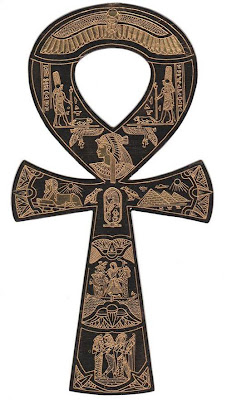
This is an Egyptian Ankh. The “upside down egg” is a symbol of the fertility goddess, and Tammuz is the reincarnation (supposedly) of Nimrod, one of the many different sun-gods, wherein his symbol later became a capital “T.”
On top of the capitol “T,” the loop is symbolic for his mother/wife Semiramis who gave herself the title “the goddess of the moon” or “the Queen of Heaven” (Jeremiah 7 & 44). While Constantine claimed to be converted to Christianity, he still secretly worshiped the sun-god.
A Pattern of Prayer in the Tabernacle Entrances
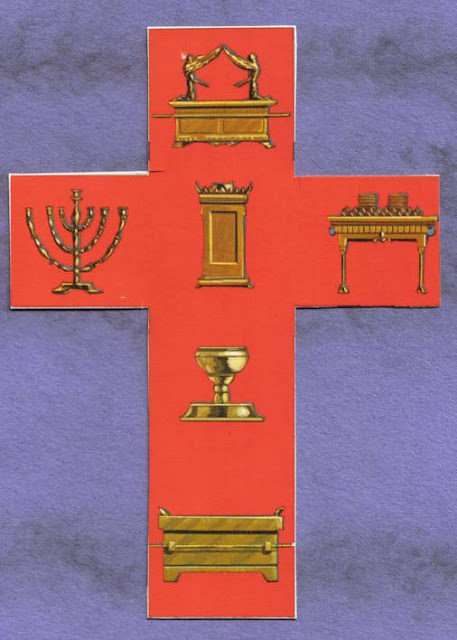
Exodus 38:18-19, Exodus 36:37-38, Exodus 36:35-36
There were three entrances into the Tabernacle of Moses:
The Gate – The Door – The Veil
The Truth – The Way – The Life
Yahuwchanon (John) 14:6 יהושׁוע Yahuwshuwa said to him, “I am the Way, and the Truth, and the Life. No one comes to the Father except through Me.”
The Tabernacle is a picture of Messiah’s body being crucified for us.
The bride is “the body of Messiah.” In Revelation 1:20 Yahuwshuwa has the seven menorah’s (lamp-stands) in his right hand. The seven lamp-stands are “the seven assemblies” (set apart ones, the bride). This is where his right hand was stretched out and nailed. And this is where the lamp-stand is located in the tabernacle (on the right side).
His feet are like bronze in Revelation 3:18 and the bronze altar is at the bottom of the tabernacle (where his feet were). His feet symbolize “crushing the serpent’s head with his heel.” The “Holy of Holies” is where his face is. We see him face to face when we are in the “Holy of Holies.” The table of show-bread is in his left hand (the hidden manna in Revelation 3:17), the altar of incense is at his heart which symbolizes worship.
Revelation 5:8 tells us that the “incense is the prayers of the saints” and this means that the bride (his body) worships from the heart (where his heart would’ve been positioned on the cross). The “bronze laver” is where the water gushed out of his side!
The Tabernacle of Mosheh is in the shape of a cross, and it represents Messiah’s Body and his bride is his body:
1st Qorintiym (Corinthians) 12:27 Now you are the body of Mashiyach, and members in particular.
The bride is also the New Yerushalayim (Jerusalem), but YaHuWaH himself and the Lamb collectively make up the temple:
Chazown (Revelation) 21:
2 And I Yahuwchanon (John) saw the holy city, New Yerushalayim (Jerusalem), coming down from Elohiym out of heaven, prepared as a bride adorned for her husband.
3 And I heard a great voice out of heaven saying, Behold, the tabernacle of Elohiym is with men, and he will dwell with them, and they shall be his people, and Elohiym himself shall be with them, and be their Elohiym.
9 And there came unto me one of the seven angels which had the seven vials full of the seven last plagues, and talked with me, saying, Come hither I will show you the bride, the Lamb’s wife…..
22 And I saw no temple therein: for the Master YaHuWaH
יהוה Ěl Shaddai and the Lamb are the temple of it.
The Two Sons: Ephrayim & Yahuwdah
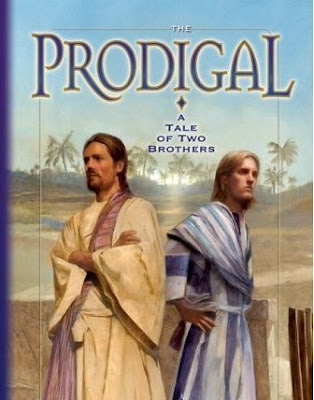
In the story of the prodigal son, the older son represents the Two Southern Tribes of Yahuwdah (Judah) & Benyamin. But the younger son represents the Ten Northern Tribes of Ephrayim.
When Ephrayim came back home to the Father and his commandments (Towrah), the Father gave him 3 things:
1.) The fatted calf (red heifer for cleansing, atonement)
2.) The ring (signet ring or signature, the name, authority, power of attorney)
3.) The robe (wedding garment, covering, provision)
Luqas (Luke) 15:
18 I will arise and go to my father, and will say unto him, Father, I have sinned against heaven, and before you,
19 And am no more worthy to be called your son: make me as one of your hired servants.
20 And he arose, and came to his father. But when he was yet a great way off, his father saw him, and had compassion, and ran, and fell on his neck, and kissed him.
21 And the son said unto him, Father, I have sinned against heaven, and in your sight, and am no more worthy to be called your son.
22 But the father said to his servants, Bring forth the best robe, and put it on him; and put a ring on his hand, and shoes on his feet:
23 And bring hither the fatted calf, and kill it; and let us eat, and be merry:
24 For this my son was dead, and is alive again; he was lost, and is found. And they began to be merry.
25 Now his elder son was in the field: and as he came and drew near to the house, he heard musick and dancing.
As you can see here, the fatted calf is for Ephrayim because Ephrayim is called a heifer in Hoshea’s prophecy.
This is why the symbol of the “Alef” is the symbol of the bull or the ox. Thus, the Alef & Taw is for Ephrayim the prodigal son. Once the prodigal sons receive atonement for their sins, the Father will give them his name YaHuWaH as a “ring” on their finger (symbolic of an engagement ring). And then he will also give them a robe or a wedding garment as a covering in order to get into the wedding.
The Alef & Taw is prophetically a picture of Messiah because it is the ox head (the red heifer) which sanctifies the altar of our hearts. It is also the Taw which represents two sticks or two trees for the two houses of Yisra’el (Ephraiym & Yahuwdah).
Yahuwshuwa Messiah laid down his life for both Yahuwdiy (Jew) and Gentile that he might join both unto himself by his once and for all sacrifice on the “two sticks.” In other words, he is the Alef & the Taw, the Red Heifer nailed to Two Trees in order to gather the Two Houses of Yisra’el from the foundations of the world!
P.S. All the above links are placing here for researches purposes only, we are not here to endorsed all of their teachings or all the subjects on their websites. Please ask the Ruach Ha Qodesh for discerment in any material that you read!
Other resources related to the subject, please visit the link here:
https://perfectgiftorg.com/?p=1259
“The Great Secret of Solomon’s Temple and the Hiding of the Ark of the Covenant.”
The dry blood of the Risen MESSIAH, Yahushua has been found on the Mercy Seat of the Ark of the Covenant. It is in a cave below a crucifixion site near the Garden Tomb. This is true and will hit the mass media in the near future.
Ron Wyatt has made many discoveries pertaining to the scripture. All things will be revealed in their time. Yahuwah takes no pleasure in what He must do to those who do not believe in Him. All of mankind was created by Yahuwah, as sure as these Scriptures are true. So will the Ark of the Covenant be revealed in it’s time. None will be without excuse, when He comes back for His people
Prayerfully Arranged Marriage
Written Date: Wed, 18 Feb 2009
The amazing story of the ” Answered Prayer ” below reminds me of Ms Heloise in Asia (and others as well) who has been faithfully keeping me in her intercessory prayers for more than 17 years now (as of Feb 2009). While reading the story, I am also impressed in my spirit that Eyd had divinely received his salvation at the end of 1997, as YAHUWAH had him in His magnificent plan such that he was being prepared to be my ” future ” husband at that time when my own life was utterly broken to pieces. . .
A spoken prophecy of YAHUWAH came to me in the beginning of the year 2001 through Pastor Prince that YAHUWAH was already preparing someone for me, and that I shall be remarried as part of the total restoration of my life. My personal life was crushed when Satan was given entrance into it, wherein he stole everything from me, nearly destroying me in the process. As a result, I had started my prayer vigil for this ” unknown brother “ in YAHUWAH, as well as for the rest of the restoration that YAHUWAH had promised!
For the second time, in the year 2005 September, YHWH urged me strongly that I needed to take action and travel to the USA and attend MCWE Conference. He had also sent a prophetic Evangelist Pastor John Koh to Singapore at the time of my birthday to announce to me that the 8th year had come, and that I should demand that “the King is to restore all that was mine . .[2 Kings 8: 6; Joel 225]:. I had been a single mother during my famine season, and that this time was now over.
In the Year 2006 during the time of my birthday again, our Messiah Yahushua said that I shall meet my future husband in Israel, and also that I must sell all my belongings and give to His Reign (Kingdom) and live by emunah (faith); eat at His table…… and that He had a new mission / an assignment for me. He also said that I must get ready to fulfill my high-calling to be an end-time financier ministering only unto Him in advancing the Reign (Kingdom) of YHWH in this season. The Master continued and said ”that I shall eat in plenty, and be satisfied, and praise the Name of YAHUWAH my Aloahiym, that had dealt wondrously with me and I shall never be in shame [Joel 2: 26]. “
And I did meet Ed on a trip to Israel organized by MCWE in 2007. Although we met at the beginning and during the course of the ministry tour, it was on the plane returning to New York City that I got to know him somewhat. Without any clue from YAHUWAH then, I did not give him my contact number nor did we even shake each other’s hand throughout the trip with the thought that our meeting was coincidental and temporary; we were only passing by each other at this time in our lives. . .
However, after we had collected our luggage and said goodbye to another, I turned away in a different direction. Immediately, a huge drop of “Liquid Love” like a small water balloon fell on my head heavily, smoothly, swiftly, and evenly, then slipping down into my heart. This was a physical sensation that had manifested from the Ruach. I was temporarily stunned and felt as if a strong refreshing cleansing process of my soul had begun. Moreover, it washed away all my past memories of romance within seconds. Then I saw and felt the supernatural hand of a messenger on my forehead “ wiping away past memories and even current emotions for anybody else.” I was lost in a ” clean yet transparent ” state of being in JFK International Airport in NYC with only that last deep, penetrating gaze from Eyd floating in my mind and my heart. Since those moments in the airport, I was suddenly immersed into a burning wave of heat of the Set Apart Spirit and totally drunk in the Ruach Ha Qodesh (Spirit) every day as I praised and worshiped before YAHUWAH for that whole month. Following my return to NYC, I was staying with a Jewish couple on Staten Island across from the City
An excerpt from my journal:
” YahnEl, can you live within the fire? ” Who among us can live with the consuming fire?” (Isa 33:14)
Father, I cannot wish for painful experiences, but I can wish for you. Give me the Favor to desire you more than life itself.
Thus, YHWH declared Himself unto me as these fiery fire assailed me: ” The Fire of My Set Apartness, The Fire of My Love, The Fire of My Compassion, The Fire of My Esteem and Honor, The Fire of My Prudent Understanding, The Fire of My Knowledge, The Fire of My Zeal, The Fire of My Purity…….” The projectiles of YHWH’s Fire were to purify and to intensify our spiritual perception.( Eph1:18)
YHWH is a consuming fire (Duet4:24). By His Word, He burns up the refuse in us, the dross and the chaff; and infuses the remainder with the burning purity of His Love. (Jer23:29, Matt3:11-12, He12:27-29) The fire of YHWH must burn within the inner person( spiritual heart and human spirit (1Pet 3:4) as well as the outer person (2 Cor4:16) of the soul expressed through the body.
Song 8:6 Set me as a seal upon thine heart, as a seal upon thine arm: for love is strong as death; jealousy is cruel as the grave: the coals thereof are coals of fire, which hath a most vehement flame.
Jer31:3 YHWH hath appeared of old unto me, saying, Yea, I have loved thee with an everlasting love: therefore with lovingkindness have I drawn thee.
“Yes, YHWH my Master, Yahushua my Love, make me a burning flame of Love for You..Your Divine Love is the very flame of Fire, The Burning, All Consuming, Everlasting Passion of Your Heart…Song 8:7 Many waters cannot quench love, neither can the floods drown it! Grant me your Word in Eph3:16-20, help me to walk the path that you have invited me into as your prayer in John 17; Yes, help me to walk with you all the way through as you have prayed, in Oneness with you here on earth. phil3:14“
Simultaneously, Eyd and I started our communications by phone calls and emails…it has never been stopped for a day until now; YHWH has finally brought us together in marriage after enduring various trials and tests over the past one year of geographic separation….(At that one year, I was ministering to YHWH in Asia and Eyd was in the USA.) YHWH has divinely arranged us to have our wedding on the 20th of Dec.2008. ( Again, it is the 8th year after the first prophecy of my new marriage is spoken unto me. )
Let me offer this as one of the praise reports that testifying YAHUWAH, our Aloahiym who is trustworthy and true, He looks over His word ( His promises unto us) to perform it. YHWH has all of the yesterdays, todays and tomorrows of our life in His hand; if we will just trust Him ( His Word ), He will get us through the darkest hours into the light of His unmerited favors where true shalom and joy prevail.
It is my honor to share this testimony with you. Thank you for supporting me as your sister in prayers for years, your friendship is highly cherished and appreciated. Be assured that you are also in my prayers always.

Shalom of YHWH be you always,
YahnEl Stephenson
Re: An Answered Prayer“The effective, fervent prayer of a righteous man avails much” (James 5:16). James Rutz, author of MegaShift, tells a wonderful” story of YAH’s supernatural hand in answering prayer.“I have a good friend named Barclay Tait who sells vacation real estate in Niceville, Florida. Back in 1977, he was a 36-year-old Florida basketball coach. That summer, he decided to hitch-hike to a Christian conference in Front Royal, Virginia. Arriving four days early, he went to a nearby forest and pitched his tent by a stream. On the last day, a tall, thin hiker with a notebook under his arm suddenly appeared, startling him as he read his Bible. Barclay explained that he came out there to fast and meditate. Dave, the hiker, replied, “Well, I’m an intercessor. What would you like me to pray for?” Feeling somewhat overwhelmed, Barclay said, “Uh, frankly, I’d like prayer for a wife.” The man wrote the request in his notebook and walked on. By 1988, Barclay, now married to Sherry, has been divinely guided to move to Asheville, North Carolina. A chance encounter in the Holiday Inn parking lot led to an invitation to join a gathering of a Christian group outside of town. Arriving just before the 7:00 P.M. meeting, the host walks in from the kitchen and stops dead in his tracks. “I know you!” he exclaims, pointing his finger. “You’re Barclay Tait!” Barclay draws a blank. “Just a minute. I have something I want to show you,” the host announces. He scampers upstairs, leaving the puzzled Taits standing in the middle of the suddenly hushed room. In a moment the host reappeared with a well-worn ledger book. “See here? This is where I wrote your prayer request in column one when I met you in Front Royal in 1977: ‘Barclay Tait: Elohim’s choice for a wife.'” Barclay looked down at the journal entry. It was the most detailed, methodical prayer journal he’d ever seen. “I prayed for you for seven years,” proclaims Dave. “Then in the middle of the night on Dec. 30, 1984, Elohim woke me up out of a sound sleep and said, ‘Write in your journal, “Prayer answered.” So I did. See? Here in column two, “Prayer answered.'” Barclay and Sherry look at each other with their mouths open. They sat down, and their eyes fill with tears. Quietly, Barclay tells Dave, “That was the day we were married.” |
Jan 2010 . . . Open Vision on a Mountain Top
(Taken from Part 2 Vol 1 of the Man Child Book –Rev 12:5)
https://perfectgiftorg.com/wp-content/uploads/2013/08/3-1-2014-PDF-Part-2-Vol-1-Only-First-Draft.pdf
While still visiting with the prayer group in Indianapolis, the entire group of seven of us left to attend a conference in Dallas, TX. During this time, Yahn EL had an Open Vision in a prophetic dream state: She was on a mountain top with many people outdoors standing in a line for a photo to be taken for identification purposes. There was a cool, gentle breeze blowing, with an atmosphere of excitement and exhilaration amongst the various people, who were representative of believers from all nations. When Yahn EL’s turn came to step forward to be photographed, there was actually no photographer present. She turned to face the mountains and flashed her best smile for whatever picture was supposedly being taken. The next second, she heard an acrimonious outcry from all the people in the crowd pursuant to the sudden display of the individual respective identity photographs that had suddenly become visible.
To Yahn EL’s surprise, she turned her head and saw that the identity photos were giant, poster- sized head shots highlighting the face and features of each person, akin to a promotional glamour shot of some Hollywood movie star. The poster sized photos were traveling slowly as if in a parade by some invisible process across the scene but in front of the audience with the mountains in the background. Yahn EL knew (in her mind in the dream) that the assigned number of her photo was the number “9”; therefore, she looked for this number in the sequential line up of these posters. To her astonishment, when her “numbered” identity picture came before her, her poster-sized photo was blank and without any image on it!
She wondered to herself: “What does this mean? Is it that I have no identity? How do I tell people who I am, if I have no self-image (identity)?” At the sight of this, Yahn EL began to worry and was confused as to what she saw. Instantly, the voice of Yahushua came to her: “My beloved, do not be afraid, your identity is hidden in me.” Yahn EL then woke up with the profound statement from her dream that Yahushua had spoken into her inner spirit [Col 2:20; 3:3; Gal 2:20].
About 2 months later, Yahn EL and I were departing from where we had been staying. Very early on that particular morning of our departure, she was again asleep and suddenly found herself in the same dream as related above; on the same mountain top and experiencing a continuation beginning at the point that she had awakened earlier in the dream the first time.
This mountain top, resembling a tourist site was filled with people; and she heard animated and vivid chattering of voices all over the mountain. Suddenly Yahushua spoke to her: “See, My beloved.” Immediately, Yahn EL’s eyes were opened and she saw and perceived a magnificent scene in front of her [John 20:8]. There were many, many more posters now crossing industriously and actively all over the range of the mountains. The Ruach opened her spiritual vision [2 Kings 6:17] to focus on different locations throughout the mountain range where there were various groups of enemy combatants hidden in the woods behind the trees and bushes. They were armed with many different types of weapons and devices targeting the giant posters crossing in front of them all over the mountains. Some threw fire darts towards the targets; some were shooting arrows; and some throwing knives’ and some firing other weapons with the intent to destroy the moving targets. As long as they could identify the poster, then the individual that was the subject of the photo could be targeted. Then Yahushua spoke again to Yahn EL: “Now you see, My beloved, you are safe when you are hidden in Me“ [Psalm 91:1-10; 27:5; 31:20; ].
When Yahn EL awoke and shared the dream with me, we both instinctively knew that YAHUWAH had been keeping the two of us in obscurity for our own protection since then and even now [Psalm 32:7; 52:8; others]. Moreover, He has declared this to us repeatedly and emphatically ever since this dream of Yahn EL’s.
In 2013, it was brought to our attention the Hebrew meaning of our last name, Stephenson, which literally means “son” of Stephen. Stephen is a more modern English translation of the Greek Stephanos, [Strong’s G4736, G4735] taken from Zephaniah, which is derived from the Hebrew name of Tzephanyah, one of the First Covenant prophets [Strong’s No. H6846, taken from No. H6845 and H3050]. Together, this name means “ . . . hidden in YAH”. Upon the realization of the meaning of our last name, and what Yahn EL’s dream held for us in a prophetic sense, our walk with Aloahiym has consistently allowed us to successfully tackle challenges to our respective emunah in ways that clearly demonstrate the depth and substance of the above referenced Psalms, as well as other Scriptures, which openly command us to depend and trust on YAHUWAH with all of our spirit and soul, without qualifications and without excuses [Matt 10:28; Jer 5:21-23; Isa 66:5; others]. Fundamentally, a true believer both accepts and believes the Word of Aloahiym, or they don’t. Anything to the contrary violates Scripture [Mark 11:22-24; Matt 17:20; Heb 3:17-19; James 1:6-8, 22-25; others].
The following is a comparison of Acts 6:8 in the KJV and The Restoration Scriptures regarding the name . . . Stephen:
Acts 6:8 (The Restoration Scriptures) And Tzephanyah, full of emunah and power, did great wonders and nisim (miracles) among the people.
Act 6:8 (KJV) And Stephen, full of faith and power, did great wonders and miracles among the people.
As just mentioned, the meaning of the dream had more to do than just our physical protection. It also includes our entire spiritual being. One of our most sincere requests in prayer and worship is to remain hidden within Him so as to be taken into the Most Qodosh Place, where no part of our flesh (our identity . . . our carnal nature) is allowed to exist apart from YAHUWAH.
Our choices must be according to our sovereign Master Yahushua’s choices [John 5:30; Prov 16:3]. He commands us to come; to abide in His Presence [John 15: 2-7; Phil 2:12]. Moreover, we must be violent to press into His Presence and give no occasion or excuses of submitting to the flesh [Matt 11:12; Psalm 16:11; Phil 3:3, 18-19; others]. For the average person, this is obviously quite difficult at first, but after a while, one gets the hang of it with practice.
However, Scripture declares that as we have been grafted into the House of Israel [Matt 10:6; 15:24; Rom 11:17-24; Heb 8:8,10] and therefore subject to the law (instructions of the Torah) of the Ruach of life (hai) that is in, and of, Yahushua [Matt 5: 17-18; John 4: 23-24; Rom 8:1-2; others] and is fulfilled by Yahushua within the individual’s spirit, then our soul [Rom 12:2] and our body [Rom 12:1; 1 Cor 3:16] is empowered in, with, and through the power of the Ruach of YAHUWAH [Phil 3:21; 1 Cor 15: 42-44]. Thus, this is His resurrection power and not that of our own [Eph 1:17-20] that strengthens us [Phil 3:10; 4:13; 2 Pet 1: 3-4; Rom 1:4; Col 3:3; others]. Thus, this is the message of total surrender in order to be hidden in YAHUWAH.
Eyd & Yahn El Stephenson
Rev 1:8 “I am the ‘Aleph’ and the ‘Tau’, Beginning and the Covenant without End,” says יהושע Messiah, “who is and who was and who is to come, the Almighty.”
“The Man Child”…upon completion, this book shall be available at NO charge.
Part 1: Please click the link below for Part 1 of 4 for the Book of Man Child Vol.1
8-1-13 PDF Part 1 – The Man Child of the Book of Revelation
Part 2: Please click the link below for Part 2 of 4 for the Book of Man Child Vol.1
3-1-2014 PDF Part 2 – Vol 1 Only – First Draft
Part 3: Please click the link below for Part 3 of 4 for the Book of Man Child Vol.1
5-25-2015 PDF Section 1 of 3, Part 3 – Vol 1 – First Draft
5-27-2015 PDF Section 2 of 3, Part 3 – Vol 1 – First Draft
WEEKLY SHABBAT PRAISE & PRAYER SERVICE安息
A. WEEKLY SHABBAT PRAISE & PRAYER SERVICE 安息日敬拜讚美會
On line service在線會議:
HTTPS://ZOOM.US/J/9289578768?PWD=DS9KQGVSYCO
密码PW: YHWH
中国/亚洲每周六早上8:00~11:30(上半场)
8:00AM ASIA TIME ZONE /EVERY FRIDAY MORNING
4.00 PM USA PACIFIC TIME ZONE/ EVERY FRIDAYAFTERNOON
美西岸时区 下午4.00PM 开场:
All Are Invited.
The Service and Time Schedule shall be:
1.預備心音樂敬拜時間
( Music Only, quiet our inner Spirits; Time alone with Yahushua Our MessiYah)
2.吹號角回應主的呼召 ( Shofar high calling for us to response in prayers in Ruach Ha Qodesh)
3.歌唱宣揚YHWH雅吾瓦的聖名(Sing Baruch Ha’Ba Shem YHWH- Praise YAH together)
4.歌頌禱告(希伯來語)"主禱文"(Worship Avinu Our Father together in singing)
5.宣告創造主給我們"安息日"的約定/"安息日"是 יהוה(雅吾瓦)與我們立約的蓋章
(Declaring that Shabbat is the SEAL of the Covenant for us given by our Creator Aloahyim)
6.全體朗讀特選經文(中英文同時進行)( Declaring Scriptures living Words of YHWH into our lives)
7. 宣告與代禱時刻 Shalom Shalom…Scripture Declaration end here: Prayer & Intercession Time
8.亞倫大祭司的祝福禱文
(Aaronic Priestly Prayers to all household assembling in the present of our Aloahyim YHWH)
9.詩歌祝禱"耶路撒冷,愿你平安"結束安息日聚會
( Shabbat Service Ending with Shalom Yerushalayim)
The service shall end @Asia Time: 11.15-11.30pm 結束
10.離席,休息, 交通, 分享,見證,團契
( Rest, Fellowship, Sharing and Testimonies, special prayer requests or even Teaching Time!)
………………………………………………….
THE MEDITATION/默禱
Who can understand his own error?
Cleanse me from secret sin.
Keep back your eved/servant also from presumptuous sins:
let them not have rule over me:
then shall I be a tzadik/Upright, and then I shall be innocent
from the great transgression.
Tehillim 19:12-13
Let the words of my mouth, and the meditation of my lev/Heart,
be acceptable in Your sight, O YâHuWaH יהוה,
my strength, and my Redeemer.
Tehillim 19:14
Psa詩 19:12 誰能知道自己的錯失呢?願你赦免我隱而未現的過錯。
Psa 19:13 求你攔阻僕人不犯任意妄為的罪,不容這罪轄制我,我便完全,免犯大罪。
Psa 19:14 יהוה(雅吾瓦)我的磐石,我的救贖主啊,願我口中的言語、心裡的意念在你面前蒙悅納。
To my precious achi/brother and achoti /sister in MessiYAH YAHUSHUA, May YAHUWAH’s presence be with you this Shabbat and May He continually baruch you and your family. Sending you much ahava/love, dear one! Shabat Shalom to you and all our Set Apart Mishpocha/believers!
我所親愛的在彌賽亞YAHUSHUA(音:雅吾贖瓦)里的弟兄achi及姐妹們achoti,願יהוה(音:雅吾瓦)在這個安息日與你們同在,並願他不斷地祝福baruch(音:巴祿)你和你的家人。親愛的!祝愿你與所有分別為聖的信徒們一起享受主豐沛的大愛,安息日的Shalom平安!
…………………………………………………………………..
6.全體朗讀特選經文(中英文同時進行)( Declaring Scriptures living Words of YHWH into our lives together)
In the given TORAH, the 10 WORDS – the prescribed instructions for the marriage covenant of יהוה to Israel, the 4th commandment:
Exo 20:8 Remember the Sabbath day, to set it apart.
在 יהוה(雅吾瓦)給以色列的10句婚約說明書(10句托拉TORAH)中,第四誡的婚約規定:
出20:8 當記念安息日,守為聖日。
Eze 20:19 ‘I am יהוה your Elohim. Walk in My laws, and guard My right-rulings, and do them.
Eze 20:20 ‘And set apart My Sabbaths, and they shall be a sign between Me and you, to know that I am יהוה your Elohim.’
Eze 以西結20:19 我是יהוה(雅吾瓦)你們的神,你們要順從我的律例,謹守遵行我的典章,
Eze 20:20 且以我的安息日為聖。這日在我與你們中間為證據,使你們知道我是יהוה(雅吾瓦)你們的神。
As we celebrating the Shabbat of יהוה, we are acknowledging and pledging Our loyalty to our Creator Aloahiym: ABBA Fatherיהוה The SON, יהושע Messiah and The RUACH Ha Qodesh יהוה!
當我們遵守慶祝יהוה(音雅吾瓦)的安息日,我們承認並承諾我們的忠誠歸屬於我們的造物主Aloahiym:ABBA天父יהוה(音雅吾瓦),聖子יהושע(音:雅吾贖瓦)彌賽亞和聖靈RUACH(音:魯阿/意譯:靈).Ha哈 (意譯:那位).Qodeshיהוה (音:古代師/意譯יהוה雅吾瓦分別為聖)!
全體朗讀特選經文(中英文同時進行)( Declaring Scriptures living Words of YHWH into our lives together):
銘記創造主 יהוה(雅吾瓦)與我們所立定的約
Remembering Our Creator יהוה Covenant & Us
ISAIAH 58:13–14
Our ABBA Father YHWH tells us,
“If you hold back from pursuing your own interests on my set-apart Day; if you call Shabbat a delight, my Yom/Day Tov worth honoring; Then honor me by refraining from your usual doings or pursuing your own interests or even speaking about them.
If you hear me, you will find delight in me. I will make you ride on the heights of the land and confirm you in my heritage through your ancestor Ya’aqov, for the mouth of YHWH has spoken.”
Isa 以賽亞 58:13
你若在安息日掉轉(或作:謹慎)你的腳步,在我聖日不以操作為喜樂,稱安息日為可喜樂的,稱יהוה(雅吾瓦)的聖日為可尊重的;而且尊敬這日,不辦自己的私事,不隨自己的私意,不說自己的私話,
Isa 58:14 你就以יהוה(雅吾瓦)為樂。יהוה(雅吾瓦)要使你乘駕地的高處,又以你祖雅各的產業養育你。這是יהוה(雅吾瓦)親口說的。
我們稱頌主上帝 WE BRACHI YHWH OUR ELOHIM
BARUCH are you, YHWH our Elohim, SOVEREIGN of the Universe, who has sanctified us by your commandment and calls us to hear the qol shofar.
Bah-ruch ah-ta Yah-weh, Eh-lo-hay-nu meh-lech ha-o-lam, A-sher kid-sa-nu beh-mitz-voh-taiv vitz-e-vanu lesh-mo-ah kol sho-far. (The Shofar Master sounds the Tekiah – one long note.)
我們稱頌你,יהוה(雅吾瓦)我们的神,天地宇宙萬物的主宰,袮以自己的誡命分別我们為聖,并呼吁我们听從袮号角的呼召。
我們稱頌主禰賽亞 WE BRACHI OUR MESSIAH
BARUCH are you, YHWH our Elohim, SOVEREIGN of the Universe, who has given us the way of salvation in MessiYah Yahshua. Amein.
Bah-ruch ah-ta Yah-weh, Eh-lo-hay-nu meh-lech ha-o-lam, Ah-sher na-tahn la-nu et deh-rech ha-yeh-shu-ah beh-mashe-ach Yah-shu-a. Ah-main.
我們稱頌你,יהוה(雅吾瓦)我们的神,天地宇宙萬物的主宰,袮以自己的方式拯救我們,為我們準備了MessiYah Yahshua(雅吾贖瓦)。 Amein
因此,我们欢喜快乐飲食這生命的活水救恩的泉源!
So with joy we will draw forth [living] water from the springs of salvation!
Ush-av-tem [cha-yim] ma-yim beh-sa-sone mi-ma-ay-nai ha-yehshu-ah
我們彼此祝福 WE BRACHA ONE ANOTHER
On that day Jacob baruch his grandchildren, he said, “In time to come, the people of Yisrael will use you as a Brachat. They will say, ‘May Elohim make you like Ephraim and Menashe’.” (Genesis 48:20)
(For men and boys)May Elohim make you like Ephraim and Menashe! Ye’simcha Elohim ke-Ephraim ve’chi-Menashe!
(For women and girls) May Elohim make you like Sarah, Rivka, Raqel and Layah! Ye’simech Elohim ke-Sarah, Rivka, Ra-chel ve-Lay’ah!
Gen創世紀 48:20 雅各當日就給他的孫子祝福說:「以后,以色列人要指著你們的祝福對男生說:『願神使你如以法蓮、瑪拿西一樣。』」。(對女生就說: 『願神使你如撒萊,利百加一樣。』
May Elohim BRACHA you and watch over you. Ye’varech’echa Elohim ve’yish’merecha.
May Elohim shine his face toward you and show you favor. Ya’ir Elohim panav eilecha viy-chuneka. May Elohim be favorably disposed toward you and grant you SHALOM.
Yisa Elohim panav eilecha, ve’yasim lecha shalom. Amein!
Num民 6:24 『願 יהוה(雅吾瓦)賜福給你,保護你。
Num民 6:25 願 יהוה(雅吾瓦)使他的臉光照你,賜恩給你。
Num 民6:26 願 יהוה(雅吾瓦)向你仰臉,賜你平安。』
我們緊守主的首要誡命 WE RECITE SHEMA, HAVTAH
Hear O Yisrael, YHWH is our Elohim, YHWH is One.
Shema Yis-ra-el, YHWH E-lo-hey-nu, YHWH E-chad.
BARUCH is the name of his esteemed reign forever.
Ba-ruch shem ke-vod mal-chu-to le-o-lam va-ed.
And you will love YHWH your Elohim,
Ve-a-hav-ta et YHWH e-lo-hey-cha,
With all your heart, with all your soul, and with all your might,
be-chol le-vav-cha, uv-chol naf-she-cha, u-ve-chol me-o-de-cha.
And you will love your neighbor as yourself.
Va-hav-ta le-ray-ah-cha ka-moe-cha.
Let these words (that I command you this day) be upon your heart.
Ve-ha-yu ha-de-va-rim ha-en-leh, a-sher a-no-chi me-tzav-cha ha-yom al le-va-ve-cha.
You will teach them diligently to your children,
Ve-shi-nan-tam le-va-neh-cha, ve-di-bar-ta bam,
And speak of them when you sit in your house,
Be-shiv-te-cha be-vey-te-cha
When you walk upon the path, when you retire, and when you arise.
Uv-lech-te-cha va-de-rech, uv-shoch-be-cha uv-ku-me-cha.
And you will bind them for a sign upon your hand
Uk-shar-tam le-ot al ya-deh-cha,
And let them be frontlets between your eyes.
ve-ha-yu le-to-ta-fot bein ey-ne-cha.
And you will write them on the doors and gates of your house,
U-che-tav-tam al me-zu-zot bey-te-cha u-vish-ah-re-cha.
Deu申命記 6:4 「以色列啊,你要聽!
יהוה(雅吾瓦)我們神是獨一的主。
יהוה(雅吾瓦)作為统領的聖名永远長存。
Deu 6:5 你要盡心、盡性、盡力愛 יהוה(雅吾瓦)你的神。 你也要愛你的鄰舍如同自己
Deu 6:6 我今日所吩咐你的話都要記在心上,
Deu 6:7 也要殷勤教訓你的兒女。無論你坐在家裡,行在路上,躺下,起來,都要談論。
Deu 6:8 也要繫在手上為記號,戴在額上為經文;
Deu 6:9 又要寫在你房屋的門框上,並你的城門上。」
7. 宣告與代禱時刻 Scripture Declaration end here: Prayer & Intercession
We Declare That:
No weapon that is formed against you shall prosper;
and every tongue that shall rise up against you in judgment, you shall condemn.
This is the heritage of the avadim/servants of YâHuWaH יהוה,
and their tzedakah is from me declares YâHuWaH יהוה.
YeshaYahu/Isaiah 54:17
我們宣告:
Isa 以賽亞54:17
凡為攻擊你而造成的器械必不順利有效;
凡在審判時興起用舌攻擊你的,你必定他為有罪。
這是 יהוה(雅吾瓦)僕人的產業,是他們從我所得的義。
這是 יהוה(雅吾瓦)說的。
8.亞倫大祭司的祝福禱文 Aaronic Priestly Prayers to all household assembling in the present of our Aloahyim YHWH
YHWH Baruch you and keep you,
Yeh-va-reh-cheh-cha YHWH veh-yeesh-meh-reh-cha,
YHWH make his face shine upon you and GRANT FAVORS to you,
Ya-air YHWH pa-naiv ay-leyh-cha vee-chu-neh-cha,
YHWH lift up his countenance upon you and give you SHALOM.
Yee-sa YHWH pa-nahv ay-leyh-cha veh-ya-same leh-cha Shalom.
Num民 6:24 『願 יהוה(雅吾瓦)賜福給你,保護你。
Num民 6:25 願 יהוה(雅吾瓦)使他的臉光照你,賜恩給你。
Num 民6:26 願 יהוה(雅吾瓦)向你仰臉,賜你平安。』
8.詩歌祝禱"耶路撒冷,愿你平安"結束安息日聚會
( Shabbat Service Ending with Song “Shalom Yerushalayim”)
9.離席,休息, 交通, 分享,見證,團契
( Rest, Fellowship, Sharing and Testimonies, special prayer requests or even Teaching Time!)


天父YHWH(希伯來音:雅吾瓦),愿我全然擁抱你的旨意;完全放下自己的Amein 誠心所愿.
…………………………………………………………………………………………………………………………………………………….
B. About 2017 YHWH Qumran Solar Calendar Month to Month Click here
Please click this link for details: https://perfectgiftorg.com/?p=1150
C. About YahushuaMelchizedekCalendar
Please click this link for details: https://perfectgiftorg.com/?p=1757
Additional info: According to Prof. Rachel Elior of the Hebrew University of Jerusalem, the Rabbis were involved in nothing less than “a reinvention of Judaism“…The short reason … she suggests, was “a dispute over the calendar… “scholars known as Pharisees who disputed the legitimacy of the Hasmonean priests and kings and who argued with the Zadokite priests about the solar calendar…“. from https://perfectgiftorg.com/?p=2023
Prof_Rachel_Elior_Public_ Lecturer_Univ_Chicago_2014.mp3
D. How the Ancient Hebrew Calendar is Built:
- The month by month’s guide below is modified with permission from the calendar frame work provided by Daniel de Caussin; we share the same way of counting of the year but we hold a different opinion on the counting of the weekly shabbat day!
- “RECENT FINDINGS At Qumran in 1947, there were apocalyptic scrolls found, and among them the Books of Jubilees and the Second Mikdash writings of Enoch I which discuss the calendar and dating system by which these people lived.
- Scholars had been attentive of the Apocryphal Calendar before this find, but interest was renewed with the discovery of these scrolls by which the Qumran sect lived. It is based on 364 days per year. The year is divided into four periods (to correspond to the four seasons of the year), of 13 weeks or 91 days in each period. There are 12 months in each year or a total of 52 weeks.
- By using this exact measure and beginning the year on the 4th day of the week once we identify the day of vernal equinox, the Set Apart days fall exactly on the same day, in the same month, every year. This calendar warrants extensive study, as there are now numerous proofs it was the calendar used by Abraham, King Solomon, King David, and High Priest Zadok in the First Qodesh Mikdash.
- A different calendar was used in the Second Commonwealth, but that Mikdash had no Presence, no Ark of the Covenant, and no means for its apostate priesthood to communicate directly with יהוה. In fact, it is recorded that 300 high priests during the second Mikdash period, died when they went into the Most Kodesh Place on Yom Kippur. Something, perhaps many things, were wrong with the Second Mikdash Cult. A team of scholars was appointed to study the scrolls in 1952. They became an elite and secretive clique. In 1991 this monopoly was effectively broken when the Huntington Library in California announced it would allow public access to its collection of Dead Sea Scrolls photographs.
- This was soon followed by the publication of a Facsimile Edition by the Biblical Archaeology Society in Washington, D.C. Until this time scholars previously controlling access to the Scrolls had been publicly contending that there was nothing interesting in the remaining unpublished Scrolls and nothing throwing further light on Judaism and Christianity’s rise in Palestine. (The Dead Sea Scrolls Uncovered, Professor Robert Eisenman & Michael Wise).
- for clarity, please go to this page: https://perfectgiftorg.com/?p=1794 :
- The Zadokite Essene calendar, the calendar attested in I Enoch and the Book of Jubilees, consisted of a solar calendar of 364 days divided into seven-day weeks, twelve months of thirty days each except for one extra day in the last month of each quarter (Jaubert 1965:27; Pfeiffer 1969:64-65; Vanderkam 1998:55; Finegan 1998:44).
- The Feast of Unleavened Bread, Feast of Trumpets, Feast of Tabernacles, and Feast of the Great Day (often seen as the eighth day of the Feast of Tabernacles), always began on the 4th day of the week ( There is NO Wednesday yet in the 1st century),
- The feast of Passover actually start on the 3rd day (Tuesday) evening, as the Jews began days at evening not midnight (Jaubert 1965:10; Simon 1967:73).
- Trumpets, Tabernacles, and the Great Day always occurred in the seventh month as set forth in the Law of Moses (Leviticus 23:24-44).
- As Nisan 15, the annual Sabbath, or Passover Sabbath, marking the start of the seven-day Feast of Unleavened bread began at sunset the fourth day night, the Essene observance of the Passover Seder was always on the third day evening of the week (Finegan 1998:43, 48).)
- The Talmud does not explain this calendar exactly, but does mention the argument of the calendars between the Pharisees and Sadducees…
- We (the Editors of this website) are observing according to the exact same principal as mentioned above. Once we identify the first day of the year is the 4th day of the week…hence we will know that 3 days later is the 7th Shabbat Day…In the Essene day, there is NO “Wednesday”…beginning the 1st day of the year on the 4th day of the week after verified the vernal equinox, the PassOver Feast days fall exactly on the same 4th day of the week, the 14th day in the same month, every year. Which bring us to the same Resurrection day every year: after our Messiah Yahushua was buried 3 days 3 nights, He arose before the sunset/before the ending of the 7th day weekly Shabbat! HalleluYah, HE is the Mater of our Shabbat!!
How the Ancient Hebrew Calendar is Built
NOTE:
To get a record of the mean sun calculations as they occur in Jerusalem time, go to this link: http://www.timeanddate.com/calendar/seasons.html?n=110 . (Remember to examine the dates and times carefully know that from the link, they are only mean calculations and not true incidences and work out when the true sun equinox would be occurring or you could be a day too early!) . Keep a copy of this page as a record for the future it presents the means sun calculations for many years to come.
שבת – Sabbath On this calendar, every seventh day is called a sabbath. See h7676 Additionally, the word sabbath is also associated to the concepts of rest and cessation. See h7673 – 7676
High Sabbath or Sabbath’own – שבתון A Sabbath’own, see h7677, is a Great or High Sabbath, and it can also be a Solemn Sabbath. It may occur on a day that is not a seventh day Sabbath indicating that this day is a special day of rest or solemnity.
Solemn Assembly or Atsara – עצרה An Atsara, see h6116, is a Solemn Assembly. It is characterized as an assembly called to be solemn. To be solemn is to not be cheerful and a time in which there is deep sincerity within the people in that assembly.
Set Apart Convocation or Miqra Qodesh – קדש מקרא A Miqra Qodesh, see h4744 and h6944, or Set Apart Convocation is set up for gatherings to remember set-apart days. These are, by definition, large formal assemblies of people.
The first example of this is the day after Passover calling for an assembly to remember the feast of Unleavened Bread. Call for many to appear or Ra’ah Paniym – פנים ראה Ex 23:14-17 Three times a year all males are commanded to appear before YHWH/Yah’oah. These times are outlined as the feasts of Unleavened Bread, Feast of Weeks of the firstfruits of wheat harvest, and In Gathering.
This Hebrew word ra’ah at h7200, has the feeling of to see something as in to feel, smell, behold, to perceive in the heart, and to hear a thing. In an assembly of this nature, all these things would be happening to the attendee. And the Hebrew word paniym at h6437, has the feeling of turning oneself as in to face a new direction, and as in to change one’s walk in a different direction. The idea was to turn one’s walk in life towards the path of YHWH/Yah’oah and the Torah (instructions). When we error from the mark, we err from the concept of love of Father, love of neighbor, and the concept of the family (father and mother). Therefore, these Ra’ah Paniym, were designed to realign the males so they could better guide their families and communities.
Month one
Step One
Let’s start building the Calendar starting in Exodus 12 where we are given in Torah that the first month has a first day.
Exodus 12: 1
And יהוה spoke to Mosheh and to Aharon in the land of Mitsrayim, saying, 2 “This month is the beginning of months for you; it is the first month of the year for you.We learn the first day begins on the Spring Equinox. We will revisit this later in this document.
Enoch 72:34 So as at the beginning the year comes back to its course where the day becomes longer, and each night becomes shorter. see also Ex 13:4, Ex 23:15, Ex 34:18, Deut 16:1, Enoch 72:6 After we verify the Spring Equinox, that day we start the calendar. as day one.
By using shadows on sticks in the ground the Spring Equinox can be verified, or go to this web site and type Jerusalem for the location. http://www.timeanddate.com/calendar/seasons.html?n=110
Please note that the team producing this document and Hebrew translations, with prayer and by leadership of RUACH, the Spirit of Truth, which is the hand of יהוה YHWH.
The days that come as the first day are special days to יהוה. Through Yahh, our Father Avinu has given us Torah to follow. Whenever we are given teachings, instructions, or direction, it is always designed for our benefit.
Month One |
||||||
1 |
2 |
3 |
4 |
5 |
6 |
Weekly Shabbat |
Day 1 of the new calendar yearVerified Spring Equinox |
Notice that we don’t use the day names like we have on a Gregorian calendar for obvious reasons. These day names are heathen based names.
Fun Fact about the Day 31: the “intercalary.”
Enoch 75
And the leaders of the heads of the thousands, who are placed over the whole creation and over all the stars, have also to do with the four intercalary days, being inseparable from their office. According to the reckoning of the year, these render service on the four days, which are not counted in the calculation of the year.
2 On account of these men go wrong, for those luminaries truly render service on the world-stations, one in the first gate, one in the third gate of the heaven, one in the fourth gate, and one in the sixth gate, and the exactness of the year is accomplished through its separate three hundred and sixty-four stations.
Night and Day
Why does a day begin at sunrise? The first clue is found in Genesis 1:5
… It became evening. And then it became the morrow, this was the first day of a multitude of days.
The stars or Angels are the leaders of the Calendar. They have been given a job, and by oath keep it in perfect and constant order. The Stars enter first.
Another clue comes from Enoch.
Enoch 82:8 He has power over night and day in the heaven to cause the light to give light to men from the sun, moon, and stars, and all the powers of the heaven, which revolve in their circular chariots. 9 These are the orders of the stars, which set in their places, and in their seasons, festivals, and months. 10 And these are the names of those who lead them, who watch that they enter at their times, in their orders, in their seasons, in their months, in their periods of dominion, and in their positions. 11 Their four leaders who divide the four parts of the year enter first; and after them the twelve leaders of the orders who divide the months; and for the three hundred and sixty days there are heads over thousands who divide the days; and for the four intercalary days there are the leaders which divide the four parts of the year.
Woe
Yet another clue comes in the form of a Great Woe. Woe to us in following the lead of the Treacherous Watchers!
Enoch 82:4 Blessed are all the righteous. Blessed are all those who walk in the way of righteousness and do not as the sinners, the treacherous Watchers! In the reckoning of all their days, in which the sun traverses the heaven entering into and departing from the gates for thirty days with the heads of thousands of the order of the stars, together with the four which are intercalated which divide the four portions of the year, which lead them and enter with them four days.
How do we know the First Day and Duration of a Year?
According to Enoch, a year has 364 days. Each year has 52 Sabbaths, every year for all generations. There are no leap days, or leap months. Other calendars count every day of the year. This requires the use of leap days as in a Gregorian calendar, leap months as in a Jewish Lunar-solar calendar.
The way to handle the fact that a year has 365.2422 days in a year is this difference of 1.2422 days is just waited out and not counted. We wait and observe the Spring Equinox to occur. The ancients required a constellation and the point where the sun rose through the constellation during the last observed equinox. When the Spring Equinox is confirmed, that day the new year begins. The two witnesses to this first day are the Stars and the Sun.
You can see how the stars are used at Enoch 74:
12 The sun and the stars bring in all the years exactly, so that they do not advance or delay their position by a single day unto eternity, but complete the years with perfect justice in 364 days.
13 In three solar [and Sidereal] years there are 1,092 days [3 times 364], and in five years 1,820 days [5 times 364], and in eight years there are 2,912 days [8 times 364].
Thirteen weeks for each season and Four seasons, and a total of 52 weeks in the Year
Jubilee 6:23 And on the new moon(first day) of the first month, and on the new moon(first day) of the fourth month, and on the new moon(first day) of the seventh month, and on the new moon(first Day) of the tenth month are the days of remembrance, and the days of the seasons in the four divisions of the year. These are written and ordained 24 as a testimony forever. 29 … each had thirteen weeks; from one to another (passed) their memorial, from the first to the second, and from the second to the third, and from the 30 third to the fourth. And all the days of the commandment will be two and fifty weeks of days, and (these will make) the entire year complete.
Another point to bring up from Enoch 74 is the fact that two methods of ensuring accuracy were employed. The solar and sidereal cycles are similar in duration. At Enoch 74:12 The Sun and the stars bring in all the years exactly, so that they do not advance or delay their position by a single day unto eternity, but complete the years with perfect justice in 364 days. A principle in the Hebrew language is that when you double something you are emphasizing its importance. So here we see that two methods are used for verification. This is because of the importance of this ancient calendar.
The Stars have a cycle used for calendars and time keeping. Their cycle is called a Sidereal cycle. The length of a sidereal day is 23.93446 hours. The length of a sidereal year is 365.25 days. Sidereal time is calculated from watching the stars and their relation to the revolution of the earth on its axis and the rotation of earth around the sun. Notice that the times for the day and the year are very similar to that of the solar cycle.
Two witnesses to confirm the first day
The consistency of the star’s location and the sun’s location are used as two witnesses to the first day of the calendar so that we all, from generation to generation, can observe the sabbath on the same seventh day, and the feast days on their appointed days and times.
The Duration of 24 hours
The Earth revolves around its axis at a fairly constant rate. Its rate is affected by earthquakes and other cosmic influences. Nevertheless, it does change, but the change is so small it is almost undetectable. A leap second was added in 1972, and 40 years later one in 2012. This is a testament to Father’s hand in this situation.
What is a Day?
The Hebrew word yom has several meanings. Using a Gesenius, a Benner, and a Klein Lexicon we see these meanings for the word יום: heat, the day, a day, a festival day, time, at that time, then, at some time, at the time in which – as in the word “when”. The definition of this word is important to consider because the word יום is used in Genesis 1:5 to describe the first day. It was called a yom even though the sun was not created. The sun has nothing to do with the usage of this term. The same is true for Genesis 1:8, and 13. In this case the first three days where counted as days. Perhaps by the precision of the earth’s rotation. YHWH/Yaha’oha was the light that was provided for those three days. His presence was the light source. As we read in the Revelation of John 22:5 And night shall be no more, and they shall have no need of a lamp or the light of the sun, because יהוה Elohim shall give them light. And they shall reign forever and ever.
Step two
Next step in understanding the Torah of the Calendar is in Leviticus. We are told that we are to work for six days and then on the seventh day we are to rest.
Leviticus 23 (from a translation of the Dead Sea Scrolls):
1 And יהוה spoke by turning towards Moshe and commanded by saying,
2 speak by turning yourself towards the sons of Yisra’el. Say to them as you motion towards them; Your places where you assemble on a regular basis, יהוה said, in order for you to be successful, call a meeting to read from the Scroll. Read to all those assembled in that place. Call out and encourage them to come towards you.
Doing these things are Set Apart and are for reverence and adoration at that time during their assembly.
3 Six times you are to produce by labor, the service that is prescribed to a person. And then on the seventh day, you are to return to your habitation to rest and cease from your prescribed work.
Use this day to consider what it takes to cease from our labor in an assembly with a reading from the Kadosh Scroll.
Whatsoever service is prescribed to anyone, you are not to labor over this anymore. Cease from your labor and adjust your focus towardsיהוה with an idea that all things in the farm or home are done and complete for this day. By adjusting your focus towards to, יהוה you can rest your mind in your assembly of persons that have come together for sitting.
This verse is part of a list of the various Angels and their main responsibilities.
Enoch 20:6 Saraqael, one of the set-apart Messengers, who is over those people which have a desire to keep Sabbath.
Just amazing. There is an Angel who is assigned to watch over those who desire to keep Sabbath.
Keeping the seventh day Sabbath as a separate day is for all people who want to keep it.
Isaiah 56:
3 “And let not the son of the foreigner who has joined himself to יהוה speak, saying, ‘יהוה has certainly separated me from His people,’ nor let the eunuch say, ‘Look I am a dry tree.’ ”
4 For thus said יהוה, “To the eunuchs who guard My Sabbaths, and have chosen what pleases Me, and hold fast to My covenant:
5 to them I shall give in My house and within My walls a place and a name better than that of sons and daughters – I give them an everlasting name that is not cut off.
6 “Also the sons of the foreigner who join themselves to יהוה, to serve Him, and to love the Name of יהוה, to be His servants, all who guard the Sabbath, and not profane it, and hold fast to My covenant –
7 them I shall bring to My set-apart mountain, and let them rejoice in My house of prayer. Their burnt offerings and their slaughtering’s are accepted on My altar, for My house is called a house of prayer for all the peoples.”
8 The Master יהוה, who gathers the outcasts of Yisra’ĕl, declares, “I gather still others to him besides those who are gathered to him.”
Difference between a Sabbath day and a day of Set Apart Convocation
In Leviticus 23:3 we receive Torah concerning rest on the seventh day and that we should read together on this seventh day, and that we should consider all work any of us have been prescribed to do as completed, and that we are to call out an encourage others to join in the reading of the Scroll, and to use this day as a day of reverence and adoration of all things our Father Av has provided to us through YHWH. A Sabbath rest has been appointed for every seventh day throughout the year. Sabbath means rest, Sabbath does not mean seventh day. We have associated the seventh day and Sabbath because of the Torah to have a Sabbath on the Seventh day. Nevertheless, a day of Sabbath can be appointed on days that are not the seventh day. We see this at Leviticus 23.
27 “On the tenth day of this seventh month is the Day of Atonement. It shall be a set-apart gathering for you. And you shall afflict your beings, and shall bring an offering made by fire to יהוה.
28 “And you do no work on that same day, for it is the Day of Atonement, to make atonement for you before יהוה your Elohim.
29 “For any being who is not afflicted on that same day, he shall be cut off from his people.
30 “And any being who does any work on that same day, that being I shall destroy from the midst of his people.
31 “You do no work – a law forever throughout your generations in all your dwellings.
32 ‘It is a Sabbath of rest to you, and you shall afflict your beings. On the ninth day of the month at evening, from evening to evening, you observe your Sabbath.”
We see here in these verses that both the ninth day and the tenth day of Month Seven are appointed as a day of rest, a Sabbath day, and notice on the calendar that these days are not on the seventh day.
So what is the difference between a Sabbath and a Kadosh Convocation? A Sabbath is a command directed towards an individual. The individual must rest from their prescribed work. The command of a Set Apart Convocation is directed towards an assembly of people. An assembly can praise Yahh in Hymn singing, Dance, and group reading of the Kadosh Scroll. We read that some Set Apart Convocations are also days where a Sabbath is commanded to have rest from our individually prescribed work. This is what we read above in Leviticus 23:32.
In both a Sabbath rest and during a Kodash Convocation, people did not sit around doing nothing. We have to be somewhat active to eat and drink and the animals need to eat and drink, too. In Leviticus 23:3 we read that the key to this rest day is the focus of our mind and heart. Our mind and heart are more precious than the act of sitting down.
Lev 23:3 Six times you are to produce by labor, the service that is prescribed to a person. And then on the seventh day, you are to return to your habitation to rest and cease from your prescribed work.
Use this day to consider what it takes to cease from our labor in an assembly with a reading from the Set Apart Scroll.
Whatsoever service is prescribed to anyone, you are not to labor over this anymore. Cease from your labor and adjust your focus towards YHWH with an idea that all things in the farm or home are done and complete for this day. By adjusting your focus towards YHWH, you can rest your mind in your assembly of persons that have come together for sitting.
So now we can build the Calendar in this second step. We will add the Sabbath day.
Month One |
||||||
1 |
2 |
3 |
4 |
5 |
6 |
Sabbath |
1/364Evening of Spring Equinox |
2/364Work day |
3/364Work day |
4/364Seventh day rest, Day of reading the Scroll |
Fun Fact about the seventh day
It seems silly to say that the Shabbat day is always the Gregorian Saturday day. It is consistently the Shabbat day in a cycle of seven days. A year has 364 days. Note that 364/7=52. There are 52 Sabbaths in a year. The Torah is clear that every seven days, during the year, we have a Sabbath. To begin a calendar on any other day by not using a seven day period leading up to a Sabbath, is following a method that does not adhere to Torah instruction.
The focus of the Sabbath is the command from our Creator Father Av, that the seventh day of rest is after the sixth day of work.
The example at the creation, was six days of work, and then the rest.
Ex 20:9 “Six days you labour, and shall do all your work,
10 but the seventh day is a Sabbath of יהוה your Elohim. You do not do any work – you, nor your son, nor your daughter, nor your male servant, nor your female servant, nor your cattle, nor your stranger who is within your gates.
11 “For in six days יהוה made the heavens and the earth, the sea, and all that is in them, and rested the seventh day. Therefore יהוה baruch the Sabbath day and set it apart.
Here again in Exodus 20 we read that the focus is the number of days.
The word (day) יום in Hebrew can also mean a time period, or time itself, and the heat of the day, and to be warm, the opposite of night, a festival day.
The example we have in Genesis 1, is the use of the word day. A “day” was founded on the fact that a “day” is a time period established on the completion of one rotation of the earth on its axis. It has nothing to do with the sun’s appearance at all. We have proof of this in the first three creation days. The days were called days without a sun.
The point is, the seventh day is after a six day period, was to be the focus of the day of rest, is reiterated at Exodus 20:11, 31:15, 17, 32:12, 34:21, 35:2, Leviticus 23:3, Deuteronomy 5:13, Ezekiel 46:1, and Luke 13:14.
Step Three
Exodus 12 (from The Scriptures Version 1998):
1 And יהוה spoke to Mosheh and to Aharon in the land of Mitsrayim, saying,
2 “This month is the beginning of months for you, it is the first month of the year for you.
3 “Speak to all the congregation of Yisra’ĕl, saying, ‘On the tenth day of this month each one of them is to take for himself a lamb, according to the house of his father, a lamb for a household.
4 ‘And if the household is too small for the lamb, let him and his neighbor next to his house take it according to the number of the beings, according to each man’s need you make your count for the lamb.
5 ‘Let the lamb be a perfect one, a year old male. Take it from the sheep or from the goats.
6 ‘And you shall keep it until the fourteenth day of the same month. Then all the assembly of the congregation of Yisra’ĕl shall kill it between the evenings.
Let us first look at the three facts here; We are told to observe the First month, the tenth day of this month, and the fourteenth day of this month.
Month One |
||||||
1 |
2 |
3 |
4 |
5 |
6 |
Sabbath |
Day 1Evening of SpringEquinoxThis day to Remember the Ark |
Day 2Work day |
Day 3Work day |
Day 4Seventh day rest, Day of reading the Scroll |
|||
Day 5Work day |
Day 6Work day |
Day 7Work day |
Day 8Work day |
Day 9Work day |
Day 10Work daySelect a Lamb for Passover |
Day 11Seventh day rest, Day of reading the Scroll |
In Exodus 12:3, we read that a lamb or a goat was to be selected. A perfect one year old male. This lamb is called a paschal lamb. This lamb is intended for פסח pronounced Pe-sa-kh. The kh is a guttural sound from the back of the throat. פסח means to pass over, to pass by or to spare. This word does have other uses; nevertheless, this is the word for the feast called Passover.
We also read in the torah of the Passover observance at Exodus 12:14, Leviticus 23:5, Numbers 28:16, Deuteronomy 16:1, and in Jubilees 49:1.
Passover and the feast of Unleavened Bread
To build the next line in the Ancient Hebrew Calendar, we need to read Leviticus 23 again.
Leviticus 23 (from a Translation of the Dead Sea Scrolls)
4 These things that follow are the set times of YHWH/Yaha’oha. They are to come from the person who calls people towards them to read from the Qodesh Scroll. To be successful, what is desired is that you cry out to all the multitude at each of these set times.
5 In the beginning of the year in the first month in the fourteenth day of the month just after when you can distinguish the division which starts the day, when there is still enough light to see things after the sunset; This is the time for YHWH’s “Passover” of Sparing the first born.
6 On the Fifteenth day, in the beginning of the year, perceive in your mind a circle for dancing. This circle is like the unleavened bread which is YHWH/Yaha’oha. And for seven times, as in seven days, you are commanded to eat this unleavened bread.
7 On the first day call a Qodesh assembly, and let it come to pass, you are to subdue your working of the work that is prescribed to you, for it is a service of obligation not to labor over something.
8 In coming together, in order to be close, you will bring a sacrifice of healing, which is YHWH/Yaha’oha, seven times as in each of the seven days. And the day time of the seventh day is a Qodesh Convocation for you shall read the Qodesh Scroll and you are to subdue your working of the work that is prescribed to you, for it is a service of obligation not to labor over something on this day.
In Jubilee 6:24-25 ... And Noah ordained them for himself as feasts for the generations for ever, 25 so that they have become thereby a memorial unto him. And on the new moon (first day) of the first month he was bidden to make for himself an ark,
Month One |
||||||
1 |
2 |
3 |
4 |
5 |
6 |
Sabbath |
Day 30Work day |
Day 31Work day |
Day 1Work dayEvening of Spring Equinox,This day to Remember the Ark |
Day 2Work day |
Day 3Work day |
Day 4Seventh day rest, Day of reading the Scroll |
|
Day 5Work day |
Day 6Work day |
Day 7Work day |
Day 8Work day |
Day 9Work day |
Day 10Work daySelect a Lamb for Passover |
Day 11Seventh day rest, Day of reading the Scroll, |
Day 12Work Day |
Day 13Work Day, |
Day 14Work Day,Roast a lamb in evening after sunset. |
Day 15Work dayAfter Sunset, High ShabbatEat Unleavened bread |
Day 16Rest Day Dancing day,Eat Unleavened bread |
Day 17Work DayEat Unleavened bread |
Day 18Rest Day,Sabbath dayEat Unleavened bread |
Step Four
We are going to add the last two lines in the Calendar for Month One. From the Spring Equinox to the last day we have 30 days. We find this in Enoch 72:8-13 where we read of a cycle of days consisting of 30 days, then 30 days, then 31 days.
The year is divided into four seasons, each consisting of 91 days. The first two months of each season has 30 days and the last month of each season has 31 days. Each year has 364 days. These 364 days per year is done in prudent understanding and divine counsel, so that the calendar is always the same for generation to generation.
There is no leap days, or leap months. This is a common way to handle the fact that a year has 365.25 days in a year. So this difference of 1.25 days is just waited out and not counted. We wait and observe the Spring Equinox to occur. It requires Sunshine to confirm it. When the Spring Equinox is observed, that day begins the new year. We see how this is determined at Leviticus 23:5 … just after when you can distinguish the division which starts the day, when there is still enough light to see things after the sunset; this is the time for the YHWH’s Passover of Sparing the first born.
We now have added the appointed days we are to remember from generation to generation in Month one.
Remembrance Day, day 1
Day 1 is the day to remember Noah’s exit from the Ark and the covenant of not to eat blood. Jubilees 6:1-12
Bring First Fruits, day 19
Day 19 we read this is the day to bring in your first fruits. Jubilee 15:1, and Jubilee 16:13-14 This day is a Qodesh Convocation. Leviticus 23:20-21 were we see the priest waves harvest sheaves, and two lambs that will be sacrificed.
Feasts of Weeks, and Feast of First Fruits, starts day 25
Day 25 is the First day of the Feast of Weeks. This feast lasts for 50 days. Another name for this last day of the feast is Pentecost. Jubilees 6:17-22, Exodus 34:22, and Leviticus 23:15-21 This day is also the Feast of First Fruits. We read this at Jubilee 6:21. This day is also the day for the Wave Offering and Burnt Offering of Grain, Incense, and Wine. We read of this in Leviticus 23:11-13. Day 25 is one of the three days that Males are required to have a convocation. We see this at Deuteronomy 16:16.
Next add the appointed days to the calendar.
Pentecost
Leviticus 23:15 ‘And from the morrow after the Sabbath, from the day that you brought the sheaf of the wave offering, you shall count for yourselves: seven completed Sabbaths.
16 ‘Until the morrow after the seventh Sabbath you count fifty days, then you shall bring a new grain offering to יהוה.
17 ‘Bring from your dwellings for a wave offering two loaves of bread, of two-tenths of an ĕphah of fine flour they are, baked with leaven, first-fruits to יהוה.
18 ‘And besides the bread, you shall bring seven lambs a year old, perfect ones, and one young bull and two rams. They are a burnt offering to יהוה, with their grain offering and their drink offerings, an offering made by fire for a sweet fragrance to יהוה.
19 ‘And you shall offer one male goat as a sin offering, and two male lambs a year old, as a peace offering.
20 ‘And the priest shall wave them, besides the bread of the first-fruits, as a wave offering before יהוה, besides the two lambs. They are set-apart to יהוה for the priest.
21 ‘And on this same day you shall proclaim a set-apart gathering for yourselves, you do no servile work on it – a law forever in all your dwellings throughout your generations.
Here is the complete Month one.
Month One |
||||||
1 |
2 |
3 |
4 |
5 |
6 |
Sabbath |
Day 1Work dayTrue sun Spring Equinox,This day to Remember the Ark |
Day 2Work day |
Day 3Work day |
Day 4Seventh day rest, Day of reading the Scroll |
|||
Day 5Work day |
Day 6Work day |
Day 7Work day |
Day 8Work day |
Day 9Work day |
Day 10Work daySelect a Lamb for Passover |
Day 11Seventh day rest, Day of reading the Scroll,. |
Day 12Work Day |
Day 13Work Day, |
Day 14Work Day,Passover Roast a lamb after sunset |
Day 15Work DaySacrificeLambAfter Sunset, High ShabbatEat Unleavened bread |
Day 16Rest Day,Convocation for Dancing day,Eat Unleavened bread |
Day 17Work Day,Eat Unleavened bread |
Day 18Rest Day,Sabbath day of meetingEat Unleavened bread |
Day 19Eat Unleavened bread |
Day 20Work dayEat Unleavened bread |
Day 21Work dayEat Unleavened bread |
Day 22Work day |
Day 23Work day |
Day 24Work day |
Day 25Rest Day,Sabbath day of meetingEnd of week one 1/7 |
Day 26Wave Offering,First day of Feast of Weeks and Feast of First Fruits |
Day 27Work day |
Day 28Work day |
Day 29Work day |
Day 30Work day |
Month Two
Step One
The second month starts, on the day after the end of the first month. Month Two that has 30 days.
Notice that it starts on the sixth day because Month One ends on the second day.
Month Two |
||||||
1 |
2 |
3 |
4 |
5 |
6 |
Sabbath |
Day 1Work day |
Day 2Seventh day rest, Day of reading the ScrollEnd of week two 2/7 |
|||||
Day 3Work day |
Day 4Work day |
Day 5Work day |
Day 6Work day |
Day 7Work day |
Day 8Work day |
Day 9Seventh day rest, Day of reading the ScrollEnd of week 3/7 |
Day 10Work day |
Day 11Work day, |
Day 12Work day |
Day 13Work day |
Day 14Work daySecond Passover |
Day 15Work day |
Day 16Rest Day,Sabbath day of meetingEnd of week 4/7 |
Day 17Work day |
Day 18Work day |
Day 19Work day |
Day 20Work day |
Day 21Work day |
Day 22Work day |
Day 23Rest Day,Sabbath day of meetingEnd of week 5/7 |
Day 24Work day |
Day 25Work day |
Day 26Work day |
Day 27Work day |
Day 28Work day |
Day 29Work day |
Day 30Shabbat dayEnd of week 6/7 |
Step Two
Next we need to add the appointed day we are to remember from generation to generation. For Month Two we read in Number 9:6-11 that men that are unclean, or on a journey can celebrate Passover on Month Two on Day fourteen.
Numbers 9 (from The Scriptures 1998 version)
6 But there were men who were defiled for a being of a man, so that they were not able to perform the Passover on that day. So they came before Mosheh and Aharon that day,
7 and those men said to him, “We are defiled for the being of a man. Why are we withheld from bringing near the offering of יהוה at its appointed time among the children of Yisra’ĕl?”
8 And Mosheh said to them, “Wait, let me hear what יהוה commands concerning you.”
9 And יהוה spoke to Mosheh, saying,
10 “Speak to the children of Yisra’ĕl, saying, ‘When any male of you or your generations is unclean for a being, or is far away on a journey, he shall still perform the Passover of יהוה.
11 ‘On the fourteenth day of the second month, between the evenings, they perform it – with unleavened bread and bitter herbs they eat it.
In Numbers 9:11 we see a curious phrase, “between the evenings.” This is a traditional understanding of this term, from the Gesenius Lexicon; When the sun visibly dips behind the horizon, this is the first evening, and the second evening is the time while the sun’s light is still visible and all is dark, which is then called the night.
Doing something between the evenings, is the period when you can still see to do things. When slaughtering a lamb, you need to use a sharp knife and this requires some light to be safe in what you are doing.
To get an idea of what makes a man unclean, please read the entire chapters of Leviticus 11, Leviticus 13, and Numbers 5.
Month Three
Step One
The Months with 31 days
In months with 31 days, there is a technical term for this ‘Thirty First’ day; it is “intercalary.” The definition of this word is; A day that is inserted into a calendar to make it harmonize with the year. In some calendars these are leap days, and leap months. The Ancient Calendar given to Enoch does not have any leap days or leap months. It has always been the same each year, and will continue to be consistent from generation to generation.
Fun Fact about Day 31
Enoch 75
And the leaders of the heads of the thousands, who are placed over the whole creation and over all the stars, have also to do with the four intercalary days, being inseparable from their office. According to the reckoning of the year, these render service on the four days, which are not counted in the calculation of the year.
2 On account of these men go wrong, for those luminaries truly render service on the world-stations, one in the first gate, one in the third gate of the heaven, one in the fourth gate, and one in the sixth gate, and the exactness of the year is accomplished through its separate three hundred and sixty-four stations.
How do we know the First Day and Duration of a Year?
According to Enoch, a year has 364 days. Each year has 52 Sabbaths, every year for all generations. There are no leap days, or leap months. Other calendars count every day of the year. This requires the use of leap days as in a Gregorian calendar, leap months as in a Jewish Lunar-solar calendar.
The way to handle the fact that a year has 365.2422 days in a year is this difference of 1.2422 days is just waited out and not counted. We wait and observe the Spring Equinox to occur. The ancients required a constellation and the point where the sun rose through the constellation during the last observed equinox. When the Spring Equinox is confirmed, that evening at sunset the new year begins. The two witnesses to this first day are the Stars and the Sun.
You can see how the stars are used at Enoch 74:
12 The sun and the stars bring in all the years exactly, so that they do not advance or delay their position by a single day unto eternity, but complete the years with perfect justice in 364 days.
13 In three solar [and Sidereal] years there are 1,092 days [3 times 364], and in five years 1,820 days [5 times 364], and in eight years there are 2,912 days [8 times 364].
Thirteen weeks for each season and Four seasons, and a total of 52 weeks in the Year
Jubilee 6:23 And on the new moon(first day) of the first month, and on the new moon(first day) of the fourth month, and on the new moon (First Day) of the seventh month, and on the new moon(First Day) of the tenth month are the days of remembrance, and the days of the seasons in the four divisions of the year. These are written and ordained 24 as a testimony forever. 29 … each had thirteen weeks; from one to another (passed) their memorial, from the first to the second, and from the second to the third, and from the 30 third to the fourth. And all the days of the commandment will be two and fifty weeks of days, and (these will make) the entire year complete.
Another point to bring up from Enoch 74 is the fact that two methods of ensuring accuracy were employed. The solar and sidereal cycles are similar in duration. At Enoch 74:12 The Sun and the stars bring in all the years exactly, so that they do not advance or delay their position by a single day unto eternity, but complete the years with perfect justice in 364 days. A principle in the Hebrew language is that when you double something you are emphasizing its importance. So here we see that two methods are used for verification. This is because of the importance of this ancient calendar.
The Stars have a cycle used for calendars and time keeping. Their cycle is called a Sidereal cycle. The length of a sidereal day is 23.93446 hours. The length of a sidereal year is 365.25 days. Sidereal time is calculated from watching the stars and their relation to the revolution of the earth on its axis and the rotation of earth around the sun. Notice that the times for the day and the year are very similar to that of the solar cycle.
Two witnesses to confirm the first day
The consistency of the star’s location and the sun’s location are used as two witnesses to the first day of the calendar so that we all, from generation to generation, can observe the Sabbath on the same seventh day, and the feast days on their appointed days and times.
The Duration of 24 hours
The Earth revolves around its axis at a fairly constant rate. Its rate is affected by earthquakes and other cosmic influences. Nevertheless, it does change, but the change is so small it is almost undetectable. A leap second was added in 1972, and 40 years later one in 2012. This is a testament to Father’s hand in this situation.
What is a Day?
The Hebrew word yom has several meanings. Using a Gesenius, a Benner, and a Klein Lexicon we see these meanings for the word יום: heat, the day, a day, a festival day, time, at that time, then, at some time, at the time in which – as in the word “when”. The definition of this word is important to consider because the word יום is used in Genesis 1:5 to describe the first day. It was called a yom even though the sun was not created. The sun has nothing to do with the usage of this term. The same is true for Genesis 1:8, and 13. In this case the first three days where counted as days. Perhaps by the precision of the earth’s rotation. YHWH/ Yaha’oha was the light that was provided for those three days. His presence was the light source. As we read in the Revelation of John 22:5 And night shall be no more, and they shall have no need of a lamp or the light of the sun, because יהוה Elohim shall give them light. And they shall reign forever and ever.
Okay, after all that information, here is the Third Month.
Notice that is starts on Day 1 because the Month Two ends on the Day 7
|
|
|
|
Month Three |
|
|
|
1 |
2 |
3 |
4 |
5 |
6 |
Sabbath |
Day 1Work day,RememberExit from Ark, and not to eat blood |
Day 2Work day |
Day 3Work day |
Day 4Work day |
Day 5Work day |
Day 6Work day |
Day 7Seventh day rest, Day of reading the ScrollEnd of week 7/7 |
Day 8Work Day |
Day 9Work day |
Day 10Work day |
Day 11Work day |
Day 12Work day |
Day 13Work day |
Day 14Seventh day rest, Day of reading the Scroll |
Day 15Rest day,Day 50 of Feast of weeks,Wave offerings,Qodaesh |
Day 16Work day |
Day 17Work day |
Day 18Work day, |
Day 19Work day, |
Day 20Work day |
Day 21Rest Day,Sabbath day of meeting |
Day 22Work day, |
Day 23Work day |
Day 24Work day |
Day 25Work day |
Day 26Work day |
Day 27Work day |
Day 28Rest Day,Sabbath day of meeting |
Day 29Work day |
Day 30Work day |
Day 31Work day |
|
|
|
|
Month Four
The first three months were the first quarter of the year. We call it Spring time. The First Day of Month Four marks the beginning of the next quarter. We call it Summer. The calendar was used for religious and civil activities, and for farmers. For farmers, it was used to mark the time to accomplish activities required to have a successful harvest.
Step One
This is easy. It is repeating Month1. It is the same except for the appointed feast and remembrance days.
You will notice that each quarter repeats. Months 1-3 which are the first quarter, repeat into 4-6 which are the second quarter, and then 6-9 which are the third quarter, and lastly 10-12 which are the fourth quarter.
Month Four |
||||||
1 |
2 |
3 |
4 |
5 |
6 |
Sabbath |
Day 1Work day This day to Remember the this Season, and the day the fountains in the Earth were closed |
Day 2Work day |
Day 3Work day |
Day 4Seventh day rest, Day of reading the Scroll |
|||
Day 5Work day |
Day 6Work day |
Day 7Work day |
Day 8Work day |
Day 9Work day |
Day 10Work day |
Day 11Seventh day rest, Day of reading the Scroll,. |
Day 12Work Day |
Day 13Work Day, |
Day 14Work Day, |
Day 15Work Day |
Day 16Work Day |
Day 17Work Day, |
Day 18Rest Day,Sabbath day of meeting |
Day 19Work day |
Day 20Work day |
Day 21Work day |
Day 22Work day |
Day 23Work day |
Day 24 Work day |
Day 25Seventh day rest, Day of reading the Scroll, |
Day 26Work day |
Day 27Work day |
Day 28Work day |
Day 29Work day |
Day 30Work day |
In Jubilee 6:23-26 we read the command to remember the first day of this month for two reasons. In Jubilees, and in other scripture, the Hebrew phrase new moon can also be translated as the new of the month, or what we would call the first day.
Jubilee 6:23 And on the new moon of the first month, and on the new moon of the fourth month, and on the new moon of the seventh month, and on the new moon of the tenth month are the days of remembrance, and the days of the seasons in the four divisions of the year. These are written and ordained
24 as a testimony for ever. And Noah ordained them for himself as feasts for the generations for ever,
25 so that they have become thereby a memorial unto him.
26 … And on the new moon of the fourth month the mouths of the depths of the abyss beneath were closed.
Lev 23:
12 ‘And on that day when you wave the sheaf, you shall prepare a male lamb a year old, a perfect one, as a burnt offering to יהוה,
13 and its grain offering: two-tenths of an ĕphah of fine flour mixed with oil, an offering made by fire to יהוה, a sweet fragrance, and its drink offering: one-fourth of a hin of wine.
14 ‘And you do not eat bread or roasted grain or fresh grain until the same day that you have brought an offering to your Elohim – a law forever throughout your generations in all your dwellings.
15 ‘And from the morrow after the Sabbath, from the day that you brought the sheaf of the wave offering, you shall count for yourselves: seven completed Sabbaths.
16 ‘Until the morrow after the seventh Sabbath you count fifty days, then you shall bring a new grain offering to יהוה.
17 ‘Bring from your dwellings for a wave offering two loaves of bread, of two-tenths of an ĕphah of fine flour they are, baked with leaven, first-fruits to יהוה.
18 ‘And besides the bread, you shall bring seven lambs a year old, perfect ones, and one young bull and two rams. They are a burnt offering to יהוה, with their grain offering and their drink offerings, an offering made by fire for a sweet fragrance to יהוה.
19 ‘And you shall offer one male goat as a sin offering, and two male lambs a year old, as a peace offering.
20 ‘And the priest shall wave them, besides the bread of the first-fruits, as a wave offering before יהוה, besides the two lambs. They are set-apart to יהוה for the priest.
21 ‘And on this same day you shall proclaim a set-apart gathering for yourselves, you do no servile work on it – a law forever in all your dwellings throughout your generations.
Month Five
Step One
Copy and paste the calendar from month two. The day numbers are the same. That’s easy.
Month Five |
||||||
1 |
2 |
3 |
4 |
5 |
6 |
Sabbath |
Day 1Work day |
Day 2Seventh day rest, Day of reading the Scroll |
|||||
Day 3Work day |
Day 4Work day |
Day 5Work day |
Day 6Work day |
Day 7Work day |
Day 8Work day |
Day 9Seventh day rest, Day of reading the Scroll |
Day 10Work day |
Day 11Work day, |
Day 12Work day |
Day 13Work day |
Day 14Work dayS |
Day 15Work day |
Day 16Rest Day,Sabbath day of meeting |
Day 17Work day |
Day 18Work day |
Day 19Work day |
Day 20Work day |
Day 21Work day |
Day 22Work day |
Day 23Rest Day,Sabbath day of meeting |
Day 24Work day |
Day 25Work day |
Day 26Work day |
Day 27Work day |
Day 28Work day |
Day 29Work day |
Day 30Shabbat day |
Month Six
Step One
Copy and paste the calendar from Month Three. The day numbers are the same. That’s easy.
|
|
|
|
Month Six |
|
|
|
1 |
2 |
3 |
4 |
5 |
6 |
Sabbath |
Day 1Work day, |
Day 2Work day |
Day 3Work day |
Day 4Work day |
Day 5Work day |
Day 6Work day |
Day 7Seventh day rest, Day of reading the Scroll |
Day 8Work Day |
Day 9Work day |
Day 10Work day |
Day 11Work day |
Day 12Work day |
Day 13Work day |
Day 14Seventh day rest, Day of reading the Scroll |
Day 15Work day |
Day 16Work day |
Day 17Work day |
Day 18Work day, |
Day 19Work day, |
Day 20Work day |
Day 21Rest Day,Sabbath day of meeting |
Day 22Work day, |
Day 23Work day |
Day 24Work day |
Day 25Work day |
Day 26Work day |
Day 27Work day |
Day 28Rest Day,Sabbath day of meeting |
Day 29Work day |
Day 30Work day |
Day 31Work day |
|
|
|
|
Next add the appointed days to the calendar. There are no appointed days this Month Six. That’s easy!
Month Seven
Step One
Copy and paste Month One. The days are the same.
Note that Month Seven is the second set of three months which is an indication that this is the next season. We call it the Fall.
Month Seven |
||||||
1 |
2 |
3 |
4 |
5 |
6 |
Sabbath |
Day 1Rest day, QadoshConvocation,Day of TrumpetsThis day to Remember the changing season, and the waters receding |
Day 2Work day |
Day 3Work day |
Day 4Seventh day rest, Day of reading the Scroll |
|||
Day 5Work day |
Day 6Work day |
Day 7Work day |
Day 8Work day |
Day 9Work day |
Day 10Day of Atonement Rest day, KadoshConvocation |
Day 11Seventh day rest, Day of reading the Scroll,. |
Day 12Work Day |
Day 13Work Day, |
Day 14Work Day, |
Day 15Rest Day, QadoshConvocation,first day Feast of Booths, Feast of in-gathering |
Day 16Work Day |
Day 17Work Day, |
Day 18Rest Day,Sabbath day of meeting |
Day 19Work day |
Day 20Work day |
Day 21Work day |
Day 22Rest day, KadoshConvocation,closing day of feasts |
Day 23Work day |
Day 24 Work day |
Day 25Seventh day rest, Day of reading the Scroll, |
Day 26Work day |
Day 27Work day |
Day 28Work day |
Day 29Work day |
Day 30Work day |
Next we add the appointed days. There are five days to add.
Trumpets, day 1
Leviticus 23:23 And יהוה spoke to Mosheh, saying,
24 “Speak to the children of Yisra’ĕl, saying, ‘In the seventh month, on the first day of the month, you have a rest, a remembrance of blowing of trumpets, a set-apart gathering.
25 ‘You do no servile work, and you shall bring an offering made by fire to יהוה.’ ”
Numbers 29: 1 ‘And in the seventh month, on the first day of the month, you have a set-apart gathering, you do no servile work, it is a day of blowing the trumpets for you.
2 ‘And you shall prepare a burnt offering as a sweet fragrance to יהוה: one young bull, one ram, seven lambs a year old, perfect ones,
3 and their grain offering: fine flour mixed with oil, three-tenths of an ĕphah for the bull, two-tenths for the ram,
4 and one-tenth for each of the seven lambs,
5 and one male goat as a sin offering, to make atonement for you,
6 besides the burnt offering with its grain offering for the New Moon (first day), the continual burnt offering with its grain offering, and their drink offerings, according to their right-ruling, as a sweet fragrance, an offering made by fire to יהוה.
Remembrance Day, day 1
Jubilee 5: 29 ... and on the new moon of the seventh month all the mouths of the abysses 30 of the earth were opened, and the water began to descend into the deep below.
Jubilee 6:23 And on the new moon (first day) of the first month, and on the new moon (first day) of the fourth month, and on the new moon (first day) of the seventh month, and on the new moon (first day) of the tenth month are the days of remembrance, and the days of the seasons in the four divisions of the year. These are written and ordained
24 as a testimony for ever.
26 …And on the new moon (first day) of the seventh month all the mouths of
27 the abysses of the earth were opened and the waters began to descend into them.
Yom Kapar, days 9-10
Notice that there are two days appointed for Yom Kapar. The first day is for preparation. It is a day of rest, or a sabbath. This is another example of a day of rest, or a day of sabbath that is appointed on a day that is not on the seventh day.
Leviticus 16:
1 And יהוה spoke to Mosheh after the death of the two sons of Aharon, as they drew near before יהוה, and died.
2 And יהוה said to Mosheh, “Speak to Aharon your brother not to come in at all times to the Set-apart Place inside the veil, before the lid of atonement which is on the ark, lest he die, because I appear in the cloud above the lid of atonement.
3 “With this Aharon should come into the Set-apart Place: with the blood of a young bull as a sin offering, and of a ram as a burnt offering.
4 “He should put on the set-apart linen long shirt, with linen trousers on his flesh, and gird himself with a linen girdle, and be dressed with the linen turban – they are set-apart garments. And he shall bathe his body in water, and shall put them on.
5 “And from the congregation of the children of Yisra’ĕl he takes two male goats as a sin offering, and one ram as a burnt offering.
6 “And Aharon shall bring the bull as a sin offering, which is for himself, and make atonement for himself and for his house.
7 “And he shall take the two goats and let them stand before יהוה at the door of the Tent of Meeting.
8 “And Aharon shall cast lots for the two goats, one lot for יהוה and the other lot for Azazel.
9 “And Aharon shall bring the goat on which the lot for יהוה fell, and shall prepare it as a sin offering.
10 “But the goat on which the lot for Azazel fell is caused to stand alive before יהוה, to make atonement upon it, to send it into the wilderness to Azazel.
11 “And Aharon shall bring the bull of the sin offering, which is for himself, and make atonement for himself and for his house, and shall slaughter the bull as the sin offering which is for himself,
12 and shall take a fire holder filled with burning coals of fire from the altar before יהוה, with his hands filled with sweet incense beaten fine, and shall bring it inside the veil.
13 “And he shall put the incense on the fire before יהוה, and the cloud of incense shall cover the lid of atonement which is on the Witness, lest he die.
14 “And he shall take some of the blood of the bull and sprinkle it with his finger on the lid of atonement on the east side, also in front of the lid of atonement he sprinkles some of the blood with his finger seven times.
15 “And he shall slaughter the goat of the sin offering, which is for the people, and shall bring its blood inside the veil, and shall do with that blood as he did with the blood of the bull, and sprinkle it on the lid of atonement and in front of the lid of atonement.
16 “And he shall make atonement for the Set-apart Place, because of the uncleanness of the children of Yisra’ĕl, and because of their transgressions in all their sins. And so he does for the Tent of Meeting which is dwelling with them in the midst of their uncleanness.
17 “And no man should be in the Tent of Meeting when he goes in to make atonement in the Set-apart Place, until he comes out. And he shall make atonement for himself, and for his household, and for all the assembly of Yisra’ĕl.
18 “And he shall go out to the altar that is before יהוה, and make atonement for it. And he shall take some of the blood of the bull and some of the blood of the goat, and put it on the horns of the altar all around.
19 “And he shall sprinkle some of the blood on it with his finger seven times, and cleanse it, and set it apart from the uncleanness of the children of Yisra’ĕl.
20 “And when he has finished atoning for the Set-apart Place, and the Tent of Meeting, and the altar, he shall bring the live goat.
21 “Then Aharon shall lay both his hands on the head of the live goat, and shall confess over it all the crookednesses of the children of Yisra’ĕl, and all their transgressions in all their sins, and shall put them on the head of the goat, and shall send it away into the wilderness by the hand of a fit man.
22 “And the goat shall bear on itself all their crookednesses, to a land cut off. Thus he shall send the goat away into the wilderness.
23 “Aharon shall then come into the Tent of Meeting, and shall take off the linen garments which he put on when he went into the Set-apart Place, and shall leave them there.
24 “And he shall bathe his body in water in the set-apart place, and shall put on his garments, and shall come out and prepare his burnt offering and the burnt offering of the people, and make atonement for himself and for the people,
25 and burn the fat of the sin offering on the altar.
26 “And he who sent away the goat to Azazel washes his garments, and shall bathe his body in water, and afterward he comes into the camp.
27 “And the bull for the sin offering and the goat for the sin offering, whose blood was brought in to make atonement in the Set-apart Place, is brought outside the camp. And they shall burn their skins, and their flesh, and their dung with fire.
28 “And he who burns them washes his garments, and shall bathe his body in water, and afterward he comes into the camp.
29 “And this shall be for you a law forever: In the seventh month, on the tenth day of the month, you afflict your beings, and do no work, the native or the stranger who sojourns among you.
30 “For on that day he makes atonement for you, to cleanse you, to be clean from all your sins before יהוה.
31 “It is a Sabbath of rest for you, and you shall afflict your beings – a law forever.
32 “And the priest, who is anointed and ordained to serve as priest in his father’s place, shall make atonement, and shall put on the linen garments, the set-apart garments,
33 and he shall make atonement for the Most Set-apart Place, and make atonement for the Tent of Meeting and for the altar, and make atonement for the priests and for all the people of the assembly.
34 “And this shall be for you a law forever, to make atonement for the children of Yisra’ĕl, for all their sins, once a year.” And he did as יהוה commanded Mosheh.
Leviticus 23: 26 And יהוה spoke to Mosheh, saying,
27 “On the tenth day of this seventh month is the Day of Atonement. It shall be a set-apart gathering for you. And you shall afflict your beings, and shall bring an offering made by fire to יהוה.
28 “And you do no work on that same day, for it is the Day of Atonement, to make atonement for you before יהוה your Elohim.
29 “For any being who is not afflicted on that same day, he shall be cut off from his people.
30 “And any being who does any work on that same day, that being I shall destroy from the midst of his people.
31 “You do no work – a law forever throughout your generations in all your dwellings.
32 ‘It is a Sabbath of rest to you, and you shall afflict your beings. On the ninth day of the month at evening, from evening to evening, you observe your Sabbath.”
Leviticus 16:31 from The Translation version
31 This is a day to stop all labor to celebrate the sabbath of the One who provides rest. And you are to look and sigh out of a passionate expression of sorrow and grief.
You who has solemnly, and with a loud voice cried out when you realized you have done an action that causes a stain.
You who do these things, to celebrate the rest of the One who provides rest and cry out in sorrow for these stains, will find refreshment and bring life to those who pine for the laws and ordinances of Heaven.
In this translated version of Leviticus 16:31 above, notice that the word afflict is ענה and it has two definitions. The first one is used to describe; to sing, to call, to read, solemnly with a loud voice, to lift up the voice, to begin to speak, to answer, to signify h6030. The second definition is to make someone to labor, to exercise oneself in something, to be afflicted as in depressed and oppressed, to submit to someone, to fast h6031. On a day of rest we are not to work, so the second definition should not be used. This translation uses the first definition.
Numbers 29:7 ‘And on the tenth day of this seventh month you have a set-apart gathering, and you shall afflict your beings, you do no work.
8 ‘And you shall bring near a burnt offering to יהוה, a sweet fragrance: one young bull, one ram, seven lambs a year old, perfect ones they are for you,
9 and their grain offering: fine flour mixed with oil, three-tenths of an ĕphah for the bull, two-tenths for the one ram,
10 one-tenth for each of the seven lambs,
11 one male goat as a sin offering, besides the sin offering for atonement, the continual burnt offering with its grain offering, and their drink offerings.
Feast of Tabernacles (sukkot) and Feast of In-Gathering, days 15-22
Festival of Tabernacles (sukkot) days 15-21
Leviticus 23:33 And יהוה spoke to Mosheh, saying,
34 “Speak to the children of Yisra’ĕl, saying, ‘On the fifteenth day of this seventh month is the Festival of Booths for seven days to יהוה.
35 ‘On the first day is a set-apart gathering, you do no servile work.
36 ‘For seven days you bring an offering made by fire to יהוה. On the eighth day there shall be a set-apart gathering for you, and you shall bring an offering made by fire to יהוה. It is a closing festival, you do no servile work.
37 ‘These are the appointed times of יהוה which you proclaim as set-apart gatherings, to bring an offering made by fire to יהוה, a burnt offering and a grain offering, a slaughtering and drink offerings, as commanded for every day –
38 besides the Sabbaths of יהוה, and besides your gifts, and besides all your vows, and besides all your voluntary offerings which you give to יהוה.
Feast of In-Gathering days 15-21
Leviticus 23:
39 ‘On the fifteenth day of the seventh month, when you gather in the fruit of the land, observe the festival of יהוה for seven days. On the first day is a rest, and on the eighth day a rest.
40 ‘And you shall take for yourselves on the first day the fruit of good trees, branches of palm trees, twigs of leafy trees, and willows of the stream, and shall rejoice before יהוה your Elohim for seven days.
41 ‘And you shall observe it as a festival to יהוה for seven days in the year – a law forever in your generations. Observe it in the seventh month.
42 ‘Dwell in booths for seven days; all who are native Yisra’ĕlites dwell in booths,
43 so that your generations know that I made the children of Yisra’ĕl dwell in booths when I brought them out of the land of Mitsrayim. I am יהוה your Elohim.’ ”
Exodus 23 15 – and do not appear before Me empty-handed;
16 and the Festival of the Harvest, the first-fruits of your labours which you have sown in the field; and the Festival of the Ingathering at the outgoing of the year, when you have gathered in the fruit of your labours from the field.
17 “Three times in the year all your males are to appear before the Master יהוה.
Notice here in verse 15-17 that all males must attend, and they are not to show up empty handed and must contribute to the celebration.
Numbers 29:12 ‘And on the fifteenth day of the seventh month you have a set-apart gathering, you do no servile work. And you shall observe a festival to יהוה seven days,
Day 22 closing day of these two festivals is both a rest day and a Holy Convocation
Numbers 29:35 ‘On the eighth day you have an assembly, you do no servile work,
36 and you shall bring near a burnt offering, an offering made by fire, a sweet fragrance to יהוה: one bull, one ram, seven lambs a year old, perfect ones,
37 their grain offering and their drink offerings for the bull, for the ram, and for the lambs, by their number, according to the right-ruling,
38 and one goat as a sin offering, besides the continual burnt offering, its grain offering, and its drink offering.
Month 8
Step One
We need to copy and paste Month Two, because the days are the same. That’s easy. There are no feasts in this Month.
Month Eight |
||||||
1 |
2 |
3 |
4 |
5 |
6 |
Sabbath |
Day 1Work day |
Day 2Seventh day rest, Day of reading the Scroll |
|||||
Day 3Work day |
Day 4Work day |
Day 5Work day |
Day 6Work day |
Day 7Work day |
Day 8Work day |
Day 9Seventh day rest, Day of reading the Scroll |
Day 10Work day |
Day 11Work day, |
Day 12Work day |
Day 13Work day |
Day 14Work dayS |
Day 15Work day |
Day 16Rest Day,Sabbath day of meeting |
Day 17Work day |
Day 18Work day |
Day 19Work day |
Day 20Work day |
Day 21Work day |
Day 22Work day |
Day 23Rest Day,Sabbath day of meeting |
Day 24Work day |
Day 25Work day |
Day 26Work day |
Day 27Work day |
Day 28Work day |
Day 29Work day |
Day 30Shabbat day |
Month 9
Step One
We need to copy and paste Month Three. That’s easy. There are no feasts for this Month.
|
|
|
|
Month Nine |
|
|
|
1 |
2 |
3 |
4 |
5 |
6 |
Sabbath |
Day 1Work day, |
Day 2Work day |
Day 3Work day |
Day 4Work day |
Day 5Work day |
Day 6Work day |
Day 7Seventh day rest, Day of reading the Scroll |
Day 8Work Day |
Day 9Work day |
Day 10Work day |
Day 11Work day |
Day 12Work day |
Day 13Work day |
Day 14Seventh day rest, Day of reading the Scroll |
Day 15Work day |
Day 16Work day |
Day 17Work day |
Day 18Work day, |
Day 19Work day, |
Day 20Work day |
Day 21Rest Day,Sabbath day of meeting |
Day 22Work day, |
Day 23Work day |
Day 24Work day |
Day 25Work day |
Day 26Work day |
Day 27Work day |
Day 28Rest Day,Sabbath day of meeting |
Day 29Work day |
Day 30Work day |
Day 31Work day |
|
|
|
|
Month 10
Step One
We need to copy and paste Month One, because the days are the same. There is only one remembrance day.
Month Ten |
||||||
1 |
2 |
3 |
4 |
5 |
6 |
Sabbath |
Day 1Work dayThis day to Remember the changing season, and the mountain tops |
Day 2Work day |
Day 3Work day |
Day 4Seventh day rest, Day of reading the Scroll |
|||
Day 5Work day |
Day 6Work day |
Day 7Work day |
Day 8Work day |
Day 9Work day |
Day 10 Work Day |
Day 11Seventh day rest, Day of reading the Scroll,. |
Day 12Work Day |
Day 13Work Day, |
Day 14Work Day, |
Day 15Work Day, |
Day 16Work Day |
Day 17Work Day, |
Day 18Rest Day,Sabbath day of meeting |
Day 19Work day |
Day 20Work day |
Day 21Work day |
Day 22Work day, |
Day 23Work day |
Day 24 Work day |
Day 25Seventh day rest, Day of reading the Scroll, |
Day 26Work day |
Day 27Work day |
Day 28Work day |
Day 29Work day |
Day 30Work day |
The tenth month is the last of four quarters. It is the beginning of the season we call winter.
Jubilee 6:23 And on the new moon of the first month, and on the new moon of the fourth month, and on the new moon of the seventh month, and on the new moon of the tenth month are the days of remembrance, and the days of the seasons in the four divisions of the year. These are written and ordained 24 as a testimony for ever.
For it was on the first day of the tenth month that Noah saw the tops of the mountains.
Jubilee 5:30 … And on the new moon of the tenth month the tops of the mountains were seen, …
Month 11
Step One
We need to copy and paste Month Two, because the days are the same. There are no days of appointment or remembrance this month.
Month Eleven |
||||||
1 |
2 |
3 |
4 |
5 |
6 |
Sabbath |
Day 1Work day |
Day 2Seventh day rest, Day of reading the Scroll |
|||||
Day 3Work day |
Day 4Work day |
Day 5Work day |
Day 6Work day |
Day 7Work day |
Day 8Work day |
Day 9Seventh day rest, Day of reading the Scroll |
Day 10Work day |
Day 11Work day, |
Day 12Work day |
Day 13Work day |
Day 14Work dayS |
Day 15Work day |
Day 16Rest Day,Sabbath day of meeting |
Day 17Work day |
Day 18Work day |
Day 19Work day |
Day 20Work day |
Day 21Work day |
Day 22Work day |
Day 23Rest Day,Sabbath day of meeting |
Day 24Work day |
Day 25Work day |
Day 26Work day |
Day 27Work day |
Day 28Work day |
Day 29Work day |
Day 30Shabbat day |
Month 12
Step One
Copy and Paste Month Three, because the days are the same. There are no days of appointment or remembrance this month.
|
|
|
|
Month Tweive |
|
|
|
1 |
2 |
3 |
4 |
5 |
6 |
Sabbath |
Day 1Work day, |
Day 2Work day |
Day 3Work day |
Day 4Work day |
Day 5Work day |
Day 6Work day |
Day 7Seventh day rest, Day of reading the Scroll |
Day 8Work Day |
Day 9Work day |
Day 10Work day |
Day 11Work day |
Day 12Work day |
Day 13Work day |
Day 14Seventh day rest, Day of reading the Scroll |
Day 15Work day |
Day 16Work day |
Day 17Work day |
Day 18Work day, |
Day 19Work day, |
Day 20Work day |
Day 21Rest Day,Sabbath day of meeting |
Day 22Work day, |
Day 23Work day |
Day 24Work day |
Day 25Work day |
Day 26Work day |
Day 27Work day |
Day 28Rest Day,Sabbath day of meeting |
Day 29Work day |
Day 30Work day |
Day 31Work day |
|
|
|
|
Time to Wait
Month 12, day 31 is the last day of the calendar, and it is the 364th day in the calendar.
So now we wait. In this waiting period we do not count the day number. There are actually 1.2422 days in this waiting period. It seems odd in a society that counts every minute as if they are precious, to have a waiting period that is not counted.
We simply wait it out, and confirm the Spring Equinox has occurred. This waiting period becomes like a reset button on a timing device. When the Spring Equinox is confirmed, we start Month One, Day 1.
This repeats for Generation, to Generation, and it never changes. This calendar is the same today, as it was in the Time of Enoch when he first received it from the Sky traveler/ the author.
Additional Items
Command for Men to appear, three times
Exodus 34:21 “Six days you work, but on the seventh day you rest – in ploughing time and in harvest you rest.
22 “And perform the Festival of Weeks for yourself, of the first-fruits of wheat harvest, and the Festival of Ingathering at the turn of the year.
23 “Three times in the year all your men are to appear before the Master, יהוה, the Elohim of Yisra’ĕl,
Command to wear Tzitziyot , days 1-364
Numbers 15:37 And יהוה spoke to Mosheh, saying,
38 “Speak to the children of Yisra’ĕl, and you shall say to them to make tzitziyot on the corners of their garments throughout their generations, and to put a blue cord in the tzitzit of the corners.
39 “And it shall be to you for a tzitzit, and you shall see it, and shall remember all the commands of יהוה and shall do them, and not search after your own heart and your own eyes after which you went whoring,
40 so that you remember, and shall do all My commands, and be set-apart unto your Elohim.
41 “I am יהוה your Elohim, who brought you out of the land of Mitsrayim, to be your Elohim. I am יהוה your Elohim.”
How to Determine the Spring Equinox
The most important thing to do is to determine the date and time of the Spring Equinox.
The easiest thing to do today is look it up from data provided by some astronomical service. Here is an example site: http://www.timeanddate.com/calendar/march-equinox.html Many sites let you enter your location. Remember that March 20th in the Americas is March 21st in Asia. This is due to the international date line.
<To get a record of the mean sun calculations as they occur in Jerusalem time, go to this link: http://www.timeanddate.com/calendar/seasons.html?n=110 . (Remember to examine the dates and times carefully know they are mean calculations and not true incidences and work out when the true sun equinox> :
http://www.timeanddate.com/calendar/seasons.html?n=110
Combining the Gregorian calendar 2014 and the Calendar Revealed to Enoch
For all practical reasons, I will show how to couple the Gregorian Calendar to the Calendar revealed to Enoch. This 2015 calendar set is relative to people who live east of the international date line. As in people living in North America. See below, calendars for people living west of the date line.
2015 Melchizedek Solar Calendar Month to Month
Month One Using Calendar2014 |
||||||
1 |
2 |
3 |
4 |
5 |
6 |
Sabbath |
3/21 Day 1 of the yearWork dayTrue Sun Spring Equinox,This day to Remember the Ark |
3/22 Day 2Work day |
3/23 Day 3Work day |
3/24 Day 4Seventh day rest, Day of reading the Scroll |
E. Explanation of Enoch’s calendar By Wayne Thibodeaux
also: https://perfectgiftorg.com/?p=2254
Romans 8:14 For as many as are led by the Set Apart Spirit (Ruach Ha Qodesh) of Aloahiym, these are sons (and daughters) of Aloahiym.
Ministry of Aloahiym
Click Here to view the original PDF for easy reading:
Website – Ministry of Aloahiym Message for Home Page
This ministry has no name or identity apart from that of Aloahiym. That which is of Aloahiym . . . belongs to Aloahiym. We strive to regulate our lives only as the Ruach Ha Qodesh of YAHUWAH directs us, moving into the “oneness” prayed for by the Yahushua the Messiah [John 17:21-23].
Our walk in the Ruach is a testimony of the validity of:
Romans 8:14 For as many as are led by the Set Apart Spirit (Heb: Ruach Ha Qodesh) of Aloahiym, these are sons (and daughters) of Aloahiym.
Jer 29:11-14 For I know the thoughts that I think toward you, saith YAHUWAH, thoughts of peace (shalom), and not of evil, to give you an expected end. Then shall ye call upon me, and ye shall go and pray unto me, and I will hearken unto you. And ye shall seek me, and find me, when ye shall search for me with all your heart. And I will be found of you, saith YAHUWAH Aloahiym: and I will turn away your captivity, and I will gather you from all the nations, and from all the places whither I have driven you, saith YAHUWAH; and I will bring you again into the place whence I caused you to be carried away captive.
Heb 11:6 But without fa-th (Heb: emunah = belief with absolute unadulterated certainty) it is impossible to please him: for he that cometh to Aloahiym must believe that he is, and that he is a rewarder of them that diligently seek him.
Heb 11:1 Now Emunah (fa-th) is the substance of things hoped for, the evidence of things not seen.
Isaiah 53:1 Who hath believed our report? And to whom has the arm of YAHUWAH Aloahiym been revealed?
John 5:44 How can ye believe, which receive honour one of another, and seek not the honour that cometh from YAHUWAH Aloahiym only?
Gen 1:27 So Aloahiym (written in ancient Hebrew as אלהים ) created man in his own image, in the image of Aloahiym created he him; male and female created He them.
Gen 2:7 And YAHUWAH Aloahiym formed man of the dust of the ground, and breathed into his nostrils the breath of life (Heb: Ruach Ha Qodesh); and man became a living soul.
John 6:63 It is the spirit (Ruach Ha Qodesh) that quickeneth (gives and sustains life) ; the flesh profiteth nothing: the words that I speak unto you, they are spirit (Ruach), and they are life (Heb: pronounced “hai”).
Rom 8:1 There is therefore now no condemnation to them which are in Yahushua Ha Maschiach (Messiah), who walk not after the flesh, but after the Spirit (Ruach Ha Qodesh).
Rom 8:6-8 For to be carnally minded is death; but to be spiritually minded is life and peace (Heb: shalom). Because the carnal mind is enmity against YAHUWAH: for it is not subject to the law of YAHUWAH, neither indeed can be. So then they that are in the flesh cannot please Aloahiym.
Gal 5:17 For the flesh lusts against the Spirit (Ruach Ha Qodesh), and the Spirit (Ruach Ha Qodesh) against the flesh: and these are contrary the one to the other: so that ye cannot do the things that ye would.
Gal 5:25 If we live in the Spirit (Ruach), let us also walk in the Spirit (Ruach).
Rev 12:5 And she brought forth a man child, who was to rule all nations with a rod of iron: and her child was caught up unto YAHUWAH, and to his throne.
Rev 1:8 “I am the ‘Aleph’ and the ‘Tau’, Beginning and the Covenant without End,” says Yahushua Ha Mashiach יהושע Messiah, “who is and who was and who is to come, the Almighty.”
May all who visit this website . . . experience and retain the shalom, love,
esteem and honor, shakan and kabod of Aloahiym, that is our Creator Father,
YAHUWAH, and His Son, the living resurrected Messiah Yahushua,
and the Ruach Ha Qodesh (Set Apart Spirit)
And receive a personal and tangible revelation of Who He is and What He is
in your lives, and may you continually be baruched for all of eternity.
Rev 1:3 Baruch (Ble-sed) is he that reads, and they that hear the words of this prophecy (Book of Revelation), and keep those things which are written therein: for the time is at hand.
Rev 19:10 . . . I am thy fellow servant, and of thy brethren that have the testimony of Yahushua: worship Aloahiym: for the testimony of Yahushua is the spirit (Ruach Ha Qodesh = Truth) of prophecy (Heb: Nebuah).
. . . Eyd and Yahn EL Stephenson
For PDF Composite Summary of Ministry with Personal Backgrounds, please click the link below:
2-2-2014 PDF – Composite Summary of Ministry with Personal Backgrounds (1)
Please click here for easy reading: PDF – July 8, 2014 Catching up of the Man Child – Taken from beginning of Part 3
Concerning the Catching Up of the Man Child [Rev 12:5]:
(Excerpt from Part 3 of the Book of the Man Child of Revelation 12:5)
To reiterate from Page 9 of Part 2, the Man Child, synonymous with the Bride; the Overcomers, 144,000, the Two Witnesses, Manifested Sons, and other terms, etc., is both for the Messiah and of the Messiah Yahushua and YAHUWAH [John 10:30].
In the most fundamental of terms, the Man Child is essentially a reward of the Father, given by the Father, and given to Himself as Yahushua. He is giving to Himself His own Bride; chosen from among man, His own creation, whose spirits that are comprised of YAHUWAH’S Ruach ha Qodesh (See Chapter 2 of Part 2, Page 35), and who love Him unconditionally such that the priority of YAHUWAH and Yahushua only . . . are clearly demonstrated in the conduct of these person’s respective lives by the decisions and choices that they each have made pursuant to their corresponding lessons that they have endured; revealing the clarity and purity of the spiritual DNA of their respective spirits being readily attested, discernable, and approved to Aloahiym’s satisfaction; these people’s souls (that directly affect their spiritual health and condition of their spirits) having been cleansed of the darkness of evil (rebellion & idolatry) [1 Sam 15:23] during their related time on the earth [2 Cor 3:18]. In short, YAHUWAH’S heart’s desires have replaced the respective believer’s soulish desires. Such is the purpose of man’s life on the earth [Deut 6:4-6; Mark 12:29-39; John 4:14; 7:38; 2 Thes 2:16-17; Psalm 51: 5-10; 119: 1-3; others].
Yahushua underwent a similar process during His tenure as a man (on the earth) [James 1:13-14; Matt 4:1; Mark 1:12-13]. Just as Yahushua overcame temptation and the world, so too man shall overcome because as Yahushua is, so is man potentially, subject to the choices (decisions) that he or she makes in the natural [1 John 4:17; John 16:33; Rev 12:11; 17:14; Deut 30:19; Gal 6: 7-8].
Thus, one who makes the right “choices” receives the just and righteous reward of YAHUWAH Aloahiym for having made those corresponding decisions according to His dictates, rules, regulations, and desires, when done so out of devoted, but unselfish, unmitigated, and unquestionable love of the Father, Son, and Set Apart Spirit; not only out of obedience, but also out of the same unconditional love for Aloahiym that He has for those that belong to Him [Deut 6:4-5; Mark 12: 29-31; John 14:28; 15:9; 17:26; 1 John 4:19; others]. These selected people would have seen, heard, and perceived Aloahiym out of His eyes instead of their own (of the flesh), having allowed Aloahiym to manifest through them according to His Will pursuant to the progress of the surrender (alignment) process [See Job 14:4; 15: 14-16; Psalm 51:17; John 14:10]. To repeat, such is the purpose of man’s life on the earth. However, most men and women do not accomplish this purpose. Notwithstanding this, Aloahiym is pure Light, (“perfect” in the true sense of the word by man’s understanding and much more), and will not choose an “imperfect” Bride that is to be “joined” with Him, hence to become “one” with Him, and that He is both willing and committed to call His own [Eph 1:4; 5:27; 2 Cor 11:2; Col 1:22; Jude 1:24; Isa 62:3; Rev 21:9; 22:17; others].
The soulish connection (DELUSION) of man’s emotions with his or her own spirit is replaced with the Truth of the Light of YAHUWAH, anThed the Truth shall set one free [John 8:32]. Hence, the priorities and desires of the flesh are replaced with the priorities AND dhesires of YAHUWAH.Rev 22:17And the Ruach and the bride say, Come. And let him that hear say, Come. And let him that is athirst come. And whosoeverwill, let him take the water of life freely. Thus, there is absolutely nothing so important of man that can, or should, supersede and/or preempt the critical imperative of anyone called as a believer to prepare for the catching up of the Man Child; given that YAHUWAH Aloahiym demands perfection from the group of believers who qualify pursuant to the selection process [Matt 5:48]. As has been made clear in Parts 1 and 2, the selection process is open to all believers. Those individuals, who are to be selected are chosen because they desired to be, and were willing to pay the price of their flesh during the course of their respective lives while on the earth in order to make it happen. To be in the flesh is not the same as being of the flesh;this differencebeing a function of the identityfactor. One either identifies with the flesh, a result of the soul (carnal nature) being attached to the flesh or one identifies with his or her spirit that is turn connected to the Ruach, where the soul is properly aligned with the respective individual’s spirit and the person’s spirit. The total surrender on one’s soul is the completion of the alignment process where the soul is subservient to the person’s spirit, and the spirit of the individual is properly aligned and subservient (conformed) to the Ruach Ha Qodesh. This was covered in Part 2 of this message.
Every believer has the same opportunity, but not all believers are willing to pay the price. Thus, potential Man Child Company members are initially chosen from the general assembly of self –purporting believers, first; subsequently progressing into the Body of Messiah; then passing through successive filters of purification as the numbers of people dwindle or diminish who at some point in their respective lives, became unwilling to further pay the price (the total surrender of the flesh); once again, a result of the improper use of the carnal nature within them, and wherein YAHUWAH’S desires had not replaced the individual’s soulish desires.
This point is critical to the basic understanding and willingness of eating from the Tree of Hai, and separating oneself from the Tree of the Knowledge of Good and Evil. To reiterate once again from Part 2, the carnal nature is the operative tool of the soul (in man’s composite being consisting of spirit, soul, and body) that serves to provide and empower man with his or her freedom of choice. The soul’s wrong choices (resulting from the dominance of the soul over the respective person’s spirit) yield results that can be damaging if not fatal, including spiritual death apart from physical death.
The Man Child is anything but a passive subject, encompassing a wild array of soulish emotions, intellect, and comprehension. The catching up of the Man Child is an event that is imminent, inevitable, and certain; is NOT contingent and/or probable, and is NOT of soulish origin and occurrence [Hab 2:3]. This is NOT what some people have termed the “rapture” or mass catching up identified in 1 Thes 4:17. The catching up of the Man Child [Rev 12:5]is a completely different and separate event occurring prior to 1 Thes 4:17. Bible prophecy will be fulfilled, and will not be changed for any man or woman. This generation of the earth’s population will witness the event. To witness the event without being a part of the catching up [Rev 12:5]istragic and invites judgment and the risk of death at the second resurrection [Rev 20:6]. As was noted in each of Parts 1 and 2 hereof, this is my first and so far only book, and is directly pursuant to the what the Ruach ha Qodesh has revealed to my wife and I, and is reported to readers pursuant to the direction and understanding that we have received from YAHUWAH Aloahiym [See 2 Pet 1:19-21; Amos 3:7-8; Dan 9:22-27; Matt 10: 26-27; Rev 1:1-3]. The validity and revelation of Scripture does not rest on man, but with Yahushua ha Mashiach Who is the Word [John 1:1, 14] and one with YAHUWAH [John 10:30]. Thus, there is no other higher authority who stands as our witness [1 Cor 4:4; Rom 14:12; John 5:32; 1 Thes 2:4; 1 Pet 3:12]as to what is articulated in this message and broadcast throughout the world, and Who holds us directly accountable for all that we say and do as the authors [Ezek 3:10-11, 20-21; James 3:1; Matt 10:24; 23: 8-10].
. . . End
This Is How The Followers Of Yah Walk Yah’s Path – The High Calling
PDF THE HIGH CALLING Using the Proper Names ( Click Link to easy reading PDF : )


![Concerning the Catching Up of the Man Child [Rev 12:5]:](https://perfectgiftorg.com/wp-content/uploads/2014/07/Your-presence-1538779_705257159511916_4793472298393000736_n-768x768.jpg)