Category

Calendar

Category


https://play.google.com/store/apps/details?id=com.RipCurrentInteractive.EnochCalendar
Description: This is a App to Convert the Gregorian Calendar to the Ancient Enoch Calendar.


A. 2015-Melchizedek-Yahushua-Solar-Calendar  

The “Melchizedek Biblical Solar Calendar” Dates for 2015 – And How To Calculate This Calendar Yourself In The Coming Years (If We Have No Internet!) By Rob Moore

2015-High-Days_Biblical-Solar-Calendar

YHWH Time schedule

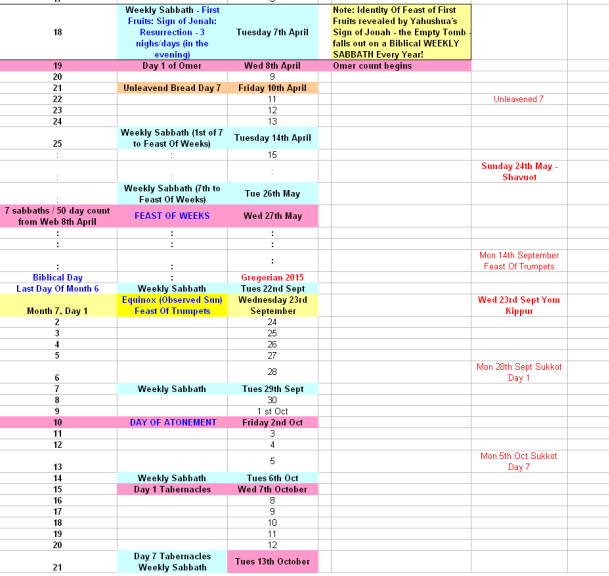
The “Melchizedek Yahushua Solar Calendar” Dates for 2015 – And How To Calculate This Calendar Yourself In The Coming Years (If We Have No Internet!) As several requests have been received asking for the “Melchizedek Yahushua solar calendar” High Days for 2015, and in the event that we may not have the freedom of the Internet to share this kind of information much longer, the first part of this article is the 2015 calendar dates. In the second part is an overview of the principles required that will enable you to work out the calendar by yourself in the coming years. The Melchizedek Yahushua solar biblical calendar for the 2015 High Days is presented immediately below. I call it the Melchizedek Yahushua Solar calendar since it follows the Apostolic testimony of Yahushua’s sign of Jonah, his death and resurrection, by which we can identify the Feast of First Fruit, since He is our First Fruits (1 Cor 15:20). The calendar also incorporates the foundational principles of the Zadok priesthood testimony. The counting pattern of days is laid out in the left column of biblical day counts to the High dates and the nature of this solar calendar is that this pattern is unchanging for each and each year if one properly identifies the actual true sun equinox date, and then consequently the date of the biblical weekly Sabbath day. No intercalation of leap days or days is ever necessary – it works out exactly the same every year, year after year, unlike the Christian calendar which requires intercalation for leap years, or the Rabbinic calendar that requires a massive intercalation of a full 13th lunar month to be added every three years to simply bring their calendar (which becomes increasingly inaccurate each year) back into line with the agricultural seasons again. Consequently for a year out of every three, Judaism is observing their Passover in the winter and not the spring as required by the law of Moses! This year, 2015, by intercalation, the Rabbinic religious lunar calendar is placed back in close coincidence to the biblical solar calendar due to the adding of the 13th month to this passing year 2014-25. But next year 2015-16 and the year after that, if you compare the biblical solar calendar with the Rabbinic lunar calendar you will see just how much the Rabbinic calendar drifts towards starting in the winter season, revealing its completely unreliability when we know in truth that YHVH, the Creator, sets all things in perfect order .

Note that in this “Melchizedek Yahushua biblical solar calendar”, that the pattern count of all the days to the festivals (first two columns) will always be exactly the same every year, and it is the Gregorian calendar dates and days that move around and change each year. The Rabbinical calendar dates for Judaism’s high days are presented in the right hand column simply to for comparison to show how even though they identify Passover to be close this year, their prescription for the rest of the festivals goes their own way. This is because the Rabbinic identification of the weekly Sabbath is integrated to the Gregorian Saturday (so adjusted by Hillel II around 300 CE), whereas the “Melchizedek Yahushua biblical solar calendar” uses the principle of the Zadok testimony on how the weekly biblical Sabbath is identified from the occurrence of equinox itself. This distinction is really important if one is sincerely seeking to identify the biblical Feast of Weeks and the Day of Atonement – the two pinnacle High Days of YHVH’s commanded worship liturgy It needs to be emphasised that whilst this year, the Rabbinic calendar – because of their additional 13th month intercalation together with a rare periodic incident this year (the new moon happens to be coinciding with the occurrence of the vernal equinox this year) the Rabbinic Passover date for Passover approximates the “Melchizedek Yahushua Biblical Solar calendar” count to the Passover. BUT thereafter – the Rabbinic calendar identification of First Fruits and subsequent festivals etc changes accoriding to their own prescriptions in relation to their definition of the occurrence of the weekly Sabbath. Of course by the time one gets to the 7th month, the Rabbinic calendar is way short because of the lunar month count rather than the biblical month and the arrival of the autumnal equinox. In other years when the Rabbinics intercalate their additional 13th month there yet may be greater differences because the astronomical new moon may not be so closely associated with the occurrence of the vernal equinox. Is it not amazing that YHVH’s festivals are linked intimately with the agricultural seasons, yet many hold to a Rabbinical calendar which completely ignores the seasons and focuses instead on the moon – all the while claiming this to be the “law of Moses! Here then we discover a very important foundational principle of the biblical calendar demonstrated: – One needs the identification of both Day 1 of the biblical year as well as the identification of the weekly biblical Sabbath, to be able to identify when the biblical festivals will take place, and the biblical weekly Sabbath does not relate to the Gregorian Saturday. It is perhaps the strongest heavenly confirmation of the biblical prophets Yahushua and The Apostles, that redeemed Jacob is yet “in the exile” and the messianic era when there will be “the restoration of all things” in the coming covenant land, has not yet arrived! The “Melchizedek Yahushua solar calendar” formula is one, which works out precisely according to Leviticus 23 instructions and the testimony of Yahushua and is the same pattern of the counting of time every year without any intercalation of days or months or leap years. On the other hand both the Rabbinic and Gregorian calendars are moving around the place every year depending on their definition of days, weeks, months and their shortfalls in their methods of counting time that require intercalary adjustments to catch up with the seasons.

In the second part of this article, together with the spreadsheet template presented for this year, I lay out the essential principles how and what is required to be able to work out the “Melchizedek Yahushua solar calendar” for yourself in the coming years, just in case we are going into the labour pains of the righteous woman in the coming days and we will need to be able to do it correctly for ourselves. After all my studies on this subject over the years, I am persuaded that Abba has revealed all this at these late minutes in the age, so that we will each be able to participate with Him and His messengers in a very important coming Feast of Weeks and Day of Atonement, which is hidden from all but His remnant elect, in the midst of very dark days that will be across the globe. I understand the timing of this to be in the same vein as the narrative of the preparation before the ancient exodus (Exodus 10:21-23) 21 ¶ And YHVH said unto Moses, Stretch out thine hand toward heaven, that there may be darkness over the land of Egypt, even darkness which may be felt. 22 And Moses stretched forth his hand toward heaven; and there was a thick darkness in all the land of Egypt three days: 23 They saw not one another, neither rose any from his place for three days: but all the children of Israel had light in their dwellings. . By learning to work it for yourself you will learn much more about the amazing biblical calendar and how ordered it is, and I expect that in doing this, you will probably come to share my own experience, that beginning to actively work it out each for ourselves is a part of the process that Abba is calling each one whereby we will KNOW Him more intimately, especially given the days in which we live ( Phil 2:12.) Wherefore, my beloved, as ye have always obeyed, not as in my presence only, but now much more in my absence, work out your own salvation with fear and trembling. I pray you will be baruch from Shamayim above as you take hold of the High scriptural festivals this coming Year. Esteem and honor to our great and coming Soveriegn, Yahushua Melchizedek!

2015-Melchizedek-Calendar-Schedule click here for better view Now!
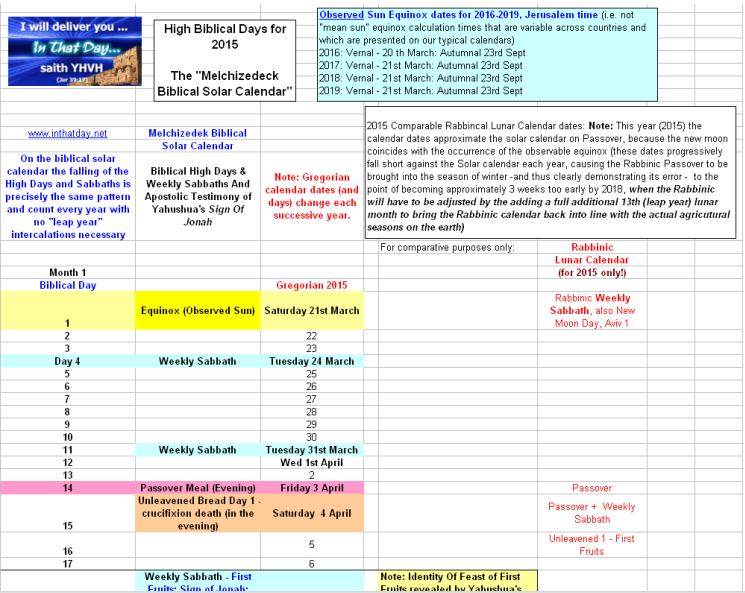
 

Capture Calendar1Capture calendar2


Everyday of life is a page of history of U

Working The Calendar Out By Yourself:

The Calendar Really Is A Hidden Mystery: The following is a synopsis of the principles from sincere study over the years, which enables the High Festival days to be discerned. The answer to identifying the biblical calendar yourself is that it really is a Divine revelation within reach of any who 1) have a sincere love for YHVH’s truth (2 Thess 2) and who have 2) the full scriptures in their hands, 3) who carefully follow Yahushua’s Divine authority as our Melchizedek King – High Priest Order, 4) who accept the Apostle’s testimony as trustworthy and authoritative, 5) who understand the testimony of the exiled Zadok priesthood (160 BCE –30 CE Qumran scrolls) concerning the solar biblical calendar and their formula for identifying the day of the biblical weekly Sabbath, and 6) know their testimony of the Pharisees who profaned the Temple in 160 BCE with the rebellious enforcement of the lunar calendar, which they brought from the Greeks and 7) who have a basic understanding of astronomy, the orbit of the earth around the sun, the ecliptic constellations, and how to the vernal and autumnal equinoxes can be easily identified. In history, the biblical calendar was deliberately replaced by the Judeo –Christian religious polemic many centuries ago each in their attempts to exert control over the “Kingdom of God” for themselves (Nicolaitanism).

First the Pharisees profaned the calendar of Judah in the century preceding the advent of Yahushua, then later the Roman Christian calendar emerged in 325 CE. In truth, the biblical calendar is only knowable by 1) the text of Leviticus 23, 2) the revelation of the Zadok testimony in the recently revealed Qumran texts, 3) trust and complete respect for the truth, accuracy and reliability of the Apostolic testimony of Yahushua as being of the Melchizedek King-High Priest Order, and especially the testimony of the precise the timing of when Yahushua both directed and observed his last Passover at the community of the “Water Carrier” (an exiled Zadok community), as precisely recorded in Luke 22 which was on the day immediately prior of the lunar based day of preparation for the Passover of the Rabbinic calendar with which they (the Pharisees) had gained control over the Temple. After more than 20 years of searching for the “ancient path”, knowing the constructed religious calendar of Christendom, and seeing all the calendar confusion in the so-called “Messianic / Hebraic roots movements”, I am persuaded that the sudden wake-up to the solar calendar that has been happening in the remnant across the globe in these last few seconds of the age, is indeed a most profound last days Divine miracle desperately necessary to the narrative of the prophesied “greater exodus” of the elect, and thus revelation from a loving Father. It is given to us through His Grace, and not because of our own academic prowess since few Christian or Rabbinic theologian academics are able to transcend their own traditional theologies on the matter. .

How do we know that we could not have come to this by our own understanding? For the reasons that while we could unravel the history of Rome and Protestantism’s religious calendars, originating way back to the 2nd century to Polycrates and the Quartodeciman disputes, and then the Council of Nicea in 325CE. The history of the impact of Rabbinicalism on Judah’s religious calendar was scandalously kept from the publicly under secret lock and key for more than 6 decades, because the only primary historical resource record we have of the history of Judah in the times of the Maccabees through to Yahushua (160 BCE to 30-70CE), is in the volumes of the Dead Sea Scroll Libraries , and it has only been through the continued struggles of certain people to be able get access to the scrolls, that the very recent public revelation of the Qumran libraries occurred in the year 2000 enabling a second generation of sincere scholars to begin to study and to publicly reveal the document contents. (For all we know some scrolls may still be being kept under certain lock and key ?) The scrolls reveal that there was an ancient religious understanding of the biblical calendar amongst Judah that was deliberately and totally obliterated from their religious memory under the hegemony of the Pharisee Rabbis. The scrolls testify to the history of the Pharisee Rabbinic destruction of the biblical calendar (beginning around 160-120 BCE) for all to read – especially laid bare for the remnant, whether Jew or Non-Jew who have love for YHVH’s truth, to search the matter out to see if it be so.

Thus the search to find and receive the revelation of the true biblical calendar is very much a personal heart issue requiring a deliberate walk that can be described as motivated by a sincere love for truth. According to 2 Thess 2:10 this condition is a prophesied precondition for the elect in the last days, since without that unique quality of character, YHVH has declared there will not be given revelation of His truth but that instead there will be a being given over to a great deception and the subsequent believing of a lie. It is in this sense that the conflicts we have all witnessed over the religious calendars in the Judeo-Christian religious polemic need to be discerned in these last prophetic days. The exiled Zadok priesthood testified that the foundational condition of all rebellion against YHVH, is to be found in the replacement of the biblical solar calendar with the lunar calendar which was originally instructed by the fallen angels, and which the Pharisees  forcefully implemented, to consolidate their hegemonic political and religious control over the ancient Temple and the ancient nation of Judah. Consequently it is not a small matter to expect that the issue of the religious calendar will be at the heart of the great deception in the last days, a deception which will be strongly promoted by the one whose coming is ”after the working of Satan” (2Thess 2:9), just as it was in the days of Antiochus, the Maccabee ruling elites, the Pharisees, as opposed to those who struggled for YHVH’s truth such as the Zadoks, John the Immerser, Yahushua Melchizedek, the Apostles and the remnant congregation of the New Covenant. Consequently while the elect has been deliberately kept blind to the truths on the biblical calendar for more than 2 thousand years, it is by the wonderful grace of Father YHVH, that His remnant be given increased understanding in the very last minutes of the age so that they are able to into worship of Him in “Spirit and in truth” together with the community of righteous angelic beings of heaven, all of whom who lso worship and honour Him in the Divine order of His biblical calendar. The ancient Zadok priesthood prophesied that in the very last days, immediately prior to the implementation of the Messianic Era and the “restoration of all things”, a communal restoration of the true biblical calendar and worship would again be restored to the remnant to reunite the worship of the remitment elect with the heavenly angelic hosts. Praise YHVH and Glory to Yahushua the Great Redeemer!

How To Work Out The Melchizedek Yahushua Solar Calendar

1. The biblical calendar is equinox based.

2. Mean Sun Equinox Dates versus The Identification Of True Sun Equinox dates Day 1 of the first month of the year is identified by the event of the true sun Vernal equinox. On our typical printed calendars the equinox date and time reported is a mean sun mathematical calculation and is not a true sun observation where the actual occurrence of the equinox occurs. Thus while our calendars give an indication, there can be a full days’ difference between the mean sun calculation and the actual sun dial observation – this can be seen in that if your calendar is reporting the equinox occurring in the night hours (Jerusalem time) then it is only possible that the actual true sun equinox will only be observable the next day, and cannot have occurred as the typical calendar reports during the night.

3. Using The Horizontal Sundial Experience with a good horizontal sun dial is best to do the observation of the equinoxes with confidence, and especially if you do not have access to the internet in the future! A horizontal sundial reveals the very day on which the equinox occurs and is observed by carefully identifying the occurrence of a straight line on a good (broad) sundial. The straight line must be read from the very edges of the sundial through the center. With small sundials, it is easy to make a mistake of reading it as having a straight line incidence and yet close inspection of the outside edges of the sundial (occurring early morning, late afternoon) might still be revealing a very slight curve to the line – meaning one may be a day early or (if it is going the other way – a day late). It is extremely important to identify the true straight line has occurred from early morning (sunrise) through late afternoon (sunset).

Below are some pictures of my horizontal sundial work on identifying the equinox:

• The sundial must point true north and not magnetic north. You need to practice getting the sundial appropriately position days before the actual day you will be measuring the equinox as you will not be able to change its position when started – if the sundial is off just a degree or so from true north achieving a straight line will be distorted and you could mistakenly miss identifying the actual day of the equinox because a sundial that is not correctly aligned will display something of a curve.

• The sundial must have a good ratio of pin height (shadow cast) to board breadth to make early morning and late evening readings possible and accurate

• In looking for the day of the equinox start hourly measuring the day before the mean sun calculation dates typically found on calendars – you may have to continue on to the day after the means usn calculation date on the calendar since the actual true sun observation of the equinox is very different form a mathematical estimate.  Make sure you are able to get early morning sun and late evening sun readings. Its on the very edges of the sun dial that a straight line can be perfectly measured, as even a day prior to the actual equinox the horizontal sun dial line will be slightly curved.

• As the middle of the day approaches (dependant of latitude) , you will need to increase the number of readings taken to every 30 minutes and down to every 10. Once the middle of the day approaches the movement of the shadow on the sun dial begins to accelerate, and you can miss an measurement if you are not alert.

• For more information on using a sundial to identify the equinox please see the article on my website: Prophecy Watch : 26 Jan 2013 How To Precisely Observe And Identify The Astronomical Equinox at the following link: http://www.inthatday.net/wpcontent/uploads/2013/archive/Watch/HowToObserveEquinox.html
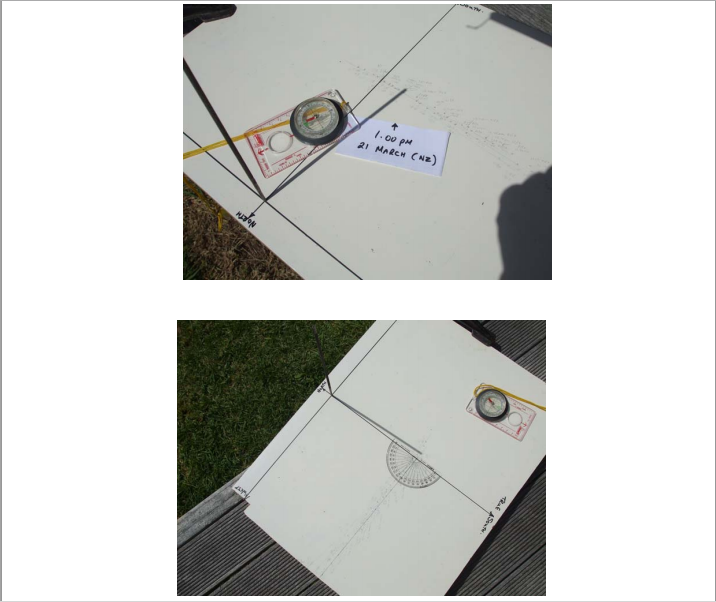
Capture Sundai

However it is possible to predict the occurrence of the true sun equinox days in advance by carefully examining the mean sun calculations (mathematical estimates) that we have presented on our modern calendars, although we need to find the estimation for Jerusalem time. However in using a mean sun calculation one must carefully noting the time and date at which the occurrence is estimated and then if this is cited as occurring during the evening and night hours, then to know that the next day (daylight period) is the date on which the true sun observation of the equinox will actually be occurring and would be so properly observed on a horizontal sundial:  To get a record of the mean sun calculations as they occur in Jerusalem time, go to this link:

http://www.timeanddate.com/calendar/seasons.html?n=110 . (Remember to examine the dates and times carefully know they are mean calculations and not true incidences and work out when the true sun equinox would be occurring or you could be a day too early!) . Keep a copy of this page as a record for the future it presents the means sun calculations for many years to come.

4. Identifying Day 1 of The First and Seventh Months Download the mean sun calculations presented on the webpage at the above link (timeanddate.com) for Jerusalem Israel. These calculations can help you to know when you should be setting up your horizontal sundials if you want to directly observe the occurrence of the equinoxes yourself (I specifically felt convicted that Abba is calling us to practise doing the sun dial observation) or alternatively carefully work out what the True sun observations of the equinox will be from the mean sun estimates. On that webpage will be presented the calculations for both vernal and autumnal equinoxes. Examine the calculations to see if the true sun observations would actually be happening the next day. Once you have the actual true sun equinox dates, the Vernal equinox is day 1 of month of the biblical year, and the true sun equinox autumnal equinox

5. Identifying the Weekly Sabbath Once you know Day 1 of the biblical year, the Zadok formula for identifying the weekly Sabbath is that while the equinox is a sign of Day 1 of the month and the beginning of the year it is also the sign of day 4 of the biblical week. Count three days from day 1 and you will have identified the weekly biblical Sabbath. Identifying the weekly Sabbath is important to identify the count to the feast of Weeks. Without it, you will not know when to bgeing the counting of the 7 Sabbaths to the appointed time.

6. Setup a Spreadsheet (As In The Previous Template For 2015) with a simple consecutive numbering of days Follow the 2015 calendar diagram in the beginning of this article, which shows the biblical Calendar of the High Festival Days, mark in the weekly Sabbath Days, and the counting of all the days to the festivals according to the instructions of Leviticus 23, knowing that the Sabbath day sign mentioned in Leviticus 23:11 is the first weekly Sabbath that occurs during the 7 days of unleavened bread, and the day which immediately follows it is the Feast Of First Fruits, which fits the sign of Jonah – the Day of Yahushua’s resurrection which is 3 nights and days from the day of crucifixion that took place on the next day after His Passover meal with His disciples.. From the day immediately after the weekly Sabbath (the Day of First Fruits) count 7 Sabbaths / 50 days to find the day after the weekly Sabbath which is the Feast of Weeks.

7. Establising the Festivals in the 7th Month: Once having identified the true sun incidence of the autumnal equinox, you have found Day 1 of Month 7, which is the Feast of Trumpets. Count 10 days to the Day of Atonement and another 5 days to find the first day of Tabernacles. Count another 7 days to find the last days of tabernacles.

If its all to confusing simply identify the dates of the true sun equinoxes and use the spreadsheet template of columns 1 and 2 in the calendar layout I have made for this year 2015 – since the pattern of the count is exactly the same for every year you should have no difficulty. The only things that change are the associated Gregorian calendar dates and days of the week.

8. What About Identifying the Days In Each Month? From time to time I have been asked how can the days of the biblical months can be known. For some their emphasis on being able to know the dates of every month is so important that if not done to their satisfaction the simply reject the Biblical solar calendar out of hand. (in my view this insistence by some on identifying all the months in the year before the solar calendar can be acceptable to them is just a self-deceiving cover that they really do not want to let go of their “messianic movement” comfort submission zone to the authority of Rabbinicalism over their calendar, since the only reasons we are concerned about the biblical calendar is the worship of YHVH and therefore identifying His High Festival worship days. Knowing all the months does nothing for a people that is yet in exile and having to live their work life according to a Gregorian calendar.

However, if one really insists, it is in fact possible to identify the days of each of the 12 months (and there are never 13 months in the “Melchizedek Yahushua calendar” year – as the months are intimately linked to the annual circuit of the sun as it passes through the 12 ecliptic constellations (as perceived from earth) based on Gen 1:14 where the authoritative time keeping signs are definitively given as the sun and the stars. (The moon is not an authority in accurate timekeeping as it does qualify as an authority that “rules” the night because the moon is only in the night sky for some two weeks a month, every each month! The rest of the time it is somewhere around in the daytime sky! But the constellations are always there, and by them we can navigate and with the sun and the stars together we can navigate the earth with perfect time keeping to identify longitude accurately. As stated above, with the solar biblical calendar, the number of days in a biblical month is dependant on the earth’s annual orbit around the sun over the year in relation to the 12 signs (constellations) of stars on the ecliptic.

At significant periods in the history of man, the days of the annual solar year have changed, such as in the days Noah’s flood, because of changes in the earths orbit around the sun, and so the number of days occurring in a solar year changed, thereby affecting changes to the number of days in the months. But on the “Melchizedek Yahushua solar calendar” this is not a worry! The biblical High Festivals, weekly Sabbaths and even adjusted days in the m12 months of the year can be readily identified no matter how many days the soalr year is suddenly changed to! All we need to do is carefully look to the behaviour of the authoritative signs of Gen 1:14 as we move from vernal equinox to vernal equinox (the full solar year) and with the instructions of scripture we will be right!

Currently our solar year consists of 365.25 days (earth’s orbit around the sun), and the time taken for the sun to travel through each of the 12 ecliptic constellations define the biblical months – the months have days that compliment the solar year count for equinox to equinox and there is never a need for any intercalation adjustment or leap years! The matter of the .25 of a day is taken care of each as it is absorbed be the recelebration of the beginning of the year on the day on which than actual sun observance (by sundial) of the vernal equinox occurs! The Astronomical Months, As Determined By the Time The Sun Takes To Move Through The 12 Ecliptic Constellations are as Follows: (Note – these counts of days per month are precisely the same every year, and would only change with a great catastrophy that would cause the earth to change in its orbit around the sun.)

The first (astronomical) month currently has approximately 31 days and corresponds roughly to March 20 through April 19 on the Gregorian calendar. The second month currently has approximately 31 days and corresponds to roughly April 20 through May 20 on the Gregorian calendar. The third month currently has approximately 31 days and corresponds roughly to May 21 through June 20 on the Gregorian calendar. The fourth currently has approximately 32 days and corresponds roughly to June 21 through July 22 on the Gregorian calendar. The fifth month currently has approximately 31 days and corresponds roughly to July 23 through August 22 on the Gregorian calendar. The sixth month currently has approximately 31 days and corresponds roughly to August 23 through September 22 on the Gregorian calendar. The seventh month currently has approximately 30 days and corresponds roughly to September 23 through October 22 on the Gregorian calendar. The eighth month currently has approximately 31 days and corresponds roughly to October 23 through November 22 on the Gregorian calendar. The ninth month currently has approximately 29 days and corresponds roughly to November 23 through December 21 on the Gregorian calendar. The tenth month currently has approximately 29 days and corresponds roughly to December 22 through January 19 on the Gregorian calendar. The eleventh month currently has approximately 30 days and corresponds roughly to January 20 through February 18 on the Gregorian calendar. The twelfth month currently has approximately 29 or 30 days (depending on what we now call leap year) and corresponds roughly to February 19 through March 19 on the Gregorian calendar.

So with the “Melchizedek Yahushua solar (astronomical) calendar” – even if we had a catastrophe to the orbit of the earth and the days of the solar year on the earth changed to 400 or even 360 days a year – with the same formulae and patterns presented in this article we could still identify the equinoxes, the weekly Sabbaths, the biblical Feast days and even the 12 months with their new count of days – the pattern would still be in accord with the law of Moses (Lev. 23) and authoritatively intact for the correct identification of the High Festival days and the lawful order for the worship of YHVH – such is the depth of wonder of the order the Creator has  established. But yet men, on the contrary, always seem to desire to develop their own authoritative calendars, which in the event of a radical sudden change to the earths orbit – get radically out of bent out shape and confused over night and take years to unravel how their calendars have become unsynchronised with the seasons! Their theologians and scholars would go into panic for sure Today many are waking up to the fact that the Rabbinic lunar calendar is but a theological construction and neither reliable nor in accordance with creation!

I expect the Rabbis will be increasingly concerned with how people are waking up to the fact that the law of Moses does not instruct the observation of the Passover to take place in the late winter, rather than the spring, periodically every three years… But what will they do about it, given that the only alternative they have is to acknowledge the ancient Zadok testimony that they, The Pharisee Rabbis, are guilty of the profanement of the biblical lawful worship calendar, which they did when they took control for themselves of the Second Temple in Judea in the decades just prior to the first advent of the Great Teacher of Righteousness, Yahushua Melchizedek, the only One who is able – according to biblical credential – to take away the sins of His people and to restore Jacob to the biblical messianic era ! Be baruch In Yahushua Melchizedek! Our soon coming Sovereign!

Rob@inthatday.net  March 6th 2015

 http://www.inthatday.net/2015/03/the-melchizedek-biblical-solar-calendar-dates-for-2015-and-how-to-calculate-this-calendar-yourself-in-the-coming-years-if-we-have-no-internet/

Yahushua Calendar

  B. About Yahushua Melchizedek Calendar

Please  click this link for details:  https://perfectgiftorg.com/?p=1757

Additional info: According to Prof. Rachel Elior of the Hebrew University of Jerusalem, the Rabbis were involved in nothing less than “a reinvention of Judaism“…The short reason … she suggests, was “a dispute over the calendar… “scholars known as Pharisees who disputed the legitimacy of the Hasmonean priests and kings and who argued with the Zadokite priests about the solar calendar…“. from  https://perfectgiftorg.com/?p=2023

Prof_Rachel_Elior_Public_ Lecturer_Univ_Chicago_2014.mp3

C. About Enoch last dayTime-line (From Adam Year 1 to A New Heaven and New Earth) by Daniel de Caussin

also: click here for details  https://perfectgiftorg.com/?p=2254 

YHWH Time schedule

D.  How the Ancient Hebrew Calendar is Built:

The month by month’s guide below is modified with permission from the calendar frame work provided by Daniel de Caussin; we share the same way of counting of the year but we hold a different opinion on the counting of the weekly shabbat day! Please refer to his file this link here: https://www.facebook.com/groups/Enoch.prophecies/909233215774667/

“RECENT FINDINGS At Qumran in 1947, there were apocalyptic scrolls found, and among them the Books of Jubilees and the Second Mikdash writings of Enoch I which discuss the calendar and dating system by which these people lived.

Scholars had been attentive of the Apocryphal Calendar before this find, but interest was renewed with the discovery of these scrolls by which the Qumran sect lived. It is based on 364 days per year. The year is divided into four periods (to correspond to the four seasons of the year), of 13 weeks or 91 days in each period. There are 12 months in each year or a total of 52 weeks.

By using this exact measure and beginning the year on the 4th day of the week just after the vernal equinox, the Set Apart days fall exactly on the same day, in the same month, every year. This calendar warrants extensive study, as there are now numerous proofs it was the calendar used by Abraham, King Solomon, King David, and High Priest Zadok in the First Qodesh Mikdash.

A different calendar was used in the Second Commonwealth, but that Mikdash had no Presence, no Ark of the Covenant, and no means for its apostate priesthood to communicate directly with יהוה. In fact, it is recorded that 300 high priests during the second Mikdash period, died when they went into the Most Kodesh Place on Yom Kippur. Something, perhaps many things, were wrong with the Second Mikdash Cult. A team of scholars was appointed to study the scrolls in 1952. They became an elite and secretive clique. In 1991 this monopoly was effectively broken when the Huntington Library in California announced it would allow public access to its collection of Dead Sea Scrolls photographs.

This was soon followed by the publication of a Facsimile Edition by the Biblical Archaeology Society in Washington, D.C. Until this time scholars previously controlling access to the Scrolls had been publicly contending that there was nothing interesting in the remaining unpublished Scrolls and nothing throwing further light on Judaism and Christianity’s rise in Palestine. (The Dead Sea Scrolls Uncovered, Professor Robert Eisenman & Michael Wise).

for clarity, please go to this page: https://perfectgiftorg.com/?p=1794 :
The Zadokite Essene calendar, the calendar attested in I Enoch and the Book of Jubilees, consisted of a solar calendar of 364 days divided into seven-day weeks, twelve months of thirty days each except for one extra day in the last month of each quarter (Jaubert 1965:27; Pfeiffer 1969:64-65; Vanderkam 1998:55; Finegan 1998:44).
The Feast of Unleavened Bread, Feast of Trumpets, Feast of Tabernacles, and Feast of the Great Day (often seen as the eighth day of the Feast of Tabernacles), always began on the 4th day of the week ( There is NO Wednesday yet in the 1st century),
The feast of Passover actually start on the 3rd day (Tuesday) evening, as the Jews began days at evening not midnight (Jaubert 1965:10; Simon 1967:73).
Trumpets, Tabernacles, and the Great Day always occurred in the seventh month as set forth in the Law of Moses (Leviticus 23:24-44).
As Nisan 15, the annual Sabbath, or Passover Sabbath, marking the start of the seven-day Feast of Unleavened bread began at sunset the fourth day night, the Essene observance of the Passover Seder was always on the third day evening of the week  (Finegan 1998:43, 48).)

The Talmud does not explain this calendar exactly, but does mention the argument of the calendars between the Pharisees and Sadducees…

We (the Editors of this website) are observing according to the exact same principal as mentioned above. Once we identify the first day of the year is the 4th day of the week…hence we will know that 3 days later is the 7th Shabbat Day…In the Essene day, there is NO “Wednesday”…beginning the 1st day of the year on the 4th day of the week after verified the vernal equinox, the PassOver Feast days fall exactly on the same 4th day of the week, the 14th day in the same month, every year. Which bring us to the same Resurrection day every year: after our Messiah Yahushua was buried 3 days 3 nights, He arose before the sunset/before the ending of the 7th day weekly Shabbat! HalleluYah, HE is the Mater of our Shabbat!!

 How the Ancient Hebrew Calendar is Built

 NOTE:

To get a record of the mean sun calculations as they occur in Jerusalem time, go to this link: http://www.timeanddate.com/calendar/seasons.html?n=110 . (Remember to examine the dates and times carefully know that from the link, they are only mean calculations and not true incidences and work out when the true sun equinox would be occurring or you could be a day too early!) . Keep a copy of this page as a record for the future it presents the means sun calculations for many years to come. 

שבת – Sabbath On this calendar, every seventh day is called a sabbath. See h7676 Additionally, the word sabbath is also associated to the concepts of rest and cessation. See h7673 – 7676

High Sabbath or Sabbath’own – שבתון A Sabbath’own, see h7677, is a Great or High Sabbath, and it can also be a Solemn Sabbath. It may occur on a day that is not a seventh day Sabbath indicating that this day is a special day of rest or solemnity.

Solemn Assembly or Atsara – עצרה An Atsara, see h6116, is a Solemn Assembly. It is characterized as an assembly called to be solemn. To be solemn is to not be cheerful and a time in which there is deep sincerity within the people in that assembly.

Set Apart Convocation or Miqra Qodesh – קדש מקרא A Miqra Qodesh, see h4744 and h6944, or Set Apart Convocation is set up for gatherings to remember set-apart days. These are, by definition, large formal assemblies of people.

The first example of this is the day after passover calling for an assembly to remember the feast of Unleavened Bread. Call for many to appear or Ra’ah Paniym – פנים ראה Ex 23:14-17 Three times a year all males are commanded to appear before YHWH/Yah’oah. These times are outlined as the feasts of Unleavened Bread, Feast of Weeks of the firstfruits of wheat harvest, and In Gathering.

This Hebrew word ra’ah at h7200, has the feeling of to see something as in to feel, smell, behold, to perceive in the heart, and to hear a thing. In an assembly of this nature, all these things would be happening to the attendee. And the Hebrew word paniym at h6437, has the feeling of turning oneself as in to face a new direction, and as in to change one’s walk in a different direction. The idea was to turn one’s walk in life towards the path of YHWH/Yah’oah and the Torah (instructions). When we error from the mark, we err from the concept of love of Father, love of neighbor, and the concept of the family (father and mother). Therefore, these Ra’ah Paniym, were designed to realign the males so they could better guide their families and communities.
Time is running out

Month one

Step One

Let’s start building the Calendar starting in Exodus 12 where we are given in Torah that the first month has a first day.

Exodus 12: 1

And יהוה spoke to Mosheh and to Aharon in the land of Mitsrayim, saying, 2 “This month is the beginning of months for you; it is the first month of the year for you.We learn the first day begins on the Spring Equinox. We will revisit this later in this document.

Enoch 72:34 So as at the beginning the year comes back to its course where the day becomes longer, and each night becomes shorter. see also Ex 13:4, Ex 23:15, Ex 34:18, Deut 16:1, Enoch 72:6 After we verify the Spring Equinox, that day we start the calendar. as day one.

By using shadows on sticks in the ground the Spring Equinox can be verified, or go to this web site and type Jerusalem for the location. http://www.timeanddate.com/calendar/seasons.html?n=110 

Please note that the team producing this document and Hebrew translations, with prayer and by leadership of the Spirit of Truth, which is the hand of יהוה YHWH.

The days that come as the first day are special days to יהוה. Through Yahh, our Father Av has given us Torah to follow. Whenever we are given teachings, instructions, or direction, it is always designed for our benefit.

Month One

1

2

3

4

5

6

Weekly Shabbat

Day 1 of the new calendar year

Verified Spring Equinox

Notice that we don’t use the day names like we have on a Gregorian calendar for obvious reasons. These day names are heathen based names.

Fun Fact about the Day 31: the “intercalary.”

Enoch 75
And the leaders of the heads of the thousands, who are placed over the whole creation and over all the stars, have also to do with the four intercalary days, being inseparable from their office. According to the reckoning of the year, these render service on the four days, which are not counted in the calculation of the year.
2 On account of these men go wrong, for those luminaries truly render service on the world-stations, one in the first gate, one in the third gate of the heaven, one in the fourth gate, and one in the sixth gate, and the exactness of the year is accomplished through its separate three hundred and sixty-four stations.
Night and Day
Why does a day begin at sunset? The first clue is found in Genesis 1:5
… It became evening, and then it became the morrow. This was the first day of a multitude of days.
The stars or Angels are the leaders of the Calendar. They have been given a job, and by oath keep it in perfect and constant order. The Stars enter first.
Another clue comes from Enoch.
Enoch 82:8 He has power over night and day in the heaven to cause the light to give light to men from the sun, moon, and stars, and all the powers of the heaven, which revolve in their circular chariots. 9 These are the orders of the stars, which set in their places, and in their seasons, festivals, and months. 10 And these are the names of those who lead them, who watch that they enter at their times, in their orders, in their seasons, in their months, in their periods of dominion, and in their positions. 11 Their four leaders who divide the four parts of the year enter first; and after them the twelve leaders of the orders who divide the months; and for the three hundred and sixty days there are heads over thousands who divide the days; and for the four intercalary days there are the leaders which divide the four parts of the year.
Woe
Yet another clue comes in the form of a Great Woe. Woe to us! This is clear! Do not to use the “day”, or sun rising, as the start of the day. By using the sunrise as the start of the day, this is following the lead of the Treacherous Watchers!
Enoch 82:4 Blessed are all the righteous. Blessed are all those who walk in the way of righteousness and do not as the sinners, the treacherous Watchers in the reckoning of all their days in which the sun traverses the heaven entering into and departing from the gates for thirty days with the heads of thousands of the order of the stars, together with the four which are intercalated which divide the four portions of the year, which lead them and enter with them four days.
How do we know the First Day and Duration of a Year?
According to Enoch, a year has 364 days. Each year has 52 Sabbaths, every year for all generations. There are no leap days, or leap months. Other calendars count every day of the year. This requires the use of leap days as in a Gregorian calendar, leap months as in a Jewish Lunar-solar calendar.
The way to handle the fact that a year has 365.2422 days in a year is this difference of 1.2422 days is just waited out and not counted. We wait and observe the Spring Equinox to occur. The ancients required a constellation and the point where the sun rose through the constellation during the last observed equinox. When the Spring Equinox is confirmed, that day the new year begins. The two witnesses to this first day are the Stars and the Sun. 
You can see how the stars are used at Enoch 74:
12 The sun and the stars bring in all the years exactly, so that they do not advance or delay their position by a single day unto eternity, but complete the years with perfect justice in 364 days.
13 In three solar [and Sidereal] years there are 1,092 days [3 times 364], and in five years 1,820 days [5 times 364], and in eight years there are 2,912 days [8 times 364].

Thirteen weeks for each season and Four seasons, and a total of 52 weeks in the Year

Jubilee 6:23 And on the new moon(first day) of the first month, and on the new moon(first day) of the fourth month, and on the new moon(first day) of the seventh month, and on the new moon(first Day) of the tenth month are the days of remembrance, and the days of the seasons in the four divisions of the year.  These are written and ordained 24 as a testimony forever.  29 … each had thirteen weeks; from one to another (passed) their memorial, from the first to the second, and from the second to the third, and from the 30 third to the fourth. And all the days of the commandment will be two and fifty weeks of days, and (these will make) the entire year complete.
Another point to bring up from Enoch 74 is the fact that two methods of ensuring accuracy were employed. The solar and sidereal cycles are similar in duration. At Enoch 74:12 The Sun and the stars bring in all the years exactly, so that they do not advance or delay their position by a single day unto eternity, but complete the years with perfect justice in 364 days. A principle in the Hebrew language is that when you double something you are emphasizing its importance. So here we see that two methods are used for verification. This is because of the importance of this ancient calendar.
The Stars have a cycle used for calendars and time keeping. Their cycle is called a Sidereal cycle. The length of a sidereal day is 23.93446 hours. The length of a sidereal year is 365.25 days. Sidereal time is calculated from watching the stars and their relation to the revolution of the earth on its axis and the rotation of earth around the sun. Notice that the times for the day and the year are very similar to that of the solar cycle.
Two witnesses to confirm the first day
The consistency of the star’s location and the sun’s location are used as two witnesses to the first day of the calendar so that we all, from generation to generation, can observe the sabbath on the same seventh day, and the feast days on their appointed days and times.
The Duration of 24 hours
The Earth revolves around its axis at a fairly constant rate. Its rate is affected by earthquakes and other cosmic influences. Nevertheless, it does change, but the change is so small it is almost undetectable. A leap second was added in 1972, and 40 years later one in 2012. This is a testament to Father’s hand in this situation.
What is a Day?
The Hebrew word yom has several meanings. Using a Gesenius, a Benner, and a Klein Lexicon we see these meanings for the word יום: heat, the day, a day, a festival day, time, at that time, then, at some time, at the time in which – as in the word “when”. The definition of this word is important to consider because the word יום is used in Genesis 1:5 to describe the first day. It was called a yom even though the sun was not created. The sun has nothing to do with the usage of this term. The same is true for Genesis 1:8, and 13. In this case the first three days where counted as days. Perhaps by the precision of the earth’s rotation. YHWH/Yaha’oha was the light that was provided for those three days. His presence was the light source. As we read in the Revelation of John 22:5 And night shall be no more, and they shall have no need of a lamp or the light of the sun, because יהוה Elohim shall give them light. And they shall reign forever and ever.

Step two

Next step in understanding the Torah of the Calendar is in Leviticus. We are told that we are to work for six days and then on the seventh day we are to rest.

Leviticus 23 (from a translation of the Dead Sea Scrolls):

1 And יהוה  spoke by turning towards Moshe and commanded by saying,
2 speak by turning yourself towards the sons of Yisra’el.  Say to them as you motion towards them;  Your places where you assemble on a regular basis, יהוה  said, in order for you to be successful, call a meeting to read from the Scroll. Read to all those assembled in that place.  Call out and encourage them to come towards you.
Doing these things are Set Apart and are for reverence and adoration at that time during their assembly.
3 Six times you are to produce by labor, the service that is prescribed to a person.  And then on the seventh day, you are to return to your habitation to rest and cease from your prescribed work.

Use this day to consider what it takes to cease from our labor in an assembly with a reading from the Kadosh Scroll.

Whatsoever service is prescribed to anyone, you are not to labor over this anymore. Cease from your labor and adjust your focus towardsיהוה  with an idea that all things in the farm or home are done and complete for this day.  By adjusting your focus towards to, יהוה you can rest your mind in your assembly of persons that have come together for sitting.

This verse is part of a list of the various Angels and their main responsibilities.

Enoch 20:6  Saraqael, one of the set-apart Messengers, who is over those people which have a desire to keep Sabbath.

Just amazing. There is an Angel who is assigned to watch over those who desire to keep Sabbath.

Keeping the seventh day Sabbath as a separate day is for all people who want to keep it.

Isaiah 56:

3 “And let not the son of the foreigner who has joined himself to יהוה speak, saying, ‘יהוה has certainly separated me from His people,’ nor let the eunuch say, ‘Look I am a dry tree.’ ”
4 For thus said יהוה, “To the eunuchs who guard My Sabbaths, and have chosen what pleases Me, and hold fast to My covenant:
5 to them I shall give in My house and within My walls a place and a name better than that of sons and daughters – I give them an everlasting name that is not cut off.
6 “Also the sons of the foreigner who join themselves to יהוה, to serve Him, and to love the Name of יהוה, to be His servants, all who guard the Sabbath, and not profane it, and hold fast to My covenant –
7 them I shall bring to My set-apart mountain, and let them rejoice in My house of prayer. Their burnt offerings and their slaughtering’s  are accepted on My altar, for My house is called a house of prayer for all the peoples.”
8 The Master יהוה, who gathers the outcasts of Yisra’ĕl, declares, “I gather still others to him besides those who are gathered to him.”

 Difference between a Sabbath day and a day of Set Apart Convocation

In Leviticus 23:3 we receive Torah concerning rest on the seventh day and that we should read together on this seventh day, and that we should consider all work any of us have been prescribed to do as completed, and that we are to call out an encourage others to join in the reading of the Scroll, and to use this day as a day of reverence and adoration of all things our Father Av has provided to us through YHWH.  A Sabbath rest has been appointed for every seventh day throughout the year. Sabbath means rest, Sabbath does not mean seventh day. We have associated the seventh day and Sabbath because of the Torah to have a Sabbath on the Seventh day. Nevertheless, a day of Sabbath can be appointed on days that are not the seventh day. We see this at Leviticus 23.
27 “On the tenth day of this seventh month is the Day of Atonement. It shall be a set-apart gathering for you. And you shall afflict your beings, and shall bring an offering made by fire to יהוה.
28 “And you do no work on that same day, for it is the Day of Atonement, to make atonement for you before יהוה your Elohim.
29 “For any being who is not afflicted on that same day, he shall be cut off from his people.
30 “And any being who does any work on that same day, that being I shall destroy from the midst of his people.
31 “You do no work – a law forever throughout your generations in all your dwellings.
32 ‘It is a Sabbath of rest to you, and you shall afflict your beings. On the ninth day of the month at evening, from evening to evening, you observe your Sabbath.”
We see here in these verses that both the ninth day and the tenth day of Month Seven are appointed as a day of rest, a Sabbath day, and notice on the calendar that these days are not on the seventh day.
So what is the difference between a Sabbath and a Kadosh Convocation?  A Sabbath is a command directed towards an individual. The individual must rest from their prescribed work. The command of a Set Apart Convocation is directed towards an assembly of people. An assembly can praise Yahh in Hymn singing, Dance, and group reading of the Kadosh Scroll. We read that some Set Apart Convocations are also days where a Sabbath is commanded to have rest from our individually prescribed work. This is what we read above in Leviticus 23:32.
In both a Sabbath rest and during a Kodash Convocation, people did not sit around doing nothing. We have to be somewhat active to eat and drink and the animals need to eat and drink, too. In Leviticus 23:3 we read that the key to this rest day is the focus of our mind and heart. Our mind and heart are more precious than the act of sitting down.
Lev 23:3 Six times you are to produce by labor, the service that is prescribed to a person.  And then on the seventh day, you are to return to your habitation to rest and cease from your prescribed work.
Use this day to consider what it takes to cease from our labor in an assembly with a reading from the Set Apart Scroll.

Whatsoever service is prescribed to anyone, you are not to labor over this anymore. Cease from your labor and adjust your focus towards YHWH with an idea that all things in the farm or home are done and complete for this day.  By adjusting your focus towards YHWH, you can rest your mind in your assembly of persons that have come together for sitting.

So now we can build the Calendar in this second step. We will add the Sabbath day.

Month One

1

2

3

4

5

6

Sabbath

 1/364

Evening of Spring Equinox

 2/364

Work day

3/364

Work day

 4/364

Seventh day rest, Day of reading the Scroll

Fun Fact about the seventh day

It seems silly to say that the Shabbat day is always the Gregorian Saturday day. It is consistently the Shabbat day in a cycle of seven days. A year has 364 days. Note that 364/7=52. There are 52 Sabbaths in a year. The Torah is clear that every seven days, during the year, we have a Sabbath. To begin a calendar on any other day by not using a seven day period leading up to a Sabbath, is following a method that does not adhere to Torah instruction.

The focus of the Sabbath is the command from our Creator Father Av, that the seventh day of rest is after the sixth day of work.

The example at the creation, was six days of work, and then the rest.

Ex 20:9 “Six days you labour, and shall do all your work,
10 but the seventh day is a Sabbath of יהוה your Elohim. You do not do any work – you, nor your son, nor your daughter, nor your male servant, nor your female servant, nor your cattle, nor your stranger who is within your gates.
11 “For in six days יהוה made the heavens and the earth, the sea, and all that is in them, and rested the seventh day. Therefore יהוה baruch the Sabbath day and set it apart.

Here again in Exodus 20 we read that the focus is the number of days.

The word (day) יום in Hebrew can also mean a time period, or time itself, and the heat of the day, and to be warm, the opposite of night, a festival day.

The example we have in Genesis 1, is the use of the word day. A “day” was founded on the fact that a “day” is a time period established on the completion of one rotation of the earth on its axis. It has nothing to do with the sun’s appearance at all. We have proof of this in the first three creation days. The days were called days without a sun.

The point is, the seventh day is after a six day period, was to be the focus of the day of rest, is reiterated at Exodus 20:11, 31:15, 17, 32:12, 34:21, 35:2, Leviticus 23:3, Deuteronomy 5:13, Ezekiel 46:1, and Luke 13:14.


Step Three

Exodus 12 (from The Scriptures Version 1998):

1 And יהוה spoke to Mosheh and to Aharon in the land of Mitsrayim, saying,

2 “This month is the beginning of months for you, it is the first month of the year for you.

3 “Speak to all the congregation of Yisra’ĕl, saying, ‘On the tenth day of this month each one of them is to take for himself a lamb, according to the house of his father, a lamb for a household.

4 ‘And if the household is too small for the lamb, let him and his neighbor next to his house take it according to the number of the beings, according to each man’s need you make your count for the lamb.

5 ‘Let the lamb be a perfect one, a year old male. Take it from the sheep or from the goats.

6 ‘And you shall keep it until the fourteenth day of the same month. Then all the assembly of the congregation of Yisra’ĕl shall kill it between the evenings.

Let us first look at the three facts here; We are told to observe the First month, the tenth day of this month, and the fourteenth day of this month.

Month One

1

2

3

4

5

6

Sabbath

Day 1

Evening of Spring

Equinox

This day to Remember the Ark

Day 2

Work day

Day 3

Work day

Day 4

Seventh day rest, Day of reading the Scroll

Day 5

Work day

Day 6

Work day

Day 7

Work day

Day 8

Work day

Day 9

Work day

Day 10

Work day

Select a Lamb for Passover

Day 11

Seventh day rest, Day of reading the Scroll

In Exodus 12:3, we read that a lamb or a goat was to be selected. A perfect one year old male. This lamb is called a paschal lamb. This lamb is intended for פסח pronounced Pe-sa-kh. The kh is a guttural sound from the back of the throat. פסח means to pass over, to pass by or to spare. This word does have other uses; nevertheless, this is the word for the feast called Passover.

 We also read in the torah of the Passover observance at Exodus 12:14, Leviticus 23:5, Numbers 28:16, Deuteronomy 16:1, and in Jubilees 49:1.

 Passover and the feast of Unleavened Bread

To build the next line in the Ancient Hebrew Calendar, we need to read Leviticus 23 again.

Leviticus 23 (from a Translation of the Dead Sea Scrolls)

4 These things that follow are the set times of  YHWH/Yaha’oha. They are to come from the person who calls people towards them to read from the Qodesh Scroll. To be successful, what is desired is that you cry out to all the multitude at each of these set times.

5 In the beginning of the year in the first month in the fourteenth day of the month just after when you can distinguish the division which starts the day, when there is still enough light to see things after the sunset; This is the time for YHWH’s “Passover” of Sparing the first born.

6 On the Fifteenth day, in the beginning of the year, perceive in your mind a circle for dancing. This circle is like the unleavened bread which is YHWH/Yaha’oha. And for seven times, as in seven days, you are commanded to eat this unleavened bread.

7 On the first day call a Qodesh assembly, and let it come to pass, you are to subdue your working of the work that is prescribed to you, for it is a service of obligation not to labor over something.

8  In coming together, in order to be close, you will bring a sacrifice of healing, which is YHWH/Yaha’oha, seven times as in each of the seven days. And the day time of the seventh day is a Qodesh Convocation for you shall read the Qodesh Scroll and you are to subdue your working of the work that is prescribed to you, for it is a service of obligation not to labor over something on this day.

In Jubilee 6:24-25 ... And Noah ordained them for himself as feasts for the generations for ever, 25 so that they have become thereby a memorial unto him. And on the new moon (first day) of the first month he was bidden to make for himself an ark,

Month One

1

2

3

4

5

6

Sabbath

Day 30

Work day

Day 31

Work day

Day 1

Work day

Evening of Spring Equinox,

This day to Remember the Ark

Day 2

Work day

Day 3

Work day

Day 4

Seventh day rest, Day of reading the Scroll

Day 5

Work day

Day 6

Work day

Day 7

Work day

Day 8

Work day

Day 9

Work day

Day 10

Work day

Select a Lamb for Passover

Day 11

Seventh day rest, Day of reading the Scroll,

Day 12

Work Day

Day 13

Work Day,

Day 14

Work Day,

Roast a lamb in evening after sunset.

Day 15

Work day

After Sunset, High Shabbat

Eat Unleavened bread

Day 16

Rest Day Dancing day,

Eat Unleavened bread

Day 17

Work Day

Eat Unleavened bread

Day 18

Rest Day,

Sabbath day

Eat Unleavened bread

Step Four

We are going to add the last two lines in the Calendar for Month One. From the Spring Equinox to the last day we have 30 days.  We find this in Enoch 72:8-13 where we read of a cycle of days consisting of 30 days, then 30 days, then 31 days.

The year is divided into four seasons, each consisting of 91 days. The first two months of each season has 30 days and the last month of each season has 31 days. Each year has 364 days. These 364 days per year is done in prudent understanding and divine counsel, so that the calendar is always the same for generation to generation.

There is no leap days, or leap months. This is a common way to handle the fact that a year has 365.25 days in a year. So this difference of 1.25 days is just waited out and not counted. We wait and observe the Spring Equinox to occur. It requires Sunshine to confirm it. When the Spring Equinox is observed, that day begins the new year. We see how this is determined at Leviticus 23:5 … just after when you can distinguish the division which starts the day, when there is still enough light to see things after the sunset; this is the time for the YHWH’s Passover of Sparing the first born.

We now have added the appointed days we are to remember from generation to generation in Month one.

Remembrance Day, day 1

Day 1 is the day to remember Noah’s exit from the Ark and the covenant of not to eat blood.  Jubilees 6:1-12

Bring First Fruits, day 19

Day 19 we read this is the day to bring in your first fruits. Jubilee 15:1, and Jubilee 16:13-14 This day is a Qodesh Convocation. Leviticus 23:20-21 were we see the priest waves harvest sheaves, and two lambs that will be sacrificed.

Feasts of Weeks, and Feast of First Fruits, starts day 25

Day 25 is the First day of the Feast of Weeks. This feast lasts for 50 days. Another name for this last day of the feast is Pentecost. Jubilees 6:17-22, Exodus 34:22, and Leviticus 23:15-21 This day is also the Feast of First Fruits. We read this at Jubilee 6:21. This day is also the day for the Wave Offering and Burnt Offering of Grain, Incense, and Wine. We read of this in Leviticus 23:11-13. Day 25 is one of the three days that Males are required to have a convocation. We see this at Deuteronomy 16:16.

Next add the appointed days to the calendar.

Pentecost

Leviticus 23:15 ‘And from the morrow after the Sabbath, from the day that you brought the sheaf of the wave offering, you shall count for yourselves: seven completed Sabbaths.

16 ‘Until the morrow after the seventh Sabbath you count fifty days, then you shall bring a new grain offering to יהוה.

17 ‘Bring from your dwellings for a wave offering two loaves of bread, of two-tenths of an ĕphah of fine flour they are, baked with leaven, first-fruits to יהוה.

18 ‘And besides the bread, you shall bring seven lambs a year old, perfect ones, and one young bull and two rams. They are a burnt offering to יהוה, with their grain offering and their drink offerings, an offering made by fire for a sweet fragrance to יהוה.

19 ‘And you shall offer one male goat as a sin offering, and two male lambs a year old, as a peace offering.

20 ‘And the priest shall wave them, besides the bread of the first-fruits, as a wave offering before יהוה, besides the two lambs. They are set-apart to יהוה for the priest.

21 ‘And on this same day you shall proclaim a set-apart gathering for yourselves, you do no servile work on it – a law forever in all your dwellings throughout your generations.

Here is the complete Month one. 

Month One

1

2

3

4

5

6

Sabbath

Day 1

Work day

True sun Spring Equinox,

This day to Remember the Ark

Day 2

Work day

Day 3

Work day

Day 4

Seventh day rest, Day of reading the Scroll

Day 5

Work day

Day 6

Work day

Day 7

Work day

Day 8

Work day

Day 9

Work day

Day 10

Work day

Select a Lamb for Passover

Day 11

Seventh day rest, Day of reading the Scroll,

.

Day 12

Work Day

Day 13

Work Day,

Day 14

Work Day,

Passover Roast a lamb after sunset

Day 15

Work Day

Sacrifice

Lamb

After Sunset, High Shabbat

Eat Unleavened bread

Day 16

Rest Day,

Convocation for Dancing day,

Eat Unleavened bread

Day 17

Work Day,

Eat Unleavened bread

Day 18

Rest Day,

Sabbath day of meeting

Eat Unleavened bread

Day 19

Eat Unleavened bread

Wave Offering,

First day of Feast of Weeks and Feast of First Fruits

Day 20

Work day

Eat Unleavened bread

Day 21

Work day

Eat Unleavened bread

Day 22

Work day

Day 23

Work day

Day 24

Work day

Day 25

Rest Day,

Sabbath day of meeting

End of week one 1/7

Day 26

Work day

Day 27

Work day

Day 28

Work day

Day 29

Work day

Day 30

Work day

 Month Two

Step One

The second month starts, on the day after the end of the first month. Month Two that has 30 days.

Notice that it starts on the sixth day because Month One ends on the second day.

Month Two

1

2

3

4

5

6

Sabbath

Day 1

Work day

Day 2

Seventh day rest, Day of reading the Scroll

End of week two 2/7

Day 3

Work day

Day 4

Work day

Day 5

Work day

Day 6

Work day

Day 7

Work day

Day 8

Work day

Day 9

Seventh day rest, Day of reading the Scroll

End of week 3/7

Day 10

Work day

Day 11

Work day,

Day 12

Work day

Day 13

Work day

Day 14

Work day

Second Passover

Day 15

Work day

Day 16

Rest Day,

Sabbath day of meeting

End of week 4/7

Day 17

Work day

Day 18

Work day

Day 19

Work day

Day 20

Work day

Day 21

Work day

Day 22

Work day

Day 23

Rest Day,

Sabbath day of meeting

End of week 5/7

Day 24

Work day

Day 25

Work day

Day 26

Work day

Day 27

Work day

Day 28

Work day

Day 29

Work day

Day 30

Shabbat  day

End of week 6/7

 Step Two

Next we need to add the appointed day we are to remember from generation to generation. For Month Two we read in Number 9:6-11 that men that are unclean, or on a journey can celebrate Passover on Month Two on Day fourteen.

Numbers 9 (from The Scriptures 1998 version)

6 But there were men who were defiled for a being of a man, so that they were not able to perform the Passover on that day. So they came before Mosheh and Aharon that day,

7 and those men said to him, “We are defiled for the being of a man. Why are we withheld from bringing near the offering of יהוה at its appointed time among the children of Yisra’ĕl?”

8 And Mosheh said to them, “Wait, let me hear what יהוה commands concerning you.”

9 And יהוה spoke to Mosheh, saying,

10 “Speak to the children of Yisra’ĕl, saying, ‘When any male of you or your generations is unclean for a being, or is far away on a journey, he shall still perform the Passover of יהוה.

11 ‘On the fourteenth day of the second month, between the evenings, they perform it – with unleavened bread and bitter herbs they eat it.

In Numbers 9:11 we see a curious phrase, “between the evenings.” This is a traditional understanding of this term, from the Gesenius Lexicon; When the sun visibly dips behind the horizon, this is the first evening, and the second evening is the time while the sun’s light is still visible and all is dark, which is then called the night.

Doing something between the evenings, is the period when you can still see to do things. When slaughtering a lamb, you need to use a sharp knife and this requires some light to be safe in what you are doing.

To get an idea of what makes a man unclean, please read the entire chapters of Leviticus 11, Leviticus 13, and Numbers 5.

Month Three

Step One

The Months with 31 days

In months with 31 days, there is a technical term for this ‘Thirty First’ day; it is “intercalary.” The definition of this word is; A day that is inserted into a calendar to make it harmonize with the year. In some calendars these are leap days, and leap months. The Ancient Calendar given to Enoch does not have any leap days or leap months. It has always been the same each year, and will continue to be consistent from generation to generation.

 Fun Fact about Day 31

Enoch 75
And the leaders of the heads of the thousands, who are placed over the whole creation and over all the stars, have also to do with the four intercalary days, being inseparable from their office. According to the reckoning of the year, these render service on the four days, which are not counted in the calculation of the year.
2 On account of these men go wrong, for those luminaries truly render service on the world-stations, one in the first gate, one in the third gate of the heaven, one in the fourth gate, and one in the sixth gate, and the exactness of the year is accomplished through its separate three hundred and sixty-four stations.
Night and Day
Why does a day begin at sunset? The first clue is found in Genesis 1:5
… It became evening, and then it became the morrow. This was the first day of a multitude of days.
The stars or Angels are the leaders of the Calendar. They have been given a job, and by oath keep it in perfect and constant order. The Stars enter first.
Another clue comes from Enoch.
Enoch 82:8 He has power over night and day in the heaven to cause the light to give light to men from the sun, moon, and stars, and all the powers of the heaven, which revolve in their circular chariots. 9 These are the orders of the stars, which set in their places, and in their seasons, festivals, and months. 10 And these are the names of those who lead them, who watch that they enter at their times, in their orders, in their seasons, in their months, in their periods of dominion, and in their positions. 11 Their four leaders who divide the four parts of the year enter first; and after them the twelve leaders of the orders who divide the months; and for the three hundred and sixty days there are heads over thousands who divide the days; and for the four intercalary days there are the leaders which divide the four parts of the year.
Woe
Yet another clue comes in the form of a Great Woe. Woe to us! This is clear! Do not to use the “day”, or sun rising, as the start of the day. By using the sunrise as the start of the day, this is following the lead of the Treacherous Watchers!
Enoch 82:4 Baruch are all the righteous. Blessed are all those who walk in the way of righteousness and do not as the sinners, the treacherous Watchers in the reckoning of all their days in which the sun traverses the heaven entering into and departing from the gates for thirty days with the heads of thousands of the order of the stars, together with the four which are intercalated which divide the four portions of the year, which lead them and enter with them four days.
How do we know the First Day and Duration of a Year?
According to Enoch, a year has 364 days. Each year has 52 Sabbaths, every year for all generations. There are no leap days, or leap months. Other calendars count every day of the year. This requires the use of leap days as in a Gregorian calendar, leap months as in a Jewish Lunar-solar calendar.
The way to handle the fact that a year has 365.2422 days in a year is this difference of 1.2422 days is just waited out and not counted. We wait and observe the Spring Equinox to occur. The ancients required a constellation and the point where the sun rose through the constellation during the last observed equinox. When the Spring Equinox is confirmed, that evening at sunset the new year begins. The two witnesses to this first day are the Stars and the Sun. 
You can see how the stars are used at Enoch 74:
12 The sun and the stars bring in all the years exactly, so that they do not advance or delay their position by a single day unto eternity, but complete the years with perfect justice in 364 days.
13 In three solar [and Sidereal] years there are 1,092 days [3 times 364], and in five years 1,820 days [5 times 364], and in eight years there are 2,912 days [8 times 364].
Thirteen weeks for each season and Four seasons, and a total of 52 weeks in the Year
Jubilee 6:23 And on the new moon(first day) of the first month, and on the new moon(first day) of the fourth month, and on the new moon (First Day) of the seventh month, and on the new moon(First Day) of the tenth month are the days of remembrance, and the days of the seasons in the four divisions of the year.  These are written and ordained 24 as a testimony forever.  29 … each had thirteen weeks; from one to another (passed) their memorial, from the first to the second, and from the second to the third, and from the 30 third to the fourth. And all the days of the commandment will be two and fifty weeks of days, and (these will make) the entire year complete.
Another point to bring up from Enoch 74 is the fact that two methods of ensuring accuracy were employed. The solar and sidereal cycles are similar in duration. At Enoch 74:12 The Sun and the stars bring in all the years exactly, so that they do not advance or delay their position by a single day unto eternity, but complete the years with perfect justice in 364 days. A principle in the Hebrew language is that when you double something you are emphasizing its importance. So here we see that two methods are used for verification. This is because of the importance of this ancient calendar.
The Stars have a cycle used for calendars and time keeping. Their cycle is called a Sidereal cycle. The length of a sidereal day is 23.93446 hours. The length of a sidereal year is 365.25 days. Sidereal time is calculated from watching the stars and their relation to the revolution of the earth on its axis and the rotation of earth around the sun. Notice that the times for the day and the year are very similar to that of the solar cycle.
Two witnesses to confirm the first day
The consistency of the star’s location and the sun’s location are used as two witnesses to the first day of the calendar so that we all, from generation to generation, can observe the Sabbath on the same seventh day, and the feast days on their appointed days and times.
The Duration of 24 hours
The Earth revolves around its axis at a fairly constant rate. Its rate is affected by earthquakes and other cosmic influences. Nevertheless, it does change, but the change is so small it is almost undetectable. A leap second was added in 1972, and 40 years later one in 2012. This is a testament to Father’s hand in this situation.
What is a Day?
The Hebrew word yom has several meanings. Using a Gesenius, a Benner, and a Klein Lexicon we see these meanings for the word יום: heat, the day, a day, a festival day, time, at that time, then, at some time, at the time in which – as in the word “when”. The definition of this word is important to consider because the word יום is used in Genesis 1:5 to describe the first day. It was called a yom even though the sun was not created. The sun has nothing to do with the usage of this term. The same is true for Genesis 1:8, and 13. In this case the first three days where counted as days. Perhaps by the precision of the earth’s rotation. YHWH/ Yaha’oha was the light that was provided for those three days. His presence was the light source. As we read in the Revelation of John 22:5 And night shall be no more, and they shall have no need of a lamp or the light of the sun, because יהוה Elohim shall give them light. And they shall reign forever and ever.

Okay, after all that information, here is the Third Month.

Notice that is starts on Day 1 because the Month Two ends on the Day 7


Month Three


1

2

3

4

5

6

Sabbath

Day 1

Work day,

Remember

Exit from Ark, and not to eat blood

Day 2

Work day

Day 3

Work day

Day 4

Work day

Day 5

Work day

Day 6

Work day

Day 7

Seventh day rest, Day of reading the Scroll

End of week 7/7

Day 8

Rest day,

Day 50 of Feast of weeks,

Wave offerings,

Qodaesh

Convocation

Day 9

Work day

Day 10

Work day


Day 11

Work day

Day 12

Work day

Day 13

Work day

Day 14

Seventh day rest, Day of reading the Scroll

Day 15

Work day


Day 16

Work day

Day 17

Work day

Day 18

Work day,


Day 19

Work day,


Day 20

Work day

Day 21

Rest Day,

Sabbath day of meeting

Day 22

Work day,


Day 23

Work day

Day 24

Work day

Day 25

Work day

Day 26

Work day

Day 27

Work day

Day 28

Rest Day,

Sabbath day of meeting

Day 29

Work day

Day 30

Work day

Day 31

Work day


 Month Four

The first three months were the first quarter of the year. We call it Spring time. The First Day of  Month Four marks the beginning of the next quarter. We call it Summer. The calendar was used for religious and civil activities, and for farmers. For farmers, it was used to mark the time to accomplish activities required to have a successful harvest.

Step One

This is easy. It is repeating Month1. It is the same except for the appointed feast and remembrance days.

You will notice that each quarter repeats. Months 1-3 which are the first quarter, repeat into 4-6 which are the second quarter, and then 6-9 which are the third quarter, and lastly 10-12 which are the fourth quarter.

Month Four

1

2

3

4

5

6

Sabbath

Day 1

Work day This day to Remember the this Season, and the day the fountains in the Earth were closed

Day 2

Work day

Day 3

Work day

Day 4

Seventh day rest, Day of reading the Scroll

Day 5

Work day

Day 6

Work day

Day 7

Work day

Day 8

Work day

Day 9

Work day

Day 10

Work day

Day 11

Seventh day rest, Day of reading the Scroll,

.

Day 12

Work Day

Day 13

Work Day,

Day 14

Work Day,

Day 15

Work Day

Day 16

Work Day

Day 17

Work Day,

Day 18

Rest Day,

Sabbath day of meeting

Day 19

Work day

Day 20

Work day

Day 21

Work day

Day 22

Work day

Day 23

Work day

Day 24   Work day

Day 25

Seventh day rest, Day of reading the Scroll,

Day 26

Work day

Day 27

Work day

Day 28

Work day

Day 29

Work day

Day 30

Work day

 In Jubilee 6:23-26 we read the command to remember the first day of this month for two reasons. In Jubilees, and in other scripture, the Hebrew phrase new moon can also be translated as the new of the month, or what we would call the first day.

Jubilee 6:23 And on the new moon of the first month, and on the new moon of the fourth month, and on the new moon of the seventh month, and on the new moon of the tenth month are the days of remembrance, and the days of the seasons in the four divisions of the year. These are written and ordained
24 as a testimony for ever. And Noah ordained them for himself as feasts for the generations for ever,
25 so that they have become thereby a memorial unto him.

26 … And on the new moon of the fourth month the mouths of the depths of the abyss beneath were closed.

Lev 23:

12 ‘And on that day when you wave the sheaf, you shall prepare a male lamb a year old, a perfect one, as a burnt offering to יהוה,

13 and its grain offering: two-tenths of an ĕphah of fine flour mixed with oil, an offering made by fire to יהוה, a sweet fragrance, and its drink offering: one-fourth of a hin of wine.

14 ‘And you do not eat bread or roasted grain or fresh grain until the same day that you have brought an offering to your Elohim – a law forever throughout your generations in all your dwellings.

15 ‘And from the morrow after the Sabbath, from the day that you brought the sheaf of the wave offering, you shall count for yourselves: seven completed Sabbaths.

16 ‘Until the morrow after the seventh Sabbath you count fifty days, then you shall bring a new grain offering to יהוה.

17 ‘Bring from your dwellings for a wave offering two loaves of bread, of two-tenths of an ĕphah of fine flour they are, baked with leaven, first-fruits to יהוה.

18 ‘And besides the bread, you shall bring seven lambs a year old, perfect ones, and one young bull and two rams. They are a burnt offering to יהוה, with their grain offering and their drink offerings, an offering made by fire for a sweet fragrance to יהוה.

19 ‘And you shall offer one male goat as a sin offering, and two male lambs a year old, as a peace offering.

20 ‘And the priest shall wave them, besides the bread of the first-fruits, as a wave offering before יהוה, besides the two lambs. They are set-apart to יהוה for the priest.

21 ‘And on this same day you shall proclaim a set-apart gathering for yourselves, you do no servile work on it – a law forever in all your dwellings throughout your generations.

 Month Five

Step One

Copy and paste the calendar from month two. The day numbers are the same. That’s easy.

Month Five

1

2

3

4

5

6

Sabbath

Day 1

Work day

Day 2

Seventh day rest, Day of reading the Scroll

Day 3

Work day

Day 4

Work day

Day 5

Work day

Day 6

Work day

Day 7

Work day

Day 8

Work day

Day 9

Seventh day rest, Day of reading the Scroll

Day 10

Work day

Day 11

Work day,

Day 12

Work day

Day 13

Work day

Day 14

Work day

S

Day 15

Work day

Day 16

Rest Day,

Sabbath day of meeting

Day 17

Work day

Day 18

Work day

Day 19

Work day

Day 20

Work day

Day 21

Work day

Day 22

Work day

Day 23

Rest Day,

Sabbath day of meeting

Day 24

Work day

Day 25

Work day

Day 26

Work day

Day 27

Work day

Day 28

Work day

Day 29

Work day

Day 30

Shabbat  day

  Month Six

Step One

Copy and paste the calendar from Month Three. The day numbers are the same. That’s easy.


Month Six


1

2

3

4

5

6

Sabbath

Day 1

Work day,


Day 2

Work day

Day 3

Work day

Day 4

Work day

Day 5

Work day

Day 6

Work day

Day 7

Seventh day rest, Day of reading the Scroll


Day 8

Work Day


Day 9

Work day

Day 10

Work day


Day 11

Work day

Day 12

Work day

Day 13

Work day

Day 14

Seventh day rest, Day of reading the Scroll

Day 15

Work day


Day 16

Work day

Day 17

Work day

Day 18

Work day,


Day 19

Work day,


Day 20

Work day

Day 21

Rest Day,

Sabbath day of meeting

Day 22

Work day,


Day 23

Work day

Day 24

Work day

Day 25

Work day

Day 26

Work day

Day 27

Work day

Day 28

Rest Day,

Sabbath day of meeting

Day 29

Work day

Day 30

Work day

Day 31

Work day


Next add the appointed days to the calendar. There are no appointed days this Month Six. That’s easy!

Month Seven

Step One

Copy and paste Month One. The days are the same.

Note that Month Seven is the second set of three months which is an indication that this is the next season. We call it the Fall.

Month Seven

1

2

3

4

5

6

Sabbath

Day 1

Rest day, Qadosh

Convocation,

Day of Trumpets

This day to Remember the changing season, and the waters receding

Day 2

Work day

Day 3

Work day

Day 4

Seventh day rest, Day of reading the Scroll

Day 5

Work day

Day 6

Work day

Day 7

Work day

Day 8

Work day

Day 9

Work day

Day 10

Day of Atonement

Rest day, Kadosh

Convocation

Day 11

Seventh day rest, Day of reading the Scroll,

.

Day 12

Work Day

Day 13

Work Day,

Day 14

Work Day,

Day 15

Rest Day, Qadosh

 Convocation, first day Feast of Booths, Feast of in-gathering

Day 16

Work Day

Day 17

Work Day,

Day 18

Rest Day,

Sabbath day of meeting

Day 19

Work day

Day 20

Work day

Day 21

Work day

Day 22

Rest day, Kadosh

Convocation,

closing day of feasts

Day 23

Work day

Day 24   Work day

Day 25

Seventh day rest, Day of reading the Scroll,

Day 26

Work day

Day 27

Work day

Day 28

Work day

Day 29

Work day

Day 30

Work day

Next we add the appointed days. There are five days to add.

Trumpets, day 1

Leviticus 23:23 And יהוה spoke to Mosheh, saying,

24 “Speak to the children of Yisra’ĕl, saying, ‘In the seventh month, on the first day of the month, you have a rest, a remembrance of blowing of trumpets, a set-apart gathering.

25 ‘You do no servile work, and you shall bring an offering made by fire to יהוה.’ ”

Numbers 29: 1 ‘And in the seventh month, on the first day of the month, you have a set-apart gathering, you do no servile work, it is a day of blowing the trumpets for you.

2 ‘And you shall prepare a burnt offering as a sweet fragrance to יהוה: one young bull, one ram, seven lambs a year old, perfect ones,

3 and their grain offering: fine flour mixed with oil, three-tenths of an ĕphah for the bull, two-tenths for the ram,

4 and one-tenth for each of the seven lambs,

5 and one male goat as a sin offering, to make atonement for you,

6 besides the burnt offering with its grain offering for the New Moon (first day), the continual burnt offering with its grain offering, and their drink offerings, according to their right-ruling, as a sweet fragrance, an offering made by fire to יהוה.

Remembrance Day, day 1

Jubilee 5: 29 ... and on the new moon of the seventh month all the mouths of the abysses 30 of the earth were opened, and the water began to descend into the deep below.

Jubilee 6:23 And on the new moon (first day) of the first month, and on the new moon (first day) of the fourth month, and on the new moon (first day) of the seventh month, and on the new moon (first day) of the tenth month are the days of remembrance, and the days of the seasons in the four divisions of the year. These are written and ordained

24 as a testimony for ever.

26 …And on the new moon (first day) of the seventh month all the mouths of

27 the abysses of the earth were opened and the waters began to descend into them.

Yom Kapar, days 9-10

Notice that there are two days appointed for Yom Kapar. The first day is for preparation. It is a day of rest, or a sabbath. This is another example of a day of rest, or a day of sabbath that is appointed on a day that is not on the seventh day.

Leviticus 16:

1 And יהוה spoke to Mosheh after the death of the two sons of Aharon, as they drew near before יהוה, and died.

2 And יהוה said to Mosheh, “Speak to Aharon your brother not to come in at all times to the Set-apart Place inside the veil, before the lid of atonement which is on the ark, lest he die, because I appear in the cloud above the lid of atonement.

3 “With this Aharon should come into the Set-apart Place: with the blood of a young bull as a sin offering, and of a ram as a burnt offering.

4 “He should put on the set-apart linen long shirt, with linen trousers on his flesh, and gird himself with a linen girdle, and be dressed with the linen turban – they are set-apart garments. And he shall bathe his body in water, and shall put them on.

5 “And from the congregation of the children of Yisra’ĕl he takes two male goats as a sin offering, and one ram as a burnt offering.

6 “And Aharon shall bring the bull as a sin offering, which is for himself, and make atonement for himself and for his house.

7 “And he shall take the two goats and let them stand before יהוה at the door of the Tent of Meeting.

8 “And Aharon shall cast lots for the two goats, one lot for יהוה and the other lot for Azazel.

9 “And Aharon shall bring the goat on which the lot for יהוה fell, and shall prepare it as a sin offering.

10 “But the goat on which the lot for Azazel fell is caused to stand alive before יהוה, to make atonement upon it, to send it into the wilderness to Azazel.

11 “And Aharon shall bring the bull of the sin offering, which is for himself, and make atonement for himself and for his house, and shall slaughter the bull as the sin offering which is for himself,

12 and shall take a fire holder filled with burning coals of fire from the altar before יהוה, with his hands filled with sweet incense beaten fine, and shall bring it inside the veil.

13 “And he shall put the incense on the fire before יהוה, and the cloud of incense shall cover the lid of atonement which is on the Witness, lest he die.

14 “And he shall take some of the blood of the bull and sprinkle it with his finger on the lid of atonement on the east side, also in front of the lid of atonement he sprinkles some of the blood with his finger seven times.

15 “And he shall slaughter the goat of the sin offering, which is for the people, and shall bring its blood inside the veil, and shall do with that blood as he did with the blood of the bull, and sprinkle it on the lid of atonement and in front of the lid of atonement.

16 “And he shall make atonement for the Set-apart Place, because of the uncleanness of the children of Yisra’ĕl, and because of their transgressions in all their sins. And so he does for the Tent of Meeting which is dwelling with them in the midst of their uncleanness.

17 “And no man should be in the Tent of Meeting when he goes in to make atonement in the Set-apart Place, until he comes out. And he shall make atonement for himself, and for his household, and for all the assembly of Yisra’ĕl.

18 “And he shall go out to the altar that is before יהוה, and make atonement for it. And he shall take some of the blood of the bull and some of the blood of the goat, and put it on the horns of the altar all around.

19 “And he shall sprinkle some of the blood on it with his finger seven times, and cleanse it, and set it apart from the uncleanness of the children of Yisra’ĕl.

20 “And when he has finished atoning for the Set-apart Place, and the Tent of Meeting, and the altar, he shall bring the live goat.

21 “Then Aharon shall lay both his hands on the head of the live goat, and shall confess over it all the crookednesses of the children of Yisra’ĕl, and all their transgressions in all their sins, and shall put them on the head of the goat, and shall send it away into the wilderness by the hand of a fit man.

22 “And the goat shall bear on itself all their crookednesses, to a land cut off. Thus he shall send the goat away into the wilderness.

23 “Aharon shall then come into the Tent of Meeting, and shall take off the linen garments which he put on when he went into the Set-apart Place, and shall leave them there.

24 “And he shall bathe his body in water in the set-apart place, and shall put on his garments, and shall come out and prepare his burnt offering and the burnt offering of the people, and make atonement for himself and for the people,

25 and burn the fat of the sin offering on the altar.

26 “And he who sent away the goat to Azazel washes his garments, and shall bathe his body in water, and afterward he comes into the camp.

27 “And the bull for the sin offering and the goat for the sin offering, whose blood was brought in to make atonement in the Set-apart Place, is brought outside the camp. And they shall burn their skins, and their flesh, and their dung with fire.

28 “And he who burns them washes his garments, and shall bathe his body in water, and afterward he comes into the camp.

29 “And this shall be for you a law forever: In the seventh month, on the tenth day of the month, you afflict your beings, and do no work, the native or the stranger who sojourns among you.

30 “For on that day he makes atonement for you, to cleanse you, to be clean from all your sins before יהוה.

31 “It is a Sabbath of rest for you, and you shall afflict your beings – a law forever.

32 “And the priest, who is anointed and ordained to serve as priest in his father’s place, shall make atonement, and shall put on the linen garments, the set-apart garments,

33 and he shall make atonement for the Most Set-apart Place, and make atonement for the Tent of Meeting and for the altar, and make atonement for the priests and for all the people of the assembly.

34 “And this shall be for you a law forever, to make atonement for the children of Yisra’ĕl, for all their sins, once a year.” And he did as יהוה commanded Mosheh.

Leviticus 23: 26 And יהוה spoke to Mosheh, saying,

27 “On the tenth day of this seventh month is the Day of Atonement. It shall be a set-apart gathering for you. And you shall afflict your beings, and shall bring an offering made by fire to יהוה.

28 “And you do no work on that same day, for it is the Day of Atonement, to make atonement for you before יהוה your Elohim.

29 “For any being who is not afflicted on that same day, he shall be cut off from his people.

30 “And any being who does any work on that same day, that being I shall destroy from the midst of his people.

31 “You do no work – a law forever throughout your generations in all your dwellings.

32 ‘It is a Sabbath of rest to you, and you shall afflict your beings. On the ninth day of the month at evening, from evening to evening, you observe your Sabbath.”

Leviticus 16:31 from The Translation version
31 This is a day to stop all labor to celebrate the sabbath of the One who provides rest.  And you are to look and sigh out of a passionate expression of sorrow and grief.

You who has solemnly, and with a loud voice cried out when you realized you have done an action that causes a stain.

You who do these things, to celebrate the rest of the One who provides rest and cry out in sorrow for these stains, will find refreshment and bring life to those who pine for the laws and ordinances of Heaven.

In this translated version of Leviticus 16:31 above, notice that the word afflict is ענה and it has two definitions. The first one is used to describe; to sing, to call, to read, solemnly with a loud voice, to lift up the voice, to begin to speak, to answer, to signify h6030. The second definition is to make someone to labor, to exercise oneself in something, to be afflicted as in depressed and oppressed, to submit to someone, to fast h6031. On a day of rest we are not to work, so the second definition should not be used. This translation uses the first definition.

Numbers 29:7 ‘And on the tenth day of this seventh month you have a set-apart gathering, and you shall afflict your beings, you do no work.

8 ‘And you shall bring near a burnt offering to יהוה, a sweet fragrance: one young bull, one ram, seven lambs a year old, perfect ones they are for you,

9 and their grain offering: fine flour mixed with oil, three-tenths of an ĕphah for the bull, two-tenths for the one ram,

10 one-tenth for each of the seven lambs,

11 one male goat as a sin offering, besides the sin offering for atonement, the continual burnt offering with its grain offering, and their drink offerings.

Feast of Tabernacles (sukkot) and Feast of In-Gathering, days 15-22

Festival of Tabernacles (sukkot) days 15-21

Leviticus 23:33 And יהוה spoke to Mosheh, saying,

34 “Speak to the children of Yisra’ĕl, saying, ‘On the fifteenth day of this seventh month is the Festival of Booths for seven days to יהוה.

35 ‘On the first day is a set-apart gathering, you do no servile work.

36 ‘For seven days you bring an offering made by fire to יהוה. On the eighth day there shall be a set-apart gathering for you, and you shall bring an offering made by fire to יהוה. It is a closing festival, you do no servile work.

37 ‘These are the appointed times of יהוה which you proclaim as set-apart gatherings, to bring an offering made by fire to יהוה, a burnt offering and a grain offering, a slaughtering and drink offerings, as commanded for every day –

38 besides the Sabbaths of יהוה, and besides your gifts, and besides all your vows, and besides all your voluntary offerings which you give to יהוה.

Feast of In-Gathering days 15-21

Leviticus 23:

39 ‘On the fifteenth day of the seventh month, when you gather in the fruit of the land, observe the festival of יהוה for seven days. On the first day is a rest, and on the eighth day a rest.

40 ‘And you shall take for yourselves on the first day the fruit of good trees, branches of palm trees, twigs of leafy trees, and willows of the stream, and shall rejoice before יהוה your Elohim for seven days.

41 ‘And you shall observe it as a festival to יהוה for seven days in the year – a law forever in your generations. Observe it in the seventh month.

42 ‘Dwell in booths for seven days; all who are native Yisra’ĕlites dwell in booths,

43 so that your generations know that I made the children of Yisra’ĕl dwell in booths when I brought them out of the land of Mitsrayim. I am יהוה your Elohim.’ ”

Exodus 23 15 – and do not appear before Me empty-handed;

16 and the Festival of the Harvest, the first-fruits of your labours which you have sown in the field; and the Festival of the Ingathering at the outgoing of the year, when you have gathered in the fruit of your labours from the field.

17 “Three times in the year all your males are to appear before the Master יהוה.

Notice here in verse 15-17 that all males must attend, and they are not to show up empty handed and must contribute to the celebration.

Numbers 29:12 ‘And on the fifteenth day of the seventh month you have a set-apart gathering, you do no servile work. And you shall observe a festival to יהוה seven days,

Day 22 closing day of these two festivals is both a rest day and a Holy Convocation

Numbers 29:35 ‘On the eighth day you have an assembly, you do no servile work,

36 and you shall bring near a burnt offering, an offering made by fire, a sweet fragrance to יהוה: one bull, one ram, seven lambs a year old, perfect ones,

37 their grain offering and their drink offerings for the bull, for the ram, and for the lambs, by their number, according to the right-ruling,

38 and one goat as a sin offering, besides the continual burnt offering, its grain offering, and its drink offering.

Month 8

Step One

We need to copy and paste Month Two, because the days are the same. That’s easy. There are no feasts in this Month.

Month Eight

1

2

3

4

5

6

Sabbath

Day 1

Work day

Day 2

Seventh day rest, Day of reading the Scroll

Day 3

Work day

Day 4

Work day

Day 5

Work day

Day 6

Work day

Day 7

Work day

Day 8

Work day

Day 9

Seventh day rest, Day of reading the Scroll

Day 10

Work day

Day 11

Work day,

Day 12

Work day

Day 13

Work day

Day 14

Work day

S

Day 15

Work day

Day 16

Rest Day,

Sabbath day of meeting

Day 17

Work day

Day 18

Work day

Day 19

Work day

Day 20

Work day

Day 21

Work day

Day 22

Work day

Day 23

Rest Day,

Sabbath day of meeting

Day 24

Work day

Day 25

Work day

Day 26

Work day

Day 27

Work day

Day 28

Work day

Day 29

Work day

Day 30

Shabbat  day

Month 9

Step One

We need to copy and paste Month Three. That’s easy. There are no feasts for this Month.


Month Nine


1

2

3

4

5

6

Sabbath

Day 1

Work day,


Day 2

Work day

Day 3

Work day

Day 4

Work day

Day 5

Work day

Day 6

Work day

Day 7

Seventh day rest, Day of reading the Scroll


Day 8

Work Day


Day 9

Work day

Day 10

Work day


Day 11

Work day

Day 12

Work day

Day 13

Work day

Day 14

Seventh day rest, Day of reading the Scroll

Day 15

Work day


Day 16

Work day

Day 17

Work day

Day 18

Work day,


Day 19

Work day,


Day 20

Work day

Day 21

Rest Day,

Sabbath day of meeting

Day 22

Work day,


Day 23

Work day

Day 24

Work day

Day 25

Work day

Day 26

Work day

Day 27

Work day

Day 28

Rest Day,

Sabbath day of meeting

Day 29

Work day

Day 30

Work day

Day 31

Work day


Month 10

Step One

We need to copy and paste Month One, because the days are the same. There is only one remembrance day.

Month Ten

1

2

3

4

5

6

Sabbath

Day 1

Work day

This day to Remember the changing season, and the mountain tops

Day 2

Work day

Day 3

Work day

Day 4

Seventh day rest, Day of reading the Scroll

Day 5

Work day

Day 6

Work day

Day 7

Work day

Day 8

Work day

Day 9

Work day

Day 10 Work Day

Day 11

Seventh day rest, Day of reading the Scroll,

.

Day 12

Work Day

Day 13

Work Day,

Day 14

Work Day,

Day 15

Work Day,

Day 16

Work Day

Day 17

Work Day,

Day 18

Rest Day,

Sabbath day of meeting

Day 19

Work day

Day 20

Work day

Day 21

Work day

Day 22

Work day,

Day 23

Work day

Day 24   Work day

Day 25

Seventh day rest, Day of reading the Scroll,

Day 26

Work day

Day 27

Work day

Day 28

Work day

Day 29

Work day

Day 30

Work day

The tenth month is the last of four quarters. It is the beginning of the season we call winter.

Jubilee 6:23 And on the new moon of the first month, and on the new moon of the fourth month, and on the new moon of the seventh month, and on the new moon of the tenth month are the days of remembrance, and the days of the seasons in the four divisions of the year.  These are written and ordained 24 as a testimony for ever.

For it was on the first day of the tenth month that Noah saw the tops of the mountains.

Jubilee 5:30 … And on the new moon of the tenth month the tops of the mountains were seen, …

                                                          Month 11

Step One

We need to copy and paste Month Two, because the days are the same.  There are no days of appointment or remembrance this month.

Month Eleven

1

2

3

4

5

6

Sabbath

Day 1

Work day

Day 2

Seventh day rest, Day of reading the Scroll

Day 3

Work day

Day 4

Work day

Day 5

Work day

Day 6

Work day

Day 7

Work day

Day 8

Work day

Day 9

Seventh day rest, Day of reading the Scroll

Day 10

Work day

Day 11

Work day,

Day 12

Work day

Day 13

Work day

Day 14

Work day

S

Day 15

Work day

Day 16

Rest Day,

Sabbath day of meeting

Day 17

Work day

Day 18

Work day

Day 19

Work day

Day 20

Work day

Day 21

Work day

Day 22

Work day

Day 23

Rest Day,

Sabbath day of meeting

Day 24

Work day

Day 25

Work day

Day 26

Work day

Day 27

Work day

Day 28

Work day

Day 29

Work day

Day 30

Shabbat  day

Month 12

Step One

Copy and Paste Month Three, because the days are the same. There are no days of appointment or remembrance this month.


Month Tweive


1

2

3

4

5

6

Sabbath

Day 1

Work day,


Day 2

Work day

Day 3

Work day

Day 4

Work day

Day 5

Work day

Day 6

Work day

Day 7

Seventh day rest, Day of reading the Scroll


Day 8

Work Day


Day 9

Work day

Day 10

Work day


Day 11

Work day

Day 12

Work day

Day 13

Work day

Day 14

Seventh day rest, Day of reading the Scroll

Day 15

Work day


Day 16

Work day

Day 17

Work day

Day 18

Work day,


Day 19

Work day,


Day 20

Work day

Day 21

Rest Day,

Sabbath day of meeting

Day 22

Work day,


Day 23

Work day

Day 24

Work day

Day 25

Work day

Day 26

Work day

Day 27

Work day

Day 28

Rest Day,

Sabbath day of meeting

Day 29

Work day

Day 30

Work day

Day 31

Work day


 Time to Wait

Month 12, day 31 is the last day of the calendar, and it is the 364th day in the calendar.

So now we wait. In this waiting period we do not count the day number. There are actually 1.2422 days in this waiting period. It seems odd in a society that counts every minute as if they are precious, to have a waiting period that is not counted.

We simply wait it out, and confirm the Spring Equinox has occurred.  This waiting period becomes like a reset button on a timing device. When the Spring Equinox is confirmed,  we start Month One, Day 1.

This repeats for Generation, to Generation, and it never changes. This calendar is the same today, as it was in the Time of Enoch when he first received it from the Sky traveler/ the author.

Additional Items  

Command for Men to appear, three times

Exodus 34:21 “Six days you work, but on the seventh day you rest – in ploughing time and in harvest you rest.

22 “And perform the Festival of Weeks for yourself, of the first-fruits of wheat harvest, and the Festival of Ingathering at the turn of the year.

23 “Three times in the year all your men are to appear before the Master, יהוה, the Elohim of Yisra’ĕl,

 Command to wear Tzitziyot , days 1-364

Numbers 15:37 And יהוה spoke to Mosheh, saying,

38 “Speak to the children of Yisra’ĕl, and you shall say to them to make tzitziyot on the corners of their garments throughout their generations, and to put a blue cord in the tzitzit of the corners.

39 “And it shall be to you for a tzitzit, and you shall see it, and shall remember all the commands of יהוה and shall do them, and not search after your own heart and your own eyes after which you went whoring,

40 so that you remember, and shall do all My commands, and be set-apart unto your Elohim.

41 “I am יהוה your Elohim, who brought you out of the land of Mitsrayim, to be your Elohim. I am יהוה your Elohim.”

How to Determine the Spring Equinox

The most important thing to do is to determine the date and time of the Spring Equinox.

The easiest thing to do today is look it up from data provided by some astronomical service. Here is an example site: http://www.timeanddate.com/calendar/march-equinox.html Many sites let you enter your location. Remember that March 20th in the Americas is March 21st in Asia. This is due to the international date line.

<To get a record of the mean sun calculations as they occur in Jerusalem time, go to this link: http://www.timeanddate.com/calendar/seasons.html?n=110 . (Remember to examine the dates and times carefully know they are mean calculations and not true incidences and work out when the true sun equinox> :

http://www.timeanddate.com/calendar/seasons.html?n=110 

 Combining the Gregorian calendar 2014 and the Calendar Revealed to Enoch

For all practical reasons, I will show how to couple the Gregorian Calendar to the Calendar revealed to Enoch. This 2015 calendar set is relative to people who live east of the international date line. As in people living in North America. See below, calendars for people living west of the date line.

 2015 Melchizedek Solar Calendar Month to Month

Month One Using Calendar

2015

1

2

3

4

5

6

Sabbath

3/21 Day 1 of the year

Work day

True Sun Spring Equinox,

This day to Remember the Ark

3/22 Day 2

Work day

3/23 Day 3

Work day

3/24     Day 4

Seventh day rest, Day of reading the Scroll

E.  Explanation of Enoch’s calendar By Wayne Thibodeaux

also: https://perfectgiftorg.com/?p=2254
Set Apart-Spirit-dove

F. Taken from “THE JUBILEE CALENDAR” by Mikhael Bauer 

“….The Encyclopedia of Religion And Ethics records that even into the 9th Century C.E. remaining Zaddikim observed Solar months of 30 days, similar to this Egyptian Solar Calendar. The Zaddikim (called the Sadducees in the English Bible) were a sect formed of Priests, merchants, and aristocrats. Their name derives from Zadok, the high priest in the days of King David. Y’chezkel (Ezekiel 40:46; 43:19 & 44:10-15) selected this family as worthy of being entrusted with the control of the Mikdash. They were the conservative priestly group, holding to the older doctrines.

The Qumran Community, composed of these Zaddikim observed the Solar Jubilee Calendar.

Moshe had been educated as a prince in Egypt. His knowledge of the solar calendar was evidently passed to his brother Aharon; and this knowledge remained with Aharon and the priesthood. Egypt kept a year of 365 days. Every four years this calendar would fall one day short of the solar cycle. The Jubilee (solar) calendar, with 364 days, would fall five days short in the same period of time. However by observing the Biblical command concerning when to begin the year, this calendar would remain correct – and the High Holy Days would fall on the same day of the week every year.

………..

“The distinguished scholar Geza Vermes has written ‘To the (Qumran) Community this (the Lunar calendar) was an abomination of the Gentiles and directly counter to the certain Law from the mouth of G-d. It had itself (the Qumran Community) inherited, probably from priestly circles, a solar calendar based on the laws of the Great Light in heaven (Gen. 1:14) in which the year was divided into fifty-two weeks exactly; into, that is to say, four seasons of thirteen weeks'” (Pfeiffer, p. 75; Levy, 1983). Hebrew University Professor S. Talmon’s book, “The World of Qumran from Within,” contains a table outlining the Jubilee solar calendar, which, unlike the lunar calendar of Rabbinic Judaism, is remarkable for its regularity. Professor Talmon shows the first day of the New Year always falls on Wednesday ( the 4th day of the week; there is NO Wednesday in the 1st century). This meant that the Day of Atonement always fell on a Friday ( the 6th day of the week); Sukkot on a Wednesday( the 4th day of the week); Pesach on a Wednesday (the 4th day of the week); and the Feast of Weeks on a Sunday ( the 1st day of the week). Shemaryahu Talmon. The World of Qumran from Within (Jerusalem, 1989).

Found among the other scrolls at Qumran were the Book of Jubilees (Sefer Yobel) and the Book of Enoch; both of which explain the Hebrew version of the solar calendar. Until these scrolls were found at Qumran they had been only extant in the Ethiopic and Greek, since the early 1800’s. The Temple Scroll from Qumran affirms that this was the calendar used by the Community; besides being the calendar used by the Zaddikim (Sadducees). The Encyclopedia Judaica advises that the Falasha Jews use the calendar of the Book of Jubilees, and base their ritual observances on it (Vol. 10, p. 326). Kenneth A. Strand (Strand, pp. 33-45) advances persuasive arguments that “the 364 days fixed solar ‘priestly’ calendar… could well have been adopted by a segment of early (messianic Jews).” Since Shavuot/Pentecost always falls on “Sunday” ( the first day of the week, there is NO Sunday in the 1st century) on this calendar, Strand sees a possible inference in some gentile minds for the observance of “Sunday.”

If we can consider the Book of Jubilees as midrash, as it was undoubtedly intended, we find that the solar calendar consisted of 364 days, divided into four seasons of three months each, thirteen weeks to a season. Each month had thirty days, with one day intercalated for each of the four seasons. There were exactly fifty-two weeks in the year, the first day of the first month always falling on Wednesday (the 4th day of the week). Thus the festivals would always recur on exactly the same day of the week each year.

The year began on the fourth day of the week (Not necessary = Wednesday) because it was explicitly written in the opening chapter of Genesis: “And Elohim said, ‘Let there be lights in the firmament of the heavens to separate the day from the night; and let them be for signs and for seasons and for days and years…’ And it was so… And there was evening and there was morning, a fourth day” (vs. 14-19). A traditional explanation for beginning each year and season on the 4th day of the week is found in the Talmud (“Rosh Hashanah” 11a): according to tradition the world was created in the (first month – Abib), and as the recognized era is reckoned from that event, an attempt was made to calculate the date of the conjunction which began the first month of Abib. The result arrived at was 4th day of the week, 9h, 642p,… i.e. Wednesday, 3h. 35’40” after midnight.

So then, the ancient Hebrews, believing the first day of the first year would have begun on the 4th day of the week – began each calendar year on this day of the week.”

 ColorBuble

G. Regarding the translation of first day of the month “Rosh Chodesh     ” is the New Day and NOT the new Moon…

 A different Article attach here, Click for PDF : Chodesh means month NOT moon

  • Some evidence as to the importance of this apparent FORGOTTEN day… Rosh Chodesh is the name for the beginning of Every month in the Hebrew calendar. The Hebrew phrase Rosh Chodesh has been incorrectly translated “new moon” to allow the false rabbinic calendar to be accepted by the unknowing. The literal translation is “Head (Rosh) of the Month (Chodesh),” and is used in context as meaning new month. The Dead Sea Scrolls use this same phrase throughout the scrolls that lay out the solar calendar with its feasts. The word CHODESH is used over 256 times in the Old Testament and always refers to a MONTH, solar month, not a moon of any type. Numbers 28:11 And in the beginning of your MONTHS -Chodesh you shall offer a burnt offering to Eloah: two young bulls, and one ram, seven lambs of the first year without spot, Numbers 28:12 and three tenth parts of flour for a food offering, mixed with oil, for one bull, and two-tenth parts of flour for a food offering, mixed with oil, for one ram; Numbers 28:13 and a separate tenth part of flour mixed with oil for a food offering to one lamb, for a burnt offering of a sweet savor, a fire offering to Eloah. Numbers 28:14 And their drink offerings shall be half a hin of wine to a bull, and the third of a hin to a ram, and a fourth a hin to a lamb. This is the burnt offering of Every MONTH-Chodesh throughout the MONTHS-Chodesh of the year. Numbers 28:15 And one kid of the goats for a sin offering to Jahwah shall be prepared, besides the continual burnt offering and its drink offering. Numbers 29:6 besides the burnt offering of the MONTH-Chodesh, and its food offering, and the daily burnt offering, and its food offering, and their drink offerings, according to their ordinance, for a sweet savor, a fire offering to Eloah. 1Ch 23:31 And they were to offer all burnt sacrifices to Eloah in the Shabbat, in the Chodesh, and on the set feasts, by number, according to the order commanded to them, continually before Eloah, 1 Samuel 20:5 And David said to Jonathan, Behold, tomorrow is the Chodesh, and I should not fail to sit at table with the king. But let me go so that I may hide myself in the field until the third day at Evening. 1Samuel 20:27 And it happened on the next day, the second day of the Chodesh, David’s place was empty. And Saul said to his son Jonathan, Why does the son of Jesse not come to the meal, neither yesterday nor today? 1Samuel 20:34 and Jonathan rose from the table in fierce anger, and did not eat food on the second day of the Chodesh. For he was grieved for David, because his father had put him to shame.
  • Given the very first commandment to the Hebrew nation was one pertaining to the Rosh Chodesh should be an indication of its supreme importance. If this ordinance was of no importance there would have been no reason for its banning during the period of the Syrian-Greek persecution. As it was, the Rosh Chodesh was one of only three commandments whose observance was prohibited. The other two forbidden commandments were the Shabbat and circumcision, proof enough that the observance of the Rosh Chodesh had great significance. Observing the Rosh Chodesh is so important that Hosea is told by Elah that He will take away HIS Rosh Chodesh as one of the penalties for not obeying HIS WORD, WORSHIPING IDOLS and RELYING ON THE BEAST SYSTEM. Hosea 2:1 Speak to your brethren, Ammi (H5971 My People), and to your sister, Ruhamah (H7355 Shown Mercy upon)! Hosea 2:2 Plead with your mother! Plead! For she is not my wife, and I am not her husband… After much warning and pleading Elah has divorced His people due to their idolatry. …And I will lift away her harlotry from in front of me, and her adultery from between her breasts; Hosea 2:3 Lest I strip her naked, and set her as in the day that she was born, and make her as a wilderness, and set her like a dry land, and slay her with thirst. Hosea 2:4 And I will not have mercy upon her children; for they be the children of whoredoms. Hosea 2:5 For their mother hath played the harlot: she that conceived them hath done shamefully: for she said, I will go after my lovers, that give me my bread and my water, my wool and my flax, mine oil and my drink. Hosea 2:6 Therefore, behold, I will hedge up thy way with thorns, and make a wall, that she shall not find her paths. Hosea 2:7 And she shall follow after her lovers, but she shall not overtake them; and she shall seek them, but shall not find them: then shall she say, I will go and return to my first husband; for then was it better with me than now. Hosea 2:8 For she did not know that I gave her grain, and wine, and oil, and multiplied her silver and gold, which they prepared for Baal. Hosea 2:9 Therefore will I return, and take away my grain in the time thereof, and my wine in the season thereof, and will recover my wool and my flax given to cover her nakedness.
    Eloah removes His blessings and coverings, allowing His people to uncovered and unprotected. Hosea 2:10 And now will I discover her lewdness in the sight of her lovers, and none shall deliver her out of mine hand. Hosea 2:11 I will also cause all her joy to cease, her feast days, her ROSH CHODESH, and her SHABBAT, and ALL HER APPOINTED FEASTS. Hosea 2:12 And I will destroy her vines and her fig trees, of which she has said, They are my rewards that my lovers have given me. And I will make them a forest, and the beasts of the field shall eat them. Hosea 2:13 And I will visit on her the days of the Baals, in which she burned incense to them, and she adorned herself with her nose-rings and her jewels, and she went after her lovers and forgot Me, says Elah. Rosh Chodesh is neither a weekly Shabbat, a 6 day work day, nor is it an annual Feast Day with the exception of Yom Teruah. It is a day unto itself, which serves as a marker between the ending month and the new month. 2 Kings 4:17 And the woman conceived and bore a son at that time that Elisha had said to her, according to the time of life. 2 Kings 4:18 And the boy grew, and the day came that he went out to his father to the reapers. 2 Kings 4:19 And he said to his father, My head, my head! And he said to a lad, carry him to his mother. 2 Kings 4:20 And he carried him and brought him to his mother. And he sat on her knees until noon and died. 2 Kings 4:21 And she went up and laid him on the bed of the man of Eloah, and shut the door on him and went out. 2 Kings 4:22 And she called to her husband and said, Please send me one of the young men and one of the asses so that I may run to the man of Eloah and come again. 2 Kings 4:23 And he said, Why will you go to him today? It is neither Rosh Chodesh nor Shabbat. And she said, It is well. We see evidence here that both the Rosh Chodesh and Shabbat are referenced equally significant, but NOT THE SAME. Her husband said why will you go to him today? Why would he ask? Because it was a work day as they had been out in the field reaping- the people would have ceased from their normal labors to assemble in the synagogues to hear the Torah read on the Shabbat and Rosh Chodesh days.
    Ezekiel 46:1 Thus saith Eloah: The gate of the inner court that looks toward the east shall be shut the six working days; but on the Shabbat day it shall be opened, and in the day of the Rosh Chodesh it shall be opened. Ezekiel 46:2 And the prince shall enter by the way of the porch of the gate without, and shall stand by the post of the gate, and the priests shall prepare his burnt-offering and his peace-offerings, and he shall worship at the threshold of the gate; then he shall go forth; but the gate shall not be shut until the Evening. Ezekiel 46:3 Likewise the people of the land shall worship at the door of that gate before Eloah in the Shabbats and in the Rosh Chodesh. Ezekiel 46:4 And the burnt-offering that the prince shall offer unto Eloah shall be in the Shabbat day six lambs without blemish and a ram without blemish; Ezekiel 46:5 and the meal-offering shall be an ephah for the ram, and the meal-offering for the lambs as he is able to give, and a hin of oil to an ephah. Ezekiel 46:6 And in the day of the Rosh Chodesh it shall be a young bullock without blemish; and six lambs, and a ram; they shall be without blemish; Ezekiel 46:7 and he shall prepare a meal-offering, an ephah for the bullock, and an ephah for the ram, and for the lambs according as his means suffice, and a hin of oil to an ephah. Ezekiel 46:8 And when the prince shall enter, he shall go in by the way of the porch of the gate, and he shall go forth by the way thereof. Ezekiel 46:9 But when the people of the land shall come before Elah in the appointed seasons- Mo’edim, he that entereth by the way of the north gate to worship shall go forth by the way of the south gate; and he that entereth by the way of the south gate shall go forth by the way of the north gate; he shall not return by the way of the gate whereby he came in, but shall go forth straight before him. Ezekiel instructs us as to the sacrifices Eloah expected at the different Mo’edim. We can clearly see that the Rosh Chodesh has an addition of the young bullock. This marks this day as a set-aside day which is the leader for the following thirty days and Shabbat cycle.

WEEKLY SHABBAT PRAISE & PRAYER SERVICE安息

YHWH Love and Torah

 A. WEEKLY SHABBAT PRAISE & PRAYER SERVICE 安息日敬拜讚美會

On line service在線會議: 

HTTPS://ZOOM.US/J/9289578768?PWD=DS9KQGVSYCO

密码PW: YHWH 
中国/亚洲每周六早上8:00~11:30(上半场)
8:00AM ASIA TIME ZONE /EVERY FRIDAY MORNING
4.00 PM  USA PACIFIC TIME ZONE/ EVERY FRIDAYAFTERNOON 
美西岸时区 下午4.00PM 开场:

All Are Invited.

 The Service and Time Schedule shall be:

1.預備心音樂敬拜時間

( Music Only, quiet our inner Spirits; Time alone with Yahushua Our MessiYah)

2.吹號角回應主的呼召 ( Shofar high calling for us to response in prayers in Ruach Ha Qodesh)

3.歌唱宣揚YHWH雅吾瓦的聖名(Sing  Baruch Ha’Ba Shem YHWH- Praise YAH together) 

4.歌頌禱告(希伯來語)"主禱文"(Worship Avinu Our Father together in singing)

5.宣告創造主給我們"安息日"的約定/"安息日"是 יהוה(雅吾瓦)與我們立約的蓋章

(Declaring that Shabbat is the SEAL of the Covenant for us given by our Creator Aloahyim)

6.全體朗讀特選經文(中英文同時進行)( Declaring Scriptures living Words of YHWH into our lives)

7.  宣告與代禱時刻 Shalom Shalom…Scripture Declaration end here: Prayer & Intercession Time

8.亞倫大祭司的祝福禱文

(Aaronic Priestly Prayers to all household assembling in the present of our Aloahyim YHWH) 

9.詩歌祝禱"耶路撒冷,愿你平安"結束安息日聚會

 ( Shabbat Service Ending with Shalom Yerushalayim)

The service shall  end @Asia Time: 11.15-11.30pm 結束

10.離席,休息, 交通, 分享,見證,團契 

 ( Rest, Fellowship, Sharing and Testimonies, special prayer requests or even Teaching Time!)

………………………………………………….

THE MEDITATION/默禱

Who can understand his own error? 

Cleanse me from secret sin.

Keep back your eved/servant also from presumptuous sins:

let them not have rule over me:
then shall I be a tzadik/Upright, and then I shall be innocent
from the great transgression.
Tehillim 19:12-13

Let the words of my mouth, and the meditation of my lev/Heart,
be acceptable in Your sight, O YâHuWaH יהוה,
my strength, and my Redeemer.
Tehillim 19:14

Psa詩 19:12 誰能知道自己的錯失呢?願你赦免我隱而未現的過錯。

Psa 19:13 求你攔阻僕人不犯任意妄為的罪,不容這罪轄制我,我便完全,免犯大罪。
Psa 19:14 יהוה(雅吾瓦)我的磐石,我的救贖主啊,願我口中的言語、心裡的意念在你面前蒙悅納。

To my precious achi/brother and achoti /sister in MessiYAH YAHUSHUA, May YAHUWAH’s presence be with you this Shabbat and May He continually baruch you and your family. Sending you much ahava/love, dear one! Shabat Shalom to you and all our Set Apart Mishpocha/believers! 
我所親愛的在彌賽亞YAHUSHUA(音:雅吾贖瓦)里的弟兄achi及姐妹們achoti,願יהוה(音:雅吾瓦)在這個安息日與你們同在,並願他不斷地祝福baruch(音:巴祿)你和你的家人。親愛的!祝愿你與所有分別為聖的信徒們一起享受主豐沛的大愛,安息日的Shalom平安!

 …………………………………………………………………..

6.全體朗讀特選經文(中英文同時進行)( Declaring Scriptures living Words of YHWH into our lives together)

YHWH seal is His ShabbatYHWH aet apart My ShabbatsYHWH Shabbat Shemoth20v8
In the given TORAH, the 10 WORDS – the prescribed instructions for the marriage covenant of יהוה to Israel, the 4th commandment:

 Exo 20:8 Remember the Sabbath day, to set it apart.

在 יהוה(雅吾瓦)給以色列的10句婚約說明書(10句托拉TORAH)中,第四誡的婚約規定:

出20:8 當記念安息日,守為聖日。


Eze 20:19 ‘I am יהוה your Elohim. Walk in My laws, and guard My right-rulings, and do them.
Eze 20:20 ‘And set apart My Sabbaths, and they shall be a sign between Me and you, to know that I am יהוה your Elohim.’

Eze 以西結20:19 我是יהוה(雅吾瓦)你們的神,你們要順從我的律例,謹守遵行我的典章, 

Eze 20:20 且以我的安息日為聖。這日在我與你們中間為證據,使你們知道我是יהוה(雅吾瓦)你們的神。

As we celebrating the Shabbat of  יהוה, we are acknowledging and pledging Our loyalty to our Creator Aloahiym: ABBA Fatherיהוה   The SON, יהושע Messiah and  The RUACH Ha Qodesh יהוה!
當我們遵守慶祝יהוה(音雅吾瓦)的安息日,我們承認並承諾我們的忠誠歸屬於我們的造物主Aloahiym:ABBA天父יהוה(音雅吾瓦),聖子יהושע(音:雅吾贖瓦)彌賽亞和聖靈RUACH(音:魯阿/意譯:靈).Ha哈 (意譯:那位).Qodeshיהוה (音:古代師/意譯יהוה雅吾瓦分別為聖)!

全體朗讀特選經文(中英文同時進行)( Declaring Scriptures living Words of YHWH into our lives together):

銘記創造主  יהוה(雅吾瓦)與我們所立定的約

Remembering Our Creator יהוה Covenant & Us

ISAIAH 58:13–14

Our ABBA Father YHWH tells us,

“If you hold back from pursuing your own interests on my set-apart Day; if you call Shabbat a delight, my Yom/Day  Tov worth honoring; Then honor me by refraining from your usual doings or pursuing your own interests or even speaking about them.

If you hear me, you will find delight in me. I will make you ride on the heights of the land and confirm you in my heritage through your ancestor Ya’aqov, for the mouth of YHWH has spoken.”

 Isa 以賽亞 58:13

你若在安息日掉轉(或作:謹慎)你的腳步,在我聖日不以操作為喜樂,稱安息日為可喜樂的,稱יהוה(雅吾瓦)的聖日為可尊重的;而且尊敬這日,不辦自己的私事,不隨自己的私意,不說自己的私話,
Isa 58:14 你就以יהוה(雅吾瓦)為樂。יהוה(雅吾瓦)要使你乘駕地的高處,又以你祖雅各的產業養育你。這是יהוה(雅吾瓦)親口說的。 

我們稱頌主上帝 WE BRACHI YHWH OUR ELOHIM

BARUCH are you, YHWH our Elohim, SOVEREIGN of the Universe, who has sanctified us by your commandment and calls us to hear the qol shofar.

Bah-ruch ah-ta Yah-weh, Eh-lo-hay-nu meh-lech ha-o-lam, A-sher kid-sa-nu beh-mitz-voh-taiv vitz-e-vanu lesh-mo-ah kol sho-far. (The Shofar Master sounds the Tekiah – one long note.)

我們稱頌你,יהוה(雅吾瓦)我们的神,天地宇宙萬物的主宰,袮以自己的誡命分別我们為聖,并呼吁我们听從袮号角的呼召。

我們稱頌主禰賽亞 WE BRACHI OUR MESSIAH

BARUCH are you, YHWH our Elohim, SOVEREIGN of the Universe, who has given us the way of salvation in MessiYah Yahshua. Amein.

Bah-ruch ah-ta Yah-weh, Eh-lo-hay-nu meh-lech ha-o-lam, Ah-sher na-tahn la-nu et deh-rech ha-yeh-shu-ah beh-mashe-ach Yah-shu-a. Ah-main.

我們稱頌你,יהוה(雅吾瓦)我们的神,天地宇宙萬物的主宰,袮以自己的方式拯救我們,為我們準備了MessiYah Yahshua(雅吾贖瓦)。 Amein

因此,我们欢喜快乐飲食這生命的活水救恩的泉源!

So with joy we will draw forth [living] water from the springs of salvation!

Ush-av-tem [cha-yim] ma-yim beh-sa-sone mi-ma-ay-nai ha-yehshu-ah

我們彼此祝福 WE BRACHA ONE ANOTHER

On that day Jacob baruch his grandchildren, he said, “In time to come, the people of Yisrael will use you as a Brachat. They will say, ‘May Elohim make you like Ephraim and Menashe’.” (Genesis 48:20)

(For men and boys)May Elohim make you like Ephraim and Menashe! Ye’simcha Elohim ke-Ephraim ve’chi-Menashe!

(For women and girls) May Elohim make you like Sarah, Rivka, Raqel and Layah! Ye’simech Elohim ke-Sarah, Rivka, Ra-chel ve-Lay’ah!

Gen創世紀 48:20 雅各當日就給他的孫子祝福說:「以后,以色列人要指著你們的祝福對男生說:『願神使你如以法蓮、瑪拿西一樣。』」。(對女生就說: 『願神使你如撒萊,利百加一樣。』

May Elohim BRACHA you and watch over you. Ye’varech’echa Elohim ve’yish’merecha.

May Elohim shine his face toward you and show you favor. Ya’ir Elohim panav eilecha viy-chuneka. May Elohim be favorably disposed toward you and grant you SHALOM.

Yisa Elohim panav eilecha, ve’yasim lecha shalom. Amein!

 Num民 6:24 『願 יהוה(雅吾瓦)賜福給你,保護你。 

Num民 6:25 願 יהוה(雅吾瓦)使他的臉光照你,賜恩給你。 

Num 民6:26 願 יהוה(雅吾瓦)向你仰臉,賜你平安。』

我們緊守主的首要誡命 WE RECITE SHEMA, HAVTAH

Hear O Yisrael, YHWH is our Elohim, YHWH is One.

Shema Yis-ra-el, YHWH E-lo-hey-nu, YHWH E-chad.

BARUCH is the name of his esteemed reign forever.

Ba-ruch shem ke-vod mal-chu-to le-o-lam va-ed.

And you will love YHWH your Elohim,

Ve-a-hav-ta et YHWH e-lo-hey-cha,

With all your heart, with all your soul, and with all your might,

be-chol le-vav-cha, uv-chol naf-she-cha, u-ve-chol me-o-de-cha.

And you will love your neighbor as yourself.

Va-hav-ta le-ray-ah-cha ka-moe-cha.

Let these words (that I command you this day) be upon your heart.

Ve-ha-yu ha-de-va-rim ha-en-leh, a-sher a-no-chi me-tzav-cha ha-yom al le-va-ve-cha.

You will teach them diligently to your children,

Ve-shi-nan-tam le-va-neh-cha, ve-di-bar-ta bam,

And speak of them when you sit in your house,

Be-shiv-te-cha be-vey-te-cha

When you walk upon the path, when you retire, and when you arise.

Uv-lech-te-cha va-de-rech, uv-shoch-be-cha uv-ku-me-cha.

And you will bind them for a sign upon your hand

Uk-shar-tam le-ot al ya-deh-cha,

And let them be frontlets between your eyes.

ve-ha-yu le-to-ta-fot bein ey-ne-cha.

And you will write them on the doors and gates of your house,

U-che-tav-tam al me-zu-zot bey-te-cha u-vish-ah-re-cha.

 Deu申命記 6:4 「以色列啊,你要聽!

יהוה(雅吾瓦)我們神是獨一的主。

יהוה(雅吾瓦)作為统領的聖名永远長存。

Deu 6:5      你要盡心、盡性、盡力愛 יהוה(雅吾瓦)你的神。 你也要愛你的鄰舍如同自己

Deu 6:6      我今日所吩咐你的話都要記在心上,
Deu 6:7      也要殷勤教訓你的兒女。無論你坐在家裡,行在路上,躺下,起來,都要談論。
Deu 6:8      也要繫在手上為記號,戴在額上為經文;
Deu 6:9      又要寫在你房屋的門框上,並你的城門上。」

7. 宣告與代禱時刻 Scripture Declaration end here: Prayer & Intercession

We Declare That:

No weapon that is formed against you shall prosper;
and every tongue that shall rise up against you in judgment, you shall condemn.
This is the heritage of the avadim/servants of YâHuWaH יהוה, 

and their tzedakah is from me declares YâHuWaH יהוה.

YeshaYahu/Isaiah 54:17 

我們宣告:

Isa 以賽亞54:17

凡為攻擊你而造成的器械必不順利有效;

凡在審判時興起用舌攻擊你的,你必定他為有罪。

這是 יהוה(雅吾瓦)僕人的產業,是他們從我所得的義。

這是 יהוה(雅吾瓦)說的。

8.亞倫大祭司的祝福禱文 Aaronic Priestly Prayers to all household assembling in the present of our Aloahyim YHWH

YHWH Baruch you and keep you,

Yeh-va-reh-cheh-cha YHWH veh-yeesh-meh-reh-cha,

YHWH make his face shine upon you and GRANT FAVORS to you,

Ya-air YHWH pa-naiv ay-leyh-cha vee-chu-neh-cha,

YHWH lift up his countenance upon you and give you SHALOM.

Yee-sa YHWH pa-nahv ay-leyh-cha veh-ya-same leh-cha Shalom.

 Num民 6:24 『願 יהוה(雅吾瓦)賜福給你,保護你。 

Num民 6:25 願 יהוה(雅吾瓦)使他的臉光照你,賜恩給你。 

Num 民6:26 願 יהוה(雅吾瓦)向你仰臉,賜你平安。』

 8.詩歌祝禱"耶路撒冷,愿你平安"結束安息日聚會

( Shabbat Service Ending with Song “Shalom Yerushalayim”)

9.離席,休息, 交通, 分享,見證,團契 

 ( Rest, Fellowship, Sharing and Testimonies, special prayer requests or even Teaching Time!)

YHWH FatherYHWH 10 words InstructionYHWH shalom in HebrewYHWH Wings天父YHWH(希伯來音:雅吾瓦),愿我全然擁抱你的旨意;完全放下自己的Amein 誠心所愿.

…………………………………………………………………………………………………………………………………………………….

B. About 2017 YHWH  Qumran Solar Calendar Month to Month Click here

Please  click this link for details: https://perfectgiftorg.com/?p=1150

C. About YahushuaMelchizedekCalendar

Please  click this link for details:  https://perfectgiftorg.com/?p=1757

Additional info: According to Prof. Rachel Elior of the Hebrew University of Jerusalem, the Rabbis were involved in nothing less than “a reinvention of Judaism“…The short reason … she suggests, was “a dispute over the calendar… “scholars known as Pharisees who disputed the legitimacy of the Hasmonean priests and kings and who argued with the Zadokite priests about the solar calendar…“. from  https://perfectgiftorg.com/?p=2023

Prof_Rachel_Elior_Public_ Lecturer_Univ_Chicago_2014.mp3

D.  How the Ancient Hebrew Calendar is Built:

  • The month by month’s guide below is modified with permission from the calendar frame work provided by Daniel de Caussin; we share the same way of counting of the year but we hold a different opinion on the counting of the weekly shabbat day!
  • “RECENT FINDINGS At Qumran in 1947, there were apocalyptic scrolls found, and among them the Books of Jubilees and the Second Mikdash writings of Enoch I which discuss the calendar and dating system by which these people lived.
  • Scholars had been attentive of the Apocryphal Calendar before this find, but interest was renewed with the discovery of these scrolls by which the Qumran sect lived. It is based on 364 days per year. The year is divided into four periods (to correspond to the four seasons of the year), of 13 weeks or 91 days in each period. There are 12 months in each year or a total of 52 weeks.
  • By using this exact measure and beginning the year on the 4th day of the week once we identify the day of vernal equinox, the Set Apart days fall exactly on the same day, in the same month, every year. This calendar warrants extensive study, as there are now numerous proofs it was the calendar used by Abraham, King Solomon, King David, and High Priest Zadok in the First Qodesh Mikdash.
  • A different calendar was used in the Second Commonwealth, but that Mikdash had no Presence, no Ark of the Covenant, and no means for its apostate priesthood to communicate directly with יהוה. In fact, it is recorded that 300 high priests during the second Mikdash period, died when they went into the Most Kodesh Place on Yom Kippur. Something, perhaps many things, were wrong with the Second Mikdash Cult. A team of scholars was appointed to study the scrolls in 1952. They became an elite and secretive clique. In 1991 this monopoly was effectively broken when the Huntington Library in California announced it would allow public access to its collection of Dead Sea Scrolls photographs.
  • This was soon followed by the publication of a Facsimile Edition by the Biblical Archaeology Society in Washington, D.C. Until this time scholars previously controlling access to the Scrolls had been publicly contending that there was nothing interesting in the remaining unpublished Scrolls and nothing throwing further light on Judaism and Christianity’s rise in Palestine. (The Dead Sea Scrolls Uncovered, Professor Robert Eisenman & Michael Wise).
  • for clarity, please go to this page: https://perfectgiftorg.com/?p=1794 :
  • The Zadokite Essene calendar, the calendar attested in I Enoch and the Book of Jubilees, consisted of a solar calendar of 364 days divided into seven-day weeks, twelve months of thirty days each except for one extra day in the last month of each quarter (Jaubert 1965:27; Pfeiffer 1969:64-65; Vanderkam 1998:55; Finegan 1998:44).
  • The Feast of Unleavened Bread, Feast of Trumpets, Feast of Tabernacles, and Feast of the Great Day (often seen as the eighth day of the Feast of Tabernacles), always began on the 4th day of the week ( There is NO Wednesday yet in the 1st century),
  • The feast of Passover actually start on the 3rd day (Tuesday) evening, as the Jews began days at evening not midnight (Jaubert 1965:10; Simon 1967:73).
  • Trumpets, Tabernacles, and the Great Day always occurred in the seventh month as set forth in the Law of Moses (Leviticus 23:24-44).
  • As Nisan 15, the annual Sabbath, or Passover Sabbath, marking the start of the seven-day Feast of Unleavened bread began at sunset the fourth day night, the Essene observance of the Passover Seder was always on the third day evening of the week  (Finegan 1998:43, 48).)
  • The Talmud does not explain this calendar exactly, but does mention the argument of the calendars between the Pharisees and Sadducees…
  • We (the Editors of this website) are observing according to the exact same principal as mentioned above. Once we identify the first day of the year is the 4th day of the week…hence we will know that 3 days later is the 7th Shabbat Day…In the Essene day, there is NO “Wednesday”…beginning the 1st day of the year on the 4th day of the week after verified the vernal equinox, the PassOver Feast days fall exactly on the same 4th day of the week, the 14th day in the same month, every year. Which bring us to the same Resurrection day every year: after our Messiah Yahushua was buried 3 days 3 nights, He arose before the sunset/before the ending of the 7th day weekly Shabbat! HalleluYah, HE is the Mater of our Shabbat!!

 How the Ancient Hebrew Calendar is Built

 NOTE:

To get a record of the mean sun calculations as they occur in Jerusalem time, go to this link: http://www.timeanddate.com/calendar/seasons.html?n=110 . (Remember to examine the dates and times carefully know that from the link, they are only mean calculations and not true incidences and work out when the true sun equinox would be occurring or you could be a day too early!) . Keep a copy of this page as a record for the future it presents the means sun calculations for many years to come. 

שבת – Sabbath On this calendar, every seventh day is called a sabbath. See h7676 Additionally, the word sabbath is also associated to the concepts of rest and cessation. See h7673 – 7676

High Sabbath or Sabbath’own – שבתון A Sabbath’own, see h7677, is a Great or High Sabbath, and it can also be a Solemn Sabbath. It may occur on a day that is not a seventh day Sabbath indicating that this day is a special day of rest or solemnity.

Solemn Assembly or Atsara – עצרה An Atsara, see h6116, is a Solemn Assembly. It is characterized as an assembly called to be solemn. To be solemn is to not be cheerful and a time in which there is deep sincerity within the people in that assembly.

Set Apart Convocation or Miqra Qodesh – קדש מקרא A Miqra Qodesh, see h4744 and h6944, or Set Apart Convocation is set up for gatherings to remember set-apart days. These are, by definition, large formal assemblies of people.

The first example of this is the day after Passover calling for an assembly to remember the feast of Unleavened Bread. Call for many to appear or Ra’ah Paniym – פנים ראה Ex 23:14-17 Three times a year all males are commanded to appear before YHWH/Yah’oah. These times are outlined as the feasts of Unleavened Bread, Feast of Weeks of the firstfruits of wheat harvest, and In Gathering.

This Hebrew word ra’ah at h7200, has the feeling of to see something as in to feel, smell, behold, to perceive in the heart, and to hear a thing. In an assembly of this nature, all these things would be happening to the attendee. And the Hebrew word paniym at h6437, has the feeling of turning oneself as in to face a new direction, and as in to change one’s walk in a different direction. The idea was to turn one’s walk in life towards the path of YHWH/Yah’oah and the Torah (instructions). When we error from the mark, we err from the concept of love of Father, love of neighbor, and the concept of the family (father and mother). Therefore, these Ra’ah Paniym, were designed to realign the males so they could better guide their families and communities.

Time is running out

Month one

Step One

Let’s start building the Calendar starting in Exodus 12 where we are given in Torah that the first month has a first day.

Exodus 12: 1

And יהוה spoke to Mosheh and to Aharon in the land of Mitsrayim, saying, 2 “This month is the beginning of months for you; it is the first month of the year for you.We learn the first day begins on the Spring Equinox. We will revisit this later in this document.

Enoch 72:34 So as at the beginning the year comes back to its course where the day becomes longer, and each night becomes shorter. see also Ex 13:4, Ex 23:15, Ex 34:18, Deut 16:1, Enoch 72:6 After we verify the Spring Equinox, that day we start the calendar. as day one.

By using shadows on sticks in the ground the Spring Equinox can be verified, or go to this web site and type Jerusalem for the location. http://www.timeanddate.com/calendar/seasons.html?n=110 

Please note that the team producing this document and Hebrew translations, with prayer and by leadership of RUACH, the Spirit of Truth, which is the hand of יהוה YHWH.

The days that come as the first day are special days to יהוה. Through Yahh, our Father Avinu has given us Torah to follow. Whenever we are given teachings, instructions, or direction, it is always designed for our benefit.

Month One

1

2

3

4

5

6

Weekly Shabbat

Day 1 of the new calendar year

Verified Spring Equinox

Notice that we don’t use the day names like we have on a Gregorian calendar for obvious reasons. These day names are heathen based names.

Fun Fact about the Day 31: the “intercalary.”

Enoch 75
And the leaders of the heads of the thousands, who are placed over the whole creation and over all the stars, have also to do with the four intercalary days, being inseparable from their office. According to the reckoning of the year, these render service on the four days, which are not counted in the calculation of the year.
2 On account of these men go wrong, for those luminaries truly render service on the world-stations, one in the first gate, one in the third gate of the heaven, one in the fourth gate, and one in the sixth gate, and the exactness of the year is accomplished through its separate three hundred and sixty-four stations.
Night and Day
Why does a day begin at sunrise? The first clue is found in Genesis 1:5
… It became evening. And then it became the morrow,  this was the first day of a multitude of days.
The stars or Angels are the leaders of the Calendar. They have been given a job, and by oath keep it in perfect and constant order. The Stars enter first.
Another clue comes from Enoch.
Enoch 82:8 He has power over night and day in the heaven to cause the light to give light to men from the sun, moon, and stars, and all the powers of the heaven, which revolve in their circular chariots. 9 These are the orders of the stars, which set in their places, and in their seasons, festivals, and months. 10 And these are the names of those who lead them, who watch that they enter at their times, in their orders, in their seasons, in their months, in their periods of dominion, and in their positions. 11 Their four leaders who divide the four parts of the year enter first; and after them the twelve leaders of the orders who divide the months; and for the three hundred and sixty days there are heads over thousands who divide the days; and for the four intercalary days there are the leaders which divide the four parts of the year.
Woe
Yet another clue comes in the form of a Great Woe. Woe to us in following the lead of the Treacherous Watchers!
Enoch 82:4 Blessed are all the righteous. Blessed are all those who walk in the way of righteousness and do not as the sinners, the treacherous Watchers! In the reckoning of all their days,  in which the sun traverses the heaven entering into and departing from the gates for thirty days with the heads of thousands of the order of the stars, together with the four which are intercalated which divide the four portions of the year, which lead them and enter with them four days.
How do we know the First Day and Duration of a Year?
According to Enoch, a year has 364 days. Each year has 52 Sabbaths, every year for all generations. There are no leap days, or leap months. Other calendars count every day of the year. This requires the use of leap days as in a Gregorian calendar, leap months as in a Jewish Lunar-solar calendar.
The way to handle the fact that a year has 365.2422 days in a year is this difference of 1.2422 days is just waited out and not counted. We wait and observe the Spring Equinox to occur. The ancients required a constellation and the point where the sun rose through the constellation during the last observed equinox. When the Spring Equinox is confirmed, that day the new year begins. The two witnesses to this first day are the Stars and the Sun. 
You can see how the stars are used at Enoch 74:
12 The sun and the stars bring in all the years exactly, so that they do not advance or delay their position by a single day unto eternity, but complete the years with perfect justice in 364 days.
13 In three solar [and Sidereal] years there are 1,092 days [3 times 364], and in five years 1,820 days [5 times 364], and in eight years there are 2,912 days [8 times 364].

Thirteen weeks for each season and Four seasons, and a total of 52 weeks in the Year

Jubilee 6:23 And on the new moon(first day) of the first month, and on the new moon(first day) of the fourth month, and on the new moon(first day) of the seventh month, and on the new moon(first Day) of the tenth month are the days of remembrance, and the days of the seasons in the four divisions of the year.  These are written and ordained 24 as a testimony forever.  29 … each had thirteen weeks; from one to another (passed) their memorial, from the first to the second, and from the second to the third, and from the 30 third to the fourth. And all the days of the commandment will be two and fifty weeks of days, and (these will make) the entire year complete.
Another point to bring up from Enoch 74 is the fact that two methods of ensuring accuracy were employed. The solar and sidereal cycles are similar in duration. At Enoch 74:12 The Sun and the stars bring in all the years exactly, so that they do not advance or delay their position by a single day unto eternity, but complete the years with perfect justice in 364 days. A principle in the Hebrew language is that when you double something you are emphasizing its importance. So here we see that two methods are used for verification. This is because of the importance of this ancient calendar.
The Stars have a cycle used for calendars and time keeping. Their cycle is called a Sidereal cycle. The length of a sidereal day is 23.93446 hours. The length of a sidereal year is 365.25 days. Sidereal time is calculated from watching the stars and their relation to the revolution of the earth on its axis and the rotation of earth around the sun. Notice that the times for the day and the year are very similar to that of the solar cycle.
Two witnesses to confirm the first day
The consistency of the star’s location and the sun’s location are used as two witnesses to the first day of the calendar so that we all, from generation to generation, can observe the sabbath on the same seventh day, and the feast days on their appointed days and times.
The Duration of 24 hours
The Earth revolves around its axis at a fairly constant rate. Its rate is affected by earthquakes and other cosmic influences. Nevertheless, it does change, but the change is so small it is almost undetectable. A leap second was added in 1972, and 40 years later one in 2012. This is a testament to Father’s hand in this situation.
What is a Day?
The Hebrew word yom has several meanings. Using a Gesenius, a Benner, and a Klein Lexicon we see these meanings for the word יום: heat, the day, a day, a festival day, time, at that time, then, at some time, at the time in which – as in the word “when”. The definition of this word is important to consider because the word יום is used in Genesis 1:5 to describe the first day. It was called a yom even though the sun was not created. The sun has nothing to do with the usage of this term. The same is true for Genesis 1:8, and 13. In this case the first three days where counted as days. Perhaps by the precision of the earth’s rotation. YHWH/Yaha’oha was the light that was provided for those three days. His presence was the light source. As we read in the Revelation of John 22:5 And night shall be no more, and they shall have no need of a lamp or the light of the sun, because יהוה Elohim shall give them light. And they shall reign forever and ever.

Step two

Next step in understanding the Torah of the Calendar is in Leviticus. We are told that we are to work for six days and then on the seventh day we are to rest.

Leviticus 23 (from a translation of the Dead Sea Scrolls):

1 And יהוה  spoke by turning towards Moshe and commanded by saying,
2 speak by turning yourself towards the sons of Yisra’el.  Say to them as you motion towards them;  Your places where you assemble on a regular basis, יהוה  said, in order for you to be successful, call a meeting to read from the Scroll. Read to all those assembled in that place.  Call out and encourage them to come towards you.
Doing these things are Set Apart and are for reverence and adoration at that time during their assembly.
3 Six times you are to produce by labor, the service that is prescribed to a person.  And then on the seventh day, you are to return to your habitation to rest and cease from your prescribed work.

Use this day to consider what it takes to cease from our labor in an assembly with a reading from the Kadosh Scroll.

Whatsoever service is prescribed to anyone, you are not to labor over this anymore. Cease from your labor and adjust your focus towardsיהוה  with an idea that all things in the farm or home are done and complete for this day.  By adjusting your focus towards to, יהוה you can rest your mind in your assembly of persons that have come together for sitting.

This verse is part of a list of the various Angels and their main responsibilities.

Enoch 20:6  Saraqael, one of the set-apart Messengers, who is over those people which have a desire to keep Sabbath.

Just amazing. There is an Angel who is assigned to watch over those who desire to keep Sabbath.

Keeping the seventh day Sabbath as a separate day is for all people who want to keep it.

Isaiah 56:

3 “And let not the son of the foreigner who has joined himself to יהוה speak, saying, ‘יהוה has certainly separated me from His people,’ nor let the eunuch say, ‘Look I am a dry tree.’ ”
4 For thus said יהוה, “To the eunuchs who guard My Sabbaths, and have chosen what pleases Me, and hold fast to My covenant:
5 to them I shall give in My house and within My walls a place and a name better than that of sons and daughters – I give them an everlasting name that is not cut off.
6 “Also the sons of the foreigner who join themselves to יהוה, to serve Him, and to love the Name of יהוה, to be His servants, all who guard the Sabbath, and not profane it, and hold fast to My covenant –
7 them I shall bring to My set-apart mountain, and let them rejoice in My house of prayer. Their burnt offerings and their slaughtering’s  are accepted on My altar, for My house is called a house of prayer for all the peoples.”
8 The Master יהוה, who gathers the outcasts of Yisra’ĕl, declares, “I gather still others to him besides those who are gathered to him.”

 Difference between a Sabbath day and a day of Set Apart Convocation

In Leviticus 23:3 we receive Torah concerning rest on the seventh day and that we should read together on this seventh day, and that we should consider all work any of us have been prescribed to do as completed, and that we are to call out an encourage others to join in the reading of the Scroll, and to use this day as a day of reverence and adoration of all things our Father Av has provided to us through YHWH.  A Sabbath rest has been appointed for every seventh day throughout the year. Sabbath means rest, Sabbath does not mean seventh day. We have associated the seventh day and Sabbath because of the Torah to have a Sabbath on the Seventh day. Nevertheless, a day of Sabbath can be appointed on days that are not the seventh day. We see this at Leviticus 23.
27 “On the tenth day of this seventh month is the Day of Atonement. It shall be a set-apart gathering for you. And you shall afflict your beings, and shall bring an offering made by fire to יהוה.
28 “And you do no work on that same day, for it is the Day of Atonement, to make atonement for you before יהוה your Elohim.
29 “For any being who is not afflicted on that same day, he shall be cut off from his people.
30 “And any being who does any work on that same day, that being I shall destroy from the midst of his people.
31 “You do no work – a law forever throughout your generations in all your dwellings.
32 ‘It is a Sabbath of rest to you, and you shall afflict your beings. On the ninth day of the month at evening, from evening to evening, you observe your Sabbath.”
We see here in these verses that both the ninth day and the tenth day of Month Seven are appointed as a day of rest, a Sabbath day, and notice on the calendar that these days are not on the seventh day.
So what is the difference between a Sabbath and a Kadosh Convocation?  A Sabbath is a command directed towards an individual. The individual must rest from their prescribed work. The command of a Set Apart Convocation is directed towards an assembly of people. An assembly can praise Yahh in Hymn singing, Dance, and group reading of the Kadosh Scroll. We read that some Set Apart Convocations are also days where a Sabbath is commanded to have rest from our individually prescribed work. This is what we read above in Leviticus 23:32.
In both a Sabbath rest and during a Kodash Convocation, people did not sit around doing nothing. We have to be somewhat active to eat and drink and the animals need to eat and drink, too. In Leviticus 23:3 we read that the key to this rest day is the focus of our mind and heart. Our mind and heart are more precious than the act of sitting down.
Lev 23:3 Six times you are to produce by labor, the service that is prescribed to a person.  And then on the seventh day, you are to return to your habitation to rest and cease from your prescribed work.
Use this day to consider what it takes to cease from our labor in an assembly with a reading from the Set Apart Scroll.

Whatsoever service is prescribed to anyone, you are not to labor over this anymore. Cease from your labor and adjust your focus towards YHWH with an idea that all things in the farm or home are done and complete for this day.  By adjusting your focus towards YHWH, you can rest your mind in your assembly of persons that have come together for sitting.

So now we can build the Calendar in this second step. We will add the Sabbath day.

Month One

1

2

3

4

5

6

Sabbath

 1/364

Evening of Spring Equinox

 2/364

Work day

3/364

Work day

 4/364

Seventh day rest, Day of reading the Scroll

Fun Fact about the seventh day

It seems silly to say that the Shabbat day is always the Gregorian Saturday day. It is consistently the Shabbat day in a cycle of seven days. A year has 364 days. Note that 364/7=52. There are 52 Sabbaths in a year. The Torah is clear that every seven days, during the year, we have a Sabbath. To begin a calendar on any other day by not using a seven day period leading up to a Sabbath, is following a method that does not adhere to Torah instruction.

The focus of the Sabbath is the command from our Creator Father Av, that the seventh day of rest is after the sixth day of work.

The example at the creation, was six days of work, and then the rest.

Ex 20:9 “Six days you labour, and shall do all your work,
10 but the seventh day is a Sabbath of יהוה your Elohim. You do not do any work – you, nor your son, nor your daughter, nor your male servant, nor your female servant, nor your cattle, nor your stranger who is within your gates.
11 “For in six days יהוה made the heavens and the earth, the sea, and all that is in them, and rested the seventh day. Therefore יהוה baruch the Sabbath day and set it apart.

Here again in Exodus 20 we read that the focus is the number of days.

The word (day) יום in Hebrew can also mean a time period, or time itself, and the heat of the day, and to be warm, the opposite of night, a festival day.

The example we have in Genesis 1, is the use of the word day. A “day” was founded on the fact that a “day” is a time period established on the completion of one rotation of the earth on its axis. It has nothing to do with the sun’s appearance at all. We have proof of this in the first three creation days. The days were called days without a sun.

The point is, the seventh day is after a six day period, was to be the focus of the day of rest, is reiterated at Exodus 20:11, 31:15, 17, 32:12, 34:21, 35:2, Leviticus 23:3, Deuteronomy 5:13, Ezekiel 46:1, and Luke 13:14.

Step Three

Exodus 12 (from The Scriptures Version 1998):

1 And יהוה spoke to Mosheh and to Aharon in the land of Mitsrayim, saying,

2 “This month is the beginning of months for you, it is the first month of the year for you.

3 “Speak to all the congregation of Yisra’ĕl, saying, ‘On the tenth day of this month each one of them is to take for himself a lamb, according to the house of his father, a lamb for a household.

4 ‘And if the household is too small for the lamb, let him and his neighbor next to his house take it according to the number of the beings, according to each man’s need you make your count for the lamb.

5 ‘Let the lamb be a perfect one, a year old male. Take it from the sheep or from the goats.

6 ‘And you shall keep it until the fourteenth day of the same month. Then all the assembly of the congregation of Yisra’ĕl shall kill it between the evenings.

Let us first look at the three facts here; We are told to observe the First month, the tenth day of this month, and the fourteenth day of this month.

Month One

1

2

3

4

5

6

Sabbath

Day 1

Evening of Spring

Equinox

This day to Remember the Ark

Day 2

Work day

Day 3

Work day

Day 4

Seventh day rest, Day of reading the Scroll

Day 5

Work day

Day 6

Work day

Day 7

Work day

Day 8

Work day

Day 9

Work day

Day 10

Work day

Select a Lamb for Passover

Day 11

Seventh day rest, Day of reading the Scroll

In Exodus 12:3, we read that a lamb or a goat was to be selected. A perfect one year old male. This lamb is called a paschal lamb. This lamb is intended for פסח pronounced Pe-sa-kh. The kh is a guttural sound from the back of the throat. פסח means to pass over, to pass by or to spare. This word does have other uses; nevertheless, this is the word for the feast called Passover.

 We also read in the torah of the Passover observance at Exodus 12:14, Leviticus 23:5, Numbers 28:16, Deuteronomy 16:1, and in Jubilees 49:1.

 Passover and the feast of Unleavened Bread

To build the next line in the Ancient Hebrew Calendar, we need to read Leviticus 23 again.

Leviticus 23 (from a Translation of the Dead Sea Scrolls)

4 These things that follow are the set times of  YHWH/Yaha’oha. They are to come from the person who calls people towards them to read from the Qodesh Scroll. To be successful, what is desired is that you cry out to all the multitude at each of these set times.

5 In the beginning of the year in the first month in the fourteenth day of the month just after when you can distinguish the division which starts the day, when there is still enough light to see things after the sunset; This is the time for YHWH’s “Passover” of Sparing the first born.

6 On the Fifteenth day, in the beginning of the year, perceive in your mind a circle for dancing. This circle is like the unleavened bread which is YHWH/Yaha’oha. And for seven times, as in seven days, you are commanded to eat this unleavened bread.

7 On the first day call a Qodesh assembly, and let it come to pass, you are to subdue your working of the work that is prescribed to you, for it is a service of obligation not to labor over something.

8  In coming together, in order to be close, you will bring a sacrifice of healing, which is YHWH/Yaha’oha, seven times as in each of the seven days. And the day time of the seventh day is a Qodesh Convocation for you shall read the Qodesh Scroll and you are to subdue your working of the work that is prescribed to you, for it is a service of obligation not to labor over something on this day.

In Jubilee 6:24-25 ... And Noah ordained them for himself as feasts for the generations for ever, 25 so that they have become thereby a memorial unto him. And on the new moon (first day) of the first month he was bidden to make for himself an ark,

Month One

1

2

3

4

5

6

Sabbath

Day 30

Work day

Day 31

Work day

Day 1

Work day

Evening of Spring Equinox,

This day to Remember the Ark

Day 2

Work day

Day 3

Work day

Day 4

Seventh day rest, Day of reading the Scroll

Day 5

Work day

Day 6

Work day

Day 7

Work day

Day 8

Work day

Day 9

Work day

Day 10

Work day

Select a Lamb for Passover

Day 11

Seventh day rest, Day of reading the Scroll,

Day 12

Work Day

Day 13

Work Day,

Day 14

Work Day,

Roast a lamb in evening after sunset.

Day 15

Work day

After Sunset, High Shabbat

Eat Unleavened bread

Day 16

Rest Day Dancing day,

Eat Unleavened bread

Day 17

Work Day

Eat Unleavened bread

Day 18

Rest Day,

Sabbath day

Eat Unleavened bread

Step Four

We are going to add the last two lines in the Calendar for Month One. From the Spring Equinox to the last day we have 30 days.  We find this in Enoch 72:8-13 where we read of a cycle of days consisting of 30 days, then 30 days, then 31 days.

The year is divided into four seasons, each consisting of 91 days. The first two months of each season has 30 days and the last month of each season has 31 days. Each year has 364 days. These 364 days per year is done in prudent understanding and divine counsel, so that the calendar is always the same for generation to generation.

There is no leap days, or leap months. This is a common way to handle the fact that a year has 365.25 days in a year. So this difference of 1.25 days is just waited out and not counted. We wait and observe the Spring Equinox to occur. It requires Sunshine to confirm it. When the Spring Equinox is observed, that day begins the new year. We see how this is determined at Leviticus 23:5 … just after when you can distinguish the division which starts the day, when there is still enough light to see things after the sunset; this is the time for the YHWH’s Passover of Sparing the first born.

We now have added the appointed days we are to remember from generation to generation in Month one.

Remembrance Day, day 1

Day 1 is the day to remember Noah’s exit from the Ark and the covenant of not to eat blood.  Jubilees 6:1-12

Bring First Fruits, day 19

Day 19 we read this is the day to bring in your first fruits. Jubilee 15:1, and Jubilee 16:13-14 This day is a Qodesh Convocation. Leviticus 23:20-21 were we see the priest waves harvest sheaves, and two lambs that will be sacrificed.

Feasts of Weeks, and Feast of First Fruits, starts day 25

Day 25 is the First day of the Feast of Weeks. This feast lasts for 50 days. Another name for this last day of the feast is Pentecost. Jubilees 6:17-22, Exodus 34:22, and Leviticus 23:15-21 This day is also the Feast of First Fruits. We read this at Jubilee 6:21. This day is also the day for the Wave Offering and Burnt Offering of Grain, Incense, and Wine. We read of this in Leviticus 23:11-13. Day 25 is one of the three days that Males are required to have a convocation. We see this at Deuteronomy 16:16.

Next add the appointed days to the calendar.

Pentecost

Leviticus 23:15 ‘And from the morrow after the Sabbath, from the day that you brought the sheaf of the wave offering, you shall count for yourselves: seven completed Sabbaths.

16 ‘Until the morrow after the seventh Sabbath you count fifty days, then you shall bring a new grain offering to יהוה.

17 ‘Bring from your dwellings for a wave offering two loaves of bread, of two-tenths of an ĕphah of fine flour they are, baked with leaven, first-fruits to יהוה.

18 ‘And besides the bread, you shall bring seven lambs a year old, perfect ones, and one young bull and two rams. They are a burnt offering to יהוה, with their grain offering and their drink offerings, an offering made by fire for a sweet fragrance to יהוה.

19 ‘And you shall offer one male goat as a sin offering, and two male lambs a year old, as a peace offering.

20 ‘And the priest shall wave them, besides the bread of the first-fruits, as a wave offering before יהוה, besides the two lambs. They are set-apart to יהוה for the priest.

21 ‘And on this same day you shall proclaim a set-apart gathering for yourselves, you do no servile work on it – a law forever in all your dwellings throughout your generations.

Here is the complete Month one. 

Month One

1

2

3

4

5

6

Sabbath

Day 1

Work day

True sun Spring Equinox,

This day to Remember the Ark

Day 2

Work day

Day 3

Work day

Day 4

Seventh day rest, Day of reading the Scroll

Day 5

Work day

Day 6

Work day

Day 7

Work day

Day 8

Work day

Day 9

Work day

Day 10

Work day

Select a Lamb for Passover

Day 11

Seventh day rest, Day of reading the Scroll,

.

Day 12

Work Day

Day 13

Work Day,

Day 14

Work Day,

Passover Roast a lamb after sunset

Day 15

Work Day

Sacrifice

Lamb

After Sunset, High Shabbat

Eat Unleavened bread

Day 16

Rest Day,

Convocation for Dancing day,

Eat Unleavened bread

Day 17

Work Day,

Eat Unleavened bread

Day 18

Rest Day,

Sabbath day of meeting

Eat Unleavened bread

Day 19

Eat Unleavened bread

Day 20

Work day

Eat Unleavened bread

Day 21

Work day

Eat Unleavened bread

Day 22

Work day

Day 23

Work day

Day 24

Work day

Day 25

Rest Day,

Sabbath day of meeting

End of week one 1/7

Day 26

Wave Offering,

First day of Feast of Weeks and Feast of First Fruits

Day 27

Work day

Day 28

Work day

Day 29

Work day

Day 30

Work day

 Month Two

Step One

The second month starts, on the day after the end of the first month. Month Two that has 30 days.

Notice that it starts on the sixth day because Month One ends on the second day.

Month Two

1

2

3

4

5

6

Sabbath

Day 1

Work day

Day 2

Seventh day rest, Day of reading the Scroll

End of week two 2/7

Day 3

Work day

Day 4

Work day

Day 5

Work day

Day 6

Work day

Day 7

Work day

Day 8

Work day

Day 9

Seventh day rest, Day of reading the Scroll

End of week 3/7

Day 10

Work day

Day 11

Work day,

Day 12

Work day

Day 13

Work day

Day 14

Work day

Second Passover

Day 15

Work day

Day 16

Rest Day,

Sabbath day of meeting

End of week 4/7

Day 17

Work day

Day 18

Work day

Day 19

Work day

Day 20

Work day

Day 21

Work day

Day 22

Work day

Day 23

Rest Day,

Sabbath day of meeting

End of week 5/7

Day 24

Work day

Day 25

Work day

Day 26

Work day

Day 27

Work day

Day 28

Work day

Day 29

Work day

Day 30

Shabbat  day

End of week 6/7

 Step Two

Next we need to add the appointed day we are to remember from generation to generation. For Month Two we read in Number 9:6-11 that men that are unclean, or on a journey can celebrate Passover on Month Two on Day fourteen.

Numbers 9 (from The Scriptures 1998 version)

6 But there were men who were defiled for a being of a man, so that they were not able to perform the Passover on that day. So they came before Mosheh and Aharon that day,

7 and those men said to him, “We are defiled for the being of a man. Why are we withheld from bringing near the offering of יהוה at its appointed time among the children of Yisra’ĕl?”

8 And Mosheh said to them, “Wait, let me hear what יהוה commands concerning you.”

9 And יהוה spoke to Mosheh, saying,

10 “Speak to the children of Yisra’ĕl, saying, ‘When any male of you or your generations is unclean for a being, or is far away on a journey, he shall still perform the Passover of יהוה.

11 ‘On the fourteenth day of the second month, between the evenings, they perform it – with unleavened bread and bitter herbs they eat it.

In Numbers 9:11 we see a curious phrase, “between the evenings.” This is a traditional understanding of this term, from the Gesenius Lexicon; When the sun visibly dips behind the horizon, this is the first evening, and the second evening is the time while the sun’s light is still visible and all is dark, which is then called the night.

Doing something between the evenings, is the period when you can still see to do things. When slaughtering a lamb, you need to use a sharp knife and this requires some light to be safe in what you are doing.

To get an idea of what makes a man unclean, please read the entire chapters of Leviticus 11, Leviticus 13, and Numbers 5.

Month Three

Step One

The Months with 31 days

In months with 31 days, there is a technical term for this ‘Thirty First’ day; it is “intercalary.” The definition of this word is; A day that is inserted into a calendar to make it harmonize with the year. In some calendars these are leap days, and leap months. The Ancient Calendar given to Enoch does not have any leap days or leap months. It has always been the same each year, and will continue to be consistent from generation to generation.

 Fun Fact about Day 31

Enoch 75
And the leaders of the heads of the thousands, who are placed over the whole creation and over all the stars, have also to do with the four intercalary days, being inseparable from their office. According to the reckoning of the year, these render service on the four days, which are not counted in the calculation of the year.
2 On account of these men go wrong, for those luminaries truly render service on the world-stations, one in the first gate, one in the third gate of the heaven, one in the fourth gate, and one in the sixth gate, and the exactness of the year is accomplished through its separate three hundred and sixty-four stations.
How do we know the First Day and Duration of a Year?
According to Enoch, a year has 364 days. Each year has 52 Sabbaths, every year for all generations. There are no leap days, or leap months. Other calendars count every day of the year. This requires the use of leap days as in a Gregorian calendar, leap months as in a Jewish Lunar-solar calendar.
The way to handle the fact that a year has 365.2422 days in a year is this difference of 1.2422 days is just waited out and not counted. We wait and observe the Spring Equinox to occur. The ancients required a constellation and the point where the sun rose through the constellation during the last observed equinox. When the Spring Equinox is confirmed, that evening at sunset the new year begins. The two witnesses to this first day are the Stars and the Sun. 
You can see how the stars are used at Enoch 74:
12 The sun and the stars bring in all the years exactly, so that they do not advance or delay their position by a single day unto eternity, but complete the years with perfect justice in 364 days.
13 In three solar [and Sidereal] years there are 1,092 days [3 times 364], and in five years 1,820 days [5 times 364], and in eight years there are 2,912 days [8 times 364].
Thirteen weeks for each season and Four seasons, and a total of 52 weeks in the Year
Jubilee 6:23 And on the new moon(first day) of the first month, and on the new moon(first day) of the fourth month, and on the new moon (First Day) of the seventh month, and on the new moon(First Day) of the tenth month are the days of remembrance, and the days of the seasons in the four divisions of the year.  These are written and ordained 24 as a testimony forever.  29 … each had thirteen weeks; from one to another (passed) their memorial, from the first to the second, and from the second to the third, and from the 30 third to the fourth. And all the days of the commandment will be two and fifty weeks of days, and (these will make) the entire year complete.
Another point to bring up from Enoch 74 is the fact that two methods of ensuring accuracy were employed. The solar and sidereal cycles are similar in duration. At Enoch 74:12 The Sun and the stars bring in all the years exactly, so that they do not advance or delay their position by a single day unto eternity, but complete the years with perfect justice in 364 days. A principle in the Hebrew language is that when you double something you are emphasizing its importance. So here we see that two methods are used for verification. This is because of the importance of this ancient calendar.
The Stars have a cycle used for calendars and time keeping. Their cycle is called a Sidereal cycle. The length of a sidereal day is 23.93446 hours. The length of a sidereal year is 365.25 days. Sidereal time is calculated from watching the stars and their relation to the revolution of the earth on its axis and the rotation of earth around the sun. Notice that the times for the day and the year are very similar to that of the solar cycle.
Two witnesses to confirm the first day
The consistency of the star’s location and the sun’s location are used as two witnesses to the first day of the calendar so that we all, from generation to generation, can observe the Sabbath on the same seventh day, and the feast days on their appointed days and times.
The Duration of 24 hours
The Earth revolves around its axis at a fairly constant rate. Its rate is affected by earthquakes and other cosmic influences. Nevertheless, it does change, but the change is so small it is almost undetectable. A leap second was added in 1972, and 40 years later one in 2012. This is a testament to Father’s hand in this situation.
What is a Day?
The Hebrew word yom has several meanings. Using a Gesenius, a Benner, and a Klein Lexicon we see these meanings for the word יום: heat, the day, a day, a festival day, time, at that time, then, at some time, at the time in which – as in the word “when”. The definition of this word is important to consider because the word יום is used in Genesis 1:5 to describe the first day. It was called a yom even though the sun was not created. The sun has nothing to do with the usage of this term. The same is true for Genesis 1:8, and 13. In this case the first three days where counted as days. Perhaps by the precision of the earth’s rotation. YHWH/ Yaha’oha was the light that was provided for those three days. His presence was the light source. As we read in the Revelation of John 22:5 And night shall be no more, and they shall have no need of a lamp or the light of the sun, because יהוה Elohim shall give them light. And they shall reign forever and ever.

Okay, after all that information, here is the Third Month.

Notice that is starts on Day 1 because the Month Two ends on the Day 7


Month Three


1

2

3

4

5

6

Sabbath

Day 1

Work day,

Remember

Exit from Ark, and not to eat blood

Day 2

Work day

Day 3

Work day

Day 4

Work day

Day 5

Work day

Day 6

Work day

Day 7

Seventh day rest, Day of reading the Scroll

End of week 7/7

Day 8

Work Day

Day 9

Work day

Day 10

Work day


Day 11

Work day

Day 12

Work day

Day 13

Work day

Day 14

Seventh day rest, Day of reading the Scroll

Day 15

Rest day,

Day 50 of Feast of weeks,

Wave offerings,

Qodaesh


Day 16

Work day

Day 17

Work day

Day 18

Work day,


Day 19

Work day,


Day 20

Work day

Day 21

Rest Day,

Sabbath day of meeting

Day 22

Work day,


Day 23

Work day

Day 24

Work day

Day 25

Work day

Day 26

Work day

Day 27

Work day

Day 28

Rest Day,

Sabbath day of meeting

Day 29

Work day

Day 30

Work day

Day 31

Work day


 Month Four

The first three months were the first quarter of the year. We call it Spring time. The First Day of  Month Four marks the beginning of the next quarter. We call it Summer. The calendar was used for religious and civil activities, and for farmers. For farmers, it was used to mark the time to accomplish activities required to have a successful harvest.

Step One

This is easy. It is repeating Month1. It is the same except for the appointed feast and remembrance days.

You will notice that each quarter repeats. Months 1-3 which are the first quarter, repeat into 4-6 which are the second quarter, and then 6-9 which are the third quarter, and lastly 10-12 which are the fourth quarter.

Month Four

1

2

3

4

5

6

Sabbath

Day 1

Work day This day to Remember the this Season, and the day the fountains in the Earth were closed

Day 2

Work day

Day 3

Work day

Day 4

Seventh day rest, Day of reading the Scroll

Day 5

Work day

Day 6

Work day

Day 7

Work day

Day 8

Work day

Day 9

Work day

Day 10

Work day

Day 11

Seventh day rest, Day of reading the Scroll,

.

Day 12

Work Day

Day 13

Work Day,

Day 14

Work Day,

Day 15

Work Day

Day 16

Work Day

Day 17

Work Day,

Day 18

Rest Day,

Sabbath day of meeting

Day 19

Work day

Day 20

Work day

Day 21

Work day

Day 22

Work day

Day 23

Work day

Day 24   Work day

Day 25

Seventh day rest, Day of reading the Scroll,

Day 26

Work day

Day 27

Work day

Day 28

Work day

Day 29

Work day

Day 30

Work day

 In Jubilee 6:23-26 we read the command to remember the first day of this month for two reasons. In Jubilees, and in other scripture, the Hebrew phrase new moon can also be translated as the new of the month, or what we would call the first day.

Jubilee 6:23 And on the new moon of the first month, and on the new moon of the fourth month, and on the new moon of the seventh month, and on the new moon of the tenth month are the days of remembrance, and the days of the seasons in the four divisions of the year. These are written and ordained
24 as a testimony for ever. And Noah ordained them for himself as feasts for the generations for ever,
25 so that they have become thereby a memorial unto him.

26 … And on the new moon of the fourth month the mouths of the depths of the abyss beneath were closed.

Lev 23:

12 ‘And on that day when you wave the sheaf, you shall prepare a male lamb a year old, a perfect one, as a burnt offering to יהוה,

13 and its grain offering: two-tenths of an ĕphah of fine flour mixed with oil, an offering made by fire to יהוה, a sweet fragrance, and its drink offering: one-fourth of a hin of wine.

14 ‘And you do not eat bread or roasted grain or fresh grain until the same day that you have brought an offering to your Elohim – a law forever throughout your generations in all your dwellings.

15 ‘And from the morrow after the Sabbath, from the day that you brought the sheaf of the wave offering, you shall count for yourselves: seven completed Sabbaths.

16 ‘Until the morrow after the seventh Sabbath you count fifty days, then you shall bring a new grain offering to יהוה.

17 ‘Bring from your dwellings for a wave offering two loaves of bread, of two-tenths of an ĕphah of fine flour they are, baked with leaven, first-fruits to יהוה.

18 ‘And besides the bread, you shall bring seven lambs a year old, perfect ones, and one young bull and two rams. They are a burnt offering to יהוה, with their grain offering and their drink offerings, an offering made by fire for a sweet fragrance to יהוה.

19 ‘And you shall offer one male goat as a sin offering, and two male lambs a year old, as a peace offering.

20 ‘And the priest shall wave them, besides the bread of the first-fruits, as a wave offering before יהוה, besides the two lambs. They are set-apart to יהוה for the priest.

21 ‘And on this same day you shall proclaim a set-apart gathering for yourselves, you do no servile work on it – a law forever in all your dwellings throughout your generations.

 Month Five

Step One

Copy and paste the calendar from month two. The day numbers are the same. That’s easy.

Month Five

1

2

3

4

5

6

Sabbath

Day 1

Work day

Day 2

Seventh day rest, Day of reading the Scroll

Day 3

Work day

Day 4

Work day

Day 5

Work day

Day 6

Work day

Day 7

Work day

Day 8

Work day

Day 9

Seventh day rest, Day of reading the Scroll

Day 10

Work day

Day 11

Work day,

Day 12

Work day

Day 13

Work day

Day 14

Work day

S

Day 15

Work day

Day 16

Rest Day,

Sabbath day of meeting

Day 17

Work day

Day 18

Work day

Day 19

Work day

Day 20

Work day

Day 21

Work day

Day 22

Work day

Day 23

Rest Day,

Sabbath day of meeting

Day 24

Work day

Day 25

Work day

Day 26

Work day

Day 27

Work day

Day 28

Work day

Day 29

Work day

Day 30

Shabbat  day

  Month Six

Step One

Copy and paste the calendar from Month Three. The day numbers are the same. That’s easy.


Month Six


1

2

3

4

5

6

Sabbath

Day 1

Work day,


Day 2

Work day

Day 3

Work day

Day 4

Work day

Day 5

Work day

Day 6

Work day

Day 7

Seventh day rest, Day of reading the Scroll


Day 8

Work Day


Day 9

Work day

Day 10

Work day


Day 11

Work day

Day 12

Work day

Day 13

Work day

Day 14

Seventh day rest, Day of reading the Scroll

Day 15

Work day


Day 16

Work day

Day 17

Work day

Day 18

Work day,


Day 19

Work day,


Day 20

Work day

Day 21

Rest Day,

Sabbath day of meeting

Day 22

Work day,


Day 23

Work day

Day 24

Work day

Day 25

Work day

Day 26

Work day

Day 27

Work day

Day 28

Rest Day,

Sabbath day of meeting

Day 29

Work day

Day 30

Work day

Day 31

Work day


Next add the appointed days to the calendar. There are no appointed days this Month Six. That’s easy!

Month Seven

Step One

Copy and paste Month One. The days are the same.

Note that Month Seven is the second set of three months which is an indication that this is the next season. We call it the Fall.

Month Seven

1

2

3

4

5

6

Sabbath

Day 1

Rest day, Qadosh

Convocation,

Day of Trumpets

This day to Remember the changing season, and the waters receding

Day 2

Work day

Day 3

Work day

Day 4

Seventh day rest, Day of reading the Scroll

Day 5

Work day

Day 6

Work day

Day 7

Work day

Day 8

Work day

Day 9

Work day

Day 10

Day of Atonement

Rest day, Kadosh

Convocation

Day 11

Seventh day rest, Day of reading the Scroll,

.

Day 12

Work Day

Day 13

Work Day,

Day 14

Work Day,

Day 15

Rest Day, Qadosh

 Convocation,first day Feast of Booths, Feast of in-gathering

Day 16

Work Day

Day 17

Work Day,

Day 18

Rest Day,

Sabbath day of meeting

Day 19

Work day

Day 20

Work day

Day 21

Work day

Day 22

Rest day, Kadosh

Convocation,

closing day of feasts

Day 23

Work day

Day 24   Work day

Day 25

Seventh day rest, Day of reading the Scroll,

Day 26

Work day

Day 27

Work day

Day 28

Work day

Day 29

Work day

Day 30

Work day

Next we add the appointed days. There are five days to add.

Trumpets, day 1

Leviticus 23:23 And יהוה spoke to Mosheh, saying,

24 “Speak to the children of Yisra’ĕl, saying, ‘In the seventh month, on the first day of the month, you have a rest, a remembrance of blowing of trumpets, a set-apart gathering.

25 ‘You do no servile work, and you shall bring an offering made by fire to יהוה.’ ”

Numbers 29: 1 ‘And in the seventh month, on the first day of the month, you have a set-apart gathering, you do no servile work, it is a day of blowing the trumpets for you.

2 ‘And you shall prepare a burnt offering as a sweet fragrance to יהוה: one young bull, one ram, seven lambs a year old, perfect ones,

3 and their grain offering: fine flour mixed with oil, three-tenths of an ĕphah for the bull, two-tenths for the ram,

4 and one-tenth for each of the seven lambs,

5 and one male goat as a sin offering, to make atonement for you,

6 besides the burnt offering with its grain offering for the New Moon (first day), the continual burnt offering with its grain offering, and their drink offerings, according to their right-ruling, as a sweet fragrance, an offering made by fire to יהוה.

Remembrance Day, day 1

Jubilee 5: 29 ... and on the new moon of the seventh month all the mouths of the abysses 30 of the earth were opened, and the water began to descend into the deep below.

Jubilee 6:23 And on the new moon (first day) of the first month, and on the new moon (first day) of the fourth month, and on the new moon (first day) of the seventh month, and on the new moon (first day) of the tenth month are the days of remembrance, and the days of the seasons in the four divisions of the year. These are written and ordained

24 as a testimony for ever.

26 …And on the new moon (first day) of the seventh month all the mouths of

27 the abysses of the earth were opened and the waters began to descend into them.

Yom Kapar, days 9-10

Notice that there are two days appointed for Yom Kapar. The first day is for preparation. It is a day of rest, or a sabbath. This is another example of a day of rest, or a day of sabbath that is appointed on a day that is not on the seventh day.

Leviticus 16:

1 And יהוה spoke to Mosheh after the death of the two sons of Aharon, as they drew near before יהוה, and died.

2 And יהוה said to Mosheh, “Speak to Aharon your brother not to come in at all times to the Set-apart Place inside the veil, before the lid of atonement which is on the ark, lest he die, because I appear in the cloud above the lid of atonement.

3 “With this Aharon should come into the Set-apart Place: with the blood of a young bull as a sin offering, and of a ram as a burnt offering.

4 “He should put on the set-apart linen long shirt, with linen trousers on his flesh, and gird himself with a linen girdle, and be dressed with the linen turban – they are set-apart garments. And he shall bathe his body in water, and shall put them on.

5 “And from the congregation of the children of Yisra’ĕl he takes two male goats as a sin offering, and one ram as a burnt offering.

6 “And Aharon shall bring the bull as a sin offering, which is for himself, and make atonement for himself and for his house.

7 “And he shall take the two goats and let them stand before יהוה at the door of the Tent of Meeting.

8 “And Aharon shall cast lots for the two goats, one lot for יהוה and the other lot for Azazel.

9 “And Aharon shall bring the goat on which the lot for יהוה fell, and shall prepare it as a sin offering.

10 “But the goat on which the lot for Azazel fell is caused to stand alive before יהוה, to make atonement upon it, to send it into the wilderness to Azazel.

11 “And Aharon shall bring the bull of the sin offering, which is for himself, and make atonement for himself and for his house, and shall slaughter the bull as the sin offering which is for himself,

12 and shall take a fire holder filled with burning coals of fire from the altar before יהוה, with his hands filled with sweet incense beaten fine, and shall bring it inside the veil.

13 “And he shall put the incense on the fire before יהוה, and the cloud of incense shall cover the lid of atonement which is on the Witness, lest he die.

14 “And he shall take some of the blood of the bull and sprinkle it with his finger on the lid of atonement on the east side, also in front of the lid of atonement he sprinkles some of the blood with his finger seven times.

15 “And he shall slaughter the goat of the sin offering, which is for the people, and shall bring its blood inside the veil, and shall do with that blood as he did with the blood of the bull, and sprinkle it on the lid of atonement and in front of the lid of atonement.

16 “And he shall make atonement for the Set-apart Place, because of the uncleanness of the children of Yisra’ĕl, and because of their transgressions in all their sins. And so he does for the Tent of Meeting which is dwelling with them in the midst of their uncleanness.

17 “And no man should be in the Tent of Meeting when he goes in to make atonement in the Set-apart Place, until he comes out. And he shall make atonement for himself, and for his household, and for all the assembly of Yisra’ĕl.

18 “And he shall go out to the altar that is before יהוה, and make atonement for it. And he shall take some of the blood of the bull and some of the blood of the goat, and put it on the horns of the altar all around.

19 “And he shall sprinkle some of the blood on it with his finger seven times, and cleanse it, and set it apart from the uncleanness of the children of Yisra’ĕl.

20 “And when he has finished atoning for the Set-apart Place, and the Tent of Meeting, and the altar, he shall bring the live goat.

21 “Then Aharon shall lay both his hands on the head of the live goat, and shall confess over it all the crookednesses of the children of Yisra’ĕl, and all their transgressions in all their sins, and shall put them on the head of the goat, and shall send it away into the wilderness by the hand of a fit man.

22 “And the goat shall bear on itself all their crookednesses, to a land cut off. Thus he shall send the goat away into the wilderness.

23 “Aharon shall then come into the Tent of Meeting, and shall take off the linen garments which he put on when he went into the Set-apart Place, and shall leave them there.

24 “And he shall bathe his body in water in the set-apart place, and shall put on his garments, and shall come out and prepare his burnt offering and the burnt offering of the people, and make atonement for himself and for the people,

25 and burn the fat of the sin offering on the altar.

26 “And he who sent away the goat to Azazel washes his garments, and shall bathe his body in water, and afterward he comes into the camp.

27 “And the bull for the sin offering and the goat for the sin offering, whose blood was brought in to make atonement in the Set-apart Place, is brought outside the camp. And they shall burn their skins, and their flesh, and their dung with fire.

28 “And he who burns them washes his garments, and shall bathe his body in water, and afterward he comes into the camp.

29 “And this shall be for you a law forever: In the seventh month, on the tenth day of the month, you afflict your beings, and do no work, the native or the stranger who sojourns among you.

30 “For on that day he makes atonement for you, to cleanse you, to be clean from all your sins before יהוה.

31 “It is a Sabbath of rest for you, and you shall afflict your beings – a law forever.

32 “And the priest, who is anointed and ordained to serve as priest in his father’s place, shall make atonement, and shall put on the linen garments, the set-apart garments,

33 and he shall make atonement for the Most Set-apart Place, and make atonement for the Tent of Meeting and for the altar, and make atonement for the priests and for all the people of the assembly.

34 “And this shall be for you a law forever, to make atonement for the children of Yisra’ĕl, for all their sins, once a year.” And he did as יהוה commanded Mosheh.

Leviticus 23: 26 And יהוה spoke to Mosheh, saying,

27 “On the tenth day of this seventh month is the Day of Atonement. It shall be a set-apart gathering for you. And you shall afflict your beings, and shall bring an offering made by fire to יהוה.

28 “And you do no work on that same day, for it is the Day of Atonement, to make atonement for you before יהוה your Elohim.

29 “For any being who is not afflicted on that same day, he shall be cut off from his people.

30 “And any being who does any work on that same day, that being I shall destroy from the midst of his people.

31 “You do no work – a law forever throughout your generations in all your dwellings.

32 ‘It is a Sabbath of rest to you, and you shall afflict your beings. On the ninth day of the month at evening, from evening to evening, you observe your Sabbath.”

Leviticus 16:31 from The Translation version
31 This is a day to stop all labor to celebrate the sabbath of the One who provides rest.  And you are to look and sigh out of a passionate expression of sorrow and grief.

You who has solemnly, and with a loud voice cried out when you realized you have done an action that causes a stain.

You who do these things, to celebrate the rest of the One who provides rest and cry out in sorrow for these stains, will find refreshment and bring life to those who pine for the laws and ordinances of Heaven.

In this translated version of Leviticus 16:31 above, notice that the word afflict is ענה and it has two definitions. The first one is used to describe; to sing, to call, to read, solemnly with a loud voice, to lift up the voice, to begin to speak, to answer, to signify h6030. The second definition is to make someone to labor, to exercise oneself in something, to be afflicted as in depressed and oppressed, to submit to someone, to fast h6031. On a day of rest we are not to work, so the second definition should not be used. This translation uses the first definition.

Numbers 29:7 ‘And on the tenth day of this seventh month you have a set-apart gathering, and you shall afflict your beings, you do no work.

8 ‘And you shall bring near a burnt offering to יהוה, a sweet fragrance: one young bull, one ram, seven lambs a year old, perfect ones they are for you,

9 and their grain offering: fine flour mixed with oil, three-tenths of an ĕphah for the bull, two-tenths for the one ram,

10 one-tenth for each of the seven lambs,

11 one male goat as a sin offering, besides the sin offering for atonement, the continual burnt offering with its grain offering, and their drink offerings.

Feast of Tabernacles (sukkot) and Feast of In-Gathering, days 15-22

Festival of Tabernacles (sukkot) days 15-21

Leviticus 23:33 And יהוה spoke to Mosheh, saying,

34 “Speak to the children of Yisra’ĕl, saying, ‘On the fifteenth day of this seventh month is the Festival of Booths for seven days to יהוה.

35 ‘On the first day is a set-apart gathering, you do no servile work.

36 ‘For seven days you bring an offering made by fire to יהוה. On the eighth day there shall be a set-apart gathering for you, and you shall bring an offering made by fire to יהוה. It is a closing festival, you do no servile work.

37 ‘These are the appointed times of יהוה which you proclaim as set-apart gatherings, to bring an offering made by fire to יהוה, a burnt offering and a grain offering, a slaughtering and drink offerings, as commanded for every day –

38 besides the Sabbaths of יהוה, and besides your gifts, and besides all your vows, and besides all your voluntary offerings which you give to יהוה.

Feast of In-Gathering days 15-21

Leviticus 23:

39 ‘On the fifteenth day of the seventh month, when you gather in the fruit of the land, observe the festival of יהוה for seven days. On the first day is a rest, and on the eighth day a rest.

40 ‘And you shall take for yourselves on the first day the fruit of good trees, branches of palm trees, twigs of leafy trees, and willows of the stream, and shall rejoice before יהוה your Elohim for seven days.

41 ‘And you shall observe it as a festival to יהוה for seven days in the year – a law forever in your generations. Observe it in the seventh month.

42 ‘Dwell in booths for seven days; all who are native Yisra’ĕlites dwell in booths,

43 so that your generations know that I made the children of Yisra’ĕl dwell in booths when I brought them out of the land of Mitsrayim. I am יהוה your Elohim.’ ”

Exodus 23 15 – and do not appear before Me empty-handed;

16 and the Festival of the Harvest, the first-fruits of your labours which you have sown in the field; and the Festival of the Ingathering at the outgoing of the year, when you have gathered in the fruit of your labours from the field.

17 “Three times in the year all your males are to appear before the Master יהוה.

Notice here in verse 15-17 that all males must attend, and they are not to show up empty handed and must contribute to the celebration.

Numbers 29:12 ‘And on the fifteenth day of the seventh month you have a set-apart gathering, you do no servile work. And you shall observe a festival to יהוה seven days,

Day 22 closing day of these two festivals is both a rest day and a Holy Convocation

Numbers 29:35 ‘On the eighth day you have an assembly, you do no servile work,

36 and you shall bring near a burnt offering, an offering made by fire, a sweet fragrance to יהוה: one bull, one ram, seven lambs a year old, perfect ones,

37 their grain offering and their drink offerings for the bull, for the ram, and for the lambs, by their number, according to the right-ruling,

38 and one goat as a sin offering, besides the continual burnt offering, its grain offering, and its drink offering.

Month 8

Step One

We need to copy and paste Month Two, because the days are the same. That’s easy. There are no feasts in this Month.

Month Eight

1

2

3

4

5

6

Sabbath

Day 1

Work day

Day 2

Seventh day rest, Day of reading the Scroll

Day 3

Work day

Day 4

Work day

Day 5

Work day

Day 6

Work day

Day 7

Work day

Day 8

Work day

Day 9

Seventh day rest, Day of reading the Scroll

Day 10

Work day

Day 11

Work day,

Day 12

Work day

Day 13

Work day

Day 14

Work day

S

Day 15

Work day

Day 16

Rest Day,

Sabbath day of meeting

Day 17

Work day

Day 18

Work day

Day 19

Work day

Day 20

Work day

Day 21

Work day

Day 22

Work day

Day 23

Rest Day,

Sabbath day of meeting

Day 24

Work day

Day 25

Work day

Day 26

Work day

Day 27

Work day

Day 28

Work day

Day 29

Work day

Day 30

Shabbat  day

Month 9

Step One

We need to copy and paste Month Three. That’s easy. There are no feasts for this Month.


Month Nine


1

2

3

4

5

6

Sabbath

Day 1

Work day,


Day 2

Work day

Day 3

Work day

Day 4

Work day

Day 5

Work day

Day 6

Work day

Day 7

Seventh day rest, Day of reading the Scroll


Day 8

Work Day


Day 9

Work day

Day 10

Work day


Day 11

Work day

Day 12

Work day

Day 13

Work day

Day 14

Seventh day rest, Day of reading the Scroll

Day 15

Work day


Day 16

Work day

Day 17

Work day

Day 18

Work day,


Day 19

Work day,


Day 20

Work day

Day 21

Rest Day,

Sabbath day of meeting

Day 22

Work day,


Day 23

Work day

Day 24

Work day

Day 25

Work day

Day 26

Work day

Day 27

Work day

Day 28

Rest Day,

Sabbath day of meeting

Day 29

Work day

Day 30

Work day

Day 31

Work day


Month 10

Step One

We need to copy and paste Month One, because the days are the same. There is only one remembrance day.

Month Ten

1

2

3

4

5

6

Sabbath

Day 1

Work day

This day to Remember the changing season, and the mountain tops

Day 2

Work day

Day 3

Work day

Day 4

Seventh day rest, Day of reading the Scroll

Day 5

Work day

Day 6

Work day

Day 7

Work day

Day 8

Work day

Day 9

Work day

Day 10 Work Day

Day 11

Seventh day rest, Day of reading the Scroll,

.

Day 12

Work Day

Day 13

Work Day,

Day 14

Work Day,

Day 15

Work Day,

Day 16

Work Day

Day 17

Work Day,

Day 18

Rest Day,

Sabbath day of meeting

Day 19

Work day

Day 20

Work day

Day 21

Work day

Day 22

Work day,

Day 23

Work day

Day 24   Work day

Day 25

Seventh day rest, Day of reading the Scroll,

Day 26

Work day

Day 27

Work day

Day 28

Work day

Day 29

Work day

Day 30

Work day

The tenth month is the last of four quarters. It is the beginning of the season we call winter.

Jubilee 6:23 And on the new moon of the first month, and on the new moon of the fourth month, and on the new moon of the seventh month, and on the new moon of the tenth month are the days of remembrance, and the days of the seasons in the four divisions of the year.  These are written and ordained 24 as a testimony for ever.

For it was on the first day of the tenth month that Noah saw the tops of the mountains.

Jubilee 5:30 … And on the new moon of the tenth month the tops of the mountains were seen, …

                                                          Month 11

Step One

We need to copy and paste Month Two, because the days are the same.  There are no days of appointment or remembrance this month.

Month Eleven

1

2

3

4

5

6

Sabbath

Day 1

Work day

Day 2

Seventh day rest, Day of reading the Scroll

Day 3

Work day

Day 4

Work day

Day 5

Work day

Day 6

Work day

Day 7

Work day

Day 8

Work day

Day 9

Seventh day rest, Day of reading the Scroll

Day 10

Work day

Day 11

Work day,

Day 12

Work day

Day 13

Work day

Day 14

Work day

S

Day 15

Work day

Day 16

Rest Day,

Sabbath day of meeting

Day 17

Work day

Day 18

Work day

Day 19

Work day

Day 20

Work day

Day 21

Work day

Day 22

Work day

Day 23

Rest Day,

Sabbath day of meeting

Day 24

Work day

Day 25

Work day

Day 26

Work day

Day 27

Work day

Day 28

Work day

Day 29

Work day

Day 30

Shabbat  day

Month 12

Step One

Copy and Paste Month Three, because the days are the same. There are no days of appointment or remembrance this month.


Month Tweive


1

2

3

4

5

6

Sabbath

Day 1

Work day,


Day 2

Work day

Day 3

Work day

Day 4

Work day

Day 5

Work day

Day 6

Work day

Day 7

Seventh day rest, Day of reading the Scroll


Day 8

Work Day


Day 9

Work day

Day 10

Work day


Day 11

Work day

Day 12

Work day

Day 13

Work day

Day 14

Seventh day rest, Day of reading the Scroll

Day 15

Work day


Day 16

Work day

Day 17

Work day

Day 18

Work day,


Day 19

Work day,


Day 20

Work day

Day 21

Rest Day,

Sabbath day of meeting

Day 22

Work day,


Day 23

Work day

Day 24

Work day

Day 25

Work day

Day 26

Work day

Day 27

Work day

Day 28

Rest Day,

Sabbath day of meeting

Day 29

Work day

Day 30

Work day

Day 31

Work day


 Time to Wait

Month 12, day 31 is the last day of the calendar, and it is the 364th day in the calendar.

So now we wait. In this waiting period we do not count the day number. There are actually 1.2422 days in this waiting period. It seems odd in a society that counts every minute as if they are precious, to have a waiting period that is not counted.

We simply wait it out, and confirm the Spring Equinox has occurred.  This waiting period becomes like a reset button on a timing device. When the Spring Equinox is confirmed,  we start Month One, Day 1.

This repeats for Generation, to Generation, and it never changes. This calendar is the same today, as it was in the Time of Enoch when he first received it from the Sky traveler/ the author.

Additional Items  

Command for Men to appear, three times

Exodus 34:21 “Six days you work, but on the seventh day you rest – in ploughing time and in harvest you rest.

22 “And perform the Festival of Weeks for yourself, of the first-fruits of wheat harvest, and the Festival of Ingathering at the turn of the year.

23 “Three times in the year all your men are to appear before the Master, יהוה, the Elohim of Yisra’ĕl,

 Command to wear Tzitziyot , days 1-364

Numbers 15:37 And יהוה spoke to Mosheh, saying,

38 “Speak to the children of Yisra’ĕl, and you shall say to them to make tzitziyot on the corners of their garments throughout their generations, and to put a blue cord in the tzitzit of the corners.

39 “And it shall be to you for a tzitzit, and you shall see it, and shall remember all the commands of יהוה and shall do them, and not search after your own heart and your own eyes after which you went whoring,

40 so that you remember, and shall do all My commands, and be set-apart unto your Elohim.

41 “I am יהוה your Elohim, who brought you out of the land of Mitsrayim, to be your Elohim. I am יהוה your Elohim.”

How to Determine the Spring Equinox

The most important thing to do is to determine the date and time of the Spring Equinox.

The easiest thing to do today is look it up from data provided by some astronomical service. Here is an example site: http://www.timeanddate.com/calendar/march-equinox.html Many sites let you enter your location. Remember that March 20th in the Americas is March 21st in Asia. This is due to the international date line.

<To get a record of the mean sun calculations as they occur in Jerusalem time, go to this link: http://www.timeanddate.com/calendar/seasons.html?n=110 . (Remember to examine the dates and times carefully know they are mean calculations and not true incidences and work out when the true sun equinox> :

http://www.timeanddate.com/calendar/seasons.html?n=110 

 Combining the Gregorian calendar 2014 and the Calendar Revealed to Enoch

For all practical reasons, I will show how to couple the Gregorian Calendar to the Calendar revealed to Enoch. This 2015 calendar set is relative to people who live east of the international date line. As in people living in North America. See below, calendars for people living west of the date line.

 2015 Melchizedek Solar Calendar Month to Month

Month One Using Calendar

2014

1

2

3

4

5

6

Sabbath

3/21 Day 1 of the year

Work day

True Sun Spring Equinox,

This day to Remember the Ark

3/22 Day 2

Work day

3/23 Day 3

Work day

3/24     Day 4

Seventh day rest, Day of reading the Scroll

E.  Explanation of Enoch’s calendar By Wayne Thibodeaux

also: https://perfectgiftorg.com/?p=2254

This time line ( from the beginning of TIME Adam Year 1 to A new Heaven and New Earth Rev 21:1-4) is constructed hand in hand goes with the PDF – Ten Weeks Prophesy. These dates are estimations from what information we have. As the time of the end gets closer we need to look for the signs. Here is a collection from my notes. by  Time line 2015 March version  PDF Click here.


Cleansing the Earth by Fire  

Published on Aug 13, 2015  by Daniel de Caussin

The flood in Noah’s time, cleansed the Earth of the godlessness taught to mankind by the fallen Watchers. The Earth has been affected by this teaching again. This time the Earth will be cleansed with fire. This have been prophesied, so we have confidence it will be happening. We understand it to be soon.


1. 10 Weeks Prophecy of Enoch by  Daniel de Caussin


2. The Ten Weeks Prophecy of Enoch is amazing ( with interpretation by Wayne Thibodeaux )


3. Enoch Sevenfold instructions rev 1 by  Daniel de Caussin


4. Enoch last dayTime-line ( This file is for viewing in Excel software) by  Daniel de Caussin


5. Book of Enoch: Revised Enoch 9_23_2014 Editors: Daniel Duane, and Martha Ann de Caussin


 6. Explanation of Enoch_s calendar By Wayne Thibodeaux

7. From the sun to the moon (How the Calendar being changed…)

also: https://perfectgiftorg.com/?p=2023

 8. 2015 Melchizedek Solar Calendar Month to Month

P.S.The month by month’s guide above is modified with permission from the calendar frame work provided by Daniel de Caussin; we share the same way of counting of the year but we hold a different opinion on the counting of the weekly shabbat day! Please refer to his file this link here: https://www.facebook.com/groups/Enoch.prophecies/909233215774667/

9  2015 Yahushua Melchizedek Solar Calendar

The “Melchizedek Solar Calendar” Dates for 2015 – And How To Calculate This Calendar Yourself In The Coming Years (If We Have No Internet!) By Rob Moore

Enoch Sevenfold instructions version 1

by  Daniel de Caussin


Dear Brothers and Sisters, I was moved to speak about the Sevenfold
Spiritual Instructions of Enoch. Actually, there are two sets of
instructions; one is spiritual and the other earthly. At this time, I will
speak about the Spiritual instructions.

As with all commands or instructions; we are always given a way or
means to execute the command and comprehend the instruction. Our
Father wants us to succeed and places no impediment in our path to
success. In fact, He wants to yoke with us and show us how to do it.
This is like the experienced Ox is yoked with the inexperienced Ox until
the inexperienced learns how to pull the plow. The implied prayer here,
is that we accept the offer of this yoke and learn how to plow with Him.


Let’s start by reading from the Book of Jasher 3:24 “When at that time
Enoch heard this, he went and assembled all the inhabitants of the
earth, and taught them wisdom and knowledge and gave them divine
instructions, and he said to them, I have been required to ascend into
heaven, I therefore do not know the day of my going. And now therefore
I will teach you wisdom and knowledge and will give you instruction
before I leave you, how to act upon earth whereby you may live; and he
did so. And he taught them wisdom and knowledge, and gave them
instruction, and he reproved them, and he placed before them statutes
and judgments to do upon earth, and he made peace amongst them,
and he taught them everlasting life, and dwelt with them some time
teaching them all these things.”


So the question that is raised here is, “How can a man teach another
man everlasting life?”
By yoking with Yahu’sha we become like Him who was like the Father.
By loving and acting like the Father, the outcome is everlasting life.
The Fallen Watchers, on the other hand, deceived mankind. They
claimed they were teaching things that were needed for life. But in fact,
these things excluded the power of the Almighty. These things
1promoted godlessness. When mankind was formed they lived in the
Garden of Pleasure. Eden means pleasure. Man could have lived there a
long time under the guide of the Father.


The grievous fact is, the teaching of the Fallen Watchers started the
process of corruption. These things continue to this day and persecute
mankind. Enoch taught against these things that the Fallen Watchers
taught. He taught us how to ignore the godless teaching and how to
incorporate the things of Father Av Elohiym in our lives. When we
unlearn from the list of things that the Fallen Watchers taught, we need
to fill the void with right-thinking and right-doing. It’s an attitude; it’s a
way of life.


At Enoch 69:11 “For men were created exactly like the Messengers, to
the intent that they should continue pure and righteous, and death,
which destroys everything, could not have taken hold of them, but
through this their knowledge they are perishing, and through this
power, it is consuming me.”
The endeavor of Enoch was to turn around or reverse the teaching of
the Fallen Watchers. He was asked to reprimand them for teaching this
godlessness. Enoch 14:3 “As He created and gave to Mankind the power
of understanding the Word of Wisdom, so has He created me also and
given me the authority to reprimand the Fallen Watchers, the children
of heaven.”

This reminds me of Yahu’sha having power and authority over the
messengers that are in charge of the storm. This also reminds me of the
two witnesses that will have power and authority over the messengers
that are in charge of the wind and rain. We were made “for a little while”
lower than the angels. As sons of Father Av, we are crowned along with
Yahu’sha to rule over all things by becoming one with His teaching. His
name is One! He wants unity with all his creation.

The word Torah means, the teaching. The teaching of the Father is
2intended to be a guide like a finger pointing the way. Now think about a
Torah Scroll. The word of Father Av is wrapped around two spindles.
The tradition of the Jews is to call these spindles “Etz Cha-eem” or
Trees of Life. The question comes up how can we pluck from a tree and
eat Knowledge of Good and Evil and how can we eat Life? Deuteronomy
8:3 “…man does not live by bread alone, but by every Word that comes
from the mouth of Yaha’oha.”

To eat knowledge means that we accept an experience into our life. We
have five gates that allow access into our temple. It is through these
that we eat “experience.” These gates are; hearing, sight, smell, touch,
and taste. It is imperative that these gates are guarded. The guard
discerns what enters in. The Guard is the word of Father Av.
We know that, what is in a man’s heart, comes out of his mouth. Here
we see that what goes in affects our unity and everlasting life.
John 6:54 “He who eats My flesh and drinks My blood possesses
everlasting life, and I shall raise him up in the last day.” This is a call
to live in the personality and character of Yahu’sha the manifestation of
Yaha’oha the son of Father Av.

We know this from Enoch 14:3 “That mankind was created with the
power of understanding the Word of Wisdom.” Each command includes
the tools to accomplish the task. The Father does not set us up for
failure! He wants us to succeed!
We are all well aware of the five senses that need guarding against
godlessness. It is through these senses that godlessness communicates
to us. Godlessness is relentless and seeks entrance into our soul. Noah
was aware of this and exhorted his three sons and us, to guard our
souls against the teaching of the Fallen Watchers.

Enoch has described a sixth gate. This sixth gate the creator Yaha’oha
gave us when we were formed. He did this for our health, both of the
spirit and of the body; It is a gate that needs more attention than we
give it. When Satan, one of the enchanters, does not want you to know
3something, he will relentlessly teach that it does not exist. He will
poison the well so that you do not drink from it. Satan does not want
you to know about it because he does not use it to communicate to us.
That sixth sense is the ear we have that hears the Spirit of Truth. I will
repeat; The Father does not want us to fail. He provided us with the
tools for success. Enoch wrote that Yaha’oha created and gave to
Mankind the power of understanding the Word of Wisdom. We were
reminded in the scriptures that with these ears we are to hear the word
of Father Av, and through this ear, this sixth sense, we are to be taught
by the Spirit of Truth. Matthew 16:17 “Flesh and blood has not shown
this to you, but the Father in Heaven.” This hearing of the heart
becomes our sixth gate of communication to the Spirit of Truth, and
Yaha’oha.

So going back to the original question, “How can a man [Enoch] teach
another man everlasting life?” Take a look at the man Enoch. Enoch’s
life revolved around the teaching of wisdom and about passing it on. To
the Hebrew thinker, someone’s name described function. Enoch’s name
means – Dedicated, as in for a special purpose. The root word for this
name is: to train, to inaugurate. It seems reasonable to say that the
function of Enoch was that he was set apart or dedicated for the job of
training righteousness, and wisdom. This wisdom was against
godlessness, demons, and wickedness.


These are the divine instructions or divine wisdom given to our father
Enoch, who then passed it on to us.
The Sevenfold Spiritual Instructions start at Enoch 93:


Enoch 93:11-13 “[1st Instruction] For who is there, of all the children of
men, that is able to hear the voice of the Holy One without being
troubled?

[2nd Instruction] Who can think His thoughts?

[3rdInstruction] Who is there that can look upon all the works of heaven?
[4th Instruction] And how should there be one who could look into the
heaven,

[5th Instruction] and who is there that could understand the
4 things of heaven and see a soul, or a spirit and could tell between them,
[6th Instruction] or ascend and see all their ends and ponder them or
do like them?

[7th Instruction] Who is there of all men that could know
what is the breadth and the length of the earth, and to whom has been
shown the measure of all of them? Or is there any one who could
discern the length of the heaven and how great is its height, and upon
what it is founded, and how great is the number of the stars, and where
all the luminaries rest?


The single answer to all these questions is Yahu’sha. He can do all
these things. Nevertheless, Enoch was trying to teach his children
everlasting life. These questions correspond to the transformation of
our spirit.


We know that In the last days a change will take place for the set-apart
and elect, and the light of days will come upon them.
Enoch knew the gravity of what he was about to say so he commanded
his grandson Methuselah to gather all the family members so he could
personally say the things that needed to be heard. Enoch 91:1 “Now,
my son Methuselah, call to me all your brothers and gather together to
me all the sons of your mother; For the word calls me, and the spirit is
poured out upon me, that I may show you everything that will come on
you for ever.”

If the ears of our heart are opened, as was Enoch’s, and we yoke with
Eloha, as did Enoch, then we too can be like Yahu’sha. This is a higher
calling. The Hebrew word Shem means “name.” To the ancient Hebrew
this word had the inference of what we would call “personality or
character.” The Hebrew thinker uses names as descriptors, not as
simple identification like we western thinkers do. This leads us to
reconsider that to do something “in the name” means to do something
using the same personality. In essence, when we are asked to
do something “in the name” of Father Av, we are being asked to do this
with His personality. This is just like Yahu’sha did. Yahu’sha is the
expression of the Father Av.


INSTRUCTION 1 At Enoch 93:11 we read, “For who is there, of all the
children of men, that is able to hear the voice of the Holy One without
being troubled?”
We know Yahu’sha spent much time in communication with the Father
Av, he did not fear, he knew the plan from beginning to the end, he saw
the plan on the Scroll, and discussed it with our Father Av. John 1:1-5
KJV 1 In the beginning was the Word, and the Word was with God, and
the Word was God. 2 The same was in the beginning with God. 3 All
things were made by him; and without him was not any thing made
that was made. 4 In him was life; and the life was the light of men. 5
And the light shineth in darkness; and the darkness comprehended it
not.
Hearing the voice, reminds me of Exodus 19 when at the base of Mount
Sinai, the thunder, and the blast of the trumpet stirred up fear and
trembling in the Children of Israel. Do not fear the communication of
our Heavenly Father.
Enoch 14:24 “And until then I had been prostrate on my face,
trembling, and the Lord called me with His own mouth, and said to me:
‘Come here, Enoch, and hear my word.’”
Enoch 15:1 “And the Lord answered and said to me, and I heard His
voice: ‘Do not be afraid, Enoch, you man of right doing and writer of
what is right. Approach Me and hear my voice.’” Compare Rev 1:10-17
where John hears the voice like a trumpet and his fear overtook him. “I
fell at His feet as dead, and He [Yahu’sha] placed His right hand on me,
saying, “Do not be afraid…’”
So how do we hear the voice of the Father and not fear? Be confident of
what we can hear from the ear of our heart. When we develop this
means of communication we no longer fear. Be confident in this; that
when we do fear, our Father is there to pick us up. Enoch saw and
heard things that frightened him. Enoch heard and saw things that no
6man had ever heard before. Nevertheless, there was the voice that said,
“Do not fear Enoch.”

INSTRUCTION 2 Enoch 93:11 “Who can think His thoughts?”
Again the direct answer is Yahu’sha. But Enoch is teaching us this
Everlasting Life mindset. Do not fear to think like our Father Av. The
mindset is one that rejects and finds repugnant the godlessness the
Fallen Watchers taught. This mindset refutes the influence of demons
and sirens. This mindset stands fast against unrighteousness and does
not even go near to it. Those who can think His thoughts, are those
who take up the invitation to be like Him.
John 14:9 Yahu’sha said to him, “Have I been with you so long, and you
have not known Me, Philip? He who has seen Me has seen the Father,
and how do you say, ‘Show us the Father’?”
John 12:26 “If anyone serves Me, let him follow Me. And where I am,
there My servant also shall be. If anyone serves Me, the Father shall
value him.”
We have been commanded to follow or be like Yahu’sha, who in turn
was like the Father. To think like the Father is possible. The fact is, He
wants us to be One with Him, as in to be in Unity so that there is no
distinction between us. This understanding is written in John 17:10
“And all mine are thine, and thine are mine; and I am glorified in them.”
Actually, the entire chapter has the feeling of oneness of unity.
Remember when we are given a command we are always given the
means to accomplish it.

Enoch 104:12-13 “Then I know another mystery that books will be

given to the righteous, and the wise, to become a cause of joy and
uprightness and much wisdom. To them will the books be given. And
they will believe in them and rejoice over them. Then will all the
righteous, who have learned from them all the paths of uprightness, be
7rewarded.”
Who thinks His thoughts? The answer would be; Those who are
determined to change their lives into a life that follows righteousness.
Those who are aware of their vulnerability and guard themselves from
the teaching of the Fallen Watchers. Those who understand the
importance of having a relationship with the Father. Those who accept
the refiner’s fire and purify or cleanse first the inside. And those who
love His creation the way He does.
Brothers and Sisters, in these last days, those who can think His
thoughts are constructing an ark. Just like Noah was saved from the
flood, we shall be saved from tribulation and oppression of godlessness.
We will be saved by the word of Father Av in our hearts.

INSTRUCTION 3 Enoch 93:11 “Who is there that can look upon all the
works of heaven?”
Work is a curious word. We primarily see this as the labor of our hands
or a product of our hands.
In the scriptures the works from heaven tend to reference things that
show the Glory and Power of Father Av, and things that witness to His
Presence and His Leadership. These were mentioned in John 5 and 14.
With our hand, do the work required by our Heavenly Father.
Yes, the universe is a beautiful place, and can be considered as the
product of His hands. Nevertheless, the underlining beauty is the fact
that we live in and around divine order. This was mentioned in, Enoch
2:1 “Observe everything that takes place in the heaven. Note how they
do not change their orbits.” Many people are oblivious to the divine
order that has been established for us. This order is the product of the
works of heaven, and it is most magnificent!
The border of the water remains at a certain place, the course of the
8sun and moon remain the same. These are things we expect to happen.
Innocently, we do not consider that they do this by command of the
Creator. There is lightning, we see it, and then there is thunder, we
hear it. The speed of light is constant, and the speed of sound is
constant. This consistency is watched over by angels who have been
given, a command to keep things as they had been assigned. The wind
is directed by command and the clouds appear by ordinance. The
waters in the deep remain in their place by oath. All this order reflects
the glory, power, presence, and leadership of the Elohiym.
Enoch 5:2 “And all His works go on from year after year forever. All the
tasks that they accomplish for Him do not change, but accordingly, as
Eloha has appointed, so is it done.”
Another example of the glory, power, presence, and leadership of Father
Av, was when the Children of Israel were guided by a pillar of fire by
night. This brought light to the camp, low in resources for fire wood or
lamp oil. It brought warmth from the desert cold. It also served as a
beacon for the shepherds or those who needed to go out temporarily
from the camp. It would also serve as a warning to the enemy, “I am
Qana [guarding],” and I will look after my children as an eagle looks
after her nest. When enemies saw the pillar, they kept their distance.
When knowledge alone does not let you understand the works of
heaven, then how best to see or behold the Works of Heaven than each
time we see a rainbow and remember from whom it comes and the oath
that was pronounced. In Gen 9:13-16 we read about how the rainbow
shall be in the cloud, and He [Yaha’oha] shall see it…and remember the
command given to the waters in the deep parts of the earth to stay in
that place. The rainbow shows us and reminds us of the glory, power,
presence, and His leadership from Heaven. We have been given
understanding, wisdom, and knowledge concerning all this from the
word of our Father who promotes our success.

INSTRUCTION 4 Enoch 93:12 “And how should there be one who could
look into the heaven”
9Yaha’oha wants oneness between Himself and his creation. He wants
unity with us because Father Av desires it like one has a desire for
water deep inside that needs to be quenched. When we yoke with Him
we start to be like Him. This yoking trains us to work in unison. Look
to Heaven for all instructions.
A father is not independent. The father is part of a family unit made up
of the mother and the children. So again the question is how can we see
into the estate of the Elohiym? The answer has to do with the Hebraic
understanding of the word “one.” In an ancient Hebrew family tent,
there are two sections; the female side and the male side. Between the
two sections is hung a curtain. The curtain has the job of division, but
it also has the dual function of unifying the two sections. This is
possible because the wall faced both sections. It is a wall of separation
and a unifier. Imagine the earth as one section and heaven the other
section. Yahu’sha is that curtain between us, he unifies us.
One responsibility of a father is to train his children the way to do
things. Like the Torah points the way to do things. It is like the finger of
our Father pointing the way. This education, from our Father, is
accomplished by communication and observation. I can still hear my
grandfather saying, “Here let me show you.” I can hear my father
saying, “Now this is the way I do it.”
Observation comes from looking at something. Looking comes from our
eyes. Our eyes have a lens that projects the light onto the back of our
retina. There are light receptors that react to the light and relay their
reaction through our optic nerve and then to the brain. The brain then
assembles all that information and then we have the perception of the
outside world, which we call sight.
It is important to note that when the light enters the lens, it is projected
upside down. Our brain flips it upward. We also have a blind spot
where the optic nerve is located. Our brain fills in this blind spot and
we have no perception of this spot. We also have blood vessels on the
surface of the retina. Our brain makes a map of these vessels and again
10fills in the areas where the shadow from the blood vessels lie. We have
no perception of the blind spot, nor the blood vessels because the brain
does all the seeing that we perceive. Needless to say, the brain is a
powerful organ.
The brain does all our seeing. So if it’s the brain that does all the
seeing, do we need our eyes to see? In Acts 2 we have been promised
that in the last days we would receive visions. Enoch experienced this
and when he saw visions it frightened him. We are in preparation now,
so when we see visions we will not be afraid.
This vision sight becomes our seventh gate of communication.
Two of Yahu’sha’s Disciples were walking to Emmaus. As they walked,
their seventh gate was obscured so that as Yahu’sha joined them they
did not recognize Him. Then we read that at the appropriate time their
eyes were opened to see Him. Luke 24:31 “And their eyes were opened
and they recognized Him. And He disappeared from their sight.”
We have been told that our eyes will be opened.
Joel 2:28-29 “And it shall come to pass afterward, that I will pour out
my spirit upon all flesh; and your sons and your daughters shall
prophesy, your old men shall dream dreams, your young men shall see
visions: And also upon the servants and upon the handmaids in those
days will I pour out my spirit.”

INSTRUCTION 5 Enoch 93:12 “Who is there that could understand the
things of heaven and see a soul or a spirit and could tell between
them.”
How does heaven do it? If we were from heaven we would understand the
things of heaven. We would see a soul and a spirit the way the Lord of
Spirits sees them. See others as our Father see them. They are all
precious.
11It’s like when you visit a country you might ask how they do this or do
that, so you can fit in. You want to act like the citizens of the country you
are visiting.
We were not born in heaven. Therefore, we need to be naturalized to that
country. We have a process to do that here in the United States just like
most countries do. It starts with a desire to be a part of that country. You
need to be moved into taking action. It is a very strong desire that makes
you want to give up the land of your nativity and attach yourself to
another. Naturally you would justify this action by observing the benefits.
So let’s assume you made it. You are a citizen of heaven! Yeah! Now
what are you going to do when you consider a soul or a spirit? To whom
do they belong? Consider this that even Michael when contending with
the devil for the body of Moses acquiesced by saying, The Father rebuke
you. Michael the archangel, who is a native from heaven, did not judge
the devil because the devil is in the hands of the Father. The soul and
the spirit belong to the Lord of Spirits and are His responsibility alone.
If Michael did not tell or judge, then we are not in a position to do this
either. When we have put on Yahu’sha’s character and personality, we
are doing things in His name, and therefore have authority to deny
Satan a place in our heart. Na’hash blasphemed our Heavenly Father
and besides Eve, he taught many to go down the wrong road. Should we
blame the people this subtle teacher taught, or should we put up guard
against the teacher?

The ability to be a naturalized citizen of heaven requires Divine Love. A
Divine Love that has compassion for a person who is influenced by the
teachings of godlessness. Yahu’sha did say, forgive them because they
truly do not know what they are doing. A common thought is that the
term godless refers to people. We need to focus our thoughts away from
that type of thinking. The word godless refers to the Fallen Watchers. It
does not in any way shape or form refer to people. Are we in a position
to categorize and judge others with feelings of disdain? No. It is easier
to love at a higher level when we realize that those who “do not know
what they are doing” will eventually be taught by the righteous. At that
12point they will know exactly what they are supposed to do and be glad.
Compassion removes us from this “us against them” mindset. With
compassion there is no more “them” to disdain.

Does Divine Love allow us to consider between a soul and a spirit? No.
We may object to what a person chooses to do right now. Nevertheless,
we need to be steadfast and take the position and say, “Father Av
rebuke the influence of the Fallen Watchers in you!” In this case we
need to consider our interpersonal relationships. This is a key point. We
have interpersonal relationships where we believe strongly that the
solution for others is that they need to listen to our wisdom. Being
naturalized citizens of heaven, taking example of Michael, we should
not act that way. We give these things to Father Av who is capable to
handle the situation. In doing so, we prevent ourselves from taking on
a burden that belongs to the Father and does not belong to us.

INSTRUCTION 6 Enoch 93:12 “Or ascend and see all their ends and
ponder them or do like them?”
We are assured that Yahu’sha has ascended and is at the right hand of
His Father.
Yahu’sha knows all his people. They are the citizens of the realm of
heaven. We know this because He considers us as a flock of sheep. A
good shepherd knows his sheep and constantly keeps an eye on them.
He watches where they are so they do not even get close to danger. He
watches what they eat and leads them to good pasture. I have raised
sheep and I know that they will aimlessly wander and will eat things
they should not eat. Sheep become frightened at impending danger.
They start to call out, and the shepherd hears their cry. Then, springing
into action, the shepherd calls out and they hear His voice. The sheep
respond to the voice of their Shepherd calling them to safety. And that’s
a great thing! Desire in your heart a righteous end for all.
He who has ascended is watching over us because He knows our end if
13we are left un-shepherded. How does He understand our end? He
experienced it when He became like us when He descended to earth
and was born through a woman. He got to know firsthand what it was
like, to be a man. He learned our vulnerabilities and had compassion
for us. He had compassion because, on the contrary, the Fallen
Watchers discovered our vulnerability and took advantage of that to
teach us how to live without the power of Father Av. Yahu’sha knows,
first hand, that we cannot live without His power.

INSTRUCTION 7 Enoch 93:13 “Who is there of all men that could know
what is the breadth and the length of the earth, and to whom has been
shown the measure of all of them? Or is there any one who could
discern the length of the heaven and how great is its height, and upon
what it is founded, and how great is the number of the stars, and where
all the luminaries rest?”
Who better knows a building than the architect and the builder? They
know all the fine and hidden details because they were the ones who
drew up the architectural drawings with all its notes. Here again, the
answer to this question is Yahu’sha. It was Yahu’sha who saw the
length, width, and height because He was there when it was built. I am
sure there were many discussions until the plans on the print became a
reality. Time, as we know it, simply passed until what was planned to
be, was manifested before our eyes.
The messengers measured it with a cord and showed it to Enoch. If you
can measure something, it exists. You cannot measure an idea with a
cord. However, to Yaha’oha an idea is reality, even if it is not yet
manifested. The word of, the plan of, and the intension of Yaha’oha is
already reality when you consider His timelessness.

When we look into the word of Father Av we are looking at the blueprint
and see the length, width, and height of the earth. We are looking at the
print and we see that we are a part of that plan. This is what Yaha’oha
did when He listened to the Father’s instructions and then created. He
did a grand and marvelous thing to follow the plan. Be like the
14Creator and with all your heart and soul follow the instructions
from our Heavenly Father. After every day of creation, Yaha’oha
looked at the plan to confirm that he had done it according to the plan
on the Heavenly Scroll.
Another example of measuring to show its reality is in Ezekiel 40 – 43.
Yahu’sha measures the temple for Ezekiel in a vision. When we know
that we are a part of the plan we can see ourselves the way The Father
sees us. We are a part of the foundation of things. Understanding what
your made of, can expand your limits and your potential. For example,
here are two Hebrew words: Bara meaning filled, and Tselem meaning
the outline of or a shadow of something. Tselem is a representation of
the originals.
With these two words in mind we can reread this verse from Genesis,
“And Elohiym filled the man with his shadow, with his outline He filled
him, male and female He filled them.
So wait a minute! We are filled with a representation of the original?
Wow! Talk about potential!
Also consider this, when the tent stake is pressed into the earth, and
the rope is attached to the tent and to the stake, the rope is then pulled
tight. It is straight and it supports the walls of the tent. This
straightness and tightness is the Hebrew understanding of the word
translated as “righteousness.” Like the straight rope is a part of the
foundation of the tent, so also righteousness is a part of the foundation
of the plan of Yaha’oha.
So who can do these things? The chosen? A person like Enoch?
Yahu’sha only?

Our father Enoch asked his grandson Methuselah to gather all the
family together so he could speak to them concerning everlasting life.
Through Noah, we are the children of Enoch and his words apply to us.
We pray our eyes are opened like his were and that we are joined to
Eloha as he was. Eloha, is the facet of deity that is the oath maker and
15who yokes with us. Yahu’sha is that yoke and He is the experienced Ox
that is teaching us how to plow. We pull along with Him knowing that
all things are possible to those who ask. Let’s ask!

In conclusion I would like to say:
The intention of the Sevenfold Instructions is to gird us up so that we
surround ourselves with things from our Father Av, in order to fully
prepare us for what is to come.


In summary, here are the instructions:
1) Do not fear the communication of our Heavenly Father.
2) Do not fear to think like our Father Av.
3) With our hand, do the work required by our Heavenly Father.
4) Look to Heaven for all instructions.
5) See others as our Father see them.
6) Desire in your heart a righteous end for all.
7) Be like the Creator and with all your heart and soul follow the
instructions from our Heavenly Father.

Enoch was assigned to teach. He taught things that were shown to him
by the Right-Doing Messengers. He wrote these things down in a book
for future generations to read and to learn. These things taught against
the teachings of the Fallen Watchers. Enoch taught things that prepare
us to be confident and ready for that great and terrible day of the Lord,
so that, “Whosoever shall call on the name of the Savior YHWH shall be
delivered.”
Amien. HalleluYah!


Prof_Rachel_Elior_Public_ Lecturer_Univ_Chicago_2014.mp3

 http://www.jpost.com/Magazine/Features/Article.aspx?id=141513
“From The Sun To The Moon”  posted @ The Jerusalem Post - Israel News

09.28.2014 | 4 Tishri, 5775


From the sun to the moon

Prof. Rachel Elior explains how the sages invented Judaism as we know it.According to Prof. Rachel Elior of the Hebrew University of Jerusalem, the Rabbis were involved in nothing less than “a reinvention of Judaism“…The short reason … she suggests, was “a dispute over the calendar… “scholars known as Pharisees who disputed the legitimacy of the Hasmonean priests and kings and who argued with the Zadokite priests about the solar calendar…“.

The scene could be out of the Haggada – a group of rabbis sitting on the floor in a circle through the night, probably reclining on pillows, scrolls scattered about them, engaging in heated disputation until the pale light outside signals that a new day is upon them. 

The fact that this particular gathering, mentioned in the Talmud, is held in an attic (aliyat gag) might suggest to a modern reader that there is something clandestine about it, perhaps a desire to take distance from Roman ears or even from the surrounding Jewish population. 

Clandestine or not, this meeting, and all the similar gatherings that preceded and followed, contained the seeds of revolution – the radical restructuring of Jewish religious thought and practice that followed the destruction of the Temple in 70 CE. 

According to Prof. Rachel Elior of the Hebrew University of Jerusalem, the rabbis were involved in nothing less than “a reinvention of Judaism… They were closing an old world based on prophecy and angelic revelation and opening the sacred canon to human reinterpretation.” 

A glimpse into that intellectual ferment is provided in the brief depiction in the talmudic tractate Shabbat (13b) of the rabbinic gathering, perhaps in Yavne – which had become the major center of Jewish learning after the destruction of Jerusalem. 

“That man should be remembered with favor,” the passage says in reference to one of the participants in the meeting, “his name being Hanania son of Hezekiah, for if it were not for him the Book of Ezekiel would have been suppressed and withdrawn as its teachings contradict those of the Torah. What did he do? They brought him jugs of oil [for lamps] and he sat in the attic and expounded upon the texts [through the night].” 

What Hanania and his colleagues were engaged in was a culling of all the Hebrew religious texts composed until that time. The works they would choose from this library would constitute the Jewish canon which henceforth would be the only texts deemed to have divine authority. 

In the end, a consensus formed around 24 works, including the five books of the Pentateuch, which together would make up the Bible. But what of the works excluded from the canon? Many were of comparable literary and religious quality to those chosen, says Elior, a professor of Jewish philosophy and Jewish mystical thought. “To many of the Jews of the first millennium BCE, all the texts had been equally holy,” she says. 

“The [excluded] Book of Enoch or Book of Jubilees were certainly not considered less sacred than the [canonical] Book of Judges or Esther or Daniel.” Yet the excluded texts – close to a dozen major works – were not just abandoned but excised as if they were a malignant growth. 

“Whoever reads them,” declared Rabbi Akiva, one of the foremost sages involved in the process, “will have no place in the world to come.” Left to die, some of the expelled texts were rescued and adopted by another religion. 

Newborn Christianity, which regarded itself as the successor of Judaism, incorporated these texts into its own corpus of holy works along with the Old Testament, as the Hebrew Bible came to be called. In time, Jewish scholars would rediscover the repudiated texts of their ancestors in Greek, Ethiopian (Geez), Syriac, Armenian and Slavic church translations. 

These writings, known as Apocrypha (“hidden scriptures” in Latin) would never be reincorporated into the Jewish library but would remain for scholars to puzzle over as they tried to understand by what criteria the texts had been rejected.

HALF A century ago another lost library with a mystery attached surfaced on the shores of the Dead Sea, this one having been literally lost for 1,900 years after being hidden in the caves of Qumran. Many of these Dead Sea Scrolls would have been suppressed, says Elior, for the same reasons that the previously known apocryphal books were suppressed.

In her recently published (Hebrew) book, Memory and Oblivion – The Mystery of the Dead Sea Scrolls, she offers a bold and coherent narrative to explain events about which scholars have long held contrary views. 

The short reason for the canon/Apocrypha divide, she suggests, was a dispute over the calendar. The more profound explanation involves a power struggle between the old priestly order that believed its rulings to be divinely inspired and an emerging class of rabbis espousing a different narrative, one which gave human reason and laws a role in shaping the religion. 

Elior demonstrates how mystic notions like cosmic calendars and heavenly chariots were part of a power struggle whose outcome would affect how Judaism is practiced to the present day. For centuries the Israelites had marked time according to a solar calendar drawn up by the priestly caste but regarded as divinely inspired. The calendar emulated the pattern set by God when He created the world in six days and rested on the seventh. The number seven would become a mystic measure of Jewish time. The Israelites adopted a seven-day week, apparently the first people in the world to do so, and they too rested on the seventh day. 

Every seventh year was designated a shmita year when the earth itself rested and lay fallow. Each cycle of seven times seven years, 49 years in all, would be followed by a jubilee year, a new beginning when indentured servants were freed and leased land reverted to its original owners. 

The time between the exodus from Egypt to Moses’s meeting with God on Mount Sinai would be remembered as seven weeks. Joshua would lead the Israelites across the Jordan in a jubilee year. There would be, until this day, seven days of mourning, seven days between birth and male circumcision, seven days of female menstrual impurity. 

Elior terms the priestly calendar an exceptional mathematical construct that reflected a presumed cosmic order revealed to Enoch (Hanoch, in Hebrew), an intriguing biblical figure central to the priestly narrative but shunted aside by the rabbis. In Genesis (5:18), he is mentioned briefly in the long list of descendents of Adam – the seventh generation of the patriarchs of mankind, and thus safely distanced from the incest that necessarily marked the earliest generations – but his listing is unique. As with all the others, it gives the number of years he lived – 365 in his case, not coincidentally the number of days of the year – and tells whom he begot – Methuselah, who lived 969 years and who in turn begat Noah. 

However, the thumbnail biography of Enoch does not end like all the others with the words “and he died.” Instead, it says “And Enoch walked with God, and he was not; for God took him.” The Bible does not elaborate on this, but the Apocrypha does. Several versions of the Book of Enoch preserved by the church have been found in different languages. (Several scrolls of Enoch turned up in Qumran as well, in Aramaic.) They describe Enoch being brought up to heaven and granted immortality along with a two-way ticket. At God’s direction, he is taught by angels to read, write and calculate numbers – the first human given this knowledge. He then returns to earth to share with humankind what he has learned, including the solar calendar. 

The priests, wrote Elior in an earlier book, The Three Temples: On the Emergence of Jewish Mysticism, viewed this calendar as “a cyclic reflection of an eternal divine order.” The priests were the calendar’s guardians, privy to secrets imparted by angels and, like Enoch, would serve as conduits between the heavenly and the terrestrial. It was members of the priestly caste and prophets, many of whom were priests, who wrote the books that would form the Bible, and they wrote the books that would become the Apocrypha as well. 

Everything the priests wrote was considered sacred because they were, in effect, taking dictation from the angels. They regarded the angels as their heavenly counterparts and saw themselves as working with them to ensure a synchronization of the cosmic order in heaven and on earth. 

THE MOST tangible earthly manifestation of the solar calendar was the priestly work roster on the Temple Mount. Twenty-four priestly families, the same number as the number of hours in a day, took weekly turns attending to animal sacrifices and other Temple rituals. Like army reservists today, members of one of these families would go up to the Mount on Sunday morning and officiate until relieved by the next family a week later. 

These priestly “watches” gave a time frame to the life of the entire community, says Elior. From the time the Temple was built by Solomon in the 10th century BCE, the High Priest was chosen from a family line descended from the priest Zadok, who had carried the Ark of God in David’s time and anointed David’s son, Solomon, as king. 

The last Zadokite (Sadducee) high priest was ousted during the political chaos that preceded the Hasmonean revolt in the second century BCE. The Hasmoneans, a priestly family but not of the Zadokite line, cast out the Hellenizers from Jerusalem but instead of restoring the Zadokite line installed their own members in the high priesthood. Some of the Zadokites and their followers challenged the legitimacy of the Hasmonean priestly leadership and seceded from Temple service. 

This conflict between the Zadokite “secessionists,” as Elior calls them, and the Hasmonean usurpers is the theme of many of the most interesting scrolls found at Qumran. Elior views the Qumran scrolls as a Zadokite library, not an Essene library as has been the consensus view. Amid the chaos and intense religious ferment of the Hasmonean period (152-37 BCE), new voices began to be heard –those of scholars known as Pharisees who disputed the legitimacy of the Hasmonean priests and kings and who argued with the Zadokite priests about the solar calendar and their claims to possess an open line to the divine. 

These scholars, who would become known as rabbis or sages, were unhappy about the exclusiveness of the priests and the power they had accrued through their claims to esoteric knowledge as confidants of angels. In a game-changing move, the rabbis declared that the age of prophecy had long since ended and that the priesthood had been severed from ongoing access to higher authority. According to one rabbinic tradition, prophecy had ended with the destruction of the First Temple in the sixth century BCE. 

According to another, it ended when Alexander the Great and the Hellenizers arrived two centuries later. The priests vigorously rejected this downsizing.The rabbis favored a lunar calendar, says Elior, because they saw it symbolically freeing the nation from dependence on a closed priestly caste locked into the solar calendar and claiming divine authority.

 They wanted to symbolize instead man’s share in the determination of time and of his own fate. “They declared that human understanding of sacred writings was a legitimate source of authority.” The month would now not commence according to a solar calendar precalculated for eternity but by mortals scanning the sky for the new moon, perhaps disagreeing about the sighting among themselves, perhaps even erring. 

A MODERN-DAY reminder of the rabbinic victory in their epic struggle with the priests can be witnessed outside Orthodox synagogues one night a month,when the congregation emerges to pronounce the prayer for the new moon. In choosing the works that would comprise the biblical canon, says Elior, the principle criteria of the rabbis was to exclude those which invoked the solar calendar and endowed the priests with ongoing divine authority. “They were saying by this, ‘The old age has ended and a new age has begun.’ ” Similar symbolic moves would follow the French Revolution when a radically new calendar, including a 10-day week, was adopted, and following the Russian Revolution when the Gregorian calendar used in the West was substituted for the Julian calendar followed by the Russian Orthodox Church. 

The issue was less the measure of time, notes Elior, than the measure of man’s sovereignty. Alongside the texts that the rabbis accepted into the canon, they created a parallel framework of oral law which they themselves – not the priests – would develop and which would become ever more relevant over the centuries to the evolving circumstances of Jewish life. The first major compilation, the Mishna, would be completed by 200 CE. In the following centuries, sages in Palestine and Babylonia would complete the Talmud. These compilations would remain oral – the ancients having a capacity for memorizing enormous texts – until the eighth or ninth centuries when they were finally put into writing. The sages represented a strongly democratic strain. Study was open to all Jewish men and was not a matter of dynasty and inherited privilege. Rabbi Akiva had been a shepherd. Other sages had been farmers and craftsmen. Resh Lakish was a reformed bandit. 

The Oral Law, says Elior, was “open to study and interpretation by the entire male Jewish population.” The meritocracy that emerged displaced the hereditary leadership of the priestly clans which had traced their dynasty, link by link, back to Moses’s brother, Aaron. “The rabbis transferred the center of gravity,” says Elior, “from a regular, priestly ritual, anchored in holy time and holy place, to an ever-changing order entrusted to sages from all classes of the population, who took charge of humanly declared time and taught a new perception of holiness.”

The debate between the sages and the priests ended abruptly with the Roman conquest. Following the destruction of the Temple, the priestly order was shattered and the rabbis were free to reconfigure the playing field. They not only discarded the apocryphal texts but, according to Elior, probably amended some passages in the books they would include in the Bible tominimize references to the solar calendar, to angels and to the story of Enoch. By doing so, the sages prepared the Jewish people for the long haul through the ages. The conduit to the divine was no longer a monumental building in Jerusalem served by a priestly caste. As they went into exile, the Jews took with them the Sabbath and the Bible but were no longer dependent on a specific holy place or on priestly intermediaries. From now on a quorum of 10 ordinary Jews assembling in the humblest of rooms, or in no room at all, could, anywhere in the world talk directly to God.

abra@netvision.net.il

………………………………………………………………………………………………………………………………………………………………………………………………..

Prof Rachel Elior – Public Lecture At The Divinity School, Chicago University on The Ancient Faith of The Zadok Priesthood And How It Was Obliterated From The Religious Memory of Rabbinical Judaism

This lecture is a must listen – it summarizes much of the information presented by Prof Elior in her book entitled “The Three Temples” in a way that is easily understood.

This public lecture by Prof Rachel Elior, (Professor of Jewish Philosophy and Jewish Mystical Thought at the Hebrew University of Jerusalem) was given recently as a visiting scholar to the Divinity School of the University of Chicago. Prof Elior presents a very definitive lecture on how the ancient documents of the Qumran library testify to the ancient Zadok Temple Priesthood, their principles of faith and how their spiritual worldview dramatically contrasts with that of  Rabbinical Judaism.

For those seeking clarity and truth on the ancient history of biblical Israel, especially in regards to the biblical calendar, the Maccabean period and the 160 years immediately prior to the coming of Yahushua Melchizedek are extremely significant to understand precisely how the Pharisee/Rabbinics gained hegemony over the second Temple and exiled the biblical, lawfully constituted Temple Priesthood, ultimately resulting in a new “Judaism” which was consolidated over the subsequent 300 years after the destruction of the second Temple.

It is my personal  conviction that the revealing of the Qumran documents to the greater public domain is in truth a Divine herald and a last days Divine prophetic exhortation to the remnant of both houses of biblical Israel.    I am convinced that Prof Elior, being a leading Jewish scholar of Jewishreligious thought,  is presenting a message that not only calls Rabbinical Judah to examine their religious foundations but also calls the rabbinically influenced “messianic” and “Hebrew roots” movements to do the same. The result of a true examination of all the facts in the light of all the biblical scriptures will be a single conclusion to those who really seek Divine Truth – all evidence will point all once again to the identity of Yahushua of Nazereth being the  Melchizedek High Priestly Order of heaven and earth, and being the Lamb of YHVH that takes away the iniquity of remnant biblicalIsrael..

Given what we read in the biblical prophecies, I expect this last days herald of the ancient Zadok testimony will soon convict Judah once again in these very last days, to hear the testimony of John the Baptist who called all to repent and prepare for the coming of the Lamb of YHVH.  This is because of John’s biblical heritage was the last High Priest from the House of Zadok (of the biblically legitimateAaronic order over the ancient Temple Priesthood) and to hear once again John’s proclamation of the biblical identity of Yahushua Melchizedek.

As the prophets declare – and so all Israel will be saved – a deep spiritual repentant re-awakening in the remnant of the House of Judah to the historical identity and ministry of John the Immerser and his message, (who was declared by Yahushua to be a spiritual shadow type of the Elijah that was prophesied to come to proceed the Redeemer of YHVH, the Teacher of Righteousness and King of Biblical Israel who restores all things…) together with a deep spiritual  repentance to biblical truth in the remnant of the House of Israel to finally “come out of her”  will result in the birth pangs of the  new redeemed nation which is ultimately born through an exodus from out of the nations of the world, that will be greater than that which occurred in the time of Moses from ancient Egypt…

To hear the lecture click here , or to download the audio file right mouse click the link and save the file to your device:

Prof_Rachel_Elior_Public_ Lecturer_Univ_Chicago_2014.mp3

Favor, confidence and joy in the Name of Our Heavenly Father, The Elohiym of Abraham, Isaac and Jacob!

Rob

Category: Audio Exhortation Prophecy Watch Yahushua


THE ESSENE CALENDAR  Zadokite Calendar Counting 

A comparison of Calendars can be found on https://perfectgiftorg.com/?p=1150
Yahushua Melchizedek Calendar VS  Rabbinic Lunar  Calendar on Year 30AD
Or scroll down to the end of the Zadokite Calendar on this page!
The Zadokite Essene calendar, the calendar attested in I Enoch and the Book of Jubilees,
consisted of a solar calendar of 364 days divided into seven-day weeks,
twelve months of thirty days each except for one extra day in the last month of each quarter
(Jaubert 1965:27; Pfeiffer 1969:64-65; Vanderkam 1998:55; Finegan 1998:44).
The Feast of Unleavened Bread, Feast of Trumpets,
Feast of Tabernacles, and Feast of the Great Day
(often seen as the eighth day of the Feast of Tabernacles),
always began on the 4th day of the week,
(Jaubert 1965:10; Simon 1967:73).
Trumpets, Tabernacles, and the Great Day always occurred
in the seventh month as set forth in the Law of Moses
(Leviticus 23:24-44).
As Nisan 15, the annual Sabbath, or Passover Sabbath,
marking the start of the seven-day Feast of Unleavened bread
began at sunset the fourth day night,
the Essene observance of the Passover Seder was always on 
the third day evening of the week  (Finegan 1998:43, 48).


Jaubert set forth in a simple chart her understanding
of the calendar (Jaubert 1965:27) shown below.
days
months 1,4,7,10
months 2,5,8,11
months 3,6,9,12
The 4rd day
1
8
15
22
29
 
6
13
20
27
 
4
11
18
25
The 5th day
2
9
16
23
30
 
7
14
21
28
 
5
12
19
26
The 6th day
3
10
17
24
 
1
8
15
22
29
 
6
13
20
27
7th day Sabbat
4
11
18
25
 
2
9
16
23
30
 
7
14
21
28
The 1st day
5
12
19
26
 
3
10
17
24
 
1
8
15
22
29
The 2nd day
6
13
20
27
 
4
11
18
25
 
2
9
16
23
30
The 3rd day
7
14
21
28
 
5
12
19
26
 
3
10
17
24
31
David Flusser suggests that the Essene calendar differed significantly from
that of the priests in order for the Essenes to distance themselves
from the Jerusalem establishment.
He wrote: The use of their own calendar was the most particular way
in which members of the sect differentiated themselves from the rest of Israel.
They celebrated their festivals on different dates,
with the deliberate intention of differentiating themselves from the other Jews.
This is a phenomenon typical of many sects
throughout the world. Even among the Jews,
the Samaritan calendar is different from the Karaite one,
and both differ from the common Jewish one. The calendar of the Sages,
of the whole House of Israel, was different from the Essene one
not only in the dating of the festivals, but in its whole conception of the year.
The Essenes had a sophisticated solar calendar,
in which there were fifty two weeks, and the festivals always
began on the same day of the week. In this they were different from other
Jews, who lived by a lunar calendar.(Flusser 1989:43.) Jaubert concludes:
it is certain that, at the beginning of the first century, A.D.,
there existed two liturgical calendars. In one of these the feasts were assigned
to days of the lunar month;
this was the official calendar, about which we can find information in
later rabbinical Judaism. In the second,
the feasts always fell on fixed days of the week.
The character of this calendar may now be discovered in
contemporary Jewish sources. It is witnessed only in its Jubilees-Qumran type;
but it is probable that it also existed in modified forms which could have either preserved
an intermediary stage of the calendar’s development or attempted a certain compromise with official reckoning. (Jaubert 1965:52.)
One of the elements leading to Jaubert’s research dealt with the dating of the Last Supper and the day of the Crucifixion. She writes:
The date of the Last Supper is linked with the problem of the day of Jesus’ death, a question which has occupied exegetes since the end of the second century. In the present work a new solution is proposed, based on an ancient Jewish calendar, recently discovered, and on an Eastern patristic tradition which has all at once been illuminated by the new calendar. (Jaubert 1965:9.)
Benedictine scholar and archaeologist Bargil Pixner, who lived on Mt. Sion in the Dormition Abby, agreed holding that Jesus’ Last Supper occurred on a the 3rd day (Tuesday) night but adding that it took place in the guesthouse of the Essene community on Mt. Zion in Jerusalem. “To my mind” writes Pixner “this took place in the Essene guesthouse on Mount Zion on the 3rd day (Tuesday) night” (Pixner 1992:64; see also Pixner 1976,1990, 1997).
Richard Mackowski, concurring, held that this “must have been a very simple dining hall in keeping with the simple life of the Essenes” (Mackowski 1980:141). In his thinking, the “site, therefore, must be secure, for it has been the only candidate for the Cenacle (Coenaculum or dining hall) from primitive Christianity until today” (Mackowski 1980:145).
Mackowski concluded, from his topographical study of the site of the Upper Room, that the Last Supper did indeed take place in the Essene dining hall on Mt. Sion from where Jesus and his followers “walked down from the Upper City’s Essene quarter, using the steps still visible beside the Chapel of Peter-in-Gallicantu on the eastern slope of Mt. Zion (Mackowski 1980:164). Moreover, he stated that:
According to Pixner, who recently has reexamined the area thoroughly, the steps leading up from the Church of St. Peter-in-Gallicantu, on the eastern slope of Mt. Zion, led up towards a point identified as the most likely spot for a doorway or a vestibule of an ancient house. This door would have opened towards a platform leading to a house whose level would correspond to a second story upper room. (Mackowski 1980:145.)
Mackowski, independently of Bargil Pixner’s study of the area (Pixner 1976), concluded that the material evidence on Mt. Zion, in the light of textual analysis, was not only the mahaneh (the camp) of the Essenes during the time of Jesus but also the birthplace of this sect in Jerusalem (Mackowski 1980:63).
While Jaubert and Pixner saw the Last Supper, a Passover ceremony, on the 3rd day night they held that the Crucifixion occurred the following “Friday”. This would not only accommodate the “Sunday” resurrection tradition but would allow three days for the incarceration and trial of Jesus of Nazareth. There are major problems with that theory and a remarkable solution to the Passion Week chronology (see The Last Seder: Unscrambling Its Baffling Chronology).
                                                                  
The Zadokite Essene Solar Calendar
Dates in bold indicate weekly Sabbaths, annual Sabbaths, and the new moons of the first, fourth, seventh and tenth month. Roman numerals indicate the month beginning with the first month. The days and months had no names and were known by number only. The seven annual Sabbaths appear in the black cells. The first day on the first month always begins at sunset (Jerusalem time) on the Tuesday evening following the vernal equinox (I Enoch; Finegan 1998:46). The calendar had a year of 364 days. As Jubilees set the Festival of Weeks (Pentecost) on III 15 the offering of the wave sheaf (Leviticus 23:11), the omer-waving ceremony from which it is dated, always fell on first day of the week, the 26th day of the first month (Jaubert 1965:27; Finegan 1998:42).
 
I
II
III
Day1
 
5
12
19
26
 
3
10
17
24
1
8
15
22
29
Day2
 
6
13
20
27
 
4
11
18
25
2
9
16
23
30
Day3
 
7
14
21
28
 
5
12
19
26
3
10
17
24
31
Day4
1
8
15
22
29
 
6
13
20
27
4
11
18
25
 
Day5
2
9
16
23
30
 
7
14
21
28
5
12
19
26
 
Day6
3
10
17
24
 
1
8
15
22
29
6
13
20
27
 
SAB
4
11
18
25
 
2
9
16
23
30
7
14
21
28
 
 
IV
V
VI
Day1
 
5
12
19
26
 
3
10
17
24
1
8
15
22
29
Day2
 
6
13
20
27
 
4
11
18
25
2
9
16
23
30
Day3
 
7
14
21
28
 
5
12
19
26
3
10
17
24
31
Day4
1
8
15
22
29
 
6
13
20
27
4
11
18
25
 
Day5
2
9
16
23
30
 
7
14
21
28
5
12
19
26
 
Day6
3
10
17
24
 
1
8
15
22
29
6
13
20
27
 
SAB
4
11
18
25
 
2
9
16
23
30
7
14
21
28
 
 
VII
VIII
IX
Day1
 
5
12
19
26
 
3
10
17
24
1
8
15
22
29
Day2
 
6
13
20
27
 
4
11
18
25
2
9
16
23
30
Day3
 
7
14
21
28
 
5
12
19
26
3
10
17
24
31
Day4
1
8
15
22
29
 
6
13
20
27
4
11
18
25
 
Day5
2
9
16
23
30
 
7
14
21
28
5
12
19
26
 
Day6
3
10
17
24
 
1
8
15
22
29
6
13
20
27
 
SAB
4
11
18
25
 
2
9
16
23
30
7
14
21
28
 
  
X
XI
XII
Day1
 
5
12
19
26
 
3
10
17
24
1
8
15
22
29
Day2
 
6
13
20
27
 
4
11
18
25
2
9
16
23
30
Day3
 
7
14
21
28
 
5
12
19
26
3
10
17
24
31
Day4
1
8
15
22
29
 
6
13
20
27
4
11
18
25
 
Day5
2
9
16
23
30
 
7
14
21
28
5
12
19
26
 
Day6
3
10
17
24
 
1
8
15
22
29
6
13
20
27
 
SAB
4
11
18
25
 
2
9
16
23
30
7
14
21
28
 

 A comparison of Calendars can be found onhttps://perfectgiftorg.com/?p=2337

Yahushua Melchizedek Calendar VS  Rabbinic Lunar  Calendar on Year 30AD

https://perfectgiftorg.com/wp-content/uploads/2015/02/2015-Melchizedek-Calendar-Schedule.pdf


Do a simple count of days to day 14 you will find that Yahushua’s crucifixion fell on the 4th day of the week given a 14 day count from the conjunctive moon day declaration as the counting of days on the equinox calendar works out the same to Passover/unleavened bread every year if one is working from the equinox, as per my diagram in the last article.


30 CE Equinox vs Conjunctive       Moon (Starry Night Pro Astronomical Software)
Yahushua       Melchizedeck Calendar
Rabbinic Lunar       Calendar
Equinox mean sun       calculation 22nd March, 11.39 pm –True       Sundial Observation on 23rd March
Day
Day
1
4
2
5
1
Conjunction New Moon Day 1 –       evening of 23rd March
3
6
2
4
7
Sabbath
3
7
Sabbath
5
1
4
1
6
2
5
2
7
3
6
3
8
4
7
4
9
5
8
5
10
6
9
6
11
7
 Sabbath
10
7
Sabbath
12
1
11
1
13
2
12
2
14 Yahushua’s
Passover
3
13
3
Crucifixion
15
Unleavened Bread
14
Rabbinic Passover
Crucifixion
16
5
15
Unleavened Bread
17
6
16
6
18
7
Sabbath
17
7
Sabbath
19
1
Resurrection
18
1
Resurrection
20
2
19
2
21
3
20
3
22
4
21
4
23
5
22
5
24
6
23
6
25
7
Sabbath
24
7
Sabbath
26
25
27
26
28
27
29
28
30
29
31
30
Month 1
Nisan 1


D.  How the Ancient Hebrew Calendar is Built:

The month by month’s guide below is based on the calendar frame work provided by Daniel de Caussin; we share the same way of counting of the year but we hold different opinion on the counting of the weekly shabbat day!

“RECENT FINDINGS At Qumran in 1947, there were apocalyptic scrolls found, and among them the Books of Jubilees and the Second Mikdash writings of Enoch I which discuss the calendar and dating system by which these people lived.

Scholars had been attentive of the Apocryphal Calendar before this find, but interest was renewed with the discovery of these scrolls by which the Qumran sect lived. It is based on 364 days per year. The year is divided into four periods (to correspond to the four seasons of the year), of 13 weeks or 91 days in each period. There are 12 months in each year or a total of 52 weeks.

By using this exact measure and beginning the year on the 4th day of the week just after the vernal equinox, the Set Apart days fall exactly on the same day, in the same month, every year. This calendar warrants extensive study, as there are now numerous proofs it was the calendar used by Abraham, King Solomon, King David, and High Priest Zadok in the First Qodesh Mikdash.

A different calendar was used in the Second Commonwealth, but that Mikdash had no Presence, no Ark of the Covenant, and no means for its apostate priesthood to communicate directly with יהוה. In fact, it is recorded that 300 high priests during the second Mikdash period, died when they went into the Most Kodesh Place on Yom Kippur. Something, perhaps many things, were wrong with the Second Mikdash Cult. A team of scholars was appointed to study the scrolls in 1952. They became an elite and secretive clique. In 1991 this monopoly was effectively broken when the Huntington Library in California announced it would allow public access to its collection of Dead Sea Scrolls photographs.

This was soon followed by the publication of a Facsimile Edition by the Biblical Archaeology Society in Washington, D.C. Until this time scholars previously controlling access to the Scrolls had been publicly contending that there was nothing interesting in the remaining unpublished Scrolls and nothing throwing further light on Judaism and Christianity’s rise in Palestine. (The Dead Sea Scrolls Uncovered, Professor Robert Eisenman & Michael Wise).

for clarity, please go to this page: https://perfectgiftorg.com/?p=1794 :
The Zadokite Essene calendar, the calendar attested in I Enoch and the Book of Jubilees, consisted of a solar calendar of 364 days divided into seven-day weeks, twelve months of thirty days each except for one extra day in the last month of each quarter (Jaubert 1965:27; Pfeiffer 1969:64-65; Vanderkam 1998:55; Finegan 1998:44).
The Feast of Unleavened Bread, Feast of Trumpets, Feast of Tabernacles, and Feast of the Great Day (often seen as the eighth day of the Feast of Tabernacles), always began on the 4th day of the week ( There is NO Wednesday yet in the 1st century),
The feast of Passover actually start on the 3rd day (Tuesday) evening, as the Jews began days at evening not midnight (Jaubert 1965:10; Simon 1967:73).
Trumpets, Tabernacles, and the Great Day always occurred in the seventh month as set forth in the Law of Moses (Leviticus 23:24-44).
As Nisan 15, the annual Sabbath, or Passover Sabbath, marking the start of the seven-day Feast of Unleavened bread began at sunset the fourth day night, the Essene observance of the Passover Seder was always on the third day evening of the week  (Finegan 1998:43, 48).)

The Talmud does not explain this calendar exactly, but does mention the argument of the calendars between the Pharisees and Sadducees…

We (the Editors of this website) are observing according to the exact same principal. Once we identify the first day of the year is the 4th day of the week…hence we will know that 3 days later is the 7th Shabbat Day…In the Essenes day, there is NO “Wednesday”…beginning the 1st day of the year on the 4th day of the week just after the vernal equinox, the PassOver Feast days fall exactly on the same 4th day of the week, the 14th day in the same month, every year. Which bring us to the same Resurrection day every year: after our Messiah Yahushua was buried 3 days 3 nights, He arose before the sunset/before the ending of the 7th day weekly Shabbat! HalleluYah, HE is the Mater of our Shabbat!!

 How the Ancient Hebrew Calendar is Built

 NOTE:

To get a record of the mean sun calculations as they occur in Jerusalem time, go to this link: http://www.timeanddate.com/calendar/seasons.html?n=110 . (Remember to examine the dates and times carefully know that from the link, they are only mean calculations and not true incidences and work out when the true sun equinox would be occurring or you could be a day too early!) . Keep a copy of this page as a record for the future it presents the means sun calculations for many years to come. 

שבת – Sabbath On this calendar, every seventh day is called a sabbath. See h7676 Additionally, the word sabbath is also associated to the concepts of rest and cessation. See h7673 – 7676

High Sabbath or Sabbath’own – שבתון A Sabbath’own, see h7677, is a Great or High Sabbath, and it can also be a Solemn Sabbath. It may occur on a day that is not a seventh day Sabbath indicating that this day is a special day of rest or solemnity.

Solemn Assembly or Atsara – עצרה An Atsara, see h6116, is a Solemn Assembly. It is characterized as an assembly called to be solemn. To be solemn is to not be cheerful and a time in which there is deep sincerity within the people in that assembly.

Set Apart Convocation or Miqra Qodesh – קדש מקרא A Miqra Qodesh, see h4744 and h6944, or Set Apart Convocation is set up for gatherings to remember set-apart days. These are, by definition, large formal assemblies of people.

The first example of this is the day after passover calling for an assembly to remember the feast of Unleavened Bread. Call for many to appear or Ra’ah Paniym – פנים ראה Ex 23:14-17 Three times a year all males are commanded to appear before YHWH/Yah’oah. These times are outlined as the feasts of Unleavened Bread, Feast of Weeks of the firstfruits of wheat harvest, and In Gathering.

This Hebrew word ra’ah at h7200, has the feeling of to see something as in to feel, smell, behold, to perceive in the heart, and to hear a thing. In an assembly of this nature, all these things would be happening to the attendee. And the Hebrew word paniym at h6437, has the feeling of turning oneself as in to face a new direction, and as in to change one’s walk in a different direction. The idea was to turn one’s walk in life towards the path of YHWH/Yah’oah and the Torah (instructions). When we error from the mark, we err from the concept of love of Father, love of neighbor, and the concept of the family (father and mother). Therefore, these Ra’ah Paniym, were designed to realign the males so they could better guide their families and communities.

Month one

Step One

Let’s start building the Calendar starting in Exodus 12 where we are given in Torah that the first month has a first day.

Exodus 12: 1

And יהוה spoke to Mosheh and to Aharon in the land of Mitsrayim, saying, 2 “This month is the beginning of months for you; it is the first month of the year for you.We learn the first day begins on the Spring Equinox. We will revisit this later in this document.

Enoch 72:34 So as at the beginning the year comes back to its course where the day becomes longer, and each night becomes shorter. see also Ex 13:4, Ex 23:15, Ex 34:18, Deut 16:1, Enoch 72:6 After we verify the Spring Equinox, that evening we start the calendar. as day one.

By using shadows on sticks in the ground the Spring Equinox can be verified, or go to this web site and type Jerusalem for the location. http://www.timeanddate.com/calendar/seasons.html?n=110 

Please note that the team producing this document and Hebrew translations, with prayer and by leadership of the Spirit of Truth, which is the hand of יהוה YHWH.

The days that come after the first day are special days to יהוה. Through Yahh, our Father Av has given us Torah to follow. Whenever we are given teachings, instructions, or direction, it is always designed for our benefit.

Month One

1

2

3

4

5

6

Weekly Shabbat

Day 1 of the new calendar year

Evening of Spring Equinox

Notice that we don’t use the day names like we have on a Gregorian calendar for obvious reasons. These day names are heathen based names.

Fun Fact about the Day 31: the “intercalary.”

Enoch 75
And the leaders of the heads of the thousands, who are placed over the whole creation and over all the stars, have also to do with the four intercalary days, being inseparable from their office. According to the reckoning of the year, these render service on the four days, which are not counted in the calculation of the year.
2 On account of these men go wrong, for those luminaries truly render service on the world-stations, one in the first gate, one in the third gate of the heaven, one in the fourth gate, and one in the sixth gate, and the exactness of the year is accomplished through its separate three hundred and sixty-four stations.
Night and Day
Why does a day begin at sunrise? The first clue is found in Genesis 1:5
… It became evening. And then it became the morrow,  this was the first day of a multitude of days.
The stars or Angels are the leaders of the Calendar. They have been given a job, and by oath keep it in perfect and constant order. The Stars enter first.
Another clue comes from Enoch.
Enoch 82:8 He has power over night and day in the heaven to cause the light to give light to men from the sun, moon, and stars, and all the powers of the heaven, which revolve in their circular chariots. 9 These are the orders of the stars, which set in their places, and in their seasons, festivals, and months. 10 And these are the names of those who lead them, who watch that they enter at their times, in their orders, in their seasons, in their months, in their periods of dominion, and in their positions. 11 Their four leaders who divide the four parts of the year enter first; and after them the twelve leaders of the orders who divide the months; and for the three hundred and sixty days there are heads over thousands who divide the days; and for the four intercalary days there are the leaders which divide the four parts of the year.
Woe
Yet another clue comes in the form of a Great Woe. Woe to us in following the lead of the Treacherous Watchers!
Enoch 82:4 Blessed are all the righteous. Blessed are all those who walk in the way of righteousness and do not as the sinners, the treacherous Watchers! In the reckoning of all their days,  in which the sun traverses the heaven entering into and departing from the gates for thirty days with the heads of thousands of the order of the stars, together with the four which are intercalated which divide the four portions of the year, which lead them and enter with them four days.
How do we know the First Day and Duration of a Year?
According to Enoch, a year has 364 days. Each year has 52 Sabbaths, every year for all generations. There are no leap days, or leap months. Other calendars count every day of the year. This requires the use of leap days as in a Gregorian calendar, leap months as in a Jewish Lunar-solar calendar.
The way to handle the fact that a year has 365.2422 days in a year is this difference of 1.2422 days is just waited out and not counted. We wait and observe the Spring Equinox to occur. The ancients required a constellation and the point where the sun rose through the constellation during the last observed equinox. When the Spring Equinox is confirmed, that evening at sunset the new year begins. The two witnesses to this first day are the Stars and the Sun. 
You can see how the stars are used at Enoch 74:
12 The sun and the stars bring in all the years exactly, so that they do not advance or delay their position by a single day unto eternity, but complete the years with perfect justice in 364 days.
13 In three solar [and Sidereal] years there are 1,092 days [3 times 364], and in five years 1,820 days [5 times 364], and in eight years there are 2,912 days [8 times 364].

Thirteen weeks for each season and Four seasons, and a total of 52 weeks in the Year

Jubilee 6:23 And on the new moon(first day) of the first month, and on the new moon(first day) of the fourth month, and on the new moon(first day) of the seventh month, and on the new moon(first Day) of the tenth month are the days of remembrance, and the days of the seasons in the four divisions of the year.  These are written and ordained 24 as a testimony forever.  29 … each had thirteen weeks; from one to another (passed) their memorial, from the first to the second, and from the second to the third, and from the 30 third to the fourth. And all the days of the commandment will be two and fifty weeks of days, and (these will make) the entire year complete.
Another point to bring up from Enoch 74 is the fact that two methods of ensuring accuracy were employed. The solar and sidereal cycles are similar in duration. At Enoch 74:12 The Sun and the stars bring in all the years exactly, so that they do not advance or delay their position by a single day unto eternity, but complete the years with perfect justice in 364 days. A principle in the Hebrew language is that when you double something you are emphasizing its importance. So here we see that two methods are used for verification. This is because of the importance of this ancient calendar.
The Stars have a cycle used for calendars and time keeping. Their cycle is called a Sidereal cycle. The length of a sidereal day is 23.93446 hours. The length of a sidereal year is 365.25 days. Sidereal time is calculated from watching the stars and their relation to the revolution of the earth on its axis and the rotation of earth around the sun. Notice that the times for the day and the year are very similar to that of the solar cycle.
Two witnesses to confirm the first day
The consistency of the star’s location and the sun’s location are used as two witnesses to the first day of the calendar so that we all, from generation to generation, can observe the sabbath on the same seventh day, and the feast days on their appointed days and times.
The Duration of 24 hours
The Earth revolves around its axis at a fairly constant rate. Its rate is affected by earthquakes and other cosmic influences. Nevertheless, it does change, but the change is so small it is almost undetectable. A leap second was added in 1972, and 40 years later one in 2012. This is a testament to Father’s hand in this situation.
What is a Day?
The Hebrew word yom has several meanings. Using a Gesenius, a Benner, and a Klein Lexicon we see these meanings for the word יום: heat, the day, a day, a festival day, time, at that time, then, at some time, at the time in which – as in the word “when”. The definition of this word is important to consider because the word יום is used in Genesis 1:5 to describe the first day. It was called a yom even though the sun was not created. The sun has nothing to do with the usage of this term. The same is true for Genesis 1:8, and 13. In this case the first three days where counted as days. Perhaps by the precision of the earth’s rotation. YHWH/Yaha’oha was the light that was provided for those three days. His presence was the light source. As we read in the Revelation of John 22:5 And night shall be no more, and they shall have no need of a lamp or the light of the sun, because יהוה Elohim shall give them light. And they shall reign forever and ever.

Step two

Next step in understanding the Torah of the Calendar is in Leviticus. We are told that we are to work for six days and then on the seventh day we are to rest.

Leviticus 23 (from a translation of the Dead Sea Scrolls):

1 And יהוה  spoke by turning towards Moshe and commanded by saying,
2 speak by turning yourself towards the sons of Yisra’el.  Say to them as you motion towards them;  Your places where you assemble on a regular basis, יהוה  said, in order for you to be successful, call a meeting to read from the Scroll. Read to all those assembled in that place.  Call out and encourage them to come towards you.
Doing these things are Set Apart and are for reverence and adoration at that time during their assembly.
3 Six times you are to produce by labor, the service that is prescribed to a person.  And then on the seventh day, you are to return to your habitation to rest and cease from your prescribed work.

Use this day to consider what it takes to cease from our labor in an assembly with a reading from the Kadosh Scroll.

Whatsoever service is prescribed to anyone, you are not to labor over this anymore. Cease from your labor and adjust your focus towardsיהוה  with an idea that all things in the farm or home are done and complete for this day.  By adjusting your focus towards to, יהוה you can rest your mind in your assembly of persons that have come together for sitting.

This verse is part of a list of the various Angels and their main responsibilities.

Enoch 20:6  Saraqael, one of the set-apart Messengers, who is over those people which have a desire to keep Sabbath.

Just amazing. There is an Angel who is assigned to watch over those who desire to keep Sabbath.

Keeping the seventh day Sabbath as a separate day is for all people who want to keep it.

Isaiah 56:

3 “And let not the son of the foreigner who has joined himself to יהוה speak, saying, ‘יהוה has certainly separated me from His people,’ nor let the eunuch say, ‘Look I am a dry tree.’ ”
4 For thus said יהוה, “To the eunuchs who guard My Sabbaths, and have chosen what pleases Me, and hold fast to My covenant:
5 to them I shall give in My house and within My walls a place and a name better than that of sons and daughters – I give them an everlasting name that is not cut off.
6 “Also the sons of the foreigner who join themselves to יהוה, to serve Him, and to love the Name of יהוה, to be His servants, all who guard the Sabbath, and not profane it, and hold fast to My covenant –
7 them I shall bring to My set-apart mountain, and let them rejoice in My house of prayer. Their burnt offerings and their slaughtering’s  are accepted on My altar, for My house is called a house of prayer for all the peoples.”
8 The Master יהוה, who gathers the outcasts of Yisra’ĕl, declares, “I gather still others to him besides those who are gathered to him.”

 Difference between a Sabbath day and a day of Set Apart Convocation

In Leviticus 23:3 we receive Torah concerning rest on the seventh day and that we should read together on this seventh day, and that we should consider all work any of us have been prescribed to do as completed, and that we are to call out an encourage others to join in the reading of the Scroll, and to use this day as a day of reverence and adoration of all things our Father Av has provided to us through YHWH.  A Sabbath rest has been appointed for every seventh day throughout the year. Sabbath means rest, Sabbath does not mean seventh day. We have associated the seventh day and Sabbath because of the Torah to have a Sabbath on the Seventh day. Nevertheless, a day of Sabbath can be appointed on days that are not the seventh day. We see this at Leviticus 23.
27 “On the tenth day of this seventh month is the Day of Atonement. It shall be a set-apart gathering for you. And you shall afflict your beings, and shall bring an offering made by fire to יהוה.
28 “And you do no work on that same day, for it is the Day of Atonement, to make atonement for you before יהוה your Elohim.
29 “For any being who is not afflicted on that same day, he shall be cut off from his people.
30 “And any being who does any work on that same day, that being I shall destroy from the midst of his people.
31 “You do no work – a law forever throughout your generations in all your dwellings.
32 ‘It is a Sabbath of rest to you, and you shall afflict your beings. On the ninth day of the month at evening, from evening to evening, you observe your Sabbath.”
We see here in these verses that both the ninth day and the tenth day of Month Seven are appointed as a day of rest, a Sabbath day, and notice on the calendar that these days are not on the seventh day.
So what is the difference between a Sabbath and a Kadosh Convocation?  A Sabbath is a command directed towards an individual. The individual must rest from their prescribed work. The command of a Set Apart Convocation is directed towards an assembly of people. An assembly can praise Yahh in Hymn singing, Dance, and group reading of the Kadosh Scroll. We read that some Set Apart Convocations are also days where a Sabbath is commanded to have rest from our individually prescribed work. This is what we read above in Leviticus 23:32.
In both a Sabbath rest and during a Kodash Convocation, people did not sit around doing nothing. We have to be somewhat active to eat and drink and the animals need to eat and drink, too. In Leviticus 23:3 we read that the key to this rest day is the focus of our mind and heart. Our mind and heart are more precious than the act of sitting down.
Lev 23:3 Six times you are to produce by labor, the service that is prescribed to a person.  And then on the seventh day, you are to return to your habitation to rest and cease from your prescribed work.
Use this day to consider what it takes to cease from our labor in an assembly with a reading from the Set Apart Scroll.

Whatsoever service is prescribed to anyone, you are not to labor over this anymore. Cease from your labor and adjust your focus towards Yaha’oha with an idea that all things in the farm or home are done and complete for this day.  By adjusting your focus towards Yaha’oha, you can rest your mind in your assembly of persons that have come together for sitting.

So now we can build the Calendar in this second step. We will add the Sabbath day.

Month One

1

2

3

4

5

6

Sabbath

 1/364

Evening of Spring Equinox

 2/364

Work day

3/364

Work day

 4/364

Seventh day rest, Day of reading the Scroll

Fun Fact about the seventh day

It seems silly to say that the Shabbat day is always the Gregorian Saturday day. It is consistently the Shabbat day in a cycle of seven days. A year has 364 days. Note that 364/7=52. There are 52 Sabbaths in a year. The Torah is clear that every seven days, during the year, we have a Sabbath. To begin a calendar on any other day by not using a seven day period leading up to a Sabbath, is following a method that does not adhere to Torah instruction.

The focus of the Sabbath is the command from our Creator Father Av, that the seventh day of rest is after the sixth day of work.

The example at the creation, was six days of work, and then the rest.

Ex 20:9 “Six days you labour, and shall do all your work,
10 but the seventh day is a Sabbath of יהוה your Elohim. You do not do any work – you, nor your son, nor your daughter, nor your male servant, nor your female servant, nor your cattle, nor your stranger who is within your gates.
11 “For in six days יהוה made the heavens and the earth, the sea, and all that is in them, and rested the seventh day. Therefore יהוה baruch the Sabbath day and set it apart.

Here again in Exodus 20 we read that the focus is the number of days.

The word (day) יום in Hebrew can also mean a time period, or time itself, and the heat of the day, and to be warm, the opposite of night, a festival day.

The example we have in Genesis 1, is the use of the word day. A “day” was founded on the fact that a “day” is a time period established on the completion of one rotation of the earth on its axis. It has nothing to do with the sun’s appearance at all. We have proof of this in the first three creation days. The days were called days without a sun.

The point is, the seventh day is after a six day period, was to be the focus of the day of rest, is reiterated at Exodus 20:11, 31:15, 17, 32:12, 34:21, 35:2, Leviticus 23:3, Deuteronomy 5:13, Ezekiel 46:1, and Luke 13:14.


Step Three

Exodus 12 (from The Scriptures Version 1998):

1 And יהוה spoke to Mosheh and to Aharon in the land of Mitsrayim, saying,

2 “This month is the beginning of months for you, it is the first month of the year for you.

3 “Speak to all the congregation of Yisra’ĕl, saying, ‘On the tenth day of this month each one of them is to take for himself a lamb, according to the house of his father, a lamb for a household.

4 ‘And if the household is too small for the lamb, let him and his neighbor next to his house take it according to the number of the beings, according to each man’s need you make your count for the lamb.

5 ‘Let the lamb be a perfect one, a year old male. Take it from the sheep or from the goats.

6 ‘And you shall keep it until the fourteenth day of the same month. Then all the assembly of the congregation of Yisra’ĕl shall kill it between the evenings.

Let us first look at the three facts here; We are told to observe the First month, the tenth day of this month, and the fourteenth day of this month.

Month One

1

2

3

4

5

6

Sabbath

Day 1

Evening of Spring

Equinox

This day to Remember the Ark

Day 2

Work day

Day 3

Work day

Day 4

Seventh day rest, Day of reading the Scroll

Day 5

Work day

Day 6

Work day

Day 7

Work day

Day 8

Work day

Day 9

Work day

Day 10

Work day

Select a Lamb for Passover

Day 11

Seventh day rest, Day of reading the Scroll

In Exodus 12:3, we read that a lamb or a goat was to be selected. A perfect one year old male. This lamb is called a paschal lamb. This lamb is intended for פסח pronounced Pe-sa-kh. The kh is a guttural sound from the back of the throat. פסח means to pass over, to pass by or to spare. This word does have other uses; nevertheless, this is the word for the feast called Passover.

 We also read in the torah of the Passover observance at Exodus 12:14, Leviticus 23:5, Numbers 28:16, Deuteronomy 16:1, and in Jubilees 49:1.

 Passover and the feast of Unleavened Bread

To build the next line in the Ancient Hebrew Calendar, we need to read Leviticus 23 again.

Leviticus 23 (from a Translation of the Dead Sea Scrolls)

4 These things that follow are the set times of  YHWH/Yaha’oha. They are to come from the person who calls people towards them to read from the Qodesh Scroll. To be successful, what is desired is that you cry out to all the multitude at each of these set times.

5 In the beginning of the year in the first month in the fourteenth day of the month just after when you can distinguish the division which starts the day, when there is still enough light to see things after the sunset; This is the time for YHWH’s “Passover” of Sparing the first born.

6 On the Fifteenth day, in the beginning of the year, perceive in your mind a circle for dancing. This circle is like the unleavened bread which is YHWH/Yaha’oha. And for seven times, as in seven days, you are commanded to eat this unleavened bread.

7 On the first day call a Qodesh assembly, and let it come to pass, you are to subdue your working of the work that is prescribed to you, for it is a service of obligation not to labor over something.

8  In coming together, in order to be close, you will bring a sacrifice of healing, which is Yaha’oha, seven times as in each of the seven days. And the day time of the seventh day is a Qodesh Convocation for you shall read the Qodesh Scroll and you are to subdue your working of the work that is prescribed to you, for it is a service of obligation not to labor over something on this day.

In Jubilee 6:24-25 ... And Noah ordained them for himself as feasts for the generations for ever, 25 so that they have become thereby a memorial unto him. And on the new moon (first day) of the first month he was bidden to make for himself an ark,

Month One

1

2

3

4

5

6

Sabbath

Day 30

Work day

Day 31

Work day

Day 1

Work day

Evening of Spring Equinox,

This day to Remember the Ark

Day 2

Work day

Day 3

Work day

Day 4

Seventh day rest, Day of reading the Scroll

Day 5

Work day

Day 6

Work day

Day 7

Work day

Day 8

Work day

Day 9

Work day

Day 10

Work day

Select a Lamb for Passover

Day 11

Seventh day rest, Day of reading the Scroll,

Day 12

Work Day

Day 13

Work Day,

Day 14

Work Day,

Roast a lamb in evening after sunset.

Day 15

Work day

After Sunset, High Shabbat

Eat Unleavened bread

Day 16

Rest Day Dancing day,

Eat Unleavened bread

Day 17

Work Day

Eat Unleavened bread

Day 18

Rest Day,

Sabbath day

Eat Unleavened bread

Step Four

We are going to add the last two lines in the Calendar for Month One. From the Spring Equinox to the last day we have 30 days.  We find this in Enoch 72:8-13 where we read of a cycle of days consisting of 30 days, then 30 days, then 31 days.

The year is divided into four seasons, each consisting of 91 days. The first two months of each season has 30 days and the last month of each season has 31 days. Each year has 364 days. These 364 days per year is done in prudent understanding and divine counsel, so that the calendar is always the same for generation to generation.

There is no leap days, or leap months. This is a common way to handle the fact that a year has 365.25 days in a year. So this difference of 1.25 days is just waited out and not counted. We wait and observe the Spring Equinox to occur. It requires Sunshine to confirm it. When the Spring Equinox is observed, that evening at sunset begins the new year. We see how this is determined at Leviticus 23:5 … just after when you can distinguish the division which starts the day, when there is still enough light to see things after the sunset; this is the time for the YHWH’s Passover of Sparing the first born.

We now have added the appointed days we are to remember from generation to generation in Month one.

Remembrance Day, day 1

Day 1 is the day to remember Noah’s exit from the Ark and the covenant of not to eat blood.  Jubilees 6:1-12

Bring First Fruits, day 15

Day 15 we read this is the day to bring in your first fruits. Jubilee 15:1, and Jubilee 16:13-14 This day is a Qodesh Convocation. Leviticus 23:20-21 were we see the priest waves harvest sheaves, and two lambs that will be sacrificed.

Feasts of Weeks, and Feast of First Fruits, starts day 26

Day 26 is the First day of the Feast of Weeks. This feast lasts for 50 days. Another name for this last day of the feast is Pentecost. Jubilees 6:17-22, Exodus 34:22, and Leviticus 23:15-21 This day is also the Feast of First Fruits. We read this at Jubilee 6:21. This day is also the day for the Wave Offering and Burnt Offering of Grain, Incense, and Wine. We read of this in Leviticus 23:11-13. Day 26 is one of the three days that Males are required to have a convocation. We see this at Deuteronomy 16:16.

Next add the appointed days to the calendar.

Pentecost

Leviticus 23:15 ‘And from the morrow after the Sabbath, from the day that you brought the sheaf of the wave offering, you shall count for yourselves: seven completed Sabbaths.

16 ‘Until the morrow after the seventh Sabbath you count fifty days, then you shall bring a new grain offering to יהוה.

17 ‘Bring from your dwellings for a wave offering two loaves of bread, of two-tenths of an ĕphah of fine flour they are, baked with leaven, first-fruits to יהוה.

18 ‘And besides the bread, you shall bring seven lambs a year old, perfect ones, and one young bull and two rams. They are a burnt offering to יהוה, with their grain offering and their drink offerings, an offering made by fire for a sweet fragrance to יהוה.

19 ‘And you shall offer one male goat as a sin offering, and two male lambs a year old, as a peace offering.

20 ‘And the priest shall wave them, besides the bread of the first-fruits, as a wave offering before יהוה, besides the two lambs. They are set-apart to יהוה for the priest.

21 ‘And on this same day you shall proclaim a set-apart gathering for yourselves, you do no servile work on it – a law forever in all your dwellings throughout your generations.

Here is the complete Month one. 

Month One

1

2

3

4

5

6

Sabbath

Day 1

Work day

Evening of Spring Equinox,

This day to Remember the Ark

Day 2

Work day

Day 3

Work day

Day 4

Seventh day rest, Day of reading the Scroll

Day 5

Work day

Day 6

Work day

Day 7

Work day

Day 8

Work day

Day 9

Work day

Day 10

Work day

Select a Lamb for Passover

Day 11

Seventh day rest, Day of reading the Scroll,

.

Day 12

Work Day

Day 13

Work Day,

Day 14

Work Day,

Passover Roast a lamb after sunset

Day 15

Work Day

Sacrifice

Lamb

After Sunset, High Shabbat

Eat Unleavened bread

Day 16

Rest Day,

Convocation for Dancing day,

Eat Unleavened bread

Day 17

Work Day,

Eat Unleavened bread

Day 18

Rest Day,

Sabbath day of meeting

Eat Unleavened bread

Day 19

Eat Unleavened bread

Wave Offering,

Day 20

Work day

Eat Unleavened bread

Day 21

Work day

Eat Unleavened bread

Day 22

Work day

Day 23

Work day

Day 24

Work day

Day 25

Rest Day,

Sabbath day of meeting

End of week one 1/7

Day 26

First day of Feast of Weeks and Feast of First Fruits

Day 27

Work day

Day 28

Work day

Day 29

Work day

Day 30

Work day

 Month Two

Step One

The second month starts, on the day after the end of the first month. Month Two that has 30 days.

Notice that it starts on the sixth day because Month One ends on the second day.

Month Two

1

2

3

4

5

6

Sabbath

Day 1

Work day

Day 2

Seventh day rest, Day of reading the Scroll

End of week two 2/7

Day 3

Work day

Day 4

Work day

Day 5

Work day

Day 6

Work day

Day 7

Work day

Day 8

Work day

Day 9

Seventh day rest, Day of reading the Scroll

End of week 3/7

Day 10

Work day

Day 11

Work day,

Day 12

Work day

Day 13

Work day

Day 14

Work day

Second Passover

Day 15

Work day

Day 16

Rest Day,

Sabbath day of meeting

End of week 4/7

Day 17

Work day

Day 18

Work day

Day 19

Work day

Day 20

Work day

Day 21

Work day

Day 22

Work day

Day 23

Rest Day,

Sabbath day of meeting

End of week 5/7

Day 24

Work day

Day 25

Work day

Day 26

Work day

Day 27

Work day

Day 28

Work day

Day 29

Work day

Day 30

Shabbat  day

End of week 6/7

 Step Two

Next we need to add the appointed day we are to remember from generation to generation. For Month Two we read in Number 9:6-11 that men that are unclean, or on a journey can celebrate Passover on Month Two on Day fourteen.

Numbers 9 (from The Scriptures 1998 version)

6 But there were men who were defiled for a being of a man, so that they were not able to perform the Passover on that day. So they came before Mosheh and Aharon that day,

7 and those men said to him, “We are defiled for the being of a man. Why are we withheld from bringing near the offering of יהוה at its appointed time among the children of Yisra’ĕl?”

8 And Mosheh said to them, “Wait, let me hear what יהוה commands concerning you.”

9 And יהוה spoke to Mosheh, saying,

10 “Speak to the children of Yisra’ĕl, saying, ‘When any male of you or your generations is unclean for a being, or is far away on a journey, he shall still perform the Passover of יהוה.

11 ‘On the fourteenth day of the second month, between the evenings, they perform it – with unleavened bread and bitter herbs they eat it.

In Numbers 9:11 we see a curious phrase, “between the evenings.” This is a traditional understanding of this term, from the Gesenius Lexicon; When the sun visibly dips behind the horizon, this is the first evening, and the second evening is the time while the sun’s light is still visible and all is dark, which is then called the night.

Doing something between the evenings, is the period when you can still see to do things. When slaughtering a lamb, you need to use a sharp knife and this requires some light to be safe in what you are doing.

To get an idea of what makes a man unclean, please read the entire chapters of Leviticus 11, Leviticus 13, and Numbers 5.

Month Three

Step One

The Months with 31 days

In months with 31 days, there is a technical term for this ‘Thirty First’ day; it is “intercalary.” The definition of this word is; A day that is inserted into a calendar to make it harmonize with the year. In some calendars these are leap days, and leap months. The Ancient Calendar given to Enoch does not have any leap days or leap months. It has always been the same each year, and will continue to be consistent from generation to generation.

 Fun Fact about Day 31

Enoch 75
And the leaders of the heads of the thousands, who are placed over the whole creation and over all the stars, have also to do with the four intercalary days, being inseparable from their office. According to the reckoning of the year, these render service on the four days, which are not counted in the calculation of the year.
2 On account of these men go wrong, for those luminaries truly render service on the world-stations, one in the first gate, one in the third gate of the heaven, one in the fourth gate, and one in the sixth gate, and the exactness of the year is accomplished through its separate three hundred and sixty-four stations.
How do we know the First Day and Duration of a Year?
According to Enoch, a year has 364 days. Each year has 52 Sabbaths, every year for all generations. There are no leap days, or leap months. Other calendars count every day of the year. This requires the use of leap days as in a Gregorian calendar, leap months as in a Jewish Lunar-solar calendar.
The way to handle the fact that a year has 365.2422 days in a year is this difference of 1.2422 days is just waited out and not counted. We wait and observe the Spring Equinox to occur. The ancients required a constellation and the point where the sun rose through the constellation during the last observed equinox. When the Spring Equinox is confirmed, that evening at sunset the new year begins. The two witnesses to this first day are the Stars and the Sun. 
You can see how the stars are used at Enoch 74:
12 The sun and the stars bring in all the years exactly, so that they do not advance or delay their position by a single day unto eternity, but complete the years with perfect justice in 364 days.
13 In three solar [and Sidereal] years there are 1,092 days [3 times 364], and in five years 1,820 days [5 times 364], and in eight years there are 2,912 days [8 times 364].
Thirteen weeks for each season and Four seasons, and a total of 52 weeks in the Year
Jubilee 6:23 And on the new moon(first day) of the first month, and on the new moon(first day) of the fourth month, and on the new moon (First Day) of the seventh month, and on the new moon(First Day) of the tenth month are the days of remembrance, and the days of the seasons in the four divisions of the year.  These are written and ordained 24 as a testimony forever.  29 … each had thirteen weeks; from one to another (passed) their memorial, from the first to the second, and from the second to the third, and from the 30 third to the fourth. And all the days of the commandment will be two and fifty weeks of days, and (these will make) the entire year complete.
Another point to bring up from Enoch 74 is the fact that two methods of ensuring accuracy were employed. The solar and sidereal cycles are similar in duration. At Enoch 74:12 The Sun and the stars bring in all the years exactly, so that they do not advance or delay their position by a single day unto eternity, but complete the years with perfect justice in 364 days. A principle in the Hebrew language is that when you double something you are emphasizing its importance. So here we see that two methods are used for verification. This is because of the importance of this ancient calendar.
The Stars have a cycle used for calendars and time keeping. Their cycle is called a Sidereal cycle. The length of a sidereal day is 23.93446 hours. The length of a sidereal year is 365.25 days. Sidereal time is calculated from watching the stars and their relation to the revolution of the earth on its axis and the rotation of earth around the sun. Notice that the times for the day and the year are very similar to that of the solar cycle.
Two witnesses to confirm the first day
The consistency of the star’s location and the sun’s location are used as two witnesses to the first day of the calendar so that we all, from generation to generation, can observe the Sabbath on the same seventh day, and the feast days on their appointed days and times.
The Duration of 24 hours
The Earth revolves around its axis at a fairly constant rate. Its rate is affected by earthquakes and other cosmic influences. Nevertheless, it does change, but the change is so small it is almost undetectable. A leap second was added in 1972, and 40 years later one in 2012. This is a testament to Father’s hand in this situation.
What is a Day?
The Hebrew word yom has several meanings. Using a Gesenius, a Benner, and a Klein Lexicon we see these meanings for the word יום: heat, the day, a day, a festival day, time, at that time, then, at some time, at the time in which – as in the word “when”. The definition of this word is important to consider because the word יום is used in Genesis 1:5 to describe the first day. It was called a yom even though the sun was not created. The sun has nothing to do with the usage of this term. The same is true for Genesis 1:8, and 13. In this case the first three days where counted as days. Perhaps by the precision of the earth’s rotation. Yaha’oha was the light that was provided for those three days. His presence was the light source. As we read in the Revelation of John 22:5 And night shall be no more, and they shall have no need of a lamp or the light of the sun, because יהוה Elohim shall give them light. And they shall reign forever and ever.

Okay, after all that information, here is the Third Month.

Notice that is starts on Day 1 because the Month Two ends on the Day 7


Month Three


1

2

3

4

5

6

Sabbath

Day 1

Work day,

Remember

Exit from Ark, and not to eat blood

Day 2

Work day

Day 3

Work day

Day 4

Work day

Day 5

Work day

Day 6

Work day

Day 7

Seventh day rest, Day of reading the Scroll

End of week 7/7

Day 8

 WORK DAY

Day 9

Work day

Day 10

Work day


Day 11

Work day

Day 12

Work day

Day 13

Work day

Day 14

Seventh day rest, Day of reading the Scroll

Day 15

Rest day,

Day 50 of Feast of weeks,

Wave offerings,

Qodaesh

Convocation


Day 16

Work day

Day 17

Work day

Day 18

Work day,


Day 19

Work day,


Day 20

Work day

Day 21

Rest Day,

Sabbath day of meeting

Day 22

Work day,


Day 23

Work day

Day 24

Work day

Day 25

Work day

Day 26

Work day

Day 27

Work day

Day 28

Rest Day,

Sabbath day of meeting

Day 29

Work day

Day 30

Work day

Day 31

Work day


 Month Four

The first three months were the first quarter of the year. We call it Spring time. The First Day of  Month Four marks the beginning of the next quarter. We call it Summer. The calendar was used for religious and civil activities, and for farmers. For farmers, it was used to mark the time to accomplish activities required to have a successful harvest.

Step One

This is easy. It is repeating Month1. It is the same except for the appointed feast and remembrance days.

You will notice that each quarter repeats. Months 1-3 which are the first quarter, repeat into 4-6 which are the second quarter, and then 6-9 which are the third quarter, and lastly 10-12 which are the fourth quarter.

Month Four

1

2

3

4

5

6

Sabbath

Day 1

Work day This day to Remember the this Season, and the day the fountains in the Earth were closed

Day 2

Work day

Day 3

Work day

Day 4

Seventh day rest, Day of reading the Scroll

Day 5

Work day

Day 6

Work day

Day 7

Work day

Day 8

Work day

Day 9

Work day

Day 10

Work day

Day 11

Seventh day rest, Day of reading the Scroll,

.

Day 12

Work Day

Day 13

Work Day,

Day 14

Work Day,

Day 15

Work Day

Day 16

Work Day

Day 17

Work Day,

Day 18

Rest Day,

Sabbath day of meeting

Day 19

Work day

Day 20

Work day

Day 21

Work day

Day 22

Work day

Day 23

Work day

Day 24   Work day

Day 25

Seventh day rest, Day of reading the Scroll,

Day 26

Work day

Day 27

Work day

Day 28

Work day

Day 29

Work day

Day 30

Work day

 In Jubilee 6:23-26 we read the command to remember the first day of this month for two reasons. In Jubilees, and in other scripture, the Hebrew phrase new moon can also be translated as the new of the month, or what we would call the first day.

Jubilee 6:23 And on the new moon of the first month, and on the new moon of the fourth month, and on the new moon of the seventh month, and on the new moon of the tenth month are the days of remembrance, and the days of the seasons in the four divisions of the year. These are written and ordained
24 as a testimony for ever. And Noah ordained them for himself as feasts for the generations for ever,
25 so that they have become thereby a memorial unto him.

26 … And on the new moon of the fourth month the mouths of the depths of the abyss beneath were closed.

Lev 23:

12 ‘And on that day when you wave the sheaf, you shall prepare a male lamb a year old, a perfect one, as a burnt offering to יהוה,

13 and its grain offering: two-tenths of an ĕphah of fine flour mixed with oil, an offering made by fire to יהוה, a sweet fragrance, and its drink offering: one-fourth of a hin of wine.

14 ‘And you do not eat bread or roasted grain or fresh grain until the same day that you have brought an offering to your Elohim – a law forever throughout your generations in all your dwellings.

15 ‘And from the morrow after the Sabbath, from the day that you brought the sheaf of the wave offering, you shall count for yourselves: seven completed Sabbaths.

16 ‘Until the morrow after the seventh Sabbath you count fifty days, then you shall bring a new grain offering to יהוה.

17 ‘Bring from your dwellings for a wave offering two loaves of bread, of two-tenths of an ĕphah of fine flour they are, baked with leaven, first-fruits to יהוה.

18 ‘And besides the bread, you shall bring seven lambs a year old, perfect ones, and one young bull and two rams. They are a burnt offering to יהוה, with their grain offering and their drink offerings, an offering made by fire for a sweet fragrance to יהוה.

19 ‘And you shall offer one male goat as a sin offering, and two male lambs a year old, as a peace offering.

20 ‘And the priest shall wave them, besides the bread of the first-fruits, as a wave offering before יהוה, besides the two lambs. They are set-apart to יהוה for the priest.

21 ‘And on this same day you shall proclaim a set-apart gathering for yourselves, you do no servile work on it – a law forever in all your dwellings throughout your generations.

 Month Five

Step One

Copy and paste the calendar from month two. The day numbers are the same. That’s easy.

Month Five

1

2

3

4

5

6

Sabbath

Day 1

Work day

Day 2

Seventh day rest, Day of reading the Scroll

Day 3

Work day

Day 4

Work day

Day 5

Work day

Day 6

Work day

Day 7

Work day

Day 8

Work day

Day 9

Seventh day rest, Day of reading the Scroll

Day 10

Work day

Day 11

Work day,

Day 12

Work day

Day 13

Work day

Day 14

Work day

S

Day 15

Work day

Day 16

Rest Day,

Sabbath day of meeting

Day 17

Work day

Day 18

Work day

Day 19

Work day

Day 20

Work day

Day 21

Work day

Day 22

Work day

Day 23

Rest Day,

Sabbath day of meeting

Day 24

Work day

Day 25

Work day

Day 26

Work day

Day 27

Work day

Day 28

Work day

Day 29

Work day

Day 30

Shabbat  day

  Month Six

Step One

Copy and paste the calendar from Month Three. The day numbers are the same. That’s easy.


Month Six


1

2

3

4

5

6

Sabbath

Day 1

Work day,


Day 2

Work day

Day 3

Work day

Day 4

Work day

Day 5

Work day

Day 6

Work day

Day 7

Seventh day rest, Day of reading the Scroll


Day 8

Work Day


Day 9

Work day

Day 10

Work day


Day 11

Work day

Day 12

Work day

Day 13

Work day

Day 14

Seventh day rest, Day of reading the Scroll

Day 15

Work day


Day 16

Work day

Day 17

Work day

Day 18

Work day,


Day 19

Work day,


Day 20

Work day

Day 21

Rest Day,

Sabbath day of meeting

Day 22

Work day,


Day 23

Work day

Day 24

Work day

Day 25

Work day

Day 26

Work day

Day 27

Work day

Day 28

Rest Day,

Sabbath day of meeting

Day 29

Work day

Day 30

Work day

Day 31

Work day


Next add the appointed days to the calendar. There are no appointed days this Month Six. That’s easy!

Month Seven

Step One

Copy and paste Month One. The days are the same.

Note that Month Seven is the second set of three months which is an indication that this is the next season. We call it the Fall.

Month Seven

1

2

3

4

5

6

Sabbath

Day 1

Rest day, Qadosh

Convocation,

Day of Trumpets

This day to Remember the changing season, and the waters receding

Day 2

Work day

Day 3

Work day

Day 4

Seventh day rest, Day of reading the Scroll

Day 5

Work day

Day 6

Work day

Day 7

Work day

Day 8

Work day

Day 9

Work day

Day 10

Rest day, Kadosh

Convocation

Day 11

Seventh day rest, Day of reading the Scroll,

.

Day 12

Work Day

Day 13

Work Day,

Day 14

Work Day,

Day 15

Rest Day, Qadosh

 Convocation,first day Feast of Booths, Feast of in-gathering

Day 16

Work Day

Day 17

Work Day,

Day 18

Rest Day,

Sabbath day of meeting

Day 19

Work day

Day 20

Work day

Day 21

Work day

Day 22

Rest day, Kadosh

Convocation,

closing day of feasts

Day 23

Work day

Day 24   Work day

Day 25

Seventh day rest, Day of reading the Scroll,

Day 26

Work day

Day 27

Work day

Day 28

Work day

Day 29

Work day

Day 30

Work day

Next we add the appointed days. There are five days to add.

Trumpets, day 1

Leviticus 23:23 And יהוה spoke to Mosheh, saying,

24 “Speak to the children of Yisra’ĕl, saying, ‘In the seventh month, on the first day of the month, you have a rest, a remembrance of blowing of trumpets, a set-apart gathering.

25 ‘You do no servile work, and you shall bring an offering made by fire to יהוה.’ ”

Numbers 29: 1 ‘And in the seventh month, on the first day of the month, you have a set-apart gathering, you do no servile work, it is a day of blowing the trumpets for you.

2 ‘And you shall prepare a burnt offering as a sweet fragrance to יהוה: one young bull, one ram, seven lambs a year old, perfect ones,

3 and their grain offering: fine flour mixed with oil, three-tenths of an ĕphah for the bull, two-tenths for the ram,

4 and one-tenth for each of the seven lambs,

5 and one male goat as a sin offering, to make atonement for you,

6 besides the burnt offering with its grain offering for the New Moon (first day), the continual burnt offering with its grain offering, and their drink offerings, according to their right-ruling, as a sweet fragrance, an offering made by fire to יהוה.

Remembrance Day, day 1

Jubilee 5: 29 ... and on the new moon of the seventh month all the mouths of the abysses 30 of the earth were opened, and the water began to descend into the deep below.

Jubilee 6:23 And on the new moon (first day) of the first month, and on the new moon (first day) of the fourth month, and on the new moon (first day) of the seventh month, and on the new moon (first day) of the tenth month are the days of remembrance, and the days of the seasons in the four divisions of the year. These are written and ordained

24 as a testimony for ever.

26 …And on the new moon (first day) of the seventh month all the mouths of

27 the abysses of the earth were opened and the waters began to descend into them.

Yom Kapar, days 9-10

Notice that there are two days appointed for Yom Kapar. The first day is for preparation. It is a day of rest, or a sabbath. This is another example of a day of rest, or a day of sabbath that is appointed on a day that is not on the seventh day.

Leviticus 16:

1 And יהוה spoke to Mosheh after the death of the two sons of Aharon, as they drew near before יהוה, and died.

2 And יהוה said to Mosheh, “Speak to Aharon your brother not to come in at all times to the Set-apart Place inside the veil, before the lid of atonement which is on the ark, lest he die, because I appear in the cloud above the lid of atonement.

3 “With this Aharon should come into the Set-apart Place: with the blood of a young bull as a sin offering, and of a ram as a burnt offering.

4 “He should put on the set-apart linen long shirt, with linen trousers on his flesh, and gird himself with a linen girdle, and be dressed with the linen turban – they are set-apart garments. And he shall bathe his body in water, and shall put them on.

5 “And from the congregation of the children of Yisra’ĕl he takes two male goats as a sin offering, and one ram as a burnt offering.

6 “And Aharon shall bring the bull as a sin offering, which is for himself, and make atonement for himself and for his house.

7 “And he shall take the two goats and let them stand before יהוה at the door of the Tent of Meeting.

8 “And Aharon shall cast lots for the two goats, one lot for יהוה and the other lot for Azazel.

9 “And Aharon shall bring the goat on which the lot for יהוה fell, and shall prepare it as a sin offering.

10 “But the goat on which the lot for Azazel fell is caused to stand alive before יהוה, to make atonement upon it, to send it into the wilderness to Azazel.

11 “And Aharon shall bring the bull of the sin offering, which is for himself, and make atonement for himself and for his house, and shall slaughter the bull as the sin offering which is for himself,

12 and shall take a fire holder filled with burning coals of fire from the altar before יהוה, with his hands filled with sweet incense beaten fine, and shall bring it inside the veil.

13 “And he shall put the incense on the fire before יהוה, and the cloud of incense shall cover the lid of atonement which is on the Witness, lest he die.

14 “And he shall take some of the blood of the bull and sprinkle it with his finger on the lid of atonement on the east side, also in front of the lid of atonement he sprinkles some of the blood with his finger seven times.

15 “And he shall slaughter the goat of the sin offering, which is for the people, and shall bring its blood inside the veil, and shall do with that blood as he did with the blood of the bull, and sprinkle it on the lid of atonement and in front of the lid of atonement.

16 “And he shall make atonement for the Set-apart Place, because of the uncleanness of the children of Yisra’ĕl, and because of their transgressions in all their sins. And so he does for the Tent of Meeting which is dwelling with them in the midst of their uncleanness.

17 “And no man should be in the Tent of Meeting when he goes in to make atonement in the Set-apart Place, until he comes out. And he shall make atonement for himself, and for his household, and for all the assembly of Yisra’ĕl.

18 “And he shall go out to the altar that is before יהוה, and make atonement for it. And he shall take some of the blood of the bull and some of the blood of the goat, and put it on the horns of the altar all around.

19 “And he shall sprinkle some of the blood on it with his finger seven times, and cleanse it, and set it apart from the uncleanness of the children of Yisra’ĕl.

20 “And when he has finished atoning for the Set-apart Place, and the Tent of Meeting, and the altar, he shall bring the live goat.

21 “Then Aharon shall lay both his hands on the head of the live goat, and shall confess over it all the crookednesses of the children of Yisra’ĕl, and all their transgressions in all their sins, and shall put them on the head of the goat, and shall send it away into the wilderness by the hand of a fit man.

22 “And the goat shall bear on itself all their crookednesses, to a land cut off. Thus he shall send the goat away into the wilderness.

23 “Aharon shall then come into the Tent of Meeting, and shall take off the linen garments which he put on when he went into the Set-apart Place, and shall leave them there.

24 “And he shall bathe his body in water in the set-apart place, and shall put on his garments, and shall come out and prepare his burnt offering and the burnt offering of the people, and make atonement for himself and for the people,

25 and burn the fat of the sin offering on the altar.

26 “And he who sent away the goat to Azazel washes his garments, and shall bathe his body in water, and afterward he comes into the camp.

27 “And the bull for the sin offering and the goat for the sin offering, whose blood was brought in to make atonement in the Set-apart Place, is brought outside the camp. And they shall burn their skins, and their flesh, and their dung with fire.

28 “And he who burns them washes his garments, and shall bathe his body in water, and afterward he comes into the camp.

29 “And this shall be for you a law forever: In the seventh month, on the tenth day of the month, you afflict your beings, and do no work, the native or the stranger who sojourns among you.

30 “For on that day he makes atonement for you, to cleanse you, to be clean from all your sins before יהוה.

31 “It is a Sabbath of rest for you, and you shall afflict your beings – a law forever.

32 “And the priest, who is anointed and ordained to serve as priest in his father’s place, shall make atonement, and shall put on the linen garments, the set-apart garments,

33 and he shall make atonement for the Most Set-apart Place, and make atonement for the Tent of Meeting and for the altar, and make atonement for the priests and for all the people of the assembly.

34 “And this shall be for you a law forever, to make atonement for the children of Yisra’ĕl, for all their sins, once a year.” And he did as יהוה commanded Mosheh.

Leviticus 23: 26 And יהוה spoke to Mosheh, saying,

27 “On the tenth day of this seventh month is the Day of Atonement. It shall be a set-apart gathering for you. And you shall afflict your beings, and shall bring an offering made by fire to יהוה.

28 “And you do no work on that same day, for it is the Day of Atonement, to make atonement for you before יהוה your Elohim.

29 “For any being who is not afflicted on that same day, he shall be cut off from his people.

30 “And any being who does any work on that same day, that being I shall destroy from the midst of his people.

31 “You do no work – a law forever throughout your generations in all your dwellings.

32 ‘It is a Sabbath of rest to you, and you shall afflict your beings. On the ninth day of the month at evening, from evening to evening, you observe your Sabbath.”

Leviticus 16:31 from The Translation version
31 This is a day to stop all labor to celebrate the sabbath of the One who provides rest.  And you are to look and sigh out of a passionate expression of sorrow and grief.

You who has solemnly, and with a loud voice cried out when you realized you have done an action that causes a stain.

You who do these things, to celebrate the rest of the One who provides rest and cry out in sorrow for these stains, will find refreshment and bring life to those who pine for the laws and ordinances of Heaven.

In this translated version of Leviticus 16:31 above, notice that the word afflict is ענה and it has two definitions. The first one is used to describe; to sing, to call, to read, solemnly with a loud voice, to lift up the voice, to begin to speak, to answer, to signify h6030. The second definition is to make someone to labor, to exercise oneself in something, to be afflicted as in depressed and oppressed, to submit to someone, to fast h6031. On a day of rest we are not to work, so the second definition should not be used. This translation uses the first definition.

Numbers 29:7 ‘And on the tenth day of this seventh month you have a set-apart gathering, and you shall afflict your beings, you do no work.

8 ‘And you shall bring near a burnt offering to יהוה, a sweet fragrance: one young bull, one ram, seven lambs a year old, perfect ones they are for you,

9 and their grain offering: fine flour mixed with oil, three-tenths of an ĕphah for the bull, two-tenths for the one ram,

10 one-tenth for each of the seven lambs,

11 one male goat as a sin offering, besides the sin offering for atonement, the continual burnt offering with its grain offering, and their drink offerings.

Feast of Tabernacles (sukkot) and Feast of In-Gathering, days 15-22

Festival of Tabernacles (sukkot) days 15-21

Leviticus 23:33 And יהוה spoke to Mosheh, saying,

34 “Speak to the children of Yisra’ĕl, saying, ‘On the fifteenth day of this seventh month is the Festival of Booths for seven days to יהוה.

35 ‘On the first day is a set-apart gathering, you do no servile work.

36 ‘For seven days you bring an offering made by fire to יהוה. On the eighth day there shall be a set-apart gathering for you, and you shall bring an offering made by fire to יהוה. It is a closing festival, you do no servile work.

37 ‘These are the appointed times of יהוה which you proclaim as set-apart gatherings, to bring an offering made by fire to יהוה, a burnt offering and a grain offering, a slaughtering and drink offerings, as commanded for every day –

38 besides the Sabbaths of יהוה, and besides your gifts, and besides all your vows, and besides all your voluntary offerings which you give to יהוה.

Feast of In-Gathering days 15-21

Leviticus 23:

39 ‘On the fifteenth day of the seventh month, when you gather in the fruit of the land, observe the festival of יהוה for seven days. On the first day is a rest, and on the eighth day a rest.

40 ‘And you shall take for yourselves on the first day the fruit of good trees, branches of palm trees, twigs of leafy trees, and willows of the stream, and shall rejoice before יהוה your Elohim for seven days.

41 ‘And you shall observe it as a festival to יהוה for seven days in the year – a law forever in your generations. Observe it in the seventh month.

42 ‘Dwell in booths for seven days; all who are native Yisra’ĕlites dwell in booths,

43 so that your generations know that I made the children of Yisra’ĕl dwell in booths when I brought them out of the land of Mitsrayim. I am יהוה your Elohim.’ ”

Exodus 23 15 – and do not appear before Me empty-handed;

16 and the Festival of the Harvest, the first-fruits of your labours which you have sown in the field; and the Festival of the Ingathering at the outgoing of the year, when you have gathered in the fruit of your labours from the field.

17 “Three times in the year all your males are to appear before the Master יהוה.

Notice here in verse 15-17 that all males must attend, and they are not to show up empty handed and must contribute to the celebration.

Numbers 29:12 ‘And on the fifteenth day of the seventh month you have a set-apart gathering, you do no servile work. And you shall observe a festival to יהוה seven days,

Day 22 closing day of these two festivals is both a rest day and a Holy Convocation

Numbers 29:35 ‘On the eighth day you have an assembly, you do no servile work,

36 and you shall bring near a burnt offering, an offering made by fire, a sweet fragrance to יהוה: one bull, one ram, seven lambs a year old, perfect ones,

37 their grain offering and their drink offerings for the bull, for the ram, and for the lambs, by their number, according to the right-ruling,

38 and one goat as a sin offering, besides the continual burnt offering, its grain offering, and its drink offering.

Month 8

Step One

We need to copy and paste Month Two, because the days are the same. That’s easy. There are no feasts in this Month.

Month Eight

1

2

3

4

5

6

Sabbath

Day 1

Work day

Day 2

Seventh day rest, Day of reading the Scroll

Day 3

Work day

Day 4

Work day

Day 5

Work day

Day 6

Work day

Day 7

Work day

Day 8

Work day

Day 9

Seventh day rest, Day of reading the Scroll

Day 10

Work day

Day 11

Work day,

Day 12

Work day

Day 13

Work day

Day 14

Work day

S

Day 15

Work day

Day 16

Rest Day,

Sabbath day of meeting

Day 17

Work day

Day 18

Work day

Day 19

Work day

Day 20

Work day

Day 21

Work day

Day 22

Work day

Day 23

Rest Day,

Sabbath day of meeting

Day 24

Work day

Day 25

Work day

Day 26

Work day

Day 27

Work day

Day 28

Work day

Day 29

Work day

Day 30

Shabbat  day

Month 9

Step One

We need to copy and paste Month Three. That’s easy. There are no feasts for this Month.


Month Nine


1

2

3

4

5

6

Sabbath

Day 1

Work day,


Day 2

Work day

Day 3

Work day

Day 4

Work day

Day 5

Work day

Day 6

Work day

Day 7

Seventh day rest, Day of reading the Scroll


Day 8

Work Day


Day 9

Work day

Day 10

Work day


Day 11

Work day

Day 12

Work day

Day 13

Work day

Day 14

Seventh day rest, Day of reading the Scroll

Day 15

Work day


Day 16

Work day

Day 17

Work day

Day 18

Work day,


Day 19

Work day,


Day 20

Work day

Day 21

Rest Day,

Sabbath day of meeting

Day 22

Work day,


Day 23

Work day

Day 24

Work day

Day 25

Work day

Day 26

Work day

Day 27

Work day

Day 28

Rest Day,

Sabbath day of meeting

Day 29

Work day

Day 30

Work day

Day 31

Work day


Month 10

Step One

We need to copy and paste Month One, because the days are the same. There is only one remembrance day.

Month Ten

1

2

3

4

5

6

Sabbath

Day 1

Work day

This day to Remember the changing season, and the mountain tops

Day 2

Work day

Day 3

Work day

Day 4

Seventh day rest, Day of reading the Scroll

Day 5

Work day

Day 6

Work day

Day 7

Work day

Day 8

Work day

Day 9

Work day

Day 10 Work Day

Day 11

Seventh day rest, Day of reading the Scroll,

.

Day 12

Work Day

Day 13

Work Day,

Day 14

Work Day,

Day 15

Work Day,

Day 16

Work Day

Day 17

Work Day,

Day 18

Rest Day,

Sabbath day of meeting

Day 19

Work day

Day 20

Work day

Day 21

Work day

Day 22

Work day,

Day 23

Work day

Day 24   Work day

Day 25

Seventh day rest, Day of reading the Scroll,

Day 26

Work day

Day 27

Work day

Day 28

Work day

Day 29

Work day

Day 30

Work day

The tenth month is the last of four quarters. It is the beginning of the season we call winter.

Jubilee 6:23 And on the new moon of the first month, and on the new moon of the fourth month, and on the new moon of the seventh month, and on the new moon of the tenth month are the days of remembrance, and the days of the seasons in the four divisions of the year.  These are written and ordained 24 as a testimony for ever.

For it was on the first day of the tenth month that Noah saw the tops of the mountains.

Jubilee 5:30 … And on the new moon of the tenth month the tops of the mountains were seen, …

                                                          Month 11

Step One

We need to copy and paste Month Two, because the days are the same.  There are no days of appointment or remembrance this month.

Month Eleven

1

2

3

4

5

6

Sabbath

Day 1

Work day

Day 2

Seventh day rest, Day of reading the Scroll

Day 3

Work day

Day 4

Work day

Day 5

Work day

Day 6

Work day

Day 7

Work day

Day 8

Work day

Day 9

Seventh day rest, Day of reading the Scroll

Day 10

Work day

Day 11

Work day,

Day 12

Work day

Day 13

Work day

Day 14

Work day

S

Day 15

Work day

Day 16

Rest Day,

Sabbath day of meeting

Day 17

Work day

Day 18

Work day

Day 19

Work day

Day 20

Work day

Day 21

Work day

Day 22

Work day

Day 23

Rest Day,

Sabbath day of meeting

Day 24

Work day

Day 25

Work day

Day 26

Work day

Day 27

Work day

Day 28

Work day

Day 29

Work day

Day 30

Shabbat  day

Month 12

Step One

Copy and Paste Month Three, because the days are the same. There are no days of appointment or remembrance this month.


Month Tweive


1

2

3

4

5

6

Sabbath

Day 1

Work day,


Day 2

Work day

Day 3

Work day

Day 4

Work day

Day 5

Work day

Day 6

Work day

Day 7

Seventh day rest, Day of reading the Scroll


Day 8

Work Day


Day 9

Work day

Day 10

Work day


Day 11

Work day

Day 12

Work day

Day 13

Work day

Day 14

Seventh day rest, Day of reading the Scroll

Day 15

Work day


Day 16

Work day

Day 17

Work day

Day 18

Work day,


Day 19

Work day,


Day 20

Work day

Day 21

Rest Day,

Sabbath day of meeting

Day 22

Work day,


Day 23

Work day

Day 24

Work day

Day 25

Work day

Day 26

Work day

Day 27

Work day

Day 28

Rest Day,

Sabbath day of meeting

Day 29

Work day

Day 30

Work day

Day 31

Work day


 Time to Wait

Month 12, day 31 is the last day of the calendar, and it is the 364th day in the calendar.

So now we wait. In this waiting period we do not count the day number. There are actually 1.2422 days in this waiting period. It seems odd in a society that counts every minute as if they are precious, to have a waiting period that is not counted.

We simply wait it out, and confirm the Spring Equinox has occurred.  This waiting period becomes like a reset button on a timing device. When the Spring Equinox is confirmed, in that evening we start Month One, Day 1.

This repeats for Generation, to Generation, and it never changes. This calendar is the same today, as it was in the Time of Enoch when he first received it from the Sky traveler/ the author.

Additional Items  

Command for Men to appear, three times

Exodus 34:21 “Six days you work, but on the seventh day you rest – in ploughing time and in harvest you rest.

22 “And perform the Festival of Weeks for yourself, of the first-fruits of wheat harvest, and the Festival of Ingathering at the turn of the year.

23 “Three times in the year all your men are to appear before the Master, יהוה, the Elohim of Yisra’ĕl,

 Command to wear Tzitziyot , days 1-364

Numbers 15:37 And יהוה spoke to Mosheh, saying,

38 “Speak to the children of Yisra’ĕl, and you shall say to them to make tzitziyot on the corners of their garments throughout their generations, and to put a blue cord in the tzitzit of the corners.

39 “And it shall be to you for a tzitzit, and you shall see it, and shall remember all the commands of יהוה and shall do them, and not search after your own heart and your own eyes after which you went whoring,

40 so that you remember, and shall do all My commands, and be set-apart unto your Elohim.

41 “I am יהוה your Elohim, who brought you out of the land of Mitsrayim, to be your Elohim. I am יהוה your Elohim.”

How to Determine the Spring Equinox

The most important thing to do is to determine the date and time of the Spring Equinox.

The easiest thing to do today is look it up from data provided by some astronomical service. Here is an example site: http://www.timeanddate.com/calendar/march-equinox.html Many sites let you enter your location. Remember that March 20th in the Americas is March 21st in Asia. This is due to the international date line.

 Combining the Gregorian calendar 2014 and the Calendar Revealed to Enoch

For all practical reasons, I will show how to couple the Gregorian Calendar to the Calendar revealed to Enoch. This 2014 calendar set is relative to people who live east of the international date line. As in people living in North America. See below, calendars for people living west of the date line.

Month One Using Calendar

2014

1

2

3

4

5

6

Sabbath

3/21 Day 1 of the year

Work day

Evening of Spring Equinox,

This day to Remember the Ark

3/22 Day 2

Work day

3/23 Day 3

Work day

3/24     Day 4

Seventh day rest, Day of reading the Scroll

E.  Explanation of Enoch’s calendar By Wayne Thibodeaux

also: https://perfectgiftorg.com/?p=2254


F. Taken from “THE JUBILEE CALENDAR” by Mikhael Bauer 

“….The Encyclopedia of Religion And Ethics records that even into the 9th Century C.E. remaining Zaddikim observed Solar months of 30 days, similar to this Egyptian Solar Calendar. The Zaddikim (called the Sadducees in the English Bible) were a sect formed of Priests, merchants, and aristocrats. Their name derives from Zadok, the high priest in the days of King David. Y’chezkel (Ezekiel 40:46; 43:19 & 44:10-15) selected this family as worthy of being entrusted with the control of the Mikdash. They were the conservative priestly group, holding to the older doctrines.

The Qumran Community, composed of these Zaddikim observed the Solar Jubilee Calendar.

Moshe had been educated as a prince in Egypt. His knowledge of the solar calendar was evidently passed to his brother Aharon; and this knowledge remained with Aharon and the priesthood. Egypt kept a year of 365 days. Every four years this calendar would fall one day short of the solar cycle. The Jubilee (solar) calendar, with 364 days, would fall five days short in the same period of time. However by observing the Biblical command concerning when to begin the year, this calendar would remain correct – and the High Holy Days would fall on the same day of the week every year.

………..

“The distinguished scholar Geza Vermes has written ‘To the (Qumran) Community this (the Lunar calendar) was an abomination of the Gentiles and directly counter to the certain Law from the mouth of G-d. It had itself (the Qumran Community) inherited, probably from priestly circles, a solar calendar based on the laws of the Great Light in heaven (Gen. 1:14) in which the year was divided into fifty-two weeks exactly; into, that is to say, four seasons of thirteen weeks'” (Pfeiffer, p. 75; Levy, 1983). Hebrew University Professor S. Talmon’s book, “The World of Qumran from Within,” contains a table outlining the Jubilee solar calendar, which, unlike the lunar calendar of Rabbinic Judaism, is remarkable for its regularity. Professor Talmon shows the first day of the New Year always falls on Wednesday ( the 4th day of the week; there is NO Wednesday in the 1st century). This meant that the Day of Atonement always fell on a Friday ( the 6th day of the week); Sukkot on a Wednesday( the 4th day of the week); Pesach on a Wednesday (the 4th day of the week); and the Feast of Weeks on a Sunday ( the 1st day of the week). Shemaryahu Talmon. The World of Qumran from Within (Jerusalem, 1989).

Found among the other scrolls at Qumran were the Book of Jubilees (Sefer Yobel) and the Book of Enoch; both of which explain the Hebrew version of the solar calendar. Until these scrolls were found at Qumran they had been only extant in the Ethiopic and Greek, since the early 1800’s. The Temple Scroll from Qumran affirms that this was the calendar used by the Community; besides being the calendar used by the Zaddikim (Sadducees). The Encyclopedia Judaica advises that the Falasha Jews use the calendar of the Book of Jubilees, and base their ritual observances on it (Vol. 10, p. 326). Kenneth A. Strand (Strand, pp. 33-45) advances persuasive arguments that “the 364 days fixed solar ‘priestly’ calendar… could well have been adopted by a segment of early (messianic Jews).” Since Shavuot/Pentecost always falls on “Sunday” ( the first day of the week, there is NO Sunday in the 1st century) on this calendar, Strand sees a possible inference in some gentile minds for the observance of “Sunday.”

If we can consider the Book of Jubilees as midrash, as it was undoubtedly intended, we find that the solar calendar consisted of 364 days, divided into four seasons of three months each, thirteen weeks to a season. Each month had thirty days, with one day intercalated for each of the four seasons. There were exactly fifty-two weeks in the year, the first day of the first month always falling on Wednesday (the 4th day of the week). Thus the festivals would always recur on exactly the same day of the week each year.

The year began on the fourth day of the week (Wednesday) because it was explicitly written in the opening chapter of Genesis: “And Elohim said, ‘Let there be lights in the firmament of the heavens to separate the day from the night; and let them be for signs and for seasons and for days and years…’ And it was so… And there was evening and there was morning, a fourth day” (vs. 14-19). A traditional explanation for beginning each year and season on the 4th day of the week is found in the Talmud (“Rosh Hashanah” 11a): according to tradition the world was created in the (first month – Abib), and as the recognized era is reckoned from that event, an attempt was made to calculate the date of the conjunction which began the first month of Abib. The result arrived at was 4th day of the week, 9h, 642p,… i.e. Wednesday, 3h. 35’40” after midnight.

So then, the ancient Hebrews, believing the first day of the first year would have begun on the 4th day of the week – began each calendar year on this day of the week.”

G. Regarding the translation of first day of the month “Rosh Chodesh     ” is the New Day and NOT the new Moon…

 A different Article attach here, Click for PDF : Chodesh means month NOT moon

  • Some evidence as to the importance of this apparent FORGOTTEN day… Rosh Chodesh is the name for the beginning of Every month in the Hebrew calendar. The Hebrew phrase Rosh Chodesh has been incorrectly translated “new moon” to allow the false rabbinic calendar to be accepted by the unknowing. The literal translation is “Head (Rosh) of the Month (Chodesh),” and is used in context as meaning new month. The Dead Sea Scrolls use this same phrase throughout the scrolls that lay out the solar calendar with its feasts. The word CHODESH is used over 256 times in the Old Testament and always refers to a MONTH, solar month, not a moon of any type. Numbers 28:11 And in the beginning of your MONTHS -Chodesh you shall offer a burnt offering to Eloah: two young bulls, and one ram, seven lambs of the first year without spot, Numbers 28:12 and three tenth parts of flour for a food offering, mixed with oil, for one bull, and two-tenth parts of flour for a food offering, mixed with oil, for one ram; Numbers 28:13 and a separate tenth part of flour mixed with oil for a food offering to one lamb, for a burnt offering of a sweet savor, a fire offering to Eloah. Numbers 28:14 And their drink offerings shall be half a hin of wine to a bull, and the third of a hin to a ram, and a fourth a hin to a lamb. This is the burnt offering of Every MONTH-Chodesh throughout the MONTHS-Chodesh of the year. Numbers 28:15 And one kid of the goats for a sin offering to Jahwah shall be prepared, besides the continual burnt offering and its drink offering. Numbers 29:6 besides the burnt offering of the MONTH-Chodesh, and its food offering, and the daily burnt offering, and its food offering, and their drink offerings, according to their ordinance, for a sweet savor, a fire offering to Eloah. 1Ch 23:31 And they were to offer all burnt sacrifices to Eloah in the Shabbat, in the Chodesh, and on the set feasts, by number, according to the order commanded to them, continually before Eloah, 1 Samuel 20:5 And David said to Jonathan, Behold, tomorrow is the Chodesh, and I should not fail to sit at table with the king. But let me go so that I may hide myself in the field until the third day at Evening. 1Samuel 20:27 And it happened on the next day, the second day of the Chodesh, David’s place was empty. And Saul said to his son Jonathan, Why does the son of Jesse not come to the meal, neither yesterday nor today? 1Samuel 20:34 and Jonathan rose from the table in fierce anger, and did not eat food on the second day of the Chodesh. For he was grieved for David, because his father had put him to shame.
  • Given the very first commandment to the Hebrew nation was one pertaining to the Rosh Chodesh should be an indication of its supreme importance. If this ordinance was of no importance there would have been no reason for its banning during the period of the Syrian-Greek persecution. As it was, the Rosh Chodesh was one of only three commandments whose observance was prohibited. The other two forbidden commandments were the Shabbat and circumcision, proof enough that the observance of the Rosh Chodesh had great significance. Observing the Rosh Chodesh is so important that Hosea is told by Elah that He will take away HIS Rosh Chodesh as one of the penalties for not obeying HIS WORD, WORSHIPING IDOLS and RELYING ON THE BEAST SYSTEM. Hosea 2:1 Speak to your brethren, Ammi (H5971 My People), and to your sister, Ruhamah (H7355 Shown Mercy upon)! Hosea 2:2 Plead with your mother! Plead! For she is not my wife, and I am not her husband… After much warning and pleading Elah has divorced His people due to their idolatry. …And I will lift away her harlotry from in front of me, and her adultery from between her breasts; Hosea 2:3 Lest I strip her naked, and set her as in the day that she was born, and make her as a wilderness, and set her like a dry land, and slay her with thirst. Hosea 2:4 And I will not have mercy upon her children; for they be the children of whoredoms. Hosea 2:5 For their mother hath played the harlot: she that conceived them hath done shamefully: for she said, I will go after my lovers, that give me my bread and my water, my wool and my flax, mine oil and my drink. Hosea 2:6 Therefore, behold, I will hedge up thy way with thorns, and make a wall, that she shall not find her paths. Hosea 2:7 And she shall follow after her lovers, but she shall not overtake them; and she shall seek them, but shall not find them: then shall she say, I will go and return to my first husband; for then was it better with me than now. Hosea 2:8 For she did not know that I gave her grain, and wine, and oil, and multiplied her silver and gold, which they prepared for Baal. Hosea 2:9 Therefore will I return, and take away my grain in the time thereof, and my wine in the season thereof, and will recover my wool and my flax given to cover her nakedness.
    Eloah removes His blessings and coverings, allowing His people to uncovered and unprotected. Hosea 2:10 And now will I discover her lewdness in the sight of her lovers, and none shall deliver her out of mine hand. Hosea 2:11 I will also cause all her joy to cease, her feast days, her ROSH CHODESH, and her SHABBAT, and ALL HER APPOINTED FEASTS. Hosea 2:12 And I will destroy her vines and her fig trees, of which she has said, They are my rewards that my lovers have given me. And I will make them a forest, and the beasts of the field shall eat them. Hosea 2:13 And I will visit on her the days of the Baals, in which she burned incense to them, and she adorned herself with her nose-rings and her jewels, and she went after her lovers and forgot Me, says Elah. Rosh Chodesh is neither a weekly Shabbat, a 6 day work day, nor is it an annual Feast Day with the exception of Yom Teruah. It is a day unto itself, which serves as a marker between the ending month and the new month. 2 Kings 4:17 And the woman conceived and bore a son at that time that Elisha had said to her, according to the time of life. 2 Kings 4:18 And the boy grew, and the day came that he went out to his father to the reapers. 2 Kings 4:19 And he said to his father, My head, my head! And he said to a lad, carry him to his mother. 2 Kings 4:20 And he carried him and brought him to his mother. And he sat on her knees until noon and died. 2 Kings 4:21 And she went up and laid him on the bed of the man of Eloah, and shut the door on him and went out. 2 Kings 4:22 And she called to her husband and said, Please send me one of the young men and one of the asses so that I may run to the man of Eloah and come again. 2 Kings 4:23 And he said, Why will you go to him today? It is neither Rosh Chodesh nor Shabbat. And she said, It is well. We see evidence here that both the Rosh Chodesh and Shabbat are referenced equally significant, but NOT THE SAME. Her husband said why will you go to him today? Why would he ask? Because it was a work day as they had been out in the field reaping- the people would have ceased from their normal labors to assemble in the synagogues to hear the Torah read on the Shabbat and Rosh Chodesh days.
    Ezekiel 46:1 Thus saith Eloah: The gate of the inner court that looks toward the east shall be shut the six working days; but on the Shabbat day it shall be opened, and in the day of the Rosh Chodesh it shall be opened. Ezekiel 46:2 And the prince shall enter by the way of the porch of the gate without, and shall stand by the post of the gate, and the priests shall prepare his burnt-offering and his peace-offerings, and he shall worship at the threshold of the gate; then he shall go forth; but the gate shall not be shut until the Evening. Ezekiel 46:3 Likewise the people of the land shall worship at the door of that gate before Eloah in the Shabbats and in the Rosh Chodesh. Ezekiel 46:4 And the burnt-offering that the prince shall offer unto Eloah shall be in the Shabbat day six lambs without blemish and a ram without blemish; Ezekiel 46:5 and the meal-offering shall be an ephah for the ram, and the meal-offering for the lambs as he is able to give, and a hin of oil to an ephah. Ezekiel 46:6 And in the day of the Rosh Chodesh it shall be a young bullock without blemish; and six lambs, and a ram; they shall be without blemish; Ezekiel 46:7 and he shall prepare a meal-offering, an ephah for the bullock, and an ephah for the ram, and for the lambs according as his means suffice, and a hin of oil to an ephah. Ezekiel 46:8 And when the prince shall enter, he shall go in by the way of the porch of the gate, and he shall go forth by the way thereof. Ezekiel 46:9 But when the people of the land shall come before Elah in the appointed seasons- Mo’edim, he that entereth by the way of the north gate to worship shall go forth by the way of the south gate; and he that entereth by the way of the south gate shall go forth by the way of the north gate; he shall not return by the way of the gate whereby he came in, but shall go forth straight before him. Ezekiel instructs us as to the sacrifices Eloah expected at the different Mo’edim. We can clearly see that the Rosh Chodesh has an addition of the young bullock. This marks this day as a set-aside day which is the leader for the following thirty days and Shabbat cycle.
 

Exploring The Authority Of Yahushua Messiah’s Biblical Calendar, In His High Priesthood Order Of Melchizedek (And Its Implications For Identifying The Appointed Times In 2014) by Rob@inthatday.net

click this link for PDF reading: YahushuaMelchizedekCalendar

 This paper presents a synopsis of principles from my research and study over many years concerning the identification of the true biblical calendar and which I trust will help others in their studies and understanding of this subject and subsequently to identify the annual biblical calendar in the emunah firm belief of Yahushua Messiah’s demonstration.


The major statement of this paper is that, given the full biblical and historical evidence now available to us it is Yahushua Messiah   ALONE who only has the biblical authority over the biblical worship calendar today, through His post-resurrection office as High Priest of the Melchizdek order.   No-one else has any biblical authority to set or proclaim the biblical calendar of YHVH, regardless of what religious orthodoxies they are. His behavioural example is thus highly significant.


The implications of understanding exactly who carries the true Divine authority over the biblical calendar today (as outlined by Moses in Leviticus 23) are both radical and profound to any who are sincerely concerned and called to prepare for the redemption and return of YHVH’s trustworthy remnant elect in the last days.


To access /download the pdf   article,   login to http://www.inthatday.net/ . The pdf article can be accessed from the blog page.
Take care in the firm belief of Yahushua Messiah
Rob

Please click here for the details in PDF  : YahushuaMelchizedekCalendar

Below is the conversation responded  from Rob @ inthatday.net:
” Hi Yahn El,
1. This is the difficulty – that the biblical Sabbath does not line up neatly with the Gregorian (Roman) Saturday – we find that HillelII changed the Rabbinic calendar in the early 300 CE it is not recorded what he did because his changes were kept secret and no one else worked with him on this task – but that he changed the calendar is acknowledged by Judaism and He did fix it  to make the Judaism calendar work in the roman exile – but I am now seeing is that he single handily must have been the one to change the Sabbath in the Rabbinic calendar to re-align with the Roman Saturday to
1) reduce persecution of the rabbinic Jews in the roman empire and
2) because of it assisting rabbinic Jewish to participate in the economy of the roman empire. 
Soon thereafter we see Emperor Constantine (365 CE) changing the Christian “Sabbath” to occur on the Roman Sunday.
We find that YHVH declared to Moses that he would “hide his face” from Israel when it would be in the exile – by this I understand he would hide His festivals and calendar because Israel had corrupted them.  Moses and the prophets confirmed this because they foretold that when these matters are brought to the last generation of redeemed Israel – the causes of the Baruch/ ble_sings and the curse (and to keep the Torah Sabbath and true appointed times is truly a Berakah /ble_sings – but when we cannot see them because we are in exile; it is a curse), then the remnant would mourn for YHVH to bring us home to be able to keep his festivals – and Zephaniah prophesied that it is those who mourn for YHVH’s worship times that YHVH will bring back to His covenant land in the last days
(see Zeph 3: 18  I will gather them that are sorrowful for the solemn assembly, who are of thee, to whom the reproach of it was a burden.)
So when we find the Sabbath does not fit our ‘Egypt” calendar of the Saturday then we have a difficulty because we have to work on His days – so we will cry out for YHVH to send His Redeemer to set us free from Egypt and bring us home once again – it becomes a heart cry of true repentance for those who are truly seeking His face and His prophetic word and the end of His judgements of Redeemed Israel.  SO I am convinced that He (YHVH) has hidden his calendar and is now revealing this so that we can see that we are in “the pig sty” – in Egypt/ in Babylon and only He can break us out of that Bozrah prison house and bring us home – so the revealing of the biblical Sabbath not fitting the Gregorian week as we have been told by religion for nearly 2000 years is in fact proving YHVH’s prophetic declarations to the last generation.  HalleluYah!
2. . According to my astronomical simulation software (Starry Night Pro) The equinox occurred in 30CE at 12.48 am (Jerusalem time) on 23rd March (Julian calendar not Gregorian) marking Day 1 Month 1. Note from the astronomic simulation that the moon was 0.12 days old and that would mean the Rabbis would have marked their Day 1 month 1 beginning on the evening of the 24th – this gives one day difference between the 14 day  count to Passover from the equinox calendar as opposed to the 14 day count to Passover from the conjunctive moon calendar (Rabbinic).
Jersualem 30 CE VE and moon
3. What is confusing you I think is thinking the Gregorian calendar is stable and how the days work out, when the Roman calendar was at that time a Julian formula  and not the Gregorian formula that we have today – so there is a change in  the Roman days that would have been on the Roman calendar in those days. However if you discard the Roman calendar which is an added confusion and do a simple count of days to day 14 you will find that Yahushua’s crucifixion fell on the 4th day of the week given a 14 day count from the conjunctive moon day declaration as the counting of days on the equinox calendar works out the same to Passover/unleavened bread every year if one is working from the equinox, as per my diagram in the last article.
30 CE Equinox vs Conjunctive       Moon (Starry Night Pro Astronomical Software)
Yahushua       Melchizedeck Calendar
Rabbinic Lunar       Calendar
Equinox mean sun       calculation 22nd March, 11.39 pm – True       Sundial Observation on 23rd March
Day
Day
1
4
2
5
1
Conjunction New Moon Day 1 –       evening of 23rd March
3
6
2
4
7
Sabbath
3
7
Sabbath
5
1
4
1
6
2
5
2
7
3
6
3
8
4
7
4
9
5
8
5
10
6
9
6
11
7
10
7
Sabbath
12
1
11
1
13
2
12
2
14 Yahushua’s
Passover
3
13
3
Crucifixion
15
Unleavened Bread
14
Rabbinic Passover
Crucifixion
16
5
15
Unleavened Bread
17
6
16
6
18
7
Sabbath
17
7
Sabbath
19
1
Resurrection
18
1
Resurrection
20
2
19
2
21
3
20
3
22
4
21
4
23
5
22
5
24
6
23
6
25
7
Sabbath
24
7
Sabbath
26
25
27
26
28
27
29
28
30
29
31
30
Month 1
Nisan 1
4.  Your second question is that the website you refer to is using the equilux as marking day 1 of month 1 and not the equinox. The equilux is something quite different and is not accurately measurable because it is dependant on the latitude position. They use this because of their interpretation of Enoch – but as I discussed in my article this is inaccurate because Enoch was a pre-flood calendar and the equator at the time of pre-flood was in proximity of the covenant land whereas to day it is moved because the earth has been moved some 23 degrees on its axis. You need to understand the physics of the difference between the equinox and the equilux.
The website you refer to simply reads that in Enoch he said the equal day equal night was occurring at beginning of the year when the sun completed its circuit (the equinox).  The astronomical reality is that the only place where the equinox and the equilux coincide is when one is at the equator – this is not the case for the covenant land today proving that the earth has been tilted on its axis because of the flood because at Jerusalem today the equilux occurs some 4 days earlier than the equinox. I have discussed this in my last article.  However the people who simply interpret the Enoch calendar in that way will not acknowledge that the Enoch calendar is a preflood calendar where the earth was not in the same orbit (they argue that there is only 364 days (when in creation reality there is 365.25 days) in the year today – by theological arguing that the Day of Atonement is not a day to be included in the calendar – it is nonsensical – but they have to do something theological like that because the tilt of the earth was not in the same position pre-flood as it is today and the earth’s orbit around the sun takes 365.25 days today (as opposed to 364 days pre-flood).
5. I do not keep the Enoch calendar that has been promoted in the Internet , but Yahushua’s calendar based which we can understand from the gospels account, based on the precepts of Enoch and the Zadok’s, but recognising the astronomical changes that have occurred.
6. Dear YahnEl,
Some advocate the equilux (the estimated day of equal day and equal night hours) as it occurs in Jerusalem as constituting Day 1 of the biblical calendar.
“Equilux Or Equinox? How Creation’s Testimony Debunks The Jerusalem Equilux As The Beginning Of The Biblical Year.” This article explores why they make such an assertion and how a calendar anchored on the equilux does not concur with the Apostolic testimonial record of the historical timing of the events surrounding Yahushua Messiah’s crucifixion, whereas a biblical calendar based on the equinox   as Day 1 of the biblical calendar,   specifically and uniquely does so. If interested, the article may be downloaded from clicking here: EquiluxOrEquinox
7. With The Exiled Zadok’s Historical Formula On The Identification Of The Biblical Sabbath Day Now Revealed, How Is It That Judaism’s Sabbath Occurs Neatly On The Gregorian Saturday? If interested, the article may be downloaded from clicking here: Biblical Sabbath Day Now Revealed
In This Article:
  • The Exiled Zadok testimony of the formula for identifying the biblical Sabbath is as follows:
  • The Rabbinical Calendar in The Talmudic and Post Talmudic Years:
  • No Historical Trace Record Exists Of The Actual Changes Hillel II Made To The Rabbinical Calendar (??)
  • But Is There Circumstantial Evidence?
  • Why Did The Rabbinic Pharisees Focus on Procuring A Charge Of Blasphemy Against Yahushua, Above Any Other Interpreted Breach Of The Law?
  • When The Redeemed “Messianics” Left Judea in 68CE , Then The Rabbinics Would Have Increased Their Hegemony Over Remaining Judeans
  • The Effect of Cumulative Error in the Rabbinical Calendar’s Measurement of Time
  • So What Of The “Hidden” Work That Hillel II Actually Carried Out On Judaism’s Religious Calendar?
Tikvah that this helps
Rob 
P.S.  More research on the YHWH’s appointed calendar can be found here: https://perfectgiftorg.com/?cat=52
Special note: Chodesh means month NOT moon


Part 3 of “Exploring The Authority Of Yahushua Messiah’s Biblical Calendar, In His High Priesthood Order Of Melchizedek”
From the Apostolic testimony of  The Begotten Son of YHVH, Yahushua’s authoritative calendar related behaviour,  in the context the foundational solar calendar precepts from the Zadok Priesthood testimony of the Qumran Library and the calculation of days according to Moses Law (Leviticus 23), we find that this year the Feast of Weeks occurs on Tuesday 27 May 2014 .
to read / download the adobe pdf article click here:

FollowingYahushuaFeastOfWeeks   or

http://www.inthatday.net/wp-content/uploads/2014/04/FollowingYahushuaFeastOfWeeks.pdf
For all relating research studies on this topic, please visit link:

https://perfectgiftorg.com/?p=1757

Yahushua Melchizedek Calendar

Exploring The Authority Of Yahushua Messiah’s Biblical Calendar, In His High Priesthood Order Of Melchizedek (And Its Implications For Identifying The Appointed Times In 2014) by Rob@inthatday.net
This paper presents a synopsis of principles from my research and study over many years concerning the identification of the true biblical calendar and which I trust will help others in their studies and understanding of this subject and subsequently to identify the annual biblical calendar in the emunah firm belief of Yahushua Messiah’s demonstration.
The major statement of this paper is that, given the full biblical and historical evidence now available to us it is Yahushua Messiah   ALONE who only has the biblical authority over the biblical worship calendar today, through His post-resurrection office as High Priest of the Melchizdek order.   No-one else has any biblical authority to set or proclaim the biblical calendar of YHVH, regardless of what religious orthodoxies they are. His behavioural example is thus highly significant. 
The implications of understanding exactly who carries the true Divine authority over the biblical calendar today (as outlined by Moses in Leviticus 23) are both radical and profound to any who are sincerely concerned and called to prepare for the redemption and return of YHVH’s trustworthy remnant elect in the last days.


Yahushua Melchizedek : The Implications of His Davidic and Zadok Heritage – Audio
By inthatday |

Click here to stream the audio, or right-mouse click to download and save:YahushuaMelchizedek_Davidic_Zadok_Kingdom Gospel.mp3

In this discussion we overview the Davidic and Zadok heritage of Yahushua Melchizedek, YHVH’s Great Redeemer, through his mother Miriam, and how this heritage is part of His lawful earthly qualification of the office of High Priest of the Melchizedek order. This human heritage, together with His Divinely begotten heritage from His Heavenly Father lawfully constitutes  His Heavenly High Priest Melchizedek order (an order of service that is eternal having no end ).  Understanding how His unique  human priestly heritage forms an integral part of the qualification of the promised redemptive physical seed of Eve which is able to lawfully stand against the serpent, serves to increase our grasp of the complete confidence that is given to the Redeemed of YHVH,  when the true biblical definition of YHVH’s Good News of the Kingdom is fully understood and accurately proclaimed.

In the course of the discussion we consider what the written Law of Moses and the Prophets declare concerning the Zadok priesthood and how the biblical writ exposes the ancient-modern Talmudic Rabbinical Pharisee mythologies of the Zadok priesthood.  Despite archaeological evidence, it becomes clear that these mythologies were historically constructed because of vested religious interests to discredit any biblical authority to  the  Zadok priesthood being acknowledged throughout Judah’s ancient-modern rabbinical religious memory, in much the same way that Yahushua Melchizedek and the Apostles have been historically discredited.  In brief,  the Rabbinic mythologies of the identity and history of the  Zadok priesthood  proclaims that the Zadoks were 1) the  Sadducees (which they were not) and 2) that they were Hellenistic imposters of the authentic Aaronic order (which they were not).

In contrast to the Rabbinical mythology, what is actually written in the Law of Moses and the biblical Prophets concerning the Zadoks’ ancient historical past and their prophesied future of priesthood service in the coming messianic millennial era, paints a very different picture.

When the Rabbinical proclamations are examined in the light of what is actually written in scripture and with the Zadok’s own primary resource documents (miraculously preserved for us today in the Qumran library), all Rabbinic conclusions (together with the opposite polemic of orthodox Christian proclamations on who the “Essenes” were),  are immediately exposed to have no biblical ground whatsoever, and are but religious attempts by both side of the polemic to distort, mystify, and cover up, with the motivation to both justify and maintain their own religious hegemony of the Kingdom of YHVH through their constructed eschatologies! Even the final releasing of the Qumran scrolls suffered under the greatest academic scandal of the 20th Century – being kept secret from the public for 6 decades !    Indeed Yahushua declared that the Kingdom of YHVH would suffer violence from the agendas of religious men, who through the centuries have worked to impose corrupt replacement systematic theologies to ensure their ownership and control over the Kingdom and biblical truth, with the goal being the continued enslavement of YHVH’s people.

The revealing of the Zadok testimony in these days is thus no less than a Divine miracle and “last days” trumpet blast from Heaven above.  The call now is to all men who claim to follow YHVH,  to carefully examine the foundations of their theological presumptions and to repent where it may be found that such presumptions have added to or taken away from what is written in the Word of YHVH.  It is the Book of Hebrews that exhorts even the last generation to make every effort to enter into YHVH’s millennial “Rest” that is appointed for His Redeemed!

This discussion presents a brief overview of substantive principles found written in the Law of Moses and the Prophets concerning the Zadok heritage. These being that the Zadok priesthood :-

  • Are direct descendants of the line of Aaron, qualified by Divine covenant to make acceptable blood offerings before YHVH.

  • Have been Divinely given an eternal (without end) covenantof intimate high order service to YHVH.

  • Will be restored to complete their service in the coming millennial reign,  where only they will attend directly to YHVH’s “Table” .

  • Will hold a singular distinctive and authoritative ministry to the Redeemed Nation in the millennial messianic era, to be YHVH’s judges, teachers and ordained declarers of what is profane and what is set apart, what is clean and unclean, and (contrary to religious calendars proclamations of men), they will declare the Divine worship calendar.

Recommended background reading Article:
To assist with the greater context of this discussion, I recommend you download and read the following article:  which holds additional information than could be covered in the discussion. (Click on the link below to download the pdf file from the ITD website)

 MASTER Yeshua, Born The Fulfilment Of The Seed Of High Priest Zadok Of The Aaronic Priesthood, And The Seed Of King David, According To The Flesh!

 Copyright © 2011 by Richard Aaron Honorof, (published on ITD Website under permission)

Article Download Link – click here to view or right-mouse click to download and save:

Yeshua-Born-Seed-Of-High-Priest-Zadok-Aaron-and-David


The discussion concludes with the exhortation to renew our vision of the true biblical Gospel of the Kingdom of Yahushua Melchizedek, which He has called us to faithfully proclaim to all the cities across the globe where exiled biblical Israel has been scattered to this day.  It is vital in theses last days  that we make sure we carry an accurate biblical understanding of the Good News of the Kingdom and what the prophetic scriptures actually reveal concerning the process of how Yahushua Melchizedek’s lawful redemption and birth of the millennial called-out righteous nation will unfold, for in these last days many traditional  eschatologies are already being increasingly found wanting and falling very short of truth. Failure to properly know and understand biblical eschatology  may cause a great many to become disillusioned and stumble in their faith when the time of the birth pangs begin…

Much is to be gained therefore if we have proper understanding of Yahushua Melchizedek’s authenticGospel of the Kingdom , to be the witnesses to it that we are called to, in obedience of our King’s command.  Not only that but we will also be personally baruch by such understanding in 1)  to be able to pray that we will be found worthy to stand in the coming dark days, and 2) increased personal confidence with clarity of vision , and  3) our spiritual gift of discernment will be strengthened to keep us from the deceptions and shortcomings of the range of  confused “kingdom theologies” and eschatologies that exist across the divide of the historical Rabbinic-Roman Christian religious polemic.

A true biblical understanding of YHVH’s Good News of the Kingdom renews our joy and strengthens our spiritual ability to hear how we are being called to prepare to be part of the  “wise virgins” that Yahushua Melchizedek prophesied would arise in the last days.   He prophesied these “wise virgins”would be enlightened by having enough “oil in their lamps” to guide them in their  necessary final preparations that will enable them to be ready for His gathering Angels,  immediately before the coming of our Great Redeemer-King, Yahushua Melchizedek, who will cover them under the “shadow of His Wings” in that day of great darkness and judgement that is fast approaching the kingdoms of men.

Esteem, Honor  and Praise to Yahushua Melchizedek, The Great Redeemer of YHVH, who comes in the Name of YHVH to “restore all things”!

Click here to stream the audio, or right-mouse click to download and save:YahushuaMelchizedek_Davidic_Zadok_Kingdom Gospel.mp3

Take care.

Rob

 ……………………………………………………………………………………………………………………………………………………………………………

Yeshua-Born-Seed-Of-High-Priest-Zadok-Aaron-and-David

by Richard Aaron Honorof, Copyright © 2011

 Tall Tree

Yeshua is both High King of Heaven and High Priest of Heaven!

We know from the Tanakh Scriptures that Yeshua the Messiah is the physical
fulfillment of the family line of king David. But Yeshua the Messiah is also
the physical fulfillment of the highest order of the Zadok high priest family
line of the Aaronic Priesthood! Biblical scripture evidence confirms this Truth!
This book seeks to clearly prove that Yeshua, through His earthly blood line and
the genetics from His mother Miriam, physically fulfilled the highest position
and order of the Zadok high priest family line of the Aaronic Priesthood.

Yeshua, King Priest Perfection, both from Heaven and also in the physical!
Beginning around 1993, God began slowly revealing to me this great mystery
piece by piece, and step by step. I am still receiving revelations of these Truths
regarding this King Priest mystery, which gives a much greater understanding,
not just foundations, but also of our divine Authority as priests and sons of God
in the Order of the Melchi Zedek (My King of Righteousness) Priesthood!

To see and understand these Truths more clearly, I will first list some of
the Messianic Scripture prophesies of the Tanakh which reveal that the coming
Messiah was prophesied to be the fulfillment of both the seed of king David and
also He would come from the seed of the Zadok high priest family of Aaron.
I will then comment on some of these Old Testament Scripture prophesies.

Genesis 3:15 (the Seed of woman)
“And I will put enmity between you (serpent) and the woman (Eve),
and between your seed and her Seed. He (the Messiah from her Seed)
shall bruise your head, and you (serpent) shall bruise His heal.”
Messiah would come from the Seed of woman, and destroy Satan!

Genesis 14:18-20
And Melchi Zedek (my King of Righteousness), King of Salem, brought
forth bread and wine; and He was Priest of God Most High. And He blessed
him (Abram), and said, “Blessed be Abram of God Most High, possessor
of heaven and earth. And blessed be God Most High, who has delivered
your enemies into your hand.” And he (Abram) gave Him tithes of all.
This Seed, carried in the loins of Abram, is blessed and anointed with
a King Priest Anointing by a Mystery Man (Yeshua), who appears to Abram
in Genesis 14:18, and who is announced with three King Priest titles.
5
Genesis 22:2,8,10-14,15-18
Then He (God) said, “Take now your son, your only son Isaac, whom you love,
[this is the first mention of ‘love’ in the bible] and go to the land of Moriah, and
offer him there as a burnt offering on one of the mountains which I will tell you.”
And Abraham said, “My son, God, Himself, will provide a lamb
for a burnt offering.” So they went both of them together… And Abraham
stretched forth his hand, and took the knife to slay his son. And the Angel
of the LORD called to him out of heaven, and said, “Abraham, Abraham,”
and he said, “Here I am.” And He said, “Do not lay your hand upon the lad,
neither do anything to him, for now I know that you fear God, seeing that
you have not withheld your son, your only son from Me.” And Abraham
lifted up his eyes, and looked, and behold behind him a ram caught in a
thicket by his horns. And Abraham went and took the ram and offered him
up for a burnt offering instead of his son. And Abraham called the name
of that place ‘Jehovah Jireh’… And the Angel of the LORD called to
Abraham out of heaven the second time, and said, “By Myself I have sworn,
says the LORD, because you have done this thing, and have not withheld
your son, your only son, that in blessing I will bless you, and in multiplying
I will multiply your seed as the stars of the heaven, and as the sand which
is upon the sea shore; and your seed shall possess the gate of your enemies.
And in your Seed (Messiah) all the nations of the earth shall be blessed,
because you have obeyed My voice.” [Angel = Messenger, Malack in Hebrew]

The Angel of the LORD, which is God Himself, the second Person of
the Godhead, speaks to Abraham, I believe implying that because of Abraham’s
obedience to God to sacrifice his only son Isaac whom he loves, that God would
someday offer Himself as the Lamb Atonement sacrifice from Abraham’s
Seed, for the Salvation of the future generations of Abraham’s children.
Perhaps the Angel of the LORD is also saying that because of his obedience
to God and the love of this father for his son, and also the great Love of our
Father and His Son for lost humanity, that He, the Son, would one day come
to earth and be that Seed and that Lamb Sacrifice for all humanity.

Exodus 6:16,18,20,23
And these are the names of the sons of Levi according to their generations;
Gershon, and Kohath, and Merari. And the sons of Kohath: Amram, and Izhar,
and Hebron, and Uzziel. And Amram took him Jochebed his father’s sister
to wife; and she bare him Aaron and Moses. And Aaron took him Elisheva,
daughter of Amminadab, sister of Nahshon, (heads of the tribe of Judah) to
wife; (Numbers 1:7) and she bare him Nadab, and Abihu, Eleazar, and Ithamar.
Aaron is from the tribe of Levi, and his wife Elisheva is from the tribe of Judah.
6
Aaron had four sons, the beginning of the Aaronic Priesthood. And these
four sons were genetically from two tribes; Levi and Judah. Through Aaron
they were from the tribe of Levi, and through Aaron’s wife Elisheva, they were
from the tribe of Judah. This knowledge is a key to this King Priest mystery.
The line of kings comes from Judah, and the line of priests comes from Levi.

1Kings 4:1,4
King Solomon was king over all Israel. Zadok and Abiathar were the priests.

1Kings 2:26,27
And king Solomon said to Abiathar the priest, “You get to Anathoth, to your
own fields; for you are worthy of death. But I will not at this time put you to
death, because you bore the Ark of the Lord GOD before David my father, and
because you had been afflicted in all that my father was afflicted.” So Solomon
removed Abiathar from being priest to the LORD; that he might fulfill the word
of the LORD, which He spoke about the house of (high priest) Eli in Shiloh.

Ezekiel 44:15,16,23,24
“But the priests, the Levites, the sons of Zadok, who kept charge of My
Sanctuary when the children of Israel went astray from Me, they shall come
near Me to minister to Me. And they shall stand before Me to offer to Me
the fat and the blood,” says the Lord GOD. “They shall enter My Sanctuary,
and they shall come near My table to minister to Me. And they shall keep
My charge.” “In controversy they shall stand as judges, and judge it according
to My statutes… and keep My laws…” (see Ezekiel 40:46; 45:3,4; 48:10,11)

King David had two high priests, Zadok and Abiathar. When Solomon
became King, he removed Abiathar and kept Zadok and his sons in authority
as God’s appointed high priests (of sons of Eleazar) of the Jerusalem Temple.
The Zadok high priests remained in authority from the days of king Solomon
to about 160 B.C. Then the Zadok priests were removed from their authority
as high priests of the Temple by the Maccabees. With the removal of Zadok
priests from the Jerusalem Temple, the Aaronic priesthood became corrupted;
this removal was a direct violation of God’s Word written in Ezekiel 40 – 48.
For about 840 years (1000 BC to 160 BC) the family of Zadok had been the
high priests, in authority of the Aaronic Priesthood in the Jerusalem Temple.

Ezekiel 43:18,19
And He said to me, “Son of man, thus says the Lord GOD, ‘These are
the ordinances for the Altar on the day when it is made, for sacrificing burnt
offerings on it, and for sprinkling blood on it. You shall give a young bull
for a sin offering to the priests, the Levites, who are of the seed of Zadok,
who approach Me to minister to Me,’ ” says the Lord GOD.

From the Messianic prophesies the religious Jews believed there would be
two different Messiah’s, ‘the Suffering Servant’ and ‘the Conquering King’.
They did not understand that Messiah’s lineage would be from two families and
from two tribes, from the high priest family of Zadok of the Aaronic Priesthood
and from the family line of king David; and that He would also come two times.
He would come first as the humble Priest of God, from the Zadok high priest
family of Aaron (and of course also being from the family line of king David),
who would offer Himself as the Lamb Sacrifice, giving His own sinless Body
and Blood for all the sins of humanity. And then the Messiah would come
again, this time as ‘the King of Glory’, the Promised Son of king David.
These Truths will now be shown from the Messianic Scripture prophesies.

Isaiah 16:5
“In Mercy the Throne will be established, and One shall sit on it
in Truth within the Tent of David, Judging and seeking Justice,
and hastening Righteousness.” [King Priest, the Messiah, Son of David!]
This prophesy reveals a great mystery because it shows that the King who
Reigns on this Throne in the Tent (Ohel) of David has to also be High Priest!
The Tent of David was the place where the Ark of the Covenant was kept,
and where only the high priest Zadok and other Aaronic priests could enter.
Levites could never enter, except when the Kohath Levites would carry the
covered Ark. Levites were never allowed to look at the uncovered Ark! You
can read my paper on this subject, called, ‘KING PRIEST AUTHORITY!’
Leviticus 16:2,13; Numbers 3:10; Numbers 4:15,19,20; Numbers 18:3,7
This King who Reigns on this Throne within the Tent of David is also
the High Priest of Heaven; He is the King Priest, Melchi Zedek, my King of
Righteousness; Yeshua, Priest of God Most High! All ‘born again’ believers
(of the Order of the Melchi Zedek Priesthood)… [and the sons of Zadok]
can minister in King Priest Yeshua’s presence within the Tent of David.

Isaiah 52:10,13-15
The LORD has made bare His Holy Arm in the eyes of all the nations;
and all the ends of the earth shall see the Salvation of our God. Behold,
My Servant shall deal prudently, He shall be exalted and extolled,
and be very high. As many were astonished at Him; His visage was so marred
more than any man, and His form more than the sons of men. So shall He
sprinkle many nations (with His Blood); kings shall shut their mouths at Him,
for that which had not been told them they shall see; and that which they had
not heard they shall consider.

8
Isaiah 53:1-12
Who has believed our report? And to whom is the Arm of the LORD
revealed? For He shall grow up before Him as a tender plant, and as a root
out of dry ground. He has no form nor comeliness, and when we shall see
Him, there is no beauty that we should desire Him. He is despised and
rejected of men; a Man of sorrows, and acquainted with grief, and we hid
as it were our faces from Him. He was despised, and we did not esteem Him.
Surely He has borne our griefs, and carried our sorrows. Yet we did esteem
Him stricken, smitten of God, and afflicted. But He was wounded for our
transgressions, He was bruised for our iniquities. The chastisement of our
peace was upon Him; and with His Stripes we are healed!

All we like sheep have gone astray; we have turned every one to his own
way; and the LORD has laid on Him the iniquity of us all. He was oppressed,
and He was afflicted, yet He opened not His mouth. He was led as a Lamb
to the slaughter, and as a sheep before its shearers is silent, so He opened
not His mouth. He was taken from prison and from judgment, and who shall
declare His generation? For He was cut off from the land of the living; for
the transgression of My people He was stricken. And He made His grave
with the wicked, and with the rich in His death; because He had done no
violence, neither was any deceit in His mouth. Yet it pleased the LORD
to bruise Him; He has put Him to grief. When You shall make His soul
an offering for sin, He shall see His seed, He shall prolong His days,
and the pleasure of the LORD shall prosper in His hand. He shall see
the travail of His soul, and shall be satisfied! By His knowledge
My Righteous Servant shall justify many; for He shall
bear their iniquities. Therefore I will divide Him a portion with the Great,
and He shall divide the spoil with the strong; because He has poured out
His soul unto death. And He was numbered with the transgressors.
He bore the sin of many, and made intercession for the transgressors.

Isaiah 63:8-10
…He was their Saviour. In all their affliction He was afflicted, and the
Angel (Messenger) of His Presence saved them. In His love and in His pity
He redeemed them; and He bare them, and carried them all the days of old.
But they rebelled, and grieved His Holy Spirit.
The following Scripture prophesies show that this ‘Suffering Servant’,
this Priest of God Most High, would come from the high priest family of Zadok
of the line of Aaron, and also from the family of king David!

9
Jeremiah 33:12,14-26
“Thus says the LORD of hosts (the second Person of the Triune Godhead),
‘Behold, the days come, says the LORD, that I will perform that good thing
which I have promised to the house of Israel and to the house of Judah.
In those days, and at that time, I will cause ‘a Righteous Branch’
to grow up unto David; and He shall execute Judgment and Righteousness
in the land. In those days Judah shall be saved, and Jerusalem shall dwell
safely. And this is what shall be proclaimed in her (Jerusalem),
‘The LORD our Righteousness!’ “For thus says the LORD,
‘David shall never lack a Man to sit upon the Throne of the House of Israel.
Neither shall the Levitical priests lack a Man before Me to offer burnt
offerings, and to kindle meat offerings, and to do sacrifice continually.’ ”
And the Word of the LORD came to Jeremiah, saying, “For thus says
the LORD: ‘If you can break My Covenant with the day and My Covenant
with the night, so that there will not be day and night in their season, then
My Covenant may also be broken with David My servant, so that he shall not
have a Son to Reign on his throne, and with the Levitical priests, My ministers.
As the host of heaven cannot be numbered, nor the sand of the sea measured,
so will I multiply the descendants of David My servant and the Levites who
minister to Me.’ ” Moreover the Word of the LORD came to Jeremiah, saying,
“Have you not considered what these people have spoken, saying, ‘The two
families (David & Aaron) which the LORD has chosen, He has also cast
them off? Thus they have despised My people, as if they should no more be a
nation before them. “Thus says the LORD: ‘If My Covenant is not with day
and night, and if I have not appointed the ordinances of heaven and earth, then I
will cast away the descendants of Jacob and David My servant, so that I will not
take any of his descendants to be rulers over the descendants of Abraham, Isaac,
and Jacob. For I will cause their captives to return, and I will have mercy on
them.’”

How do we know that the Man who sits as King upon the Throne of David
and the Man who will represent the Aaronic priests to offer burnt offerings,
and kindle grain offerings, and to do sacrifices continually before the LORD
is the same Man? [God confirms this in Zechariah 6: verses 11 and 13]
The LORD of hosts prophesies two times that ‘a Righteous Branch’
who is also called ‘the LORD our Righteousness’, another title for Messiah,
will be both a King upon the Throne of David and He will also offer sacrifices
and be a representative for the Aaronic Priesthood: This KING PRIEST
is from both the seed of David and, as we shall see, from the seed of Zadok!
By the mouth of two or three witnesses the matter shall be established.
Deuteronomy 19:15

10
Zechariah 3:6,8,9
Then the Angel of the LORD (Yeshua in heaven) spoke to Yehoshua, saying,
“Hear now, O Yehoshua, the high priest (of the Aaronic family of Zadok),
you and your fellows that sit before you; for they are men wondered at.
For, behold, I will bring forth My Servant ‘the Branch’ (Messiah)!
For behold ‘the Stone’ that I have laid before Yehoshua; upon the Stone
are seven eyes…” [This same Zadok high priest ‘Yehoshua’ is named ‘Yeshua’
in Ezra 3:2; 5:2; Nehemiah 7:7; 12:26; and his father, in 1st Chronicles 6:14,15]
LORD Yeshua speaks to Zadok high priest Yeshua about the Messiah Yeshua!
[‘Angel of the LORD’ and ‘Messenger of the LORD’ are synonymous terms]
Here the Angel of the LORD, second Person of the Godhead, prophesies
to Yehoshua (Yeshua) high priest of the family of Zadok, announcing to him
the coming of God’s Servant ‘the Branch’, , another name for ‘the Messiah’.
He also announces ‘the Stone’, a Messianic title for the Messiah, and talks of
the seven eyes, which are the Seven Spirits of God, as seen in Revelation 5:6.
The coming Messiah is prophesied to a Zadok high priest named Yeshua!
Zechariah 6:11,12,13 [King Priest!]

“Take silver and gold, and make crowns (plural) and set them on the head
of Yehoshua (Yeshua) the son of Jehozadok, the high priest. Then speak
to him (Yehoshua), saying, “Thus says the LORD of hosts, saying,
‘Behold the Man whose name is ‘The Branch’; and He shall grow up
out of His place, and He shall build the Temple of the LORD. Even He
shall build the Temple of the LORD; and He shall bear the Glory, and shall
sit and Rule upon His Throne and He shall be a Priest upon His Throne;
and the counsel of Peace shall be between Them both.’ ”

Here we again see God, the LORD of hosts, prophesying to Yehoshua,
the Zadok high priest, telling Yehoshua that the Man called ‘the Branch’
(the Messiah) is coming who will be both a King and a Priest upon His
Throne … Also, many crowns are also physically and symbolically placed
on the head of this high priest Yehoshua (Yeshua) of the family of Zadok.
We see the fulfillment of this in Revelation 19:12, when King Priest
Yeshua returns from Heaven wearing many crowns, coming with His Bride.
[This Zadok high priest is named Yehoshua. But this same Zadok high
priest is also called Yeshua in Ezra 3:2 and 5:2 and Nehemiah 7:7; 12:26]
Here are the five scripture references from Ezekiel 40-48,
where God changed the whole Aaronic Priesthood, and clearly declared that
of all the sons of Aaron only sons of Zadok would be God’s priests allowed
to come into the Presence of God, to stand and serve and minister before God.
[Ezekiel 40:46; 43:18,19; 44:15-18, 21-24; 45:3,4; 48:10,11]

11
Having read these Messianic prophesies of the Old Testament which indicate
that the Messiah would be the fulfillment of the high priest family of Zadok
of the Aaronic Priesthood, besides being from the family / seed of king David,
we are now ready to go to the New Covenant, and to see this great Mystery
revealed of just how Messiah Yeshua, the King and High Priest of Heaven is
also the fulfillment of the Zadok high priest family of the Aaronic Priesthood.
But before we continue, it is extremely important to understand that with
the removal of the Zadok high priest family by the Maccabees about 160 B.C.
from their rightful position of authority as high priests of the Jerusalem Temple,
and the corruption of the Aaronic Priesthood which followed, all in violation of
the Word of God, that those who were of this high priest family of Zadok later
hid their identities! For in the days of king Herod, if the real Zadok high priest
and his family had been found out, they would most likely all have been killed.

High priests Annas and Caiaphas were Roman politically appointed positions.
[Many revelations just given and those that follow are taken from my book,
‘Revealing The Mysteries Of The Melchi-Zedek Priesthood’, published 2001.
Much of what is written in this book is a synopsis of keys from that earlier book.
These are revelations that God began placing in my spirit almost 20 years ago.]

So the real question behind the scene which opens the New Covenant
is just how would God restore the high priest position to the Zadok family?
And also unless God somehow miraculously intervened by giving a son
to this high priest family of Zadok, the family could not continue. But this
Zadok high priest family had to continue … to fulfill God’s divine plan for
Messiah’s coming to earth. Just how would God cause all this to happen?

This mystery Zadok high priest and his wife had been hiding their identity
for many years. They had no children, no son to pass on this high priest mantle
of authority to for the next generation, because his wife was barren and both
were well advanced in years. What would God do? This opening scene of
the New Covenant would be the catalyst that changed the world. [Luke 1:5-20]
Priest Zechariah had drawn the lot to serve God at the Altar of Incense in
the Jerusalem Temple. Every day, morning and evening, for the last 160 years
or more a different priest had served God at this position at the Altar of Incense,
most in violation of God’s Word from Ezekiel. But this day something different
was about to happen. God sent His angel Gabriel to speak to this priest as he
ministered at the Altar of Incense, to tell Zechariah two special things that day,
… that he was going to have a son, and that his son would have to be called
Yochanan! Then the angel Gabriel took away Zechariah’s speech, so he
could not speak for over the next nine months, until his son’s circumcision.

12
God will never lie nor confuse us! What was God saying? After over
160 years of Temple priest corruption, God was pointing out the real mystery
Zadok high priest, Zechariah! How do we know this? In Exodus 30:7,
God tells us in His Word the position of serving God at the Altar of Incense
belonged to priest Aaron and his future son who would serve next as high priest.
By sending His angel while Zechariah was serving God at this Altar of Incense
position, God was telling us very clearly who this priest Zechariah really was!
God, in recognizing priest Zechariah at the high priest position, was saying
loudly, “This is My priest who has the right to minister to Me at this position!”
God was also telling him through His angel Gabriel that he would have a son,
so that the line of the Zadok high priests would now be able to continue. Also,
as you will be told later, just why this special son, who thirty years later would
become the next Zadok high priest of Aaron, had to be named Yochanan!

God will only recognize Aaronic priests of the sons of Zadok. Ezekiel 44:13-16
God also told us about Yochanan’s parents. Priest Zechariah and his wife
Elisheva were both of Aaron, and righteous before God, walking in all the
ordinances of the LORD blameless. [Luke 1:5,6] What an amazing statement
from God! Zadok means righteous. Both were baptized and filled with the
Holy Spirit; Elisheva, while Yochanan was in her womb, and Zechariah, at the
time when he named his son ‘Yochanan’, at his son’s circumcision. Listen to
Zechariah’s words: “serve Him…in holiness and righteousness before Him…”
Luke 1:74,75 [Only Aaronic priests of Zadok were allowed that priviledge.]
The next miracle God did was to give divine conception of a Child, a Son
to a virgin named Miriam, who was betrothed to a man of the tribe of Judah.
Scripture in hebrew says Miriam was a close relative of Elisheva. Luke 1:36
Miriam was from this same Zadok high priest family as Elisheva!

That was Miriam’s family secret which God has now revealed! God wants
this Truth to now be released to His whole Body and also to the unsaved world.
As Zechariah was the mystery Zadok high priest, so Miriam also carried in
her womb the Seed for the highest position of this Zadok high priest family.
God had so amazingly done it all, arranging all the details absolutely perfectly!
“And this will be a Sign to you: You will find the Babe wrapped in swaddling
clothes lying in a Succah!” Mishna says these were priests undergarments???
Luke 2:12 Was this Babe wrapped in high priest Zechariah’s undergarments?
I have stated from the Old Testament Messianic Scripture prophesies
that the promised Messiah was of the Seed of Eve of Genesis 3:15; this Seed
would carry the fulfillment of two special tribes of Israel, both Judah and Levi,
the line of kings and the line of the Zadok high priests. Yeshua had appeared in
His preincarnate form, coming to earth to bless this Seed in the loins of Abram,
in Genesis 14:18. Our Great King and High Priest Yeshua has fulfilled these
Messianic scripture prophesies concerning Himself. Luke 24:25-27; 44-48;

13
But just how can all this be proven?
To keep this Truth clear and simple, I will present one very important point.
We all value the Blood of Yeshua shed to forgive us of all of our sins and bring
us into Eternal Life forever with God our Father and with Yeshua. Yeshua
from Heaven, had changed the whole Aaronic priesthood. He had placed
the Zadok priests in authority as His high priests over all the other families
of the Aaronic priesthood (and over all the children of Israel). God specifically
stated only the sons of high priest Zadok would be able to minister to God,
and to come into the Presence of God to offer the Blood Sacrifice. We will
again look at these changes that God made to the whole Aaronic Priesthood,
specifically in two of these five Scriptures on Zadok in the book of Ezekiel.

Ezekiel 43:18,19
And He said to me, “Son of man, thus says the Lord GOD, ‘These are
the ordinances for the Altar on the day when it is made, for sacrificing burnt
offerings on it, and for sprinkling blood on it. You shall give a young bull
for a sin offering to the priests, the Levites, who are of the seed of Zadok,
who approach Me to minister to Me,’ says the Lord GOD.”
Ezekiel 44:15
“But the priests, the Levites, the sons of Zadok, who kept charge of My
Sanctuary when the children of Israel went astray from Me, they shall come
near Me to minister to Me. And they shall stand before Me to offer to Me
the fat and the Blood,” says the Lord GOD. [Only the blood offering
coming from the sons of Zadok would from now on be acceptable to God!]

My Question? Would Yeshua Himself, who can never lie, violate these same
decrees, and statutes, and ordinances by which He changed the whole Aaronic
Priesthood, to bring special authority to only the sons of high priest Zadok?
Let me state this another way… Yeshua Himself came into the Presence
of His Father and God in Heaven when He brought His shed Blood offering
to the Mercy Seat in Heaven as the High Priest Sin Offering, to be accepted
on our behalf, for all of our sins, for your sins and for my sins.
For Yeshua to bring His Blood before His Father in Heaven, He had to
qualify by the same rules which He gave to His priests, the sons of Zadok, for
His Blood to be accepted for our sins. He had to pass the same qualifications!
Yeshua, besides being Priest of God Most High, He also had to be a Son of
the Zadok priest family on earth! He also had to be of the seed of Zadok
for His Blood Sacrifice to be accepted by His Father in Heaven!
‘… and now, behold, I have brought the Firstfruits of the land which You,
O LORD, have given me.’ Then you shall set it before the LORD your God,
And worship before the LORD your God. Deuteronomy 26:10

14
The Word of God in Ezekiel 44:15 says that only priests, the sons of Zadok,
can come into the Presence of God, to bring the blood sacrifice. Yeshua is
Priest of God Most High! But through the Seed from His mother Miriam,
He is also a son of the Zadok high priest family, and therefore He qualifies
to bring His Blood into Heaven and to set it before His Father, on our behalf!
Yeshua said to her, “Do not cling to Me, for I have not yet ascended
to My Father. But go to My brethren and say to them, ‘I am ascending to
My Father and your Father, and to My God and your God.’ ” John 20:17
And the LORD spoke to Moses, saying, “Speak to the children of Israel,
and say to them: ‘When you come into the land which I give to you and
reap its harvest (on Feast of Unleavened Bread), then you shall bring a sheaf
of the firstfruits of your harvest to the priest. He shall wave the sheaf before
the LORD … Leviticus 23:10,11 [Yeshua’s Resurrection Day!] In the book
of Hebrews it says, “…with His own Blood He entered the Most Holy Place
once for all, having obtained Eternal Redemption.” Hebrews 9:12 … the Blood
of the Eternal Covenant … How much more shall the Blood of the Messiah,
through the Eternal Spirit… cleanse your conscience… Hebrews 13:20; 9:14;
Yeshua was never an Aaronic priest, because the Aaronic Priesthood
was passed from father to son, and Yeshua’s Father is God! But through His
mother Miriam, the Seed ‘of woman’, of Eve, was passed on to Him, of Genesis
3:15. Yeshua is the fulfillment of this Seed! For He carries in His genetics
the highest position of the physical line of the Zadok high priest family,
as He also carries in this Seed the fulfillment of the line of king David.
Can you see it now? This King Priest Mystery fulfilled in Yeshua!

Why did God say Zechariah and Elisheva had to name their son Yochanan?
Why did God make the announcement through His angel Gabriel that this name
Yochanan was so important? Luke 1:13 As Zechariah was the mystery Zadok
high priest of the line of Aaron, so his son would be the one to carry this mantle
as the next Zadok high priest! But why did his name have to be Yochanan?
One morning, early in 1999, God sent me on a special library quest to find
the names of all Aaronic high priests of the First and Second Temple periods.
I would never have guessed what God was about to show me next for this book.
The name Yochanan was the high priest’s name that had previously been
given to two of the Zadok high priests. It was first given to Zadok’s own great
grandson. And the second time this name was used, and this is the bonanza …
15
Yochanan was the name given to the last recorded
Zadok high priest of the second Temple period!
This was just prior to or during the time of corruption of the
Temple priesthood, with the overthrow of the Zadok priests
by the Maccabees, during the Hasmonean era. [171 BC]
And now can you see why it was so important for God to make sure that
this baby boy, Yochanan, born to high priest Zechariah and Elisheva, would
have this name Yochanan? For it literally showed the fulfillment of God’s
promised Word spoken to the Zadok priests. God gave to Zechariah’s and
Elisheva’s newborn son the name of the last righteous Zadok high priest,
Yochanan, the Kohen Gadol.

It is generally agreed that Yochanan, Kohen HaGadol, lived just before
or during the ‘Hasmonean era’, the period following the Chanukah miracle,
from 165 BC. [The Art Scroll Publications, Yoma Edition, Volume 9,
Section: ‘Kohanim Gedolim in the First and Second Temples!]

What we see, arranged so perfectly by God, and announced by the angel
Gabriel in the opening scene of the New Covenant, and then also at the time of
circumcision of their baby son was a continuation of this Zadok high priest’s
name and lineage through Yochanan, high priest Zechariah’s son, until the time
would come when Yochanan would transfer this Zadok high priestly mantle
of authority on to God, on to Yeshua, ‘the Word made Flesh’, Creator, and
fulfillment of the Aaronic Priesthood, in order to fulfill all Righteousness!
But the angel (Gabriel) said to him, “Do not be afraid, Zechariah, for your
prayer is heard, and your wife Elisheva will bear you a son, and you shall call
his name Yochanan.” “For he will be great in the sight of the Lord, and shall
drink neither wine nor strong drink. He will be filled with the Holy Spirit even
from his mother’s womb. And he will turn many of the children of Israel to the
LORD their God. He will also go before Him in the spirit and power of Elijah,
to turn the hearts of the fathers to the children [Malachi 4:6], and the disobedient
to the wisdom of the just, to make ready a people prepared for the Lord.”
His mother (Elisheva) answered and said, “No; he shall be called Yochanan!”
So they made signs to his father (priest Zechariah) what he would be called.
And he asked for a writing tablet, and wrote, saying, his name is Yochanan!”
So they all marveled. Immediatelly his mouth was opened and his tongue
loosed, and he spoke praising God… “And you, child, will be called the prophet
of the Highest, for you will go before the face of the Lord to prepare His ways,
to give knowledge of Salvation to His people, by the remission of their sins,
through the tender Mercy of our God… to give light to those who sit in darkness,
to guide our feet into the way of Peace.” Luke 1:13,15-17,60,62-64,76-79

16
[ This Zadok high priest’s calling was to Prepare the Way of the LORD! ]
… while Annas and Caiaphas were high priests, the Word of God
came to Yochanan the son of (priest) Zechariah in the wilderness. Luke 3:2
We see Yochanan’s submission to Yeshua at the Jordan River … That’s why
Yeshua said, “Permit it to be so now, in order to fulfill all Righteousness…”
What was Yeshua implying? Yochanan’s submission as the Zadok high
priest to Yeshua at the Jordan River implied that Yochanan already knew
that Yeshua was in a position of far greater spiritual Authority than he, both
from Heaven, and also physically, from their own Zadok family relationships.
“I indeed baptize you with water unto repentance, but He who is coming
after me is Mightier than I, whose sandal strap I am not worthy to loose,
He will baptize you with the Holy Spirit and fire.” Matthew 3:11, Luke 3:16
Then Yeshua came from Galilee to Yochanan at the Jordan to be baptized
by him. And Yochanan tried to prevent him, saying, “I need to be baptized
by You, and are you coming to me?” But Yeshua answered and said to him,
“Permit it to be so now, for thus it is fitting for us to fulfill all Righteousness!”
Then he allowed Him. When He had been baptized, Yeshua came up…
immediately from the water, and behold the heavens were opened to Him,
and he saw the Spirit of God descending like a dove and alighting upon Him.
And suddenly a Voice came from heaven, saying, “This is My beloved Son,
in whom I am well pleased.” Matthew 3:11,13-17 [also see Daniel 9:24]
The next day Yochanan saw Yeshua coming toward him, and said, “Behold,
the Lamb of God who takes away the sin of the world! This is He of whom
I said after me comes a Man who is preferred before me, for He was before me.
I did not know Him, but that He should be revealed to Israel, therefore I came
baptizing with water.” And Yochanan bore witness, saying, “I saw the Spirit
descending from heaven like a dove, and He remained upon Him. I did not
know Him, but He who sent me to baptize with water said to me, ‘Upon whom
you see the Spirit descending and remaining on Him, this is He who baptizes
with the Holy Spirit.’ And I have seen and testified that this is the Son of God!”
Looking at Yeshua … he said, “Behold the Lamb of God!” John 1:29-34,36
This was the mystery that existed between these two cousins, Yeshua and
Yochanan. They were both high priests, but Yeshua, the King and Great
High Priest of Heaven, carried within His genetics from His mother Miriam
the fulfillment of the highest position of the Zadok high priest family line.
Yeshua, ‘the King of Righteousness’, was the physical fulfillment of
this ‘righteous seed’, which ran thru two tribes, Judah and Levi. This seed
showed up in Noah, Genesis 7:1; then in Abram, Genesis 14:18, 15:6. Next
it was in Aaron’s grandson Phinehas of Eleazar, Psalm 106:31; Then we see it
in king David and his seed, Psalm 110:4; and in high priest Zadok and his seed.
Last in Yochanan; and then in Yeshua, in order to fulfill all Righteousness!

The writer of the Book of Hebrews had something to say about this Mystery
of Yeshua and the Melchi Zedek Priesthood … that seems to suggest that
Yeshua, from the tribe of Judah, head of the Melchi-Zedek Priesthood,
was in no way connected to the family of the Aaronic Priesthood …
‘Therefore, if perfection were through the Levitical Priesthood,
what further need was there that another Priest should Rise
according to the Order of Melchi-Zedek (Father’s side),
and not be called according to the Order of Aaron (father’s side)?

For the priesthood being changed, of necessity there is also a change
of the law. For He of whom these things are spoken belongs to another tribe,
from which no man has officiated at the Altar. For it is evident that our Lord
arose from Judah, of which tribe Moses spoke nothing concerning priesthood.
And it is yet far more evident if, in the likeness of Melchi Zedek there arises
another Priest, who came, not according to the law of a fleshly commandment,
but according to the power of an Endless Life. For He testifies,
You are a Priest forever after the Order of Melchi Zedek!’
Hebrews 7:11-17 (from Psalm 110:4, a Psalm of David to David)
[Priesthood, Aaronic or Melchi-Zedek, is always from father’s side.]
This statement in Hebrews is perfectly correct, and also partially correct.
Perhaps God wanted the full revelation of Yeshua to be veiled until now,
for the End Times, as the LORD had foretold in Daniel 12:4,9. For Yeshua’s
geneology is from two tribes, Judah and Levi! [As the Aaronic Priesthood’s
origin is also genetically from two tribes, Levi and Judah! see page 5]

Do you see that it is totally impossible for Yeshua

to ever have been an Aaronic Priest, of the sons of Zadok. Why?
For the simple reason that the Aaronic Priesthood was passed
from father to son,
and Yeshua’s Father is God!
*** However, here is the answer that has long been missed …
It is what Yeshua inherited genetically from His mother’s Seed,
the Seed of Eve of Genesis 3:15
The Seed of woman carried the answer to this mystery!
Yeshua: fulfillment of two family lines: David and Zadok!

18
And also the ‘unspoken Blessing’ that this mystery King Priest
passed into Abram in Genesis 14:19, when He said: “Blessed be Abram
of God Most High, possessor of heaven and earth…” (‘I bless you Abram,
and I bless your Seed to bring forth Myself to the earth!’)
This is what God physically passed into Yeshua through Miriam’s Seed:
not only the fulfillment of both the line of David’s kingship and Zadok’s
high priesthood, in the flesh, but also Miriam’s part of this divine love story
was to bring forth ‘the One’ into the earth, whose carried the three Mantles
of Authority revealed in Genesis 14:18: ‘Priest of God Most High’,
‘King of Salem’, and ‘My King of Righteousness (Melchi Zedek)!’
Through His mother Miriam’s bloodline, as a daughter of Zadok priests,
(probably granddaughter to the previous mystery Zadok high priest) …
Yeshua automatically was born a Son of Zadok priests!
And this is exactly how Yeshua fulfilled all these prophesies!
Now let’s look at some other keys on this subject …
“And you, child, will be called the Prophet of the Highest, for you will
go before the Face of the LORD, to prepare His Ways, to give knowledge
of Salvation to His people by the remission of their sins…” Luke 1:76,77;
Malachi 2:7; 3:1 Hebrew words, ‘salvation’ and ‘righteousness’, are related.
Both Yochanan and Yeshua were six months apart, and both waited
until the legal Aaronic Priesthood age of thirty, before beginning their
unique ministries as Priests of God, to fulfill the Torah. Numbers 4:1-4

For Yochanan, this was the Aaronic Priesthood. But why did Yeshua,
of the tribe of Judah, have to wait until the age of thirty, the legal age for
an Aaronic Priest to begin, before He began His earthly ministry? Luke 3:23
Yeshua was asked by the chief priests, the scribes and the elders: “By what
Authority do you do these things?” And Yeshua responded: “The baptism of
Yochanan, was it from Heaven or from men?” Matthew 21: 23-27; Luke 20:1-4
Yeshua then said “Yochanan came to you ‘in the way of Righteousness!’ ”
Matthew 21:32 This was another clue that Yochanan was from the sons of
Zadok. [Righteous, as the Hebrew word ‘zadakah’ is closely related to Zadok.]
Yeshua was really answering their question by asking them his question.

19
Yeshua was indicating to them that His Authority was also from God,
released to Him from Heaven when Yeshua was immersed in the Jordan River
by God’s high priest and prophet Yochanan of the Aaronic Priesthood.
Yeshua’s ministry began when the mantle of priestly authority was passed
on to Him from God through His cousin Yochanan’s position and submission,
as the highest spiritual authority in Israel, the Zadok high priest of Aaron!
[“He must increase, but I must decrease.” John 3:30]

But Yochanan submission really began when he jumped in the womb of his
mother, when Miriam entered their home, pregnant with Yeshua. Luke 1:41-44
What I want to share with you now are more revelations from God
on this King, Priest, Prophet mystery, which I received in the fall of 2009…
It is God’s pattern for anointing a king … using His priest and prophet …
Samuel: Prophet (and priest ?), who as a child slept next to the Ark of God,
studied under high priest Eli, wore the linen ephod of the high priest of Aaron,
and was used by God to anoint Saul and then David as kings of Israel;
Zadok: High priest of the Aaronic Priesthood and prophet, used with Nathan
to anoint Solomon king of Israel at Gihon Spring in Jerusalem; 1st Kings 1:39
Eliyahu: Prophet and Zadok priest of God. [How can we know this?

God told us that only priests of the sons of Zadok would be allowed to come
into the Presence of God, to stand and minister before God. Ezekiel 44:15,16]
And Eliyahu the Tishbite, who was of the inhabitants of Gilead, said to Ahab,
“As the LORD God of Israel lives, before whom I stand, there shall not
be dew nor rain these years, but according to my word.” And Elijah said,
“As the LORD of hosts lives, before whom I stand…” 1Kings 17:1; 18:15;
1Kings 18:21 And Eliyahu came to all the people, and said, “How long
shall you be between two opinions? If the LORD is God, follow Him…”
1Kings 18:24 “And call on the name of your gods, and I will call on the
name of the LORD. And the God who answers by fire, He is God!”

1Kings 18:36-39 And it came to pass at the time of the offering of the evening
sacrifice, that Elijah the prophet came near, and said, “LORD God of Abraham,
Isaac, and of Israel, let it be known this day that You are God in Israel, and that
I am Your servant, and that I have done all these things at Your word. Hear me,
O LORD, hear me, that this people may know that You are the LORD God, and
that You have turned their heart back again.” Then the fire of the LORD fell,
and consumed the burnt sacrifice, and the wood, and the stones, and the dust,
and licked up the water that was in the trench. And when all the people saw it,
they fell on their faces: and they said, “The LORD, He is God … He is God!”

20
And after the earthquake a fire; but the LORD was not in the fire;
and after the fire a still small voice. And the LORD said to him (Eliyahu),
“Go, return on thy way to the wilderness of Damascus. And when you come,
anoint Hazael to be king over Syria. And Jehu the son of Nimshi
you shall anoint to be king over Israel. And Elisha, the son of Shaphat of
Abelmeholah, you shall anoint as prophet in your place.” 1Kings 19:12,15,16
Yochanan, the miracle born son of high priest Zechariah and Elisheva.
Zadok high priest of Aaron and prophet … baptized King Priest Yeshua;
Matthew 3:11 I indeed baptize you with water to repentance: but He that
comes after me is mightier than I, whose shoes I am not worthy to bear.
He shall baptize you with the Holy Spirit, and with fire. (also Luke 3:16)
[Eliyahu said, “The God who answers by fire, He is God!” 1st Kings 18:24]

Listen to Yeshua’s words concerning His cousin Yochanan …
“But what went you out for to see? A prophet? Yes, I say to you,
and more than a prophet. For this is he of whom it is written, ‘Behold,
I send My messenger before My face, who will prepare the Way before Me.’
For I say to you, among those born of women there is not a greater prophet
than Yochanan the baptizer. But he who is least in the Kingdom of God
is greater than he.” Matthew 11:9-11 and Luke 7:26-28
[also see Matthew 10:38,39; 18:3,4; 16:24,25; 20:26-28; 23:11,12; Mark
8:34,35; 9:35; Luke 9:23,24; 14:11, 27; James 4:6,10; 1st Peter 5:5-7;]
“But I say to you that Eliyahu has come already, and they knew him not,
but did to him whatever they wished. Likewise ‘the Son of man’ is also about
to suffer at their hands.” Then the disciples understood that He spoke to them
of Yochanan the baptizer. Matthew 17:12,13 [Philippians 2:5-9; Hebrews 12:2]
Eliyahu (‘my God is Yah’) is again coming soon to restore all things!

He will be a Zadok high priest of Aaron, and a true prophet of God.
Matthew 17:10,11 And His disciples asked Him saying,
“Why then do the scribes say that Eliyahu must come first?” Yeshua answered
and said to them, “Indeed, Eliyahu is coming first and will restore all things!”
Malachi 3:1 “Behold, I will send My messenger, and he shall prepare the Way
before Me. And the Lord, whom you seek, shall come suddenly to His Temple,
even the Messenger of the Covenant, whom you delight in. Behold, He shall
come, says the LORD of hosts!”

Malachi 4:5,6 “Behold, I will send you Eliyahu the prophet before the coming
of the great and dreadful day of the LORD. And he shall turn the heart of the
fathers (Orthodox Jews) to the children (Messianic Jews), and the heart of
the children (Messianic Jews) to their fathers (Orthodox Jews), lest I come
and smite the earth with a curse.”

21
On Rosh HaShanah, September 30, 2000, a special group of 27 believers
marched with 7 silver trumpets from the ben Hinnom Valley, just below Mount
Zion hill in Jerusalem, to the Gihon Spring, where just above the flowing waters
of the Gihon Spring, with a special ram’s horn shofar, filled with anointing oil,
LORD Yeshua was spiritually anointed as the coming King Priest of Israel
of the sons of David. The 7 silver trumpets were then quickly blown over
the Gihon Spring, sealing this inauguration of Yeshua as the King of Israel.
And the Presence and Power and Glory of God were greatly experienced!

Let’s look at some other interesting relationships that God had made…
God used two women, Miriam, Moses’s sister, and Elisheva, wife of Aaron,
as key people in the formation of the Aaronic Priesthood. Elisheva became
‘the mother of the Aaronic Priesthood.’
But then God also used these same two women’s names, Miriam,
mother of Yeshua, and Elisheva, wife of Zechariah, mother of Yochanan,
in the formation of the New Covenant and the Melchi Zedek Priesthood.
Yochanan means ‘God is Gracious.’ Elisheva means ‘God of the oath.’
Zechariah means ‘The LORD remembers.’ Zadok means ‘righteous.’
Yeshua means ‘Salvation.’ Yehoshua means ‘The LORD is Salvation.’
God remembers and keeps all His Promises which
He has made to the Zadok priests of the Aaronic Priesthood!

Yeshua is our King Priest arising from another Priesthood, the Melchi Zedek
Priesthood, a Priesthood that pre-dated the Aaronic Priesthood. The Melchi-
Zedek Priesthood is the Eternal Priesthood of Heaven, which may have first
begun on earth with Adam in the Garden of Eden, or perhaps had its earliest
origin with Enoch, long before God formed the Aaronic Priesthood. I believe
that Moses was also a member of this heavenly Priesthood. (Psalm 99:6)
However, the Aaronic Priesthood is also an Eternal Priesthood, indicated
in many Scriptures. ‘You shall put the Holy garments on Aaron, and anoint
him and sanctify him, that he may minister to Me as priest. And you shall
bring his sons and clothe them with tunics. You shall anoint them, as you
anointed their father, that they may minister to Me as priests; for their anointing
shall surely be an Everlasting Priesthood throughout their generations.’
Exodus 40:13-15 (also Exodus 29:9; Numbers 25:13; Deuteronomy 18:1-5)
“I will raise up for Myself a faithful priest who shall do according
to what is in My heart and in My mind. I will build him a sure house,
and he shall walk before My Anointed (Messiah) forever!” 1st Samuel 2:35
[I believe this faithful priest is king David of the Melchi Zedek Priesthood,
who will walk before God’s Anointed Messiah, Yeshua, forever!]

22
Blessed by the name of God forever and ever, for Wisdom and Might
are His. And He changes the times and the seasons; He removes kings and
raises up kings. He gives wisdom to the wise and knowledge to those who
have understanding. He reveals deep and secret things; He knows what
is in the darkness and light dwells with Him. Daniel 2:20-22
I will give you treasures of darkness and hidden riches of secret places,
that you may know that I, the LORD, am the God of Israel. I am the LORD,
and there is no other. There is no other God besides Me. Isaiah 45:3,5
It is the Glory of God to conceal a matter,
but the glory of kings is to search out a matter. Proverbs 25:2

Conclusions:
Just as the Zadok high priest Yochanan of the Aaronic Priesthood
was brought into perfect position and submission by God when Yeshua
came to earth the first time as Great High Priest of God, with the mantle
of high priest authority being passed from Yochanan, the Zadok high priest
[coming in the spirit and power of Eliyahu] to Yeshua. Even so …
the next true Zadok high priest of the Aaronic Priesthood [coming in the spirit
and power of Eliyahu] will again also be in perfect position and submission
for King Priest Yeshua’s Second Coming as ‘the King of Glory’!
(Psalm 24:7-10)

God may be bringing the Melchi Zedek Priesthood
into perfect alignment and submission before Yeshua’s
Second Coming, returning with His Bride to the earth!
Certain things must first proceed Yeshua’s Second Coming, such as God
sending Eliyahu the prophet before Him to turn the hearts of the fathers
(the Orthodox and ultra Orthodox Jews) to the children (the Messianic Jews),
and to turn the hearts of the children (the Messianic Jews) back to their fathers.
Malachi 4:5,6
This book has been written to prove that our Great and Awesome God,
King Priest Yeshua, has not only fulfilled the line and seed of king David,
but also King Priest Yeshua, while being God’s humble Servant on earth,
has also fulfilled the Aaronic Priesthood by being a Son in the Zadok high
priest family, and the fulfillment of all these Messianic Scripture prophesies.
What will these new revelations and new findings concerning Yeshua mean
for the Salvation of Israel and for God’s Jewish people and for the whole world?
23
When the Orthodox and ultra Orthodox Jews clearly learn about these truths
and new revelations concerning Yeshua, and finally realize that Yeshua is their
God and King Priest Messiah, and are saved and brought into the Kingdom of
God, then all Israel will be saved! For the main Stronghold in Israel is found
in the Orthodox and ultra Orthodox religious Jews. Perhaps God has hidden
these revelations about Yeshua for centuries until now, which hopefully will
be used by God to bring down the demonic strongholds of the enemy and help
lift the veil off of Judaism, to bring Salvation to God’s chosen people, Israel.
This book reveals much more of the Great Mystery of what is contained

in the precious Living Blood of Yeshua. The Eternal Spirit of God resides
with this Living Blood of the Lamb, the Son of God, which contains both
the fulfillment of the bloodline of king David and that of the Zadok high priest
family from Miriam’s DNA; along with what Yeshua received through His
Father’s DNA: as the King of Heaven and the Great High Priest of Heaven!
[Psalm 110:4; Revelation 1:5,6; 5:9,10]
Yeshua came to earth the first time primarily as a Priest, a humble Priest,
and Servant of God, the Son of man, coming from the Zadok high priest family
(and also the family of king David), to bring God’s Salvation to the earth. This
knowledge of His true relationship to the family of Aaron was kept secret for
the protection of the family, because Herod would have killed all this family.
When Yeshua returns, He will be coming back as the King of Righteousness!
Yeshua, the King of Righteousness,
was the Author and Perfector of the earthly ‘Righteous Seed’.
‘This Righteous Seed’ was first placed by God into Eve;
It was ‘the Seed of woman’, the Seed of Genesis 3:15.
This ‘Righteous Seed’ mainly ran through two tribes,
through Judah and Levi, and through two families,
David and the line of kings; Aaron and the line of priests.
… the two families which God has chosen. Jeremiah 33:24
This righteous seed was first seen in Abel, Adam and Eve’s son.
Matthew 23:35 and Hebrews 11:4
Next this Righteous Seed showed up in Noah, Genesis 7:1
(Ezekiel 14:14) “Come with all your house into the Ark,
for I see you righteous before Me in this generation.”

24
Then this Righteous Seed appeared in Abram,
“He (Abram) believed in the LORD, and it was accounted
to him for righteousness.” Genesis 15:6 (Romans 4:9)
but only after Melchi Zedek (my King of Righteousness)
Priest of God Most High, King of Salem, blessed Abram,
in Genesis 14:18.

Next this seed was seen in priest Phinehas, Aaron’s grandson.
“…it was accounted to him for righteousness” Psalm 106:30,31
“Phinehas, the son of Eleazar, the son of Aaron the priest,
has turned back My wrath from the children of Israel,
because he was zealous with My zeal among them,
so that I did not consume the children of Israel in My zeal.
Therefore say, ‘Behold, I give to him My Covenant of Peace,
and it shall be to him and to his descendants after him
a Covenant of an Everlasting Priesthood,
because he was zealous for his God,
and made atonement for the children of Israel.’ ”
Numbers 25:11-13

We next see this Righteous Seed found in king David.
“You are a priest forever after the Order of Melchi Zedek.”
Psalm 110:4
“… that My servant David may always have a lamp
before Me in Jerusalem, the city which I have chosen
for Myself, to put My name there.” 1st Kings 11:31,36
Nevertheless for David’s sake the LORD his God
gave him a lamp in Jerusalem, by setting up his son after him
and by establishing Jerusalem; because David did what was right
in the eyes of the LORD, and had not turned aside from
anything that He commanded him all the days of his life,
except in the matter of Uriah the Hittite. 1st Kings 15:4,5
The following are the kings of Judah who followed
David’s example, in doing what was right before the LORD …
Asa (1st Kings 15:11,14; 2nd Chronicles 14:2);
Jehoshaphat (1st Kings 22:41,43; 2nd Chronicles 17:3);
Hezekiah (2nd Kings 18:1,3; 2nd Chronicles 29:1,2, 31: 20);
Josiah (2nd Kings 22:1,2; 2nd Chronicles 34:1,2);

25

We also find this righteous seed in Daniel (Ezekiel 14:14)
and in Job (Ezekiel 14:14) Job 1:1 and 42:7
This righteous seed was also in high priest Zadok [‘righteous’],
This seed was then passed on through the sons of Zadok.
Ezekiel 43:18,19; 44:15,16,23,24; 45:3,4; 48:10,11; 40:46
We see this seed in the prophet Zechariah, of the Aaronic
priest family. Matthew 23:35 (2nd Chronicles 24:20-22)

Next this righteous seed appeared in the opening scene
of the New Testament, in both Zechariah, the mystery Zadok
high priest, and in his wife Elisheva, in Luke 1:5,6,
“righteous before God, walking in all the ordinances blameless.”
Then this seed was seen in prophet and high priest Yochanan,
“Yochanan came to you ‘in the way of righteousness!”
Matthew 21:32
This Righteous Seed was always in Yeshua,
‘the Son of man’, the Son of God (the Aleph and Tav),
the fulfillment of all Righteousness,
who is the fulfillment of the family line of king David,
and also the family line of high priest Zadok;
This Righteous Seed from Eve, the Seed of woman,
carried in Yeshua’s mother Miriam, was passed on to Him.

Listen to Yeshua greeting to Yochanan at the Jordan River,
He said to him, “Permit it to be so now,
in order to fulfill all Righteousness!”
Matthew 3:15
This Righteousness will also be found in Yeshua’s Bride!
“Let us be glad and rejoice and give Him Glory,
for the Marriage of the Lamb has come
and His wife has made herself ready. And to her
it was granted to be arrayed in fine linen, clean and bright,
for the fine linen is the righteous acts of the saints.”
Revelation 19:7, 8

26
God prophesied much about His Son Yeshua’s Righteousness …
“Behold, a King shall Reign in Righteousness.” Isaiah 32:1
“…My Righteous Right Hand.” Isaiah 41:10
“My Righteous Servant …” Isaiah 53:11
“… a Righteous Branch …” Jeremiah 23:5; 33:15
“…the LORD our Righteousness…” Jeremiah 23:6; 33:16
“…to bring in Everlasting Righteousness!” Daniel 9:24
“Behold your King comes to you. He is Just…” Zechariah 9:9
“Sun of Righteousness shall Arise with Healing in His Wings.”
Malachi 4:2
This writer gives all the Honor and Glory to Yeshua, my God, my LORD
and my Savior! His Power and His LOVE and His Mercy are really Infinite!
All revelations found in this book are from Him, and for Him, which He wants
shared with His Body of believers and the unsaved, especially religious Jews.
[1st Corinthians 13:2 and Revelation 21:7]

Is anything too hard for our LORD? For with God nothing is impossible!
Forever, O LORD, Your Word is settled in Heaven!
Your Faithfulness endures to all generations.” Psalms 119:89,90
For You have magnified Your Word above all Your name! Psalm 138:2

The Word of our God stands forever! Isaiah 40:8
LORD YESHUA, BORN THE FULFILLMENT OF THE SEED
OF HIGH PRIEST ZADOK OF THE AARONIC PRIESTHOOD,
AND THE SEED OF KING DAVID, ACCORDING TO THE FLESH!

Richard Aaron Honorof, Copyright © 2011
Feed My Sheep Jerusalem, P.O. Box 32128, Jerusalem 91320
www.FeedMySheepJerusalem.com Email: richfms@netvision.net.il
Related writings, free to download from Feed My Sheep Jerusalem website:
‘Revealing The Mysteries of The Melchi-Zedek Priesthood’, © 2000, book
‘Revealing Mysteries of The End Times!’ © 2009, book
‘The True Birthday of LORD Yeshua, The Feast of Tabernacles!’ paper
‘King-Priest Authority (of the Melchi-Zedek Priesthood)!’ paper
‘Zadok High Priest of Aaronic Priesthood vs Melchi Zedek Priesthood!’ paper

Acknowledgments and Comments:
This book is my gift of love, dedicated to my King and LORD
and Savior and Messiah, Yeshua, my King of Glory and the Lover
of my soul, for all Your Love and for the gifts that You have so richly
given to me, and for all that You have done for me in my life.
I give special thanks to my wife Feryl Christine for faithfully
standing with me, encouraging me, and for putting up with so much.
Richard Aaron Honorof
Over the years I have watched my husband become excited
as the Holy Spirit would reveal another part of this book.
This book is the resulting fruit of a great deal of dedication and
perseverance on Richard’s part, along with much spiritual warfare.
I truly believe that at some point in the future that the information
contained in this small but revelatory book is going to be an answer
for the religious Jew to understand just how Yeshua fulfilled the line
of the Zadok priesthood, as their true Messiah.
Feryl Christine Honorof
Special thanks is hereby given to Pastor Bill Ligon and
to Michael Cohen and to Elliot Klayman for being friends who have
helped me in the writing and editing of this book and the Power Point
slide presentation that goes along with it, and to all the many people
who have encouraged me over the years to keep putting out these
most important materials and revelations about our LORD Yeshua
to the Body of Messiah.

28
Books by author Richard Aaron Honorof
1) THE COMING MESSIAH! The Son of David
Copyright © 1992, 184 pages (no longer available)
2) THE RETURN OF THE MESSIAH / THE KING OF GLORY
Copyright © 1997, 204 pages, $15 / 60 NIS (no longer available)
3) WHO IS THE GOD OF ISRAEL? Different Faces of the LORD God
Copyright © Jerusalem 1999, 20 pages, (Hebrew–Russian not available)
Available in English-Hebrew only, $5.00 U.S.; price includes freight.
4) WHERE IS THE GOD OF ISRAEL?
Why Is He Hiding His Face From Jacob?
Copyright © 2000, Jerusalem, 20 pages, $5.00 U.S.; price includes freight.
Available in English, Hebrew, and Russian,
5) REVEALING MYSTERIES OF MELCHI-ZEDEK PRIESTHOOD!
Copyright © 2001 (5761), Jerusalem, printed for Yom Teruah, 40 pages.
Available in English only, $6.00 U.S.; price includes freight.
6) THE WISE SHALL UNDERSTAND!
Copyright © 2002 (5762), Jerusalem, Israel, printed for Succot, 44 pages,
Available in English–Hebrew, $6.00 U.S.; price includes freight.
7) THE DAY GOD SHOWED UP IN THE ISRAELI KNESSET!
Copyright © 2003, (5764), Jerusalem, printed for the Fall Feasts of Israel,
128 pages. ISBN 965-555-141-5 Available in English for $14.00 U.S.
8) YOU SHALL ARISE AND HAVE MERCY ON ZION… Psalm 102
Copyright © 2008, (5769), Jerusalem, 138 pages, ISBN 965-90820-0-2,
Available only in Hebrew for $15.00 U.S.
9) REVEALING MYSTERIES OF THE END TIMES!
Copyright © 2009, (5769), printed in Bethlehem for the Feast of Passover,
64 pages, ISBN 978-965-90820-1-8 Available in English for $12.00 U.S.
10) LORD YESHUA, BORN THE FULFILLMENT OF THE SEED
OF HIGH PRIEST ZADOK … ACCORDING TO THE FLESH!
Copyright © 2011, (5771), 24 pages, printed in Jerusalem for Passover,
ISBN 978-965-90820-2-5 Available in English for $8.00 U.S.
Ordering: all prices include freight charges for shipping books from Israel.
Permission is granted to freely copy and distribute all the above books.
Many of these books can now be downloaded free from my website.
Website: www.FeedMySheepJerusalem.com July 20th, 2011

This paper demonstrates how astronomical, historical and biblical evidence directly

points to Yahushua’s Passover meal as described in Mark 14:12-26 as being:

1)      a most significant lawful Passover and not a “last supper”,

2)      that Yahushua’s very timing of His Passover meal speaks loudly

concerning the biblical calendar He is observing,

3)      that 30 CE is the only year where the astronomical events are closely

associated to permit precisely 1 day difference between Yahushua’s Passover

and the Temple’s calendar for the Passover,

4)      that 30 CE is the only year where the timing of the proper astronomical

events of the year permit the fulfillment of Yahushua’s sign of  three days and

three nights, and

5)     the timing of the astronomical events occurring in that year, together with

the biblical account of Yahushua’s behaviour reveal that the first sliver new moon

was not observed by the Temple calendar in the year of His suffering.

…………………………………………………………………………………………………………..

The issue of the biblical calendar is not simply a central issue of passion to messianics but,

at its highest level it is at the heart of all institutionalized religions of the so-called “Abrahamic faiths”,

and as such the most significant theological issue second only to the deity of Yahushua Messiah.


The Main Religions Avoid The Equinox From The Calculations Of Their Calendars

Historical Christianity determines their appointed weekly day of worship as Sunday,

having replaced the Sabbath, and their date of Easter in their calendar is determined

by the first Sunday which occurs after the first full moon after the vernal equinox.

The modern Christian calendar, based on the Roman Gregorian calendar, adjusts itself

back to the vernal equinox with a leap month day every 4th year.

In the Rabbinical Jewish calendar the determination of the beginning of the year is on the

first conjunctive moon closest to the vernal equinox, thereafter counting conjunctive new moons,

with a 13th month periodically implemented to readjust to the calendar back to a close alignment

with the vernal equinox when it drifts out some, three weeks or more.

In the Karaite calendar, there is no acknowledgement of the vernal equinox,

and the calendar is determined by the visual sighting of the first “sliver” of the new moon

after the identification of the “aviv’ condition of the wild barely growing in and around Jerusalem.

Again, a 13th month is kept periodically to re-adjust the drift of the calendar back to the times of

the vernal equinox, given that the “aviv” condition of the Barley is reached through as a biological

response to the ratio of hours of sunlight and darkness – although they will not concur with that assessment.

It is interesting to note that all three religious calendars purposely avoid the significance of the

vernal equinox as being directly significant to the anchor leap year adjustments of their calendars

and all then proceed to differently define the various conditions of the moon to determine the

beginning of the months and the appointed times of worship. To be noted is that all three of these

calendars practice leap year adjustments, which tacitly means that in the final analysis their

calendars are steadily drifting out of alignment of the equinox all the time and need to be readjusted

from becoming totally out of season.

The issue at its core is that the Rabbinical and Karaite lunar year calendars can range from

approximately 354 days through to 383 days (when a leap month is intercalated), whereas the

physical astronomical year (one full 360 degree circuit around the sun) takes 365.242 days.

Some have written me to say that today the average person cannot pinpoint the equinox,

therefore how could the ancients have had this ability to have knowledge of the astronomical

year and the identification of equinoxes, yet archeology of the ancients bears a different testimony –

for instance the mathematics of the great pyramid of Egypt presents a precise witness of the exact

measure of  365.242 days in the astronomical year, and certain passages point a line precisely to the

star Alcyone of the Pleiades cluster, identifying the precise time of the autumnal equinox in the year of 2144 BC.

How is it that modern archeological evidence reveal the ancients circumnavigated the world far more

than modern academia understood, yet in the Hereford Cathedral of England there exists a world map

from the 1300’s that shows the known world as flat and consisting of the Mediterranean and the lands of

known Roman Empire, surround by a circular ocean, after which one would fall off the earth? The fact is

the effects of the darkness of the dark ages that was brought about by Roman Christendom (Edom), are

vastly still underestimated.

Not only that, but in more recent history, archeological artifacts from the dead sea scrolls recently released

(after many decades of secrecy) indicate that the citizens of Judea in the time of Yahushua Messiah were

able to identify the equinox by the use of small portable clay tablet instrument.

The predominant viewpoint of lunar-calendar Messianics today, is that the equinox was simply far too complex

for ordinary ancient people to know or identify (a perception possibly influenced by the experience that today

it is a fact that the common person has absolutely no knowledge of the heavenly luminaries and no expertise

as to identifying the equinoxes), and thus deductively the argument follows that the plain sighting of either the

conjunctive moon (Rabbinical Judaism) or sliver moon (Karaite Judaism) is the obvious identification of the beginning

of the months and the beginning of the years, thus the lunar conjunction/first sliver is argued to be the authentic

calendar rather than that based on the equinox.  The plain subjective experience of the condition of the moon then

provides first hand support to various theological treatises.

However, in amongst the antiquities discovered in the Dead Sea Scrolls at Qumran was found a small clay tablet

instrument, which Archaeologists have determined that this Qumran Sundial was used for the purpose of

determining the Spring “tekufah” (circuit of the sun, the vernal equinox). From the picture below, it can be seen

that this was a small portable clay instrument, which would have been clearly within the reach of common people and farmers.


The above picture is from :http://www.lightedway.org/year.html from the reference : Uwe Glessmer and Matthias Albani, “An Astronomical Measuring Instrument from Qumran”, The Provo International Conference on the Dead Sea Scrolls, Technological Innovations, New Texts, and Reformatted Issues, edited by Donald W. Parry and Euguene Ulrich (Boston: Brill, 1999), p. 442.

What Did Yahushua Teach On The Subject?

In the New Testament scriptures there appears no straight forward easily understood clear plain teaching by Yahushua Messiah on this subject of calculation of the biblical calendar.

This has had a significant impact by leaving a large degree of room for the Christian traditions to form their own opinions.  From the Historical Christian tradition, the theological position has been that whilst the Gospels accounts clearly testify of Yahushua and His Apostles arranged and had a Passover on the night before He was crucified, this was not in fact a authentic legal Passover but could only therefore be a last supper, since the Passover offering at the Temple – which held the authentic authority over the biblical calendar – had yet to happen the next day,  when the Messiah would be hung on the tree. Thus to many the 14th of Nisan was marked the next day with Yahushua’s crucifixion along with the sacrifice of the lamb in the Temple, with the feast of Unleavened bread (15th Nisan) yet to commence that evening.

This issue of avoiding the equinox was also well considered in early protestant evangelical theology as we can see from the writings of Newton, who when publishing his calculation of the year of the crucifixion of Messiah as being 33 or 34 CE  stated:

 “Computing therefore the new moons of the first month according to the course of the moon and the rule Jah, and thence counting 14 days, I find that the 14th day of this month in the year of Christ 31, fell on tuesday March 27; in the year 32, on sunday Apr. 13; in the year 33, on friday Apr. 3; in the year 34, on wednesday March 24, or rather, for avoiding the Equinox which fell on the same day, and for having a fitter time for harvest, on thursday Apr. 22,”

In this case Newton was referring to the “New Moons” as the conjunction moon, rather than the sliver moon, and he noted that when the conjunction fell on the day of the equinox – that day was to be avoided from any counting of the appointed times.

Why would Newton state that the day on which the equinox falls should be isolated from the counting to identify the date of crucifixion? He did so because he understood that this was the practice in place in the establishment of the calendar that in operation by the Temple, in the day of Yahushua Messiah.

It must also be noted, that not only do the Sadducee/ Pharisee/ Rabbinical Jews isolate the equinox from their count of their calendar, but so also do the modern Karaite Jews in their counting of the “sliver” new moon, although the Karaite’s differ in that rather than following the conjunctive moon they substitute the equinox for the sighting of a condition of the barley and then focus on the sighted first sliver moon.  In addition, it should also be noted that historical Christendom also avoids the equinox by identifying the first Sunday after the first full moon after the equinox for its declaration of the day of its Easter celebration.


But What Calendar Did Yahushua Messiah Observe?

This is now a very significant question and brings us back to a careful and detailed consideration of the witness account of Yahushua’s preparations and Passover account as witnessed by the Apostles. In Mark’s Gospel, there are significant details that need to be re-examined as they give evidence to the biblical calendar that Yahushua observed in the year of His crucifixion.


Mark 14: 12 ¶  And the first (Strongs 4413 – “protos” meaning “before”) day of unleavened bread, when they killed the passover, his disciples said unto him, Where wilt thou that we go and prepare that thou mayest eat the passover?

13  And he sendeth forth two of his disciples, and saith unto them, Go ye into the city, and there shall meet you a man bearing a pitcher of water: follow him.

14  And wheresoever he shall go in, say ye to the goodman of the house, The Master saith, Where is the guestchamber, where I shall eat the passover with my disciples?

15  And he will shew you a large upper room furnished and prepared: there make ready for us.

16  And his disciples went forth, and came into the city, and found as he had said unto them: and they made ready the passover.

17  And in the evening he cometh with the twelve.

18  And as they sat and did eat, Yahushua said, Verily I say unto you, One of you which eateth with me shall betray me.

19  And they began to be sorrowful, and to say unto him one by one, Is it I? and another said, Is it I?

20  And he answered and said unto them, It is one of the twelve, that dippeth with me in the dish.

21  The Son of man indeed goeth, as it is written of him: but woe to that man by whom the Son of man is betrayed! good were it for that man if he had never been born.

22  And as they did eat, Yahushua took bread, and blessed, and brake it, and gave to them, and said, Take, eat: this is my body.

23  And he took the cup, and when he had given thanks, he gave it to them: and they all drank of it.

24  And he said unto them, This is my blood of the new testament, which is shed for many.

25  Verily I say unto you, I will drink no more of the fruit of the vine, until that day that I drink it new in the kingdom of God.

26  And when they had sung an hymn, they went out into the mount of Olives.


Summary:

We note that:

  • It was the day before the feast of Unleavened Bread according to the Apostles account, yet the day before the Feast of Unleavened Bread as defined by the current temple practice was the next day, when Yahushua would be crucified
  • Two disciples were sent to find a man carrying a water pitcher
  • They would follow that man to his quarters for Yahushua’s Passover.
  • Yahushua called this man ‘the good man”
  • That the disciples must tell him that Yahushua would keep His Passover/Unleavened Bread (not a last supper) that night in the man’s guest upper room
  • That neither the Apostles nor the “Goodman” showed any protest in anyway that this was the incorrect day for the Passover preparation for Unleavened Bread to be held, or that this was unlawful according to the law of Moses, or that they should rather only be doing this the following day, as was the recorded institutional religious practices of the Temple at that time where the Temple’s Passover Day of Preparation (Nisan 14) was the very next day.


The Identity of the “Good Man” who was Carrying The Water Pitcher

Many bible scholars have identified this “Goodman” man who was carrying the water pitcher as being an Essene.  In both Mark 14:13 and Luke 22:10, Yahushua commanded two Apostles to “follow a man bearing a pitcher of water”. It is known that men in the 1st Century Judah did not carry water. Only women or slaves carried water in Judea.  The Essenes carried their jars of water because of their personal practices of ceremonial washing.

Josephus presents a detailed account of the Essenes in The Jewish War (75 CE), with a shorter description in Antiquities of the Jews (94 CE) and The Life of Flavius Josephus (97 CE). Josephus claimed firsthand knowledge of the Essenes and he described the “Essenoi” as one of the dominant religious sects of Jewish philosophy alongside the Pharisees and the Sadducees.

Josephus stated that the Essenes lived in communities within the cities in Judea and lived lives of piety, with some observing celibacy, the absence of personal property and of money, the belief in communality and commitment to a strict observance of Sabbath.

Josephus also stated that the Essenes ritually immersed in water every morning, ate together after prayer, devoted themselves to charity and benevolence, forbade the expression of anger, studied the books of the elders, preserved secrets, and were very mindful of the names of the angels kept in their sacred writings.

From the evidence of the Dead Sea scrolls that has been permitted to be made public, other scholars have noted that the Essenses were in fact reflecting much of the tribal communities of the Levites in the cities of Judah, who had exiled themselves from participation of the rites of the Temple in those times because they viewed the Temple as having been taken over by unauthorized leadership and corrupted in its calendar practices. We know however that John the Baptist’s father, Zechariah undertook his course of duty at the Temple in the time around John’s birth so we know that not all Levites had exiled themselves from participation in the Temple even though it had been captured by a biblically unauthorized leadership.

We also know that in the time of Yahushua, the Temple was dominated by the sect known as the Sadducees, who were not the Levites, but wealthy Hasmonean aristocrats that had taken power over the Temple after the time of the Maccabees. We also know that the positions of the priesthood in the Temple in the day of Yahushua, such as Caiaphas the High Priest, were political appointees by the ruling Edomites, such as Herod, and later by the Romans.

Some biblical scholars point to John the Baptist as being qualified as the rightful high priest who should have been in position in the Temple in the day of Yahushua, because he was a direct descendant of the line of Aaron.

Also to be noted is that the Essenes took specific issue with the Temple priesthood hierarchy stating that they were falsely claiming themselves to be the descendants of the Zaddock priestly line.

The Essenes Were A Significantly Large Constituency of People in Judea

It appears that the Essenes were not simply a small group of people in a few isolated communities in Judea as historical Christendom would like to have us believe. According to Josephus, the Essenes were “not in one city” but “in large numbers in every town” (Josephus, The Wars of the Jews. vol 2; p. 124).  The Roman philosopher Philo also made similar mention of “more than four thousand” Essaioi living in “Palestine and Syria”, “in many cities of Judaea and in many villages and grouped in great societies of many members.

Consequently the whole population of Judea would have known who the Essenes were, what they believed and what they practiced.   Interestingly there was no sign of the common people wanting to rid themselves of the Essenes which would have happened  if they were breaking the law of Moses, or if they were the mystical “Gnostics” that Historical Christianity would have us believe.

One perspective on the formation of the Essenes was that they were founded by a Jewish high priest, dubbed by the Essenes the Teacher of Righteousness, whose office had been usurped by one Jonathan (of a priestly but not Zadokite lineage), labeled the “man of lies” or the false priest”.

This points to other historical information confirming that the Levites in the Second temple had been largely usurped sometime after the Maccabean revolt, when the Hasmoneans (an aristocratic wealthy class of Jews who emerge after the great Maccabean wars) and politically claimed the offices of the high / senior priesthood as part of the spoils of war in driving out the Seleucids.

Apparently, there was argument that arose that the Maccabees couldn’t be priests because they didn’t come from the Levites, but that consequently the Levites were pushed aside to a junior position and this take over and oppression of the Levites in the Temple resulted, with the emergence of a foreign priesthood class not qualified by the Law of Moses resulted in many (but not all)  of the Levites rejecting the Temple and remaining in communities within their cities which came to be known as the Essenes.  This separation was further promoted because the Essenes honoured a biblical calendar which was different to the ruling Hasmonean priesthood, resulting in the keeping of different appointed times of worship.  However the Essenes apparently still continued to honour the Temple itself in their taking up of their offerings.  Having exiled themselves from the Temple, the Essenes worked mainly as farmers and shepherds in the cities of Judeah and made farm tools or household articles.

There is much that intrigues about the practices of the Essenes, since those who have studied them report that they followed a way of life that closely resembled the early messianic congregations of the Book of Acts.  Some mention that the Essenes did not appear to present their sacrifices at the Temple on the days of the Temple calendar, because they believed the Temple calendar was incorrect and the appointed times profaned.  However they apparently did present their offerings to the Temple revealing that they revered the geographical place of YHVH’s Name rather than the profaned institution.  The Essenes reveal that in the day of Yahushua, a radical challenge to the corrupt political hegemony of the Temple was already in existence.

The Essenes Kept a Different Biblical Calendar

The Dead sea scrolls give evidence that the Essenes observed the equinox and the earth’s solar circuit of the sun as the foundational count of the annual biblical calendar and the calculation of months and that they gave no acknowledgement whatsoever to the new moon lunar conjunctions or sighted slivers for the calculation of the months, nor did they observe the condition of the Aviv barley as espoused by contemporary Karaites. In the Essenes’ “Book of Jubilees”, also found in the Dead Sea Scrolls, the practises of the lunar calendar by those who were in control of the temple is described in this way:

 6:34. And there will be those who will make observations of the moon, for this one (the moon) corrupts the stated times and comes out earlier each year by ten days. (35) And in this way they will corrupt the years and will observe a wrong day as the day of testimony and a corrupted festival day, and every one will mix holy days with unclean ones and unclean with holy; for they will err as to months and sabbaths and festivals and jubilees.

From the Dead Sea Scrolls, we find that the Essenes revered the Book of Jubilees and considered it an authoritative text. The injunction of Jubilees 6:34 explains much as to why the Essenes, being the tribal Levitical priesthood who had been superseded and then subsequently chose exile themselves from their office and function of a corrupted Temple priesthood, refused to bring sacrifices up to the Temple on the days of religious calendar days that the Temple practiced.

Further historical evidence of this usurping of the Levitical priesthood is confirmed to us in the in the gospel accounts, that the Temple was controlled by the Hasmonean Sadducees and Caiaphas in Yahushua’s day, as described. With the political hegemony that the Sadducees and Pharisees held over the Temple in an alliance with the infiltration of Edomites who eventually ruled the Jews through Herod, it is not difficult to understand why both John The Baptist and Yahsuhau Messiah would ultimately be killed, because they would have both been highly regarded by the Essenes and the common people as front line leaders of the way of Moses.

Christian Theologians across the board have collectively told us that the Essenes were essentially Gnostics, and of course this label has scared many to seriously consider what they actually stood for in relation to the Sadducees and Pharisees. It is probable that in Yahushua’s time they were not all gnostic in their ways, and that many Essenes would have followed the way of Yahushua Messiah, leaving those who did not to remain behind and become more mystical and isolated in their communities as they continued to struggle against the dominance of the Saduccees and Pharisees.  Ultimately we know that with the Roman conquest of Jerusalem of 70 CE, the Sadducean hegemony over the Temple was destroyed, the Essenes were isolated into small communites in the wilderness, but the Pharisees consolidated their position as Rabbinical Judaism was able to quickly adapt to the Roman exile.  However 20th century Roman Christendom and Rabbinicalism appears to have controversially guarded the Dead Sea Scroll artifacts from being made available to the public for many decades causing some commentators to argue that was a deliberate theologically motivated conspiracy marking the most significant Christian controversy of the 20th Century.

The book “The Dead Sea Scrolls Deception” details the explosive contents of the Dead Sea Scrolls and how the Christian Church was concerned to suppress them. Whilst the Dead Sea Scrolls were found in 1945, it  has taken 60 years for just some of the archeological information to leak out about these extraordinary people. Information has been released in little parts over the years with the last release of texts being occurring in 2011. It is not known what still remains under lock and key. What apparently was so shocking to the scholars who have examined the ancient documents is that they presented evidence of a Jewish sect practicing a faith in many instances congruent with the ethics of the early messianic believers and the Apostles, for nearly 200 years before John the Baptist and Yahushua.

The Essenes believed in the resurrection from the Dead, and the keeping of the Law of Moses and they, specifically in contrast to the Sadducees and Pharisees were prophetically expecting the imminent arrival of the Messiah to come and redeem them. They lived in a way whereby they held all things in common with no private properties, as was the experience and testimony of the early congregation of Yahushua described in the book of Acts.

It is significant to note that John the Baptist was ministering to the people of Jerusalem and Judea when he saw the Pharisees and Sadducees pitch up, whereupon he directly rebuked them both as being vipers and snakes, and he called on them to do some serious repentance back to the written scriptures.


Matthew 3: 5  Then went out to him Jerusalem, and all Judaea, and all the region round about Jordan,

6  And were baptized of him in Jordan, confessing their sins.

7 ¶  But when he saw many of the Pharisees and Sadducees come to his baptism, he said unto them, O generation of vipers, who hath warned you to flee from the wrath to come?

8  Bring forth therefore fruits meet for repentance:

We remember that Yahushua himself also gave admonishment to his disciples to watch out and to beware the leaven of the Pharisees and of the Sadducees (Matthew 16:6).

We also know from the book of Acts that it was the Pharisees and Sadducees who, in the endeavor to preserve their hegemony, undertook actions to destroy the both the testimony and the individual people of the messianic congregation, as recorded in the martyrdom of Stephen.

We should also take notice that nowhere in the Gospel accounts or the Book of Acts,  is their evidence of either John the Baptist, Yahushua Messiah or the Apostles rebuking the Essenes or giving warning to the early congregation to avoid the teachings of the Essenes. This is not to say that the Essenes are to be seen as teaching John and Yahushua Messiah, but that John and Yahsuhua would have been received as teachers by the Essenes. In this historical reality is it not a curious omission in the annals of historical Rabbinical and Christian history that the Essenes have been brushed aside as a minor aberration to mainstream religion, when in fact they were such a large part of the religious fabric of in Judea at the time of both John the Baptist and Yahushua messiah?.

The fact that the Essenes were such a large and significant part of the struggle over the biblical calendar leads some today some conclude that a significant conspiracy still continues to be afoot by Christian and Jewish institutional religious powers, to keep the information about Essenes being publicly known. This is especially so when it comes down to the matter of which biblical calendar did Yahushua actually observe – the lunar calendar or the astronomical solar calendar?

 Summary

From this we note that:

  • The Essenes were one of the three main leading Jewish sects in Judea in the time of Yahushua Messiah and John the Baptist. The others we know from the gospels were the Pharisees and the Sadducees. The Essenes were in major conflict with the other sects over the way of faith, the ethics and way of the commandments of Moses.
  • Many think that John The Baptist was a Levite of the Aaronic order and as such was usurped by the Hasmoneans Sadducees and Idumeans, typified by Caiaphas, and that John was living a life closest to the sect of the Essenes.
  • Both John the Baptist and Yahushua Messiah made direct comments reflecting their utter rejection of the Sadducees and Pharisees and their religion and authority in YHVH’s Kingdom.
  • Both John the Baptist and Yahushua Messiah made no rebuke of the Essenes and proclaimed a way of faith and life that reflects much of the ways the Essene observed.
  • Historical Christianity blacklisted the Essene’s as being Gnostics, and together with Rabbinicalism (Pharisaic Judaism) it would appear that the silence of both concerning the keeping of information contained in the Dead Sea Scrolls from view of the public for many decades now, appears to demonstrate an interest to suppress the information the Qumran Scrolls hold concerning the Essenes under lock and key only releasing on (select?) portions over a period of some 60 years now.

 The Essene Calendar And Yahushua’s Behavioural Testimony

Thus in this historical context, what is of particular significance to us is the religious calendar of the Essenes, and given the Gospel of Marks testimony, whether the Passover of Yahusha can be explained by the close proximity of the astronomical calendar similar to that being observed by the Essenes against the lunar calendar being observed by the Temple at the time of Yahushua.

The Essenes kept the astronomical solar calendar, which is completely different to the Sadducean /Rabbinical lunar calendar.  The Essenes used the reference point of the equinoxes and solstices as the 4 markers of the biblical year. Theologically the Essenes began counting their calendar from the first Wednesday (Day 4) following the vernal equinox (about March 20, Gregorian), given their understanding of the account of creation, and consequently the 14th of Aviv – the Day of Preparation for the Passover always fell on a Tuesday.  This is a very significant point when we come to consider Yahushua’s behaviour in choosing the day of preparation for His Passover as we saw previously record in Mark 14:12-26.

It is beyond the scope of this article to make a full consideration of the Essene religious calendar here and whether the way they initiated the calendar is correct. What we need to be aware of though is the historical reality that in Yahushua’s days there were two completely different religious calendars being observed in Judea.

The Rabbinical lunar calendar we know today is derived from the foundational precepts of the practice of those who controlled the Temple in the time of Yahushua – that being lunar based, whilst the Essene followed the astronomical equinox calendar, and it can be reasonably assumed that this calendar was also followed by many common people across the cities of Judea. The Essene calendar was not a hidden or minor movement in that historical time and all of Judea at that time would have known about this calendar and how it differed from the Sadducean / Pharisee lunar calendar.

Hence, when Yahushua said to his disciples they were to go and find the man carrying the water pitcher, who was “the good man” we now can understand that they knew they were looking for an Essene, a Levite in the city who was living in the “Way of the Torah of Moses”, and that this man would be keeping a different calendar date for the Passover than to the Temple. Hence we do not find recorded in the scriptures any protest or comment being made by the Disciples that Yahushua might have surprised them by electing the wrong date for His Passover.

We know that Yahushua’s Apostles were mainly selected from among the supposedly religiously uneducated common people (as perceived by the Sadducean and Pharisaic perspective that is), and that the disciples were not surprised at Yahushua command for His Passover date. The reality is that the common people including the Apostles were very familiar with the Torah of Moses and the writings of the prophets and the Essenes and their practises concerning the biblical calendar. What the common people and the Essenes did not know was what Yahushua, as Messiah, would come to correct in His teachings of how Moshe was pointing to Him concerning “the Way, the Truth and the Life” in YHVH.

In addition, the Qumran materials point out strongly that the Essenes were apocalyptic in their worldview and were looking for imminent appearance of the Messiah who would come and redeem them and restore “the Way”, and having already experienced John the Baptist’s ministry, many would have already become disciples of John and clearly would then have been open to receive Yahushua into their community home at his request that He would keep the Passover there in their residence.  The Sadducees and Pharisees however would have rejected any request from Yahushua to keep the Passover in their homes, particularly since their calendar dates were for the appointment to be a day later.

With Yahushua commanding His disciples to go to the house of the water carrier ( the “good man”) He is very clearlydemonstrating by His behaviour that He is in accord with the Essene calendar identification on that specific year for the Passover.

We do not have any evidence whether Yahushua supported the method of how the Essenes began their count of their calendar on a Wednesday, since it will be shown below in that specific year the vernal equinox fell out during the daylight part of Wednesday, making the 1st of Aviv to fall out on the Tuesday evening/night previous.  But what we do know, is that when Yahushua chose his Passover meal on the evening beginning Aviv 15, the Essene water carrier was there at the house on the very day and evening that Yahushua chose to keep the Passover.

For the sake of repetition, it is important remember that neither a Pharisee nor a Sadducee would have accepted such a request from Yahushua since they did not keep the solar calendar and their day for the observance of Passover would, from the account of the Gospels, only be occurring the following evening.

Consequently we now know from the history of the Essenes and the dead sea scrolls that the account of scripture that Yahushua indeed kept His LAWFULL Passover, but it was on a calendar concomitant with the traditions of the Essenes, that was different to the lunar based calendar of the Sadducees and Pharisees.


The Year of the Yahushua’s Crucifixion

With this information we can also work out the year in which Yahushua Messiah was crucified, since Yahushua called the Sadducees and the Pharisees who were testing Him for a sign that He was the Messiah, a “wicked and adulterous” generation – terminology by which he was referring to them as the religious sects which dominated the Temple  –  that there would specifically be three days and three nights after which He would rise from the dead.  When we bring together this prophetic sign together with knowledge of the Essene calendar which observed the astronomical year beginning with the vernal equinox, and with the knowledge of the Rabbinical lunar calendar which altogether had to fall together with 1 single day separating them, whilst still preserving the sign of the three days and nights, astronomically I have discovered that that it was only possible to have occurred on only one but one specific year in the known time of Yahushua Messiah.  That year is 30 CE and is demonstrated in the data tables below.

The following tables will demonstrate, based on astronomical data of the luminaries, that 30 CE appears as the only yearthe two religious calendars (the calendar of the “water carrier” the “Good Man” and the Saducean Temple calendar), occurred singularly to the proximity of just one day separating them, with the Yahushua holding His Passover at the house of the “Good Man” in the evening exactly and precisely on Aviv 14/15, precisely a day before the concomitant Rabbinical calendar date of the Temple’s practicing of their Nisan 14/15 date, for Passover / Unleavened Bread, whilst at the same time exactly fitting Yahushua’s sign to the “wicked and adulterous generation” of three days and three nights before the occurring of the resurrection.  In no other years examined between 25 CE and 34 CE was this be an astronomical reality found to be realised because of the variations in the dates occurring between the vernal equinox and the conjunction new moon in each other year.

Table 1 presents the JULIAN Calendar dates for the astronomical events of the vernal equinox, the new moon conjunction and the first visible crescent moon:

 Table 1: Julian Calendar Dates Of Astronomical Events: Years 25-37 CE

Year
Vernal Equinox (Julian)
Astronomical New Moon (Conjunction)
First Visible Crescent
26 CE 
Fri.    Mar. 22, 0
Sat.   Apr.    6,  7 a.m. 
Sun.    Apr.   7
27 CE
Sun.  Mar. 23, 6 a.m.
Wed. Mar. 26,  7 p.m.
Fri. Mar. 28
28 CE
Mon.  Mar. 22, noon
Mon. Mar. 15,   4 a.m.
Tues.  Mar 16 / Wed. Apr 14
29 CE
Tues. Mar. 22,  6 p.m.
Sat.   Apr.   2,   7 p.m.
Mon.    Apr.    4
30 CE
Wed. Mar. 22,  12.00 a.m.
Wed. Mar. 22,  8 p.m.
Fri. Mar.  24: 7 pm
31 CE
Fri.    Mar. 23,  5 a.m.
Tues. Apr.  10,  2 p.m.
Wed.   Apr.   11
32 CE
Sat.   Mar. 22, 11 a.m.
Sat.  Mar.  29, 10 p.m.
Mon. Mar.   31
33 CE
Sun.  Mar. 22,  5 p.m.
Fri.   Mar.  20,  9 a.m. Fri.   Apr.  17,   9 p.m.
Sat.  Mar.     21 Sun.  Apr.     19
34 CE
Mon. Mar. 22,11 p.m.
Tues. Mar.   9,   6 a.m.
Wed. Apr.    10
Some who support the first sliver of the moon calendar have pointed to 31 CE as the week of the crucifixion simply because the new moon sliver occurred a Wednesday (April 11), as this they believe would mark Nisan 1, (day 1 of the 14 day count to Passover). However the vernal equinox of that year occurred some 19 days previous and given the Essenes would have begun counting Aviv 1 on Wednesday 28th March, the falling of the days proves that in that year the Essene Water Carrier would have already be keeping his Passover on that day when the sliver moon would be indicating that the year was just beginning. In other words the sliver moon was about two weeks late that year! So  the year 31 CE does not fit the scriptural account of Mark 14:12-26.


Table 2 presents the Vernal Equinox calculated from NASA are presented in the Gregorian dates (see:http://www.giss.nasa.gov/ar5/srvernal.html (NASA)

Table 2: Gregorian Calendar Dates And GMT Of Equinox Events: Years 25-37 CE

Year CE
Vernal Equinox GMT Time

25

20th March
09:00

26

20th March

14:49

27

20th March

20:38

28

20th March

02:28

29

20th March

08:17

30

20th March

12:06**

31

20th March

19:55

32

20th March

01:44

33

20th March

07:34

34

20th March

13:23

35

20th March

19:12

36

20th March

01:01

37

20th March

06:50

**Middle East time is 2 later than GMT and would be precisely 14:06 hours (2pm).

Before continuing further, the Gregorian dates need to be converted to Julian dates. The 20th March CE converted from the Gregorian Calendar to the Julian Calendar dates falls out on Wednesday 22nd March 30 CE (seehttp://www.csgnetwork.com/julianmanycalconv.html ).

Note: because the equinox occurs during the day of Wednesday 22nd  the Essenes would not have looked to a Wednesday a week later to start their beginning of year count, but would have counted Aviv 1 from Tuesday evening 21st at even, in alignment with the Apostles’ account of Passover in  

Table 3: Counting the Days Between The Two Religious Calendars In 30 CE 


From the above table it is clear that the sighted sliver moon calendar fell even further out by yet another day as compared to the conjunctive moon calendar, revealing that the new moon first sliver moon calendar (as proposed by the contemporary Karaites) was simply not observed in the Temple or in Judea in the time of Yahushua, and that if one was observing the moon sliver calendar that year of 30 CE one would be keeping Passover on the Friday evening – 3 days after Yahushua kept His Passover! This also points out that the Karaite lunar sliver calendar is invalid when explaining the events described in Mark 14:12-26.

It also becomes apparent from the table as presented that the date of Aviv 1, as instructed by Moses, is not necessarily the date of Nisan 1 proclaimed by the Rabbinical lunar calendar.

The difference between the two calendars in 30 CE was just one day, which explains that the Passover of Yahushua was authentic and lawful, but the crucifixion carried out by the religious leaders of the day was an illegal act undertaken by a “wicked and adulterous generation” who did not hold any respect for the calendar the Essenes claimed has existed from ancient times before the Noah. Yahushua, however having kept His Passover a day earlier was lawfully correct, and the institutional religion of the day was iniquitous and wrong, and thus Yahushua was unjustly condemned and illegally crucified by an illegal priesthood who imposed an illegal calendar on the temple and the Jewish people. Consequently everything about the crucifixion reveals the grace and mercy of YHVH that Yahushua would submit his life to such an idolatrous and apostate religious authority, which he described as “wicked and adulterous”.

Historical Christendom would have us believe that Yahushua consequently never kept the Passover on the date that He did but only a last supper, colluding with the perspective that the practise of the temple in that day was lawful.  This is an entirely wrong perspective, since Yahushua Messiah is the face of YHVH, and according to the testimony of the Apostle Paul, He was in the wilderness with Israel at Mount Sinai when the law was given. Thus the proper perspective should be that Yahushua was correct and righteous in holding His Passover on the date that He chose, according to the law of YHVH given at Mount Sinai.


The Wicked And Adulterous Generation

When the Pharisees and Sadducees came to Yahushua asking for a sign from heaven to test him in a claim that he was Messiah, Yahushua responded by calling them a “wicked and adulterous generation”. There is no evidence that Yahushua showed any of such vehemence to the Essenes, but rather called the Water Carrier the “good man”

 Mathew 16: 1 ¶  The Pharisees also with the Sadducees came, and tempting desired him that he would shew them a sign from heaven.2  He answered and said unto them, When it is evening, ye say, It will be fair weather: for the sky is red.

3  And in the morning, It will be foul weather to day: for the sky is red and lowring. O ye hypocrites, ye can discern the face of the sky; but can ye not discern the signs of the times?

A wicked and adulterous generation seeketh after a sign; and there shall no sign be given unto it, but the sign of the prophet Jonas. And he left them, and departed.


It was the “wicked and adulterous generation” that murdered John the Baptist. It was the “wicked and adulterous generation” that was ruling the Temple and had over ruled the Levites.  From Yahushua’s example, it was the “wicked and adulterous generation” that observed the lunar calendar and thereby changed the appointed times of YHVH as instructed by Moses. It was the “wicked and adulterous generation” that was the presiding religious authority who had control over the Temple in Yahushua’s day.

This being the case, how can one continue to proclaim that Yahushua’s Passover was but a “last supper” and that it is the time of His crucifixion was the time when His role as the Passover lamb was Divinely proclaimed?  Rather the text indicates that His proclamation of being the Passover Lamb occurred at his very Passover meal.  Is Yahushua not YHVH – did He not make the proclamation that He was the Lamb at His own Passover and did He not offer participation in the renewed covenant directly to His Apostles at that specific Passover?

In the day of Yahushua ministry, the “wicked and adulterous generation”, under the sovereignty of the Sadducean Temple, Herod the Idumean (Edomites) and later the Romans (Edomites), the biblical biblical calendar was compromised and Yahushua was thus illegally and wickedly murdered under the iniquitous, adulterous religious calendar of the Sadducees and Pharisees. Was the Shekinah presence of YHVH in the Temple at that time, or was the glorious presence of YHVH in the midst of the Apostles in the very time of the Gospel witness of the time of Yahushua’s Passover meal when He said this is my body…this is my blood..given for you? Whose report will we believe?

Having discovered the historical, astronomical and biblical witness, I now am convicted that it was all accomplished and fulfilled at Yahushua’s Passover. The events of the next day was just a carrying out of the what needed to be done, and the timing of it was to fulfil the only sign of three days and nights that Yahushua had given the wicked and adulterous generation. It was the only sign that these wicked were given since they were not invited to Yahushua’s Passover meal.

It is but the grace and mercy of YHVH that He reached through the adultery of the Temple and permitted His Son to be crucified in the very heart of an apostate religious Temple system, yet still identifying with a Passover Lamb when it was being sacrificed in the temple.

Thus we have to re-examine our view of Yahushua’s Passover – it was indeed a lawful Passover and Yahushua sacrifice was lawfully put in place for His people when He identified himself at His Passover meal as the Lamb of YHVH, at the very time when HE broke the bread and gave the wine as His body and blood sacrifice been given in our place – that was that lawful time when His identification of the Lamb was lawfully consecrated in Heaven, rather than when He was sacrificed on the tree by an apostate religious system. Then, according to Yahushua’s prophesy, the sign given to the wicked and adulterous generation was that he would be resurrected 3 days and 3 nights from the time when they had themselves illegally organised to have him executed, would be fullfilled.


What Of The Aviv Barley Report?

It is not possible to exhaustively review the theology of the Karaite calendar concerning the anchor condition of the Aviv Barley precept for identifying the beginning of the biblical year.  However, having considered the timing of the luminary events of the equinox and the conjunction and sliver moons around the Passover in its historical 30 CE context, and from Genesis 1:14 we find that YHVH’s law is not compromised in anyway by the Calendar Yahushua observed (which we know from the archaeology of the Qumran Dead Sea Scrolls which the Essenes observed, and which was based on the equinox).

 Genesis 1:14 ¶  And Elohiym said, Let there be lights in the firmament of the heaven to divide the day from the night; and let them be for signs, and for seasons, and for days, and years:


No where in this declaration of Genesis 1:14 is the Barley Aviv mentioned for the counting of days and years. Thus the Aviv Barley is not a sign for biblical days or years, or appointed times of YHVH, but is a purely constructed (oral) theology that seems right in the eyes of some men.

By the behavioural witness of Yahushua, the Aviv barley condition for the identification of the new biblical year is thus a constructed theology and is merely indirectly a result of the changes occurring around astronomical equinox. However, both Rabbincs and Kairates, do not accept the Apostles testimony of Yahushua as The Messiah of YHVH.

In my understanding, the Barley is but a blessing of first fruits from YHVH to His people when they were in the land for the time approaching for the required offering of the First Fruits, and the very provision of the First Fruits offering, so that, as a blessing of being in the land, it could the people of Israel could present the offering before YHVH at the appointed time. It was also the season when Israel would remember they were brought out of Egypt on the first exodus.


Exodus 13:4 This day came ye out in the month of Abib

The “month of Abib” means the month of newly ripened grain, the month when the barley is ripening. Where does the scripture plainly say that it say that the next new moon signals the beginning of the new year? A lot of theological inference is being added don’t you think?

Moreover, neither did Moses and the Israelites receive the Barley report when they were in the wilderness for 40 years, yet the year and the appointed times were declared and the months were heralded by the blowing of silver trumpets by the priests at the Tabernacle.

The Aviv Barley condition however does enable the Karaite to keep their version of the lunar calendar from completely drifting away from the equinox, since the growth condition of plants is directly impacted on by the amount of light they receive and so is linked to the equinox.


Is there a 13th Month Leap Year in YHVH’s Biblical Calendar?

The Essene astronomical calendar only permited 12 months to be the biblical year and never a 13th month as needed for intercalation in the lunar calendar. In the Essene calendar an adjustment of 7 days was intercalated on the 5th or 6th year, but other than that their calendar was very stable an the appointed times occurred each year on the same dates, given the equinox role in the start of the count, thus making the calendar very orderly and predictable which enabled the Israelites, who residing in distant lands, to be able to know when they had to begin their journeys for the “going up” times that was required three times a year, without being dependant on either Aviv or lunar sightings in the land of Judea.

In 1 Kings 4:7 it is written that there were 12 months in the year during the time of King Solomon.

In 1 Chronicles 27:1-15, it is written that there were 12 months for the changing of the royal guard, with each month set delegated one of 12 months.

 Whose Report Will You Believe?

The last days are upon us and we are about to meet our Redeemer, Yahushua Messiah. So whose report will we believe concerning the biblical calendar?  Will it be Yahushua’s testimony and the witness of His Apostles as plainly written in the text of the Gospels that we consider to be the true way, or will it be the Rabbis, the Karaites or the Christians, with their forbidding treatises of avoiding the astronomical equinox.

Abba is calling His remnant to deep repentance and acknowledgement that we have inherited deceptive lies from out fathers (Jer 16:19).  Praise YHVH for He has called us in these last days to remember the words of Moshe and in doing this the ground has been prepared that we might be able to understand the difficult matters of our faith. Yet He is testing us to see if we will seek Him with all our hearts. Then He will enable us to find Him and to know His Way!!

I certainly do not make any claim have all the answers on YHVH’s biblical calendar or the Essene calendar, and I am convinced from this study that all of us probably still have the calendar incorrect at this time – but we are learning and He will bring us into greater revelation as He brings us back from the exile and sets us free from the prison houses of Babylon.

I found myself called by Abba to examine this subject for myself after Shavuot this year as I became increasingly convicted of the significance of the Day of Atonement this year and my anticipation of what Yahushua Messiah might prophetically accomplish on this day, this year, in the heavenly place. I am on a journey of faith and still do not consider to have everything all right at this point, however a re-consideration of Yahushua’s testimony concerning the calendar He observed, has struck me with far greater significance now.

If  the 1st day of the first biblical month and the 1st Day of seventh biblical month can be correctly identified, then it is simply a matter of counting days according to the law of Moses (Lev 23) to be able to identify the correct days for all the appointed times.

Should we follow the Essenes? No, we are not instructed by the scripture to do this. Our way, according to the Apostles, is to follow Yahushua’s Messiah’s way and to believe His testimony and leave all religion of men behind us, as the prophet Jeremiah declared religion is nothing but vanity.  Praise YHVH that Yahushua Messiah will redeem us in the coming days and will lead us to the highway of righteousness!

In the end, we who care to follow Yahushua and are called must continue to study the matter for ourselves and to pray that Abba brings us into His truth. Whether this be a matter of truth in accordance to the Word of YHVH, and the Gospels of the Apostles, will be established in the end – and to each we need to be fully persuaded in our own minds.

There are some who have written to me that I should refrain from discussing the significance of equinox to the biblical calendar since it is a matter that it only serves to further exacerbate division” at a time when so-called “Messianic Movement” is (denominationally?) divided on this issue. In answer to my critics I am reminded of the words of Polycrates, who in the matter of the Quartodeciman Disputes between the Eastern congregations (represented by Polycrates) and the Western congregations (represented by Bishop Victor) in the late second century, stated “greater men than I have said we must follow YHVH rather than men”.

I thank Abba for His grace and mercy even in these very late hours He has extended to me, in opening my eyes to the fuller testimony of Yahushua’s worship calendar! It has become evident to many across the globe that there are an increasing number other sincere believers in Yahushua, who keep the commandments of YHVH, who are also being woken up to this issue of the historicity of the astronomical biblical calendar and the behavioural testimony of Yahushua Messiah with His last Passover meal.  Contrary to the few who have written to me of their objections in this matter, a good number have written to me to commend my defence of the biblical calendar. I thank you for your encouragement.

As this matter is at the heart of our walk in faith and testimony of Yahushua, I do expect that if what I have reported here is indeed biblically and astronomically true, then we are soon facing a great Elijah type wake up call in the coming days – it is the last days and decisions will be made, as to whose report we will follow – the Rabbis, the Karaites, (who both reject Yahushua Messiah), or the Messianic Rabbis, the Messianic Karaites, or the report of Yahushua’s Apostles.  Its seems to me this might be our final call to come out of the “prison houses” of Babylon.

This bulletin comes as a result of my own wake up call and repentance from the lunar calendar, which I understood to be correct in the past, and to explain to the many who have asked as to why I am keeping a slightly different calendar dates to what is considered mainstream. I do not claim to have all things understood at this time – I find it to be as in the time twenty years ago when I first began discovering the Hebraic roots of the faith and I trusting in Abba to lead me into his truth of His remnant return. As it was then, so I find myself again crawling and again trust in Abba to both convict, to guide and to reveal His Way.

 Let us continue to be strong in faith in Yahushua Messiah, until He comes, for He will not forget His covenant with us!

Take care

Rob


 Website Readings etc:

NASA: Time And Date of the Vernal Equinox: http://www.giss.nasa.gov/ar5/srvernal.html

Gregorian / Julian Calendar Converter: http://www.csgnetwork.com/julianmanycalconv.html

Calendar for Israel Year 30 CE: http://www.timeanddate.com/calendar/?year=30&country=34

Timing and Calculating the Holy Days – Calculating the Beginning of the Biblical Year http://www.lightedway.org/year.html
 The Essenes: http://en.wikipedia.org/wiki/Essenes
Essenes: http://reluctant-messenger.com/essene/index.html
Essenes: Profile of the Essenes – Creators of the Dead Sea Scrolls: http://bible.org/seriespage/essenes
The Essenes: http://bible.org/seriespage/essenes
Who Were The Essenes? http://www.essortment.com/were-essenes-20344.html
The Essenes and the Dead Sea Scrolls
What does the discovery of these scrolls reveal about first century Judaism and the roots of Christianity?http://www.pbs.org/wgbh/pages/frontline/shows/religion/portrait/essenes.html
The Mystery and Meaning of the Dead Sea Scrolls. This is the introduction from noted scholar Hershel Shanks’ book (Random House April 1998), an illuminating and readable background summary on the scrolls.http://www.pbs.org/wgbh/pages/frontline/shows/religion/portrait/scrollmeaning.html
Qumran http://www.biblewalks.com/Sites/Qumran.html


Clear Cut Proof Why Barley is Not the Parameter for the start of the Year

By Don Esposito


click link here for PDF reading Clear Cut Proof Why Barley is Not the Parameter for the start of the Year (1)

I have lived in Israel for the last almost 15 years or so, and have studied the Biblical calendar for

almost 20 years. I would like to show quite conclusively that Barley in Israel was never the

biblical mandate to start the New Year.

First of all there is nothing in the bible about starting the year based on the barley harvest. This

was too arbitrary and how would Noah have known when barley was seen in Israel on the ark or

any biblical person for that matter before Israel entered the Promised Land in 1443 B.C.? Also,

barley grows quite different from place to place and even in Egypt where Israel came out from

the barley harvest there is in late January or early February depending on the year and weather.

Clearly the sun, moon and stars were given to calculate the biblical calendar.

Gen 1:14

And Elohim said, Let light sources be in the expanse of the heavens, to divide

between the day and the night.

 And let them be for signs and for (Holy day) seasons, and

for days and years.

Also, clearly, the Holy Days of Yahweh had to be kept in their season and not at any time of the

year as each Holy Day depended on the harvest of its particular season associated with it.

Exo 13:10

And you shall keep this ordinance at its appointed time (in its season), from year to year.

Exo 12:2

This month (Aviv) shall be the head of months for you. It shall be the first of the

months of the year for you.

So, the question is not whether to add a 13th month but when to add the 13th month. Since

Exodus 12:2 clearly states that Aviv 1 and not simply Passover is the dividing line between the

old year and the New Year, it would not be correct to start the New Year 10 or 11 days into Aviv,

to simply have the Passover fall in the New Year, but have the other 10 days in the old year.

Also, according to the biblical reckoning you cannot have Sukkot start before the autumn equinox.

Exo 34:22

And you shall observe a Feast of Weeks for yourself, the first-fruits of the harvest of  wheat; also the Feast of Ingathering

 after the turn of the year.

The Hebrew word for turning of the year is “Tekufah” and is the word used for equinox for a

revolution of the sun. If you start your year before the spring equinox you will not have your Holy

Days fall after the autumn equinox. Also, every Holy Day needs the harvest fruits for whichever

feast celebration is being done. In the spring you need the new grain for the wave sheaf offering

on the feast of firstfruits, and in the fall you need the 7 harvest fruits for the Sukkot celebration. If

you start your year too early in the winter while the old year is still going on many years you will

not have ripe harvest grain or fruits in the spring or fall. In the year 2013 the Jewish feast of

Sukkot started September 19th, but the turning of the year (tekufah, equinox) is not until September 22nd; clearly proving the Jewish calendar in 2013 was incorrect. Even look at the

following quote from the Rabbis own writings in the Talmud stating that if Sukkot fell before the

autumn equinox than a 13 month must be added to avoid this.

Should the Tekufah of Tammuz extend till after the Succoth Festival, or the Tekufah of Tebeth

till the sixteenth of Nisan, the year would be intercalated,

so that the festivals might fall in

their due seasons, viz., Passover in Spring, Succoth in Autumn (after the equinox

.

(Sanh 11b)

The reason to wait until after the tekufah (equinox) or turning of the year for Sukkot is quite

simple; not only does the fall harvest have to be ripe before Sukkot, but it has to be harvested

as this is the main reason of the feast. That reason being to take the harvest fruits of the dates,

and the pomegranates, and the figs, and the wine and the olives. That is why it is called the

feast of “

ingathering”. It is inconceivable that Israelites would have went to Jerusalem for Sukkot

empty handed, as it would be about a month trip turnaround from the time leaving until

returning, while their harvest fruits would have ripened and fell and rotted while they were away.

If one biblically waits until after the tekufah (equinox) to start the year, then they will always have

Sukkot after the autumn tekufah and the fruits will be ripened and harvested.

Calculating Aviv only by Barley is not scriptural and has actually turned out to be a major scam

by some elements hoodwinking brethren for control and money. I have checked for barley

almost every year here from Israel and except for it taking a day of my time and gasoline, there

are no other costs involved. However, some of these so-called barley hooligans have websites

up with paypal links collecting much money for this so-called barley hunt.

The problem with only using barley to try to calculate the month of Aviv is that it makes the

calendar dependent on man’s assessment, which is at times flawed and at times outright

deceitful. As I mentioned, the barley in Israel does not ripen at the same time throughout the

country and is actually a two month harvest starting around the beginning of April until late May

or early June.

The people who come here to try to pervert the New Year according to their own agenda will

either ignore barley in some years as 2014 if they don’t want to call Aviv yet, or they will try to

create a perception of over ripe barley that isn’t there.

I have said before that if barley and the firstfruit omer on the feast of firstfruits is a direct

reflection of Yahshua as the firstfruit born of the dead to Yahweh, then it stands to reason that

there would have to be representation of barley throughout Israel and the harvest would have to

be more than 50 to 60% harvestable by the feast of firstfruits.

Last year there was minimal (probably only about 10%) barley available by the Jewish incorrect

feast of firstfruits, and yet the barley hunters claimed it was Aviv. This year is like last year and

there is a small early harvest and small minimal Aviv barley just like last year and probably even

a little more, and yet the barley hunters did NOT claim it was Aviv.

So what was the difference from last year to this year? The difference is that if they called the

New Moon that just happened the month of Aviv, not only would they have their year start in

winter of the old year before the equinox, but they would also have their Passover commence

before the equinox and have 2 Passovers in the same year, clearly against scripture.

So they simply claim there is no barley to avoid this problem. This clearly shows why Yahweh

would never leave His sacred Holy Day calendar to be dependent on a few rogue barley hunters

in Israel that have no authority from him or His ordained elderhood.

By living here for the last some-odd 15 years I can attest that the barley hunters on several

occasions have not been honest about the barley harvest. It doesn’t matter that they send a few

pictures as I mentioned the harvest happens over 2 months throughout the land, so if they want

to call Aviv, they will sent pictures in the area that there may be barley, and if they don’t want to

call Aviv yet, they will simply go to areas that haven’t turned Aviv yet.

Yahweh would never have such a confusing way to start His sacred Biblical calendar. He clearly

stated in Gen 1:14- that

the moon, and sun and stars are for calculating days, and months

and years.

It says nothing about barley.

Barley as well as other harvest fruits are simply an earthly sign to the heavenly calendar, but

they do not signify the start of the year, the biblical tekufah, or in English, the equinox, does

according to scripture. For full information on the start of the biblical year and timing please read

our book called “The Biblical calendar” on-line at www.coyhwh.com .


Passover and the Calendar

By  Brick Parrish


http://www.emetyahshua.com/uploads/Passover_and_the_Calendar.pdf

One of the most divisive issues facing most Messianic and Hebrew Roots
believers is the controversy over the calendar. Which calendar do you use to
observe the biblical Feasts of YHWH? When does the New Year begin and when
is the New moon?
I have spent considerable time studying these issues and often find myself in
disagreement with many of my close brethren and most Messianic believers as to
the timing of Passover, beginning of the month and the New Year.
Most Messianic believers look to unbelievers for guidance in regards to the
calendar. They look to the Karaites, who do not believe in Yahshua, to find a
handful of barley around Jerusalem to signal the start of the New Year. Then they
look for the closest New Moon, regardless of whether if falls before or after the
Vernal Equinox. Beginning the year before the vernal equinox can lead to the
Feasts being out of their seasons. About 3 years ago I received some pictures
from Jerusalem showing unripe fruit on many fruit trees during the time most
Jews and Messianic believers were celebrating Sukkot. Sukkot is a harvest festival
in which the harvest is supposed to be reaped so that you can then enjoy the
fruits of your labor during the Feast. The green fruit still remaining on the trees
proved that they had begun the New Year a month too early.
On another occasion, before I began to look into the calendar issue, I found that
we had observed 2 Passovers in the same year. Even the Jews make sure that
doesn’t happen.
So where do we start? Let’s begin with scripture to tell us what determines the
days, years and seasons.
Gen 1:14 And Elohim said, Let there be lights in the firmament of the heaven to divide
the day from the night; and let them be for signs, and for seasons, and for days,
and years:
If you go by the barley and the sighted sliver of the moon to determine the New
Year, what roll does the sun play in it? Where is barley mentioned above? I
maintain that the barley has nothing to do with when the New Year begins.
The New Year only begins in the month in which the barley ripens, that’s all. The
word “Abiv” means “ripening, completing development” according to the
Etymological Dictionary of Biblical Hebrew. The first crop to be harvested was
flax in March and April, then barley and wheat in April and May (The Lion Ency.
of the Bible p.221). This shows various stages of Abiv (grain crops ripening)
lasting over a period of 2-3 months.
1Also, when the commandment was given, that this time was the beginning of
months and the first month of the year to Israel, they were in Egypt which has a
ripening season of up to two months earlier than in Israel. Was Israel to use the
presence of ripe barley in Egypt to begin the New Year? Obviously not! YHWH
knew He would lead the children of Israel into the Promised Land where the
harvest was later than in Egypt. He was just stating a principle to them that the
New Year would begin during the time of the year when grain ripened. But it does
not specifically say barley. Only because Barley ripened first, was it used for the
wave sheaf offering of the first fruits of their harvest.
We are also told that Israel observed at least one Passover one year after they had
left Egypt (Num 9:5). Did Moses carry around a little cart of barley in order to
know when it was Abiv and when to start the New Year? No, Moses was educated
in the house of Pharaoh and would have been well acquainted with how to
determine the equinoxes and the solstices. The equinoxes occur when the sun
passes over the equatorial plane. The two solstices occur when the sun reaches its
position farthest from the equator. Each solstice lies halfway between the two
equinoxes. Some will argue that the word for equinox or solstice does not exist in
the bible, but there is a word that is used which means a turning or a revolution.
That word is Tekufah and its root (naqaf) means a circle or cycle. This word is
found 4 times in scripture and pertains to the calendar all of those times. The
tekufot (pl) mark the seasons of the year.
The Hebrew word for year comes from the idea of change or repeated action.
Thus the year expresses the concept of “a complete cycle of change” (Nelson’s
Illustrated Bible Dictionary p. 200)
Herb Solinsky in his article “The Hail Plague and the First Biblical Month
states” The moon determines the months, but not which month is the first. Only
the sun remains to be considered. The only repeatable time points involving the
sun are the two equinoxes and the two solstices. Considering that the barley and
wheat in Yisrael are harvested in the spring, the vernal equinox is the only
logical candidate to consider that involves the lights in the heavens on the direct
basis on Gen 1:14.”
The four intermediate cycles (equinoxes and solstices) determine the seasons of
the year.
Exo 34:22 And thou shalt observe the feast of weeks, of the firstfruits of wheat harvest,
and the feast of ingathering at the year’s end.
Here the word ‘end’ is the word tekufah. The phrase “At years end” are the words
“tekufat Ha shanah,” which indicates a revolution in time. This can only refer to
the “equinox”. This ‘turning cycle’ would be autumnal equinox which marks the
end of the summer and the beginning of fall.
Frank Nelte expresses it this way:
2Jewish encyclopaedias, the Talmud and many other Jewish reference works will freely
acknowledge that this word “tekufah” has exactly TWO meanings. Firstly, it refers to
the only FOUR “TURNING DAYS” in the solar year that can be predicted in advance,
the two equinoxes and the two solstices. Secondly, it refers to THE FOUR SEASONS
which start on those four “turning days”. It has no other meanings, and certainly not
the meaning “end”.
He goes on to say:
It is well-known that in Exodus 34:22 the expression “tekufat ha-shanah” is a specific
reference to the autumn equinox (on September 23), and therefore this Scripture makes
quite clear that the Feast of Tabernacles can NEVER start before the autumn
equinox.(F. Nelte)
The Feast of tabernacles is a fall Feast and must never start in the summer just as
the New Year must never start in the winter of the old year before the vernal or
spring equinox.
The other 3 scriptures that use the word “tekufah” are:
1Sa 1:20 Wherefore it came to pass, when the time was come about after Hannah had
conceived, that she bare a son, and called his name Samuel, saying, Because I have
asked him of YHWH.
The words translated ‘was come” is tekufah. This could also be translated
“Wherefore it came to pass when the day had come around, after Hannah had
conceived…”
Young translated it this way:
And it cometh to pass, at the revolution of the days, that Hannah conceiveth, and
beareth a son, and calleth his name Samuel, `for, from Jehovah I have asked him.’
Here again we are presented with the idea of a revolution (cycle) of days or
seasons. The next verse that contains the word “tekufah” is:
2Ch 24:23 And it came to pass at the end of the year, that the host of Syria came up
against him: and they came to Judah and Jerusalem, and destroyed all the princes
of the people from among the people, and sent all the spoil of them unto the king of
Damascus.
Kings would go out to wage war in the spring of the year according to 2 Sam 11:1,
so this is likely after the vernal equinox or the beginning of spring.
The last reference to tekufah is found in Psalms 19:6.
Psa 19:6 His going forth is from the end of the heaven, and his circuit unto the ends
of it: and there is nothing hid from the heat thereof.
The word tekufah here is translated as “circuit” and the language implies that it is
talking about the sun by referring to nothing being hidden from its heat. This
would be the suns passage through the equinoxes and solstices to make a yearly
circuit.
I think I have presented sufficient evidence that the word “tekufah” means the 4
turning points of the year, the equinoxes and solstices. Most Messianic believers
would agree with this, but the real problem is that they have no problem
beginning the New Year while still in the old one. Most follow the Karaites barley
3hunt and when found, use the closest New Moon to the vernal equinox to begin
the New Year. Many times they select the New Moon before the equinox which
causes them to begin the year in the old one. Common logic dictates that this is
wrong.
Another problem with the Karaite barley hunt is that it is only for barley around
the Jordan valley. There is up to a month’s difference between the barley harvest
in the highlands and the lowlands of Israel. Scripture is clear that each man is to
bring in the first fruits of his harvest to the priest at the temple to be waved
before YHWH.
Lev. 23:10 Speak to the sons of Israel, and you shall say to them, When you come in
to the land which I am giving to you, and have reaped its harvest, and have
brought in the sheaf, of the beginning of your harvest, to the priest,
Lev. 23:11 and (then) he shall wave the sheaf before Jehovah for your acceptance;
on the morrow of the sabbath the priest shall wave it (Greens literal translation).
Notice, when you have reaped the harvest, THEN you bring a sheaf of the first
fruits. You don’t scour the country side looking for a handful of ripe barley. Each
of the sons of Israel had to bring in a sheaf (omer) of his harvest. The barley has
to be ripe all over the land, not just around Jerusalem. The reply given by the
Karaites to this problem is that they are offering the omer of first fruits of the
harvest for all of Israel. This shows a lack of understanding the scriptures from a
Messianic perspective. Don Esposito explains it this way:
Each person had to cut his own sheaf, as each one of us need to have the wave sheaf (a
type of Messiah’s sacrifice for our sins) accepted by Yahweh, and the people could not
bring the offering themselves, only the priest (type of Yahshua) could bring the
sacrifice on behalf of the people and then wave the sheaf up to heaven. The wave sheaf
could not be issued on behalf of one or two fields, or even one area, of only one tribe,
because Yahshua is the wave-sheaf of “all 12 tribes of Israel”.
Also, since the wave sheaf represented Yahshua as the first-fruit of those born from the
dead, then, it would have to be completely mature, as Yahshua was not an immature or
imperfect sacrifice (Esposito).
Another problem with the finding of a handful of Jerusalem barley is that if the
year is started based upon barley being ripe in the Jordan valley, the time when
the wave sheaf offering is to be presented might be before the harvest in the
highlands. The highlanders would be forbidden, according to scripture, to eat of
their harvest.
The solution to this problem is to do away with the barley hunt altogether; there
is nothing in scripture that instructs us to start the New Year in this way. If the
New Year is always started on the first New Moon AFTER the equinox, the barley
will always be ripe when needed in all areas. Those harvesting first would store
their omer of first fruits and continue to eat their old grain until the offering
could be made. No one is going to starve because they can’t eat the new grain
until it is harvested all over. They simply continue to eat the stored grain of the
previous year as they were doing up until this time.
4Conjunction vs Sighted Sliver of the Moon.
Here is another area of controversy. When the Jews were in Babylon, they
adopted many of the practices of the Babylonians including the lunar-solar
calendar, naming their months after pagan gods, and their method of sighting the
first sliver of the moon to determine the New Moon.
Chart used by permission of http://www.moonconnection.com/
The above chart should help one to visualize what occurs during a New Moon. It
is YHWH’s reset button for the New Month. It occurs in a moment of time when
the sun, moon and earth are in a straight line, with the moon being between the
earth and sun. The New Moon will be invisible to the inhabitants of the earth at
this time. No where in scripture are we told to “sight” the New Moon.
You can readily see that the New Moon is the direct opposite of a Full Moon.
There are two Full Moon Feasts, the first day of Unleavened Bread and the first
day of Sukkot. If the New Moon is determined by the first sighted sliver of the
5waxing moon, these two full moon Feasts will never occur on a Full Moon, but
will always be slightly off.
The Hebrew word for “moon” (yerach) is used only 4 times in the Law or Torah of
Moses. The first occurrence is in Gen. 37:9 where Joseph had a dream in which
the sun represented his father, the moon represented his mother and the stars
were his brothers.
The next two times we find this word in the Torah of Moses is where we’re told
not to worship it.
Deu 4:19 And lest thou lift up thine eyes unto heaven, and when thou seest the sun,
and the moon, and the stars, even all the host of heaven, shouldest be driven to
worship them, and serve them, which YHWH thy Elohim hath divided unto all
nations under the whole heaven.
Deu 17:3 And hath gone and served other elohim, and worshipped them, either the sun,
or moon, or any of the host of heaven, which I have not commanded;
The last occurrence is in Deut. 33:14, which is dealing with a blessing of Joseph
by Moses. The only reference to the moon in the Torah is the warning against
worshiping it.
The word that was translated “month/monthly” 221 times in scripture is the
word חדש “Chodesh” Strong’s # 2320. Another 20 times it was translated “New
Moon”. Strong’s concordance gives the meaning of this word as “new moon,
month, monthly.” However, he also gives the exact word another number #2318”
and gives the meaning as “to be new, renew or repair”. Clearly, this is Mr.
Strong’s personally biased interpretation as the two Hebrew words are identical.
This is why most people think the meaning of Chodesh is “New”. A look at the
“Etymological Dictionary of Biblical Hebrew” by Clark gives the primary
definition of the word “chodesh/Chadash” as to “renew”. You don’t have a brand
new moon each month, but a renewal of the old one. This renewal begins at the
time when the moon is dark to our view. When the crescent is sighted, the
renewed, or we’ll continue to use the terminology most are familiar with, the New
moon is already from 16 to 42 hours old. This doesn’t seem to be the precision
with which YHWH operates. Common sense in the absence of any scripture to
the contrary will tell you that a 16 to 42 hour old crescent moon is not the New
Moon. And as I mentioned above, all the Feast dates will be off by at least a day.
Rav Samuel Thompson in his article “When is Rosh Chodesh” demonstrates that
there is a perfectly good Hebrew word that does mean “crescent” that was not
used anywhere to refer to determining the New Moon. That word is “saharon”.
This word is used to describe crescent shaped ornaments in Isa. 3:18; and Jdg
8:21, 26. The Hebrew word “yarech saharon” was not used at all to describe the
New Moon.
Is there evidence in scripture that Israel did not use a sighted crescent after the
conjunction to determine the New moon? Yes, there is. How did David know that
the following day was to be a New Moon?
61Sa 20:5 And David said unto Jonathan, Behold, to morrow is the new moon, and I
should not fail to sit with the king at meat: but let me go, that I may hide myself in
the field unto the third day at even.
And
1Sa 20:18 Then Jonathan said to David, To morrow is the new moon: and thou shalt
be missed, because thy seat will be empty.
How did David and Jonathan know that the next day was to be the New Moon?
They simply could have observed the last sliver of the waning moon and knew the
following day there would be no visible moon at all and hence, the New moon.
There is evidence that ancient Israel did not use a lunar-solar calendar at all, but
we will leave that for another time. It is certain that there were two calendars in
use at the time of Yahshua. A calculated lunar-solar calendar was used primarily
by rabbinic Judaism and a solar calendar was commonly used by others. The
discovery of the Dead Sea scrolls gives us the information that the Essenes
Community at Qumran used a solar calendar as did the Sadducees, the priestly
authority of the day, and the Jews at Masada.
The Encyclopedia of Religion And Ethics records that even into the 9th Century
C.E. remaining Zaddikim observed Solar months of 30 days, similar to this
Egyptian Solar Calendar. The Zaddikim (called the Sadducees in the English
Bible) were a sect formed of Priests, merchants, and aristocrats. Their name
derives from Zadok, the high priest in the days of King David.
The Qumran community began the month when the new moon was invisible
(conjunction).
According to The Encyclopedia Judaica, Vol 5 C-DH: “The present Jewish
calendar (Hillel II – 358-59 AD) is lunarsolar, the months being reckoned
according to the moon and the years according to the sun. A month is the period
of time between one conjunction of the moon with the sun and the next
conjunction. The conjunction of the moon with the sun is the point in time at
which the moon is directly between the earth and the sun (but not on the same
plane) and is thus invisible.
In the Book of Jubilees, we find a prophecy and warning that addresses the
observing of the moon.
Jub. 6:34 And there will be those who will make observations of the moon, for
this one (the moon) corrupts the stated times and comes out earlier each year
by ten days.
Jub 6:35 And in this way they will corrupt the years and will observe a wrong
day as the day of testimony and a corrupted festival day, and everyone will mix
holy days with unclean ones and unclean with holy; for they will err as to
months and Sabbaths and festivals and jubilees.
New Testament evidence shows us that Yahshua observed Passover a full day
before the Pharisees did. He was operating on the solar calendar that was also
used at Qumran. It is also a fact that Hillel the Elder re-instituted the conjunction
to start the month in 10 B.C. right before Yahshua’s birth.
7 Don Esposito points out that in 30 A.D., the conjunction occurred on the vernal
equinox. And Passover occurred on a Wednesday 14 days later. Yahshua was
crucified on a Wednesday afternoon and rose from the dead at the end of the
Sabbath, exactly 3 days and 3 nights later. The closest you could get to a
Wednesday crucifixion by sighting a “crescent” was in 34 A.D., but that is only
provided you could see it 10 hours after the conjunction, which is almost
impossible.
Some try to prove that Yahshua did not eat a Passover meal with his disciples by
trying to resolve the discrepancies in the New Testament. Let’s examine those:
Mat 26:17 Now the first day of the feast of unleavened bread the disciples came to
Yahushua , saying unto him, Where wilt thou that we prepare for thee to eat the
passover?
Mat 26:18 And he said, Go into the city to such a man, and say unto him, The Rabbi
saith, My time is at hand; I will keep the passover at thy house with my disciples.
Mat 26:19 And the disciples did as Yahushua had appointed them; and they
made ready the passover.
This is a mistranslation as we see in the Aramaic. The Aramaic has “Now the first
day of unleavened bread drew near.” The word “protos”, that is translated in almost
every translation as “first” can also be translated more correctly here as “prior or before”.
It would correctly read “Now prior to the Feast of Unleavened Bread…” The word “day” is
not in the Greek text.
This next verse in Mark’s gospel is also in error.
Mar 14:12 And the first day of unleavened bread, when they killed the passover, his
disciples said unto him, Where wilt thou that we go and prepare that thou mayest
eat the passover?
The Passover lamb is never killed on the first day of Unleavened Bread. Again,
this should read “And prior to the Feast of Unleavened Bread….”
Mar 14:14 And wheresoever he shall go in, say ye to the goodman of the house, The
Rabbi saith, Where is the guestchamber, where I shall eat the passover with my
disciples?
Mar 14:18 And as they sat and did eat, Yahushua said, Verily I say unto you, One
of you which eateth with me shall betray me.
Clearly, Yahshua did observe the Passover. Some try to use the following
scripture to indicate that Yahshua didn’t really eat the Passover, but just said he
desired to.
Luk 22:13 And they went, and found as he had said unto them: and they made
ready the passover.
Luk 22:14 And when the hour was come, he sat down, and the twelve apostles with
him.
Luk 22:15 And he said unto them, With desire I have desired to eat this passover
with you before I suffer:
Luk 22:16 For I say unto you, I will not any more eat thereof, until it be fulfilled in
the kingdom of YHWH.
Luk 22:17 And he took the cup, and gave thanks, and said, Take this, and divide it
among yourselves:
8Luk 22:18 For I say unto you, I will not drink of the fruit of the vine, until the
kingdom of YHWH shall come.
Luk 22:19 And he took bread, and gave thanks, and brake it, and gave unto them,
saying, This is my body which is given for you: this do in remembrance of me.
Luk 22:20 Likewise also the cup after supper, saying, This cup is the new testament
in my blood, which is shed for you.
Only someone with an agenda to prove that the Rabbinic Passover is on the
correct day would try to read into this something that is not there. They even say
this wasn’t really a Passover that Yahshua observed, but a graduation ceremony
for his disciples. I wouldn’t have personally been able to come up with a more
stupid answer.
The reality is that Yahshua did observe Passover with his disciples on the correct
day or he would be in violation of Torah. He plainly said it was a Passover he was
eating with his disciples as per the portions I have underlined and bolded in the
scriptures above. If he didn’t eat the Passover as he said, then he lied about it.
Others, ignoring the accounts in the other 3 gospels, argue that the account in
John shows that Yahshua did not have a Passover with his disciples, but a plain
reading of the text in John 13 shows this to be in error for the following reasons.
Passover is not called a “Feast”. John is referring to the Feast of Unleavened
Bread which the Jews had been calling Passover since the Babylonian captivity.
Yahshua was crucified the following day. The Jews had not yet observed their
Passover on the first day of Unleavened Bread. Yahshua was taken down from
the cross before sundown which began the Feast of Unleavened Bread, a high
Sabbath. Passover is the 14th
of Abiv and the Feast of Unleavened Bread is the
15th. Yahshua kept Passover on the correct date; the Jews did not.
When is the Correct Day for Passover?
The Pharisees and Sadducees had a dispute as to the time when the
slaughtering of the lamb should take place. The FORMER held it should be in
the last 3 hours before sunset (and therefore at the end of the 14
th day), the
LATTER, between sunset and nightfall (and therefore AT THE BEGINNING of
the 14
th day!) – Universal Jewish Encyclopedia.
Apparently, Yahshua agreed with the Sadducees and the solar calendar. He
observed Passover on Abiv 14 whereas the Jews observed theirs in the month of
Nissan during the Feast of Unleavened Bread. Yahshua did have a dispute with
the Pharisees over their oral traditions. He said they had made the law of none
effect with their oral traditions. He told us to beware of the Leaven of the
Pharisees which was their false doctrine. Yet, today many blindly follow
unbelieving Jews in their observance of Passover.
To determine the correct date for Passover, let’s go to the original Passover
account. The lamb was taken from the flock on the 10th
of Abiv and kept 4 days
while each family inspected their lamb to make sure it was free of blemishes.
9Exo 12:6 And ye shall keep it up until the fourteenth day of the same month: and the
whole assembly of the congregation of Israel shall kill it in the evening.
The Hebrew word translated “evening” is Ha Arbayim, which means “between the
evenings”. This is what is disputed by the Rabbinic (Pharisee) Jews and the
Sadducees as described in the paragraph from the Universal Jewish Encyclopedia
above. It is obvious that Yahshua agreed with the Sadducees and also the
Samaritans as he conducted his Passover at the beginning of the 14th
of Abiv
whereas as the Jews did theirs at the end of it.
The Book of Jubilees also seems to agree when it says “ And it is not permissible
to slay it during any period of the light, but during the period bordering on the
evening, and let them eat it at the time of the evening, until the third part of the
night, and whatever is left over of all its flesh from the third part of the night
and onwards, let them burn it with fire.” (Jubilees 49:12)
The Targum of Onkelos also rendered “between the evenings” in Exo. 12:6 as
“between the two suns” and explained this was the time between sunset and the
coming out of the stars.
Let’s continue with the original account.
Exo 12:7 And they shall take of the blood, and strike it on the two side posts and on the
upper door post of the houses, wherein they shall eat it.
Exo 12:8 And they shall eat the flesh in that night, roast with fire, and unleavened
bread; and with bitter herbs they shall eat it.
Exo 12:9 Eat not of it raw, nor sodden at all with water, but roast with fire; his head
with his legs, and with the purtenance thereof.
Exo 12:10 And ye shall let nothing of it remain until the morning; and that
which remaineth of it until the morning ye shall burn with fire.
We see that the blood was put on the door posts of the houses that night. They
were to eat the Passover lamb that night and any that remained until morning
shall be burned with fire. Also see Exo 34:25.
Exo 12:12 For I will pass through the land of Egypt this night, and will smite all the
firstborn in the land of Egypt, both man and beast; and against all the elohim of
Egypt I will execute judgment: I am YHWH.
Exo 12:13 And the blood shall be to you for a token upon the houses where ye are: and
when I see the blood, I will pass over you, and the plague shall not be upon you to
destroy you, when I smite the land of Egypt.
We are told that the death angel would pass through the land and kill the first
born of every household that did not have the blood on the door posts. Now
notice what the next verse said’ “When I see the blood, I WILL PASS OVER you.
Do you suppose that this act is where the term “Passover” comes from? Clearly, it
was on the 14
th of Abiv that this took place and the only night time portion of the
14th
was at the beginning of it. Passover is on the 14
th of Abiv, not the 15th. (Lev
23:5; Num 9:5; 28:16).
Israel was also cautioned to stay indoors all night and only go out in the morning
to burn the remainder of the Passover lamb.
Exo 12:22 And ye shall take a bunch of hyssop, and dip it in the blood that is in the
bason, and strike the lintel and the two side posts with the blood that is in the
1bason; and none of you shall go out at the door of his house until the
morning.
So if they couldn’t even go out of their houses until morning, how could they
leave that same night? The truth is they didn’t. We are told when they left in the
following scripture:
Num 33:3 And they departed from Rameses in the first month, on the fifteenth day of
the first month; on the morrow after the passover the children of Israel went
out with an high hand in the sight of all the Egyptians.
The Hebrew word translated “morrow” is the word “mochorath” which means
“the next day or the day after”. They left on the 15th of Abiv, the day after Passover
which was on the 14th
.
The Feast of Unleavened Bread is clearly the day AFTER Passover.
Exo 12:17 And ye shall observe the feast of unleavened bread; for in this selfsame
day have I brought your armies out of the land of Egypt: therefore shall ye observe
this day in your generations by an ordinance for ever.
Exo 12:18 In the first month, on the fourteenth day of the month at even, ye shall eat
unleavened bread, until the one and twentieth day of the month at even.
The word translated “evening” here is B’ereb which is correctly translated. It is
not “between the evenings” as we saw earlier. This simply means to observe the
Feast of Unleavened Bread beginning at sundown on the 14
th of Abiv, which is the
beginning of the 15th. Remember, the Hebrew day begins at sundown and ends at
sundown of the following day. You begin eating Unleavened Bread on the 15th and
eat it until the evening of the 21
st
, a period of 7 days.
This “selfsame” day is the 15th of Abiv, not the Passover on the 14th
.
Another thing to consider too is the logistics of moving such a large number of
people. Obviously, Moses rehearsed the plan with them before hand. There were
about 3 to 4 million of them scattered out all over Goshen. It would have been
sometime after midnight on the 14th
that Pharaoh became aware of the deaths of
the first born of Egypt, including his own firstborn. He had to send a chariot for
Moses about 10 miles away, bring him to Pharaoh and then take him back again.
It would likely have been around dawn when Moses was returned. They most
likely blew the shofar with a pre-arranged signal to move out. They then had to
round up their herds and flocks, take down their tents, pack up their belongings,
borrow from the Egyptians, who would have given them anything to get rid of
them, and then they had to walk to the meeting place at Rameses. There is no way
that the Passover could have occurred on the night of the 15th
as the Jews allege.
This flatly contradicts scripture. Besides, scripture tells us the came out at noon.
Exo 12:17 And ye shall observe the feast of unleavened bread; for in this “b’eZTeM
haYom haZeH” (selfsame day) have I brought your armies out of the land of
Egypt: therefore shall ye observe this day in your generations by an ordinance for
ever.
“Selfsame day” literally translates as “bone or essence of the day” which would be
the middle of the day or at noon. However, Deut 16:1 says it was at night that
YHWH brought them out of Egypt. I think with such a large number of people,
1they began leaving Egypt at night (15th) and continuing on into the following
daytime portion of the 15th.
There has been a lot of tampering with scripture which makes it hard to unravel
all these traditions. It was the discovery of the Dead Sea Scrolls (DSS) in 1947
that allowed us to see where some of the changes to scripture were made by the
Masoretic scribes. Many of the changes were made in an attempt to obliterate any
possible reference that would point to Yahshua as the promised Messiah.
Thankfully, we have two witnesses that show us some of the alterations in the
Masoretic text, the DSS and the Septuagint.
There are other scriptures that I believe have been forged, but will not address
these at this time even though they do have a bearing on the timing of the
Passover, which contradicts other scripture. Analyze carefully Deut 16:1-7. These
verses are actually referring to the Feast of Unleavened Bread, not Passover.
Remember, the Jews while in Babylon began calling the combined 8 day
observance of Passover and Unleavened bread, by the term Passover. You see that
reflected in the confusion over Passover in the Brit Chadashah.
The correct determination of the date for Passover is to start the Abiv 1 count on
the first new moon after the vernal equinox and then count 14 days from that
point. Passover will be at the beginning of the 14th
of Abiv rather than at its end as
observed by the Pharisees, the Karaites and most Messianic believers. The barley
will be ripe when needed for the wave sheaf offering as per historical evidence.
The first day of Unleavened Bread will be on a full moon as will the first day of
Sukkot. Otherwise, they will not.
Herd Mentality Thinking
It is hard for us to break out of the common mold in our thinking if we hear
something often enough. We had been taught all our lives that Sunday was the
Sabbath and never questioned it. We celebrated Easter and Xmas without ever
questioning that either. And when these sacred cows were challenged, we bowed
up and got stubborn. It was only when solid evidence was shown to us that these
were false that we began to break out of the common mold. This is the same
problem we’re having today. Just because the majority believes something does
not make it true.
This is the same problem we have with the calendar and the timing of Passover.
The herd mentality is in full operation in this calendar controversy. Most simply
observe Passover when the Karaites tell them to. And on some occasions, they are
a month off. The ancient Israelites did not use the sighted sliver of the moon
prior to going into the Babylonian captivity. They may have used the ancient
Egyptian solar calendar of 30 days each month with 5 supplementary days added
at the end of the year. Or the months may have corresponded to the Mazzaroth
(Zodiac). There are 12 signs of the Zodiac and there are 360 degrees in a circle.
Each 30 degrees roughly corresponds to each of the 12 signs of the Zodiac. If the
1month began each time the earth entered a new sign of the Mazzaroth, you would
have months of varying lengths of 29 to 31 days each. The ancients would know
what month they were in by simply looking up at the stars at night. Why use a
lunar-solar calendar each month and then correct it by adding a 13
th month to get
it to agree with the solar calendar? Why not just use the solar calendar instead?
I have decided to use a bit of logic along with the scriptures in determining these
calendar issues. If things don’t make sense, it is usually because they are wrong.
One thing is sure, the Passover did not occur on Abiv 15th, the first day of the
Feast of Unleavened Bread….. Else what was Passover on the 14th
for?
Brick Parrish